
Our readers keep the lights on and the garage heater humming. As an Amazon Associate, I earn from qualifying purchases.
A 4‑channel amplifier upgrade is one of those “why didn’t I do this sooner?” moves—if you buy the right amp, wire it correctly, and tune it like a grown‑up. Because here’s the dirty secret: most disappointing installs aren’t caused by “bad amps.” They’re caused by gain set like a volume knob, filters left in random positions, poor grounding, and speakers being forced to play bass they were never designed to reproduce.
If you’re hunting for the best 4 channel car amplifier, you’re not really shopping for “max watts.” You’re shopping for clean headroom, quiet background, easy integration (especially with factory stereos), and an amp that behaves predictably when you push it—no weird hiss, no thermal drama, no “why does channel 3 sound different?” moments.
This guide is built from real friction points people run into after the honeymoon week: amps that are technically powerful but annoying to mount, high‑level inputs that are “possible” but awkward, tiny mini‑amps that sound great until you gain them up and discover a hiss floor, and big Class A/B chassis that sound glorious but require you to plan for heat, airflow, and serious wiring.
Below you’ll find 15 standout options—from ultra‑compact under‑seat amps that make stock systems sound premium, to high‑headroom A/B workhorses that wake up component sets, to premium models with smarter gain‑setting tools that help you avoid clipping.
How to Choose the Best 4 Channel Car Amplifier for Your Build
A 4‑channel amp can be the best “sound per dollar” upgrade in car audio, but only if you buy it like a system designer—not like someone collecting features. Think of the amplifier as the engine, and your speakers as the tires. A bigger engine doesn’t help if your tires can’t grip, and a great engine still feels awful if the alignment is off. Here’s the framework I use when I help people build a setup that sounds clear, loud, and effortless on real roads.
1. Decide what you’re powering (and what you’re protecting)
A 4‑channel amp can be used a few different ways, and the “best amp” depends on which one you’re doing:
- 4 speakers, all channels: The classic “front + rear” upgrade—simple, balanced, and perfect for daily drivers.
- Front stage only (2 or 4 channels): The sound quality approach—more power and control to your front components, rear speakers kept quieter or not amped.
- 3‑channel mode: Front speakers on channels 1/2 and a sub on bridged channels 3/4. Great when you want a small sub without adding a second amplifier.
- Active front stage: Tweeters on one pair, mids on the other. It’s powerful and clean—but only if you understand crossovers and time alignment.
2. RMS power matters. “Max watts” is just noise.
If you take one lesson from this guide, let it be this: match RMS power to your speaker’s real capability and your listening habits. More power than you need is fine (it’s called headroom) as long as you set gains correctly. Too little power is also fine—until you crank the head unit and clip the signal.
- For stock speakers: A moderate RMS per channel is usually plenty. The goal is clarity and control, not brute force.
- For aftermarket coaxials: Extra headroom helps the midbass and dynamics snap into place.
- For component sets: This is where good amplification becomes addictive. The crossover, tweeter control, and midbass authority all improve.
Also: a lot of “it blew my speakers” stories are really “I clipped the amp.” Clipping is not a power number. It’s a tuning problem.
3. Class D vs Class A/B: choose based on heat, size, and character
Both can sound excellent today. The practical differences show up in the car, not in the marketing.
- Class D: Typically smaller, more efficient, runs cooler, easier for under‑seat installs and modern cars with limited electrical headroom.
- Class A/B: Often larger and warmer-running, but many people love the “effortless” midrange feel and the way A/B amps handle transient punch.
If you’re mounting under a seat or in a tight panel, Class D is usually the smart play. If you have space and airflow and want a traditional “big amp” front stage, A/B can be a joy.
4. OEM integration: high‑level input quality can make or break your day
If you’re keeping the factory head unit (super common), prioritize amps that accept speaker‑level input cleanly and turn on reliably. The “high‑level input” details are where real‑world convenience lives:
- Auto turn‑on that actually works: Some amps wake up the moment they sense signal. Others are picky and cause random “no sound” mornings.
- High input voltage tolerance: Modern factory radios can output higher voltage on speaker lines. Some amps are built for it; some are not.
- Noise rejection: Good differential inputs and smart grounding behavior can reduce alternator whine and hiss.
5. Filters and crossovers: the “secret weapon” feature
The fastest path to “louder AND cleaner” is usually not more watts—it’s better filtering. When you set high‑pass filters (HPF) correctly, you stop your door speakers from trying to play sub‑bass. That means:
- More volume before distortion
- Cleaner vocals and guitars
- Less door rattle
- More usable midbass punch (because the speaker isn’t flailing on low notes)
If you plan to bridge a pair of channels for a small sub, adjustable low‑pass filters (LPF) and a bass‑level control can make that sub blend instead of “boom.”
6. Size and terminals: the stuff nobody thinks about… until install day
This is where real reviews are gold. People don’t complain about “frequency response.” They complain about:
- Terminals that don’t accept the wire size you planned (or set screws that don’t clamp evenly)
- Controls buried on the wrong side (making tuning miserable once installed)
- Weird input adapters (like dongle RCAs that create a cable cluster)
- Fans that run all the time (fine in a trunk, annoying in a hatchback)
A slightly less “spec‑monster” amp that installs cleanly is often the better daily driver choice.
Quick Comparison: 15 Best 4 Channel Car Amplifier Picks
Use this table to find the amps that match your install style—under‑seat compact, factory stereo integration, high‑headroom A/B, or premium “set it once” tuning tools— then jump to the full reviews for the real‑world details.
On smaller screens, swipe or scroll sideways to see the full table.
| Model | Amp class | Real‑world strength | Best match | Amazon |
|---|---|---|---|---|
| AudioControl EPICFOUR | Compact Class D | High output in a tight footprint + smart protection + easy factory integration | Most daily drivers who want “clean, loud, no drama” | Amazon |
| Kicker 46CXA3604 (CXA360.4) | Class A/B | Flexible inputs (including high‑level) + classic punch + brand reliability | Factory radio upgrades and balanced 4‑speaker builds | Amazon |
| Alpine S-A32F | Class D | Clean, controlled sound with smart crossover range in a compact chassis | Sound-quality daily drivers who want a “tight and crisp” upgrade | Amazon |
| Rockford Fosgate R2-500X4 Prime | Premium Class D | C.L.E.A.N gain setup + efficient power supply + strong noise rejection | People who want premium clarity and “set it right once” tuning confidence | Amazon |
| Stinger Audio MT-600.4 | High power Class D | Big real RMS output, runs cool, and still fits in “normal car” spaces | Front stage builds that want serious headroom without huge chassis | Amazon |
| Skar Audio RP-150.4AB | High headroom A/B | Lots of real channel power with high SNR—made for loud, clean front stages | Space‑available installs chasing big dynamics and punch | Amazon |
| Taramps TS 1200×4 | Power-dense Class D | Huge RMS per channel (at 2Ω) in a compact chassis—loves efficient wiring | High-output builds and pro-style speakers that thrive on power | Amazon |
| DS18 SXE-1200.4/RD | Class A/B | Strong everyday speaker amp with flexible crossover controls (watch the fan) | DS18-focused speaker setups and clean mids/highs builds | Amazon |
| Pioneer GM-A4704 | Classic A/B | Reliable “set and forget” amp with auto signal sensing and practical filtering | Stock-to-aftermarket upgrades and 3-channel (small sub) systems | Amazon |
| BOSS Audio PF1800 | Big chassis A/B | Lots of tuning options + bridgeable flexibility (and it’s physically large) | Budget “big build” installs that have room and proper wiring | Amazon |
| Recoil DI550.4 | Compact Class D | Small footprint with strong mid/high power and flexible user controls | Space‑limited installs that want clean sound without overheating | Amazon |
| Orion Cobalt CBA2500.4 | Budget A/B | Punchy sound with basic filters—ignore marketing watts, focus on real setup | Budget builds that still want A/B feel and strong midbass impact | Amazon |
| Orion Cobalt CBA2000.4 | Budget A/B | Simple, affordable 4‑channel power with high/low inputs | Starter systems and “better than head unit power” upgrades | Amazon |
| Taramps TS 400×4 (Black) | Ultra-compact Class D | Great under-seat OEM upgrade amp, especially when your car uses 2Ω speakers | Factory systems needing clean power in a tiny space | Amazon |
| Timpano TPT-500.4 | Mini Class D | Ridiculously small amp that still hits hard (learn its shared-negative outputs) | Motorcycles, jeeps, tight dashes, and “no room anywhere” installs | Amazon |
In‑Depth Reviews: 15 4‑Channel Amps That People Actually Enjoy Living With
Now we’ll go amp by amp. I’m going to talk like a person who installs, tunes, and then has to live with the choices: what’s easy, what’s annoying, what sounds surprisingly clean, what runs hot, what hides under a seat beautifully, and what you should know before buying.
1. AudioControl EPICFOUR – The Compact “Clean and Loud” Daily‑Driver Winner

The EPICFOUR is the kind of amp that makes a system feel “grown up.” Not because it has flashy gimmicks, but because it’s built around the realities of modern cars: tight mounting spaces, factory radios that you don’t want to replace, and people who want real volume without turning the cabin into a hiss festival. It’s compact Class D, but it’s tuned for that “clean slam” feeling—where the speakers get louder and more dynamic without getting sharp or brittle.
What I like most about the EPICFOUR is the way it removes two common pain points at once: space and thermal stress. A lot of owners talk about it running cool even when pushed. That’s exactly what you want for under‑seat installs or trunk side‑panel mounts where airflow is limited. And because it supports high‑level input, it plays nicely with factory systems and “t‑harness” setups—meaning you can keep OEM features while still getting real amplification.
Here’s the expert-level truth that matters: if someone says they “only got half the rated power,” that’s often gain structure. If your head unit’s preout voltage is low, or you’re tuning at a conservative volume level, you might not swing full output on a quick measurement. In real listening, that doesn’t matter nearly as much as clean headroom. Set this amp up correctly (HPF for door speakers, gains matched to signal, solid ground), and it makes mids and highs pop without turning harsh.
Why you’ll like it
- High output in a small chassis – Perfect when you want real power without giving up trunk space or fighting fitment.
- Factory‑stereo friendly – High‑level input and modern integration mindset reduce the need for extra boxes and adapters.
- Runs cool when installed right – A huge win for long drives and warm climates where heat kills cheap amps.
- Predictable tuning behavior – The amp responds cleanly to proper HPF/LPF settings, so the system “snaps into focus” quickly.
Good to know
- To get the best results, spend time on gain structure—this is an amp that rewards careful setup more than “quick twist until loud.”
- Compact amps still need airflow; don’t bury it inside foam or carpeted cavities with no venting path.
- If you want classic A/B warmth and have room, Kicker or Skar may match your taste better.
Ideal for: daily drivers who want a clean, loud system in a compact install—especially with a factory head unit and limited mounting space.
2. Kicker 46CXA3604 (CXA360.4) – The Reliable A/B Amp That Plays Nice With Factory Systems

This Kicker is a “safe bet” in the best possible way. It’s one of those amps you buy when you don’t want to gamble with weird noise, flaky turn‑on behavior, or tuning controls that feel like they were labeled by a committee. It’s a Class A/B design, so you get that classic punch and midrange authority that a lot of people love for door speakers—especially when you’re upgrading from head-unit power and you suddenly want music to feel effortless at highway speed.
One of the most practical advantages here is input flexibility. Modern factory radios can output surprisingly high speaker‑level voltage, and this amp is designed to handle that kind of real‑world situation without you needing a “mystery” line output converter that introduces hiss. That’s why Kicker is a frequent choice for factory‑radio upgrades: it’s built around the idea that not everybody is running a boutique aftermarket head unit.
Real owner feedback tends to land in a familiar pattern: “It sounds crisp and clear,” “it runs my speakers easily,” and “setup was straightforward once I understood filtering.” The part that trips up beginners is the manual style—some people feel it assumes you already know what HPF/LPF does. So here’s the shortcut: if you’re powering door speakers, set HPF to keep deep bass out of them, and your system will instantly sound cleaner while getting louder. Then use KickEQ only as seasoning, not as a rescue tool. If you’re cranking bass boost to compensate for missing subwoofer output, you’re asking the wrong speaker to do the wrong job.
Why it’s a favorite
- Brand reliability – Kicker has a long reputation for amps that survive real cars, real heat, and real daily use.
- Flexible integration – Works well with aftermarket head units and factory stereos when you’re doing a clean upgrade.
- A/B punch for door speakers – Great choice when you want midbass impact and a “solid” sound character.
- Mounting flexibility – Vertical/horizontal hardware helps when you’re trying to build a tidy install.
Good to know
- It’s not the smallest chassis; measure your mounting location before buying.
- If you’re new to tuning, plan to spend 20 minutes learning HPF/LPF basics—your sound quality depends on it.
- For extreme power needs, you’ll want something like the Stinger MT or Taramps TS 1200×4.
Ideal for: factory radio upgrades and balanced 4‑speaker builds where you want dependable A/B punch and easy real‑world integration.
3. Alpine S-A32F – The Tight, Crisp Upgrade That Makes Speakers Feel Expensive

Alpine amps have a specific vibe: clean, controlled, and “finished.” The S‑A32F is a great example. It’s Class D, compact, and engineered to give you a noticeable jump in clarity without turning your system into a science project. This is the amp you buy when you want to hear details—vocal texture, cymbal decay, guitar bite—without the top end getting brittle or fatiguing.
Where the Alpine shines in real installs is how predictable it is. Set a sensible high‑pass filter for your door speakers, keep your gains honest, and the system starts sounding like a premium trim package. People often describe “night and day” improvement compared to smaller, lower‑current amps. And Alpine tends to be conservative in the way it performs: you’re not paying for fantasy numbers; you’re paying for an amp that behaves.
There is one practical “installer note” that shows up in long‑term ownership: the power and speaker terminals use set‑screw style clamping. That isn’t automatically bad—but it rewards good cable prep. If your wire is frayed or the screw clamps unevenly, you can get intermittent issues. The fix is simple: use pin terminals or properly tinned wire ends, and tighten evenly. Do that, give it airflow, and the S‑A32F becomes a very low‑drama daily driver amp.
Why it’s special
- Clean sound signature – Great for people who want clarity without harshness.
- Compact and easy to mount – Fits well in trunks, side panels, and many under‑seat scenarios.
- Useful crossover range – Lets you protect door speakers properly and shape a front stage with confidence.
- Build quality feel – Alpine gear tends to hold up well when installed with good wiring and grounding.
Good to know
- Terminal style rewards pin connectors or careful wire prep—don’t rush this part.
- If you want more raw per‑channel power, Stinger MT‑600.4 or Taramps TS 1200×4 will feel more aggressive.
- For factory integration, confirm your input strategy (RCA vs high‑level) before install day.
Ideal for: sound‑quality daily drivers who want a compact amp that makes the system feel cleaner, tighter, and more “premium” without complicated setup.
4. Rockford Fosgate R2-500X4 – “Set It Right Once” Power With C.L.E.A.N Confidence
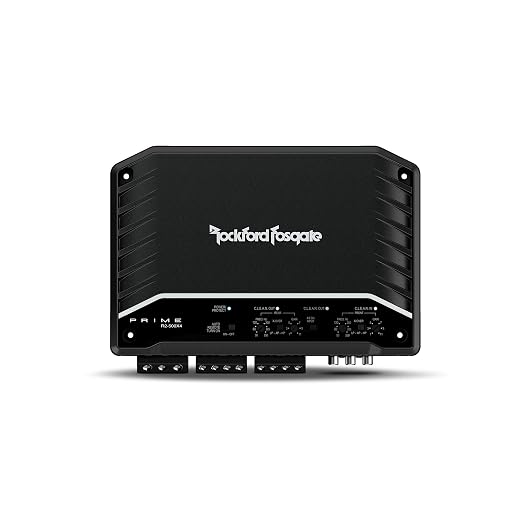
If you want a premium amp experience without needing a doctorate in tuning, the R2‑500X4 is a seriously smart pick. Rockford Fosgate builds amps with a “real car” mentality: strong efficiency, good noise rejection, and controls that are meant to be used, not just printed on the chassis for marketing.
The standout feature here is C.L.E.A.N. It’s essentially a gain‑setup aid that helps you dial in input level without driving the amp into clipping. That matters because clipping is the silent killer of speakers and the #1 reason people end up saying, “My upgrade sounds harsh.” When your gains are right, everything gets easier: vocals are smooth, snare hits have snap, and the system stays composed when you crank it. A lot of owners describe this amp as “so clean” and “more powerful than expected,” and that’s often what clean power feels like: effortless.
This amp is also a strong pick for people worried about electrical strain. Class D efficiency helps reduce demand on the vehicle’s system, and many users mention it doesn’t feel like it’s “sucking the battery dry” the way some older amps do. Combine that with Rockford’s build quality and you get a premium daily driver amp that doesn’t need constant babysitting. If you’re building a system you want to enjoy for years, this is the tone.
Why it earns the premium slot
- C.L.E.A.N gain setup – Helps you avoid clipping and get the best sound without guesswork.
- Efficient Class D design – Strong output without unnecessary electrical strain.
- Great “quiet background” behavior – Good choice when you hate hiss and want a refined system.
- Controls designed for real tuning – Filters and EQ are useful, not just decorative.
Good to know
- It’s a premium-priced model in most lineups; the value is in long-term satisfaction and less tuning frustration.
- Like any amp, it still depends on wiring quality—bad grounds can make any system noisy.
- If you want maximum compact power per dollar, Stinger MT or Taramps may feel more “aggressive.”
Ideal for: drivers who want premium clarity, efficient power, and a tuning experience that helps them get it right—especially if you value “clean loud” over “spec-sheet loud.”
5. Stinger Audio MT-600.4 – Underrated “Big Clean Power” That Stays Cool

Stinger’s MT line has been called “slept on” for a reason: it delivers the kind of clean output that usually costs more, and it does it in a footprint that fits normal vehicles. This is a Class D amp that people buy expecting “good for the money” and then end up saying things like “night and day difference,” “zero audible noise,” and “runs super cool.” That combination—clean output + low noise floor + cool operation—is what makes an amp feel high-end in daily use.
What you get in the real world is headroom. Door speakers stop sounding strained. The soundstage opens up. Midbass tightens. And because it stays cool, it’s happy under seats, on trunk panels, or in tight installs where A/B amps would heat soak. The crossover range is also genuinely useful: it gives you enough control to run tweeters or mids more safely without relying on external crossovers for basic protection. That matters for people doing a “front stage plus rear fill” build or a 3‑channel setup.
The most common “good to know” complaint is also the most practical: the RCA inputs are on a dongle. That’s not a sound quality problem, but it can create a cable cluster if you’re trying to do a super tidy rack. If you’re the type who wants everything perfectly routed, plan your cable management before you mount the amp. Also, remember that bass output depends on how you configure your system—if you’re trying to get subwoofer-level bass from a single 4‑ohm driver on a bridged pair, you may be underfeeding that sub. This amp is amazing, but physics still applies: door speakers are not subs, and subs want real low-frequency power and proper loading.
Why people love it
- Clean power for the money – Many users describe a noticeable jump in clarity and dynamics compared with older amps.
- Runs cool – A real advantage for under-seat installs and long listening sessions.
- Strong real-world headroom – Makes door speakers feel more controlled, louder, and less strained.
- Useful crossover range – Lets you protect speakers and shape a system without extra gear.
Good to know
- RCA dongle inputs can be annoying for ultra-clean installs—plan cable routing early.
- Bridging is powerful, but match the load correctly; don’t expect miracles from an inefficient sub wiring choice.
- Use quality copper power wire and correct fusing—this amp rewards proper electrical support.
Ideal for: people who want serious clean power and cool operation without jumping to the most expensive brand tier—especially for a strong front stage.
6. Skar Audio RP-150.4AB – The Big A/B Workhorse for Loud, Clean Front Stages

The RP‑150.4AB is for a specific kind of person: someone who wants their front stage to feel like it has unlimited breath. This is a bigger, higher-current Class A/B amp designed to push speakers hard while keeping the midrange clean. If you’re running a quality component set and you want the midbass to hit with authority—without the “thinness” that sometimes shows up on smaller amps—this is the lane.
In the real world, a high-headroom A/B like this does two things extremely well. First, it gives you dynamic punch at moderate volumes. Music sounds alive even before you crank it. Second, when you do turn it up, it doesn’t collapse into harshness as quickly—assuming you set gains correctly and don’t ask your door speakers to play deep bass. That’s why this amp is a favorite in “loud daily driver” builds: it has muscle and it stays composed.
The trade-off is not sound—it’s logistics. This is not a tiny under-seat toy. It’s physically large, and A/B amps run warmer than compact Class D options. That means you need to think like an installer: airflow, mount surface, solid power/ground, and clean signal routing. If you do those things, the RP‑150.4AB can be the anchor of a system that makes you grin every time a kick drum hits. If you skip those things, you’ll blame the amp for problems the install created.
Why it hits so hard
- Big A/B headroom – Great for front stages that need punch, control, and volume without strain.
- Serious wiring support – Larger terminals and current capacity make it feel “real” in a multi-speaker system.
- Strong noise performance – High SNR rating helps keep background quiet in a properly wired install.
- Versatile tuning – Useful HPF/LPF and EQ controls for shaping door speakers and bridging when needed.
Good to know
- It’s physically large—measure first, especially if you planned under‑seat mounting.
- Class A/B runs warmer; give it airflow and avoid trapping heat in carpeted cavities.
- If you want compact efficiency, AudioControl EPICFOUR or Rockford R2-500X4 may suit your install better.
Ideal for: louder daily driver builds with space for a bigger amp, where you want A/B punch and a front stage that feels effortless.
7. Taramps TS 1200×4 – The Compact “Power Brick” for High‑Output Speaker Builds

Taramps amps have a reputation for packing a surprising amount of real-world output into compact chassis—and the TS 1200×4 is the “turn it up” version of that idea. This amp is built for people who want a high-output speaker system: loud mids, strong midbass, and the ability to feed power-hungry drivers without needing a giant traditional amp rack.
The key to loving the TS 1200×4 is understanding its personality. It’s happiest when you respect wiring and impedance. If you’re running speakers that can take power and you’re willing to set proper high‑pass filtering, it can make a system feel insanely energetic. Where people go wrong is trying to use raw power as a substitute for good tuning. If you run door speakers full-range and hammer them with low frequencies, you’ll get distortion and you’ll blame the amp. That’s not the amp. That’s the setup.
Another practical win: it supports both RCA and high‑level inputs, which makes it flexible for factory integration. If you’re building a system that you’ll actually drive hard—windows down, highway noise, real life—this amp can deliver the kind of volume that smaller, softer amps can’t reach without sounding stressed. It’s a power tool: use it like one, and it will absolutely transform your system.
Why it’s a monster (in a good way)
- Huge power density – Great when you need serious output but don’t want a giant chassis.
- Works for many speaker styles – Good match for pro-style speakers, loud coaxials, and aggressive front stages.
- Flexible input options – Helps when you’re keeping a factory head unit.
- Built for real output – A strong choice when “just a little louder” isn’t the goal.
Good to know
- This is not the amp for sloppy tuning—set HPF correctly or you’ll punish your speakers.
- Power-dense amps demand solid wiring and grounding; cheap wire can choke performance and increase issues.
- If you prefer a calmer, refined sound-first vibe, Alpine or Rockford may match your taste better.
Ideal for: high-output speaker builds that want a compact amp with serious power, especially when you’re upgrading beyond “mild” daily driver volume.
8. DS18 SXE-1200.4/RD – Clean A/B Power With Great Control (Watch the Fan)

DS18 builds gear for people who want an “extreme increase” in perceived loudness and clarity—especially in setups that lean toward high-energy mids and highs. The SXE‑1200.4 fits that vibe: it’s a Class A/B full-range amp with flexible crossover control and enough power to wake up a set of speakers that felt sleepy on head‑unit output. When tuned properly, this style of amp gives a system that “forward” live feel without collapsing into fuzz.
Real-world feedback is mostly positive on the fundamentals: it gets loud, it stays reasonably cool when mounted with airflow, and it does a solid job eliminating problems caused by weaker or noisier amps (like hiss on tweeters). That’s a big deal in systems where tweeters are prominent—because any noise gets amplified. People also mention that many “bad experiences” with amps at this level often come down to install errors: bad grounds, too-small wire, or gains set hot to compensate for weak signal.
The one recurring practical issue is the internal fan behavior. Some users report the fan is not temperature-controlled—it’s simply on when the amp is on. If your amp is mounted in a trunk, you probably won’t care. If it’s in a hatchback or closer to the cabin, you might hear it between songs. The fix is installation planning: mount it farther from the cabin, isolate the mounting surface, or (if you’re the DIY type) consider a quieter fan swap. The sound performance can be worth that small nuisance if this amp matches your build style.
Why it works well
- Flexible crossover control – Helps you tailor output for tweeters, mids, or full-range speakers.
- A/B sound character – Many people prefer A/B for mids/highs impact and presence.
- Good “fix my noisy amp” replacement – Owners often notice reduced hiss and cleaner output when upgrading.
- Pairs well with DS18 ecosystems – Great match if your speakers already lean DS18.
Good to know
- The fan may run continuously—plan mounting location accordingly.
- Mount with spacers or standoffs for airflow; it improves longevity and stability.
- If you want silent operation in-cabin, consider a compact Class D like AudioControl or Rockford.
Ideal for: DS18-style builds and speaker systems where you want adjustable control and strong mids/highs power—especially when you can mount it where fan noise isn’t an issue.
9. Pioneer GM-A4704 – The Classic “Just Works” Amp That Outlasts Cars
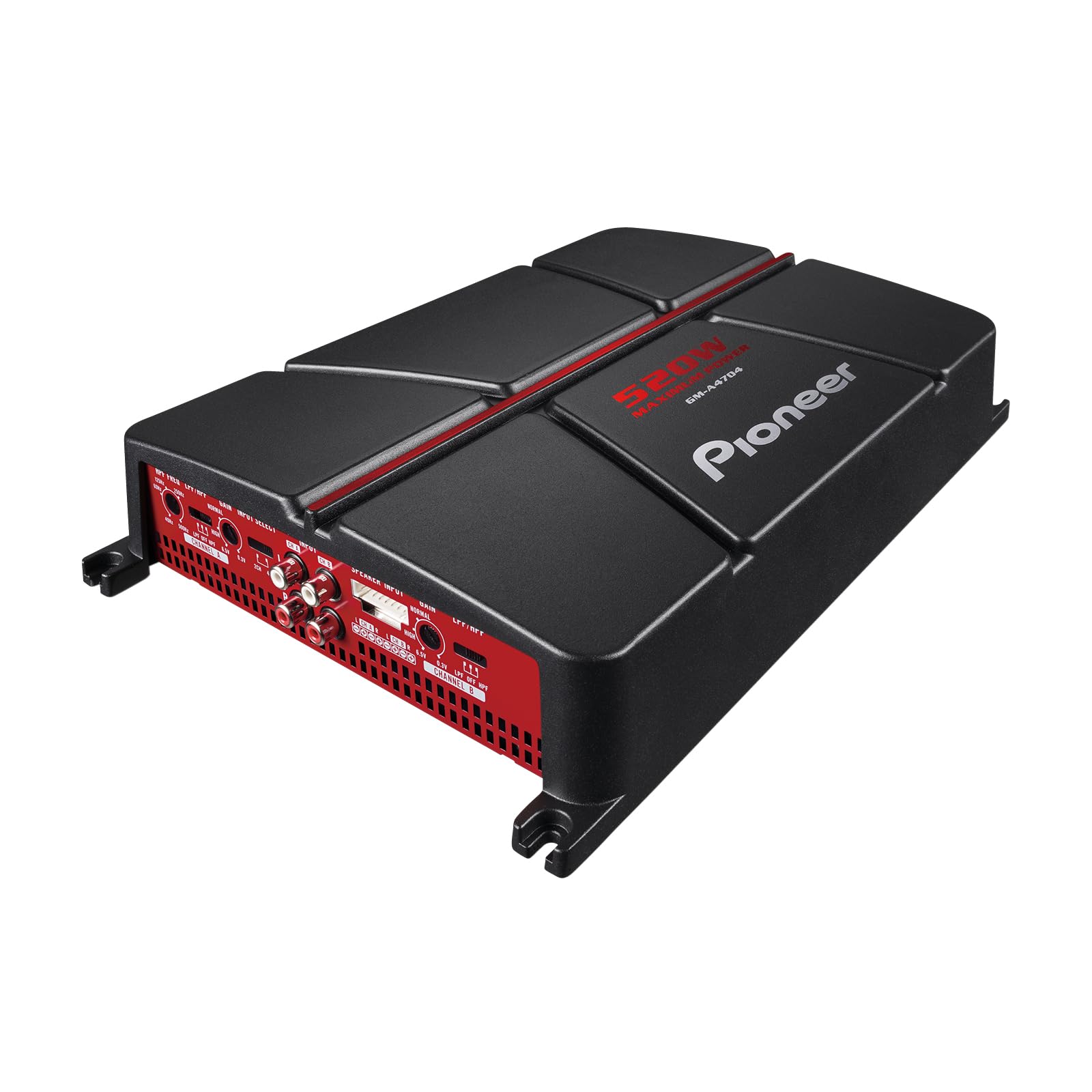
The GM‑A4704 is one of those amps that doesn’t need hype because its reputation is built on something more valuable: boring reliability. People run it for years. They install it once, tune it, and forget it exists—because it just keeps working. That’s a big deal in car audio, where many “budget upgrades” turn into weekend re-wiring projects after a few months.
Pioneer designed this amp to solve real problems: improving sound quality over road noise, offering speaker‑level inputs for factory head units, and providing flexible channel modes so you can run a basic 4‑speaker setup or bridge channels for a small sub. It’s especially good for “stock speaker plus mild sub” systems where you want a little more fullness without going into full custom builds. Users regularly mention it stays stable at 2 ohms and doesn’t overheat when wired and tuned reasonably—exactly what you want in a daily driver.
The smart move with the Pioneer is using filters like a pro. Set HPF so your door speakers aren’t trying to play deep bass, and suddenly the system sounds clearer at all volumes. If you want to run a small sub in 3‑channel mode, you can bridge the rear channels and low‑pass that output, while the front channels stay high‑passed for clean vocals and punch. It’s not the most aggressive amp in this guide, but it’s one of the most satisfying “install it and smile” picks for normal human beings.
Why it keeps winning
- Proven reliability – Many long-term owners report years of flawless operation.
- Factory head unit friendly – Speaker-level inputs and auto signal sensing simplify OEM upgrades.
- Great everyday sound improvement – Strong clarity boost over stock power without drama.
- Versatile channel modes – Works well for 4 speakers or 3-channel with a small sub.
Good to know
- It’s not a “huge output” amp; it’s designed for practical upgrades, not competition SPL.
- For big component sets or pro-style speakers, you’ll want more headroom (Stinger, Taramps, Skar).
- The best sound comes from good filter settings—don’t leave it full-range by accident.
Ideal for: daily drivers who want reliable, noticeable sound improvement with easy OEM integration and flexible configuration—without chasing extreme output.
10. BOSS Audio PF1800 – Feature-Heavy, Bridgeable, and Physically Massive

The PF1800 is the “lots of features, big chassis, budget energy” amp in this list. It’s built to be flexible: full-range operation, bridgeable channels, variable filtering, bass boost, and the kind of knob-and-switch control that lets you adapt it to a variety of speaker layouts. If your build goal is “loud, fun, and configurable,” this can fit—especially if you have a larger vehicle with room to mount a bigger amp properly.
Real-world feedback around BOSS tends to split into two camps. Camp one: people who install it correctly with proper copper wiring, good grounds, and smart RCA routing, and are shocked by how loud and clean it can sound for the category. Camp two: people who treat wiring as an afterthought, run RCAs beside power cable, skip proper fusing, set gains wildly, and then blame the amp for noise or instability. This is not an amp that magically corrects sloppy installs. But if you install with care, it can deliver a very satisfying “big system” experience.
The most important practical note is size. This amp is not subtle. It’s large enough that it often won’t fit under seats in smaller cars. Plan a trunk-side install with airflow, and treat your wiring like part of the product. The biggest mistake people make with big amps is choking them with weak power/ground and then cranking gain to compensate—creating noise and heat. Build the foundation right, and the PF1800 can be a fun, flexible centerpiece.
Why it can be a win
- Feature-rich control set – Plenty of adjustments for different speaker setups.
- Bridgeable flexibility – Useful for 3-channel ideas or stronger output to a pair of speakers.
- Strong “loud daily driver” potential – When installed correctly, it can deliver satisfying volume and clarity.
- Built for many install situations – Works with different impedance and input approaches when set up properly.
Good to know
- It’s physically large—measure your space and plan mounting carefully.
- Install quality matters more than ever: good copper wire, correct fuse, clean ground, smart signal routing.
- Ignore “max watt” marketing. Tune by ear and by clean signal, not by knob position.
Ideal for: budget-conscious “big install” builds with room for a large amp and the willingness to do proper wiring and tuning.
11. Recoil DI550.4 – Tiny Footprint, Big Output (With One Input Quirk)

The Recoil DI550.4 is popular for one simple reason: it’s small enough to fit in install locations where “normal” amps won’t, but it still delivers real, useful power for mids and highs. Owners often describe it as a “little powerhouse” that brings speakers to life with surprising clarity and volume—and it tends to run cool, which is exactly what you want when you’re mounting in a constrained space.
In real systems, this amp shines as a dedicated mids/highs driver. If you already have a separate mono amp for a subwoofer, the DI550.4 can be a clean way to power components or coaxials with better dynamics than head-unit output. People praise its ability to play loud without obvious distortion and without getting too hot to touch after extended listening—one of the best compliments you can give a compact Class D.
Now, the honest “good to know”: the high‑level input approach is unusual. Some documentation and user feedback suggests the high-level wiring can be awkward because of the connector style (and in some cases may require creative wiring). If you’re using RCA preouts, you’re golden. If you’re planning a factory speaker-level integration, double-check your approach before you commit. Also, like many compact amps, the noise floor depends on gain setting. If your vehicle is extremely quiet, you may hear a faint hiss if gains are set too hot. That’s not unique to Recoil—it’s what happens when you amplify noise along with signal. Set gains properly, keep your RCAs cleanly routed, and this amp can be a ridiculously good value.
Why it’s so popular
- Small enough for hard installs – Great for tight trunks, under-seat, or hidden compartments.
- Strong mids/highs performance – Makes component sets and coaxials sound louder and more alive.
- Runs cool – Helps longevity in compact mounting locations.
- Useful tuning controls – Lets you shape the system and protect speakers with proper filtering.
Good to know
- If you need clean high-level integration, confirm input wiring details before installation day.
- Very sensitive speakers + high gain can reveal hiss; strong signal in + lower gain is the cleaner strategy.
- If you want premium “quietest possible” behavior, Rockford or AudioControl may be a safer bet.
Ideal for: space-limited installs and value-focused builds that still want real power and clean sound—especially when using RCA preouts.
12. Orion Cobalt CBA2500.4 – Solid A/B Punch If You Ignore the Marketing Numbers

Orion’s name carries nostalgia for a lot of car audio people. Older Orion gear had a reputation for serious performance. The modern Cobalt series is more budget-focused, and it comes with a reality check: ignore the giant “marketing wattage,” and judge it as a practical A/B speaker amp. When you do that, it can actually make a lot of sense for the right buyer.
The CBA2500.4 is built to power speakers, not to win spec-sheet wars. Real owner feedback often says the same thing in different words: “plenty loud,” “punchy bass,” “no distortion when tuned correctly,” and “great for the money.” You’ll also see experienced users calling out that dyno testing or fuse math suggests real output is far below the headline number—yet still enough to make a daily driver system satisfying. That honesty is helpful: if you buy it expecting miracles, you’ll be disappointed. If you buy it expecting a functional A/B amp with basic controls, you’ll likely be happy.
What this amp does well is straightforward: it adds volume and impact to door speakers, and it gives you basic HPF/LPF control to protect them. The smartest way to use it is with sane gain settings and a real high-pass filter so your speakers aren’t trying to play sub-bass. Do that, and the “A/B feel” comes through: midbass has weight, vocals stay present, and the system doesn’t sound thin. If you want an affordable step into amplified sound and you’re not chasing boutique refinement, the CBA2500.4 can absolutely get you there.
Why it’s worth considering
- Affordable A/B punch – Good for people who want a warmer, heavier door-speaker sound.
- High/low input options – Flexible for OEM or aftermarket head units.
- Simple controls that work – HPF/LPF and gain adjustment cover the essentials for most builds.
- Good “starter amplified system” energy – Makes stock power feel weak once you hear it.
Good to know
- Marketing watt numbers are optimistic—evaluate it as a budget A/B speaker amp, not a competition monster.
- Install quality matters: proper power wire, correct fuse, and clean grounding keep it stable and quieter.
- If you want premium refinement and tools, look at Rockford or AudioControl instead.
Ideal for: budget builds that want A/B character and real improvement over head-unit power, without paying premium brand pricing.
13. Orion Cobalt CBA2000.4 – The Simpler Sibling for Basic Speaker Power

The CBA2000.4 is the “just give my speakers real power” option in the Orion Cobalt family. It’s built for simple upgrades—especially when you want your system louder and cleaner than head-unit power but you’re not trying to build a complex multi-amp setup. If your current sound feels flat, strained, or thin at higher volume, a basic 4-channel A/B amp like this can make the system feel much more confident.
The key is expectations. Just like the bigger CBA model, the headline “watts” are not the point. The point is the experience: more control over your speakers, less strain at the same volume, and better dynamics when music gets busy. Owners who go in with that mindset often come out happy—especially when they use the built-in HPF/LPF to keep low bass away from door speakers. That one move usually makes the system instantly cleaner and increases usable volume.
Where it fits best is as a “starter amp” in a realistic daily driver: factory head unit, basic speaker upgrade, and a desire for more punch. It won’t compete with the refinement and noise control of premium amps, but it also doesn’t require a premium budget. Install it with good wiring, keep the ground short and solid, and treat gain as a matching tool—not a loudness tool—and it can be a very satisfying upgrade.
Why it makes sense
- Simple daily-driver upgrade – Adds volume and control without complicated system planning.
- Flexible inputs – Useful for OEM head units or aftermarket stereos.
- Basic filtering included – HPF/LPF helps protect speakers and clean up sound quickly.
- Good “first amp” learning curve – Teaches you how much tuning matters without overwhelming controls.
Good to know
- Like many budget amps, output claims can be optimistic; buy for experience, not marketing.
- If your car is very quiet, premium amps often have better noise floor behavior.
- For compact installs, Taramps TS 400×4 or Timpano may fit more easily.
Ideal for: first-time amp buyers who want a simple 4-speaker upgrade with A/B character and flexible integration.
14. Taramps TS 400×4 – Tiny, Efficient, and Shockingly Good for Factory 2Ω Speakers

The TS 400×4 is one of the smartest “small upgrade, big payoff” amps for modern cars—especially cars with factory 2‑ohm door speakers. It’s compact enough to hide under a seat, efficient enough to behave well on a normal electrical system, and simple enough that you don’t need to be an audio engineer to enjoy it. That’s why you see so many real installs where it’s described as “looks factory,” “sounds superb,” and “never got hot even on long drives.”
What makes the TS 400×4 feel special is how quickly it improves the system’s confidence. Stock stereos often sound fine at low volume, then collapse when you turn them up. A small amp changes that by giving the speaker more controlled power and reducing strain. Owners frequently mention that it tunes easily, fits in tight spaces, and plays clean without hiss. That’s the dream for daily drivers who just want better sound without rebuilding the entire car.
There are two practical quirks to understand. First, the built-in crossover system is more “preset” than “surgical.” That’s fine for most people—you can run full-range, high-pass, or low-pass without overthinking. Second, some old-school installers notice the speaker output wiring style is different than older amps. That’s not a flaw, but it does mean: read the diagram, don’t guess. Once wired correctly, it tends to be extremely stable. If your goal is “make my factory system sound premium without visible gear,” this is a top-tier move.
Why it’s a hidden gem
- Fits almost anywhere – Under-seat installs are realistic in many vehicles.
- Excellent with factory 2Ω speakers – A huge advantage in modern OEM systems.
- Efficient and stable – Runs cool and tends to behave well on long drives.
- Easy OEM integration – High-level input and automatic activation simplify factory radio setups.
Good to know
- Filter controls are more “simple preset” than fully adjustable; perfect for many, limiting for advanced active setups.
- Read wiring diagrams—don’t assume it’s identical to older-school terminal layouts.
- If you want more headroom for power-hungry speakers, step up to Stinger MT or Taramps TS 1200×4.
Ideal for: daily drivers keeping a factory head unit who want a compact, clean, under-seat upgrade—especially when the car uses 2‑ohm factory speakers.
15. Timpano TPT-500.4 – The Mini Amp That Feels Impossible Until You Hear It

The TPT‑500.4 is the amp you buy when you have a real problem: you want amplified sound, but you have nowhere to put a normal amplifier. Motorcycles, older Jeeps, tiny convertibles, behind-dash installs, and “the only available spot is weird and small” builds—this is where it lives. And the funniest part is how many people start skeptical, then end up calling it “amazing” once installed.
In real-world feedback, the themes are consistent: it’s shockingly compact, it punches above expectations, and it can make a set of door speakers suddenly sound “alive” even in noisy vehicles (off-road tires, no doors, highway wind). That’s a big deal because noisy vehicles reveal weak systems immediately. This amp also tends to behave thermally better than some cheap mini Class D options—many users report it gets warm but not dangerously hot when configured sensibly.
Now the expert warning that saves people headaches: mini amps often use non-traditional output layouts. This one has a shared output negative concept that can confuse installers if they assume “four independent negatives” like traditional amps. It’s not necessarily a problem, but you must wire it correctly and avoid mixing its outputs in ways it doesn’t support. Also, like many compact amps, gain setting matters: if you crank gain to compensate for a weak input signal, you can reveal hiss on sensitive speakers. Feed it a strong RCA signal, keep gain lower, and it can sound impressively clean for its size.
Why it’s a problem-solver
- Fits where almost nothing fits – Great for behind-dash, under-dash, and ultra-tight installs.
- Real improvement in noisy vehicles – Owners report dramatic upgrades in Jeeps and open vehicles.
- Surprisingly clean for a mini amp – When fed properly and gained correctly, it avoids the “cheap mini amp” sound.
- Good value performance – A lot of output for the footprint when installed intelligently.
Good to know
- Learn the shared-negative output wiring before install—don’t guess.
- Mini amps can reveal hiss if gain is too high; strong signal in + lower gain is the clean approach.
- Wire size limits are real on tiny amps; plan your kit accordingly and keep runs efficient.
Ideal for: ultra-tight installations where a normal amp won’t fit, but you still want real amplified sound and better clarity at speed.
How to Tune a 4‑Channel Amp So It Sounds Clean (Not Harsh)
Most “my new amp sounds worse” stories are tuning stories. The amp is rarely the villain. The villain is almost always: (1) gains set too high, (2) door speakers forced to play deep bass, or (3) noise introduced by poor grounding or cable routing. Here’s how to avoid the common traps and make your system sound like a professional install.
The clean-sound checklist (do this in order)
- Start with filters, not gains: If you’re powering door speakers, set a high‑pass filter so they aren’t trying to play sub-bass. This instantly increases usable volume.
- Set head unit volume first: Find a “clean max” on your head unit (often around 70–80% of max volume) where it doesn’t distort, and treat that as your tuning reference.
- Match gain to signal: Gain is not a volume knob. It’s a sensitivity match between your head unit output and your amp input.
- Use a test tone when possible: A simple sine wave tone lets you set gain with less guesswork. An oscilloscope is best, but even careful listening can work.
- Balance front and rear intentionally: Rear speakers are usually “fill,” not the main show. Too much rear level pulls vocals behind you.
If you want an easier life, amps with tuning aids (like Rockford’s C.L.E.A.N) reduce the chance of accidental clipping. But any amp can sound excellent when you treat tuning like a process, not a quick twist.
Noise, hiss, and alternator whine: what actually fixes it
- Ground like you mean it: Short ground run, bare metal, solid bolt, and no paint. Bad grounds create noise and instability.
- Route RCAs away from power wire: If your power wire runs down one side of the car, your RCAs run the other side. This single move fixes a shocking number of noise complaints.
- Don’t use “mystery” cheap wire: Quality copper (not CCA) holds voltage better and reduces weird problems under load.
- Keep signal strong, gain low: Strong RCA voltage or solid high-level input lets you keep gains lower—which often reduces hiss.
- Mount for airflow: Even Class D needs breathing room. Heat is a slow, silent killer of budget installs.
The biggest takeaway: the amp is part of a system. The cleanest amps in the world can sound terrible if the install is messy. Build a clean signal chain and the “wow” factor shows up fast.
FAQ: 4‑Channel Amplifiers (Answered Like a Real Installer)
Do I need a 4‑channel amp if I already upgraded my speakers?
Should I choose Class D or Class A/B?
Can I run my speakers at 2 ohms?
What’s the easiest “safe” filter setup for door speakers?
My system has hiss. Is my amp bad?
Can I run a subwoofer off a 4‑channel amp?
Where should I mount my amplifier?
Final Thoughts: The Best 4 Channel Car Amplifier Is the One You Can Tune
A 4‑channel amp upgrade should feel like you upgraded the entire car—not just the stereo. The right amplifier makes music sound effortless: louder without harshness, clearer without thinness, and punchier without needing to crank bass boost.
Here’s how to translate this guide into the right purchase—based on how people actually use these amps:
- Want the most balanced “daily driver win” with modern integration? Start with the AudioControl EPICFOUR. It’s compact, clean, and built for the reality of factory head units and tight mounting spaces.
- Want classic A/B punch with dependable brand reputation? Choose the Kicker 46CXA3604. It’s a reliable “sounds great, works with real cars” upgrade that fits a lot of systems.
- Want compact clean sound quality without drama? The Alpine S‑A32F is a strong choice when you care about clarity, control, and a refined daily-driver sound.
- Want premium “set it right once” confidence? Pick the Rockford Fosgate R2‑500X4 for efficient power and smarter gain setup that helps you avoid harsh clipping mistakes.
- Want maximum bang-for-buck clean power and cool operation? The Stinger MT‑600.4 is a killer choice for front stages that need real headroom without a huge chassis.
- Need high output speaker power in a compact “power brick” style? Look at the Taramps TS 1200×4 if your build leans loud and you’re ready to tune and wire it correctly.
- Need a tiny under-seat or hidden OEM upgrade amp? The Taramps TS 400×4 or Timpano TPT‑500.4 can deliver serious improvement when space is your biggest enemy.
Pick the best 4 channel car amplifier for how you actually drive—factory radio or aftermarket, under‑seat or trunk, “clean and balanced” or “loud and aggressive.” Then give it the one thing most installs skip: a proper filter and gain setup. Do that, and your system won’t just be louder—it’ll sound like it finally makes sense.