
Our readers keep the lights on and the garage heater humming. As an Amazon Associate, I earn from qualifying purchases.
A subwoofer amp isn’t just “more bass.” It’s the difference between bass that feels tight and confident versus bass that sounds big for five minutes and then turns into distortion, heat, and protect-mode panic.
If you’re hunting for the best subwoofer amplifier for car builds, you’re probably feeling the same frustration most people feel: every product page is a parade of “max watts,” and every basic guide repeats the same tired line—“match RMS.” That advice isn’t wrong… it’s just not enough to keep you from buying an amp that’s annoying to install, hard to tune, or unpredictable on real roads.
This guide is built around what actually separates a “love it for years” sub amp from a “why is it doing that?” sub amp: how the amp behaves at low impedance, whether the controls are usable (not just present), how the remote knob actually feels day-to-day, how hot the chassis runs in tight mounting spots, how clean the bass stays when you push it, and which failure patterns show up again and again in real owner feedback.
You’ll also notice I’m not obsessed with chasing one “winner” for every person. A compact under-seat build needs a different amp personality than a trunk build. A single sealed 10 needs a different approach than two ported 12s. And a full-system upgrade (door speakers + sub) has its own rules. So instead of one generic “top pick list,” you’ll get clear decision paths and deep, real-life reviews—so you can buy once and move on.
Below, you’ll find 14 standout amplifiers: compact monoblocks, daily-driver powerhouses, value monsters, and two excellent 5-channel choices for people who want one amp to run the whole car.
How to Choose the Best Subwoofer Amplifier For Car Bass That Feels Right
A sub amp is “right” when it does three things at the same time: it delivers the power your sub can actually use, it stays stable in your real install, and it gives you controls that are easy to tune without constant second-guessing. Here’s the exact framework I use to avoid regret purchases.
1. Start with the bass personality you want (not the watt number)
Different amps and different setups create different “bass personalities.” This is the part most buying guides ignore—and it’s why people buy a strong amp and still feel underwhelmed.
- “Tight & controlled” bass: You want definition. Kick drums sound like a kick, not a blur. Prioritize control (good filters, clean gain, solid damping behavior) and don’t rely on bass boost.
- “Low & deep” bass: You want that chesty rumble. Your sub box and subsonic filter matter as much as the amp. Choose an amp with useful subsonic control and stable low-impedance performance.
- “Loud daily driver” bass: You want impact that stays fun at highway volume. Prioritize reliable power delivery and a remote level control you’ll actually use.
- “One amp does it all”: You’re upgrading door speakers and adding a sub. A quality 5-channel amp can make the whole system feel more cohesive than stacking random amps.
2. RMS matters—but the real question is: “clean RMS at your final impedance”
Yes, RMS is the number that matters. But the deeper question is whether the amp can deliver clean power at the impedance you’ll actually run. Real-world builds usually land here:
- 4 ohm loads: Often a single sub wired conservatively. Efficient and cool-running, but you get less output power from most amps.
- 2 ohm loads: The sweet spot for many daily drivers. Great power, less stress than 1 ohm, and easier to keep clean.
- 1 ohm loads: Maximum output for many monoblocks. Amazing when your wiring and cooling are correct… frustrating when they aren’t.
That’s why you’ll see some owners say an amp is a “beast” and others say it’s “constantly in protect.” They’re not necessarily disagreeing—they might be running different loads, different boxes, different electrical support, and different gain settings.
3. Pick your impedance strategy before you pick your amp
If you choose your sub and wiring strategy first, amp shopping becomes easy instead of emotional. Here are the most common paths:
- Single DVC sub, flexible wiring: This is the easiest way to target 2 ohms or 1 ohm depending on your amp. It gives you upgrade options later.
- Two subs, daily driver build: You’ll often wire to 1 ohm for maximum output—great if your amp is truly stable and you’re using strong power/ground.
- Conservative build for reliability: Many people run 2 ohms even on a 1-ohm stable amp because it runs cooler and stays clean longer into the volume knob.
If you want “set it and forget it” bass, 2 ohms is often the calmest place to live. If you want maximum output and you’re comfortable doing the electrical work properly, 1 ohm can be extremely rewarding.
4. Features that actually matter (and the ones that just look good on a box)
Most amps have “features.” Only a few features truly reduce headaches in real installs:
- Useful filter ranges: A low-pass filter that lets you land in the common sub crossover zone without guessing, and a subsonic filter that’s actually usable for ported boxes.
- Remote bass knob you’ll use: This is not a gimmick. It’s how you avoid “too much bass” fatigue, and how you quickly balance the system for different music or passengers.
- Clip indication: The most underrated quality-of-life feature. A clip light on the remote (or amp) can save your sub and keep your bass clean.
- High-level inputs / signal sensing: If you’re integrating with a factory system, this can simplify install and reduce the need for extra adapters.
- Terminal quality and fit: It sounds boring… until your “4 gauge” doesn’t fit the terminals, or your speaker wire slips under vibration.
Meanwhile, the features that are often “fine but not life-changing” are things like flashy LEDs and extreme bass boost ranges. If your system only sounds good with bass boost cranked, something else is wrong.
5. Heat and mounting are not afterthoughts—they’re part of the amp choice
A compact micro amp can be the difference between “clean install” and “where do I put this giant brick?” But compact also changes thermal behavior. If you’re mounting under a seat:
- Prioritize amps owners report as running cool during long sessions.
- Mount to a solid surface (not thick carpet that traps heat).
- Leave breathing room around the heatsink fins and side panels.
- Be realistic: high output + zero airflow = protect mode eventually.
If you’re mounting in a trunk, you have more airflow and space. That opens the door to bigger amps and full system layouts.
6. Your electrical system is the “hidden amplifier”
This is where most installs quietly fail. You can buy a great amp and still get weak, distorted bass if voltage is sagging. The fix is not “turn the gain up.” The fix is proper power delivery.
- Use quality copper power wire sized to your current needs, not your hopes.
- Fuse correctly near the battery and match your fuse strategy to your wiring and amp needs.
- Ground like you mean it: short ground, solid metal, clean contact point, and correct hardware.
- Consider the “Big 3” upgrade if you’re running higher-power setups and want stable voltage under load.
7. Decide what “success” looks like before you buy
Here are three different “success definitions.” Choose yours:
- Success = clean bass all day: Choose a conservative impedance, a proven reliable amp, and tune with a clip-aware method.
- Success = maximum output for the money: Choose a 1-ohm stable amp, wire correctly, and treat electrical support as part of the purchase.
- Success = easiest install: Choose a compact amp with flexible inputs and a remote knob, then mount it where it stays cool and accessible.
Now, let’s make the shopping part easy.
Quick Comparison: 14 Best Subwoofer Amplifier For Car Picks
Use this table to quickly match an amp to your build style, then jump into the reviews for the real-life details—like protect mode patterns, remote knob usability, and the small install quirks that never show up on a spec sheet.
On smaller screens, swipe or scroll sideways to see the full table.
| Model | Amp type | System strength | Best match | Amazon |
|---|---|---|---|---|
| Alpine S-A60M + Bass Knob | Monoblock | Clean, confidence-building power with tuning that’s hard to mess up | Most daily-driver builds that want “set it once, love it forever” bass | Amazon |
| STINGER Audio MT-1000.5 | 5-channel | One-amp full-system upgrade: door speakers + sub with clean power | People who want a cohesive system without stacking multiple amps | Amazon |
| Stinger Audio MT20001 | Monoblock | Big-output attitude in a compact footprint with strong controls | Truck/under-seat builds that need power in tight spaces | Amazon |
| Skar Audio RP-800.1D | Monoblock | Daily-driver punch with strong reliability feedback and easy controls | Single-sub builds that want loud, fun bass without overcomplication | Amazon |
| Hifonics BG-1900.1D Brutus Gamma | Monoblock | Brute-force output style with classic “big amp” feel and strong terminals | People who want loud headroom and a traditional high-output build | Amazon |
| Skar Audio RP-1200.1D | Monoblock | High-output value that’s popular for “loud daily driver” setups | Two-sub or single high-power sub builds that want strong output | Amazon |
| Soundstream RSM1.4000D | Compact | Micro-chassis power for under-seat installs without sacrificing cargo space | Vans/SUVs/trucks that need a powerful amp in a small footprint | Amazon |
| Recoil RED1200-1 | Monoblock | Strappable/expandable design with useful controls and remote bass knob | Budget-minded builders who want upgrade runway and strong output | Amazon |
| BOSS Audio PV3700 | 5-channel | Flexible full-range power with lots of install options and onboard crossovers | Budget full-system upgrades when you want one amp to run everything | Amazon |
| Audiozerone ZE1000.1 | Value | Surprisingly clean “budget banger” reputation with strong long-term feedback | People who want big output value and are willing to install carefully | Amazon |
| Orion Cobalt CBA2000.1D | Value | Legacy-brand feel with “good bass if tuned right” owner feedback | Conservative builds that want solid sound and manageable power | Amazon |
| Recoil RED600-1 | Value | Accurate clip indicator remote + real-world power tests praised by owners | Budget builds that still want control and clean output potential | Amazon |
| Recoil DI600.1 | Compact | Tiny footprint, easy placement, and “hits harder than expected” feedback | Small installs (including scooters/compact cars) that still want bass | Amazon |
| Skar Audio RP-350.1D | Starter | Simple, 1-ohm stable entry power with a useful remote level control | First-time sub installs or small subs that don’t need huge power | Amazon |
In‑Depth Reviews: 14 Subwoofer Amplifiers That People Actually Enjoy Owning
Now we go model by model. I’m not going to talk like a brochure. I’m going to talk like someone who cares about the parts that decide whether your system feels “professional” or “fussy”: gain behavior, clip control, heat, wiring quirks, and how easy it is to live with the amp week after week.
1. Alpine S-A60M + Bass Knob – The “Clean Bass Without Drama” Daily Driver

If you want bass that sounds mature—tight, clean, and controlled—this is the amp that consistently delivers that feeling. The Alpine S-A60M is the kind of product that doesn’t need to scream for attention because the win is in how it behaves: you set it up, dial in the crossover, match gain properly, and it just keeps doing its job.
Real owner feedback tells the story you actually want to hear: people push it for weeks and months, in hot summers, on road trips, and it stays stable without turning into a protect-mode lottery. That “quiet reliability” is a huge part of why this is my best overall pick. Because the most expensive thing in car audio isn’t the amp—it’s buying twice because your first amp felt inconsistent.
One detail I love from experienced users is how easy it is to find the “clean ceiling.” Several people describe checking gain near the point of clipping (some using scopes), and the amp staying composed. That matters because your gain knob is not a volume knob—it’s a sensitivity control. An amp that makes the gain process feel predictable is an amp you’ll end up tuning correctly, which means better sound and longer sub life.
It’s also one of those rare amps that makes smaller subs feel bigger—not by boosting and smearing the signal, but by staying controlled when the music gets busy. If your goal is bass you can listen to all day without fatigue, this is the “adult in the room” choice.
Why it’s best overall
- Clean, controlled bass character – Owners consistently describe it as strong without turning muddy.
- Confidence tuning – Simple controls that let you dial in a proper crossover without guessing games.
- Real-world reliability vibe – People run it hard for long sessions without constant thermal drama.
- Compact for the power – Easy to place in trunks and many tighter installs.
Good to know
- If you’re chasing extreme SPL or running multiple high-power subs, you may want a higher-output monoblock.
- Like any amp, it rewards correct electrical support—clean ground, proper fuse strategy, and solid wire quality.
- The clean “Alpine sound” can feel less wild than some budget amps that exaggerate upper bass; it’s a quality choice, not a gimmick choice.
Ideal for: daily-driver systems that want clean bass you can live with for years—especially sealed or well-tuned ported setups where control matters.
2. STINGER Audio MT-1000.5 – The Full-System Upgrade That Stays Clean at Volume
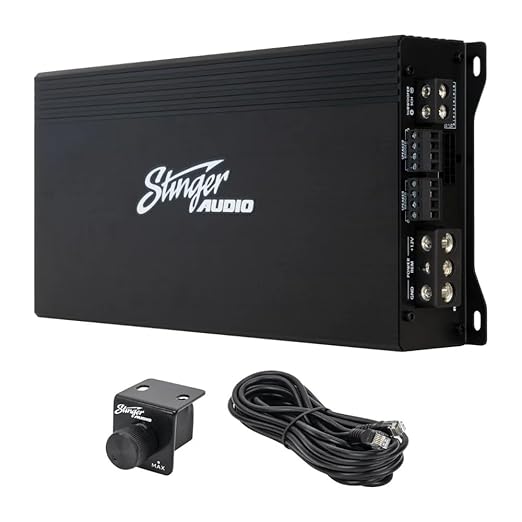
A great 5-channel amp doesn’t just save space—it makes the whole car sound like one system, not “front speakers over here and the sub over there.” That’s the MT-1000.5’s superpower: owners describe a night-and-day jump in dynamics, clarity, and noise floor compared to cheaper or older setups, especially when the amp is installed with solid wiring and tuned with restraint instead of boost-hunting.
In real feedback, two themes show up repeatedly. First: it runs cool for the output and stays quiet (meaning you’re not fighting hiss or random mechanical noise). Second: it feels like clean power, not “loud power.” That matters because the difference between “impressive” and “annoying” is often a few dB of distortion you can’t immediately identify—until it wears you out.
There’s also an honesty point in owner comments that I love: this amp rewards a smart sub impedance choice. Several users mention that sub output feels stronger when the sub channel is given a more favorable load, and that a 4-ohm sub can feel underwhelming compared to a 2-ohm approach. That’s not a flaw—it’s simply how a lot of multi-channel designs allocate power. If you plan for it up front, you get an incredibly balanced result.
One practical friction point: some people dislike “dongle” style RCA layouts (it can look messy if you don’t manage the cables). That’s not a sound problem—it’s an install neatness issue. If you’re tidy with zip ties and routing, it’s a non-issue. If you hate cable clutter, note it.
Why it’s a system builder
- One amp = one tuning philosophy – Helps your front stage and sub blend instead of fighting.
- Low noise floor – Owners describe “no audible noise” even at high volume when installed correctly.
- Runs cool for many users – Better long-session comfort and less protect-mode stress.
- Useful onboard crossovers – Lets you simplify the build without external crossovers in many setups.
Good to know
- Plan your sub impedance so the sub channel delivers the punch you want without overdriving the gain.
- If you dislike RCA dongle layouts, consider how you’ll route and secure unused ends.
- Like any powerful 5-channel, it wants quality wiring—cheap power wire can sabotage what you paid for.
Ideal for: people upgrading the whole car—front speakers, rear fill, and sub—who want clean volume without stacking multiple amps.
3. Stinger Audio MT20001 – Compact “Hits Like a Brick” Output for Tight Installs

This is the amp you buy when you want to open a door and think, “How is that much bass coming from that?” Owners who love the MT20001 talk about two things: the sheer punch for the size, and the way it can wake up subs that felt sleepy on weaker amplification. In trucks and tight under-seat setups, that’s exactly the point—you get output without losing space.
Now, here’s the expert read: compact high-output amps tend to reveal the quality of the rest of your install. If your ground is weak, if your power wire is undersized, or if you’re running an aggressive impedance without enough electrical stability, this is the kind of amp that might show you that reality by going into protection. And yes—owner feedback includes both experiences: many people thrilled with hard-hitting output, and a smaller group reporting protect issues that look like either a defective unit or a stressed install.
So how do you win with this amp? You treat the install like part of the purchase: clean ground, correct fuse plan, secure terminals, and airflow. Then you tune like a professional: low-pass set where the sub blends, subsonic set to protect the driver (especially ported boxes), and gain set with a clip-aware method. When you do that, the amp feels like a “cheat code” for tight installs.
The included remote knob matters here, because this is the kind of amp that can easily overpower your cabin on certain tracks. A good remote level lets you keep the system enjoyable instead of constantly “too much.”
Why it’s a space-saver monster
- Huge output personality for the size – Perfect for trucks and tight mounting locations.
- Useful control set – You get the tuning tools needed to make the bass clean, not just loud.
- Remote bass control – A genuine daily-driver feature, not just a bonus accessory.
- Strong “wow factor” – Owners describe noticeable upgrades from previous amps.
Good to know
- High-output compact amps need good power delivery—poor wiring can look like “amp problems.”
- Some users report protect mode issues; treat install quality as non-negotiable and test impedance carefully.
- If you want the calmest, most conservative long-term setup, you may prefer a slightly less aggressive power target.
Ideal for: tight-space builds that still want real output—especially trucks and vehicles where under-seat mounting is the cleanest option.
4. Skar Audio RP-800.1D – Loud, Fun Bass with “Set It and Go” Popularity

Skar’s RP series is popular for a reason: it hits hard for the size, it’s straightforward to use, and it has a “daily driver” personality. Owners regularly describe strong output and solid durability for normal real-life abuse—long drives, high volume, cabin vibration, and the occasional “let’s show a friend” moment.
One of the most interesting patterns in owner feedback is also one of the most useful lessons in sub amp shopping: some users describe Skar’s bass as “punchy” rather than ultra-deep. That’s not automatically good or bad—it depends on your goal, box, and tuning. If you’re running music that lives in the kick region, a punchy amp can feel incredibly satisfying. If your entire happiness depends on ultra-low extension, you’ll want to be extra careful with subsonic settings, enclosure choice, and crossover points.
Where this amp shines is in how simple it feels. The controls are familiar, the remote level control does its job, and the unit is built around being used by normal people—not just competition builders. When people say “works great for the price,” what they often mean is: it delivers the bass they wanted without demanding a PhD to install and tune.
From an expert perspective, this is a great choice when you want a strong “middle-to-high output” daily system without the bulk of the giant brick amps. Pair it with solid wiring, keep the gain honest, and it can be a very satisfying long-term solution.
Why it’s a favorite
- Strong daily-driver output – A lot of bass for a manageable footprint.
- Remote level control included – Easy day-to-day bass balancing from the driver’s seat.
- Durability praise – Many owners report consistent use without early failure.
- Simple control layout – Easy to tune without “feature overload.”
Good to know
- Some users feel it’s more punch-focused than ultra-low focused; your enclosure and tuning matter a lot here.
- If you chase maximum output at 1 ohm, be disciplined about power delivery and heat management.
- If you want the most “audiophile tight” bass, a more control-focused amp may suit you better.
Ideal for: single-sub daily builds that want loud, fun, noticeable bass without making the install complicated.
5. Hifonics BG-1900.1D Brutus Gamma – The “Big Amp Energy” Low-End Hammer

The Brutus name exists for a reason: it’s a “big amp” style product—built to bring serious low-end energy, with the physical presence and terminal layout that feels like it belongs in a real trunk build. Owners who upgrade within the Hifonics family often describe a noticeable jump in bass authority and overall clarity, especially when the system is tuned with restraint instead of boost-heavy shortcuts.
What this amp tends to do well is deliver that “strong headroom” sensation. Headroom is the difference between bass that collapses under stress and bass that stays confident when the track gets busy. When people say “the bass output was stronger, the highs were clearer,” what they’re usually experiencing is a system that’s no longer fighting for power. The amp isn’t constantly near its edge, so the sound relaxes.
Now for the practical, real-life side: as with many high-output amps, reliability feedback can be split. Some owners run it happily; a smaller group reports early failure patterns like speaker output dropping. That doesn’t automatically mean the design is bad—but it does mean you should treat installation and tuning like the deciding factor: good grounding, proper fuse strategy, secure connections, and a gain setting that avoids clipping.
If your build goal is “I want the bass to feel effortless,” this kind of amp is the right vibe. Just don’t install it like a budget amp. High output rewards high-quality fundamentals.
Why people buy it
- Big headroom feel – Bass stays strong when you turn it up.
- Traditional trunk-build personality – Feels like it belongs in higher-output systems.
- Remote bass control – Practical daily-driver feature for managing heavy bass.
- Strong “upgrade impact” reports – Owners often notice immediate improvement from older amps.
Good to know
- Like many high-output amps, install quality matters more than ever—voltage drop and weak grounds show up fast.
- Some owners report early failure; test thoroughly, keep wiring neat, and avoid “gain as volume” mistakes.
- It’s not a micro amp—plan space and ventilation like a grown-up trunk build.
Ideal for: builders who want that “effortless” low-end headroom feeling and have the space and wiring discipline to support it.
6. Skar Audio RP-1200.1D – The “Wake Up the Trunk” Power Upgrade

If the RP-800.1D is “strong daily-driver punch,” the RP-1200.1D is “okay, now the mirrors are involved.” Owners describe this amp as a serious step up—especially when paired with subs that can actually absorb the power cleanly. When people say it “unlocked the full potential,” that’s usually a sign the previous amp was running out of headroom and clipping early.
This model also highlights a classic car-audio truth: power doesn’t automatically equal better sound. The way to make this amp sound great is not turning everything up—it’s choosing the right crossover points and keeping distortion out of the chain. Owners who love it talk about it being loud and clean when set correctly. That is the goal: impact without mush.
Some owners still note the same Skar flavor: punchy, energetic, not always the deepest-feeling amp on ultra-low test tones depending on setup. In practice, that’s often more about enclosure tuning and subsonic settings than the amp alone. A ported box that’s tuned high and a too-aggressive subsonic filter will make any amp feel “less low.” So if you care about deep extension, plan the box and filters intentionally.
This is an amp that rewards smart restraint. If you set gain correctly and treat the remote knob as “adjustment,” not “more power,” you can get a daily system that feels massive without constantly flirting with failure.
Why it’s a popular upgrade
- Big output for daily systems – Enough power to make many subs feel brand new.
- Remote level control – Makes a powerful system livable across music styles.
- Simple controls – Easy to dial in for people who want results, not complexity.
- Strong “value power” reputation – Many buyers feel the output is worth it when installed correctly.
Good to know
- Your enclosure and subsonic filter will strongly influence whether it feels “deep” or “punchy.”
- High power demands good electrical basics—don’t treat wiring like an afterthought.
- If you’re ultra-sensitive to low-frequency extension, test and tune instead of assuming “more watts = deeper.”
Ideal for: loud daily-driver builds that want strong output without stepping into “competition-only” complexity.
7. Soundstream RSM1.4000D – Serious Output in a “Where Did You Mount That?” Size

This amp is for the person who refuses to sacrifice cargo space just to get real bass. Owners buy it because it fits in places bigger amps simply don’t: under seats, behind panels, tight SUV cavities, compact vans—the spots where a normal monoblock becomes a problem. And the surprising part? It still delivers the kind of output that makes people say, “This little thing hits.”
The heat question is always the first concern with compact amps, especially in tight cabins that get hot in summer. Real owner feedback is reassuring here: many people report it running without heat issues even in warm vehicles, as long as the install leaves some breathing room and the amp isn’t buried in insulation or pressed against thick carpet. That’s the practical secret: compact doesn’t mean “no airflow required.” It means “mount smart.”
Another win is install flexibility. Users mention it being easy to integrate using standard power/ground sizing and the included remote knob. That matters because under-seat builds often need you to move fast and keep the wiring tidy. A compact amp with clear controls and a predictable behavior curve is a gift.
From an expert perspective, this is a fantastic “high-performance stealth” option. If your build needs to look clean and factory-like—but you still want the cabin to feel alive—this is one of the most logical picks in the whole list.
Why it’s a stealth favorite
- Ultra-compact footprint – Solves mounting problems that kill many builds.
- Surprisingly strong output feel – Owners often report being impressed for the size.
- Good heat feedback in real installs – Many report stable performance when mounted correctly.
- Remote knob + flexible inputs – Makes integration and day-to-day use smoother.
Good to know
- Under-seat installs still need airflow—don’t bury it in carpet or foam.
- Compact amps can reveal wiring weakness quickly; keep power delivery solid and clean.
- If you’re running extreme output goals, a larger chassis with more heatsink mass may be calmer.
Ideal for: under-seat and stealth builds where space is tight but you still want bass that feels powerful and clean.
8. Recoil RED1200-1 – Strappable Power with Useful Controls and Real-World Punch

The RED1200-1 is a smart pick for people who want strong bass now—and want a clear upgrade path later. The “strappable” (master/slave) capability is the headline, but the real reason people enjoy owning it is more practical: it gives you a full, usable set of controls and a remote bass knob that makes daily driving better.
Owner feedback includes the kind of details I trust: people specifically praise the clip indicator (both on the remote and on the amp), and they describe stable behavior at low impedance without overheating. That’s not just “nice.” It’s the difference between bass you can push confidently and bass you’re scared to touch because you don’t know when distortion is happening. A clip-aware setup is how you protect your sub while still enjoying output.
This amp also reveals a very real “installation friction” theme: terminal fit. Some users report that certain wire sizes or ferrules can be tight in the terminals, even when using correct gauge. This doesn’t mean “bad amp.” It means you should plan your cable ends cleanly: use proper ferrules, trim correctly, and don’t force oversized lugs that create a weak clamp. A great amp can still be annoying if the connection points are sloppy.
There are also negative owner experiences (including early failure reports). That doesn’t automatically disqualify it, but it does tell you to install carefully and test thoroughly: verify your impedance, verify speaker outputs, and don’t “tune by pain.” If you do the basics well, this can be one of the most satisfying budget-friendly power platforms in the group.
Why it’s a smart builder pick
- Strappable upgrade runway – Lets you scale later without replacing everything.
- Clip indication feedback – Helps keep tuning clean and protects your sub.
- Strong “bang for the buck” reputation – Many owners feel the output is impressive for the category.
- Useful control panel – LPF, subsonic, bass EQ give you real tuning options.
Good to know
- Some users report terminal tightness with certain wire setups—use clean ferrules and correct fit.
- There are occasional early failure reports; test thoroughly and avoid wiring shortcuts.
- If you want the “most refined” bass control, more premium amps may feel tighter at the same output level.
Ideal for: builders who want strong output now, practical tuning tools, and a future upgrade path—without needing a premium brand ecosystem.
9. BOSS Audio PV3700 – The “So Many Install Options” Full-System Workhorse

The PV3700 is the kind of amp people buy when they want one box to handle “the whole car,” and they want it to be adaptable: different input types, lots of adjustments, multiple channel strategies, and room to experiment. Owners who install it correctly often describe it as loud, flexible, and surprisingly satisfying for a full system.
The most valuable “real-life lesson” in PV3700 owner feedback has nothing to do with the amp itself—it’s installation discipline. People who get noise issues often solve them by routing RCAs away from power wire, grounding correctly, and tuning gains properly. And when they do? The amp sounds dramatically better. That’s not unique to this amp, but it’s worth highlighting because 5-channel installs create more cable complexity—and mistakes are easier.
Let’s talk about the elephant in the room: power claims versus reality. Experienced users often point out that marketing numbers can be optimistic, and the practical way to think about this amp is: “does it deliver enough clean power for my speakers and sub goal?” For many normal daily builds, yes—especially if you wire and tune intelligently and avoid trying to force the amp into roles it wasn’t designed for.
The other very real factor is size. Owners describe it as physically large. That can be a feature (more chassis, more “big amp” feel) or a problem (where do you mount it?). Measure first. Plan airflow. And if you want a tidy install, take the time to route everything cleanly—this is not a “throw it in and forget it” product.
Why people keep buying it
- Full-system flexibility – Tons of ways to wire and tune for different builds.
- High/low level inputs – Makes integration with different head units easier.
- Strong “louder than expected” feedback – Many owners are impressed when installed and tuned correctly.
- Remote sub control – Great for balancing the system quickly.
Good to know
- It’s large—measure and plan mounting before buying.
- It rewards correct install habits (RCA routing, grounding, gain matching); sloppy installs tend to get noisy.
- If you want “premium honesty” about power ratings, focus on results and tuning rather than marketing labels.
Ideal for: budget full-system upgrades where you want one amp to run speakers and sub—and you’re willing to install it carefully.
10. Audiozerone ZE1000.1 – The “Generic Look, Serious Results” Surprise Performer

If you judge amps by aesthetics, you might scroll right past this one. Don’t. The ZE1000.1 has one of the most interesting owner reputations in this entire list: people buy it expecting “cheap,” then they’re shocked by how clean it sounds and how hard it pushes their subs when installed correctly.
What makes the feedback especially persuasive is the long-term updates. Some owners wait months (or longer) and report it still running strong with hard daily use, barely getting warm, and delivering consistent output without protect-mode drama. That kind of “it just keeps working” feedback is rare in budget categories—and it matters.
From a tuning standpoint, owners praise the basics: LPF behaving as expected, clean impact, and a sense that the amp isn’t straining to do its job. That typically means the power supply and output stage are behaving reasonably and that the design isn’t “all numbers, no substance.” But there’s one very real physical caveat mentioned by users: the speaker wire terminals can be less forgiving if you tug on wiring during placement. This is an install-style warning: secure your wire, leave slack, and don’t mount in a way that pulls on terminals during vibration.
In expert terms, this is the perfect “budget banger” if you’re the kind of person who installs carefully and tunes responsibly. If you want to throw gear in without thinking, you should choose something with more premium terminals and tighter build tolerance. But if you want maximum output value, this is one of the smartest plays.
Why it surprises people
- Clean sound reputation for the category – Owners often describe it as unusually “clean” for the cost tier.
- Strong long-term updates – Many report it staying reliable under consistent use.
- Hits hard with correct wiring – Frequently paired with dual-sub daily builds successfully.
- Simple controls – Easy to tune without fighting confusing feature sets.
Good to know
- Terminal handling matters—avoid tugging wiring and secure everything neatly.
- Ignore “max watt” hype and tune by clean output; responsible gain setting makes this amp shine.
- If you want premium fit-and-finish, this isn’t the “luxury” choice—it’s the “results” choice.
Ideal for: value-focused builders who want strong output and are willing to do a clean, careful install (especially 1-ohm daily builds).
11. Orion Cobalt CBA2000.1D – Good Bass When Tuned Right (Skip the Fantasy Numbers)

Orion has history in car audio, and that history creates expectations. Owners who remember older Orion gear often talk about the “underrated power” era, and some feel modern marketing is more optimistic than reality. Here’s the expert translation: don’t buy this amp because you believe a giant watt number. Buy it because you want a solid, usable monoblock with tuning controls that can deliver satisfying bass in a normal daily build.
What I like about the best Orion feedback is that it’s balanced. People mention clean sound, no distortion in their setup, and a result that makes them (or their family) genuinely happy. They also mention that measured output or fuse-based math suggests the real power can be lower than the headline. Both can be true: the amp can still sound good and still be enough for a lot of practical systems.
In real builds, Orion shines when you match it with the right subs and don’t overreach. If you’re powering shallow-mount subs, compact boxes, or daily-driver setups where you want “strong and clean” more than “competition loud,” it can be a very satisfying solution. And the included bass knob is a real quality-of-life feature for controlling your low end without messing with gain.
The caution is the same caution I’d give for any amp that people sometimes describe as “overrated”: set gains correctly, keep your load stable, and avoid turning bass boost into a crutch. When you tune it cleanly, it can sound polished and punchy.
Why it can be a smart buy
- Good “daily bass” results – Many owners are happy with the output when tuned responsibly.
- Useful control set – LPF, subsonic, phase, and bass knob make it flexible for real installs.
- Works well in practical builds – Especially where you want solid bass without extreme demands.
- Low/high level input flexibility – Helpful for factory integration and different head-unit setups.
Good to know
- Keep expectations realistic about marketing numbers—judge it by clean results, not hype.
- Some owners report defects or replacements; install carefully and test thoroughly.
- Best results come from good enclosure matching and disciplined gain setting.
Ideal for: practical daily builds that want solid bass and flexible controls—and buyers who care about real results more than headline watt claims.
12. Recoil RED600-1 – Accurate Clip Light Remote + “Better Than It Should Be” Power

If there’s one feature that deserves more respect in budget car audio, it’s a reliable clip indicator. The RED600-1 earns its reputation because owners report the clip light behavior matching real clipping points when tested properly (some even using scopes), which is a huge deal in the real world. Why? Because most people blow subs not from “too many watts,” but from distortion they didn’t realize they were creating.
Owners also talk about surprisingly strong real-world output and good audio quality for the category. Some report doing tone tests and seeing power that makes sense, and they describe the amp running lukewarm even on long low-frequency sessions. That combination—usable power + manageable heat—is exactly what makes a budget amp feel like a “steal.”
Now for the deeper expert detail: some users describe the amp as powerful but not having the same “cone control” feeling as more premium amps, especially when comparing to higher-end models with stronger damping behavior. That’s not an insult; it’s just honest system design reality. At this level, you can get loud and fun. If you want the tightest, most controlled “audiophile kick,” you move up-market. But for most daily drivers, this amp is absolutely enjoyable—especially when you tune it cleanly and avoid using bass boost as your main tone tool.
One real usability note from owners: the remote’s power LED can be very bright at night. That’s not a performance issue, but it is a comfort issue. If you’re sensitive to cabin lighting, plan to mount it intelligently or dim it. The upside? The remote itself is often described as well built and linear, meaning you get predictable adjustment rather than “all the bass in the first inch of rotation.”
Why it’s a smart budget buy
- Clip indicator you can trust – A real tool for keeping bass clean and protecting subs.
- Strong real-world output feedback – Many owners are surprised by how hard it hits.
- Runs manageable temps – Frequently described as staying lukewarm during use.
- Remote knob usability – Linear adjustment makes daily control easy.
Good to know
- Some users feel premium amps have better damping/control; this is more “loud and fun” than “studio tight.”
- The remote LED can be very bright for night driving (easy fix, but worth knowing).
- As always: clean wiring and honest gain setting determine whether it feels “amazing” or “harsh.”
Ideal for: budget builds that still want clean tuning discipline—especially anyone who values a clip-aware setup.
13. Recoil DI600.1 – Micro Footprint for Creative Installs (Cars, Scooters, Anything)

This is the amp for people who are allergic to wasted space. The DI600.1 is compact enough to fit in creative mounting locations, and owners describe it as a “solid little amp with an attitude.” When something is small and hits hard, it changes what kinds of builds are possible—especially in small cars, tight trunks, or non-traditional installs.
One of my favorite pieces of owner feedback is someone running it in a completely unconventional setup (yes, even on a scooter). That tells you something important: the amp is physically adaptable, and the control layout is simple enough that you can tune it without turning the project into a science fair. For a lot of people, that’s the win: simple, compact, and satisfying.
The real-world caveat here is ventilation. Small amps have less heatsink mass. They can still run cool when designed well, but they need some airflow. Owners who get great results tend to mount it where it can breathe and avoid trapping it against thick material. If you mount it in a sealed pocket with no airflow and then push heavy bass for long periods, you’re asking for thermal protection eventually.
From an expert lens, this is a great “small power that feels bigger than expected” amp for moderate sub setups. The best use case is a single sub or a practical daily build where you want noticeable bass without needing giant power numbers. Tune cleanly, use the subsonic filter intelligently if you’re ported, and this amp can be a surprisingly fun little foundation.
Why it’s uniquely useful
- Very compact – Makes installs possible where full-size amps don’t fit.
- Punchy output feel – Owners often describe it as hitting harder than expected.
- Simple control set – Easy for first-time tuners who still want real adjustments.
- Creative build friendly – Works for unusual installs when you need small footprint power.
Good to know
- Ventilation matters—don’t trap it in a heat pocket.
- Great for moderate builds; if you want extreme output, choose a larger high-power monoblock.
- As always: impedance and wiring discipline decide whether “small” stays reliable.
Ideal for: compact installs and creative builds where space is tight but you still want real bass impact.
14. Skar Audio RP-350.1D – The “First Sub Setup” Amp That’s Easy to Live With

Not everyone needs huge power. A lot of people need a reliable “first step” that adds real low end without turning their install into a high-current project. That’s where the RP-350.1D makes sense. It’s designed to be approachable: simple controls, small footprint, remote level control included, and enough output to make a modest sub feel alive.
The best way to think about this amp is “clean enhancement.” If your stock system feels empty, a small sub amp can change the entire feel of your music—because you stop asking your door speakers to pretend they’re subwoofers. When you hand low frequencies to a dedicated sub and amp, the whole system relaxes: mids clean up, vocals feel clearer, and the bass stops sounding strained.
This is also a smart choice for people who want to keep electrical demands reasonable. Lower-power amps are generally easier on stock charging systems, and you’re less likely to run into voltage sag issues that cause protect-mode behavior—assuming your wiring is still done correctly. You still need a clean ground and solid connections, but you don’t need to rebuild the car to get great results.
From an expert standpoint, this is the “buy it, install it cleanly, and enjoy it” option for beginners. If you later upgrade to a bigger sub or a second sub, you can move up the ladder. But as a first system, this is a very satisfying way to get bass without stress.
Why it’s a great starter
- Approachable power – Enough to make a sub feel real without demanding extreme electrical support.
- Remote level control included – Helps balance bass for different music and passengers.
- Small footprint – Easy to mount cleanly.
- Simple tuning – Less “feature clutter,” more “get results.”
Good to know
- If you want “shake the block” bass, you’ll outgrow it—this is an entry power level.
- It still needs correct wiring and a good ground; small amps still clip if you force them.
- For ported boxes, set subsonic properly if your setup includes that control elsewhere in the chain.
Ideal for: first-time sub installs, modest subs, or anyone who wants clean low-end fill without turning their electrical system into a project.
How Subwoofer Amplifiers Actually Make Bass (and What Ruins It Fast)
Most people think the amp “makes bass” by being big. In reality, an amp makes great bass by staying clean under load, controlling the signal you feed the sub, and avoiding the one killer that destroys subs and sound quality: clipping.
What makes an amp feel “clean and powerful” in real life
- Stable voltage under load – If your system voltage drops hard when bass hits, the amp loses control and distortion rises.
- Useful crossover range – A low-pass filter that lets you blend the sub naturally without boomy overlap.
- Subsonic protection – Essential for many ported setups; it prevents “unloaded” low notes from beating the sub.
- Predictable gain behavior – A gain control that doesn’t feel like a booby trap helps you tune correctly.
- Remote control that’s actually usable – Daily comfort matters; the best systems are the ones you can adjust quickly.
This is why owners love amps with accurate clip indicators (like the Recoil RED600-1) and why stable, conservative “clean power” amps (like Alpine) earn loyalty. You’re not just buying watts—you’re buying control under stress.
Tuning shortcuts that dramatically improve bass quality
- Set low-pass first – Start around the “typical sub blend” zone and adjust until vocals stop sounding thick or boomy.
- Use subsonic like a seatbelt – If you’re ported, set it to protect the driver from low frequencies your box can’t support cleanly.
- Keep bass boost modest – Boosting hides problems and increases distortion quickly. Use it as seasoning, not the meal.
- Gain is not volume – Match gain to your head unit’s clean output. If you need more bass, you usually need more power or a different enclosure—not more gain.
- Use your remote knob correctly – Set the system’s “max clean” with the knob at max, then use it to turn bass down as needed.
When you tune with discipline, your system stops sounding “loud” and starts sounding “expensive.” And you’ll enjoy it longer because your sub isn’t being punished by distortion.
FAQ: Choosing and Tuning a Subwoofer Amp Without Guesswork
Do I need a 1-ohm stable amp?
Why does my amp go into protect mode?
What’s the biggest mistake people make with gain?
What should I do first: upgrade the amp or upgrade the sub?
Do 5-channel amps work well for subs?
Do I need a capacitor?
How do I avoid “boomy” bass?
Which amps are best for tight under-seat installs?
Final Thoughts: The Best Subwoofer Amplifier For Car Builds Is the One You Can Tune Cleanly
The best sub amp isn’t the one with the loudest marketing. It’s the one that makes you grin every time a kick drum hits— because it sounds controlled, powerful, and effortless instead of harsh or stressed.
Here’s how to turn this guide into a confident “buy once” decision:
- Want the best overall daily-driver experience? Start with the Alpine S-A60M + Bass Knob. It’s the clean, reliable, easy-to-tune option that keeps people happy long after the install.
- Upgrading your whole system with one amp? Choose the STINGER Audio MT-1000.5 for a cohesive “speakers + sub” build with strong real-life praise for cleanliness and dynamics.
- Need big output in a tight space? The Stinger Audio MT20001 is the compact punch pick—perfect for trucks and under-seat installs when wired and tuned properly.
- Want daily-driver punch without complexity? Consider the Skar Audio RP-800.1D or step up to the Skar Audio RP-1200.1D if your subs can use the extra headroom.
- Need stealth power under a seat? The Soundstream RSM1.4000D is the “where did you mount that?” solution that owners love for space-saving builds.
- Want strong output with upgrade runway? The Recoil RED1200-1 is a smart builder option thanks to its strappable design and practical control set.
- Shopping value-first, but still want real results? Try the Audiozerone ZE1000.1 or the clip-aware Recoil RED600-1 if you want budget power with smarter tuning feedback.
- Want a flexible “one amp runs everything” budget system? The BOSS PV3700 is feature-rich and adaptable—especially when installed cleanly and tuned correctly.
- Starting small and keeping it simple? Pick the Skar RP-350.1D or the compact Recoil DI600.1 for clean low-end fill without a high-current project.
The best systems aren’t built by chasing hype—they’re built by matching your sub, your wiring plan, and your tuning method to the amp you choose. Pick the best subwoofer amplifier for car setups that fits how you actually listen, install it cleanly, and you’ll get bass that feels effortless every day.