
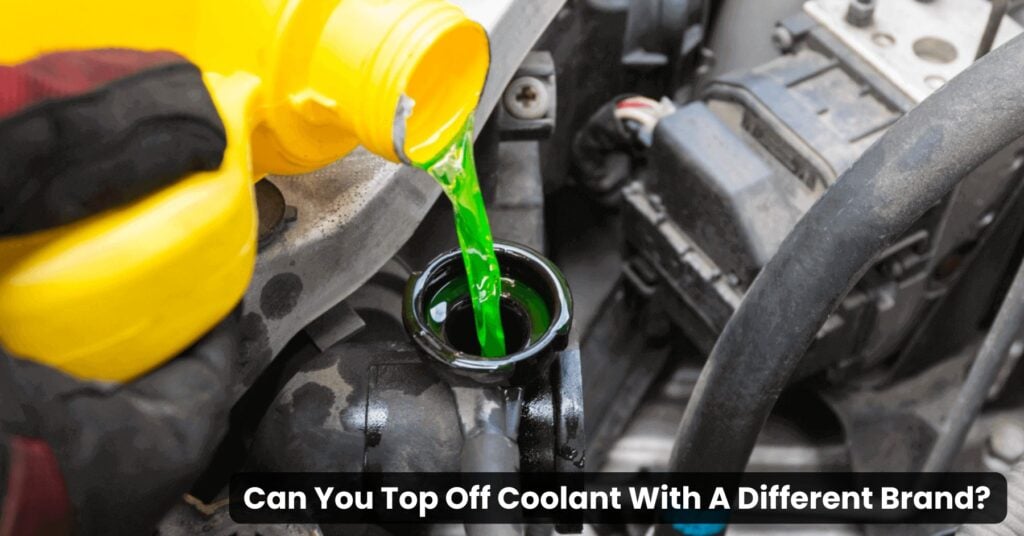
You can top off with another brand if it meets the same coolant spec for your car; mixing mismatched types can cause sludge, leaks, and rust.
You pop the hood, the coolant tank is low, and the only jug you can grab is a different brand. This is a common spot to be in. It’s also where small choices can snowball into clogged passages, a noisy water pump, or a heater that barely warms.
The good news: “brand” is rarely the deal-breaker. The deal-breaker is the formula and the spec your engine was built around. If the new coolant matches that spec, topping off is usually fine. If it doesn’t, you’re rolling dice with corrosion protection and additive chemistry.
Can You Top Off Coolant With A Different Brand?
Yes, you often can—if the coolant you add matches your vehicle’s required specification and chemistry type. Many brands sell coolant that meets the same OEM specs, so the label matters more than the logo on the jug.
If you can’t confirm the match, treat it as a short-term patch. Add the smallest amount needed to keep the level safe, then plan a proper correction soon.
What “Matches” Actually Means With Coolant
Coolant isn’t just colored water. It’s a base fluid (usually ethylene glycol or propylene glycol) plus an additive package that protects aluminum, iron, solder, seals, and the water pump. Those additives are where mixing goes wrong.
When people say “don’t mix coolants,” they’re talking about mixing different additive systems. Some combinations can cancel out corrosion protection. Some can form deposits or gel-like sludge that slows flow through the radiator and heater core.
Start With The Vehicle Spec, Not The Color
Color is marketing. It’s not a universal code. One brand’s “pink” can be a different chemistry than another brand’s “pink.” Use color only as a clue, then confirm by reading the back label and your owner’s manual or service guide.
Look For These Label Clues
- OEM approval or spec wording: phrases like “meets” or “approved for” a manufacturer spec (the spec itself varies by automaker).
- Chemistry family: IAT, OAT, HOAT, P-HOAT, Si-OAT (names vary by region and brand).
- Concentrate vs premix: premix is often 50/50; concentrate needs distilled water.
- Silicates, phosphates, borates, nitrites: the presence/absence can hint at compatibility for certain makes.
Topping Off Coolant With A Different Brand: The Real Risk Points
Most trouble comes from additive mismatch, not from the base glycol. A mix that “looks fine” today can still set up slow corrosion or deposit buildup over months. That’s why topping off should follow a simple decision path.
Risk Point 1: Mixing Additive Systems
Different chemistries protect metals in different ways. Some use silicates for fast aluminum protection. Others avoid silicates and rely on organic acids. When you combine them, the blend can lose the balance it was designed to hold.
Risk Point 2: Water Quality
Hard tap water can add minerals that form scale. Scale acts like insulation inside the radiator and heater core. If you need to dilute concentrate, use distilled water so you don’t add minerals that don’t belong there.
Risk Point 3: “Universal” Claims
Some coolants are marketed as “all makes, all models.” Many work well when used as a full fill after a flush. As a top-off into an unknown existing coolant, they’re less predictable. The safest top-off is still a coolant that matches your car’s spec.
Coolant Types At A Glance
This table is a quick map of the common coolant families you’ll see. Use it to interpret labels, not as a color chart. Brands can dye the same chemistry different shades.
| Coolant Family | Common Dye Colors (Varies) | What To Know Before Mixing |
|---|---|---|
| IAT (Inorganic Additive Tech) | Green, Blue | Often silicate-heavy; mixing with long-life OAT can reduce protection and leave deposits. |
| OAT (Organic Acid Tech) | Orange, Red, Dark Pink | Long-life formulas; mixing with silicate-heavy coolants can cause drop-out and sludge. |
| HOAT (Hybrid OAT) | Yellow, Turquoise, Light Orange | Hybrid packages can be picky; match the OEM spec, not the shade. |
| P-HOAT (Phosphate HOAT) | Pink, Red | Common in some Asian makes; avoid random top-offs unless the label matches the required spec. |
| Si-OAT (Silicated OAT) | Purple, Pink, Violet | Used by several European makers; small silicate content changes compatibility behavior. |
| Nitrited OAT (Heavy-Duty) | Red | Often for diesels; not a safe “close enough” swap for passenger cars without spec match. |
| Propylene Glycol Coolant | Green, Yellow | Lower toxicity base; still needs the right inhibitor package to match the system metals. |
| “Universal” Extended-Life | Any | Works best as a complete fill after flush; as a top-off, confirm compatibility claims in writing. |
How To Decide In Two Minutes At The Store
If you’re standing in front of a shelf, use this fast checklist. It’s not fancy. It saves engines.
Step 1: Check The Manual Or Underhood Label
Many cars list a coolant spec on a sticker near the radiator support or on the coolant reservoir. If you can pull your manual on your phone, search for “coolant” and “specification.” Write down the exact spec name.
Step 2: Match The Spec On The Jug
Pick a coolant that states it meets that spec. Brand doesn’t matter if the spec is truly met. If the jug only says “recommended for,” and doesn’t list the spec or approvals, treat it with caution.
Step 3: Prefer Premix When You’re In A Rush
If you’re topping off on the road and you don’t have distilled water, premix avoids dilution mistakes. If you buy concentrate, don’t cut it with tap water at a gas station. That’s how mineral scale gets invited into the system.
Step 4: When In Doubt, Use Distilled Water As A Temporary Top-Off
If the level is low and you can’t verify compatibility, a small distilled-water top-off can be safer than pouring in an unknown coolant chemistry. This is a short-term move, not a final fix. Too much water lowers freeze and boil protection.
What Can Happen If You Mix The Wrong Stuff
Bad mixes don’t always fail fast. Sometimes you get a slow drift: the coolant turns cloudy, the reservoir gets gritty, or the heater starts blowing lukewarm air at idle.
Signs You Should Stop And Correct It
- Thick, milky, or gelatin-like coolant in the reservoir
- Brown rust tint, floating grit, or sludge stuck to the tank walls
- Sweet coolant smell with no obvious spill
- Temp gauge creeping higher in traffic
- Heater output dropping at idle, then warming while driving
If you see these, don’t keep “topping off and hoping.” Plan a flush and refill with the correct spec coolant, and check for leaks while you’re there.
Why Specs Matter More Than Brand Names
Engine cooling systems are built around metal mixes, gasket materials, and pump designs. The coolant spec is the recipe that protects those parts. Two brands can both meet the same recipe. Two coolants with the same color can be different recipes.
Industry standards also exist that define baseline performance for glycol coolants, including corrosion protection and freeze/boil behavior. If you want a deeper look at a widely cited baseline spec, see the overview for ASTM D3306, which describes requirements for glycol-based engine coolant used in light-duty systems.
Manufacturers of coolant chemistry also warn against casual mixing. BASF’s GLYSANTIN notes that mixing with other manufacturers’ products is generally not recommended due to compatibility problems, in their coolant mixing FAQ. That matches what many technicians see in the field: the wrong blend can create deposits that don’t show up until later.
What To Do If You Already Topped Off With A Different Brand
Don’t panic. A small top-off that still matches the correct spec is usually fine. The job is to figure out what’s in the system and decide if you should leave it alone or reset it.
Check How Much You Added
If you added a few ounces, the risk is lower than dumping in a full gallon. The more you change the ratio of additive chemistry, the more you change how the coolant behaves over time.
Get The Coolant Identified If It’s Unknown
Some shops can test pH, freeze point, and sometimes identify chemistry with test strips. That won’t always tell you the full inhibitor package, but it can flag coolant that’s already worn out or contaminated.
Plan A Flush If Any Of These Are True
- You can’t confirm the spec of what’s already in the system
- You mixed two different coolant families (label shows different chemistry types)
- The coolant looks dirty, cloudy, or gritty
- You’ve had overheating, heater issues, or recurring low level
| Situation | Safe Short-Term Move | Best Fix |
|---|---|---|
| Same spec, different brand, small top-off | Monitor level and temp for a week | Keep it, then follow normal change interval |
| Spec unknown, level low | Add a little distilled water to reach minimum line | Flush and refill with the correct spec coolant |
| Different chemistry family mixed | Avoid more top-offs with random coolant | Flush soon, replace with spec-matched coolant |
| Coolant is brown, cloudy, or gritty | Limit driving if temps rise | Flush, inspect radiator cap, check for rust and leaks |
| Heater weak at idle | Check level when cold, bleed air if needed | Flush if sludge is present, verify thermostat function |
| Repeated low coolant | Top to minimum line only | Pressure test system, repair leak, then refill correctly |
| Overheating after mixing | Stop and cool down, don’t keep pushing it | Tow if needed, inspect for blockage, flush and refill |
How To Top Off Coolant Without Making A Mess Or Trapping Air
This is the part that gets skipped, then people wonder why the heater blows cold. A sloppy fill can leave air pockets, and air pockets can trigger hot spots.
Let The Engine Cool Fully
Never open a hot cooling system. Wait until the upper radiator hose feels cool and the reservoir is no longer warm. Hot coolant can spray out under pressure.
Use The Reservoir Markings
Most cars use a pressurized reservoir with “MIN” and “MAX” lines. Fill to the correct cold level line, not to the brim. Overfilling can push coolant out of the overflow as it expands.
Add Slowly
Pour a little, pause, then pour again. Slow filling helps air move out rather than getting trapped. If your vehicle has a bleed screw, follow the service procedure for bleeding air.
Recheck After Two Heat Cycles
After two normal drives, let the engine cool and recheck the level. A small drop can happen as air works its way out. If it keeps dropping, that’s a leak or a bad cap, not “normal burn-off.”
Common Myths That Get People In Trouble
“If The Color Matches, It’s Compatible”
No. Dye isn’t a spec. Two coolants can share a color and still use different inhibitor packages. Treat color as a weak clue only.
“All 50/50 Coolant Is The Same”
50/50 only describes dilution. It doesn’t tell you which corrosion inhibitors are inside. Two premixes can protect differently in the same engine.
“Topping Off Fixes Overheating”
Low coolant can cause overheating, but overheating can also come from a stuck thermostat, a failing water pump, a blocked radiator, trapped air, or a leak that keeps returning. If you’re topping off often, chase the cause.
The Simple Rule That Keeps You Safe
If you remember one thing, make it this: topping off with a different brand is usually fine when the coolant meets the same spec your vehicle calls for. If you can’t confirm that, treat the top-off as a temporary measure and plan a reset to the correct coolant soon.
That approach keeps the cooling system stable, protects the metals inside the engine, and cuts the odds of sludge and corrosion that show up later when you least want a surprise.
References & Sources
- ASTM International.“Standard Specification for Glycol Base Engine Coolant (D3306).”Describes baseline performance requirements for glycol-based engine coolants used in light-duty cooling systems.
- BASF (GLYSANTIN).“Usage & Maintenance FAQ.”States that mixing coolants from different manufacturers is generally not recommended due to compatibility risks.