
Our readers keep the lights on and the garage heater humming. As an Amazon Associate, I earn from qualifying purchases.
Specs are compiled from manufacturer listings and verified buyer reviews and can change over time — please confirm the key details on the product page before buying.
When your car’s AC blows warm air, the system often needs to be opened for repair — and the refrigerant inside must be captured safely before you touch a fitting. A vehicle AC machine (also called a refrigerant recovery machine) pulls the old gas and oil out and stores it in a tank, so you can fix the leak and recharge without venting anything into the air. The real buying question is pull speed, portability, and refrigerant compatibility, since R-134a and R-1234yf require different machines.
I’m Mo Maruf — the founder and writer behind GoCarLife. This guide is built by comparing the manufacturers’ published specifications and the patterns across verified customer reviews, so you get each pick’s real strengths and trade-offs instead of marketing spin.
Whether you are a weekend DIYer or a working tech, this breakdown of the vehicle ac machine landscape separates the shop-grade workhorses from the backyard bargains.
Our Picks at a Glance

How To Choose The Best Vehicle AC Machine
Match the recovery machine’s speed, weight, and refrigerant support to your actual workload. A home mechanic pulling refrigerant once a year has very different needs than a shop tech doing multiple cars a day, so the decision depends on speed, portability, and the refrigerants you touch.
Match the Horsepower to Your Workload
The motor’s horsepower (HP) is the single biggest driver of recovery speed. A 1/3 HP unit like the Robinair RG3 is compact and perfect for light residential jobs, while 3/4 HP and 1 HP machines pull much faster, which matters when you are doing this all day for a living.
Check the Refrigerant List Before You Buy
Not every machine handles every gas. Older units cover R-12, R-134a, and R-410a, but if you work on newer cars, you need a machine that explicitly lists R-1234yf and R-32 compatibility — otherwise you are locked out of modern vehicles.
Quick Comparison
| Model | Best For | Power | Weight | Refrigerants | Amazon |
|---|---|---|---|---|---|
| Robinair RG3★ Best Overall | Portable light-duty jobs | 1/3 HP | 18 lbs | CFC, HFC, HCFC | Amazon |
| VEVOR 3/4 HPBest Value | Budget pro performance | 3/4 HP | 33.8 lbs | Liquid & Vapor | Amazon |
| P PBAUTOS 3/4 HPTop Performer | DIY & light shop use | 3/4 HP | 29.8 lbs | R12, R134a, R410a | Amazon |
| VIVOHOME 3/4 HP | Versatile home & shop | 3/4 HP | 29.7 lbs | R12, R134a, R410a | Amazon |
| P PBAUTOS 1 HP Dual | Modern A2L refrigerants | 1 HP | 33 lbs | R1234yf, R32 | Amazon |
| VIVOHOME A2L 1 HP | High-demand field work | 1 HP | 33 lbs | R32, R1234yf, R454B | Amazon |
| Hilmor 1950536 | Lightweight pro speed | Brushless DC | 25 lbs | Standard AC | Amazon |
| Inficon Vortex Dual | Fleet & daily pros | 1 HP | 29.8 lbs | R410a, R22 | Amazon |
| Robinair RG6 | High-speed heavy use | 3/4 HP Twin | 27 lbs | CFC, HFC, HCFC | Amazon |
| APPION G5TWIN | Crews needing speed | Twin Cylinder | 24 lbs | R410a Liquid | Amazon |
| Fieldpiece MR45 | Water-resistant pro work | 1 HP | 22 lbs | R32, R1234yf | Amazon |
In‑Depth Reviews
1. Robinair RG3 Portable Liquid and Vapor Refrigerant Recovery Machine
Our pick — over 4.5★ from 950+ verified ratings; the strongest balance of quality and price.
The featherweight champ that hauls up ladders and onto rooftops without breaking your back.
Weighing in at just 18 pounds, the RG3 is the lightest serious recovery machine here — a full 15.8 pounds lighter than the VEVOR 3/4 HP below. That gap is the whole story for techs who carry their gear up stairs all day, and the compact footprint makes it easy to tuck into a service van. It is built around a 1/3 HP, 115V, 60 Hz single-cylinder oil-less compressor that handles both liquid and vapor recovery across all common CFC, HFC, and HCFC refrigerants, including R-410A.
Owners consistently praise how simple the two-valve controls are, and the high-efficiency cross-flow fan and condenser layout keeps cycle times short. A high-pressure safety shut-off switch automatically kills the machine if pressure rises above 550 PSI, which is a genuine peace-of-mind feature for anyone working alone. The rugged case, easy-to-read gauges, and comfortable handle round out a design that has earned a 4.6-star rating across a large owner base — the crowd favorite for good reason.
Buyers report that it “recovered 7.9 lbs R-410 from 2-ton heat pump in high 90°F without strain,” which speaks to its real-world capability in brutal conditions. About the only wish-list item is an oil separator, which this unit lacks — but for residential and appliance-sized jobs, the trade-off for the light weight is worth it. The single-cylinder design caps recovery speed, so high-volume commercial work may feel slow.
Why It Wins
- Weighs just 18 lbs for easy portability
- Auto shut-off above 550 PSI protects the tank
- Handles liquid and vapor on common refrigerants
Know Before You Buy
- Single-cylinder speed is moderate, not fast
- No built-in oil separator
Grab it for: the mobile tech who wants the lightest reliable machine for residential and auto AC work.
Think twice if: your day is full of big commercial systems where raw speed is everything.
2. VEVOR Portable 3/4 HP Refrigerant Recovery Machine
Professional-grade pull for a fraction of what the big names charge.
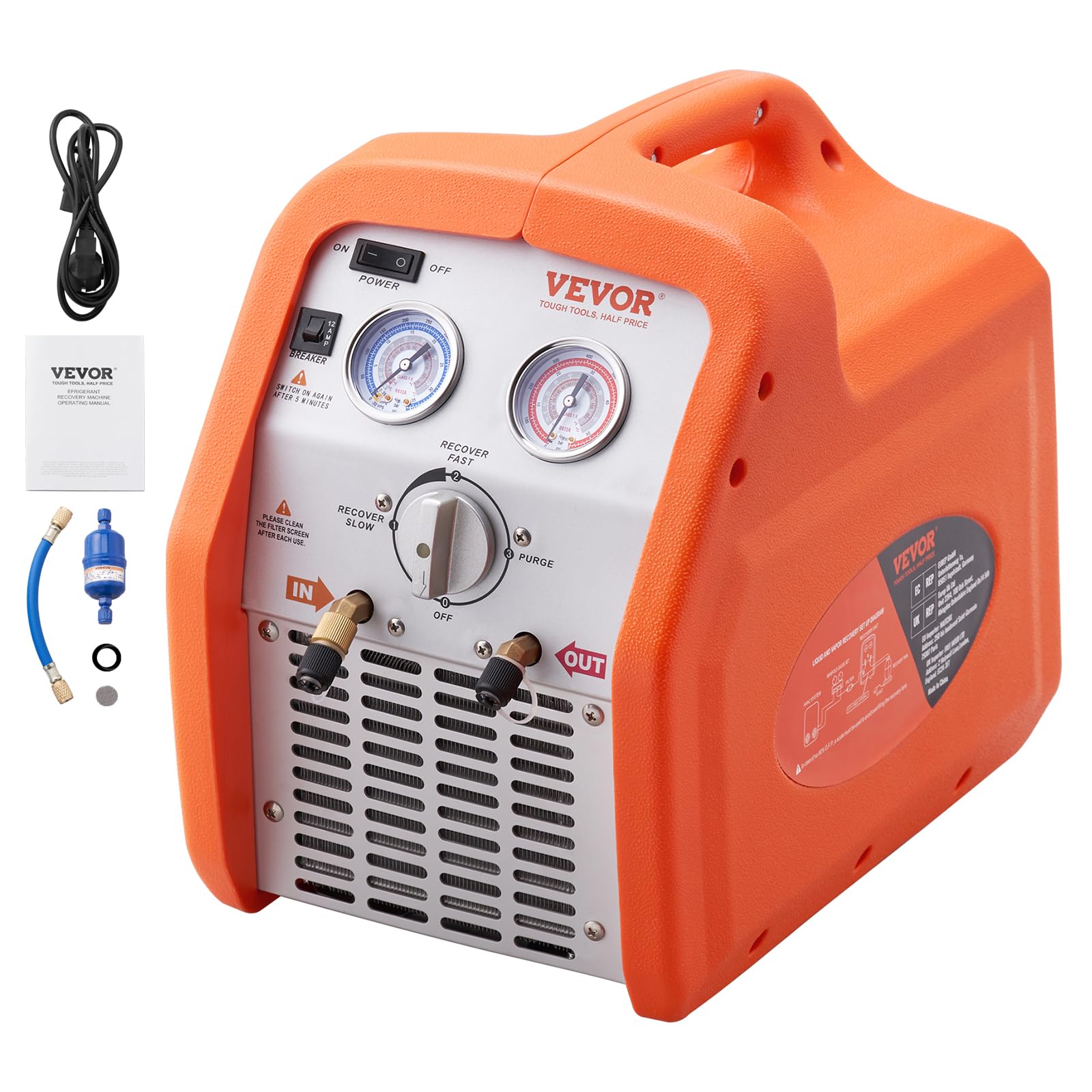
This VEVOR packs a 3/4 HP punch that recovers both liquid and vapor refrigerant for automotive AC and HVAC work, and it does it at a price that undercuts the premium brands dramatically. The headline feature is the professional self-cleaning system — a knob turn to the PURGE position flushes leftover refrigerant automatically, so you are not tearing the machine apart after every job. That alone saves serious downtime for anyone working across multiple cars a day.
A dual filtration system, with a filter net and an advanced dryer, strips impurities and moisture from the refrigerant as it passes through, protecting the machine from rust and keeping the recovered gas clean. Safety comes from a precise pressure gauge and high-pressure protection that triggers automatic shut-off at or above 558 PSI (38.6 bar), plus overcurrent protection for the electrical side. The built-in condenser and fan handle heat dissipation, so it can run for extended sessions without overheating.
Professional users are the loudest fans here — owners mention they were “tired of paying 3X the cost for similar results,” which is about as direct an endorsement as you will read. At 33.8 pounds, this is the heaviest unit here, a 15.8-pound lift over the Robinair RG3. That extra weight is the price of the 3/4 HP speed, a fair trade for shop use on a cart.
The Strong Suit
- 3/4 HP motor pulls fast for the price
- Self-cleaning purge keeps maintenance simple
- Dual filtration for clean, dry recovery
The Trade-Off
- Heavy at 33.8 lbs
- Newer brand, fewer long-term owner reports
Reach for this if: you want pro-level speed and self-cleaning without emptying your wallet.
Look elsewhere if: you need to carry it up stairs — the weight will wear you out.
3. 3/4 HP Single Cylinder Oil-Less Refrigerant Recovery Machine (P PBAUTOS)
A straightforward workhorse that makes DIY Freon removal feel genuinely doable.
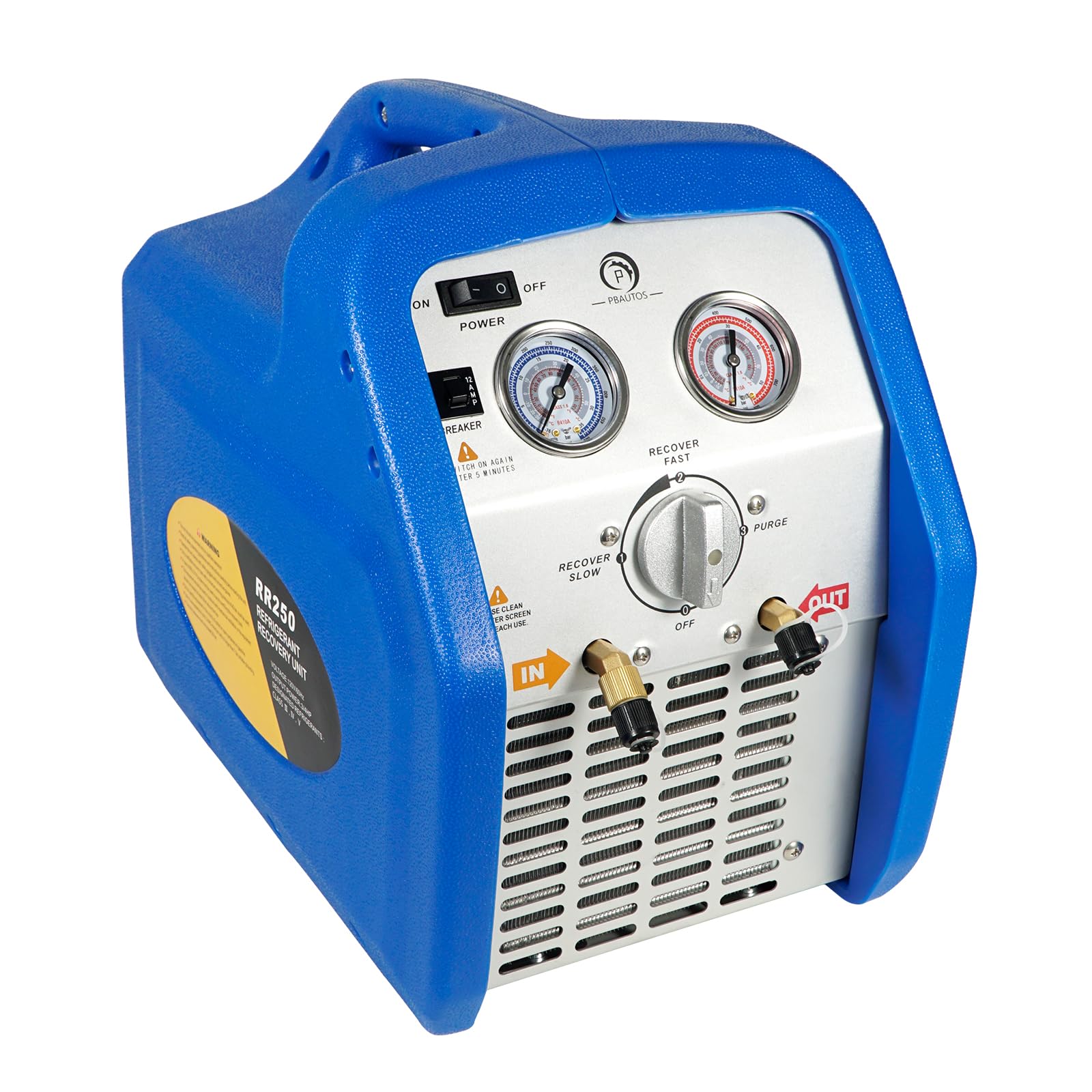
This P PBAUTOS machine puts a 3/4 HP single-cylinder oil-less compressor to work at 110V-120V 60 Hz, and it is built for people who want reliable recovery without a steep learning curve. The big condenser and upgraded cross-flow fan layout keep cycle times short, and the two gauges — blue for intake, red for discharge — give you clear real-time pressure readings at a glance. If pressure climbs above 558 psi, the unit shuts down automatically and resets on its own when safe, plus an overload protector repositions the breaker after 5 minutes if it pops.
The self-purge function is a standout for anyone switching between refrigerants, and the included replaceable filter drier removes moisture and liquid from the air to protect the machine. Compatibility is broad — it handles R12, R134a, R410A, R404A, R407C, and a long list of Category III, IV, and V refrigerants across automotive, household, and commercial appliances. Just note it is not for explosive, flammable, or corrosive refrigerants, and it is incompatible with single-use tanks.
Owners describe a DIY Freon removal that “takes time, 1 hour for me,” but they also praise that it is “not that heavy to move where you need it” at 29.8 pounds. Daily users report being impressed with the build quality and note the machine does not leak whatsoever, which is the kind of trust you want in a tool that handles pressurized gas. Single-cylinder recovery is slower than twin-cylinder units, a fair trade for the lower price.
Solid pick: the easy-to-read dual gauges and self-purge make this approachable for a first-time owner, and the 3/4 HP motor leaves room to grow.
Who it beats: lighter-duty 1/3 HP units for anyone doing their own car or home AC work on a budget.
Who it doesn’t: high-volume shops needing twin-cylinder speed on every pull.
4. VIVOHOME 3/4 HP Single Cylinder Portable Refrigerant Recovery Machine

The balanced all-rounder that keeps your compressor alive with dual-stage filtration.
VIVOHOME’s 3/4 HP oil-less, air-cooled piston compressor pairs with a high-powered fan to recover both vapor and liquid refrigerant quickly, and the broad compatibility list — R12, R22, R134a, R410A, R404A, and more — makes it a true multi-purpose tool. The dual-stage filtration is the real engineering story here: the filter drier first pulls out moisture, acids, and fine contaminants, then the inlet-port filter screen catches metal shavings and dust before they reach the compressor. That two-step approach extends equipment life in a way budget machines often skip.
Safety is handled by an automatic shut-off at 558 PSI (38.5 bar) plus overcurrent protection, and the precision pressure gauge gives you live monitoring during high-intensity work. The ergonomic non-slip handle and waterproof feet make transport and placement easy, and the corrosion-resistant materials are built for rugged field use. Owners note it performs comparably to more expensive models and call it one of the best values on Amazon.
The feedback loop on speed is honest and split — some find it fast while others say vapor recovery is slow, with one owner timing 16 oz of vapor at 12-15 minutes but noting liquid is much quicker. It is also on the heavier side at 29.7 pounds and runs loud, but for a home mechanic or small shop that is a fair trade for the price and the filtration protection.
Balanced value: you get pro-grade filtration and broad refrigerant support at a price that makes sense for serious DIYers and small shops.
Best for: the home mechanic who wants one machine that can handle a car, a home AC, and a commercial chiller.
Fair warning: vapor-side speed is not its strength, so patience is part of the deal.
5. 1 HP R32 Dual Cylinder Oil-Less Recovery Machine (P PBAUTOS)

The future-proof twin that speaks fluent R-1234yf and R-32.
If you work on newer cars, this is the machine that keeps you relevant, because its 1 HP dual-cylinder oil-less compressor is explicitly rated for R-1234yf and R-32 — the refrigerants taking over modern automotive AC. The dual-cylinder design delivers noticeably faster recovery than any single-cylinder unit, which owners confirm by noting it “emptied a 13 lb R410 refrigerant charge very quickly.” That extra speed is exactly what separates a tool from a bottleneck.
The safety package mirrors the best in this class: blue intake and red discharge gauges with clear scales, automatic shut-off above 558 psi with auto-reset, and an overload protector that repositions the breaker after 5 minutes. The self-purge function clears residual refrigerant to protect the machine between different gas types, and the replaceable filter drier strips moisture from the air. The upgraded cross-flow condenser and fan layout keeps cooling strong for shorter cycle times.
Buyers are impressed with the build quality even before first use, calling it “very well made,” and the compact design with ergonomic handle makes it easy to move around a shop at 33 pounds. Like other P PBAUTOS units, it is not compatible with single-use tanks — use approved refillable recovery cylinders only. The small owner base so far means it has less long-term track record than the Robinair name, but the specs point the right direction.
Future-proof pick: the dual-cylinder 1 HP motor and R-1234yf/R-32 support mean this handles today’s cars and tomorrow’s, without the premium-brand price tag.
Buy it for: the tech who services modern vehicles and wants twin-cylinder speed on a budget.
Wait if: you only work on older R-134a cars and do not need the A2L capability yet.
6. VIVOHOME A2L 1 HP Dual Cylinder Portable Refrigerant Recovery Machine

A twin-cylinder 1 HP beast that masters R-32, R-1234yf, and R-454B alike.
This upgraded VIVOHOME RR500 runs a 1 HP, 1750 r/min motor driving a twin-cylinder, oil-less, air-cooled piston compressor, and the larger condenser boosts cooling for high-demand jobs. Its refrigerant list is among the most future-ready here: R32, R134a, R22, R410A, R1234yf, R454B, and more, which means it is equally at home on a residential heat pump, a car AC, or a commercial chiller. The 3-knob control layout (Inlet/Outlet/Function) keeps operation simple even for newcomers.
What sets this unit apart is the AUTO/MANUAL low-pressure bypass mode, which lets you switch between maximizing refrigerant recovery and protecting the compressor from damage. That is real field control, not just a spec-sheet checkbox. Safety includes high-pressure automatic shut-off at 558 PSI, overcurrent protection, and a new pressure warning lamp panel that gives a visual alert before things get dicey. Dual-stage filtration with a filter drier and interior mesh intake filter keeps the compressor safe from moisture and debris.
Owner experiences lean positive, with one tech noting it “recovered faster than I expected” — pulling a little more than 6 lbs of R-410a in around half an hour during a condenser leak repair. Another calls it a “great powerful machine” and prefers the manual controls over auto. The practical tip from experienced users: recover refrigerant as gas rather than liquid to minimize oil carryover and extend filter life, since there is no internal oil separator. At 33 pounds, it is portable but not featherlight.
What Impresses
- 1 HP twin-cylinder speed with A2L support
- Auto/Manual bypass gives real control
- Pressure warning lamp adds safety visibility
What to Know
- No internal oil separator
- Heavier at 33 lbs
Best for: the pro who juggles modern A2L refrigerants and wants twin-cylinder speed with a control edge.
Check first: if you do all your pulls as liquid, the missing oil separator is worth planning around.
7. Hilmor 1950536 Brushless DC Refrigerant Recovery Machine

Brushless DC tech delivers surprising speed in a body that is easy to carry.
Hilmor brings something different to the table with brushless DC motor technology, which balances lightweight portability and real power in a way conventional motors often cannot. At 25 pounds with a compact 9.6″ x 5.4″ x 13.3″ footprint, it is noticeably lighter than most of the 3/4 HP and 1 HP machines here, yet customers note it “definitely goes fast — 5 pounds in just a few minutes.” That combination of speed and weight makes it a strong candidate for techs who move between jobsites all day.
The digital LCD screen is a genuine upgrade over analog-only gauges, offering precise and easily readable information that simplifies monitoring through the whole recovery process. Built-in hoist points enable hands-free carrying, which is a thoughtful touch for anyone hauling gear up ladders or across rooftops, and the integrated power cord wrap keeps the cord tidy in storage. It is designed for professional use, which shows in the attention to these daily-workflow details.
The owner base is small but enthusiastic, with the top-line praise being efficiency and ease of use. The honest counterweight is one report of a coil failure after a few uses, which is note even if it is not a pattern — brushless units are newer tech and Hilmor’s support response varies. For a working pro who values carry comfort as much as raw pull, the trade-off leans favorable, but the limited long-term data is the thing to weigh.
Speed meets portability: the brushless motor and LCD display make this a modern, easy-to-read machine that out-carries heavier rivals.
Choose it for: the mobile tech who wants fast pulls without lugging 30+ pounds around.
Be mindful: the small owner base means less long-term reliability data than the established names.
8. Inficon Vortex Dual Refrigerant Recovery Machine
The shop-proven reclaimer crews put one of in every truck.
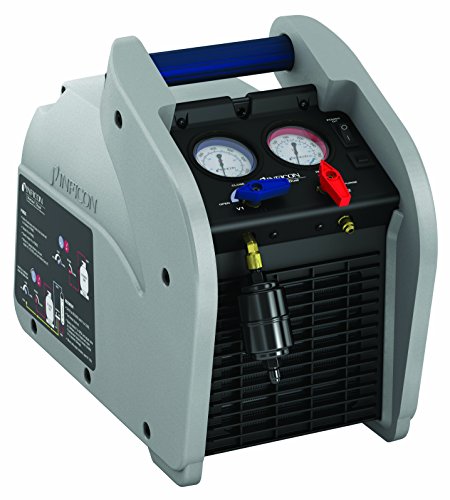
The Inficon Vortex Dual earns its reputation with a powerful 1 HP dual-piston compressor that delivers industry-leading recovery rates, and the microchannel condenser provides exceptional heat exchange even in high ambient temperatures. Owners who run these daily report recovering 12+ lb systems in 15-20 minutes, which is the kind of speed that keeps a service schedule on track. It handles both R-410a and R-22, which matters for techs who service a mix of older and newer equipment.
The design is all about field durability: two-valve operation with self-purge, large easy-to-read gauges, durable metal knobs, and a heavy-duty blow-molded case that survives the van. It ships with a shoulder strap, filter/dryer, and detachable power cord, and it is fully serviceable so repairs do not mean a full replacement. The three-year replacement warranty plus US technician support via email and phone is a real safety net that budget brands cannot match.
Fleet owners are the most vocal fans, with one reporting about 50 vehicles done in two months with no issues and another saying, “love this reclaimer, have one in each of our trucks now.” The recurring theme is that it performs better than other machines they have owned for the money. At 29.8 pounds it is not the lightest, but it is a proven daily driver with a warranty that backs the investment.
Proven daily driver: the 1 HP dual piston speed, three-year warranty, and US support make this the low-risk choice for working fleets.
Best for: shops running constant recovery work who value reliability and a real warranty over the lowest price.
Skip if: you only pull refrigerant a few times a year and cannot justify the pro-tier cost.
9. Robinair RG6 Portable Liquid and Vapor Refrigerant Recovery Machine
Robinair’s speed king, built tough for the hottest days on the job.
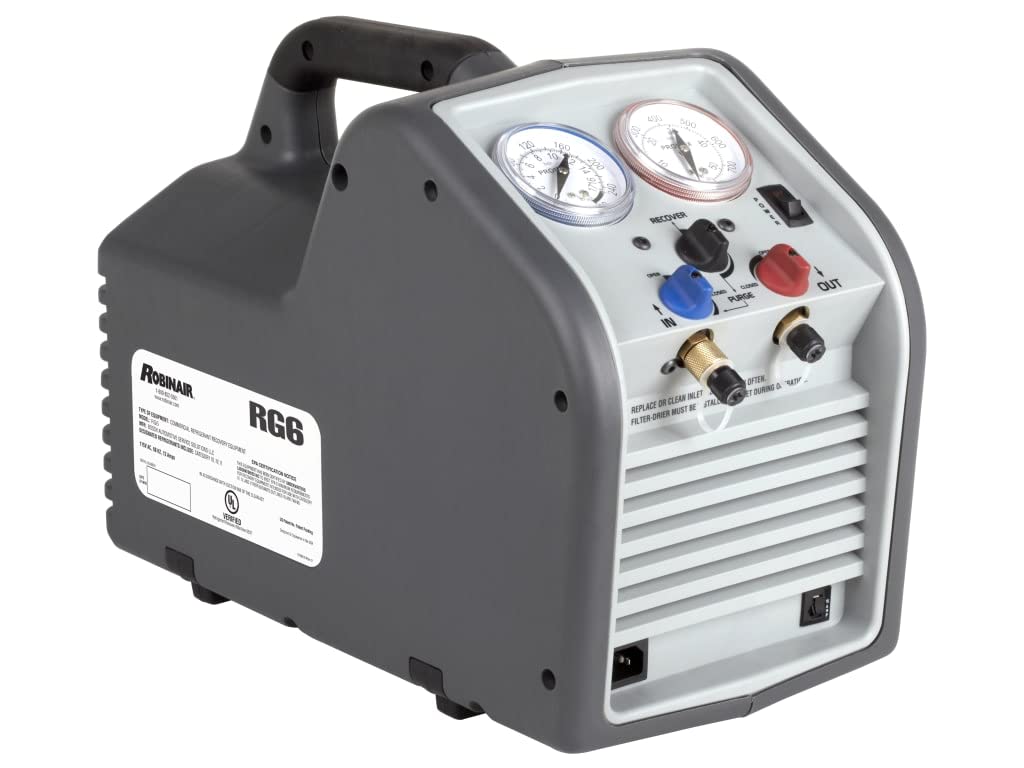
If the RG3 is Robinair’s lightweight, the RG6 is its speed demon. A twin-cylinder 3/4 HP direct-drive compressor delivers the best recovery speeds the brand offers, even in high-temperature conditions where lesser machines struggle — and a larger condenser area plus a bigger fan do the cooling work to keep cycle times short. It handles push-pull, liquid, and vapor recovery across all common CFC, HFC, and HCFC refrigerants, including R-410A, making it a true all-rounder for busy techs.
Safety and convenience are baked into the rugged outer shell: a high-pressure shut-off switch kills power above 550 psi, and the built-in self-purge prevents cross-contamination between incompatible refrigerants while saving time between jobs. The oversized pressure gauges are easy to read, controls are simple, and the comfortable handle makes positioning easy. At 27 pounds and 17″ L x 9″ W x 12″ H, it is portable enough for field work while still feeling substantial.
An ASE-certified mechanic paired this with a 30lb recovery tank for evacuations on car AC systems and found it quick and easy — one owner removed R-134 from a car “in 10 mins or less.” The broader owner base calls it durable, portable, and worth the money, with normal noise levels. The RG6 weighs 9 pounds more than the RG3 but delivers twin-cylinder speed, a fair trade for techs prioritizing pull rate.
Speed with provenance: the Robinair name, twin-cylinder 3/4 HP, and self-purge make this the upgrade path for owners who outgrew single-cylinder units.
Get it for: the working tech who wants fast recovery on every car and the brand reliability to back it.
Pass on it: if you are a light DIY user — the RG3 saves you weight and money.
10. APPION G5TWIN Twin Cylinder Recovery Unit

The twin-cylinder, twin-condenser unit crews swear runs the fastest.
APPION’s G5TWIN is built around a simple idea: twin cylinders and twin condensers for ultra-fast recovery, and the specs back it up. A 7-inch 10-blade turbine fan spinning at 3000 rpm blasts 600 cfm of cooling air over the twin heads and condensers, which is how it maintains speed without overheating. It pumps R-410a liquid and vapor, and the refrigerant-isolated crankcase keeps the oil where it belongs.
At just 24 pounds, it is remarkably light for a twin-cylinder machine — lighter than many single-cylinder rivals — which makes it a favorite for crews who move constantly. One fleet owner runs 7-8 of these across his crew and calls them “the best,” noting they “seem to work the fastest and the most comfortable setup” of everything he has tried. Another praises that it “almost draws a vacuum on its own,” which speaks to the pull efficiency.
The owner base of 188 ratings with strong positive sentiment is built on durability too — one reports running it for 10 hours without issues and needing no repairs, while others note that when parts like capacitors or relays do need replacing, they are relatively cheap and accessible. Crews choose this for its pure speed, accepting the higher price for maximum pull performance.
Crew-grade speed: the twin-cylinder, twin-condenser design plus 24-pound weight make this the fastest-feeling unit per pound in this guide.
Pick it for: the crew or fleet that wants maximum speed and easy transport, and trusts a machine with proven long-run durability.
Think hard if: you need A2L refrigerant support — this unit is not the R-1234yf answer.
11. Fieldpiece MR45 Lightweight Digital Refrigerant Recovery Machine

The water-resistant, ceramic-cylinder pro machine that survives the rain and the roof.
Fieldpiece’s MR45 is the top-shelf pick for pros who work in the elements, thanks to a twin-cylinder oil-less compressor with ceramic cylinders for longer life and less friction, plus water resistance that withstands direct rain. The microchannel condenser compresses more refrigerant at 3,300 RPM and 1 HP — twice the RPMs and horsepower of a standard compressor — which is exactly why reviewers point out it saves significant time on every pull. At 22 pounds it is also one of the lightest 1 HP machines here, and the easy-access ports keep hose hookups quick.
What really separates it is the digital reliability. Owners love that they can walk away from it, confident it will automatically shut off when recovery is complete — no pulling the unit into a vacuum and no blowing a recovery tank. The pressure reading is reported as spot-on compared to both digital and analog gauges, which builds real trust on the job. It is R-32 ready (A2L compatible) and the simple UI makes it approachable even for newer techs.
Long-time HVAC techs call it “one of the best on the market,” praising the speed, quiet operation, and durability after 20+ years in the trade. The one real caution: it is not R-22 compliant, which is not widely disclosed, so if you still service R-22 systems this is a deal-breaker. Also, one owner had a motor fault at 6 months, though Fieldpiece replaced the unit within 2 days under warranty — a support response that speaks to why pros pay the premium.
The Pro Edge
- Water resistant for rain-safe field work
- Ceramic cylinders for longer life
- Auto shut-off protects the unit and tank
The Catch
- Not R-22 compliant
- Premium price for the Fieldpiece name
Worth it for: the full-time pro who works in tough weather and wants the lightest 1 HP machine with auto shut-off safety.
Look elsewhere if: you still service R-22 systems — this unit cannot handle that gas.
Understanding the Specs
Horsepower (HP)
This is the raw muscle of the compressor motor and the number that tracks closest to recovery speed. A 1/3 HP unit like the Robinair RG3 is compact and light but slower, while 3/4 HP and 1 HP machines pull much faster — a gap that matters when you are doing multiple cars a day.
Auto Shut-Off Pressure
This safety feature kills the machine if pressure climbs too high, and most units in this class trigger at 558 PSI or 550 PSI. It protects both you and the recovery tank from overpressure, so you never have to babysit the machine to the end of a pull.
Refrigerant Compatibility
Not every machine handles every gas. Older units cover R-12, R-134a, and R-410a, but the modern wave of R-1234yf and R-32 requires a specific A2L-rated machine. Always check the list before you buy, or you are locked out of newer vehicles.
Self-Purge Function
This feature clears residual refrigerant from the machine after a job, so you can switch to a different gas without cross-contamination. It saves time between pulls and extends the life of the machine, which is why it is standard on most pro-tier units here.
FAQ
What is the difference between a vehicle AC machine and a standard recovery machine?
Will a 3/4 HP recovery machine work for automotive AC work?
How long does it take to recover refrigerant from a car?
Can I use a recovery machine with a single-use refrigerant tank?
What does the self-purge function actually do?
Is an oil-less compressor better for refrigerant recovery?
What refrigerants will I need to handle as a home mechanic?
How heavy is too heavy for a portable recovery machine?
Can I recover both liquid and vapor refrigerant with these machines?
Do I need a separate vacuum pump with a recovery machine?
Final Thoughts: The Verdict
Across the board, the vehicle ac machine winner is the Robinair RG3 because it combines the lightest weight at 18 pounds with the trusted Robinair name and a safety shut-off at 550 PSI, making it the best all-around pick for mobile techs and serious DIYers. If you want the speed of a twin-cylinder pull without the premium price, grab the VEVOR 3/4 HP. And for the working pro who needs A2L refrigerant support and water resistance for tough field conditions, the Fieldpiece MR45 is the one to reach for — just confirm you do not service R-22 systems, since that is its one real gap.
How We Picked
We do not accept paid placement. Every pick is matched to a real buyer and a real use-case; we do not hands-on test units.
Sources & Methodology
Specifications: manufacturer listings and product documentation. Review insights: verified customer reviews, as of August 2026. Pricing: not shown on this page (it changes often); check the current price via the retailer link.
As an Amazon Associate, GoCarLife earns from qualifying purchases. This does not affect which products we feature.