
Our readers keep the lights on and the garage heater humming. As an Amazon Associate, I earn from qualifying purchases.
Car electrical problems don’t usually announce themselves with a neat, obvious symptom. They show up as “the battery is fine… right?” or “the dash flickered once and now I’m spiraling,” or the classic: “it only happens when it rains and I’m late.” Modern vehicles are rolling networks of sensors, modules, grounds, and power feeds—so when something goes weird, you need a tool that turns mystery into measurable facts.
If you’re hunting for the best multimeter for cars, here’s the promise of this guide: I’m not going to hand you a spec sheet and call it a day. I’m going to walk you through what actually matters when you’re diagnosing real-world automotive issues—parasitic drain, voltage drops, bad grounds, flaky relays, dying alternators, noisy signals, and the “why does this circuit look alive when it’s not?” moments.
And I’m going to do it the way experienced techs think: workflow-first. Because the difference between a multimeter you love and one you regret is rarely “this one has more digits.” It’s things like: how fast the continuity beeper responds when you’re tracing grounds, how stable the reading is when the engine bay is vibrating, whether the lead jacks are idiot-proof when you’re tired, and whether your current-measuring plan is realistic without blowing a fuse.
Below you’ll find 15 picks that cover the full “car life” spectrum: advanced power-probe style tools that can activate components, serious clamp meters for tracking draw without breaking circuits, proven Fluke and Klein workhorses, and budget-friendly meters that still handle the core jobs cleanly.
How to Choose the Best Multimeter For Cars (Without Overbuying)
A car-focused meter isn’t “better” because it has a longer feature list. It’s better because it helps you get a confident diagnosis with fewer mistakes—and with less time wasted second-guessing your setup. Car electrical work has three big realities:
- Most tests are low-voltage DC (battery, charging, sensors, modules), but they happen in messy, noisy environments.
- The hardest problems are intermittent (heat, vibration, moisture, load), which punishes slow meters and vague readings.
- The biggest risks are self-inflicted (wrong jack, wrong function, blown meter fuse, shorted circuit, backprobing damage).
Here’s the decision framework I use when I want someone to buy a meter once—and still like it months later.
1. Identify your “top 3” car tests (this decides everything)
Most owners think they need “a multimeter for cars,” but what they really need is a tool that nails the few tests they’ll do repeatedly. Pick your top 3 from this list and shop around that:
- Battery & charging checks: battery voltage at rest, cranking voltage drop, alternator charging voltage.
- Parasitic draw: finding what’s draining the battery overnight.
- Voltage drop testing: finding resistance in cables, grounds, connectors under load.
- Continuity & ground integrity: chasing broken wires, bad grounds, intermittent opens.
- Sensor signal sanity checks: frequency/duty-cycle on certain sensors, verifying reference voltage, watching fluctuation.
- Component activation / circuit probing: powering a motor, relay, or circuit to confirm “it works” vs “it’s not being commanded.”
2. Know what “counts” actually do (and when they don’t matter)
“Counts” (2000, 4000, 6000, 20,000…) are basically display resolution. Higher counts can help you see small changes without the meter constantly jumping ranges. On cars, that matters most for:
- Voltage drop testing (you’re often hunting tenths or hundredths of a volt under load).
- Small sensor changes (a lazy ground or weak connection that only shows as tiny wobble).
- Current draw work (especially if you’re trying to see the difference between “sleeping” and “barely awake”).
But counts don’t magically fix a slow meter, noisy leads, or a laggy autorange algorithm. A “lower-count” meter that is stable and fast can beat a high-count meter that hunts for range every time you touch the probes.
3. Continuity speed is the secret weapon (seriously)
Specs love to brag about voltage limits. Real car diagnosis lives in continuity mode. When you’re tracing grounds, checking connectors, verifying repaired wires, or doing “wiggle tests” to reproduce an intermittent fault, a fast continuity beeper saves your sanity.
- Fast response helps you catch micro-breaks as you flex a harness.
- Loud, consistent audio matters in a garage with fans, engines, and tools.
- Stable “hold” behavior helps you confirm what happened when the reading flickers.
This is why professional brands earn loyalty: not because they measure voltage (almost all do), but because they behave predictably under real conditions.
4. Decide how you’ll measure current (this is where most DIYers struggle)
In cars, current measurement is both useful and risky. Useful because it helps you quantify a draw or confirm a component load. Risky because a multimeter in series is basically “part of the circuit”—and the moment you set it up wrong, you can blow a meter fuse or create a short.
- Series current (traditional): more precise on small currents, but higher “oops” risk. Best if you’re patient and methodical.
- Clamp current: faster and safer because you don’t break the circuit. Best if your clamp can do DC current well (many cheap ones do not).
- Power probe style tools: a different approach—more like “circuit commanding and verification” than pure measurement.
5. Leads, clips, and probe control matter more than you think
A car’s electrical system is physical. You’re reaching behind a fuse box, around a battery, past a hot header, into a cramped door boot, or under a dash where gravity is not your friend. That’s why “accessories” aren’t fluff:
- Silicone leads stay flexible in cold weather and feel less “fight-y” in tight spaces.
- Alligator clips are the difference between “steady reading” and “my probe slipped again.”
- Backprobe and piercing options let you test without damaging connectors or removing insulation (when done carefully).
- Lead-alert systems help prevent the most common meter mistake: wrong jack, wrong measurement, blown fuse.
If you’ve ever tried to hold two probes on a connector while also cranking the engine, you already know: hands-free isn’t a luxury, it’s accuracy.
6. Don’t get trapped in a tool style that doesn’t match your brain
Some people think in numbers. Some people think in “does it have power?” Some people think in waveforms and timing. That’s why there’s no single “perfect” tool:
- Classic DMMs are best for steady measurements: voltage, resistance, continuity, diode tests, and basic frequency/duty cycle.
- Clamp meters shine when current is central to your diagnosis (and when you don’t want to break circuits).
- Power circuit probe testers (like ANCEL PB-series) are built for automotive workflow: verifying polarity, activating loads, tracing shorts, and sometimes even viewing signals.
Choose the tool that fits the way you troubleshoot, not the way a product listing wants you to troubleshoot. That’s how you end up with gear you actually use.
Quick Comparison: 15 Best Multimeter For Cars Picks
Use this table to shortlist the models that match your workflow, then jump to the deep reviews for the real-life details— like which meters feel stable in the engine bay, which ones make parasitic draw testing easier, and which ones are “good on paper” but annoying in practice.
On smaller screens, swipe or scroll sideways to see the full table.
| Model | Type | Car-strength | Best match | Amazon |
|---|---|---|---|---|
| ANCEL PB500 Automotive Power Circuit Probe Tester | Power probe + meter | Automotive workflow tool: probing, polarity, activation, signal checks, plus meter + scope-style insight | Most car DIYers/techs who want faster electrical diagnosis | Amazon |
| ANCEL PB600 Automotive Power Circuit Probe Tester | Power probe + scope | “All-in-one” pro tool: adds battery/cranking/charging, injector and relay test, long cable reach | Shops, serious DIYers, and people who live in electrical faults | Amazon |
| Fluke 17B+ Digital Multimeter | DMM | Confidence-grade stability + frequency + temperature; a “buy once” bench-to-garage meter | People who want premium feel without endless complexity | Amazon |
| Fluke 15B+ Digital Multimeter | DMM | Rugged, quick, stable readings for the “90% of car tests” that matter most | DIYers who want Fluke quality without extra modes | Amazon |
| Klein Tools CL810 Digital Clamp Meter | Clamp meter | AC/DC clamp + LoZ + inrush + microamps; strong choice for draw tracking + versatile diagnostics | Current-focused diagnostics and “don’t break the circuit” workflows | Amazon |
| INNOVA 3340 Professional Automotive Digital Multimeter | Auto DMM | Automotive specialties: RPM/dwell/pulse width + inductive pickup; great for older ignition work | Mechanics who work on mixed old/new vehicles | Amazon |
| Klein Tools MM420 Digital Multimeter | TRMS DMM | Lead-alert jacks + TRMS + temperature + capacitance/frequency; very practical “do everything” feel | Home + car users who want one solid meter | Amazon |
| KAIWEETS HT118E TRMS 20000 Counts Multimeter | High-res DMM | High resolution, lots of modes, safety features; strong “features-per-dollar” vibe | DIYers who want more detail without premium pricing | Amazon |
| INNOVA 3320 Auto-Ranging Digital Multimeter | Budget DMM | Battery load test LEDs + ECU-safe impedance + dependable basics | Glovebox meter that still gives trustworthy readings | Amazon |
| Klein Tools 69149P Electrical Test Kit | Kit | Multimeter + NCV tester + outlet tester; great “starter bundle” for general electrical confidence | New DIYers who want a ready-to-go kit | Amazon |
| Klein Tools MM325 Manual-Ranging Multimeter | DMM | Simple, durable, lead-alert, battery test; fewer modes, fewer mistakes | People who want straightforward basics | Amazon |
| Neoteck 6000 Counts TRMS Multimeter | Budget TRMS | Good mode coverage with NCV + backlight; strong value for basic car checks | Budget buyers who still want versatility | Amazon |
| AstroAI Digital Clamp Meter (2000 Counts) | Clamp meter | Budget clamp convenience (AC current only) + NCV; great for household + quick checks | Light-duty users who want clamp ease on a tight budget | Amazon |
| TESMEN TM-510 Smart Digital Multimeter | Smart DMM | Super beginner-friendly smart mode + NCV; fast for voltage/continuity—but no current mode | New DIYers who want “easy wins” first | Amazon |
| ANENG SZ26 Automotive Engine Analyzer Multimeter | Tach/Dwell | Targets points-era work (tach/dwell/duty), includes lots of accessories | Classic car owners who specifically need dwell + tach tools | Amazon |
In‑Depth Reviews: 15 Car‑Ready Meters (What They’re Like to Actually Use)
Now we go model by model. I’m not going to talk like a catalog. I’m going to talk like someone troubleshooting: what feels fast, what feels fiddly, what reduces “did I mess this up?” anxiety, and what each tool is genuinely best at once you’re under the hood.
1. ANCEL PB500 – The “Do More Than a Multimeter” Shortcut for Faster Troubleshooting
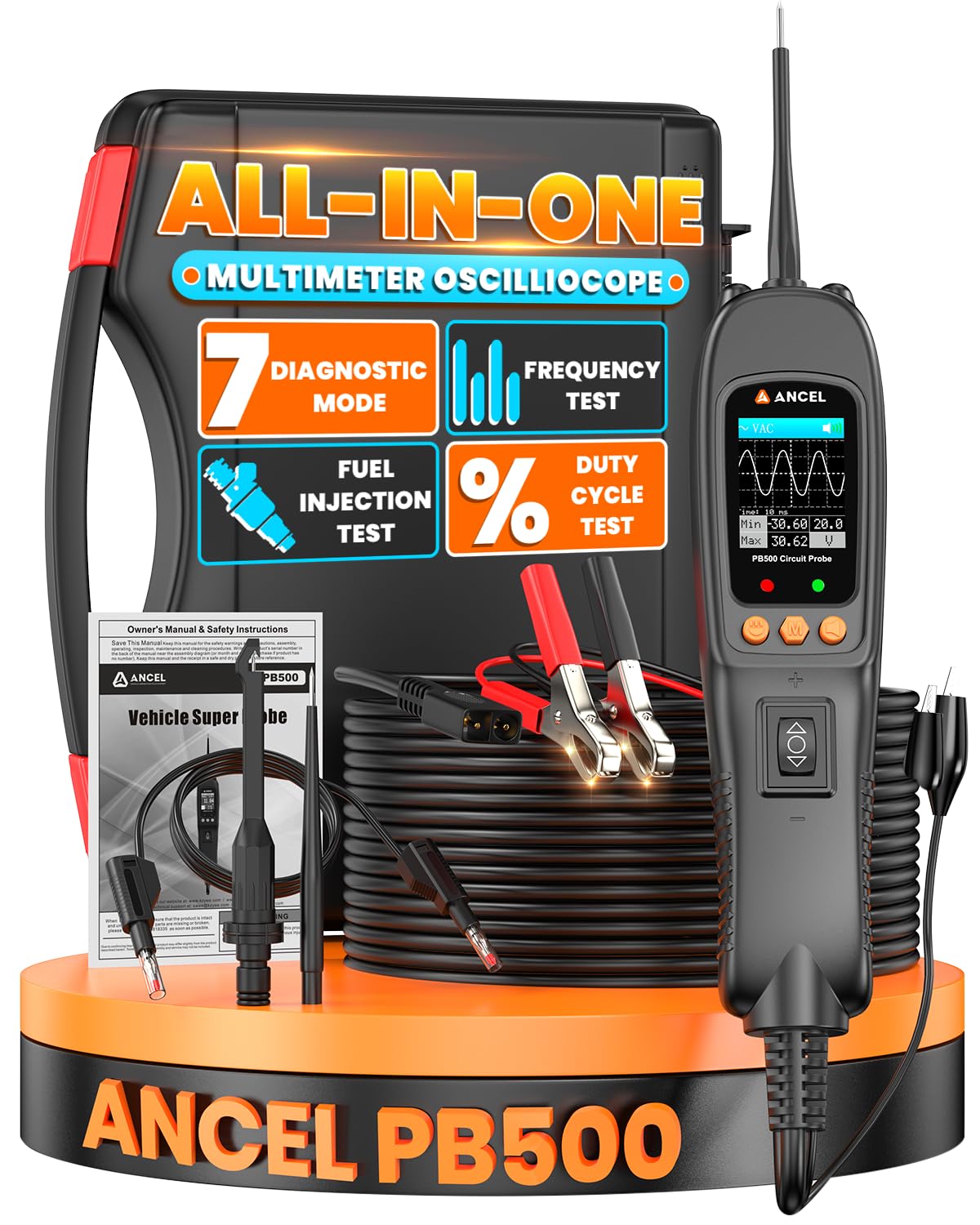
A normal multimeter is a measuring tool. The PB500 is a measuring tool plus an automotive workflow tool—and that distinction matters. If you’ve ever wasted time asking, “Is the circuit dead, or is my ground bad, or is my probe slipping?” this is the kind of tool that reduces those loops. It’s built around the way car electrical diagnosis actually happens: quick polarity identification, continuity checks you can trust, and the ability to activate components to separate “broken part” from “not being commanded.”
Where the PB500 shines is when the problem is not a single measurement, but a chain of checks: verify power, verify ground, verify load, verify signal. It’s also the rare pick here that tries to bridge two worlds: simple “probe it” testing and deeper signal analysis. The moment you add frequency and duty cycle into the same handheld workflow, you stop guessing about pulsed signals and start verifying whether a control signal is present and behaving. And having an oscilloscope-style waveform view, even a basic one, can reveal why “the voltage looks normal” but the behavior is still wrong.
The other real-life win is how people describe it as an “all-rounder” that reduces tool swapping. In owner feedback, the consistent theme is speed: it’s the tool they wish they’d had years ago because it gets them to a confident answer faster, especially on common faults like bad grounds, intermittent wiring, and stubborn relays that look fine until you load them.
Why it’s a smart “one tool” buy
- Automotive-first workflow – polarity, continuity, component activation, and signal checks are built into how you use it.
- Less second-guessing – the tool gives multiple confirmation cues (display + indicators), which reduces false conclusions.
- Signal insight without a full lab scope – duty cycle/frequency plus waveform viewing helps on pulsed circuits and sensors.
- Fewer tool swaps – owners often describe it as the “best all-rounder” because it covers common electrical tasks end-to-end.
Good to know
- This is more specialized than a basic DMM; if you only check battery voltage twice a year, it may feel like “extra tool.”
- Power/activation tools require you to think about what you’re commanding—great when used intentionally, risky when used casually.
- If your main focus is ultra-precise bench electronics, a traditional high-end DMM may feel cleaner for that niche.
Ideal for: car owners and techs who troubleshoot more than once in a blue moon and want a tool that feels like it was designed for automotive electrical reality, not just generic measurement.
2. ANCEL PB600 – The “Electrical Diagnostic Station” in Your Hand

If the PB500 is “do more than a multimeter,” the PB600 is “replace a stack of tools.” It’s built for people who live inside electrical diagnostics—shops, technicians, serious DIYers—and it shows in the feature choices. The big upgrade isn’t just “more modes.” It’s that the tool leans into the core automotive triad: battery health, starting, and charging, then layers on injector, relay, and component activation workflows in a single handheld unit.
Why does that matter? Because many electrical problems are not isolated. A weak battery can mimic a bad starter. A marginal alternator can create ripple that confuses modules. A relay can click but fail under load. The PB600 is designed to handle those overlapping stories without forcing you to switch tools, re-learn interfaces, and lose your diagnostic momentum.
The other underappreciated advantage is physical workflow: long cable reach changes what you can test comfortably. Anyone who has tried to probe deep in an engine bay while balancing a meter knows this pain. The PB600’s extended reach and probe design make it easier to test “downstream” without moving everything, which is one of those small improvements that adds up over a day of work.
If you’re the kind of person who wants answers like “the injector is being commanded but the waveform is weak” or “the circuit is powered but the drop under load is unacceptable,” this is the kind of tool that feels like it’s meeting you where you are—especially when you’re diagnosing faults that basic test lights and basic meters can’t explain.
Why it’s a shop-level upgrade
- Battery + cranking + charging insight – helps you stop guessing whether the electrical system is “healthy enough” under load.
- Injector and relay diagnostics – fast separation of “command problem” vs “component problem.”
- Waveform + meter workflow – reveals signal quality issues that hide behind “normal voltage.”
- Reach and access – extended cable and probing design make deep-bay testing more practical.
Good to know
- It’s heavier and more “tool station” than pocket meter; this is a commitment to a workflow.
- If you mainly do household electrical or bench electronics, much of the value is unused.
- There’s a learning curve—worth it for frequent diagnosis, unnecessary for occasional checks.
Ideal for: serious automotive electrical work—especially if you want one handheld tool that can test, activate, and verify across multiple systems without constant gear swapping.
3. Fluke 17B+ – Premium Stability for People Who Hate Wobbly Readings

Fluke earns its reputation in a boring way: the meter behaves like it should, over and over, for years. On cars, where you’re often measuring DC voltage and verifying continuity, that stability feels like peace. Owners repeatedly describe this kind of Fluke as “quick” and “consistent”—and that’s not marketing fluff. When you’re diagnosing, a stable reading is a decision: “yes, this is real,” or “no, this is noise.”
The 17B+ is especially appealing because it’s the point where Fluke starts adding the extra modes that actually make sense on vehicles: frequency/duty cycle and temperature. Frequency and duty cycle can help verify pulsed signals and switching control, and temperature can help with diagnostics where heat is the clue (overheating connectors, suspect resistors, sensor context). It’s not a lab instrument. It’s a durable, highly usable field meter with the kind of interface that doesn’t fight you.
The “feel” matters too: dial detents, button press confidence, display readability. This is why people keep Flukes for decades. Even if you don’t measure something exotic every day, you feel the difference in the basics: continuity checks that respond quickly, voltage readings that don’t bounce around, and a general sense that the meter isn’t guessing.
If you want a traditional DMM that can handle car work, home electrical checks, and bench hobby projects without feeling like a compromise, the 17B+ is a classic “safe bet” purchase.
Why people love it
- Stable, consistent readings – less “jumpy” behavior means fewer misdiagnoses.
- Useful extras – frequency/duty and temperature expand what you can confirm on vehicles.
- Built to be used – good ergonomics, readable display, and durable feel.
- Long-term value – many owners buy Fluke because they want one meter that lasts.
Good to know
- It’s a classic DMM, not a car-specific power probe: it won’t “activate” components like the PB-series.
- If you never use frequency or temperature, the 15B+ can cover most needs for less complexity.
- You may still want better leads or clips for deep automotive work (true for most meters).
Ideal for: anyone who wants a premium-feeling meter for years of car work and general diagnostics, with a few genuinely useful added modes.
4. Fluke 15B+ – The “Everything You Actually Need” Workhorse

Most car troubleshooting doesn’t require a hundred modes. It requires a meter that does the basics fast and confidently: DC voltage, continuity, resistance, diode checks, and current when needed. The 15B+ is built around that reality. Owners often describe the experience as “stable and consistent” and “easy to operate”—and that’s the value. You stop thinking about the meter and start thinking about the car.
This is also the kind of meter that builds confidence when you’re doing important tests like parasitic draw setup or voltage drop work. Not because it has a secret feature, but because it behaves predictably. The dial clicks decisively, the readings settle without drama, and the continuity buzzer is the sort of thing you can trust in a noisy garage. If you’ve ever fought a cheap meter that lags, autoranges slowly, or reads “phantom stuff” until it decides to behave, this feels like relief.
In car terms, the 15B+ is a “daily driver” meter. It’s great for battery voltage sanity checks, alternator output confirmation, fuse checks, ground verification, connector troubleshooting, and general electrical problem solving. It’s also a solid pick if you want a high-quality meter that doesn’t tempt you into using modes you don’t understand yet.
If you’re choosing between the 15B+ and 17B+, here’s the simple logic: if you want frequency and temperature built in, go 17B+. If you want “pure basics done beautifully,” the 15B+ is the sweet spot.
Why it’s so easy to recommend
- Core automotive modes done right – voltage, resistance, continuity, diode, capacitance: clean and consistent.
- Stable readings – reduces false conclusions when diagnosing intermittent issues.
- Simple interface – fewer mode mistakes, easier learning curve.
- Durable feel – built for real hands, real garages, and real years of use.
Good to know
- No built-in temperature/frequency modes like the 17B+ (if those matter to your diagnostics).
- Like most classic DMMs, accessories can make or break your experience—clips and better leads help a lot.
- If you want component activation and circuit commanding, look at the ANCEL PB tools instead.
Ideal for: DIYers and techs who want Fluke reliability for the real-world automotive tests they’ll do constantly.
5. Klein Tools CL810 – When Current Diagnostics Are Your Superpower

Clamp meters are misunderstood in the car world. People either ignore them (“I don’t do electrician work”) or buy a cheap one and then discover it doesn’t do what they actually needed. The CL810 is the type that’s worth buying because it’s built for real diagnostics: it measures current via the clamp, but it also behaves like a full-featured meter through the leads. So you get both worlds: current convenience and classic DMM capability.
The killer use case is current tracking without breaking circuits. That’s huge for troubleshooting draw, verifying loads, and monitoring changes while you manipulate the vehicle (lock/unlock, wake modules, pull fuses, unplug components). It’s also a calmer workflow because you’re not constantly in series with a battery cable hoping you don’t bump something and reset the car.
Two features matter more than people think: LoZ (low impedance) and microamp capability. LoZ is mostly an electrician “ghost voltage” feature, but it can also help when you’re dealing with induced or stray readings in messy environments. Microamps matter when you’re dealing with small current signals or trying to be more precise about tiny draws. Owners also rave about the display readability—especially in bright conditions—and the worklight/dial lighting is genuinely useful under a dash.
If you’re the kind of troubleshooter who thinks, “I want to see what changes when I do X,” a clamp meter like this makes you faster. It’s less about raw specs, more about keeping your diagnostic brain in motion.
Why it’s a diagnostic accelerator
- Clamp current without circuit disruption – faster, safer current tracking during troubleshooting.
- Real meter features – voltage/resistance/continuity/frequency/temperature tools aren’t an afterthought.
- Great visibility – reverse-contrast screen and lighting help in both sunlight and dark spaces.
- LoZ mode – can reduce confusion from ghost/stray voltage behaviors in certain scenarios.
Good to know
- Clamp meters are bulkier than handheld DMMs; it’s a different carry style.
- Some users note the dial can feel stiff at first—common with new, tightly-built tools.
- If you never measure current, the value over a standard DMM shrinks.
Ideal for: anyone who troubleshoots parasitic draw, module wakeups, and load behavior—and wants current measurement without constantly breaking circuits.
6. INNOVA 3340 – The Automotive Multimeter That Still Cares About RPM & Dwell
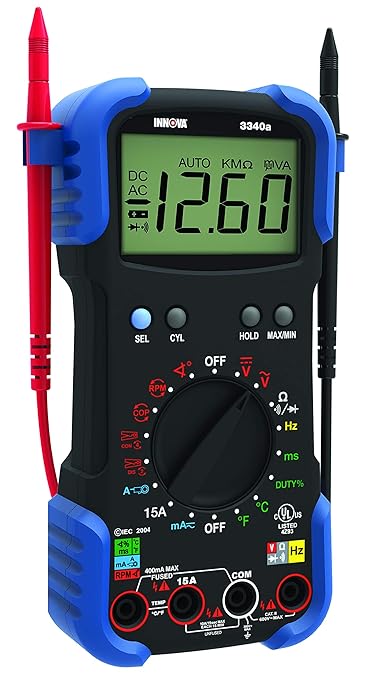
Here’s the thing many modern multimeters quietly stopped doing: they stopped being “automotive” in the old-school sense. They assume you’ll never touch points ignition, never need dwell, and never care about RPM measurement options. The Innova 3340 is built for the messy reality that many garages live in: you might be working on a modern daily driver this week and a classic project next week.
Owners who love the 3340 tend to love it for one reason: it has the automotive-specific extras that are hard to find now, and it still behaves like a competent multimeter for everyday electrical troubleshooting. That combination is rare. It measures the basics, but it also gives you dwell angle and RPM measurement with an inductive pickup—tools that can turn old ignition tuning from “by ear” into “by numbers.”
The most honest feedback is also helpful: several users report that the tach functions can be jumpy or erratic in noisy ignition environments, especially compared with dedicated tach tools or meters that filter the signal more aggressively. That doesn’t make it “bad,” but it does mean you should think of RPM readings as “usable with technique” rather than “instant perfection.” In practice, many users solve this by looking for an average reading and ensuring their pickup placement is consistent.
If you’re an automotive tinkerer who wants one meter that can handle wiring, charging system checks, and classic ignition diagnostics without buying a separate dwell/tach tool, the 3340 is one of the most purpose-built picks in this entire list.
Where it shines
- Automotive-specific modes – dwell, RPM, pulse width/duty cycle are genuinely useful for engine/ignition work.
- Good value feature stack – owners often note it competes with pricier meters in capability.
- Solid accuracy for basics – voltage and resistance readings are widely reported as dependable.
- Comes as a “kit” – case and accessories make it easier to keep organized and ready.
Good to know
- RPM readings can be jumpy on some setups; ignition noise and pickup placement matter.
- It’s not as physically rugged as a heavy-duty industrial meter—treat it like a precision tool.
- Some users prefer a dedicated tach for ultra-stable RPM tuning; this is “very good,” not “specialist-only.”
Ideal for: mechanics and DIYers who want automotive-focused modes—especially classic ignition dwell/RPM—without giving up a full-featured multimeter.
7. Klein Tools MM420 – The “Just Works” Meter with Lead-Alert Confidence

Klein’s recent meter lineup has a specific “field usability” vibe: build tools that are hard to mess up. The MM420 is a great example. It’s auto-ranging, TRMS-capable, and offers the measurements most people want (voltage/current/resistance, plus temperature, capacitance, frequency/duty cycle, diode, continuity). But the real magic is how it protects you from common mistakes and makes hands-on work easier.
The standout feature for many users is lead-alert protection—LEDs that help indicate proper lead placement. That might sound small, but in automotive work it prevents the #1 meter-facepalm: leads in the wrong jack when you switch modes. That mistake can blow fuses, waste time, or create confusing readings. Add a backlit display, lead holders, and a kickstand that doesn’t feel like an afterthought, and you get a meter that’s simply pleasant to use.
In real-world car use, the MM420 is a strong “one meter for most people” pick: battery voltage checks, alternator output, continuity/ground chasing, sensor resistance checks, fuse verification, and occasional duty/frequency checks. If you want a meter that feels professional without being intimidating, Klein tends to land that balance well.
One nuanced point: TRMS matters more in distorted AC environments than in typical 12V DC automotive circuits, but it becomes more relevant if you’re using the meter for home/HVAC work too. Many buyers end up loving the MM420 because it’s not “just for cars”— it’s for life.
Why it’s easy to live with
- Lead-alert guidance – reduces wrong-jack mistakes and improves confidence for newer users.
- Balanced feature set – covers the common automotive tests plus useful extras.
- Good ergonomics – kickstand, backlight, and lead holders support hands-free testing.
- Durable feel – designed for field use with drop resistance in mind.
Good to know
- Like many “mid-tier” meters, included leads are fine—but silicone upgrades can make it feel higher-end.
- If you want deep automotive signal diagnosis, a power probe tool or true lab scope still wins.
- Manual learning still matters: the meter helps reduce mistakes, but it can’t replace understanding circuits.
Ideal for: people who want one dependable meter for cars and home use—especially if lead-placement guidance sounds like stress relief.
8. KAIWEETS HT118E – When You Want More Detail Without Premium Pricing

The HT118E is popular for a simple reason: it offers a lot of “advanced meter” behavior at a price that doesn’t feel like a dare. High resolution (20,000 counts) is the headline, but the more important story is how that resolution supports real car tasks like voltage drop diagnostics and watching small changes as you load a circuit. When you can see cleaner steps instead of constant re-ranging, your confidence goes up.
Owners often highlight the practical touches: Min/Max capture for catching fluctuations, backlight/flashlight for tight spaces, and input jack indicators that help prevent mistakes. That last piece is underrated: if you’re moving between voltage tests and current tests in a garage, anything that reduces a wrong-jack mistake is gold.
In car use, the HT118E can feel like a “level up” meter for DIYers who are ready to go beyond “is there 12V here?” and start doing deeper troubleshooting: voltage drops across grounds, verifying sensor supply stability, checking frequency/duty on certain circuits, and doing continuity work with more confidence. It’s also one of those meters where the feature list actually maps to plausible automotive scenarios.
The honest limitation is that it’s not a Fluke in durability, and included leads may be typical PVC-style. But within its lane—high feature density, good usability, strong value—it’s one of the most compelling picks.
Why it’s a value standout
- 20000-count resolution – more detail for voltage drop and subtle changes.
- Min/Max – helpful for catching momentary dips or spikes.
- Jack indicators – reduces lead placement mistakes.
- Feature-rich – temperature, frequency/duty, NCV, and more for broader troubleshooting.
Good to know
- Not “industrial tank” rugged; treat it as a precision tool and it will last longer.
- Included leads are usable but not premium; silicone leads improve cold-weather and tight-space work.
- It’s easy to get lost in features—stick to a workflow and the tool becomes powerful instead of distracting.
Ideal for: DIYers who want a feature-rich, higher-resolution meter for real troubleshooting—not just basic checks.
9. INNOVA 3320 – Simple, Accurate, and Surprisingly Useful for Battery/Charging Checks

The Innova 3320 is one of those “cheap but not junk” meters that earns a loyal following because it’s tuned for practical troubleshooting. Auto-ranging means fewer setup mistakes, and the core measurements—AC/DC voltage, resistance, continuity—are what most car owners actually use. But the reason it shows up in garages for years is the battery test design: it’s built to give you a more meaningful snapshot than “open-circuit voltage.”
Many people check a battery with a simple voltage reading and assume they’re done. The 3320’s battery test uses indicator LEDs and load-style behavior to help you see whether a battery is “good, weak, or replace,” which is extremely useful for quick decisions—especially when diagnosing no-start situations where “it reads 12.4V” doesn’t tell the full story.
There’s also a real-world usability angle: owners often keep multiple 3320s in different places (car, garage, house) because the tool is small, affordable, and “good enough” that you actually reach for it. It’s also commonly praised for speed in auto-ranging: you set the dial, touch the leads, and it settles quickly enough to be useful. That matters when you’re checking a fuse bank or verifying a suspected ground.
If your goal is a dependable meter for basic car checks without spending into premium territory, the 3320 is a smart, proven choice. It’s not a specialist tool. It’s a practical one.
Why it’s so popular
- Battery testing convenience – LED guidance helps quick battery decisions.
- Auto-ranging simplicity – fewer range mistakes, faster checks.
- Great “always have it” meter – affordable enough to keep in multiple locations.
- Strong basics – voltage and continuity work well for common automotive troubleshooting.
Good to know
- Not a heavy-duty current specialist; for serious parasitic draw work, clamp meters or higher-end DMM workflows may be better.
- Like many budget meters, very low resistance measurements can be less consistent than premium tools.
- It’s best when used as a “core basics” meter, not a deep electronics analyzer.
Ideal for: car owners who want a dependable, easy multimeter for the common checks—especially battery and charging sanity tests.
10. Klein Tools 69149P Kit – “Everything I Need to Start Diagnosing” in One Box
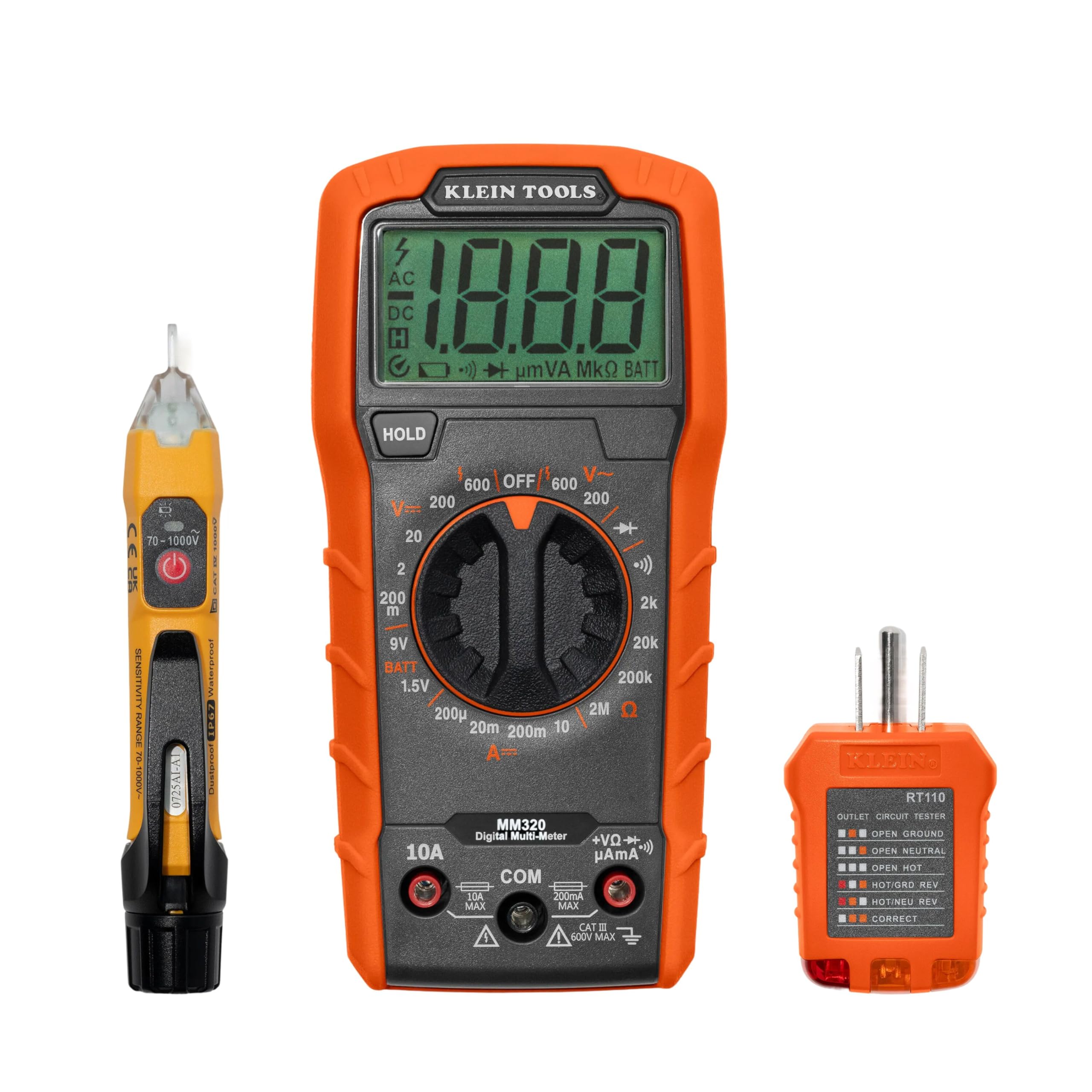
Not everyone wants to research lead quality, accessory compatibility, and “what else do I need?” before they can even start testing. That’s where this kit wins. The 69149P is essentially a confidence bundle: a manual-ranging multimeter (MM320) for voltage/current/resistance basics, a non-contact voltage tester for quick “is this live?” checks, and an outlet tester for household wiring sanity.
For car work specifically, the multimeter is the star: it covers the basic diagnostics most DIYers start with—battery voltage, fuse checks, continuity and resistance tests, and basic DC current checks (within its intended limits). The NCV tester is more of a home electrical tool than an automotive one, but it can still be useful for quickly confirming the presence of AC voltage in certain contexts (think: garage outlets, chargers, extension cords, and general “is this circuit powered?” checks).
The kit also gets a lot of love because it’s easy to understand and easy to use daily. That matters: tools that feel approachable are tools that get used—and the fastest way to improve at electrical diagnosis is repetition. One important reality check: the outlet tester is designed around standard receptacles, so its value is highly region-dependent. But the overall kit still makes sense for people who want a “one purchase, start learning” solution.
If you’re new to diagnostics and want to go from “guessing” to “measuring” quickly, this kit is an unusually smooth on-ramp.
Why beginners love it
- All-in-one starter pack – you can begin testing immediately without extra shopping.
- Clear, basic multimeter workflow – great for learning voltage, resistance, and continuity fundamentals.
- Extra testers add confidence – NCV and outlet tester help with general electrical safety and troubleshooting.
- Good brand consistency – Klein’s build quality is usually solid for daily DIY use.
Good to know
- The outlet tester is targeted at specific receptacle types; its usefulness varies by region.
- Manual ranging requires a bit more learning than auto-ranging meters (but it teaches fundamentals well).
- Not designed for advanced automotive signal diagnosis—this is a “learn the basics fast” kit.
Ideal for: new DIYers who want a ready-to-go diagnostic kit for home and basic car electrical troubleshooting.
11. Klein Tools MM325 – Manual-Ranging Basics with the Right Safety Cues

Manual-ranging meters get dismissed, but they have an underrated advantage for car DIYers: they force you to be intentional. That can reduce “why is my meter doing something weird?” confusion, especially early on. The MM325 is a clean, simple tool that focuses on the basics: voltage, DC current, resistance, continuity, diodes, and battery testing. It’s not trying to be everything. It’s trying to be reliable.
Where it feels especially friendly is the “mistake prevention” design: Klein’s lead-alert indicators help you avoid placing the leads incorrectly for the mode you’re using. That matters because the easiest way to blow a meter fuse is an innocent jack mistake. The MM325 also includes a backlight, which is not a luxury in automotive work—it’s the difference between “readable” and “guessing” when you’re under a dash or in a dim garage.
In real automotive use, this is a very practical meter for: battery voltage checks, fuse and continuity verification, basic resistance checks of sensors and wiring, and simple diode testing. It won’t replace a power probe or a scope, but it’s more than enough to solve a huge percentage of common issues. It’s also a good “loaner” meter: the interface is straightforward and the build quality is solid.
If you’re the type who wants a meter that won’t distract you, the MM325 is refreshingly focused.
Why it’s a great “basic” choice
- Manual ranging = clarity – fewer autorange surprises, more intentional testing.
- Lead-alert protection – helps prevent wrong-jack mistakes.
- Backlight + usability – easier reading in real automotive environments.
- Battery test mode – handy for quick battery checks beyond “just measure volts.”
Good to know
- Manual ranging has a learning curve; you’ll need to understand ranges to use it efficiently.
- No advanced modes like frequency/duty or temperature—this is intentionally basic.
- Some users prefer auto-ranging for speed; this is better for people who value control.
Ideal for: DIYers who want straightforward basics and appreciate guidance features that reduce mistakes.
12. Neoteck 6000 Counts TRMS – A Versatile Budget Meter That Covers the Common Bases

Neoteck’s appeal is straightforward: you get a lot of measurement modes for the money, and the tool is aimed at both DIYers and light professional use. For cars, what matters is whether the meter can do the fundamentals reliably: DC voltage, continuity, resistance, and ideally frequency/duty cycle for occasional signal checks. This model also leans into usability: backlight, flashlight, data hold, and NCV for quick presence detection.
For automotive troubleshooting, the Neoteck is best treated as a “good utility meter”: use it to confirm battery voltage, check fuses, verify continuity, measure resistance on sensors and wiring, and do basic AC/DC checks when you’re dealing with chargers or accessory circuits. Where it can fall short compared to premium tools is in long-term durability and the subtle “feel” factors: how stable readings are in a noisy environment, how fast the continuity buzzer responds, and how confident you feel trusting the result.
That said, many users are perfectly happy with it for basic readings—especially if they’re not doing automotive diagnosis daily. If you want a budget meter that still gives you enough features to grow into, Neoteck is a reasonable option. Just pair it with a good workflow: clean contact points, steady probing, and a habit of confirming results with a second method when something seems odd.
Why it’s a good value
- Mode coverage – voltage/current/resistance plus frequency, capacitance, temperature, continuity.
- Backlight + flashlight – more usable in dark garages or under dashboards.
- Auto/manual range – flexibility for both beginners and more controlled testing.
- Comfortable price point – good “starter-to-intermediate” option.
Good to know
- May not feel as rugged or as “trust-inspiring” as premium meters for daily professional use.
- Accessories like alligator clips may need to be added for smoother automotive testing.
- If parasitic draw is your main mission, a clamp meter or a very robust DMM workflow might be better.
Ideal for: budget buyers who want a versatile multimeter for cars, home, and general troubleshooting without stepping into premium pricing.
13. AstroAI Digital Clamp Meter – Great Convenience, But Know Its Lane

This is a budget clamp meter that people buy for convenience—and it delivers that convenience if you understand what it is. The important limitation is simple and non-negotiable: it clamps AC current, not DC current. That means it’s not the ideal tool for classic car parasitic draw diagnosis on a 12V DC system (unless you’re measuring AC ripple or AC loads). But it can still be useful around a garage and household because it covers AC/DC voltage, resistance, continuity, diodes, capacitance, and includes NCV.
Where it shines is “light-duty versatility.” If you want a meter for basic checks—battery voltage, continuity, resistance—and you like the clamp form factor for occasional AC work, it’s a strong value. The included backlight and flashlight are the kinds of features that make budget tools feel more usable in real spaces.
Owner feedback is also a useful reality check: most users say it works fine for general DIY, but some report occasional defects or quirks (like power cycling when changing modes). The good news is that when units are working properly, users often describe them as fast and accurate enough for basic tasks. The lesson is to treat it like a budget tool: verify it early, and don’t lean on it for high-stakes measurements without confirmation.
If you want the clamp form but you need DC current, move up to a clamp meter designed for that (like the Klein CL810). If you want “basic checks plus a clamp body,” AstroAI is a reasonable entry point.
What it does well
- Budget-friendly clamp format – comfortable for quick checks and general troubleshooting.
- Good feature set for the price – voltage, resistance, continuity, diodes, capacitance, NCV.
- Helpful visibility features – backlight and flashlight make it usable in tight spaces.
- Great for household + garage – especially if you do mixed AC/DC checking.
Good to know (important)
- Clamp does not measure DC current – that limits classic automotive current diagnostics like parasitic draw by clamping.
- Budget units can vary; test it early and confirm key readings against another meter if possible.
- Not built for professional daily abuse—this is a light-duty tool.
Ideal for: light-duty users who want a versatile meter with clamp convenience for AC work, plus basic car checks on a tight budget.
14. TESMEN TM-510 – The “Don’t Make Me Choose a Mode” Smart Meter

Some people don’t want to learn multimeter mode logic on day one. They just want to stop guessing. That’s what the TM-510 is for. Its “smart mode” is designed to automatically switch between common measurement tasks like AC/DC voltage, resistance, and continuity. In practice, that can be a confidence boost for beginners because it removes the most common early friction: choosing the wrong mode and thinking the circuit is broken when it’s actually your setup.
For simple car work—checking battery voltage, confirming a fuse has power, verifying continuity on a wire, seeing if a connection is open—this approach can be very effective. The meter also includes a non-contact voltage function, which is more useful for home and general electrical safety than it is for typical 12V DC automotive work, but it’s a nice extra for people who use the meter around the house too.
The limitation is also clear: this model is not designed to measure current. That means it’s not the pick for parasitic drain testing workflows or current draw verification. Think of it as a “measurement confidence builder” rather than an advanced diagnostic tool. Owners who love it often say it made them feel comfortable tackling small electrical tasks because it reduces setup decisions. Owners who dislike it tend to be the ones who wanted more manual control.
If you’re a beginner and your goal is to build competence quickly on the basics, a smart meter like this can be a great first step. Then, once you’re comfortable, you can graduate to a full-featured DMM or a clamp meter depending on what you diagnose.
Why it’s a great “first meter”
- Smart auto mode – reduces the learning curve for voltage/resistance/continuity testing.
- Quick confidence – helps beginners stop guessing and start measuring.
- Good convenience features – backlight/flashlight and NCV add usability.
- Compact and light – easy to keep in a drawer or toolbox.
Good to know
- Cannot measure current – not suitable for parasitic draw workflows or current diagnostics.
- Smart mode can feel limiting if you prefer manual control and specific functions on demand.
- This is an entry tool; advanced diagnosis will eventually ask for more capability.
Ideal for: beginners who want a simple, low-friction meter for basic car and home checks without learning complex mode selection first.
15. ANENG SZ26 – A Budget Dwell/Tach Idea (With Mixed Real-World Results)

The SZ26 is aimed at a specific kind of buyer: someone who needs dwell angle and tach-style functionality for older ignition systems, but doesn’t want to spend on a premium dedicated instrument. It also comes with a lot of accessories, which can feel like a win if you’re doing wire probing, clipping, and testing in awkward locations.
Here’s the honest reality from user feedback: this is the most “mixed” tool in the list. Some owners buy it specifically for points dwell adjustment and say it’s accurate and easy enough to use for that purpose. Others report frustration—especially with tach behavior—describing readings that don’t make sense or feel scaled incorrectly. That tells you the key truth about this product: you should buy it only if you’re comfortable validating results and treating it as a budget tool with quirks.
In practical garage terms, think of the SZ26 as a “niche experiment” tool. If you’re working on a classic vehicle and you want a budget way to get dwell readings, it might do the job. If you need stable, trustworthy RPM tuning data every time, you may be happier with a more proven automotive meter like the Innova 3340, or a dedicated tach/dwell instrument.
If you do choose it, the best way to get value is to use it for what it’s best suited for: points-era work and basic testing, not deep modern-module diagnosis. And if tach readings seem odd, validate with another method rather than assuming the engine is suddenly idling at a bizarre speed.
Why it can make sense
- Dwell/tach target – aimed at a classic-ignition use case that many modern meters ignore.
- Accessory-rich – lots of connectors/clips can help in awkward test setups.
- Budget-friendly approach – for occasional points work, it may cover the need without a dedicated instrument.
- Basic measurement coverage – includes standard voltage/resistance testing capability.
Good to know
- User reviews are mixed—especially around tach accuracy and usability.
- Not the tool to trust blindly; validate critical readings with a second method.
- If you need consistent, professional-grade stability, step up to a more proven automotive meter.
Ideal for: classic car owners who specifically need dwell tools and are comfortable working around a budget tool’s quirks.
“Power Moves”: How to Diagnose Car Electrical Issues Like You Actually Mean It
A multimeter doesn’t fix cars—your process does. The fastest technicians aren’t faster because they have magic tools. They’re faster because their testing sequence is clean: they confirm power, confirm ground, confirm load, and only then chase the “weird stuff.” This section is the playbook that turns any decent meter into a serious diagnostic weapon.
1. Stop “measuring voltage” and start “measuring voltage drop”
Here’s the trap: a circuit can show 12V and still fail under load. Why? Because corrosion, loose connections, and damaged strands add resistance that only reveals itself when current is flowing. Voltage drop testing is how you catch that. Instead of measuring voltage at a point, you measure the difference between two points under load: across a ground strap, across a connector, across a fuse, across a cable.
- Rule of thumb: If a component is weak (dim light, slow motor, intermittent module), check voltage drop on both the power side and ground side under load.
- What you’re hunting: a reading that is “too big” across something that should be nearly zero (like a cable or connector).
- Why high resolution helps: small changes matter; a stable meter makes it easier to spot a bad connection before it becomes an obvious failure.
2. Parasitic drain testing without the rage (and without blowing fuses)
Battery drains are one of the most misunderstood “simple” problems. The car isn’t always asleep immediately. Modern vehicles can take time to settle, and if you measure too early you’ll see a draw that isn’t the real culprit. Here’s the calmer workflow:
- Prepare the vehicle: engine off, accessories off, doors closed (or latched), interior lights disabled, and let the car sit so modules can go to sleep.
- Start high: if you’re measuring in series with a DMM, start on the higher current input/range first so you don’t instantly blow a fuse.
- Connect in series correctly: battery negative cable off, meter becomes the bridge between the post and the cable.
- Watch the story: you’ll often see a higher draw that slowly drops as systems sleep. Don’t chase the early number.
- Isolate with fuses: pull one fuse at a time and watch for a significant drop—then identify what’s on that circuit.
If you do parasitic drain testing often, this is where a DC-capable clamp meter becomes a life upgrade: you can observe changes without breaking the circuit repeatedly.
3. Ground tests that actually tell you something
A bad ground can mimic almost anything: sensor faults, module weirdness, low charging, random resets, intermittent flickers. The fastest way to approach grounds is “prove it under load”:
- Continuity is not enough: a ground can pass continuity and still fail under load due to corrosion and resistance.
- Do a voltage drop test to ground: measure between the component ground and battery negative while the component is operating.
- Wiggle test with continuity: fast continuity response helps find intermittent opens in harnesses and connectors.
4. Sensor sanity: numbers vs waveforms
Many sensors aren’t “steady.” They’re pulsed, switching, or frequency-based. A multimeter can confirm reference voltage, basic resistance, and sometimes frequency/duty cycle. But when the problem is signal quality (noise, dropouts, weak amplitude), an oscilloscope-style view becomes valuable. That’s why the ANCEL PB tools are so compelling for automotive work: they give you a peek into signal behavior without a full lab scope.
- Use a DMM for: 5V reference checks, ground integrity, sensor resistance sanity, frequency/duty cycle when available.
- Use waveform tools for: dropouts, noisy signals, timing issues, weak actuator command signals.
5. The fastest “is it the part or the command?” method
This is where automotive circuit probe testers shine. When a motor doesn’t run or a relay won’t engage, you need to know: is the component dead, or is the car not commanding it? A power-probe style tool can help you activate a component and see if it responds. If it does, you pivot to control-side diagnosis. If it doesn’t, you pivot to the component and its feed/ground. That single fork in the road saves hours.
6. A simple rule that saves expensive mistakes
Before you conclude anything, confirm your measurement in two ways:
- Confirm with a second test point (move the probe upstream/downstream).
- Confirm under load (turn the thing on while measuring).
- Confirm with a different mode (voltage drop + continuity, not just one).
That habit is what separates “I replaced three parts and it’s still broken” from “I fixed it in one pass.”
FAQ: Choosing & Using a Car Multimeter (Without the Guesswork)
Do I need a “special automotive” multimeter, or will any DMM work?
What’s the #1 feature that makes a meter feel “pro” on cars?
Clamp meter vs standard meter: which is better for cars?
Can I test parasitic drain without blowing my multimeter fuse?
Do I need True RMS (TRMS) for automotive work?
Why do some meters show “weird” voltage on a wire that shouldn’t be powered?
What accessories should I buy first for car diagnostics?
I work on older cars with points ignition. What should I prioritize?
If I only buy one tool for electrical diagnosis, what should it be?
Final Thoughts: Buy the Tool That Makes Electrical Problems Feel Solvable
The best purchases don’t just give you measurements—they give you confidence. The right tool makes you think, “Okay, I can figure this out,” instead of “I guess I’ll replace parts until the problem disappears.”
Here’s the simplest way to translate this guide into the right choice:
- Want the best “most people should start here” automotive diagnostic tool? Go with the ANCEL PB500. It’s built for real automotive workflow, not just bench measurements.
- Want the most capable all-in-one for serious electrical work? Choose the ANCEL PB600. It’s the closest thing here to an “electrical diagnostic station” you can hold.
- Prefer a classic, premium-feeling multimeter you’ll keep for years? Pick the Fluke 17B+ (or the Fluke 15B+ if you want the core modes done beautifully).
- Do a lot of current-focused troubleshooting? The Klein CL810 is a strong clamp-first choice that still behaves like a full meter.
- Work on older ignition systems and want dwell/RPM options? The INNOVA 3340 is one of the most genuinely automotive-focused DMMs still commonly available.
- Want strong value with high resolution and lots of modes? Look at the KAIWEETS HT118E. It’s a feature-dense meter that helps you see more detail in real testing.
The right decision isn’t about chasing the “most features.” It’s about choosing the best multimeter for cars that matches how you actually troubleshoot: quick checks or deep diagnosis, classic ignition or modern modules, occasional use or weekly battles. Pick the tool that makes you calm, methodical, and consistent—and your next electrical problem will feel a whole lot smaller.