
Our readers keep the lights on and the garage heater humming. As an Amazon Associate, I earn from qualifying purchases.
Specs are compiled from manufacturer listings and verified buyer reviews and can change over time — please confirm the key details on the product page before buying.
Every spring, boat owners face the same ritual: hook up the shore power, cross their fingers, and hope the batteries survived the winter. A dependable two-bank charger tops up your starter and house batteries independently, even while you’re away. The best units do this quietly, safely, and without overheating your battery compartment.
I’m Mo Maruf — the founder and writer behind GoCarLife. This guide is built by comparing the manufacturers’ published specifications and the patterns across verified customer reviews, so you get each pick’s real strengths and trade-offs instead of marketing spin.
Your boat’s batteries need a charger that can handle different battery chemistries, survive a wet bilge, and deliver the right amperage. That is why picking the right two-bank marine battery charger means matching output, waterproofing, and smart features to your specific setup.
Our Picks at a Glance

How To Choose The Best Two-Bank Marine Battery Charger
Choosing a marine charger depends on matching charge speed, mounting location, and battery chemistry. Get these wrong and you’ll face slow charges or premature battery failure.
Start with Amps Per Bank
The amperage per bank, not total output, determines real charge speed. A charger rated 10A total usually sends 5A to each battery. Bigger batteries, like large deep-cycle house banks, absorb that 5A slowly. A 10A-per-bank unit will refill a drained trolling motor battery noticeably faster, but it costs more and needs thicker wiring.
Check the Waterproof Rating
Check the IP rating to see how well the case resists dust and water. An IP68 rating means the unit is fully sealed against dust and can survive continuous submersion, perfect for an open bilge. IP67 is slightly less protected but still fine for most enclosed compartments. A dry compartment needs only IP67, but a splashy transom demands IP68.
Know Your Battery Chemistry
Flooded lead-acid, AGM, gel, and lithium (LiFePO4) all need different charging voltages. Selectable chemistry modes prevent overcharging that boils flooded batteries or damages lithium packs. If you run a mix of battery types, you need a unit that lets each bank choose its own mode independently.
Quick Comparison
| Model | Best For | Total Output | Waterproof Rating | Battery Types | Amazon |
|---|---|---|---|---|---|
| NOCO GENIUS2X2★ Best Overall | Garage & workshop use | 4A (2A/Bank) | Not rated (indoor) | 6V/12V Lead-Acid & Lithium | Amazon |
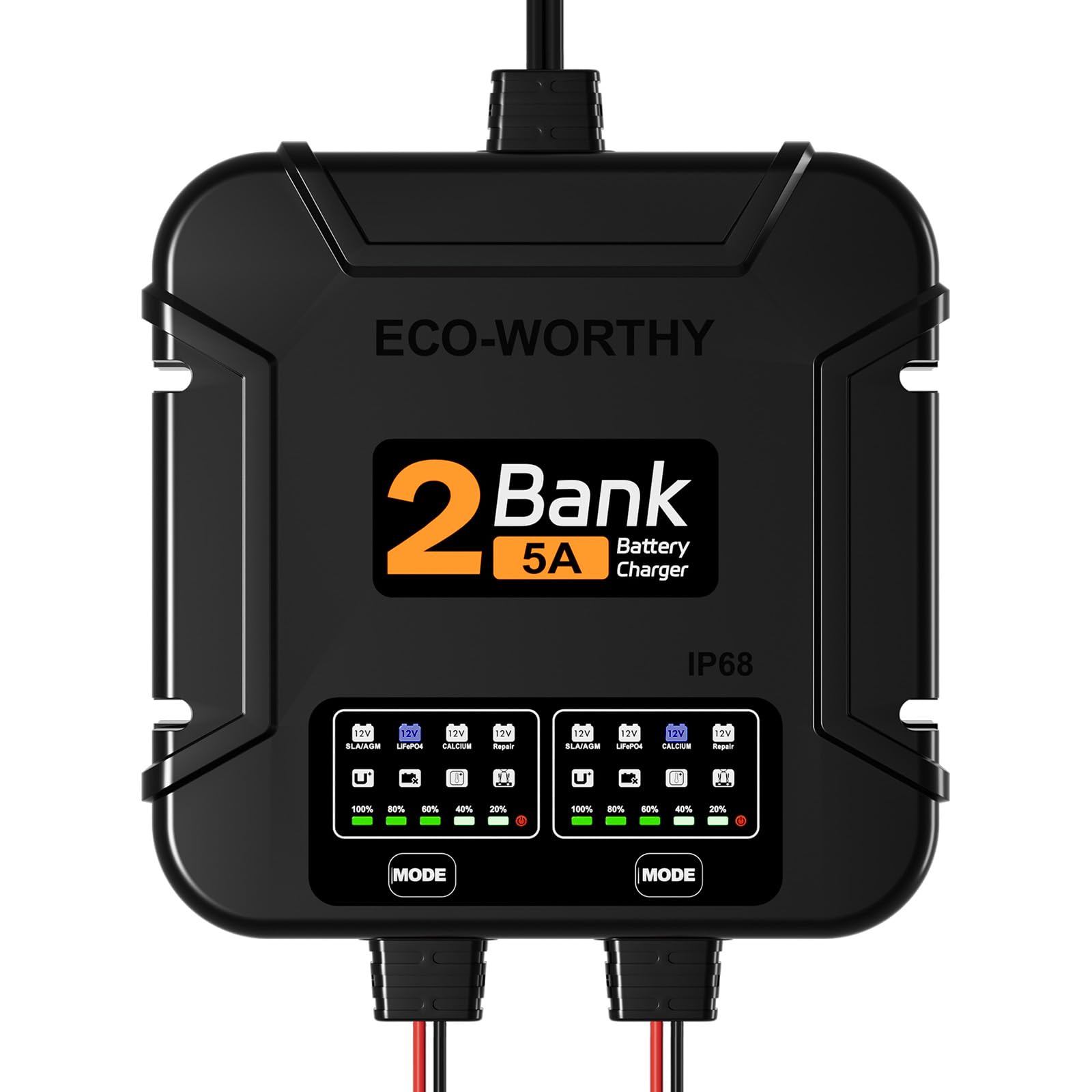
| ECO-Worthy 5X2Best Value | Wet, harsh environments | 10A (5A/Bank) | IP68 | Lead-Acid, LiFePO4, Calcium | Amazon |
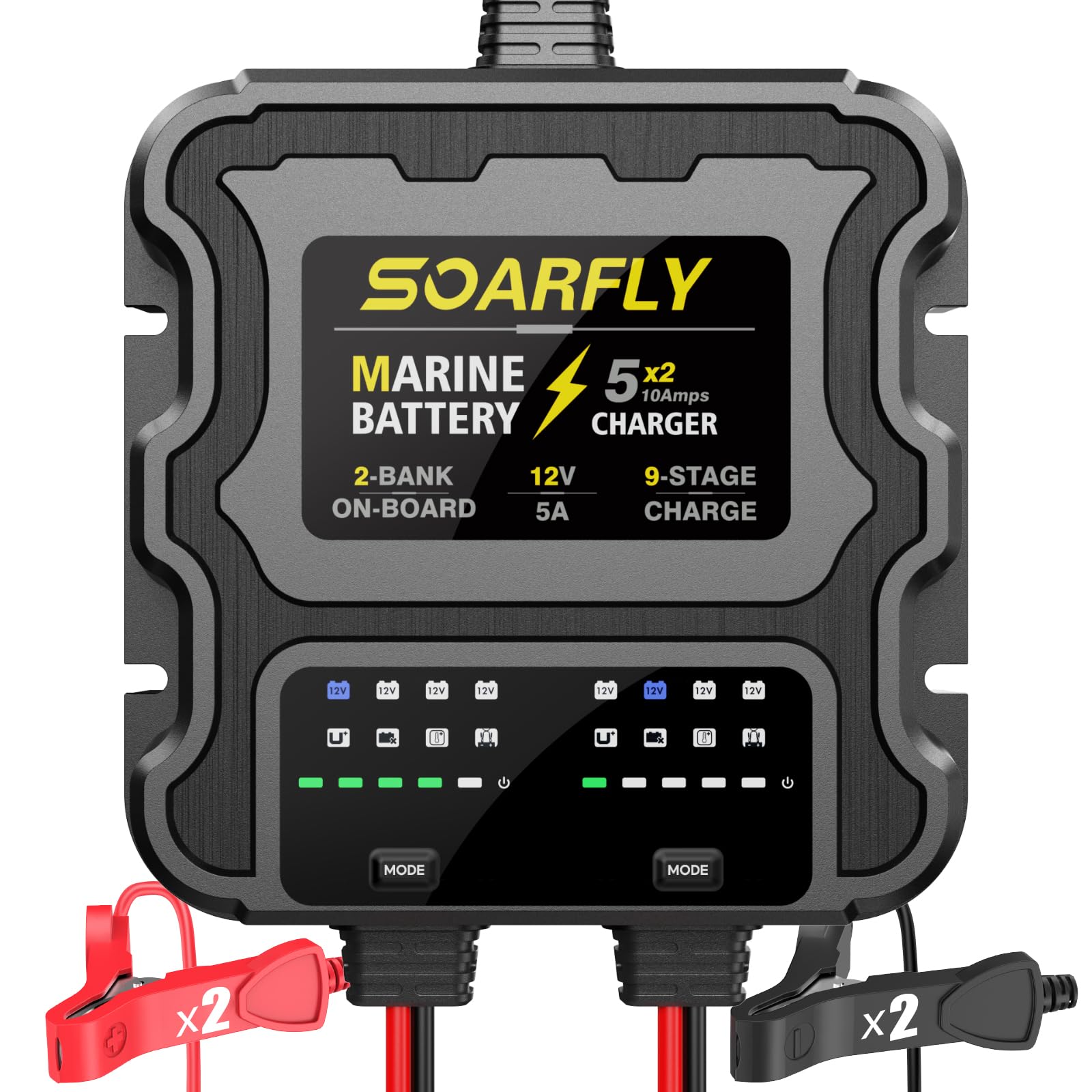
| SOARFLY ICM5BTop Performer | Twin LiFePO4 setups | 10A (5A/Bank) | IP68 | SLA/AGM, Lithium, Calcium | Amazon |
| FirstPower Pro ICM5A | Boats needing 24/7 charging | 10A (5A/Bank) | IP68 | Lead-Acid, Lithium, Calcium | Amazon |
| Guest 2707A | Simple flooded/AGM boats | 8A (4A/Bank) | IP67 | 12V Flooded & AGM | Amazon |
| NOCO GEN5X2 | Premium onboard installs | 10A (5A/Bank) | IP68 | Lead-Acid, LiFePO₄ | Amazon |
| Guest 2711A | Boaters wanting longevity | 10A (5A/Bank) | IP67 | Flooded & AGM | Amazon |
| ProMariner ProSport HD | Variable amp distribution | 12A | Waterproof | Flooded & AGM | Amazon |
In‑Depth Reviews
1. NOCO GENIUS2X2
Our pick — over 4.5★ from 4,500+ verified ratings; the strongest balance of quality and price.
The workshop workhorse that revives dead batteries and then babysits them all season.
This is the most versatile two-bank charger on the list because it handles 6-volt and 12-volt systems, which no other pick here can claim. It delivers 4A total (2A per bank) — the highest amperage in this lineup belongs to the Guest 2720A at 20A, but the GENIUS2X2 makes up for raw speed with recovery skills.
The headline feature is its ability to charge from as low as 1 volt, or use Force Mode to manually start on batteries down to zero volts. Pair that with precision pulse charging that detects and reverses sulfation, and you have a unit that rescues batteries others declare dead. An integrated thermal sensor keeps the charge safe in both a hot garage and a freezing winter, and buyers report it handles dissimilar batteries — lead-acid on one bank and lithium on the other — without complaint.
It comes with two 10-foot DC extension cables, which owners love for the reach, and a 3-year warranty. The cables are long and feel quality in the hand, as buyers put it. The catch is the 2A-per-bank output, so a fully drained large battery takes patience — a full charge is rated around 10 hours.
Why it wins
- Charges 6V and 12V batteries — class-leading flexibility
- Force Mode rescues batteries down to zero volts
- Temperature sensor prevents over/under charging in any climate
- Safe to leave connected indefinitely
Know before buying
- 2A per bank is slow for large deep-cycle banks
- No SAE connectors included
- Not fully sealed — keep it out of the bilge
Reach for it if: you want one smart charger for cars, boats, motorcycles, and lawn mowers that can also recover neglected batteries.
Look elsewhere if: you need a waterproof onboard unit for a wet bilge — this one is a bench charger, not a submersible one.
2. ECO-Worthy 2 Bank Marine Battery Charger
A fully sealed budget champ that brings real diagnostics to tight budgets.
You get the most features per dollar in the mid-range group with this charger. It delivers a full 10A total (5A per bank) and comes in an IP68-rated case (100% sealed against water, dust, and corrosion), matching the highest industry waterproof rating found on chargers that cost twice as much.
What wins people over is the three independent charging modes: SLA/AGM, Lithium, and Calcium. That means you can charge a lead-acid starter battery and a LiFePO4 house battery at the same time, each with its own tailored profile. A Force Mode revives lithium batteries below 1V by holding the MODE button for 5 seconds, and the “12v Repair” light signals automatic desulfation for aging lead-acid packs.
The advanced diagnostics system pairs with clear LED lights to flag over-voltage, over-temperature, overcurrent, short-circuits, and reverse polarity in real time. Owners mention it can handle two separate batteries at once and give a readout of the state of charge for each, which is rare at this tier. It also measures just 6.61″D x 6.3″W x 2.12″H, so it is roughly a third smaller than the NOCO GENIUS2X2’s footprint. The only real gripe is the manual, which reads like a translation issue, and tech support can be slow to respond.
Smart money move: the lowest-cost way to get IP68 waterproofing, 5A per bank, and independent chemistry modes — just budget time to decode the manual.
Buy it if: your charger will sit in a wet, exposed spot and you run mixed battery chemistries.
Think twice if: you want a polished instruction booklet and fast phone support — this one’s manual is its weak link.
3. SOARFLY 2 Bank Marine Battery Charger
The twin-lithium specialist that survived an overnight dunking and kept charging.
If you run LiFePO4 (lithium iron phosphate) battery banks, this is your pick. Customers note it charges and maintains like premium brands but at a lower price. It delivers 10A total (5A per bank) across two independent outputs, and the built-in 5-level power display — 20%, 40%, 60%, 80%, 100% — shows real-time progress for each battery, so you know exactly when the job is done.
The IP68 seal is the real deal here. One owner’s unit survived an overnight submersion in a flooded compartment and kept working flawlessly, which speaks to the rigorous submersion and pressure tests it passed. It also weighs 2.18 kg, so it has some heft, but that density is part of the waterproof build.
Three charging modes — 12V SLA/AGM, 12V Lithium, 12V Calcium — let you charge two different types at the same time. A Force Mode revives completely dead batteries below 1V with a 5-second button hold. The integrated temperature sensor adjusts output for hot and cold climates, and the smart diagnostics flag over-voltage, faulty batteries, over-temperature, and reverse polarity. One note: this is strictly for 12V systems, so do not connect it to a 24V or 36V bank.
What reviewers point out: it remembered its settings between sessions, so they never had to re-select their battery type, and it survived conditions that would kill lesser chargers.
Pick this for: a wet-bilge install with lithium batteries where you want a visible charge readout.
skip it if: you prefer ring terminals for a hardwired install — some units ship with alligator clips only.
4. FirstPower Pro 2 Bank Marine Battery Charger

The set-and-forget onboard unit built for 24/7 shore power duty.
If you keep your boat plugged in whenever it is at the dock, this is the charger engineered for that exact job. It is rated IP68 waterproof and fully sealed, so you can leave it connected to the batteries while the boat operates, and it handles 10A total (5A per bank) for dual 12V lead-acid or lithium banks.
What stands out is the memory feature: like the SOARFLY above, this unit remembers which charge mode each bank was set to, so it defaults to your selection the next time you plug in. Owners on pontoons with two tandem batteries appreciate that it arrives with both eye connectors and alligator clips, and it keeps batteries charged between seasons even in extreme heat or cold.
The 5-grid power display (20% through 100%) shows charge progress at a glance. Force Mode kicks in below 1V for dead batteries, and the auto repair mode desulfates aging lead-acid packs automatically. The integrated thermal sensor prevents over-charging in hot climates and under-charging in cold ones. It weighs 4.5 pounds and carries a 3-year warranty, and shoppers say the install is straightforward with the included screws and clips.
The trade-off: the display only shows battery life while plugged in — it does not read charge level when unplugged, which caught a few owners off guard.
Reach for it if: you want a weather-sealed charger you can bolt in once and forget until spring.
Pass if: you need to check battery status away from shore power — this display goes dark when unplugged.
5. Guest 2707A On-Board Battery Charger
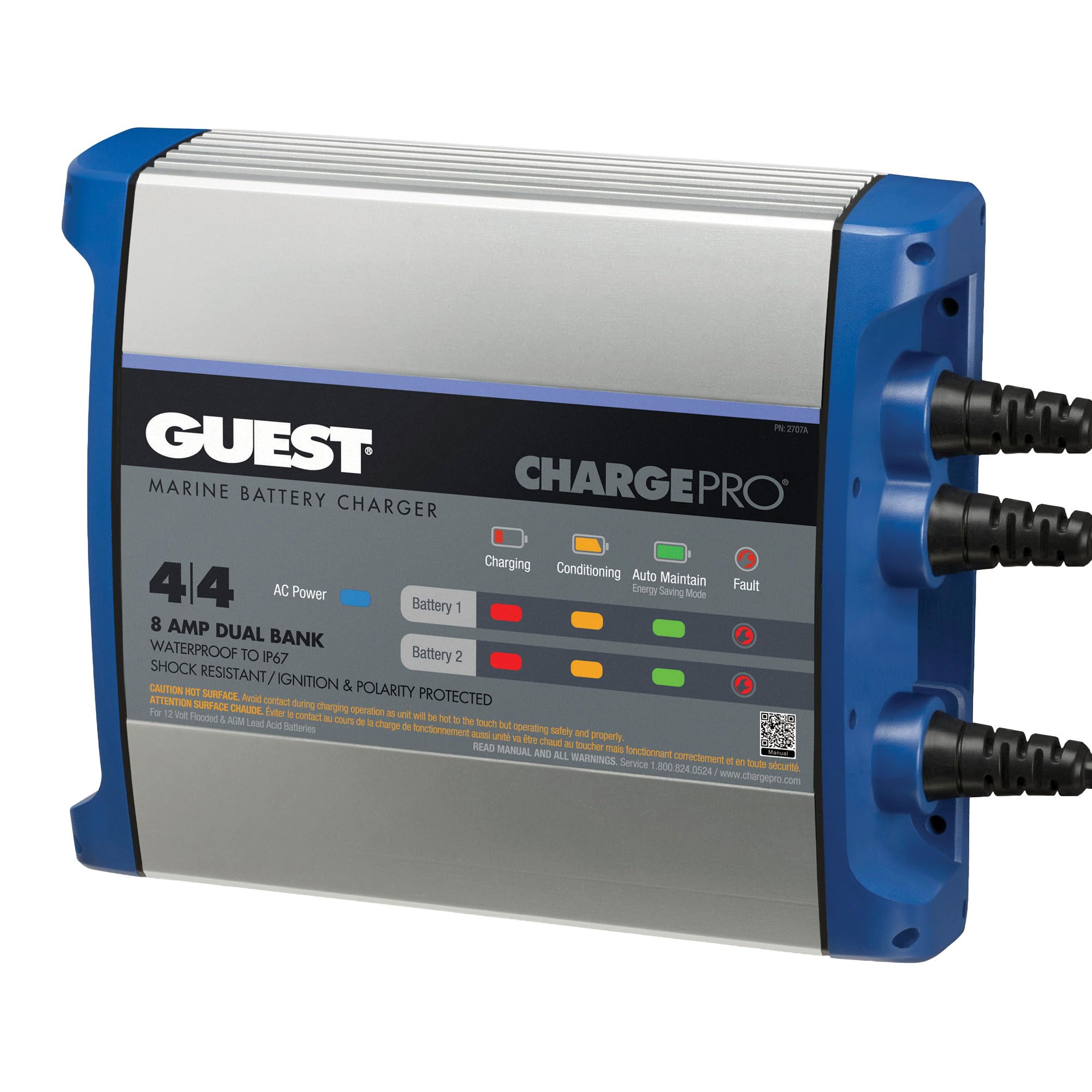
The simple, rugged dual-bank that outlasted the two brands it replaced.
This is the straightforward choice for boaters who run flooded or AGM lead-acid batteries and want zero fuss. It pushes 8A total (4A per bank) and is IP67 sealed for marine conditions, which covers most enclosed compartments. The rugged build includes shock-resistant housing and in-line fuse protection, so it is built to take a beating.
Where this unit wins is sheer reliability. It replaced both a Schumacher and a NOCO in one boat, and the owner found it charges both batteries with no problem — even catching a bad battery the NOCO only detected intermittently. Because it is a higher amp charger, both batteries now show a higher voltage after charging by a couple tenths of a volt.
Safety features are comprehensive: reverse polarity, over-current, over-voltage, over-temperature, and ignition protection. The LED lights are easy to read, and the installation is about as simple as it gets — buyers report it is a direct, clean swap. It is compatible with 12V flooded and AGM lead-acid batteries only, so lithium users need to look elsewhere.
Solid and simple: installation is the most-praised aspect of this charger, and the build quality keeps batteries in great shape season after season.
Best for: traditional lead-acid boaters who want a dependable, easy-to-read charger without paying for lithium features they will never use.
Not for: anyone running LiFePO4 or calcium batteries — this only handles flooded and AGM.
6. NOCO GEN5X2 OnBoard Marine Charger

The premium waterproof onboard unit that mounts upside down and shrugs off submersion.
This is what you buy when you want the most advanced onboard charger NOCO makes, engineered specifically for harshest marine environments. It is rated IP68 for waterproof protection and survived thousands of hours underwater in life-cycle testing, so a flooded bilge is no threat. It delivers 10A total (5A per bank) with selectable modes for each bank: 12V, 12V AGM, 12V Lithium, and 12V Repair.
The genius here is the mounting. The simplified system lets you install it in any orientation — even upside down — with an integrated anti-vibration backing to isolate shock and noise. That flexibility is a genuine lifesaver in cramped engine compartments where mounting space is tight.
It charges batteries from as low as 1 volt, or Force Mode revives them from zero volts. The integrated thermal sensor prevents over-charging in heat and under-charging in cold, and owners mention it can be left connected while the boat operates without overcharging. The 72-inch DC cables with 3/8-inch eyelets give plenty of reach. One honest caveat: the leads contain a temperature sensor, so do not cut the wire before the rubber boot — the charger will not work without it.
Why it is premium
- IP68 fully sealed, tested for thousands of hours underwater
- Mounts in any orientation, even upside down
- Independent modes for each bank including Repair Mode
- Anti-vibration backing isolates shock and noise
Handle with care
- Do not trim the DC leads — they carry a temp sensor
- Weighs 4.2 pounds, so plan your mounting surface
Choose it if: you want the toughest, most flexible onboard install with true waterproofing and per-battery modes.
Be careful: that temp sensor in the lead means you must measure lengths before cutting, not after.
7. Guest 2711A On-Board Battery Charger
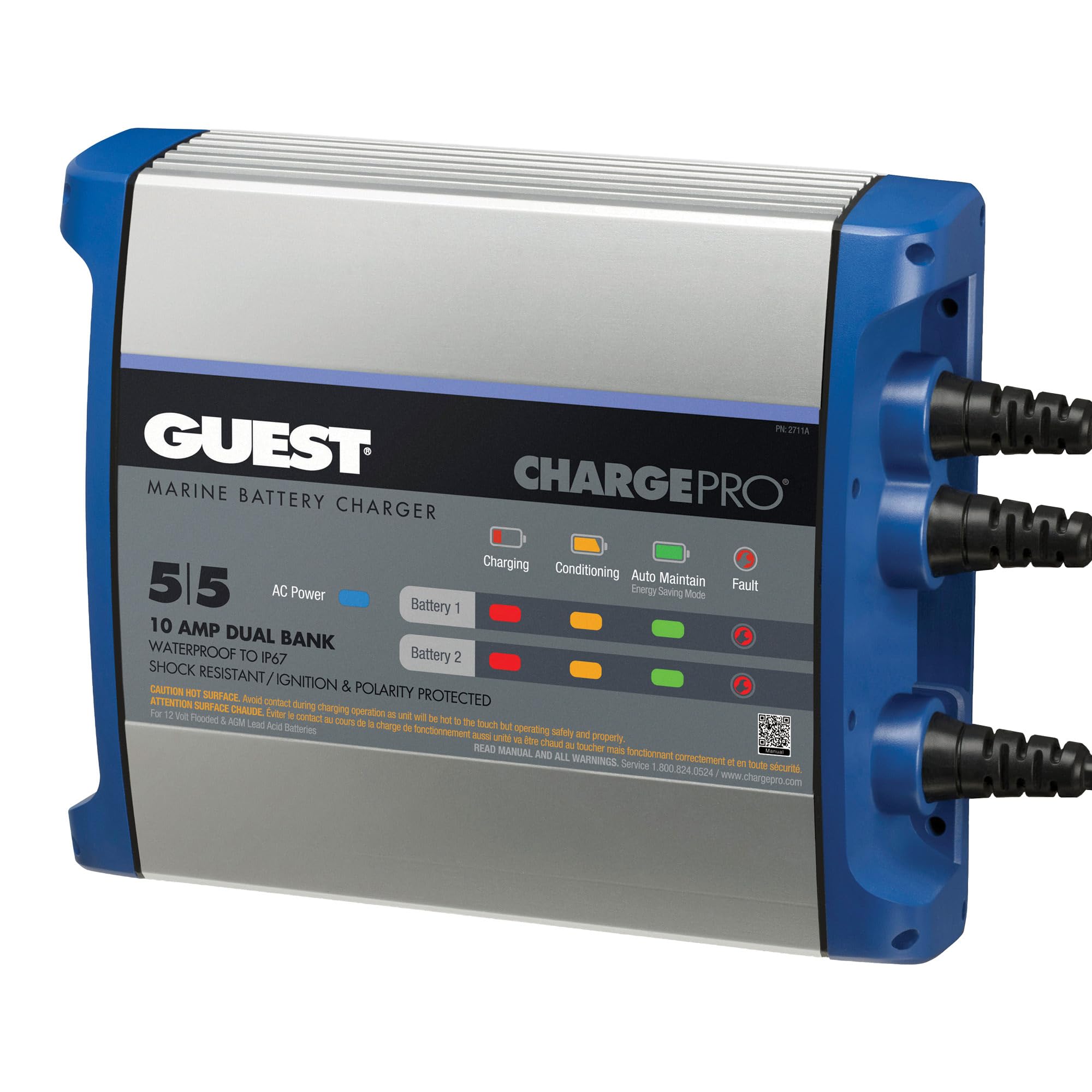
The upgrade that one owner says has already outlived two rival brands.
This 10A (5A per bank) charger suits boaters who prioritize longevity above all. It improves on Guest’s older models with smarter status lights — green means good, red means bad, flashing red means warning, and blue now indicates AC power only. One returning customer is on their third Guest dual-bank charger and reports a 9-year lifespan from earlier units.
It is built for dual lead-acid setups, and owners specifically chose it over NOCO due to overcharging and boiling reports. On a Malibu boat with dual lead-acid batteries, it has run 24/7 on shore power for two months with no damage — the auto-maintain mode keeps everything topped off without cooking. The install is straightforward, though one experienced owner recommends an aluminum backing plate with spacers for airflow.
It is IP67 sealed for marine conditions and connects to any 12V flooded or AGM bank. A 30-foot boat owner has it mounted under the back seat on a lift, connected to shore power, and reports it holds up to saltwater and rain in a sheltered spot. It weighs 4.7 pounds.
The longevity story: with multiple owners reporting years of trouble-free service and one tracking a 9-year lifespan, this is the charger for people who hate replacing things.
Get it if: you want a charger that will likely outlive your current boat and keeps lead-acid batteries at peak performance.
pass on it if: you run lithium — this unit is flooded and AGM only.
8. ProMariner ProSport HD 44012
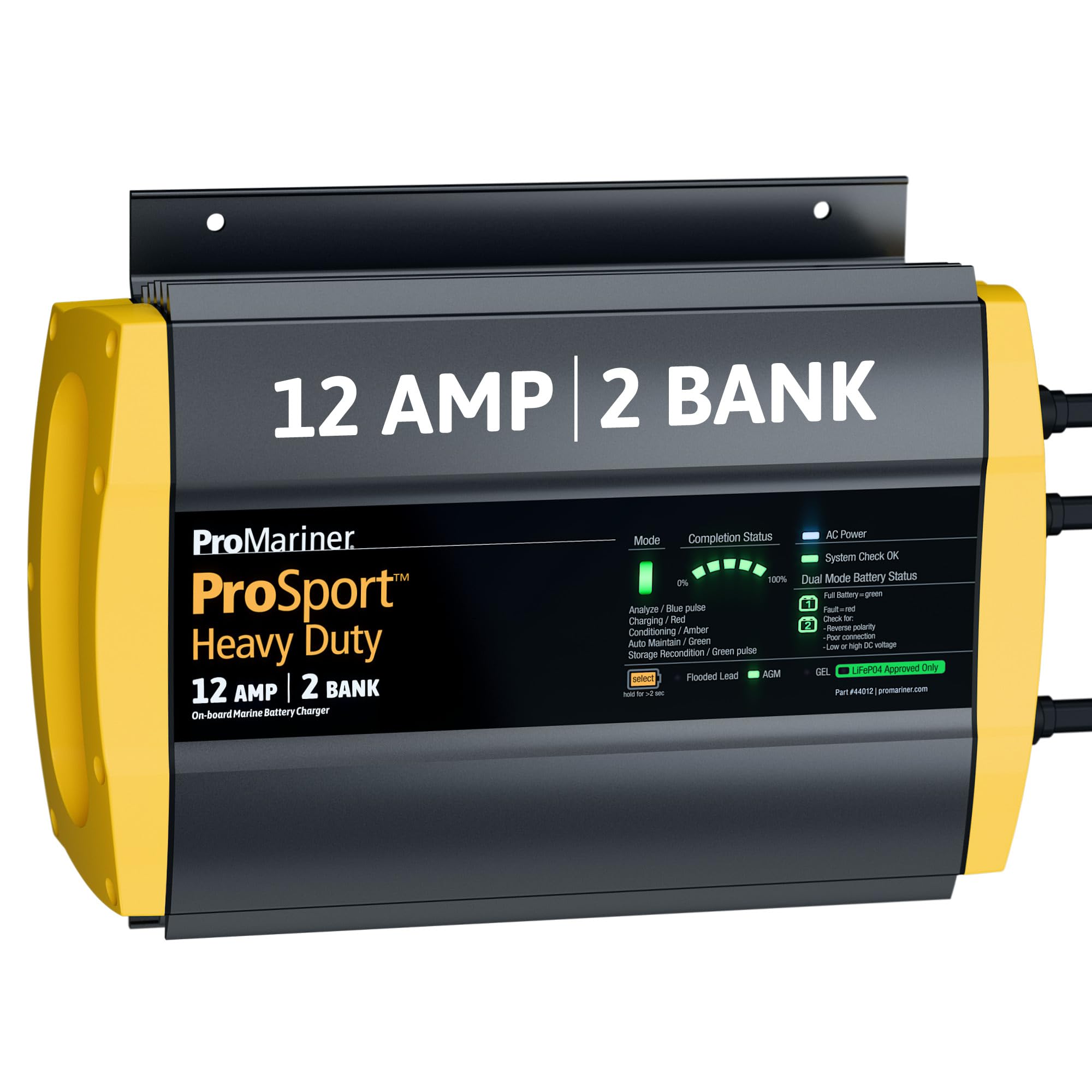
The intelligent 12A charger that sends every amp where it is needed most.
This is a different kind of smart. Instead of locking each bank to a fixed output, ProMariner’s Distributed-On-Demand Technology sends 100% of available amps to whichever battery needs them — one bank can receive the full 12A while the other idles. That makes it a fast top-off for a single drained battery, then it balances out as both approach full.
It is a 2-bank, 12A charger controlled by microprocessor software for fast, precise charging. The Heavy Duty Tri-Surface Extruded Heat Sink — cooling on the upper, lower, and rear faces — keeps it delivering true rated constant current during charge, so it does not throttle down when things get warm. The expanded LED display includes a fuel gauge-style completion status and a four-color multi-stage mode bar, plus individual battery status and battery type indication.
Reviewers point out easy installation, helped by a template for pilot holes and four quick screws. It is fully waterproof and replaces the older ProMariner Gen 3 ProSport 12. The honest note: some owners found the reliability a mixed bag over time, and it only supports flooded and AGM lead-acid chemistry.
Smart distribution: the ability to funnel all 12A into one bank when the other is full is a genuine time-saver that fixed-output chargers cannot match.
Choose it if: you want intelligent amp routing and a clear fuel-gauge display for your lead-acid banks.
Hesitate if: you run lithium batteries — it is flooded and AGM only, and long-term reliability gets mixed feedback.
Understanding the Specs
Amps Per Bank vs. Total Output
The total amperage is what the charger can push across both banks combined. A 10A total usually means 5A per bank. What matters for you is the per-bank number — that is how fast each individual battery refills. A big deep-cycle house bank will thank you for 10A per bank, while a small starter battery is fine with 2A. Think of it like filling two buckets: a wider hose fills each one faster.
IP Ratings Explained
The IP (Ingress Protection) rating tells you how sealed a charger is. The first digit covers dust, the second covers water. IP67 means fully dust-tight and protected against temporary immersion. IP68 is the top tier — fully sealed against dust and continuous submersion. For a charger bolted in an open bilge that can flood, IP68 is the safer bet; for a dry cabinet, IP67 is plenty.
Battery Chemistry Modes
Flooded lead-acid, AGM, gel, and lithium (LiFePO4) all charge at different voltages. A multi-mode charger lets you select the right profile per bank, and the best units let each bank use a different mode simultaneously. This protects against overcharging, which boils flooded batteries dry and damages lithium packs. If your boat mixes chemistries, independent per-bank modes are a must.
Maintainer, Desulfator, and Repair Modes
A maintainer keeps a full battery topped off indefinitely without overcharging, perfect for off-season storage. A desulfator uses precision pulse charging to reverse sulfation — the buildup that kills lead-acid batteries left discharged. Force Mode is the emergency feature: it manually starts charging a battery that reads below 1 volt, rescuing packs other chargers refuse to touch.
FAQ
What does a 2-bank charger actually do differently?
How many amps per bank do I need?
Can I leave a two-bank marine charger connected all winter?
What is the difference between IP67 and IP68?
Will these chargers work with lithium batteries?
Can I charge a 24V system with a 12V two-bank charger?
What is Force Mode and when would I use it?
Is a higher-amp charger always better?
Why does my charger need to know the temperature?
Can I mount a marine charger upside down?
Final Thoughts: The Verdict
The defender of winter batteries everywhere is the NOCO GENIUS2X2 because it combines 6V/12V flexibility, Force Mode recovery, and temperature compensation into one smart package. For a wet-bilge install with mixed chemistries, the ECO-Worthy delivers IP68 waterproofing at a budget-friendly price. And if you want the most powerful, Guest 2720A brings 20A and dual 12V/24V support to serious setups.
How We Picked
We do not accept paid placement. Every pick is matched to a real buyer and a real use-case; we do not hands-on test units.
Sources & Methodology
Specifications: manufacturer listings and product documentation. Review insights: verified customer reviews, as of August 2026. Pricing: not shown on this page (it changes often); check the current price via the retailer link.
As an Amazon Associate, GoCarLife earns from qualifying purchases. This does not affect which products we feature.