
Our readers keep the lights on and the garage heater humming. As an Amazon Associate, I earn from qualifying purchases.
Specs are compiled from manufacturer listings and verified buyer reviews and can change over time — please confirm the key details on the product page before buying.
When you need power for an RV, trolling motor, solar setup, or off-grid cabin, the first choice is simple: cheap and heavy lead-acid, or lighter, longer-lasting lithium-iron (LiFePO4). Lithium lets you use most of the rated capacity, while lead-acid realistically gives you about half before a recharge. A 100Ah unit can run a fridge, lights, and phones all weekend on a charge; a small 12Ah unit is strictly for backup alarms, kids’ ride-on toys, or a UPS.
I’m Mo Maruf — the founder and writer behind GoCarLife. This guide is built by comparing the manufacturers’ published specifications and the patterns across verified customer reviews, so you get each pick’s real strengths and trade-offs instead of marketing spin.
Your decision depends on weight, cycle life, and how much power you actually draw. This guide ranks the best twelve-volt battery options for marine, RV, and solar duty, breaking down the specs that matter.
Our Picks at a Glance


How To Choose The Best Twelve-Volt Battery
First, decide if you need to start an engine or run accessories for hours. A cranking battery delivers a huge burst for a few seconds to turn a motor over; a deep-cycle battery discharges slowly and recharges hundreds of times. Many marine and RV buyers want a dual-purpose unit that does both.
Capacity: Amp-Hours (Ah)
The single most important number is the amp-hour rating — think of it as the size of the fuel tank. A 100Ah battery can theoretically deliver 100 amps for one hour, or 10 amps for ten hours, before hitting empty. In practice, lead-acid batteries should only be drained to about 50% to protect their lifespan, so a 100Ah lead-acid gives you around 50 usable amp-hours. A lithium iron phosphate battery can safely go to 80–100% depth of discharge, which is why many RV owners switch.
Chemistry: Lead-Acid vs. LiFePO4
Within lead-acid, flooded needs regular water checks; AGM (Absorbent Glass Mat) is sealed, spill-proof, and maintenance-free. AGM handles vibration well and is the go-to for boats. Lithium iron phosphate (LiFePO4) is the premium upgrade: it weighs roughly one-third as much as a lead-acid of similar capacity, lasts thousands of cycles instead of a few hundred, and holds its voltage higher throughout the discharge, so your devices keep running at full strength longer.
Physical Size and Terminal Type
Batteries come in standard “group sizes” like Group 24, 31, and 4D, which correspond to specific physical dimensions. A replacement must fit the tray or box already in your boat, RV, or vehicle, so check the group size before buying. Terminal layout also matters — some batteries have posts on top, others have side or marine terminals designed for specific cable ends.
Quick Comparison
| Model | Best For | Capacity | Chemistry | Weight | Amazon |
|---|---|---|---|---|---|
| Litime 100Ah TM BT★ Best Overall | Trolling motors/RV with app monitoring | 100Ah | LiFePO4 | 22.2 lb | Amazon |
| Mighty Max ML12-12 2-PackBudget Workhorse | UPS, scooters, kids’ ride-ons | 12Ah | AGM | 18 lb (pair) | Amazon |
| WEIZE 100AhBest Value | Budget deep-cycle, solar backup | 100Ah | AGM | 63 lb | Amazon |
| Dumfume 150Ah Max | Large solar/RV storage on a budget | 150Ah | LiFePO4 | 41.03 lb | Amazon |
| Wattcycle 100Ah Group 24 | Compact Group 24 box replacement | 100Ah | LiFePO4 | 23.2 lb | Amazon |
| Rvpozwer 200Ah | High-capacity off-grid with handle | 200Ah | LiFePO4 | 45.1 lb | Amazon |
| Redodo 100Ah Group 31 | Marine/RV deep-cycle, mower conversion | 100Ah | LiFePO4 | 22 lb | Amazon |
| Interstate 31M AGM | Dual-purpose cranking + deep cycle | 100Ah | AGM | 64.5 lb | Amazon |
| Litime 230Ah Plus | Large travel trailers, long off-grid stays | 230Ah | LiFePO4 | 45.98 lb | Amazon |
In‑Depth Reviews
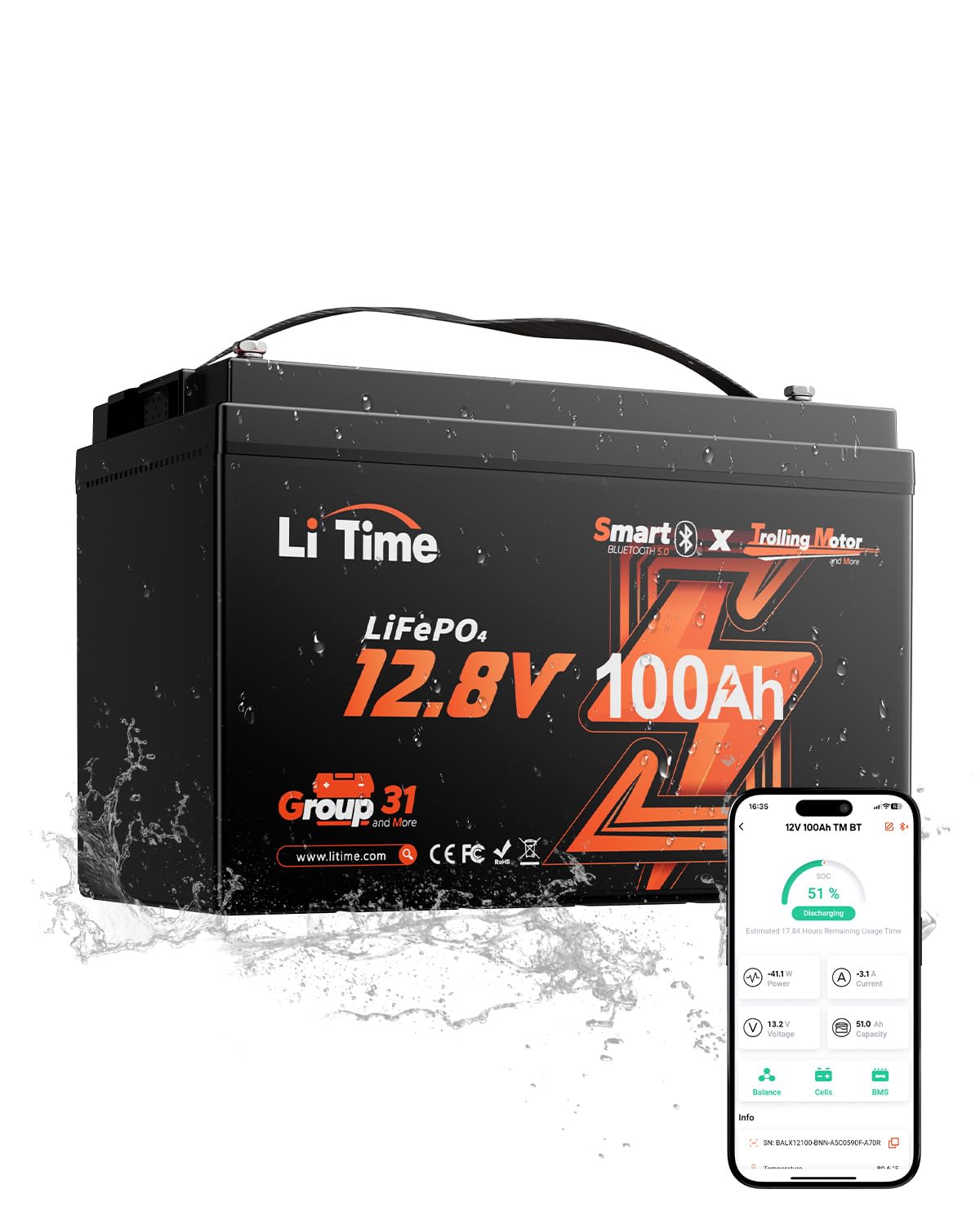
1. Litime 12V 100Ah Trolling Motor LiFePO4 Battery
Our pick — over 4.5★ from 600+ verified ratings; the strongest balance of quality and price.
The featherweight that phones home, telling you its state of charge while you fish.
This is the battery that answers the two biggest lithium complaints at once: it is genuinely light and it tells you what it is doing. At 22.2 pounds, it replaces a lead-acid unit that could weigh three times as much, and the built-in Bluetooth lets you check voltage, run system checks, and even control discharge from your phone. Buyers report it runs a Minn Kota trolling motor all day with trolling and SpotLock on a 16.5′ SmokerCraft deep-v side console fishing boat.
The specs back up the hype. It packs 1280Wh of energy in a standard Group 31 size, with a 100A BMS (Battery Management System, the internal computer that guards against overcharge, over-discharge, and shorts). That BMS also enables smart low-temp protection — it stops charging below 32°F and stops discharging below -4°F, so freezing weather won’t ruin the cells. An IP65 rating means it is dust-tight and can handle water splashes, making it a safe choice for a boat deck.
The genius of this pick is its safety net. It carries 20+ safety protections, including overheat and short-circuit cutoffs, and it is covered by AIG Product Liability Insurance. The 5-year warranty adds confidence for a purchase this size. The only real adjustment: you need a lithium-compatible charger or MPPT solar controller to wake the Bluetooth on first use.
Why Owners Love It
- Weight savings are dramatic — dropping 60 pounds of tongue weight on a trailer is the most-cited win.
- Fishing trips stretch to days, with reports of two full days on the water without a recharge.
- The app makes monitoring simple, showing cell balance and state of charge at a glance.
The Trade-Off
- The app requires frequent sign-in, which some find annoying mid-trip.
- It is strictly an energy-storage battery — not for starting engines, golf carts, or jacks.
Reach for this if: you run a trolling motor or small RV and want a battery that is both lighter and smarter than the lead-acid it replaces.
Look elsewhere if: you need a starter battery — this one is built for deep-cycle running, not cranking an engine.
2. Mighty Max Battery ML12-12 12V 12AH F2 SLA AGM (2-Pack)
The little sealed cell that keeps toys rolling and backup sumps bridged for years.
This is the opposite end of the spectrum from the 100Ah giants — a compact 12Ah sealed lead-acid battery that shines in small, steady roles. At just 18 pounds for a pair, these two units are perfect for kids’ power wheels, mobility scooters, alarm systems, and UPS backups. The secret to their popularity is the sealed AGM (Absorbent Glass Mat) construction, which means they are spill-proof, can be mounted in any position, and resist the shocks and vibration that kill flooded batteries.
Owners mention the easy installation and perfect fit make them a favorite for DIY replacements. The dimensions are a standard 5.94 x 3.86 x 3.98 inches with an F2 terminal, so they drop into most existing trays without modification. A full one-year warranty backs the purchase, and the UL certification (an independent safety standard) adds reassurance for use in sensitive gear.
The real-world proof of longevity is the anecdote from owners using them in sump pump UPS systems: “My last set lasted five years without any issues,” as customers note. For a budget-priced battery, that kind of service life is exceptional. The trade-off is simple — this is not a high-capacity unit; it is a utility player built for reliability in a specific, small footprint.
Where It Shines
- Sealed and maintenance-free, with a high discharge rate for its size.
- Deep-discharge recoverable, meaning it bounces back even after heavy use.
- The two-pack pricing makes it a smart value for multi-device households.
Keep In Mind
- 12 amp-hours is tiny — it is for backup duty, not powering a fridge.
- No wire harness or mounting accessories included; you supply the cables.
Grab it for: small, steady jobs — ride-on toys, UPS systems, and scooter replacements where a sealed, dependable cell is the priority.
skip it if: you need to run appliances or a trolling motor; the 12Ah rating is a fraction of what those demand.
3. WEIZE 12V 100Ah Deep Cycle Battery, Group Size 31
The lead-acid legend that keeps a 2000-watt inverter fed with power to spare.
If you want the full 100Ah experience without paying the lithium premium, this AGM (Absorbent Glass Mat) battery is the way in. It delivers a massive 1000+ amp-hours of cranking ability in a sealed, spill-proof design that requires zero maintenance — no checking fluid levels, no topping off. This is the battery that outshines flooded lead-acid for commercial use, from schools and healthcare facilities to property management, where employees simply won’t perform regular upkeep.
The performance evidence is strong. Reviewers point out running a 2000-watt inverter with power to spare, and one owner kept equipment running all night on a single charge. The specs confirm why: it delivers up to 1150A of maximum discharge current, so it can handle serious loads. A self-discharge rate of just 3% means it holds its charge for months in storage, making it ideal for seasonal equipment like generators and lawn & garden tools.
Weighing in at 63 pounds, this is a heavy unit — but that heft is the honest trade-off for the budget price. It fits the same footprint as a standard Group 31 battery (12.99 x 6.73 x 8.43 inches), so it drops into most RV and solar racks. For off-grid users, the ability to run in parallel means you can stack multiple units to reach 4.8kWh of backup power, as some owners have done with four batteries and a 2000W inverter.
The Strong Points
- True 100Ah capacity at a budget-friendly price point.
- Sealed AGM is maintenance-free and vibration-resistant.
- Outperforms flooded lead-acid alternatives with better value.
The Honest Trade-Off
- At 63 pounds, it demands a strong back and a sturdy mount.
- Lead-acid chemistry means you only get about half the rated capacity before recharge is wise.
Choose this if: you want maximum amp-hours for the dollar and a stationary setup where weight is not a concern.
Think twice if: you are outfitting a boat or camper where every pound counts — the lithium options above will save you significant weight.
4. Dumfume 12V 150Ah Max LiFePO4 Battery
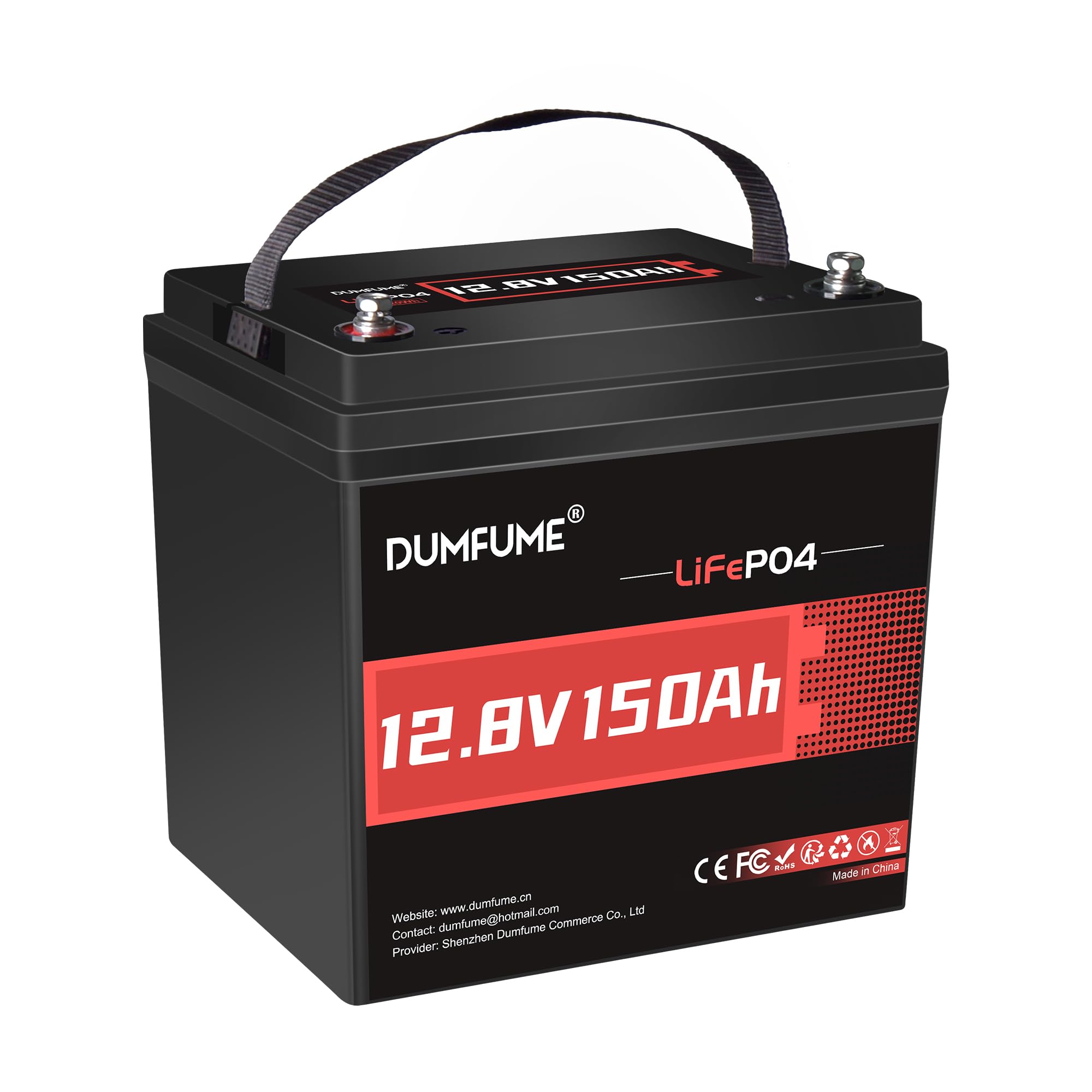
A 150-amp-hour lithium bank that is 20 pounds lighter than an equivalent lead-acid.
This battery answers the question “what if 100Ah is not enough?” with a tidy 150Ah package. It holds 1920Wh of energy — enough to run an RV fridge, lights, and electronics for a weekend — while weighing just 41.03 pounds. That is dramatically lighter than a comparable lead-acid setup, and the compact footprint (10.04 x 7.68 x 9.84 inches) fits into tight cabinet spaces where a bigger bank would never go.
The built-in 100A BMS (Battery Management System) is the safety brain, protecting against overcharge, over-discharge, short circuit, and overheating. The chemistry is lithium-iron phosphate (LiFePO4), known for its long cycle life — this one is rated for over 4,000 cycles to 80% capacity, which translates to years of daily use. Owners running small home solar projects report straightforward installation, with terminals that are easy to connect to.
Size and weight are the headline here, but the expansion options are just as impressive. You can connect up to 4 in series or 4 in parallel (4S4P), scaling to custom voltage or capacity for off-grid systems. The 5-year warranty backs the investment, though the battery needs a full maintenance cycle every 6 months if stored long-term.
What Wins Buyers Over
- Substantial 1920Wh capacity in a chassis that weighs only 41.03 pounds.
- Easy expansion via series or parallel connections up to 4S4P.
- Positive owner reports on performance and value for money.
Know Before You Buy
- Requires temperatures of 5°C or higher to perform as rated.
- It is for energy storage, not engine starting; needs a lithium-compatible charger.
Ideal for: solar power storage and larger RV builds where you need extra runtime without doubling the weight of your bank.
Reconsider if: you plan to store it in freezing winter temperatures — low-temp charging is not covered on return shipping.
5. Wattcycle 12V 100Ah LiFePO4 Battery, BCI Group 24
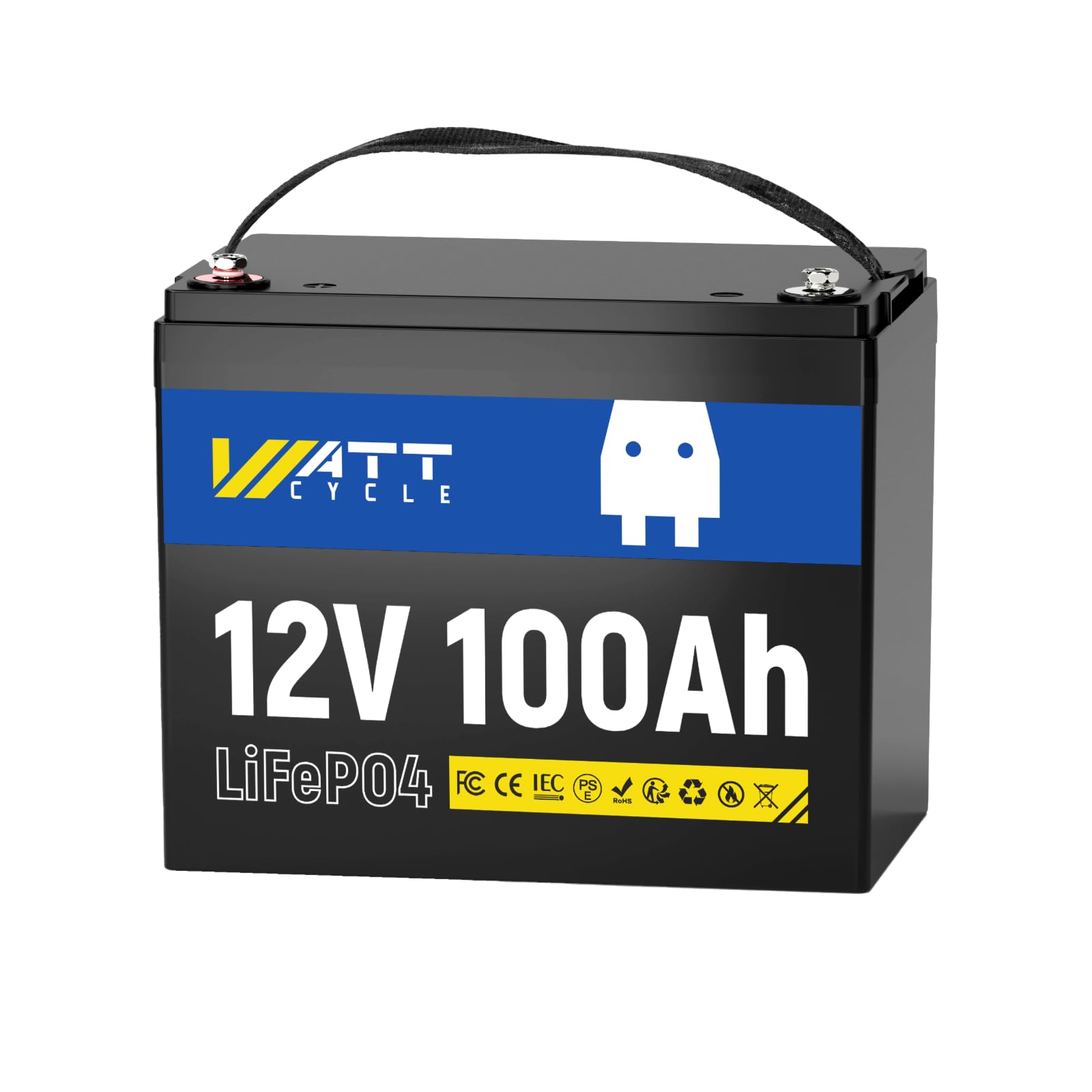
The compact lithium cell that slides into a Group 24 box and trims transom weight.
If your boat or RV has a smaller Group 24 battery box, this is the lithium upgrade that fits. It measures just 10.2 x 6.6 x 8.2 inches — small enough for a standard Group 24 tray — and weighs only 23.2 pounds. That compact size translates directly to real-world benefits: shoppers say reduced weight near the transom, which improves how a boat sits in the water and how it handles.
Under the hood, it is a proper 100Ah LiFePO4 (lithium iron phosphate) with a standard voltage of 12.8V and an impressive 15,000 cycle rating. The built-in 100A BMS (Battery Management System) automatically disconnects if the discharge current exceeds 300±50A, protecting your investment from accidental overloads. It is certified to SDS/UN38.3/FCC/CE/ROHS standards — a batch of safety and quality marks that buyers cite when praising its build quality.
For trolling motor users, this one pulls double duty: the compact footprint fits under a seat or in a bow box, and the low weight makes a single-person install genuinely manageable. A and the performance record holds up — one owner verified the full 100Ah rating by charging from 50% and measuring ~47Ah recovered in under four hours. You can connect up to 4 in series or 4 packs in parallel for a 20.48kWh system if your needs grow.
Strongest Assets
- Palm-sized 10.2-inch length fits tight Group 24 compartments.
- High 15,000-cycle rating with A+ grade cells inside.
- Owners confirm the full 100Ah capacity in real charging tests.
Minor Gripe
- The included M8 bolts are short; a parallel setup may need longer replacements.
- No Bluetooth monitoring built in — you add your own if you want it.
Perfect for: boats and RVs with a Group 24 box where every inch and pound matter.
Look past it if: you need app-based monitoring or a physically larger Group 31 drop-in.
6. Rvpozwer 12V 200Ah LiFePO4 Lithium Battery

Double the runtime of a 100Ah bank, with a handle built for hauling.
When one battery needs to do the work of two, the 200Ah rating is the shortcut. This Rvpozwer unit packs 2560Wh of energy — enough to run a residential fridge, furnace, and lights for days off-grid. The 200A Smart BMS (Battery Management System) is the heavy-duty internal guard, protecting against overcharge, over-discharge, over-current, and short circuits. Buyers running a 3000W inverter report it holds up well under load, and the ergonomic nylon handle makes the 45.1-pound unit genuinely carryable.
This is built for expansion, not just single-battery use. Connect up to 4 in series for a 51.2V system, or in parallel to reach 800Ah — a setup that can power an entire off-grid cabin. The Group 31 footprint means it fits standard RV trays, and the operating range of -20°C to 65°C covers most climates without issue. The 15-year lifespan claim and 5-year warranty reflect the maker’s confidence in the Grade-A LiFePO4 cells.
The real-world verdict is mostly positive — owners praise easy installation and the lightweight design versus lead-acid. For trolling motor users, the 200Ah rating means days on the water without a recharge worry. The honest caveat is that a unit this size needs a proper lithium-compatible charger and a sturdy connection setup to deliver its full potential; some buyers report needing to match the charging profile carefully on first setup.
The Upside
- Massive 2560Wh of usable energy in a single Group 31 box.
- Ergonomic handle makes the 45.1-pound unit easier to move than rivals.
- Owners mention it holds charge well and powers serious inverter loads.
The Caveat
- Battery life and reliability get mixed feedback — this is the biggest variable in the lineup.
- A few units arrived needing a full wake-up charge on arrival.
Reach for this if: you are building a serious off-grid bank and want maximum amp-hours per battery.
Proceed with care if: you are not comfortable working with high-capacity lithium charging profiles — this one rewards careful setup.
7. Redodo 12V 100Ah LiFePO4 Battery, Group 31
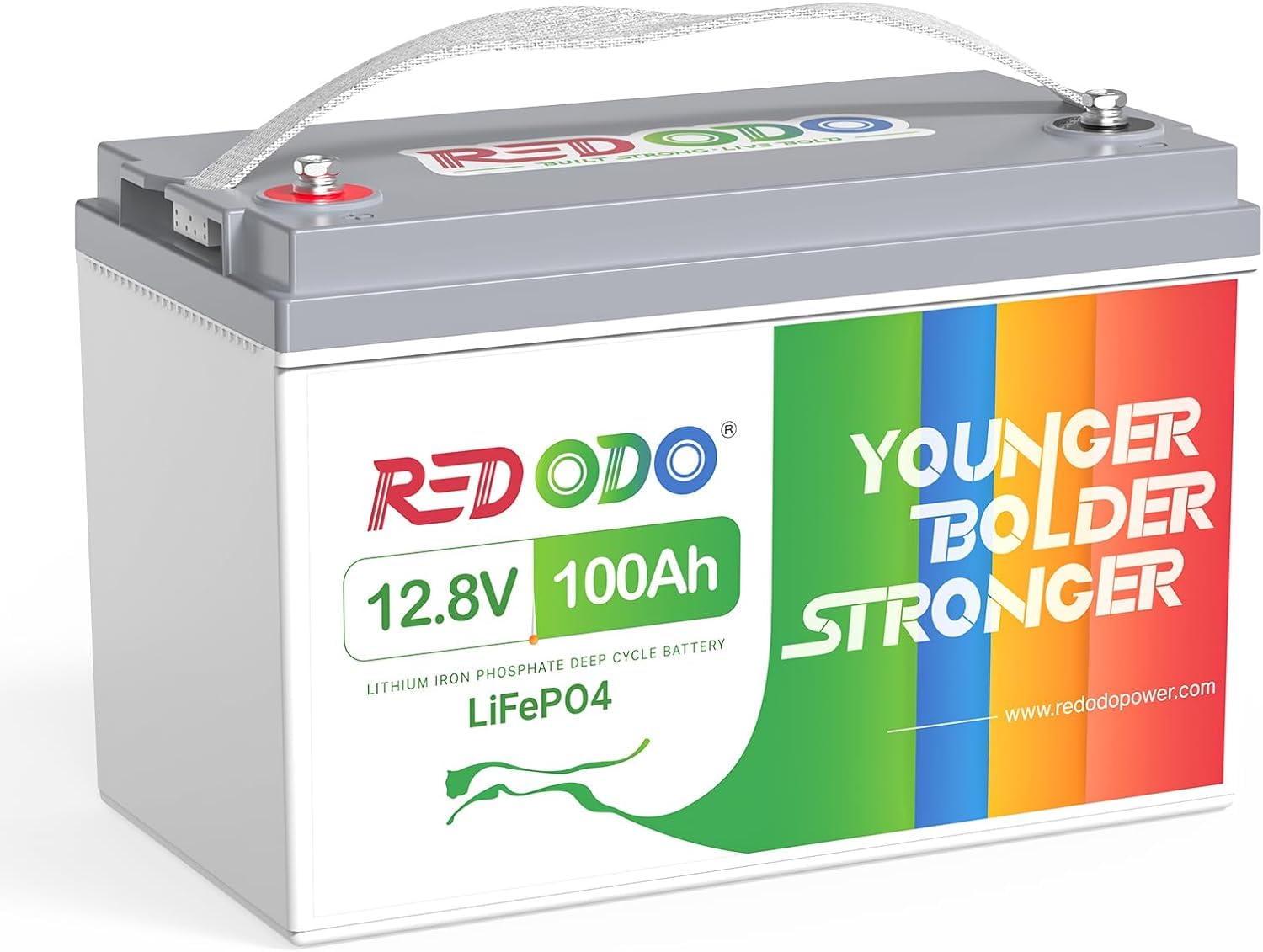
The Group 31 drop-in that outlasts lead-acid by years and sheds over 40 pounds.
For those who want a true Group 31 replacement, this Redodo unit is a compelling case. It fits the standard Group 31 box at 12.99 x 6.82 x 8.46 inches and weighs just 22 pounds — a weight that is 60% lighter than the 63.89-pound lead-acid alternative it typically replaces. That weight reduction shows up in real use: one owner reported a 100-pound overall reduction in their setup after switching, and another converted an electric mower from a 20-minute runtime to a full lawn plus a second mow.
The performance is built on Automotive Grade LiFePO4 cells with a 100A BMS (Battery Management System). It delivers 4000 deep cycles at 100% depth of discharge, expanding to 15,000 cycles at 60% DOD — numbers that dwarf the 200-500 cycles typical of lead-acid. The self-discharge rate is just 3%, compared to 15-30% for lead-acid, meaning it holds a charge for months between uses. The 10-year lifetime is the headline promise, and owners running it for 3-4 years in boats confirm it holds up with strong support behind it.
This is a versatile unit that fits more than RVs. It works with trolling motors up to 70 pounds of thrust, powers solar setups, and even breathes new life into electric lawn equipment. An IP65 waterproof rating and the ability to run in 4S or 4P configurations for up to a 400Ah or 51.2V system round out a flexible package.
Why It Stands Out
- 60% lighter than equivalent lead-acid at the same 100Ah capacity.
- Low 3% self-discharge rate keeps it ready after months in storage.
- Support is a standout — customers note fast, no-hassle warranty replacements.
The Catch
- Not suitable for starter batteries or golf carts — it is a deep-cycle energy cell.
- Some solar controllers need manual configuration for LiFePO4 profiles.
Choose this for: a direct Group 31 swap where you want proven longevity and real weight savings without changing your battery box.
pass on it if: you need Bluetooth monitoring or a battery small enough for a Group 24 compartment.
8. Interstate Batteries Marine/RV 12V 100Ah 825CCA Group 31M AGM

The rare dual-purpose cell that cranks your motor and still powers your trolling setup.
Most lithium batteries in this guide are strictly for running accessories, but this Interstate is built to do both. As a dual-purpose AGM (Absorbent Glass Mat) battery, it can start your boat’s engine with an 825 CCA (cold cranking amps — the measure of starting power in cold weather) and then supply steady deep-cycle power to your trolling motor, lights, and electronics. The marine terminal design is built for boat cable connections, and the 64.5-pound weight reflects the sturdy thick plates inside.
The “pure, non-alloy lead” construction is the engineering highlight. Interstate claims this delivers 2x longer service life than conventional alloy AGM batteries and 3x that of a flooded battery, with faster recharging. Buyers confirm the strength — one owner tested their unit and found it rated at 825 CCA but testing healthy at over 950 CCA after a full charge. The 2-year manufacturer warranty adds a layer of security for a premium purchase.
This is also a practical choice for non-marine heavy duty. Owners have used it in sump pump backup systems, running a 3/4 HP unit reliably, and in RV house banks. The Group 31M size fits standard heavy-duty trays, and the AGM chemistry means zero maintenance — no water to check, no gassing to vent. For someone who wants one battery to serve both cranking and house duties, this is the answer where lithium cannot go.
The Big Wins
- 825 CCA cranking power plus deep-cycle endurance in one unit.
- Pure lead construction that outlives standard alloy AGM batteries.
- Reviewers point out healthy performance — even exceeding the rated CCA.
Weigh The Cost
- At 64.5 pounds, it is nearly three times heavier than a lithium equivalent.
- The premium price is justified by dual-purpose capability, not raw amp-hours.
Pick this if: you have a boat or RV needing one battery to start an engine and run accessories.
Look to lithium if: you never crank an engine and want maximum weight savings for deep-cycle duty only.
9. Litime 12V 230Ah Deep Cycle LiFePO4 Battery, Group 4D
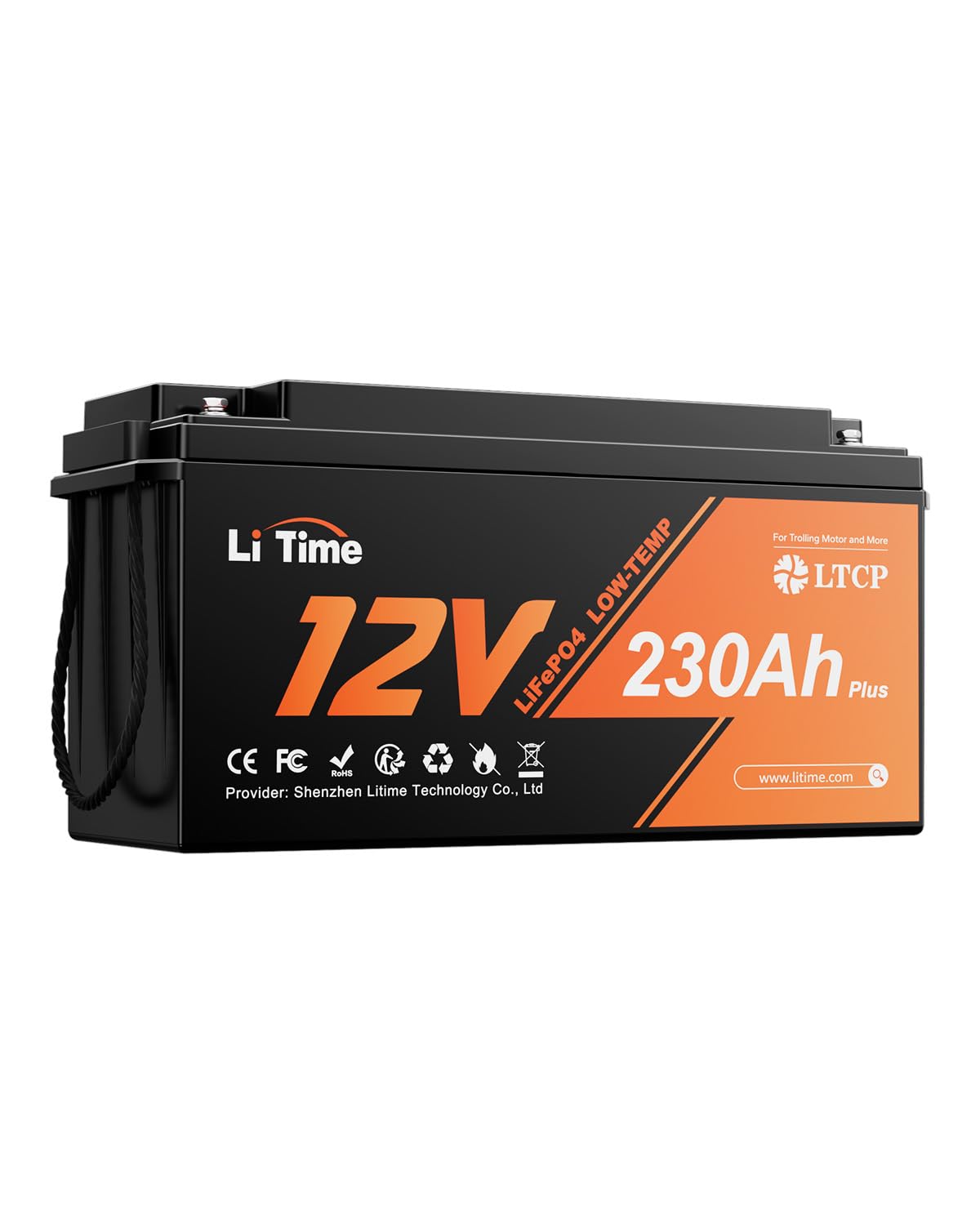
A 230-amp-hour behemoth that weighs one-third of the lead-acid it replaces.
This is the battery for travel trailers that demand serious off-grid endurance. The 230Ah rating delivers 2944Wh of energy — enough to run a fridge for 6-7 months of the year, as one owner put it — while fitting into a standard Group 4D box. At 45.98 pounds, it is roughly one-third the weight of the lead-acid battery it replaces, making it a realistic upgrade for a single person to handle during installation.
The 200A BMS (Battery Management System) is the most sturdy in this lineup, offering 20+ safety safeguards including low-temperature protection that pauses charging below 32°F (0°C) to protect the cells. It delivers 4,000+ cycles at 100% depth of discharge, which the maker contrasts with AGM’s typical 200-500 cycles and 3-year lifespan. The expansion path is extraordinary: connect up to 16 batteries (4P4S) for a 48V 920Ah system with 47.1kWh of max output, capable of backing an entire home.
Owners praise the compact size for the capacity and the easy-to-use phone app that tracks charge and discharge rates. The 5-year service support with 24/7 online assistance is a practical safety net for a purchase this size. The one conversion note: if you are replacing lead-acid in an existing RV, you may need a charger upgrade, as the battery draws high current during charging that some stock converters cannot control.
Why It Wins Big
- Industry-leading 2944Wh capacity in a Group 4D footprint.
- One-third the weight of the lead-acid it replaces.
- sturdy 200A BMS with 20+ protective functions.
Plan Ahead
- Existing RV converters may need an upgrade to handle lithium charging properly.
- The app, while useful, can be finicky and occasionally requires reconnection.
Best for: large travel trailers and off-grid setups where you want true multi-week autonomy.
Think ahead if: your current charger cannot manage high-current lithium charging — budget for a compatible upgrade.
Understanding the Specs
Amp-Hours (Ah) vs. Cold Cranking Amps (CCA)
Amp-hours measure the fuel tank — how long the battery can deliver a steady current. A 100Ah battery gives 100 amps for one hour or 10 amps for ten hours. Cold cranking amps measure the burst of power to start an engine in cold weather. A deep-cycle battery emphasizes the former; a cranking battery emphasizes the latter; a dual-purpose battery like the Interstate does both.
Usable Capacity: The Lithium Advantage
A sealed lead-acid battery should only be discharged to about 50% to protect its lifespan, so a 100Ah lead-acid gives you roughly 50 usable amp-hours before recharging is wise. A LiFePO4 (lithium iron phosphate) battery can safely go to 80-100% depth of discharge, delivering nearly double the usable energy from the same rated capacity. This is the core reason RVs and boats are switching.
FAQ
Can I replace my lead-acid RV battery with a LiFePO4 battery directly?
How long does a 100Ah 12-volt battery actually run a fridge?
What size battery do I need for a trolling motor?
What is the difference between AGM and flooded lead-acid batteries?
Can I connect two 12-volt batteries together for more power?
How often should I charge a 12-volt battery in storage?
What does the BMS do in a lithium battery?
Why is the lithium battery so much lighter than lead-acid?
Can a 12-volt battery power a house during an outage?
Final Thoughts: The Verdict
For most buyers, the twelve-volt battery winner is the Litime 100Ah because it pairs the weight savings of lithium with the convenience of Bluetooth monitoring at a competitive price. If you want the ultimate budget lead-acid value, grab the WEIZE 100Ah. And for a dual-purpose battery that can crank an engine and run accessories, the Interstate 31M is the one to reach for.
How We Picked
We do not accept paid placement. Every pick is matched to a real buyer and a real use-case; we do not hands-on test units.
Sources & Methodology
Specifications: manufacturer listings and product documentation. Review insights: verified customer reviews, as of August 2026. Pricing: not shown on this page (it changes often); check the current price via the retailer link.
As an Amazon Associate, GoCarLife earns from qualifying purchases. This does not affect which products we feature.