
Our readers keep the lights on and the garage heater humming. As an Amazon Associate, I earn from qualifying purchases.
Specs are compiled from manufacturer listings and verified buyer reviews and can change over time — please confirm the key details on the product page before buying.
Finding a subwoofer amplifier that delivers real bass without cooking itself mid-drive or draining your battery is the trickiest part of any car audio build. You need raw power, sure, but you also need an amp that can sustain it, stay cool, and integrate cleanly with your car’s electrical system.
I’m Mo Maruf — the founder and writer behind GoCarLife. This guide is built by comparing the manufacturers’ published specifications and the patterns across verified customer reviews, so you get each pick’s real strengths and trade-offs instead of marketing spin.
Below you will find a focused shortlist of the best woofer amplifier for a car options that balance honest power output, stable impedance handling, and proven reliability for daily driving.
Our Picks at a Glance


How To Choose The Best Woofer Amplifier for a Car
Choosing a mono amplifier for your subwoofer boils down to three things: matching the power, checking the impedance, and fitting the space. You do not need a degree in electrical engineering to get this right.
RMS Power is the Truth
A woofer amplifier’s RMS (continuous) power rating tells you how much clean output it can sustain, not just a brief peak. Your subwoofer’s RMS rating and the amp’s RMS rating should pair up closely — aim for the amp to deliver roughly as much RMS as your sub can handle, or slightly less if you want to play it safe.
Impedance and Wiring Options
Every subwoofer has an impedance, measured in ohms (typically 1, 2, or 4). A mono amp that is “1-ohm stable” can handle the lowest load, which gives you the most power from a single channel. If you plan to run multiple subwoofers, a 1-ohm stable amp gives you the wiring flexibility to connect them all without losing power.
Class D Efficiency
Class D amplifiers are smaller, run much cooler, and draw less current from your car’s battery than older Class A/B designs. For a subwoofer amplifier, Class D is the smart choice — it delivers high wattage without requiring a massive heatsink or a heavy-duty alternator upgrade.
Quick Comparison
| Model | Best For | RMS Power | Impedance | Weight | Amazon |
|---|---|---|---|---|---|
| Kicker 46CXA4001★ Best Overall | Solid, reliable daily driving | 400 watts | 1-ohm stable | 5 lbs | Amazon |
| VEVOR MonoblockMost Compact Powerhouse | Compact, high-power systems | 2000 watts | 1/2/4-ohm | 5.7 lbs | Amazon |
| AUDIOZERONE ZE1000.1Best Value Watts | Budget-friendly big bass | 2000 watts MAX | 1-ohm stable | 6.6 lbs | Amazon |
| Recoil DI600.1 | Tight spaces, small subs | 600 watts | 2/4-ohm | — | Amazon |
| Recoil RED600-1 | 1-ohm stable, great value | 660 watts | 1/2/4-ohm | — | Amazon |
| Planet Audio PL2000.1M | Budget, sound quality focused | 2000 watts | 2-8 ohm | 6.3 lbs | Amazon |
| CT Sounds CT-1500.1D | High power in a tiny chassis | 1500 watts RMS | 1-ohm stable | — | Amazon |
| Alpine S-A60M | Reliable, clean bass | 600 watts | — | — | Amazon |
| AudioControl EPIC1000 | Pro-level control & clarity | 1000 watts RMS | 1-ohm stable | — | Amazon |
| Stinger MT20001 | Massive power, stays cool | 2000 watts RMS | 1-ohm stable | 8 lbs | Amazon |
| Taramps Smart 3 Bass | Extreme SPL setups | 3000 watts RMS | 0.5-2 ohm | 6.6 lbs | Amazon |
In‑Depth Reviews
1. Kicker 46CXA4001 CXA4001-400-Watt Mono Class D Subwoofer Amp
Our pick — over 4.5★ from 750+ verified ratings; the strongest balance of quality and price.
The proven survivor that shrugs off heat and keeps pounding.
What wins people over is the build quality — it is solid enough that owners mention it outlasting several amps that failed before. After several amps failed and overheated within 45 minutes, one owner reports this one runs for hours without thermal shutdown. The amp delivers 400 watts of RMS output and is stable down to 1 ohm, meaning it can handle a serious subwoofer load without protest. It also uses Kicker’s FIT+ technology, which allows it to accept a speaker-level input signal up to 40 volts, so you can install it with a factory radio without needing a separate line-output converter.
At 12 x 9 x 4 inches and weighing 5 pounds, it is compact enough to fit under a back seat in a Tacoma. The bass sounds crisp and clear, and it picks up higher bass notes well — a detail that separates it from amps that only deliver muddy low-end. The gripes are minor: the remote bass knob uses a 1/8″ connector that can pull loose, and the power and ground terminals prefer fork terminals. Compared to the VEVOR which puts out 2000 watts RMS in a smaller chassis at 7.64 x 8.86 x 2.56 inches, the Kicker is physically larger and delivers far less peak power, but it earns its spot on sheer, proven thermal reliability.
What makes it great: A 400W RMS amp that runs cool, stays stable at 1 ohm, and integrates with factory radios via Kicker FIT+ technology — a real workhorse for daily systems.
One honest trade-off: The 400-watt RMS ceiling means it will not satisfy SPL competitors; this is a powerful daily driver, not a ground-shaker.
Reach for this if: you want a no-surprises, thermally bulletproof amp that plays nice with a factory head unit and a single quality 12″ or 10″ sub.
Look elsewhere if: you are chasing huge wattage above 600W RMS or need a sub-3-inch deep footprint for a tight hideaway install.
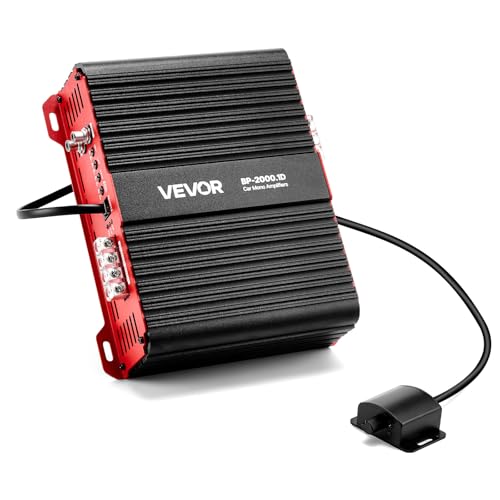
2. VEVOR Monoblock Car Amplifier, 2000W RMS MAX
Barely bigger than a paperback, yet cranks out 2000 watts.
This amp delivers a claimed 2000 watts RMS at 1 ohm and packs it into a footprint of just 7.64 x 8.86 x 2.56 inches versus the Kicker’s 12 x 9 x 4 inch frame, delivering 2000 watts RMS to the Kicker’s 400 watts RMS. Keep in mind the Kicker delivers 400 watts RMS; this VEVOR is in a different league for raw output. It also comes with a 16.4-foot remote bass knob cable, so you can dial in the intensity from the driver’s seat without reaching into the trunk.
Buyers report it does exactly what it says on the box, delivering clean power at 1 ohm and working well with high-power 12-inch or 15-inch subwoofers. The aluminum chassis and built-in fan help with heat management, though a handful note the circular wire terminals do not clamp the cable fully, so you will want to double-check your connections. The VEVOR tips the scales at 5.7 pounds, compared to the Kicker’s 5 pounds, but that extra weight is mostly the sturdy cooling hardware.
Standout trait: 2000W RMS in a chassis smaller than most 600W amps — as buyers put it, “you will not find a better quality amplifier anywhere else with the smallest footprint as this one.”
Watch for: The wire terminals are circular rather than set-screw, which some find less secure with large-gauge cable.
Grab this for: a high-output 1-ohm system where trunk space is precious and you want real wattage without a giant chassis.
Think twice if: you prefer a brand with decades of proven customer support; VEVOR is newer to car audio and its long-term durability is still being written.
3. AUDIOZERONE ZE1000.1 2000W Monoblock Class D MOSFET Subwoofer Amp
The crowd-favorite budget amp that punches far above its price bracket.
This amp has earned a devoted following by delivering a legitimate 1000 watts RMS at 1 ohm — the actual RMS, not inflated peak numbers — at a price that leaves room in the budget for better subwoofers. “For the price on this amp you get some absolute exceptional power,” is how one owner puts it, running two Skar Audio 1200W subs at 1 ohm without entering protect mode. The Class D MOSFET design keeps heat in check, and owners mention it running cool even in hard daily use over nearly two years.
At 11 x 6.9 x 2 inches and weighing 6.6 pounds, it is a moderate footprint but still slim enough for most installations. The speaker wire terminals are the only recurring complaint — they can pull loose if not tightened very firmly, so plan to check them periodically. Unlike the Kicker, which focuses on bulletproof thermal stability at a lower 400-watt RMS, the AUDIOZERONE offers 1000 watts RMS, compared to the Kicker’s 400 watts RMS, at a lower entry price, but with slightly less refinement in the connection hardware.
What the crowd loves
- True 1000W RMS in a compact, budget-friendly package
- Stable at 1 ohm without overheating issues
- Powers dual 12-inch subs with clean, consistent sound
What to watch
- Speaker wire terminals can loosen over time if not cranked down
- Some owners prefer the crisper sound of Class AB amps
Best for: budget-conscious builders who need serious wattage for one or two 12-inch subs without spending on premium branding.
skip it if: you need a warranty longer than the standard offering or want terminal blocks that accept 0-gauge wire without adapters.
4. Recoil DI600.1 Class-D Car Audio Mono-Block Subwoofer Amplifier
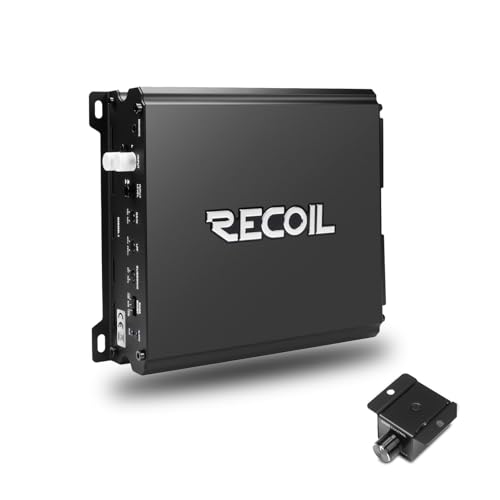
Tiny enough to fit under a steering column, but still delivers a real 600 watts.
This amp measures just 7.48 x 5.90 x 1.77 inches — easily the smallest full-power mono amp in this lineup. One owner installed it under the steering column of a Jeep Wrangler, powering a single 8-inch sub without any space compromise. It puts out 600 watts RMS at 1 ohm, with a variable low-pass filter and a subsonic filter built in. The included bass remote knob lets you adjust the bass level from the driver’s seat without reaching into the back.
Owners praise the build quality (the most-discussed aspect) and note that the gain can be turned fully up without clipping when tested with an oscilloscope. Unlike the Kicker which is best for a single daily sub, the Recoil DI600.1 is for those who need bass in a space where no conventional amp will fit — a Miata trunk, a truck under-seat compartment, or a custom kick panel. The trade-off is lower overall wattage; if you are trying to push dual 12s, this 600W RMS amp will run out of gas long before the AUDIOZERONE will.
Why it wins: The quality-to-size ratio is unrivalled here — owners call it “small enough to be mounted anywhere, packs a punch,” and the oscilloscope-confirmed clean gain is rare at this level.
The honest catch: At 600W RMS (1200W max), it will not satisfy a competition SPL build; this is a clean, modest-power amp for a single quality sub.
Choose this for: tight vehicle installs like Jeeps, coupes, and under-seat compartments where every cubic inch counts.
Not for: anyone running two 12-inch subwoofers or needing more than 800W RMS of continuous output.
5. Recoil RED600-1 1320 Watts Class-D Mono-Block Subwoofer Amplifier
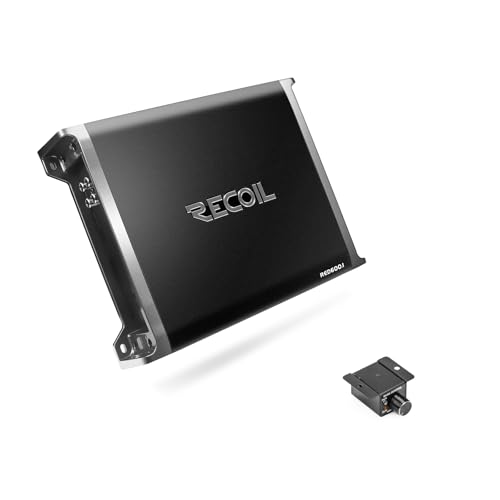
A 1-ohm stable upgrade over the DI600, with an extra 60 watts and a proven clip light.
The RED600-1 is the next step up from the DI600, offering 660 watts RMS at 1 ohm (versus the DI600’s 600W RMS) in a slightly larger 9.84 x 7.6 x 2.2 inch frame. The defining feature here is the accurate clip light that multiple owners verified with an oscilloscope — you can set your gain precisely without distortion. The subsonic filter is also accurate, protecting your sub from damaging low frequencies below the tuning frequency.
Build quality is the most-praised aspect, with owners running two units in separate vehicles reporting they stay cool and hit rated power at 2 ohms. The metal remote knob offers linear adjustment, a nice touch over cheaper plastic knobs. The honest downside is sound quality is a known mixed point — some owners find the bass less controlled and deep compared to higher-end amps like the Kicker 800.1. If you are a basshead who values tight, articulate low-end over raw volume, the Recoil RED600-1 is a good match, but it stops short of reference-level damping control.
Smart buy if: you want an oscilloscope-confirmed clip light for clean gain staging and a subsonic filter that actually works, all at a very competitive price.
The mixed point: sound quality audits give it praise for volume but a split verdict on bass articulation — some owners find it less controlled than premium alternatives.
Get it for: a budget 1-ohm build where accurate tuning tools matter and you value clean, no-distortion setup.
Steer clear if: you are an audiophile who prioritizes damping factor and tight bass precision over raw power output.
6. Planet Audio PL2000.1M Monoblock Car Amplifier, 2000 Watts

The Class A/B amp that delivers genuinely satisfying low bass — but needs careful cooling.
Most subwoofer amps today are Class D, but Planet Audio builds this 2000-watt monoblock with a Class A/B topology. That means it runs less efficiently and generates more heat, but many owners feel the low-bass reproduction is warmer and more natural. Sound quality is the single most praised aspect — 29 owners call it out — with one owner noting it thumps hard with a single 1200W Sony Xplod sub without overheating or clipping.
The amp measures 12.75 x 7 x 2.39 inches and weighs 6.3 pounds, making it one of the larger single-channel amps here. It includes a variable low-pass crossover, variable bass boost, and both low-level (RCA) and high-level (speaker wire) inputs. The reliability and power output are a mixed bag — while some customers note trouble-free use, others note it does not deliver the full 2000 watts claimed, and overheating is the top negative theme. If you push this amp hard, adding a small dedicated cooling fan is a smart idea. The Kicker is a far safer bet for low-maintenance daily use, but the Planet Audio delivers a richer low-end character for those willing to manage the heat.
Likes
- Excellent low-bass sound quality with warm, natural tone (29 owners mention it)
- Accepts both RCA and high-level inputs for easy factory radio integration
- Solid build with deep heatsink design
Dislikes
- Overheating can trigger protection mode at high volume — a cooling fan is advised
- Power output runs below the advertised 2000 watts for some users
Best for: listeners who value the harmonic richness of low bass and can accommodate a larger chassis with active cooling.
Think twice if: you compete in SPL or need an amp that sustains full power for long freeway sessions without any thermal babysitting.
7. CT Sounds CT-1500.1D Compact Class D Monoblock Amplifier, 1500 Watts RMS

A 1500-watt RMS amp that is compact enough to slide under a second-row seat and cool enough to run all day.
Despite its small chassis, the CT-1500.1D delivers a genuine 1500 watts RMS — enough to push a 15-inch subwoofer or a pair of 12s. One owner has this powering an EVL 15 and calls it “extremely powerful for the size.” The MOSFET pulse-width modulated power supply and proprietary heat dissipation design are the engineering secrets here, and cooling is a standout quality with 14 owners specifically praising it. The 4-way protection circuitry covers high voltage, low voltage, over current, and high temperature, giving you confidence during long sessions.
At this power level, the CT Sounds competes directly with the Stinger MT20001 (2000W RMS) and the Taramps Smart 3 Bass (3000W RMS), but it carves its own niche by being the most thermally balanced and build-quality-focused option in the 1500W segment. Performance is a mildly mixed aspect — a small number of reviewers point out failures after a couple of years, but the overwhelming consensus (quality has 46 positive mentions and sound quality has 39) is that this amp is reliable and punchy.
Why it stands out: 1500W RMS in a chassis that fits under a second-row SUV seat, with cooling performance that owners describe as “never overheats.”
One honest caveat: A few shoppers say the amp failing after two to three years due to signal caps going bad, which is a long-term durability question for a 1500W RMS unit at this price.
Reach for it if: you need a high-wattage daily subwoofer amp that stays cool, sounds clear, and fits in a tight install space.
Consider alternatives if: you plan to run the amp at absolute max power for years on end; a larger chassis like the Stinger may offer longer component life.
8. Alpine S-A60M, S Series Class D Monoblock Subwoofer Amplifier, 600 Watts

The Alpine staple that delivers clean, reliable bass year after year without fuss.
Alpine earns its reputation here with an amp that owners consistently describe as “clean reliable power.” It is a Class D monoblock that produces 600 watts RMS, with preamp and speaker-level inputs so it works with both aftermarket and factory radios. The build quality is top-tier (48 positive mentions), and the power output (38 positive mentions) is praised for being honest and consistent rather than exaggerated.
The Alpine is a direct competitor to the Kicker CXA4001 — both offer about 400-600 watts RMS, but the Alpine has a slight edge in brand perception and long-term owner satisfaction. The main reason is not raw wattage but consistency. Unlike the AUDIOZERONE or VEVOR, which push big numbers at budget prices, the Alpine S-A60M is for someone who wants to install an amp once and forget about it. The one complaint is that the mounting fastener cover is plastic rather than metal, a minor detail on an otherwise excellent build.
The key stat: 48 owners single out the build quality as the top positive — more than any other aspect — and overheating is at most a mixed issue rather than a pattern.
The small catch: At 600 watts RMS, it is fixed in the moderate-power camp; it will not satisfy the 1000W+ crowd or anyone competing in SPL.
Buy this for: a low-maintenance, set-and-forget subwoofer amp that delivers clean, honest power and will likely outlast the car you put it in.
Pass on it if: you need 1000+ watts RMS to push multiple subwoofers or compete in bass competitions.
9. AudioControl EPIC1000 Monoblock Amplifier, 1000W RMS
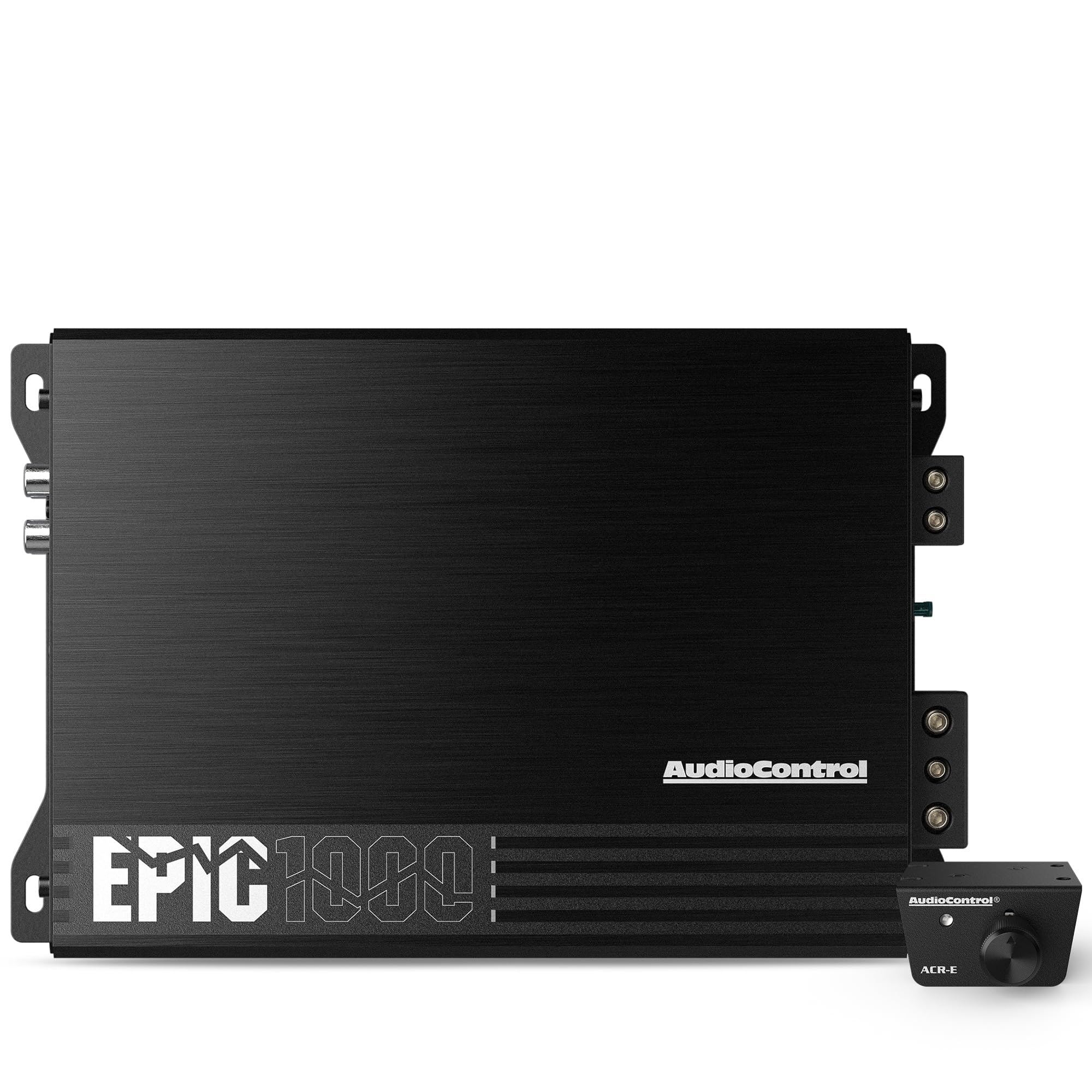
An audiophile-grade 1000-watt RMS amp with genuine bass restoration capability.
The EPIC1000 is built to a higher fidelity standard than most subwoofer amps at its price. It is a Class D monoblock delivering a true 1000 watts RMS, stable at 1, 2, or 4 ohms, with the option to bridge up to 2000W at 2 ohms for strapped configurations. The real differentiator is the EPICENTER Link port, which connects directly to AudioControl’s legendary bass restoration processor, restoring low frequencies that were lost in recording or compression. It also includes a variable 0-12dB Epic Bass boost equalizer and 12dB/octave Linkwitz-Riley crossovers for surgical frequency control.
Compact at 6.1 x 9.41 x 2.01 inches, it is smaller than the Stinger MT20001 but delivers 1000 watts RMS versus the Stinger’s 2000 watts RMS — the trade-off is precision over brute force. Owners who pair it with the LC2iPro note that integration is top-notch, and running it as part of a full AudioControl ecosystem is clearly the intended use case. At 1000W RMS, it easily outguns the Alpine S-A60M (600W RMS) while staying more refined and feature-rich than the AUDIOZERONE. The trade-off is price — you are paying for processing, filters, and brand engineering, not just raw wattage.
what separates it: The EPICENTER Link port and Linkwitz-Riley crossovers make this the best choice for integrating with a full DSP-based audio build.
The honest trade-off: At this price point, you get 1000W RMS when the VEVOR or Stinger offers 2000W RMS for similar money — you are paying for precision, not peak numbers.
Best for: SQ-focused enthusiasts who want to restore lost bass frequencies and control every crossover point with pro-grade precision.
Not the pick for: pure SPL competitors who boost wattage per dollar without caring about signal processing or bass restoration.
10. Stinger Audio MT20001 Compact Digital Class D Monoblock 2000W RMS

The 2000-watt RMS beast that somehow packs a ton of features into a compact chassis.
Stinger’s MT20001 delivers a massive 2000 watts RMS at 1 ohm in a chassis that measures 12.16 x 6.10 x 2.09 inches — notably compact for its power class. The advanced HEXFET MOSFET power supply and Class X2 aluminum zinc high-frequency capacitors give it low resistance and fast switching, translating to efficient power delivery. It also works with aftermarket head units via RCA line-level inputs, and it includes a remote bass knob that can be flush-mounted in the dash.
The most-discussed theme is power — 30 owners call it out positively. Multiple buyers report it outperforms larger, more expensive amps that previously failed. One owner even survived an accidental reverse polarity connection (the amp worked perfectly afterward), and dyno tests show it exceeding its claimed 2000-watt rating, hitting around 2800 watts. The bass knob is the single negative theme (7 mentions), with some owners finding the included unit less sturdy than expected. The Stinger is a stronger value pick than the Taramps Smart 3 Bass if you need 2000RMS versus 3000RMS, but the Taramps offers more headroom for extreme builds.
Why it earns its spot: It dynos above its rated wattage, survives electrical abuse, and delivers clean bass without overheating — an exceptional value for the 2000W RMS class.
The honest caveat: The remote bass knob quality is a recurring minor complaint; some owners replace it with an aftermarket unit.
Get it for: a high-power system where you want every watt of RMS promised and a track record of overperforming on the test bench.
pass on it if: you want a sub-2-inch deep amp or need to integrate with a factory radio without an external LOC.
11. Taramps Smart 3 Bass 0.5 to 2 Ohms 3000 Watts RMS

The 3000-watt monster with ultra-low 0.5-ohm stability for serious SPL builds.
Taramps is known in the competitive SPL scene, and the Smart 3 Bass lives up to the reputation. It delivers 3000 watts RMS and operates across a wide multi-impedance range from 0.5 to 2 ohms, meaning it can handle extreme subwoofer configurations that would shut down most amps. It accepts power wire from 4 AWG up to 1/0 AWG for serious current flow. The Class D design keeps it relatively compact at 9.37 x 9.45 x 2.8 inches and 6.6 pounds — smaller than the Stinger MT20001 in footprint despite delivering 3000 watts RMS, compared to the Stinger’s 2000 watts RMS.
Owners mention unbelievably deep bass, with one owner noting that it hits lows down to 20Hz after the subs break in. The gains require careful tuning (they are very temperamental), and the cooling fans can screech at high volume. The amp demands oxygen-free copper (OFC) wire — CCA wire causes grounding issues and warm cables. If you want extreme SPL without the cost of a full competition-grade amplifier rack, the Taramps is the go-to choice. It is not for rock or metal listeners who need punchy 40-80Hz response; this amp is tune for deep, low-frequency bass that vibrates through your whole body.
The defining stat: 3000 watts RMS with 0.5-ohm stability — a combination that no other amp in this list can touch for pure, raw low-end authority.
The fine print: Gains are extremely sensitive and require a DMM or oscilloscope to set correctly; inaccurate setup will trigger protection mode. OFC wire is mandatory.
Buy this for: building an SPL-focused system with multiple 15-inch subs or a single massive sub in a low-tuned enclosure, targeting sub-30Hz bass.
Pass on it if: you listen mainly to rock, metal, or punchy pop and want tight, articulate mid-bass; the Taramps booms deep but lacks snap in the 40-80Hz range.
Understanding the Specs
RMS Power vs Peak Power
RMS (Root Mean Square) is the continuous power an amplifier can deliver safely for long periods. Peak power is a brief maximum. When matching an amplifier to a subwoofer, always use RMS ratings — the peak number is mostly marketing. A 1000-watt RMS amp paired with a 1000-watt RMS sub will sound clean and last. Overpowering is safer than underpowering, but avoid sending a clipped signal.
Impedance and Load Stability
Impedance, measured in ohms, is the electrical resistance the amplifier sees from the subwoofer. A lower impedance (1 ohm) allows more power output from the same voltage. An amplifier’s stability rating (e.g., “1-ohm stable”) tells you the lowest impedance it can safely drive. If your subwoofers are wired to 0.5 ohms total, you need an amp rated for 0.5-ohm operation. Mismatching impedance loads can trigger protection mode or damage your amplifier.
Low-Pass and Subsonic Filters
A low-pass filter (LPF) blocks frequencies above a set cutoff, so only the deep bass reaches your subwoofer. A subsonic filter removes ultra-low frequencies (typically below 20-30Hz) that you cannot hear but that can damage your subwoofer by causing excessive cone excursion. Both filters let you tune the sound to your enclosure type and listening preferences, and most mono amps in this list include them as variable controls.
Class D Amplifier Efficiency
Class D amplifiers use pulse-width modulation to convert power with very high efficiency — typically 80-90% — compared to Class A/B’s 50-60%. This means they produce less heat, draw less current from your alternator, and can be built in much smaller chassis. For a subwoofer amplifier, Class D is the standard for any system above 300 watts RMS. The exceptions, like the Planet Audio PL2000.1M (Class A/B), trade efficiency for a different sonic character.
FAQ
What size fuse do I need for a 2000-watt RMS monoblock amplifier?
Can I run two subwoofers on a monoblock amplifier?
What is the difference between a monoblock and a multi-channel amplifier for subwoofers?
What size fuse do I need for a 2000-watt RMS monoblock amplifier?
Continuing from the very next character.
s a solid mono amp that can safely handle a 2-ohm or 1-ohm load with the right wiring configuration.
Can I use a monoblock amplifier with a factory radio?
What gauge power wire should I use for a 1000-watt RMS mono amp?
How long should a car subwoofer amplifier last?
Do I need a capacitor for my mono subwoofer amp?
What is the difference between Class D and Class A/B for a subwoofer amp?
Will a subwoofer amplifier drain my car battery when the car is off?
Final Thoughts: The Verdict
If you want one dependable pick, the woofer amplifier for a car winner is the Kicker 46CXA4001 because it combines class-leading thermal reliability, true 400-watt RMS output at 1 ohm, and low-maintenance factory radio integration — all in a 5-pound package that fits under most seats. If you want massive 2000-watt RMS output in the smallest footprint possible, grab the VEVOR Monoblock. And for extreme SPL builds that demand 3000 watts RMS with 0.5-ohm stability, the Taramps Smart 3 Bass is the one to reach for.
How We Picked
We do not accept paid placement. Every pick is matched to a real buyer and a real use-case; we do not hands-on test units.
Sources & Methodology
Specifications: manufacturer listings and product documentation. Review insights: verified customer reviews, as of July 2026. Pricing: not shown on this page (it changes often); check the current price via the retailer link.
As an Amazon Associate, GoCarLife earns from qualifying purchases. This does not affect which products we feature.