
Our readers keep the lights on and the garage heater humming. As an Amazon Associate, I earn from qualifying purchases.
Specs are compiled from manufacturer listings and verified buyer reviews and can change over time — please confirm the key details on the product page before buying.
Trailer wiring doesn’t have to be complicated. The real breakthrough is the plug-and-play connector that mates directly to your vehicle’s factory socket — no cutting, no splicing, no voltage tester required. The single biggest decision is if you need a vehicle-specific harness or a universal kit, and we have picked the ones that make the job genuinely easy.
I’m Mo Maruf — the founder and writer behind GoCarLife. This guide is built by comparing the manufacturers’ published specifications and the patterns across verified customer reviews, so you get each pick’s real strengths and trade-offs instead of marketing spin.
Trailer wiring can feel like a dense tangle of color codes and connector types, but the right setup is a simple one-hour job that gets your brake lights, turn signals, and tail lights working without a hitch — and these are the top contenders for any wiring for trailer project.
Our Picks at a Glance


How To Choose The Best Wiring for Trailer
Picking the right trailer wiring starts with one question: does your vehicle have a factory tow-package socket, or are you starting from scratch? A vehicle-specific T-connector (like the CURT 56420) plugs directly into an existing port behind your tail light — no wire stripping required. A universal harness, on the other hand, requires you to run wires from your vehicle’s tail lights to a connector at the hitch. The second factor is connector type: a 4-way flat handles basic tail, brake, and turn signals, while a 7-way blade adds electric brakes, reverse lights, and a 12V auxiliary line for charging a trailer battery.
Vehicle-Specific vs Universal Fit
A vehicle-specific harness is designed to match the exact shape and pin layout of a particular model — for example, a 2023 Hyundai Tucson or a Honda Pilot. Installation is usually under 30 minutes and requires no electrical experience. A universal fit harness works across many vehicles but demands cutting into your car’s wiring or using t-taps, which adds time and complexity. If your vehicle is a common SUV or crossover, the T-connector route is almost always the smarter choice.
Wire Gauge and Material
The thickness of the wire directly affects how reliably power reaches your trailer lights. A 14-gauge wire, like the LIMICAR 100FT spool, is thicker than the standard 16-gauge and delivers more stable power over long runs — critical for a 20-foot utility trailer. Stranded pure copper or copper-clad aluminum is the norm; copper offers the best conductivity, while copper-clad aluminum is a lighter, more affordable compromise. Always match the gauge to your total trailer length: longer trailers need heavier gauge to prevent voltage drop.
Pin Count: 4-Way vs 7-Way
A 4-way flat connector is the standard for small utility trailers and boat trailers. It handles the three essential circuits — left turn/brake, right turn/brake, and tail lights — plus a ground. A 7-way round (blade) connector adds four more pins: electric brake controller output, reverse lights, auxiliary 12V power, and a second ground. If your trailer has electric brakes, a 7-way is mandatory. If you only tow a lightweight landscape trailer, a 4-way is all you need.
Quick Comparison
| Model | Best For | Connector Type | Wire Gauge | Install Style | Amazon |
|---|---|---|---|---|---|
| CURT 56420★ Best Overall | Best Overall | 4-Way Flat | 2-Wire System | Plug & Play | Amazon |
| Nilight 4-to-7 AdapterUpgrade Adapter | Upgrade Adapter | 4-Way to 7-Way | — | Plug & Play | Amazon |
| WALSIO 4-Pin HarnessFull Rewire | Full Rewire | 4-Way Flat | 18 AWG | Hardwire | Amazon |
| MECMO 7-Way Connector | Truck End Pigtail | 7-Way Round | — | Hardwire | Amazon |
| Partsam Halo Glow Kit | LED Light Upgrade | 3-Wire Pigtail | — | Hardwire | Amazon |
| CheeMuii 7-Way Kit | Complete 7-Way Kit | 7-Way Round | — | Junction Box | Amazon |
| Partswcgg LED Kit | Complete Light System | 4-Way Flat | — | Hardwire | Amazon |
| LIMICAR 100FT Wire | Bulk Rewire Spool | 4-Way Bonded | 14 AWG | Hardwire | Amazon |
| CURT 56291 | Honda Pilot Fit | 4-Way Flat | 3W System | Plug & Play | Amazon |
In‑Depth Reviews
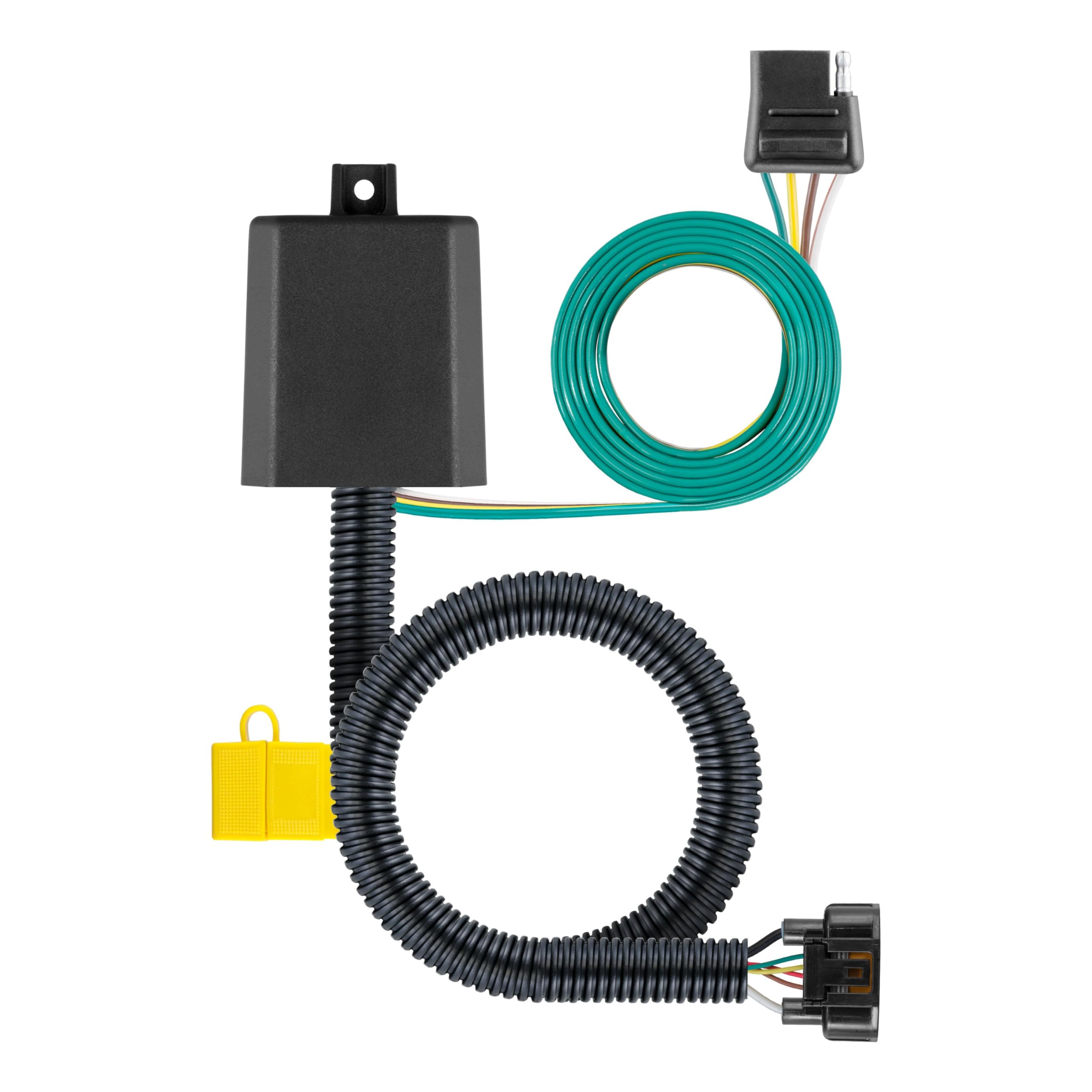
1. CURT 56420 Custom Wiring Connector
Our pick — over 4.5★ from 950+ verified ratings; the strongest balance of quality and price.
The crowd favorite turns a dealer quote into a 15-minute weekend project.
The dealer’s labor bill? This harness renders it obsolete. The CURT 56420 plugs directly into the existing OEM socket on Hyundai Palisade, Santa Fe, Kia Telluride, and Tucson models — no cutting or splicing required. It provides a 4-way flat output that connects tail lights, brake lights, and turn signals, and it includes a built-in tail light converter to keep everything compatible. The SMT circuitry inside the connector is a step up from basic boards, contributing to better durability and consistent signal performance over time.
What wins people over is the fit. Owners consistently mention that the assembly is intuitive from the moment you see the car’s factory harness. One owner who tackled the job on a 2022 Kia Telluride reported a clean one-hour install and noted that the only missing piece of instruction was that the included fuse needs to be inserted into the in-line holder — a small detail, but worth checking. The 14.88-ounce weight tells you it is a solid, built-to-last piece of plastic and circuitry, and the 4.7-star consensus across nearly a thousand owners backs that up.
Why it wins
- Genuine plug-and-play: matches the factory port shape perfectly — buyers report a 15-minute install on the 2023 Tucson.
- SMT circuitry provides better signal reliability than basic pin connectors, reducing the chance of flickering lights.
- Tail light converter is built in, so you do not need a separate module for vehicle-trailer compatibility.
The trade-offs
- Only works on a narrow list of Hyundai and Kia models — check your vehicle before buying.
- The included fuse is loose in the packaging; owners advise locating and inserting it before installation, not after.
Reach for this if: you drive a compatible Hyundai or Kia SUV and want a wiring solution that sidesteps the dealer entirely — the crowd favorite for a reason.
Look elsewhere if: your vehicle is not on the list (it excludes Toyota, Ford, and most domestic trucks); you need a 7-way for electric brakes.
2. Nilight 4 Way Flat to 7 Way Round Blade Trailer Adapter
A smart bridge for trucks that already have a factory 4-pin socket but need a 7-way round plug.
If you already have a factory tow package on a pickup truck, the Nilight adapter converts the 4-way flat vehicle end into a 7-way blade trailer end — without touching a single wire. The heavy-duty black plastic body resists rust, while the spring-loaded cover seals the terminals against dust and moisture when the connector is not in use. Owners mention it provides a tight connection with no wiggle room, which matters for maintaining consistent signal to electric trailer brakes.
The kit comes with a mounting bracket, screws, and nuts, so you can bolt the plug securely to your hitch or bumper. Functionality is the most-discussed positive — customers note that brake lights, turn signals, running lights, and electric brakes all work immediately after plugging in. The small caveat: a minority of owners find that the plug can work itself loose over rough terrain if not mounted firmly. The build quality earns consistent praise, and the included bracket makes proper installation straightforward.
At just over half a pound, it adds negligible weight to your hitch setup. For anyone pulling a camper or RV that requires a 7-pin connection, this is the most direct upgrade path from a basic 4-pin vehicle socket.
Perfect for: pickup and SUV owners with a factory 4-pin who are upgrading to a 7-pin trailer — plug it in, mount it, and go.
skip it if: your trailer uses a 4-way flat or you need a full rewiring solution rather than an adapter.
3. WALSIO 4 Pin 5 Wire Trailer Wiring Harness, 22FT
The 22-foot harness eliminates the need for extensions or splices on nearly any trailer.
This is the harness you grab when you are rewiring an entire trailer from scratch. The WALSIO kit uses 18 AWG pure copper wire wrapped in thickened PVC, with an outermost layer of black braided nylon mesh tubing — a combination that buyers describe as excellent build quality. The Y-harness design splits at the front, meaning you run one cable to each side of the trailer without running a wire across the axle, which simplifies routing and keeps wiring out of harm’s way.
The 22-foot overall length and 2.5-foot ground wire give you plenty of slack for larger trailers, including marine boat trailers, horse trailers, and ATV trailers. Color-coded wires match the industry-standard 4-way flat pattern (white = ground, brown = tail, yellow = left turn/brake, green = right turn/brake), making installation accessible even if you are new to wiring. The protective connector cap and included zip ties add convenience. The recurring owner insight is that the wires are well-insulated and the split is correctly positioned for easy routing. A minor note: some owners wish the Y-split were bundled a few feet back from the plug rather than splitting at the plug itself, but this does not affect function.
Best for: replacing old, brittle wiring on a boat or utility trailer where you want a full-length, color-coded harness with strong protective sleeving.
Think twice if: your trailer is under 10 feet and you prefer a shorter, tangle-free wire; the 22-foot length may need to be coiled and secured.
4. MECMO 7 Way RV Trailer Light Connector Socket
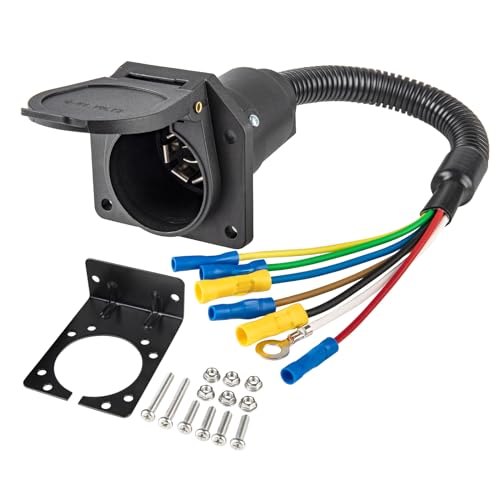
A prewired 7-way pigtail that hardwires into your truck’s existing wiring for full RV connectivity.
The MECMO connector is the vehicle-end side of a 7-way system — you wire it into your truck’s wiring, and it powers the trailer’s taillights, brake lights, turn signals, reverse lights, electric brakes, and auxiliary 12V line. The plug opens a full 180 degrees for easy hookup, and the spring-loaded cover keeps the terminals clean when it is not connected.
Construction uses tin-plated copper terminals inside a rust-free black plastic housing, with a black sealed tubing wire conduit for corrosion resistance. The prewired pigtail comes with butt connectors and color-coded wires, but the consensus among owners is that you should have your vehicle’s wiring diagram handy. An owner who installed this on a truck recommends using t-taps instead of cutting into the factory wiring, which is a smart approach for anyone wanting to preserve their vehicle’s original harness. A few reviewers point out that the plug fit is a bit tight on some trailer ends, but that tightness usually means a clean connection with no wiggle.
Solid pick for: truck owners installing a 7-way from scratch — the prewired pigtail and included bracket make it a clean install.
Watch for: the color codes may differ from your vehicle’s wiring; always reference a wiring diagram or test with a multimeter before finalizing.
5. Partsam Led Submersible Trailer Tail Lights Kit, Halo Glow

A visually distinct Halo Glow tail-light kit that is completely submersible and street-legal.
The Partsam kit is more than just wiring — it is a full light upgrade. The square tail lights use 32 to 38 LEDs depending on the side (the street-side light includes a built-in license plate illuminator with 6 white diodes), and they produce a unique solid light pattern that makes your trailer stand out on the road. Every function is covered: brake, tail, turn, side marker, side reflector, rear reflector, and license plate light.
The lights are sonically sealed and fully submersible, which is critical for boat trailers. Owners confirm that the housing does not collect water, even on trailers that live outside year-round. The kit includes a 25-foot wiring harness with a 3-wire pigtail (white = ground, gray = tail, red = brake/turn), a license plate bracket, and mounting hardware. Surface-mount diodes resist vibration better than through-hole LEDs, adding to the durability. The main trade-off noted by buyers is that the included quick-connects and license plate bracket feel less premium than the lights themselves, but the consensus is that the lights and main wire harness are solid for the price.
Great for: boat trailers and marine use — the submersible build is the defining feature here, and the Halo Glow adds style without compromising legality.
Note: the included hardware (quick-connects, plate bracket) is a step down in quality; plan to supplement with your own heat-shrink connectors and a sturdier bracket.
6. CheeMuii 7 Way Trailer Wiring Harness Kit, 8 FT Cord with Junction Box

An all-in-one kit that pairs an 8-foot cord with a waterproof junction box for a clean, organized install.
The CheeMuii system is built around a junction box equipped with 7 color-coded terminals, so you can identify each circuit without a multimeter. The 8-foot cord uses a double-prong plug (a design upgrade over single-prong connectors) to ensure reliable contact. The assembly is ideal for RVs, campers, caravans, and food vans — any application where a tidy, weather-resistant 7-way connection is the goal.
Buyers consistently highlight the box as a standout feature: it eliminates the mess of loose wires and provides a central connection point that is easy to diagnose later. The mold includes a detailed wiring chart, though a few owners note that the color coding differs from some standard trailers — the included chart resolves this, but double-check before crimping. The hard plastic housing is heavy-duty, though an owner points out that the lid lacks a rubber gasket, so moisture could enter if mounted in a low-lying, exposed area. For most installations under a trailer or enclosed in a box, this is not an issue.
Best for: rewiring an equipment or utility trailer where you want a clean junction-box setup instead of a spliced-together bundle.
Consider carefully: if you need a fully waterproof seal around the box lid, you may want to add a bead of silicone sealant as a precaution.
7. Partswcgg 12V Trailer Led Light Kit

Everything you need to completely re-light a trailer in one box — tail lights, marker lights, and a third brake bar.
This is the most comprehensive light-and-wire kit in the lineup. It includes two square rear combination tail lights (each with 15 diodes: 12 red + 3 red for stop/turn/tail functions), a 15.5-inch third brake light bar with 11 LEDs, six mini oval side marker lights (2 red + 4 amber), a 25-foot wiring harness with a 4-flat plug, and a license plate bracket. The wiring tips are printed clearly: white = ground, yellow = brake (high brightness), brown = running light/low brightness on the square lights; red = brake/stop/turn on the light bar; black = positive on the markers.
The entire kit is submersible and sealed — no water can enter the circuit board. An owner reported flawless performance for a full year with excellent brightness visible in rain and fog, and no flickering or moisture ingress. The only recurring shortfall is the harness length: some buyers found the 25-foot spec does not quite reach end to end on a long trailer (one needed extra wire for an 18-foot trailer). For most standard trailers up to 16 feet, though, the length works fine. The lights are bright enough to be seen well in daytime, and the polycarbonate lens material holds up to road debris.
Pick this if: you need a full lighting system — lights, marker lights, license plate light, and third brake bar — in one purchase with submersible protection.
Measure first: the advertised 25-foot harness may fall short on trailers longer than 16 feet; have extra wire on hand if your trailer is large.
8. LIMICAR 100FT 14 Gauge Bonded 4-Way Trailer Wire

A full 100-foot spool of 14-gauge bonded wire for those who are doing a complete ground-up rewiring job.
If you are rewiring a car hauler, horse trailer, or large utility trailer, buying wire by the spool is more economical than multiple short harnesses. The LIMICAR wire is SAE J1128 certified and rated for 60V, which means it meets automotive-grade standards for outdoor use. The 14 AWG gauge is thicker than the typical 16 AWG found in budget harnesses, providing lower resistance and more stable power delivery over the entire 100-foot distance — critical for keeping your stop and turn signals bright at the far end of a long trailer.
The bonded design keeps the four conductors (white = ground, brown = tail, yellow = left stop/turn, green = right stop/turn) flat and tangle-free as you pull it through trailer channels. The PVC insulation is rated from -40°F to 200°F, so it handles extreme weather without cracking. A few owners caution that the copper-clad aluminum construction can corrode if not properly sealed, especially in salt-air environments. One owner found the wire began corroding within two months when used on a boat trailer without waterproof connectors — a reminder that this wire requires sealed butt connectors or liquid electrical tape at every splice for marine use. For dry land applications, it performs reliably and is a solid value per foot.
Best for: large-scale trailer rewiring where you need to run a continuous, bonded 4-wire run without splicing short sections together.
Use with care in: marine or salt-air environments — seal every connection with waterproof connectors to prevent corrosion; land use is straightforward.
9. CURT 56291 OE Custom Vehicle-to-Trailer Connector
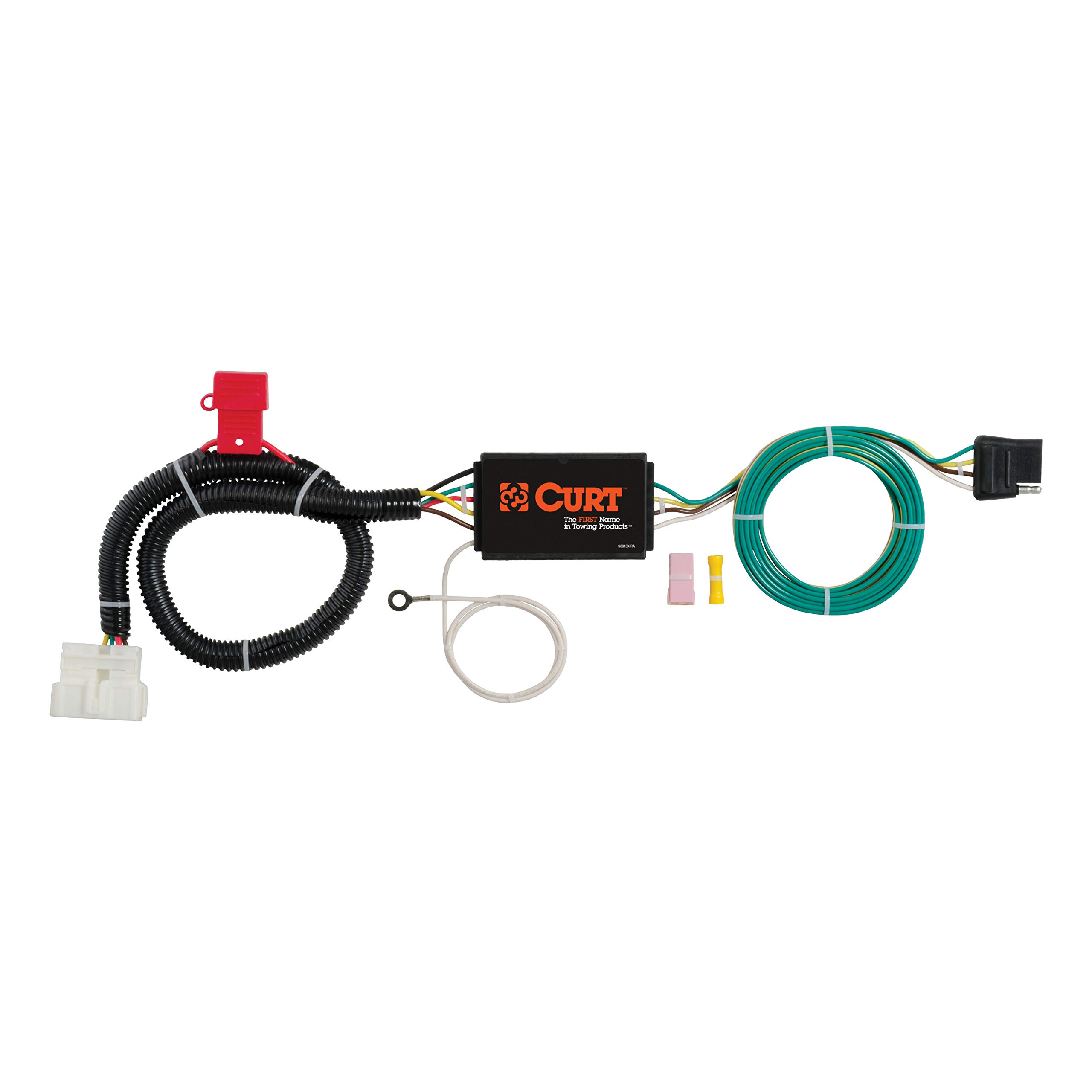
A vehicle-specific harness that makes towing with a Honda Pilot or Passport a 20-minute no-splice affair.
The CURT 56291 is the sister harness to the 56420, designed specifically for the Honda Pilot and Passport. Like its Kia/Hyundai counterpart, it uses a plug-and-play design that mates directly to the factory connector behind the rear panel — no cutting, splicing, or tapping into the vehicle’s wiring. It includes a dust cover to keep the connector clean when not in use and a built-in converter to ensure the Pilot’s electrical system communicates correctly with standard trailer lights.
The 3-wire electrical system is rated for a 10-amp fuse (fuse is included in the kit). The approximate install time is 20 minutes, and owners confirm that is realistic — one 2017 Pilot owner completed the install in under 10 minutes by accessing the plug through the jack storage area instead of removing interior trim. The consensus is that the instructions overcomplicate the job (they recommend removing interior panels), but a quick YouTube search reveals the shortcut. The harness works on model years from 2016 through 2022, and the light output (turn signals, brake lights, taillights) is reported as flawless. It is made in the USA, adding a layer of manufacturing quality assurance.
The right choice for: any Honda Pilot or Passport owner who wants a factory-grade harness without a dealer appointment — the 20-minute install is real.
Ignore the printed instructions: watch a video walkthrough instead; owners unanimously say the official manual makes it harder than it is.
Understanding the Specs
Wire Gauge (AWG) and Voltage Drop
Wire gauge, measured in American Wire Gauge (AWG), tells you the thickness of the copper or copper-clad aluminum conductor inside the insulation. A lower number means thicker wire: 14 AWG is thicker than 16 AWG. Thicker wire has less electrical resistance, which matters on a long trailer because voltage drops over distance. If your trailer is over 20 feet long, a 14-gauge or 16-gauge bonded wire supplies more stable power to the tail lights and brakes than a thinner 18-gauge wire would — your lights stay bright at the far end of the line.
4-Way Flat vs 7-Way Round Connector
A 4-way flat connector is the standard for basic trailers. It uses four flat pins to deliver the three essential circuits — left turn and brake, right turn and brake, and tail lights — plus a ground wire. A 7-way round (blade) connector adds four additional functions: reverse lights, electric brake controller signal, an auxiliary 12V power line (for charging a trailer battery or running a winch), and a second ground. If your trailer has electric brakes, you need a 7-way. If you are pulling a small utility or boat trailer, a 4-way is sufficient and simpler.
FAQ
Can I install a trailer wiring harness myself without professional help?
What is the difference between a 4-way flat and a 7-way round connector?
Will a vehicle-specific harness work on any car or SUV?
What gauge wire should I use for a long trailer?
Do I need a tail light converter to tow with a modern vehicle?
Can I use a 4-way to 7-way adapter on any vehicle?
Are submersible trailer lights necessary for a boat trailer?
What does bonded trailer wire mean?
Why are the wires color-coded on a trailer harness?
How do I know if my vehicle has a factory tow package?
Final Thoughts: The Verdict
Across the board, the wiring for trailer project starts and ends with the CURT 56420 — it is the highest-rated option in the group, the install takes well under an hour, and the plug-and-play design removes every point of confusion for a first-timer. If you drive a Honda Pilot or Passport, the CURT 56291 offers the same no-splice convenience for that specific chassis. For anyone building or rewiring a trailer from the frame up, the WALSIO 22-foot harness and the LIMICAR 100-foot spool give you the raw materials to do it right the first time.
How We Picked
We do not accept paid placement. Every pick is matched to a real buyer and a real use-case; we do not hands-on test units.
Sources & Methodology
Specifications: manufacturer listings and product documentation. Review insights: verified customer reviews, as of July 2026. Pricing: not shown on this page (it changes often); check the current price via the retailer link.
As an Amazon Associate, GoCarLife earns from qualifying purchases. This does not affect which products we feature.