
Our readers keep the lights on and the garage heater humming. As an Amazon Associate, I earn from qualifying purchases.
Specs are compiled from manufacturer listings and verified buyer reviews and can change over time — please confirm the key details on the product page before buying.
Choosing the right wiring for a wiring harness is the difference between a project that works first time and one that leaves you diagnosing flickering lights on a dark road. The gauge, the strand count, the conductor material, and the insulation type all decide whether your trailer, boat, or automotive circuit stays reliable season after season — or starts to corrode, crack, and fail. This guide cuts through the spec-sheet clutter to the numbers that actually matter.
I’m Mo Maruf — the founder and writer behind GoCarLife. This guide is built by comparing the manufacturers’ published specifications and the patterns across verified customer reviews, so you get each pick’s real strengths and trade-offs instead of marketing spin.
The nine products below represent the best wiring for a wiring harness available right now, ranging from flexible tinned-copper spools for custom builds to complete color-coded wishbone kits that get a trailer rewired before lunch.
Our Picks at a Glance

How To Choose The Best Wiring for a Wiring Harness
Picking the right wire means matching three things to your job: the gauge (thickness), the conductor material, and the jacket. Too thin a gauge and voltage drops over long runs. Pure copper carries current best but costs more; tinned copper resists the salt and road spray that eats bare copper. A wishbone harness saves splicing time on a trailer, while individual spools give you flexibility for a custom automotive or marine project. Start with the environment — wet or dry, exposed or hidden — and the current draw of the lights or accessories you are powering.
Gauge and Current Capacity
The American Wire Gauge (AWG) number gets smaller as the wire gets thicker. A 14 AWG wire handles more current over longer distances than an 18 AWG wire without voltage drop. For a standard trailer lighting circuit running 25 to 35 feet, 18 AWG usually works fine, but many owners prefer 14 AWG for the extra headroom and reliability, especially on larger trailers or loaded utility rigs. If you are running multiple accessories or a long combined run, sizing up to 14 or even 12 AWG is a smart move.
Conductor Material: Copper vs. CCA vs. Tinned Copper
Oxygen-free copper is the best conductor, but it is heavier and pricier. Copper-clad aluminum (CCA) is lighter and cheaper but has higher resistance and can corrode faster if the jacket gets nicked. Tinned copper — copper strands coated in a thin tin layer — is the balance for marine, trailer, and automotive use because the tin layer blocks corrosion from moisture and salt. Several owners note that CCA wire starts to corrode within months in wet environments, so bare copper or tinned copper is worth the premium for outdoor or marine wiring.
Strand Count and Flexibility
A wire with more strands of smaller diameter is more flexible and resists metal fatigue from vibration — important for a trailer bouncing down the road or a harness routed through tight engine-bay spaces. The strand count is listed in the specs: a 14 AWG wire with 41 strands is noticeably more pliable than one with 10 or 19 strands. If you are routing through a trailer frame or wrapping around corners, a higher strand count saves frustration and makes a cleaner installation.
Quick Comparison
| Model | Best For | Gauge (AWG) | Strands | Length | Amazon |
|---|---|---|---|---|---|
| NAOEVO 14 Gauge 2-Conductor★ Best Overall | Custom trailer & RV wiring | 14 | 41 | 50 ft | Amazon |
| LIMICAR 100FT 14 Gauge Bonded 4-WayLongest Run | Large utility & horse trailer runs | 14 | 100 | 100 ft | Amazon |
| NAOEVO 18 Gauge Silicone 6-PackFlex Master | Custom DIY & soldering projects | 18 | 150 | 180 ft | Amazon |
| VINAUO 35FT 18 Gauge 4-Way | Boat & utility trailer rewiring | 18 | 10 | 35 ft | Amazon |
| FZSFVAQ 25FT 4-Pin 5-Wire | Tow dolly & small trailer restoration | 18 | — | 25 ft | Amazon |
| Nilight 2-Pack 16 AWG Extension | Extending LED light bar harnesses | 16 | — | 20 ft | Amazon |
| Aufind 30FT 4-Pin 5-Wire | All-weather trailer rewiring | 18 | — | 30 ft | Amazon |
| GS Power 350ft 7-Color 14 AWG | Shop stock & multi-project bulk | 14 | 54 | 350 ft | Amazon |
| BABOOM BABOOM 600ft 12 AWG 6-Pack | Heavy-duty automotive & high-current circuits | 12 | — | 600 ft | Amazon |
In‑Depth Reviews
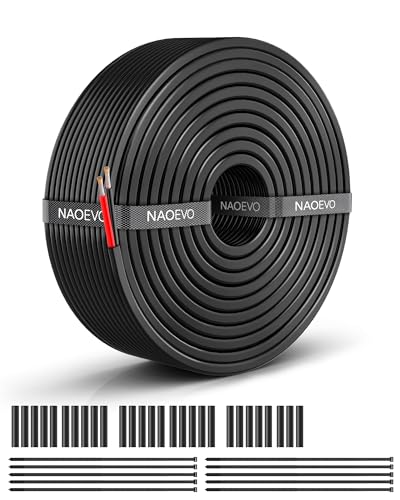
1. NAOEVO 14 Gauge Wire 2 Conductor Tinned Copper Electrical Wire, 50FT
Our pick — over 4.5★ from 550+ verified ratings; the strongest balance of quality and price.
The tinned-copper specialist that marine and RV owners keep coming back to.
This is the pick that balances every priority — current capacity, corrosion resistance, and ease of routing — into one spool. The 14 AWG wire uses 41 strands of 0.24 mm tinned copper per circuit, which gives it a noticeably softer feel than a standard 14-gauge wire with fewer strands. That higher strand count makes it easier to bend around tight corners in an RV chassis or a boat console without the wire fighting you. The PVC jacket has an IP68 waterproof rating and is flame-retardant VW-1 rated, so it handles engine-bay heat and wet bilge environments without degrading.
The obvious advantage over the 18 AWG wishbone kits below is the pure copper build. Because it is tinned, the strands resist the oxidation that eats bare copper trailer wire in salt-air environments. Buyers report it “worked perfectly for reworking RV systems” and that the spool feeds cleanly without kinking. At 50 feet of 2-conductor wire, you get enough for a full trailer rewire or a pair of long accessory runs with leftovers for future projects. The kit also includes 28 heat-shrink tubes and 10 cable ties — small but welcome extras that save a hardware-store trip. The only trade-off is bulk: this is individual spool stock, not a pre-assembled wishbone harness, so you will crimp your own terminals and divide the positive/negative yourself.
What wins people over
- Excellent quality — the top thing owners praise — with 44 owners calling it out for solid build and performance.
- 14 AWG tinned copper handles 600V and resists corrosion far longer than standard CCA trailer wire.
- 41-strand construction is notably flexible, making routing in tight RV and marine spaces much easier.
Who should think twice
- No pre-attached connectors or wishbone split; you build your own harness from scratch.
- 2-conductor design means you need multiple runs for a 4-way trailer light circuit compared to a bonded 4-wire cable.
Reach for this if: you want a premium 14 AWG tinned-copper wire for a custom harness on an RV, boat, or trailer where corrosion resistance and flexibility matter more than pre-made convenience.
Consider the wishbone kits instead if: you need a color-coded, ready-to-run trailer harness that you can splice and be driving in an hour.
2. LIMICAR 100FT 14 Gauge Bonded 4-Way Trailer Wire
One spool rewires an entire big trailer without a single splice.
This bonded 4-wire cable is built for the owner of a 30-foot car hauler, horse trailer, or large utility rig where a 25- or 35-foot wishbone kit simply will not stretch from the tongue to the rear lights and back. The four color-coded conductors (white ground, brown tail, yellow left stop/turn, green right stop/turn) are bonded side-by-side in a flat ribbon, which feeds through trailer frame channels cleanly without tangling. At 100 feet, you have enough to run a full circuit on trailers pushing 30 feet long, plus extra for a spare.
It uses 14 AWG CCA (copper-clad aluminum) wire with 100 strands per conductor, SAE J1128 certified and rated for 60V. The 14 AWG gauge is thicker than the standard 16 or 18 AWG found on most trailer harnesses, which means lower resistance over long runs and more reliable brake and turn signal voltage at the far end. The PVC jacket is rated from -40°F to 200°F, so it stays flexible in winter wiring and does not soften under summer asphalt heat. One owner noted a corrosion issue after a couple of months in a wet environment — that is the CCA trade-off. For land trailers, the bonded convenience is excellent. For boat trailers where salt spray is constant, you will want to seal every splice meticulously.
One full spool, one trailer: 100 ft of bonded 14 AWG wire saves splicing and voltage drop on long frames — a practical length play that smaller kits cannot match.
Reach for this if: you are rewiring a large utility, car, or horse trailer and want a single continuous run with no splices and heavier 14 AWG current capacity.
Look elsewhere if: your trailer is under 20 feet or used in constant salt-water submersion — a shorter wishbone kit or a tinned-copper spool is a better fit.
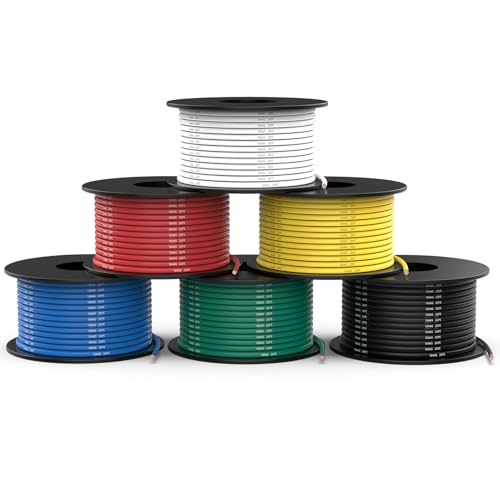
3. NAOEVO 18 Gauge Wire Tinned Copper Silicone Electrical Wire, 180FT (6 Colors)
The silicone-jacketed wire that bends like rope and handles soldering iron heat.
This kit gives you six individual spools of 18 AWG stranded wire — red, black, white, blue, green, yellow — each 30 feet long for a total of 180 feet. The big differentiator here is the silicone insulation instead of PVC. Silicone stays soft and flexible down to -76°F and does not melt or shrink when you hold a soldering iron near it, rated up to 392°F. That makes it the right choice for engine-bay repairs, 3D printer wiring, R/C models, or any project where you are soldering terminals directly onto the wire.
Each conductor uses 150 strands of tiny 0.08 mm tinned copper, which gives this wire an almost fabric-like flexibility — it drapes and routes without holding a set curl, unlike PVC wire that tends to keep its spool shape. The tin coating on the strands also makes soldering noticeably faster: the solder wets the conductor immediately rather than beading up. Several owners use it for boat and motorcycle wiring specifically because the tinned strands resist the corrosion that eats bare copper in humid bilges. The recurring note from owners is that the wire is so soft it does not hold a bent shape, which is a minor headache if you are trying to dress a neat breadboard or tidy harness with fixed 90-degree bends.
Best for soldered connections and tight spaces: the 150-strand silicone build and tinned copper make this the most flexible and iron-friendly wire in the lineup.
Reach for this if: you are soldering a custom harness for a motorcycle, boat, 3D printer, or restoration project and want a wire that strips easily and resists corrosion.
skip it if: you need a 4- or 5-wire bonded trailer harness that splices in minutes — this is raw spool stock, not a wishbone assembly.
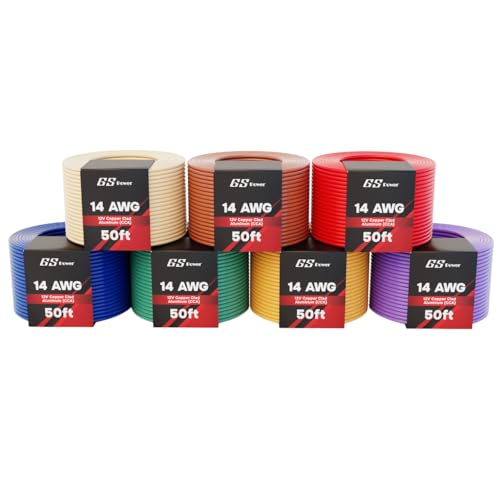
4. GS Power 350ft 14 AWG Automotive Wire (7 Colors, 50ft Rolls)
A 350-foot wardrobe of 14 AWG colors for the shop that does everything.
Seven rolls of 14 AWG wire, each 50 feet long, in red, white, blue, yellow, brown, green, and purple — this is the bulk kit for someone who wires an 18-foot car trailer one week and a set of auxiliary lights the next and wants the right color on hand. It uses copper-clad aluminum (CCA) with 54 strands per conductor and is rated for 12V automotive applications up to 221°F. The CCA construction keeps it lighter and more affordable than pure copper, and owners consistently note it is the best value for rewiring a trailer — one owner called it “the best solution for rewiring a car trailer” after their research.
The 350-foot total length means you can rewire an 18-foot trailer and still have rolls left for future jobs. The 14 AWG gauge is a step up from the standard 16 or 18 AWG trailer wire, giving you lower resistance and more reliable voltage at the lights. The one consistent caution from owners is durability: some report that CCA wire can start to oxidize or become brittle over time if the insulation is nicked and moisture gets in. This is not a wire for a marine environment or for burying in a damp frame tube without sealing every connection. On a dry-land utility trailer with proper splices, it performs as well as wire costing twice as much.
Low-cost bulk for dry trailers: 350 feet of 14 AWG in seven colors at a budget-friendly price — ideal for covering one big rewiring job and stocking your shelf for the next.
Reach for this if: you are rewiring an 18-foot or smaller utility trailer and want all the color-coded conductor lengths you need from one multi-pack.
Think twice if: your trailer lives near salt water or you expect the wire to sit exposed to rain and road spray — CCA corrodes faster than tinned copper in those conditions.
5. BABOOM BABOOM 600ft 12 Gauge Wire, 6 Color Pack

The thickest wire in the roundup for high-current circuits and long combined runs.
Six rolls of 12 AWG CCA wire, 100 feet each, in blue, green, and white. The 12 AWG gauge is the heaviest in this list — it handles up to 15 amps and delivers stable 12V power over longer distances than 14 or 18 AWG can manage without voltage drop. That makes it the pick for running a trailer’s brake lights, turn signals, interior ceiling lights, and reverse lights all on the same feed without worrying about dimming at the far end. One owner completely rewired a cargo trailer — brakes, running lights, interior dome, and reverse — using these spools with no issues.
The CCA construction keeps the cost manageable for a 600-foot kit, but the same caveat applies here as with any CCA wire: the conductor is aluminum with a copper cladding, so it is more prone to oxidation and breakage if nicked or exposed to moisture. A handful of owners mention that the wire can break inside the jacket if it is nicked during stripping or installation. For a clean, dry interior wiring job on a shop, car, or trailer cabin, this is a massive amount of wire for the money. For open-frame trailer wiring exposed to road spray, a tinned-copper or pure-copper 12 AWG spool is safer.
Highest current capacity: 12 AWG gives you 15-amp headroom on long trailer runs and a full 600 feet of wire in six versatile colors.
Reach for this if: you need 12 AWG wire for a heavy-duty automotive or trailer wiring project with multiple circuits and want a huge bundle of color-coded spools.
pass on it if: your wiring runs along the underside of a boat trailer or anywhere that sees consistent road moisture — CCA is not the right material for wet environments.
6. VINAUO 35FT 18 Gauge 4-Way Trailer Wire, Wishbone Wiring Harness Kit

The 35-foot wishbone kit that covers a 30-foot boat trailer in one run.
This is a traditional 4-wire wishbone harness with color-coded conductors (white ground, brown tail, yellow left, green right) bonded in a flat cable and terminating in a 4-way flat plug. At 35 feet, it is notably longer than most standard trailer harnesses — enough to run the full length of a boat trailer up to about 30 feet, as several owners confirm. The 18 AWG SAE J1128-rated wire with 10 strands per conductor works fine for standard LED or incandescent trailer lighting loads at this length, and the wishbone shape means you split the harness at the rear into two runs, one for each side’s lights.
Owners consistently call it a “good harness, good length” and praise the sturdy connector fit. The installation is straightforward: splice the color-matched wires from the harness to your trailer’s light wires, and the 4-way flat plug connects to your vehicle’s standard trailer socket. The honest trade-off is the wire itself — at 18 AWG with 10 strands, it is thinner and less rugged than the 14 AWG bulk wire spools above. The recurring note in owner feedback is that the wire can be fragile if pulled hard or routed over sharp edges unprotected. On a smooth-frame trailer with careful routing, it holds up fine for years.
Return to form: this is the straightforward, 35-foot wishbone kit that gets a boat or utility trailer rewired in an afternoon — no cutting individual spools.
Reach for this if: you need a longer-than-standard trailer wiring harness and want the convenience of a color-coded wishbone with a 4-way flat plug already attached.
Think twice if: your trailer sees heavy off-road use or sharp frame edges — the 18 AWG wire demands careful routing and protection.
7. FZSFVAQ 25Ft Trailer Wiring Harness Kit, 4 Pin 5 Wire
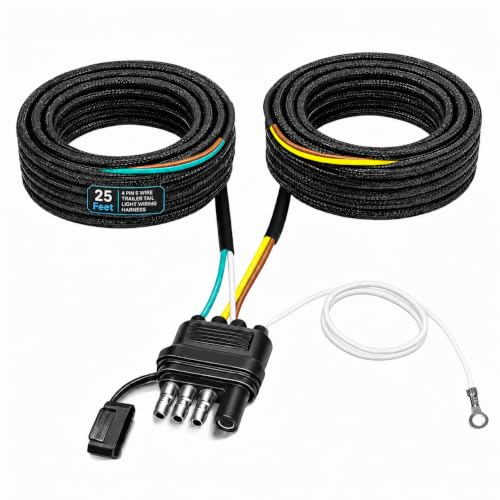
A 5-wire wishbone harness wrapped in black nylon mesh for extra all-weather toughness.
This kit takes the standard 4-pin flat trailer harness and adds a fifth ground wire, giving you a dedicated ground circuit that reduces the chance of erratic light behavior from a bad frame ground. The 25-foot main cable is reinforced with a black nylon mesh outer tubing over the PVC-insulated wires — an upgrade over bare PVC that adds abrasion resistance when routing through a trailer frame or along the underside of a tow dolly. It includes a waterproof dust cover for the 4-pin plug and 2.5 feet of bonded ground wire for a clean connection.
Customers note this as “just what I needed” for rewiring a 12-foot trailer and a used tow dolly, and the Y-shaped wishbone design splits cleanly to reach both sides. The 18 AWG wire is identical in gauge to the VINAUO harness above, so current capacity is comparable, but the mesh sleeve gives it a real edge if you are pulling the wire through a rough channel or over sharp metal. One owner noted the ground wire loop is small and had to be swapped for a larger ring terminal — a minor fit issue to check before your installation.
Extra physical protection: the black nylon mesh sleeve over the cable bundle makes this the most physically rugged 18 AWG wishbone kit here.
Reach for this if: you are pulling the harness through an enclosed trailer frame rail or metal channel and want more abrasion resistance than bare PVC wire.
Consider the 35-foot kit above if: your trailer is longer than 20 feet — 25 feet may come up short for bigger boats or 30-foot utility rigs.
8. Nilight 2 PCS 16 AWG 20 Feet Wiring Harness Extension Kit

Two 20-foot extension cables for stretching an LED light bar harness into the bumper.
This is not a standalone wiring harness — it is an extension kit designed to lengthen an existing harness for off-road LED light bars, pods, or driving lights. You get two 20-foot runs of 16 AWG stranded copper wire with a thick PVC jacket rated to 105°C, plus plug-and-play connectors that mate directly with standard Nilight-style harnesses and rocker switch panels. The 16 AWG gauge is thicker than the standard 18 AWG found on many light-bar harnesses, which helps prevent voltage drop over the extra 20-foot run.
Owners who have installed these on full-size pickups report they have “plenty to spare” for routing from the engine bay to a front bumper or roof rack. The rubber over-molding on the connectors seals out moisture and the wire is flexible enough to route through firewalls and fender gaps. The one honest note from owners is that the 16 AWG wire feels closer to 18 AWG in hand — it is not heavy-duty battery cable, but it is adequate for LED lighting loads that typically draw 3-5 amps. If you are running a 300-watt light bar, size up to a 14 or 12 AWG dedicated feed.
Plug-and-play reach: two 20-foot extensions with matched connectors turn a short light-bar harness into a cable that reaches the far end of a long truck bed or bumper.
Reach for this if: you already own a Nilight-style LED light bar harness and need to extend it another 20 feet to reach the installation point.
it’s not for you if: you need a standalone trailer wiring harness or a full-length spool for a custom project — this is a purpose-built extension, not a primary wire roll.
9. Aufind 30FT 4 Pin 5 Wire Trailer Wiring Harness Kit
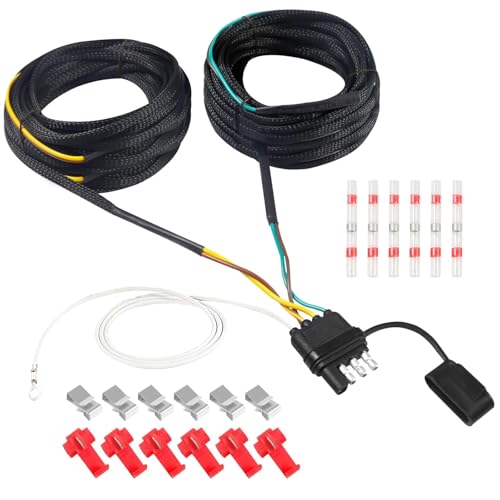
A well-rounded 30-foot wishbone kit with tinned wire ends and all the accessories included.
This kit uses 18 AWG pure copper (not CCA) wire with a thickened PVC coating reinforced by a black braided nylon mesh outer layer — the same kind of physical protection as the FZSFVAQ kit above, but at 30 feet rather than 25. The 5-wire configuration (left turn, right turn, tail, ground, plus a dedicated auxiliary) gives you a full trailer circuit plus an extra conductor for a backup light or side marker. The exposed wire ends are tinned, which means they resist corrosion at the splice point and solder more easily than bare copper.
Owners call it “easy to install” and report using it to completely rewire boat trailers with great success. The kit also includes six trailer frame wire clips, six solder seal wire connectors, and six plastic wire connectors — everything you need for the job except a crimping tool. At 30 feet it splits the difference between the 25-foot kit and the 35-foot VINAUO harness, fitting most boat and utility trailers up to around 25 feet long with room to spare. The pure copper conductors and braided nylon sleeving give this kit a noticeably more substantial feel than the bare-basics 18 AWG wishbone harnesses.
Accessories included: tinned wire ends and a full set of clips and connectors make this the most complete all-in-one kit for a quick weekend trailer rewire.
Reach for this if: you want a 30-foot wishbone harness with the durability of braided nylon mesh, pure copper conductors, and pre-tinned splice ends — all in one box.
Think twice if: you need wire longer than 30 feet or prefer 14 AWG for maximum voltage headroom on a very long trailer run.
Understanding the Specs
Gauge (AWG)
The American Wire Gauge number tells you how thick the conductor is — smaller numbers mean thicker wire. A 14 AWG wire carries more current and drops less voltage over a long run than an 18 AWG wire, which is why 14 AWG is the favorite for full trailer rewiring and 18 AWG works for shorter standard trailer harnesses. If you are running multiple lights or a long cable path, size up to 14 or 12 AWG to keep the voltage stable at the far end.
Strand Count
This is the number of individual copper (or CCA) strands twisted together inside the insulation jacket. More strands — like the 150-strand wire in the NAOEVO silicone kit — make the wire more flexible and resistant to fatigue from vibration. Fewer strands (10 or 19) in an 18 AWG wire are stiffer and more prone to break if bent repeatedly in the same spot. For trailer wiring that runs along a chassis that flexes on the road, a higher strand count is always worth having.
Tinned Copper vs. CCA
Tinned copper wire is bare copper dipped in a thin tin layer that resists the oxidation and corrosion caused by moisture, salt, and road spray. It costs more but lasts longer in marine, RV, and exposed automotive installations. Copper-clad aluminum (CCA) is an aluminum core with a copper outer layer — cheaper, lighter, but more prone to corrosion and breakage if the insulation is damaged. For dry indoor or sealed-trailer wiring, CCA is fine. For outdoor or boat-trailer use, tinned copper is the right material.
Wishbone vs. Individual Spools
A wishbone harness is a pre-assembled cable with multiple conductors bonded together, split at one end into two runs for the left and right trailer lights. It is the fastest way to rewire a standard trailer because the colors are pre-mapped and the 4-pin flat plug is already attached. Individual spools give you the freedom to build a custom harness for a boat, RV, or car project with exactly the wire lengths and colors you need — but they require you to crimp your own connectors and route each conductor yourself.
FAQ
Can I use regular household electrical wire for trailer wiring?
What gauge wire should I use for a 20-foot trailer?
How do I decide between a wishbone harness and individual spools?
Is copper-clad aluminum (CCA) wire good enough for trailer lights?
How long does trailer wiring typically last?
What is the difference between a 4-wire and a 5-wire trailer harness?
Can I splice trailer wire with regular twist-on wire nuts?
How many strands of wire do I need for a flexible harness?
What voltage do these trailer wires handle?
Can I use 12 AWG wire for trailer lights?
Final Thoughts: The Verdict
For most users building a custom harness, the wiring for a wiring harness winner is the NAOEVO 14 Gauge Tinned Copper Spool because it combines the corrosion resistance of tinned copper, the flexibility of 41 strands, and a crowd-favorite 4.8-star satisfaction rate across more than 500 owners. If you want a ready-to-run trailer harness that installs in an afternoon, grab the VINAUO 35-foot Wishbone Kit. And for heavy-duty or high-current circuits, the BABOOM BABOOM 12 AWG 600-foot Multi-Pack is the one to reach for.
How We Picked
We do not accept paid placement. Every pick is matched to a real buyer and a real use-case; we do not hands-on test units.
Sources & Methodology
Specifications: manufacturer listings and product documentation. Review insights: verified customer reviews, as of July 2026. Pricing: not shown on this page (it changes often); check the current price via the retailer link.
As an Amazon Associate, GoCarLife earns from qualifying purchases. This does not affect which products we feature.