
Our readers keep the lights on and the garage heater humming. As an Amazon Associate, I earn from qualifying purchases.
Specs are compiled from manufacturer listings and verified buyer reviews and can change over time — please confirm the key details on the product page before buying.
Pulling a deep vacuum is non-negotiable on any HVAC or refrigeration job. A wireless vacuum gauge lets you watch the micron level fall from your phone, so you are not crouched by the pump waiting for the needle to settle. The trouble is that not all of these tools hold a seal or read accurately below 500 microns — getting a false pass on a decay test can cost you a callback weeks later. This guide breaks down the real-world accuracy, leak-holding ability, and app connectivity of the top wireless vacuum gauges so you know which one earns a spot in your tool bag.
I’m Mo Maruf — the founder and writer behind GoCarLife. This guide is built by comparing the manufacturers’ published specifications and the patterns across verified customer reviews, so you get each pick’s real strengths and trade-offs instead of marketing spin.
Whether you are commissioning a mini-split or servicing a commercial rack system, the right wireless vacuum gauge is the difference between a confident evacuation and a system that never fully dries out.
Our Picks at a Glance


How To Choose The Best Wireless Vacuum Gauge
A wireless vacuum gauge must read accurately below 200 microns, hold a seal, and log decay tests via its app. You need a sensor that reads accurately under 200 microns, a housing that does not leak, and an app that logs the decay test. Here are the three specs that separate a reliable tool from a frustrating one.
Accuracy and Sensor Type
Look for a gauge that claims accuracy within a tight margin below 1000 microns. Some use Pirani or thermal-conductivity sensors, others use a simple diaphragm. The best gauges can resolve down to a single micron. An accuracy spec like ±10 micron + 10% of reading (in the 100-1000 micron range) tells you the gauge will not fool you when you are trying to hit 300 microns for a mini-split.
Leak-Proof Construction and O-Ring Quality
A gauge that leaks internally is useless. The seal at the 1/4 SAE port and the body itself must hold vacuum when isolated. The most frequently mentioned failure across owner reports is a gauge that shows rising microns when it should be holding steady. A metal or reinforced polymer body with a serviceable filter is a clear sign the manufacturer expects the tool to survive daily commercial use.
App Capability and Data Logging
A wireless gauge should let you see real-time readings on your phone from across the jobsite. The best apps let you log the entire evacuation curve, set alarms for target micron levels, and export a PDF or Excel report for the customer. A gauge that only mirror-reads on the app is better than nothing, but one that stores offline data and generates reports is the difference between a tool and a professional system.
Quick Comparison
| Model | Best For | Accuracy | Bluetooth Range | Weight | Amazon |
|---|---|---|---|---|---|
| Fieldpiece SM480V★ Best Overall | All-in-one manifold replacement | Onboard micron gauge | Job Link system | 6.2 lbs | Amazon |
| Elitech VGW-MiniBudget Champion | Budget-conscious DIY and light pro | ±10% or ±10 micron | App connect | 7.36 oz | Amazon |
| Testo 552iPro Accuracy | Accurate deep vacuum for mini-splits | ±10 micron + 10% | 40+ ft typical | Lightweight | Amazon |
| Fieldpiece MG44 | Standalone wireless micron gauge | 50 to 2000 micron range | 1000 ft line of sight | 13.44 oz | Amazon |
| Appion AV760 | Industrial and commercial reliability | 1 to 760,000 micron | ~50 ft | 16 oz | Amazon |
| Testo Smart Probe Kit | Complete HVAC/R probe system | Single-digit vacuum | 350 ft | 3.5 lbs | Amazon |
| Fieldpiece SM482V | Advanced digital manifold with data logging | Built-in vacuum gauge | Job Link system | N/A | Amazon |
In‑Depth Reviews
1. Fieldpiece SM480V SMAN Digital Manifold
Our pick — over 4.5★ from 700+ verified ratings; the strongest balance of quality and price.
The four-valve manifold that folds a vacuum gauge and data logging into one rugged package.
This is the tool that replaces pipe clamps, thermometers, and a separate micron gauge all at once. The onboard vacuum gauge matches the reading of a dedicated Bluvac Pro, according to experienced techs, and the temperature-compensated tightness test (pdif) gives you a fast leak-check without waiting for a full decay. The four-valve block means you can recover, evacuate, and charge without swapping hoses — a real time-saver on commercial racks where every minute counts.
Owners consistently praise the SM480V for its build quality and how it simplifies daily workflow. A 45-year heavy-duty technician confirmed the tightness test is especially valuable for nitrogen leak checks, adding that the SM480V replaces the need for a separate set of tools. It survived a heavy downpour on a roofs with no damage, which speaks to the rugged ABS plastic build. The catch: the carrying bag is soft and cumbersome when clamps are attached, and the price reflects a serious investment that only makes sense for techs who pull vacuum daily.
Fieldpiece digital manifold
- Saves time by eliminating gauge changes for adding refrigerant
- Onboard vacuum gauge matches dedicated micron gauge accuracy
- Tightness test (pdif) provides fast leak detection
Heavy and pricey
- Expensive — best for pros who need it every day
- Bag is soft and cumbersome with clamps attached
daily driver: you work on commercial or residential systems full-time and want one manifold that handles diagnostics, vacuum, and charging.
tight budget: you only need a standalone micron gauge for occasional mini-split work — the price is hard to justify for light use.
2. Elitech VGW-Mini Wireless Digital Vacuum Gauge
A low-cost entry point that covers the full micron range from atmosphere to hard vacuum.
The VGW-Mini packs an impressive measurement span — 19,000 microns down to 0 — and communicates through the Elitech Tools app on both iOS and Android. You can set a target micron level and receive a notification when the system hits it, and the data can be exported as Excel or PDF for job documentation. At just over 7 ounces and measuring 4.9 x 1.4 x 1.1 inches, it is small enough to tuck into a pocket or a spare hose slot in your bag. The large LCD screen gives you a clear readout without needing the phone.
The real selling point is cost — the price makes a proper evacuation check accessible to a DIY homeowner installing a mini-split. The app monitoring works well for checking progress while you work elsewhere on the install. However, the reliability record is mixed: the most common complaint is a gauge that stops working after just a few uses, often showing a stuck reading or failing to hold vacuum below 3000 microns. The included filter can trap oil, but replacing it does not always restore function. Budget-friendly is the right label, but expect variability. The cost is low enough that some owners treat it as disposable. skip it if you need a gauge that survives daily commercial punishment.
light duty: DIY homeowners and occasional pro use where the low entry price outweighs the risk of early failure.
heavy use: you need a tool that reliably holds vacuum for decay tests day after day on commercial jobs.
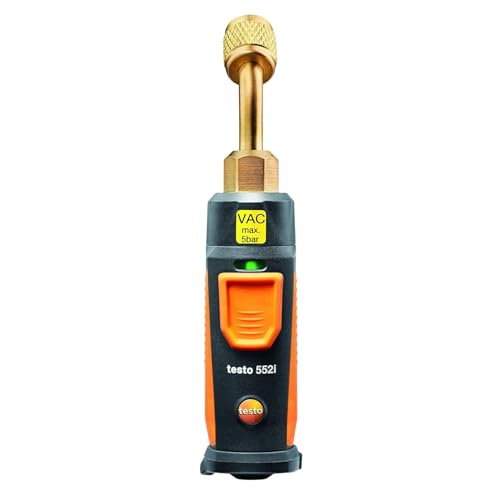
3. Testo 552i Wireless Digital Vacuum Probe
The compact probe that nails single-digit microns and talks to your phone without fuss.
The 552i delivers the kind of accuracy a serious installer trusts: ±10 micron + 10% of the measured value in the 100-1000 micron range. That means when you are chasing 300 microns on a mini-split, you can be confident the gauge is not lying to you. The 45-degree integrated service-port design makes it easier to screw onto a tight port without a separate adapter, and the IP54-rated housing keeps moisture and dust out during outdoor evacuations. It uses a single service port and automatically pairs with Testo digital manifolds if you are already in that ecosystem.
Accuracy is the most-praised aspect across hundreds of owners — techs report achieving 200-300 microns consistently and note that a leak-free system shows a rise under 500 microns over 10 minutes. The Smart App saves logged data and generates reports for customers. The main limit is that it ships without the 90-degree or 5/16 adapters needed for some mini-split service valves, so budget for those separately. Also, keep the sensor clean — nylog contamination can throw readings until wiped with alcohol. Do not exceed 300 PSI on the sensor.
go-to gauge: mini-split and residential system evacuations where single-digit micron accuracy and easy app reporting matter most.
no phone: techs who need a complete manifold replacement — this is a standalone probe, not a gauge set.
4. Testo 552 I Digital Vacuum Gauge

A standalone micron gauge that pairs long wireless range with three ways to view your data.
The MG44 is built for techs who want a dedicated wireless vacuum gauge without buying into a full manifold system. It reads from 50 to 2000 microns directly on its backlit LCD, and you can switch the display between a numeric value, a bar graph, or a rate meter to see how fast the vacuum is pulling. The reversible angled coupler is a genuinely clever design — it screws on at a 45-degree angle in either direction, so you can fit it into tight condenser compartments without kinking the hose. The 2.4 GHz radio claims a 1000-foot line-of-sight range, though owners note the real-world range through walls is closer to 30 feet.
You get a gauge that owners call noticeably more reliable than cheaper alternatives like the CPS VG200, with 33 reviewers praising its build quality. It holds a steady decay test (a check for system leaks) under 1000 microns over 10 minutes, so you can trust the reading during a long evacuation. A marine AC technician reports using it successfully in tight engine-room spaces. The biggest functional issue is a split among owners about leak-proofing — some have had units fail within two weeks, and there is disagreement about whether the seal is reliable when the coupler is not perfectly tightened. The 40-hour battery life on alkalines is solid, but the auto-off feature can be frustrating if you are in the middle of a long decay test.
pick for jobs: you want a standalone, Job Link-compatible gauge with excellent battery life and a flexible reversible coupler.
small spaces: you need a guaranteed leak-proof seal for every single job — quality control on seals is not 100%.
5. Appion AV760 Full Range Digital Vacuum Gauge
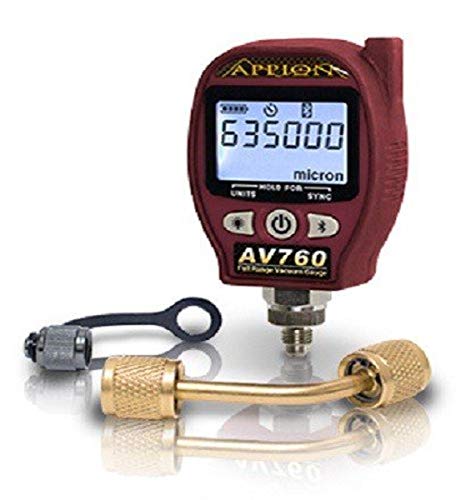
A water-resistant, full-range gauge with sensor protection that survives commercial abuse.
The AV760 covers the entire span from atmospheric pressure (760,000 microns) down to a single micron, using a thermal-conductivity sensor rather than a standard diaphragm. The IP65-rated rubberized housing is built for wet conditions, and the built-in filter and oil catch protect the sensor from the contamination that kills cheaper gauges. Appion is known in the refrigeration world for tools that outlast the competition, and the AV760 feels like it was designed for a commercial van floor: sturdy metal and plastic construction, clear display, and a responsive Bluetooth app that logs the evacuation curve and produces a decay-test proof.
Reliability is the standout story here. Owners who have used the gauge for six months of daily commercial work say it performs consistently, and a fleet of over a dozen units reportedly passes calibration every time. The two-layer filter protection is a real advantage if you ever back-fill through a contaminated hose. However, there is a known quirk: Bluetooth activation causes the micron reading to jump about 15-20 microns (for example, 250 to 271). This is a normal effect of the RF interference and does not affect the final reading once you know about it. The first unit for some owners arrived with a defect (stuck at 25 or 43 microns), so Appion’s quality control on early production was not perfect. At a premium price point, it is a tool for serious commercial techs only.
reach for accuracy: you work commercial refrigeration or heat pumps daily and need a water-resistant, full-range gauge with a proven filter system.
wireless need: your budget is tight or you only need a gauge for occasional residential mini-split work.
6. Testo Smart Probe Kit (115i & 549i)
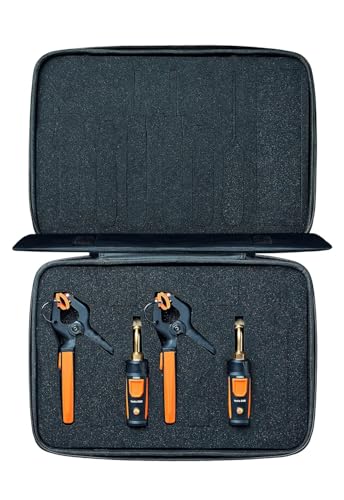
A complete wireless gauge set that turns your phone into an HVAC/R diagnostic center.
This is not a single gauge — it is a system. The kit includes two Testo 115i pipe clamp thermometers (NTC sensors, more accurate than thermocouples) and two Testo 549i high-pressure gauges with 45-degree connectors for low-loss connection. Together they cover superheat, subcooling, pressure, and temperature measurement, all streamed to the free Testo Smart Probes App. The 549i boasts a 350-foot Bluetooth range, which means you can set the probes on the outside unit and monitor readings from the attic or the basement.
What wins owners over is the quality of the build and the ease of setup. Techs who have used analog gauges for years say the Bluetooth connectivity is fast and the app display is intuitive. One daily user calls it a standout because he can set up on the compressor and then move freely around the building without carrying hoses. Battery life is strong with standard AAA batteries, which are easy to find on the road. The clear downside mentioned most is the Bluetooth range — while the 549i claims 350 feet, the 115i clamps are weaker, and some users report disconnections when moving more than one room away. Also, this kit does not include a vacuum gauge (you would add the Testo 552i separately), so if your main job is evacuation, buy the 552i as a complement.
ideal for diagnostics: techs who want a complete wireless diagnostic kit for charging, superheat, and pressure checks across multiple jobs per day.
single gauge: evacuation is your primary need — this set lacks a dedicated vacuum gauge and requires a separate purchase.
7. Fieldpiece SM482V Wireless 4-Port SMAN Refrigerant Manifold

The latest Fieldpiece four-port manifold that streams data to your phone while you work.
The SM482V takes the SM480V formula and adds a vacuum gauge and data-logging capability. The four-valve block handles recovery, evacuation, and charging without pulling your hoses off, and the built-in micron gauge lets you monitor the vacuum level directly on the manifold screen. The Job Link app extends that data to your phone, making it possible to check subcool or vacuum from the attic while the manifold stays outside. The temperature-compensated system tightness test is one of the features that professional techs use most to confirm a leak-free system.
Quality is what owners lead with — Fieldpiece has a reputation for rugged tools, and the SM482V is described as extremely well-made with a clear, easy-to-read display. The ability to log data and monitor from a remote location is a real productivity boost on commercial jobs. However, a recurring note from experienced users is that the built-in vacuum gauge can show inconsistent readings due to refrigerant evaporation in the hoses (a sawtooth pattern from 200 to 350 to 400 microns). This is not a leak — the system holds solid microns when isolated — but it makes the onboard vacuum gauge less reliable as the primary evacuation tool. Owners recommend using the SM482V for charge monitoring and adding a dedicated wireless micron gauge on separate vacuum hoses for the final evacuation check.
right pick: experienced techs who want a high-quality digital manifold with remote monitoring and data logging for commercial work.
long runtime: the onboard vacuum gauge is better suited as a backup — keep a dedicated standalone gauge for critical decay tests.
Understanding the Specs
Accuracy Specification
Look for a spec like ±10 micron + 10% of reading in the 100-1000 micron range. That means at 500 microns, the gauge is accurate within about 60 microns total. A gauge that is only accurate to ±10% above 1000 microns may give you a false sense of achievement if you rely on it for deep vacuum decay testing.
Decay Test (Rise Test)
A decay test measures how much the vacuum rises after you isolate the gauge from the pump. If it rises more than 500 microns in 10 minutes, moisture is likely boiling out of the oil or there is a leak in the system. The best wireless gauges log this automatically and show you the curve on the app.
Bluetooth Range
Advertised range figures (350 feet, 1000 feet) are line-of-sight with no obstacles. Through building materials like drywall and concrete, expect 20-40 feet. A gauge that drops connection mid-evacuation is frustrating, so look for models with strong 2.4 GHz radios and apps that re-pair quickly.
Sensor Protection
Vacuum sensors are delicate. A built-in filter or oil catch prevents refrigerant oil, nylog, and debris from blocking the sensor port. Without it, you risk a false reading or a completely dead gauge after one contaminated back-fill.
FAQ
What is a good target micron level for an HVAC system?
Does a wireless vacuum gauge need an app to work?
Will a wireless vacuum gauge fit on a mini-split service port?
Why does my micron gauge reading jump when I turn on Bluetooth?
Can I use a wireless vacuum gauge with a standard vacuum pump?
How do I clean a contaminated vacuum gauge sensor?
What does the decay test (rise test) tell me?
Is a manifold with a built-in vacuum gauge better than a standalone gauge?
How long do the batteries last in a wireless vacuum gauge?
Can I export data from a wireless vacuum gauge to share with a customer?
Final Thoughts: The Verdict
For most people, the wireless vacuum gauge winner is the Testo 552i because it delivers proven single-digit accuracy in a compact, IP54-rated body that pairs easily with a free app for full data logging. If you want a complete multi-tool manifold with an onboard vacuum gauge, grab the Fieldpiece SM480V — it replaces several tools and is built for daily commercial use. And for a budget-friendly entry point that still covers the full micron range, the Elitech VGW-Mini is the one to reach for, though its reliability varies. The Testo 552i holds a 4.4-star rating across nearly 500 owners, giving you confidence to pull a deep vacuum on every install.
How We Picked
We do not accept paid placement. Every pick is matched to a real buyer and a real use-case; we do not hands-on test units.
Sources & Methodology
Specifications: manufacturer listings and product documentation. Review insights: verified customer reviews, as of July 2026. Pricing: not shown on this page (it changes often); check the current price via the retailer link.
As an Amazon Associate, GoCarLife earns from qualifying purchases. This does not affect which products we feature.