
Our readers keep the lights on and the garage heater humming. As an Amazon Associate, I earn from qualifying purchases.
Specs are compiled from manufacturer listings and verified buyer reviews and can change over time — please confirm the key details on the product page before buying.
If you tow a trailer, the single most important safety upgrade you can make is a brake controller that matches the way you drive. The problem is, most controllers require drilling into your dash, running heavy-gauge wires through the firewall, and half an afternoon of frustration. A wireless trailer brake controller fixes that, letting you install the unit in minutes and often control everything from your phone. The key spec that separates the good from the average is the type of accelerometer — a triple-axis sensor gives you the smoothest, most proportional braking, so your trailer slows down with you rather than shoving you through an intersection.
I’m Mo Maruf — the founder and writer behind GoCarLife. This guide is built by comparing the manufacturers’ published specifications and the patterns across verified customer reviews, so you get each pick’s real strengths and trade-offs instead of marketing spin.
The shortlist below covers the six best models you can buy today, from portable plug-and-play units to hardwired premium systems. You will know exactly which wireless trailer brake controller fits your truck, your trailer, and your budget before you buy a thing.
Our Picks at a Glance


How To Choose The Best Wireless Trailer Brake Controller
A trailer brake controller is a safety device that tells your trailer’s electric brakes when to engage. Getting the right one means understanding how it senses the world and how it talks to you.
Proportional vs. Time-Delayed Braking
The most important decision is how the controller measures your stopping force. A proportional controller uses an internal accelerometer — a motion sensor that detects how quickly you are slowing down — to send a matching amount of power to the trailer brakes. That gives you smooth, natural stops that feel like part of the vehicle. A time-delay controller sends a fixed burst of power every time you hit the pedal, which can grab or jerk the trailer. For any load over a few thousand pounds, proportional is the safer, more comfortable choice.
Mounting Style: In-Cab, Portable, or Trailer-Mounted
Where you put the controller changes how you install it and how portable it is. In-cab units bolt under the dashboard and connect to your vehicle’s factory wiring with a plug-and-play harness; they look factory-fresh but stay in one truck. Portable units like plug-and-play dongles clamp between your 7-way connector and the trailer — you move them between vehicles in seconds and use your phone as the display. Trailer-mounted controllers sit on the tongue of the trailer and communicate wirelessly with a small remote inside your cab; they are the least intrusive because you never wire into your truck at all.
Bluetooth and App Reliability
Most modern wireless controllers let you adjust settings, monitor diagnostics, and store multiple trailer profiles from a smartphone app. That is incredibly convenient — until the Bluetooth drops. Look for a controller that still holds your last braking profile if the phone disconnects, so you are not left with zero trailer brakes on a busy highway. A triple-axis accelerometer helps here because it maintains proportional braking independently of the phone, even if a call interrupts the connection.
Quick Comparison
| Model | Best For | Braking Type | Mount Style | Axle Capacity | Amazon |
|---|---|---|---|---|---|
| Blue Ox Patriot 3★ Best Overall | Best Overall | Proportional | In-Cab (Portable) | 1–4 axles | Amazon |
| Plug and Tow AutowbrakeZero-Wire Cabin | No Interior Wiring | Proportional | Trailer-Mounted | 1–4 axles | Amazon |
| TEKONSHA Prodigy iD | OEM Integrated Look | Proportional | In-Cab (Hardwired) | 1–4 axles | Amazon |
| CURT Echo (Portable) | Rental or Multi-Vehicle Towing | Proportional | Plug-and-Play | 1–2 axles | Amazon |
| FEITON 90195 | Budget-Friendly | Proportional | In-Cab (Hardwired) | 1–4 axles | Amazon |
| CURT Echo Under-Dash | Compact Ford/Jeep Fit | Proportional | In-Cab (Under-Dash) | 1–4 axles | Amazon |
In‑Depth Reviews
1. Blue Ox BRK2019 Patriot 3 Brake System
Our pick — over 4.5★ from 350+ verified ratings; the strongest balance of quality and price.
The portable in-cab unit that owners call the easiest install of any system — no drilling, no guessing.
You get smooth, proportional braking from a small controller that clamps over your brake pedal and runs on 12V from a cigarette outlet. That means you can move it between vehicles in seconds, which is a lifesaver if you tow with more than one truck. The company claims an extended RF range — the wireless link between the pedal sensor and the trailer stays solid even on long, winding roads. Owners who have used it across thousands of miles confirm the reliability; one report describes towing a Jeep Wrangler over 2,000 miles and noticing a clear improvement in stopping distance, even though no emergency stop was needed. Another owner racked up 6,000+ miles through mountain terrain and says the braking assist was noticeable and consistent. The breakout into three separate components — the in-cab unit, the RF module, and the trailer-mounted actuator — means you spend minimal time under the dash.
The primary constraint is not mechanical but physical: the unit sits on the floorboard near the brake pedal, and some owners find it temperamental to position. In one instance with a Jeep Wrangler Rubicon, the controller required multiple repositioning attempts and seat adjustments to get the green ready-light. Once it is set, it stays set, but that initial placement can be fiddly in a tight cab.
Why owners grab it
- Install wins every conversation — installation is the single most-praised aspect (28 positive mentions) because you only hook a claw over the brake pedal and plug into power.
- The braking performance earns strong marks; the controller applies braking smoothly and adapts to varying trailer weights, so you do not get the grabby, jerky stops common with time-delay units.
- Portability is a genuine advantage — you can stash it in the glove box and use it in a rental, a spare truck, or a borrowed RV without any permanent wiring.
The honest limits
- Floorboard placement can be finicky — the sensor must sit level and in the right spot, which may take a few tries in tight driver footwells like the Jeep Wrangler.
- If you disconnect power, the unit loses its setup and needs recalibration, so it is not a true set-and-forget device.
Your best move if: you want the simplest possible install that still delivers full proportional braking and can travel between vehicles without a tool.
Think twice if: your footwell is cramped or you hate the idea of a small box sitting near your pedals — a trailer-mounted unit may suit your cab better.
2. Plug and Tow Autowbrake Trailer Mounted Electric Brake Controller
The controller lives on the trailer tongue, so you never run a single wire inside your truck.
This is the most radical departure from the norm: the entire braking brain mounts directly on the trailer, communicating with your cab via a small wireless remote (key fob). That means zero dash wiring, zero firewall penetration, and zero cables to hide. The unit operates proportionally using its own accelerometer, so it feels smooth whether you are towing a car dolly or a 6,000-pound travel trailer. Owners consistently praise the ease of installation — the top two praised aspects are functionality (17 positive mentions) and installation (16 positive mentions). It simply bolts to the trailer tongue, connects to the running-light circuit for power, and you are done. One owner installed it on a 1977 Chevy K20 and was back on the road in under an hour.
The trade-off is that the remote fob is basic. It has three modes and six levels, but you get no screen feedback on which setting is active — you have to stop and look at the fob or memorize the clicks. There is also a slight delay in brake apply and release that one owner described as roughly one second, which can feel sluggish in stop-and-go traffic. The company backs the unit with a free 3-year warranty, which is reassuring for a device exposed to road salt and weather.
Why it stands out
- Absolutely no interior wiring — ideal for leased vehicles, motorhomes, or anyone who dislikes messing with the factory dash.
- Works in all-weather conditions and auto-switches to sleep mode if another brake controller is detected on the same vehicle.
- Customer service from the manufacturer is a major theme; buyers report getting after-hours support and video-call troubleshooting from the company’s founder.
What to know before buying
- No screen on the remote — you set the braking level via clicks on the fob with no confirmation display, so it can be hard to tell what mode you are in while driving.
- A fraction of a second delay between pressing the brake and the trailer responding is noticeable to some, particularly in city traffic.
Reach for this when: you do not want to touch your vehicle’s wiring at all — perfect for motorhomes, rentals, or anyone who switches trailers frequently.
skip it if: you want a real-time brake-force display while driving, or you are sensitive to any lag in trailer response.
3. TEKONSHA 90920 Prodigy iD Smart Phone Configured Brake Controller

The only controller here that lets you set every braking parameter from your phone and still get a factory-installed look in the dash.
This is the tech-forward pick. TEKONSHA’s EDGE app lets you program power output, boost level, and braking type from an Apple or Android device, so you do not have to bend under the dash to fiddle with tiny dip switches. The real highlight, though, is the aesthetic: a large rotary knob mounted in your dashboard that looks like a factory option, while the control module stays hidden behind the dash. The crowd favorite feature is that large knob — it is much easier to operate while driving than the tiny thumbwheels on older controllers. Owners also note that the braking is smooth and the unit actively corrects trailer sway, which is a critical safety feature on windy highways. One report describes towing a 7,000-pound trailer 300 miles with a Lincoln Navigator and calling the braking “smooth” and the sway correction effective.
The Achilles heel is the Bluetooth app. Multiple owners describe it as “janky” — it works after the initial setup but has occasional connection hiccups. The mounting bracket also receives mixed feedback; the controller is described as tricky to mount perfectly level, and the knob itself feels a bit cheap with some mechanical play. The wiring harness (sold separately) is necessary, and for a unit in this price range, the all-in cost climbs quickly.
The big knob advantage: the oversized rotary dial makes on-the-fly adjustments intuitive and safe while driving — no phone distraction needed once it is set.
The app headache: the Bluetooth pairing can be frustrating during first setup, and the app interface itself feels laggy; once configured, the unit holds its settings independently, so you rarely need the app again.
Who it fits: anyone who wants the cleanest, most integrated factory look in their vehicle and likes the idea of smartphone programming.
Who should pass: drivers who do not want to deal with an iffy app or who prefer a fully physical control interface without a phone dependency.
4. CURT 51180 Echo Mobile Bluetooth Trailer Brake Controller
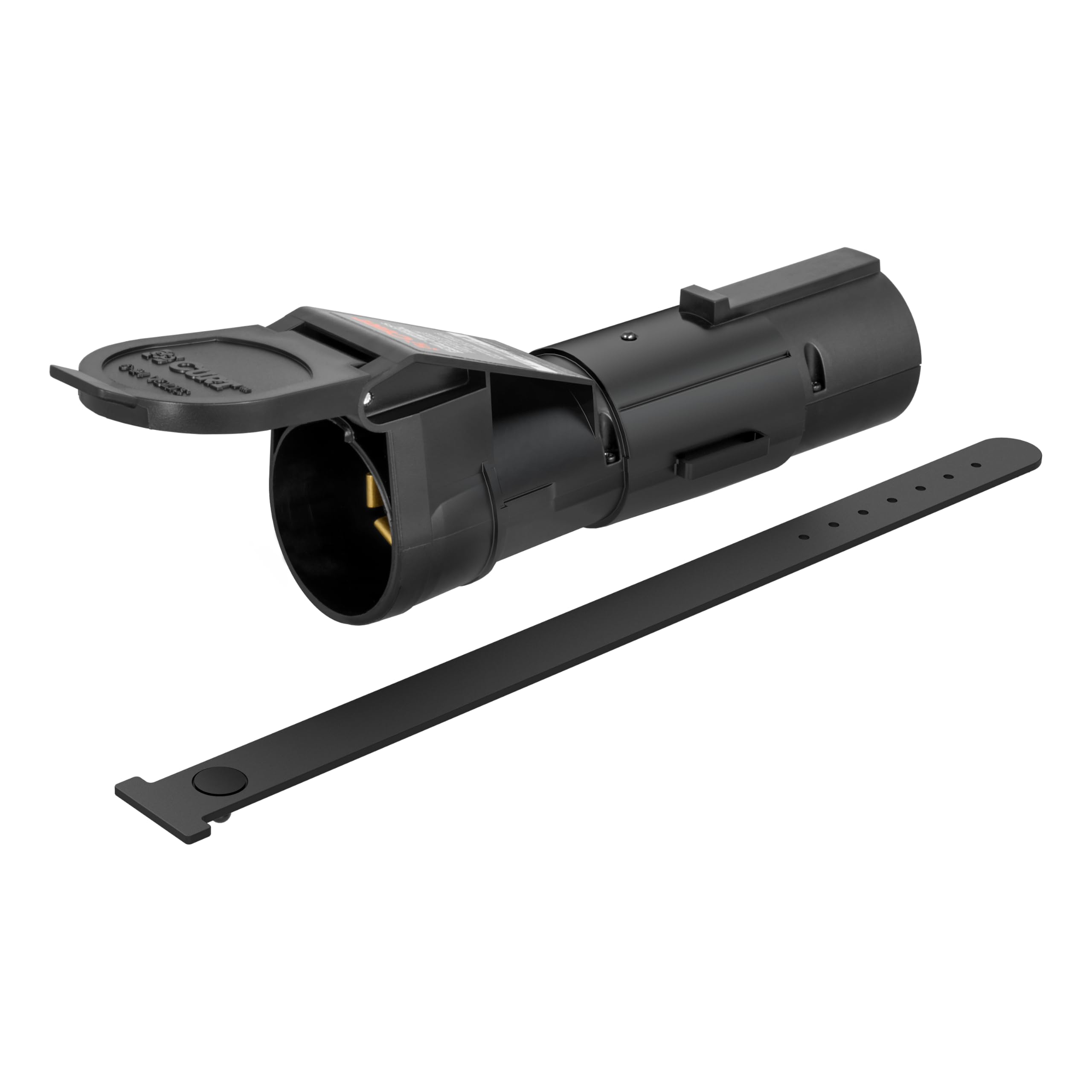
The plug-and-play dongle that swaps between vehicles faster than you can say “7-way connector.”
This is the most popular portable controller on the market for a simple reason: it takes zero tools, zero permanent wiring, and zero drilling. You plug it between your vehicle’s 7-way RV blade connector and the trailer, download the Smart Control app, and you are towing with proportional braking. The innards are protected by a potted circuit board (the electronics are encased in a weather-resistant resin), so it survives rain and road spray. The triple-axis accelerometer keeps braking proportional even if your phone screen locks, a call comes in, or Bluetooth disconnects entirely — the last saved profile stays active. That is a critical safety feature that many Bluetooth-only controllers lack.
The biggest cluster of feedback here is mixed connectivity — some owners find the Bluetooth connection unreliable, and the physical unit sticks out behind the truck’s 7-way connector, making it vulnerable to road debris and requiring a bungee or strap to secure it. A small number of units fail prematurely (under a year), usually due to a broken power pin or water ingress past the locking tab. Despite those issues, the sheer volume of positive feedback — functionality (495 positive mentions) and ease of use (302 positive mentions) — tells you that for most owners, it just works. It is the obvious pick for towing with a rental truck, a borrowed SUV, or your own multi-vehicle fleet.
What makes it the crowd favorite
- Zero-tool install — pops onto any 7-way connector in seconds and stores multiple vehicle-trailer profiles in the app.
- Highly responsive triple-axis accelerometer — has enough independent intelligence to maintain proportional braking even when the phone disconnects.
- Portable enough to move between three trucks over four years of use, a common real-world pattern reported by owners.
The known compromises
- Bluetooth connectivity is the most-discussed mixed aspect — it works reliably for many but drops signal for a significant minority.
- The long body (6.63 inches) hangs low, risking impact with the ground on steep driveways unless you secure it with a bungee or zip tie.
Reach for this if: you tow with multiple vehicles, sometimes rent a truck, or want a controller that installs in 30 seconds without touching a tool.
Look elsewhere if: you are nervous about Bluetooth reliability as a sole control method, or your trailer connector sits low to the ground where the dongle could scrape.
5. FEITON 90195 Electric Proportional Trailer Brake Controller Kit Wireless

A budget-friendly in-cab controller that gives you adjustable boost levels and a colorful LCD screen.
For less than many portable dongles, you get a full proportional controller with a customizable multilingual LCD display (English, French, Spanish) and a manual lever you can grab to apply the trailer brakes independently of the pedal. That manual brake is a genuinely useful tool for burnishing new brake shoes or checking connection. The boost feature has three levels of sensitivity, so you can tune how aggressively the controller responds to a heavy trailer load. Reliability is the top praise — 19 positive mentions — and installation is described as quick and clean by most owners.
However, the long-term reliability data is thin. There is a significant minority of owners reporting failures: one unit gave an “output to ground” error message after 30 minutes, leading the owner to return it. Another never shuts off as advertised — it keeps drawing power instead of entering its promised 15-minute sleep mode. The customer-say summary flags these as isolated examples, but they are more frequent than you see with the TEKONSHA or Blue Ox units. For the price, the risk may be acceptable, but this is not the pick for a trip where a controller failure would ruin your vacation.
What works: the proportional braking is smooth for a controller at this price point, and the LCD screen — with adjustable contrast and color — is a welcome feature in a dark cab.
The reliability risk: a few owners hit early failures or power-off issues, so you are buying a feature-rich unit that carries a higher failure rate than premium brands.
Ideal for: the budget-conscious tower who wants a feature-packed controller with manual override and multiple saved profiles on a tight budget.
Not for: anyone towing far from home where a controller failure mid-trip would be a serious problem — the premium picks are safer for long hauls.
6. CURT 51190 Echo Under-Dash Electric Trailer Brake Controller

The under-dash brother of the portable Echo with Bluetooth app control and multi-trailer memory.
This is a clever middle-ground: it hides under the dash like a traditional hardwired controller but still uses a Bluetooth app on your phone for all adjustments. The triple-axis accelerometer is the same responsive unit found in the portable Echo, so smooth proportional braking is the baseline. It stores multiple trailer profiles, which is convenient if you switch between a boat, a utility trailer, and a travel trailer. One owner installed it in a 2023 Genesis GV80 with a factory hitch using a Curt pigtail adapter — no panel drilling required — and reports that app-based settings persist after the vehicle is turned off. Another calls it the most responsive Echo controller they have owned.
The catch is that the Android app is unreliable. A notable number of owners mention that the app refuses to connect to the controller at all, making the unit unusable for those on Android phones. iPhone users seem to fare better, but the inconsistency is a real barrier. Additionally, the controller requires a separate vehicle-specific adapter cable to connect to your tow vehicle’s wiring harness (sold separately), which adds to the total cost and complexity. The functionality aspect is marked as MIXED in shareholder data — some units work perfectly, others never establish a Bluetooth link.
Why it wins a spot
- Very small form factor — the unit measures just 7 x 4 x 2 inches and weighs 4.64 ounces, so it tucks behind the dash easily.
- App-based setup is quick when it works, and the settings persist without needing the app running while you drive.
The real limitation
- Android app compatibility is a known issue — multiple customers note the app never connects, forcing a swap to a different controller.
- You must purchase a separate vehicle-specific wiring adapter (another –) before installation, which makes the total cost approach the premium tier.
Pick this for: a clean, low-profile install in a compact vehicle (like a Genesis GV80 or a Jeep Wrangler) where space under the dash is at a premium and you use an iPhone.
Avoid if: you use an Android phone — the app incompatibility is a real filter that has caused owners to return the unit.
Understanding the Specs
Proportional vs. Time-Delay Braking
This is the single spec that determines how a brake controller feels. A proportional controller uses a motion sensor (accelerometer) to measure exactly how fast you are decelerating, then sends a matching amount of power to your trailer brakes. The result is smooth, natural stops that match your driving style. A time-delay controller sends a fixed burst of power for a preset number of seconds whenever you press the pedal. That feels grabby and can cause the trailer to push or jerk. Every product on this list is proportional — that is the only safe choice for trailers over 1,500 pounds.
Axle and Brake Count Compatibility
Not every controller handles every trailer. The axle count determines how many trailer brakes the unit can power. For example, the CURT Echo (51180) works on trailers with 1–2 axles (2–4 electric brakes), while the FEITON 90195 works on up to 4 axles (8 brakes). If you tow a heavy fifth-wheel or a large flatbed, you need a controller rated for your full brake count. Overloading a controller can cause overheating or failure. Always check the manufacturer’s stated axle and brake range before buying.
FAQ
Do I need a special wiring harness for my truck with a wireless brake controller?
Can I use a Bluetooth brake controller without the app?
Is a trailer-mounted controller better than an in-cab one?
How many axles do I need a brake controller for?
Will a wireless controller work if I am towing in remote areas with no cell service?
What is the difference between boost level and power output?
Does a proportional brake controller need calibration every time I change the trailer?
What does a triple-axis accelerometer do in a brake controller?
Final Thoughts: The Verdict
For most buyers, the wireless trailer brake controller that strikes the best balance is the Blue Ox Patriot 3 because it delivers proven proportional braking with the simplest install and true vehicle-to-vehicle portability — the crowd favorite for a reason. If you want to keep your truck’s interior completely stock and never touch a wiring harness, the Plug and Tow Autowbrake is the trailer-mounted specialist for you. And for the cleanest factory-integrated look with smartphone programming, the TEKONSHA Prodigy iD is the one to reach for.
How We Picked
We do not accept paid placement. Every pick is matched to a real buyer and a real use-case; we do not hands-on test units.
Sources & Methodology
Specifications: manufacturer listings and product documentation. Review insights: verified customer reviews, as of July 2026. Pricing: not shown on this page (it changes often); check the current price via the retailer link.
As an Amazon Associate, GoCarLife earns from qualifying purchases. This does not affect which products we feature.