
Our readers keep the lights on and the garage heater humming. As an Amazon Associate, I earn from qualifying purchases.
Specs are compiled from manufacturer listings and verified buyer reviews and can change over time — please confirm the key details on the product page before buying.
If you tow a trailer, drive a box truck, or pilot an RV, the single most unnerving blind spot sits right beside you — the space your mirrors simply cannot reach. A wireless side view camera for cars solves that by putting a live, wide-eyed view of both flanks front and center on your dashboard, making lane changes and tight campsite parking feel almost routine. This guide cuts through the noise to find the systems that deliver a crisp picture, a stable signal at highway speeds, and the real-world durability to survive a season on the road.
I’m Mo Maruf — the founder and writer behind GoCarLife. This guide is built by comparing the manufacturers’ published specifications and the patterns across verified customer reviews, so you get each pick’s real strengths and trade-offs instead of marketing spin.
You need a wireless side view camera for cars that shows you the lane beside your rig clearly at dusk, reaches the full length of your trailer, and installs without complicated wiring. The three deciding factors are signal range, image clarity in low light, and how easy the system is to set up.
Our Picks at a Glance

How To Choose The Best Wireless Side View Camera for Cars
Your choice depends on your trailer length, whether you prefer a dedicated monitor or want to use an existing display, and how important a sharp nighttime view is to you. Every system here comes with side-view cameras as part of the package — none are rear-only systems with a side-view add-on.
Signal Stability: The Real Range Test
Manufacturers often advertise open-field range (500 feet is common), but your trailer or RV is full of metal and interference. Look for systems with dual-antenna designs, which dramatically reduce the chance of dropouts on a 40-foot fifth wheel at highway speed.
Resolution and Field of View
A 480p camera and a 1080p (Full HD) camera look like two different products at dusk. Higher resolution makes it easier to read a license plate or spot a pedestrian alongside the road. Field of view (FOV) — how wide an area the camera sees — is the other critical number: 65 degrees catches a narrow corridor, while 105 to 170 degrees gives you a much better picture of the lane next to you and the ground beside the trailer wheels.
Durability: Water and Dust Sealing
A camera mounted on the side of your vehicle faces rain, road spray, mud, and grit. Look for an IP65 rating at minimum — that means it is dust-tight and protected against low-pressure water jets. The more sturdy IP69K rating handles high-pressure, high-temperature spray, which is overkill for most but welcome for full-timers and off-road users.
Quick Comparison
| Model | Best For | Resolution | Field of View | Max Range (Open Area) | Amazon |
|---|---|---|---|---|---|
| Haloview BTC129★ Best Overall | Top-Rated Clarity | 1080p (2.1 MP) | 70° | — | Amazon |
| VOONOA 9″ 4-CameraValue Pick | Maximum Camera Coverage | 1080p | 170° | 500 ft | Amazon |
| Furrion Vision S FCE48TASH | Budget Pair | 480p (720×480) | 65° | 492 ft | Amazon |
| AUTO-VOX WF4 | Triple-Split + 500ft Range | 1080p | — | 500 ft | Amazon |
| AUTO-VOX Campsync | Best Value 3-Camera System | 1080p | 105° | 500 ft | Amazon |
In‑Depth Reviews
1. Haloview BTC129 Wireless RV Side Marker Light FHD 1080P Cameras
Our pick — over 4.5★ from 250+ verified ratings; the strongest balance of quality and price.
The picture quality that makes every other side cam look fuzzy.
This pair of side cameras from Haloview replaces your existing marker lights and delivers a 1080p (2.1 MP) image so sharp that the rear and side views become genuinely useful at a glance, not just a vague shape-check. Owners who have run these for years — including one who noted they held up perfectly after four years on a fifth wheel — point to the smooth integration with the Haloview BT7 or BT6 monitor as the real win: the whole system feels like a factory-installed digital mirror, not an aftermarket add-on.
Compared to the Furrion Vision S below, which maxes out at 480p, the BTC129 leaps ahead in clarity — 1080p versus 480p is a difference you notice the first time you glance at the monitor during a lane change. The catch is that these cameras require the Haloview monitor (sold separately), so it is a system investment, and the 70-degree field of view is narrower than some rivals; it frames the lane beside you well but will not show the trailer tire on the ground.
What Wins People Over
- Stunning 1080p (2.1 MP) image day and night — owners describe it as “crisp” and “perfect”
- Easy installation that replaces the factory marker lights; no drilling or complex wiring
- Works smoothly with the Haloview monitor for a unified rear and side view
The Real Trade-Off
- Requires a Haloview BT7 or BT6 monitor — you are locked into that ecosystem
- 70-degree field of view is narrower than the 105-degree and 170-degree cameras in this guide
- Turn-signal view switching is slow at highway speeds, according to one long-term owner
Reach for this if: you already have or plan to buy a Haloview monitor and you value sharp, reliable images above all else — the picture quality here is the benchmark.
Look elsewhere if: you need a stand-alone monitor included in the box and want a 105-degree or wider view for maneuvering in tight campgrounds.
2. VOONOA 9″ 4-Camera Wireless RV Backup Camera System
The largest screen and the widest view — four cameras, one big display.
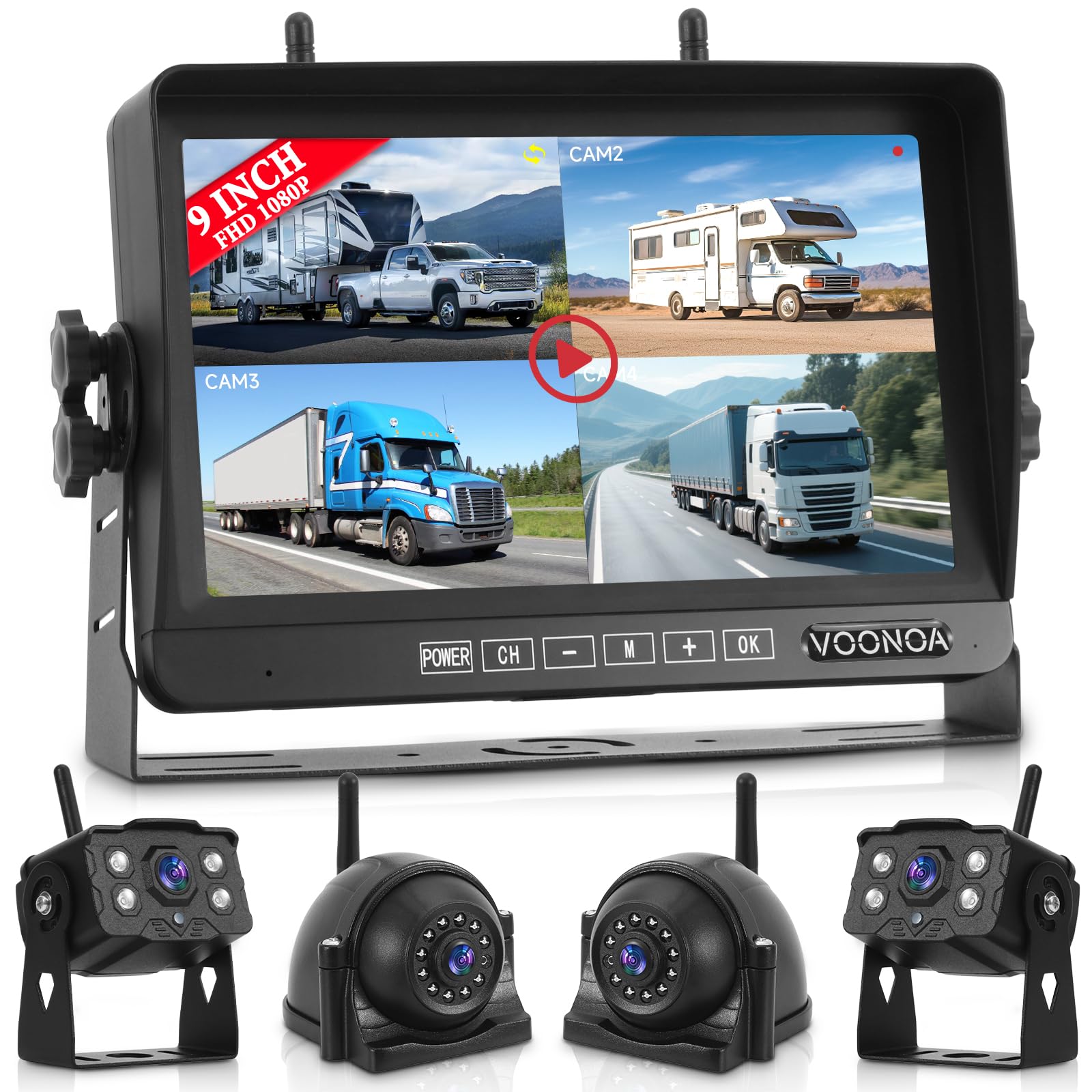
If you are tired of squinting at a small monitor, the VOONOA’s 9-inch 1080P screen is the visual upgrade. It comes with four cameras (two side, two rear) that each have a 170-degree field of view — so you can watch all four feeds in a single 4-way split screen and see nearly everything around your rig at once. Owners describe the setup as “intuitive” and say the “rugged metal cameras” and clear IR night vision make driving safer from the first trip.
There are a few minor UI quirks: the clock does not roll over, so the date/time stamp on your DVR recordings is off on long trips, and the playback resolution drops when all four cameras are recorded simultaneously. The 2-year replacement warranty from VOONOA is a solid safety net, and the system includes a Furrion-compatible mount adapter for easy installation on prepped RVs.
What Makes It Stand Out
- 9-inch 1080P monitor — the biggest screen in this guide, easy to read at a glance
- 170-degree field of view on every camera, so even the trailer tires are visible
- IP69K waterproof rating handles the harshest weather and high-pressure washing
The Downsides
- 4-way split-screen playback is lower resolution (VGA) than single-camera mode (720p)
- Clock does not roll over on recordings (a minor annoyance for trip logs)
- At 3.1 kg (6.8 lb), it is the heaviest system in this guide
Ideal for: the full-time RV traveler who wants a complete 360-degree view and does not mind a larger monitor taking up dash space.
Not ideal for: the minimalist who wants a clean, compact setup with a single rear camera and one side view.
3. Furrion Vision S Wireless RV Backup Cameras, Amber Right and Left Side FCE48TASH

The most affordable way to replace your marker lights with side cameras.
If you are on a tight budget or already own a Furrion Vision S monitor, this pair of side cameras is the cheapest entry point into wireless side views. They replace your existing amber running lights and use a 2.4GHz proprietary signal that Furrion says reaches up to 492 feet in open space. The cameras include motion detection that can wake the display when you are parked, turning them into a security system.
But the resolution is 480 pixels (720×480), which is a 2.2x gap compared to the 1080p on the AUTO-VOX Campsync A and Haloview systems — you get a general sense of traffic rather than a crisp view. The 65-degree field of view is also the narrowest here, meaning you see a smaller slice of the lane. As buyers put it: “The install was easy once I determined I had received a faulty unit and got it replaced.” The image quality is good enough for confidence but not for reading details.
Why Choose It
- Lowest entry price — the most affordable way to get both left and right side views
- Replaces existing marker lights cleanly; no drilling or bracket fabrication needed
- Motion detection doubles as a security system while parked
The Trade-Offs
- 480p resolution is noticeably softer than the 1080p systems here
- 65-degree field of view means you need to be precise about camera aim
- Requires a Furrion Vision S monitor (5-inch or 7-inch) — not included
Best for: the frugal RVer who already has a Furrion monitor and just needs a quick, functional side-view pair for lane-change confidence.
pass on it if: you are buying a system from scratch and want a sharp 1080p image that shows roadside details clearly.
4. AUTO-VOX WF4 Wireless RV Backup Camera: Rear & Side View
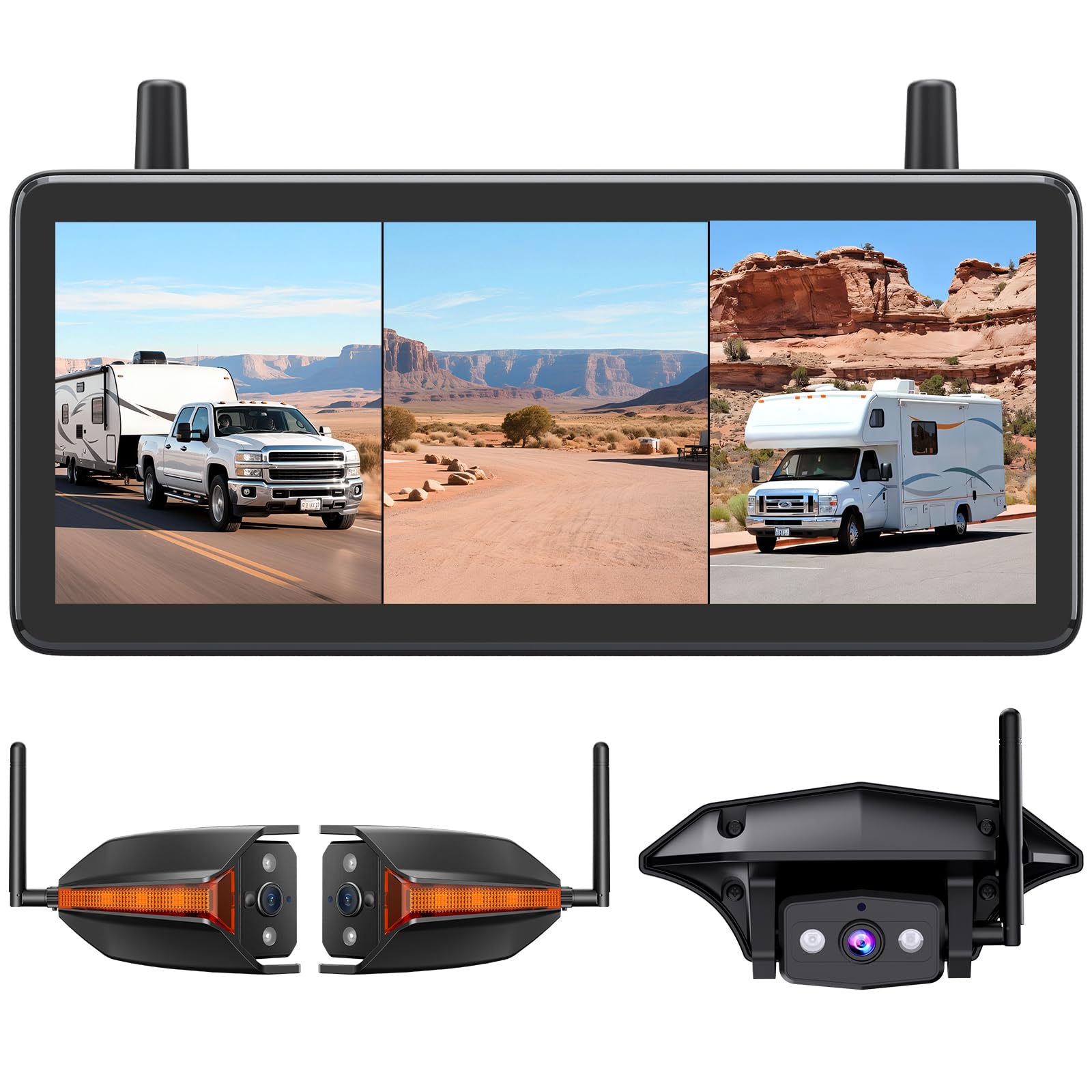
The 3-camera system that gives you a full 500-foot range at a mid-range price.
This AUTO-VOX WF4 system is the bridge between the budget-friendly Campsync A and the premium CampSyncD-3CAM. It includes a rear camera and two side cameras, all feeding a 7.2-inch HD monitor with triple-split view. The upgraded dual antennas push the range to 500 feet in open areas — a significant jump from the Campsync A’s 60-foot limit — and the IP69 waterproof rating means you can hose it off without worry.
Owners like its “excellent part quality” and the fact that the system includes everything for installation, including theft-proof screws. The honest feedback is that the triple-view mode compresses each camera image noticeably, and the rear camera has limited tilt adjustment. Picture quality got mixed responses — most call it sharp, but a few found it blurry on their setup. The DVR recording works automatically with loop overwrite, so you never have to manage storage yourself.
Biggest Advantage: 500-foot wireless range at a mid-range price — far beyond the Campsync A’s tested 48 feet, giving highway-speed confidence on long rigs.
Honest Feedback: triple-split view compresses images, so you are trading full-resolution clarity for the convenience of seeing all three angles at once.
Ideal for: the owner of a long fifth wheel or motorhome who needs reliable 500-foot signal range and a waterproof build without paying premium-tier money.
Not for: the buyer who insists on uncompressed image quality in split-screen mode or wants adjustable parking guidelines on the side views.
5. AUTO-VOX Campsync Wireless RV Backup Camera System
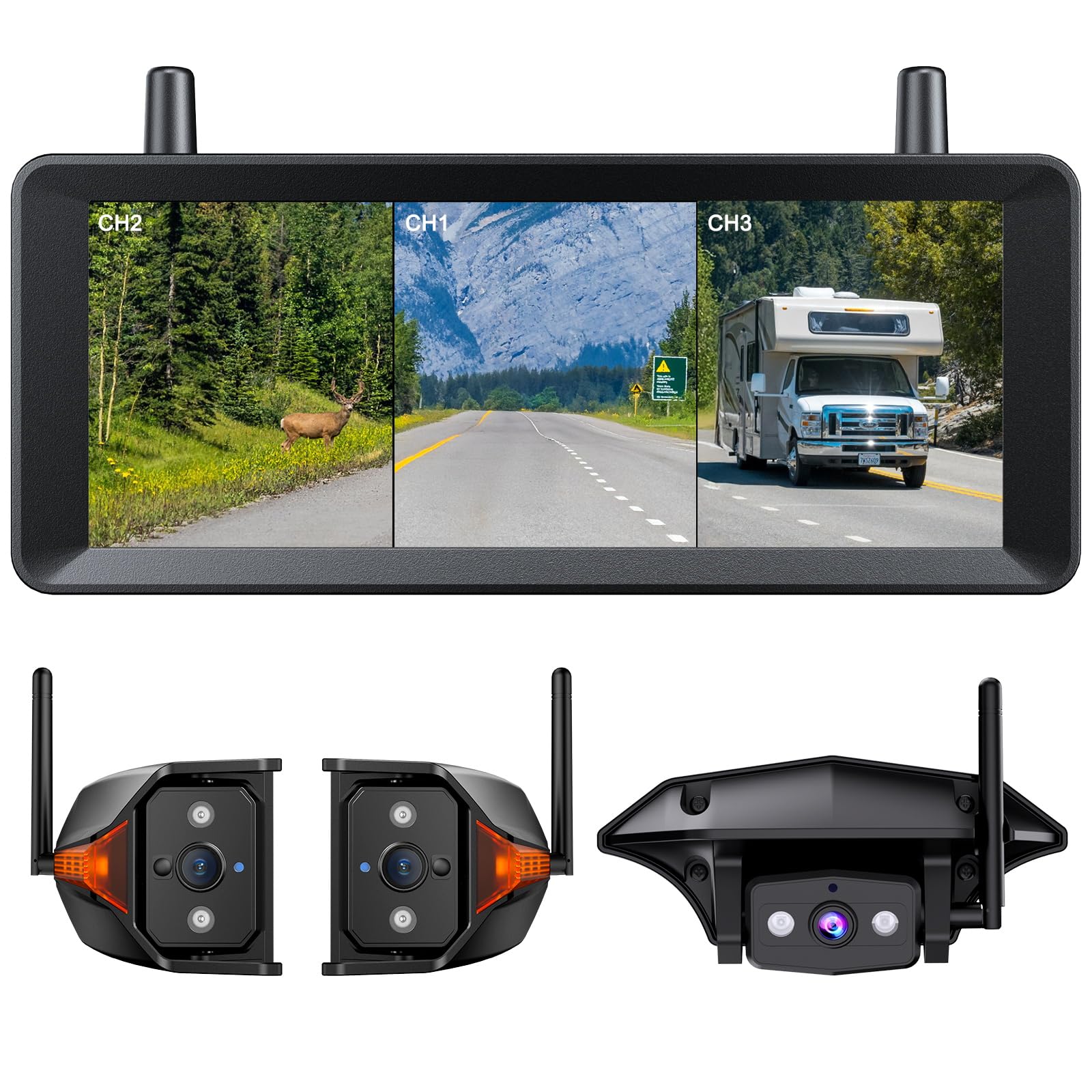
The 500-foot system that includes a 32GB card and USB power flexibility.
This Campsync system is essentially the refined version of the earlier Campsync A — same 7.2-inch 1080p monitor and 105-degree field of view, but with a jump to 500-foot open-area range and a USB/12V dual-power setup that adapts to modern and older trucks. It includes a 32GB SD card for DVR loop recording, so your footage is captured from the moment you power up.
Owners consistently praise the easy installation and clear 1080p video, calling it a “great value for the price.” The trade-off appears at highway speed: one owner noted the screen can get laggy at highway speeds, though it is tolerable, and the triple-view mode again distorts the aspect ratio of each camera feed. The side cameras are placed at the top corners of the trailer, making them most useful for angled backing rather than constant lane-change monitoring.
The Strengths
- 500-foot range with dual antennas — tested stable on a 43-foot toy hauler
- USB and 12V charger included, so you can plug into any dash socket
- 32GB SD card is included; no separate purchase needed for DVR recording
The Weaknesses
- Screen lag reported at highway speeds, especially in triple-view mode
- Side cameras are better for backing than lane changes; image aspect ratio distorts in split view
- Only one adhesive mount included; no standard ball-mount option
Reach for this if: you want a ready-to-go 3-camera system with strong range and included storage, and you mostly use the side views for parking maneuvers.
Look elsewhere if: you need a real-time, lag-free side view for frequent highway lane changes and do not want any image distortion.
Understanding the Specs
Resolution: 1080p vs 480p
The difference between a 480p camera and a 1080p (Full HD) camera is the difference between a vague shape and a sharp, detailed picture. At 1080p, you can read a license plate or spot a person in the lane beside you. At 480p, you see a car is there but you cannot identify it. For side-view cameras, 1080p is worth the extra money if you drive in traffic.
Field of View (FOV)
This spec tells you how wide the camera can see. A 65-degree FOV (like the Furrion) is a narrow corridor — you see the lane beside you but nothing on the ground near your trailer wheels. A 170-degree FOV (like the VOONOA) lets you see the lane, the shoulder, and the side of your own vehicle. For backing into campsites, wider is always better.
Wireless Range in Real Life
Open-air range claims (500 feet) assume no metal or walls between the camera and the monitor. Inside a 40-foot fifth wheel with metal walls, that range drops. Systems with dual antennas (like the AUTO-VOX and VOONOA picks) handle real-world interference better than single-antenna systems. If your rig is over 30 feet, look for tested real-world numbers or dual antennas.
Waterproof Rating: IP65 vs IP69K
IP65 means the camera is dust-tight and can handle low-pressure water spray (rain, a garden hose). IP69K is a step up — it can survive high-pressure, high-temperature spray (like an automatic car wash). If you live in a rainy climate or wash your RV at a truck wash, IP69K is worth the bump. If you park in a garage and drive on dry roads, IP65 is fine.
FAQ
How do I power the side cameras without running a long cable?
Will a wireless system work on a 50-foot semi-truck and trailer combination?
Can I use a wireless side view camera system on a car or SUV without a trailer?
How long does a wireless side view camera system last?
Will side cameras interfere with my rear camera signal?
What monitor size is best for side view cameras?
Can I record footage from the side cameras?
How hard is it to install side cameras without a pre-wired RV?
What is the difference between a 7.2-inch and a 9-inch screen for daily use?
Do I need a separate monitor for the side cameras, or can I use my existing RV touchscreen?
Final Thoughts: The Verdict
For the majority of shoppers, the wireless side view camera for cars winner is the Haloview BTC129 because it offers the sharpest 1080p image in the guide and a straightforward marker-light replacement installation, backed by a loyal following of owners who have trusted it for years. If you want the best value with a 1080p monitor and a 105-degree view included in the box, grab the AUTO-VOX Campsync A. And for maximum coverage — four cameras, a 9-inch screen, and a 170-degree field of view — the VOONOA 4-camera system is the one to reach for.
How We Picked
We do not accept paid placement. Every pick is matched to a real buyer and a real use-case; we do not hands-on test units.
Sources & Methodology
Specifications: manufacturer listings and product documentation. Review insights: verified customer reviews, as of July 2026. Pricing: not shown on this page (it changes often); check the current price via the retailer link.
As an Amazon Associate, GoCarLife earns from qualifying purchases. This does not affect which products we feature.