
Our readers keep the lights on and the garage heater humming. As an Amazon Associate, I earn from qualifying purchases.
Specs are compiled from manufacturer listings and verified buyer reviews and can change over time — please confirm the key details on the product page before buying.
Buying a wireless dash camera for your car is supposed to give you one thing: proof when you need it. But too many models ship with fuzzy night footage, unreliable WiFi connections that drop mid-download, and parking modes that need a secret wiring kit you didn’t know about. This guide cuts through those traps to find the dash cams that actually deliver clear footage, dependable app control, and real parking protection.
I’m Mo Maruf — the founder and writer behind GoCarLife. This guide is built by comparing the manufacturers’ published specifications and the patterns across verified customer reviews, so you get each pick’s real strengths and trade-offs instead of marketing spin.
Whether you drive a daily commuter, a family SUV, or run a rideshare, these are the nine best wireless dash camera for car options that actually earn their place on your windshield.
Our Picks at a Glance
How To Choose The Best Wireless Dash Camera for Car
Tonight’s drive is the real test. A dash cam earns its place by recording crisp license plates when headlights are blinding and streetlights are few. Beyond that, you need a camera that connects to your phone without frustration, and offers reliable protection for when you leave your car parked. These are the core factors to weigh.
Resolution and Sensor Quality
Higher resolution is good, but the sensor that captures the light is just as important. A 4K camera with a basic sensor will struggle at night, while a camera with a STARVIS or STARVIS 2 sensor can pull detail from the dark. Look for a wide aperture (F1.5 or F1.6) as a smaller number means the lens lets in more light, translating to brighter night footage.
WiFi Speed and App Reliability
A dash cam’s WiFi lets you download clips without pulling the memory card. The standard is 2.4GHz WiFi, which is slow. Upgraded models offer 5GHz WiFi for faster downloads, and the latest Wi-Fi 6 standard can hit 30MB/s — turning a three-minute wait into a thirty-second grab. A glitchy app is a common frustration, so models with high-quality app experiences win the real world.
Parking Mode
Every dash cam says “24-hour parking mode.” The catch is that almost all of them require a separate hardwire kit (sold separately) to keep the camera powered when the engine is off. If you park on the street, this feature is essential. Look for time-lapse or motion-detection options, not just collision-only recording.
Quick Comparison
| Model | Best For | Front Resolution | WiFi Standard | Sensor Type | Amazon |
|---|---|---|---|---|---|
| TERUNSOUl 3-Channel★ Best Overall | Best Overall 3-Channel | 4K UHD | 5.8GHz / 2.4GHz | Starlight-grade | Amazon |
| WOOLAACOO C5Budget Champion | Budget Entry | 4K UHD | 5GHz | F1.8 Aperture | Amazon |
| Coolcrazy N8Wide-Angle Champ | Wide-Angle Coverage | 4K UHD | 5GHz | STARVIS | Amazon |
| FAIMEE F6 | Rear 2K Detail | 4K UHD | 5.8GHz / 2.4GHz | F1.8 Aperture | Amazon |
| 70mai T800E | 3-Channel Rideshare | 4K UHD | Wi-Fi 6 | F1.55 Aperture | Amazon |
| Pelsee S12 Pro | Mirror Replacement | 4K @25fps | 5.8GHz Wi-Fi 6 | STARVIS 2 | Amazon |
| ROVE R2-4K Dual | Reliable Performer | 4K @30fps | 5GHz / 2.4GHz | STARVIS 2 (IMX675) | Amazon |
| REDTIGER F7N Touch | Touchscreen Ease | 4K UHD | 5.8GHz | STARVIS 2 | Amazon |
| ROVE R2-4K Dual PRO | Premium Night Vision | 4K @30fps | Wi-Fi 6 | Dual STARVIS 2 (IMX678 + IMX675) | Amazon |
In‑Depth Reviews
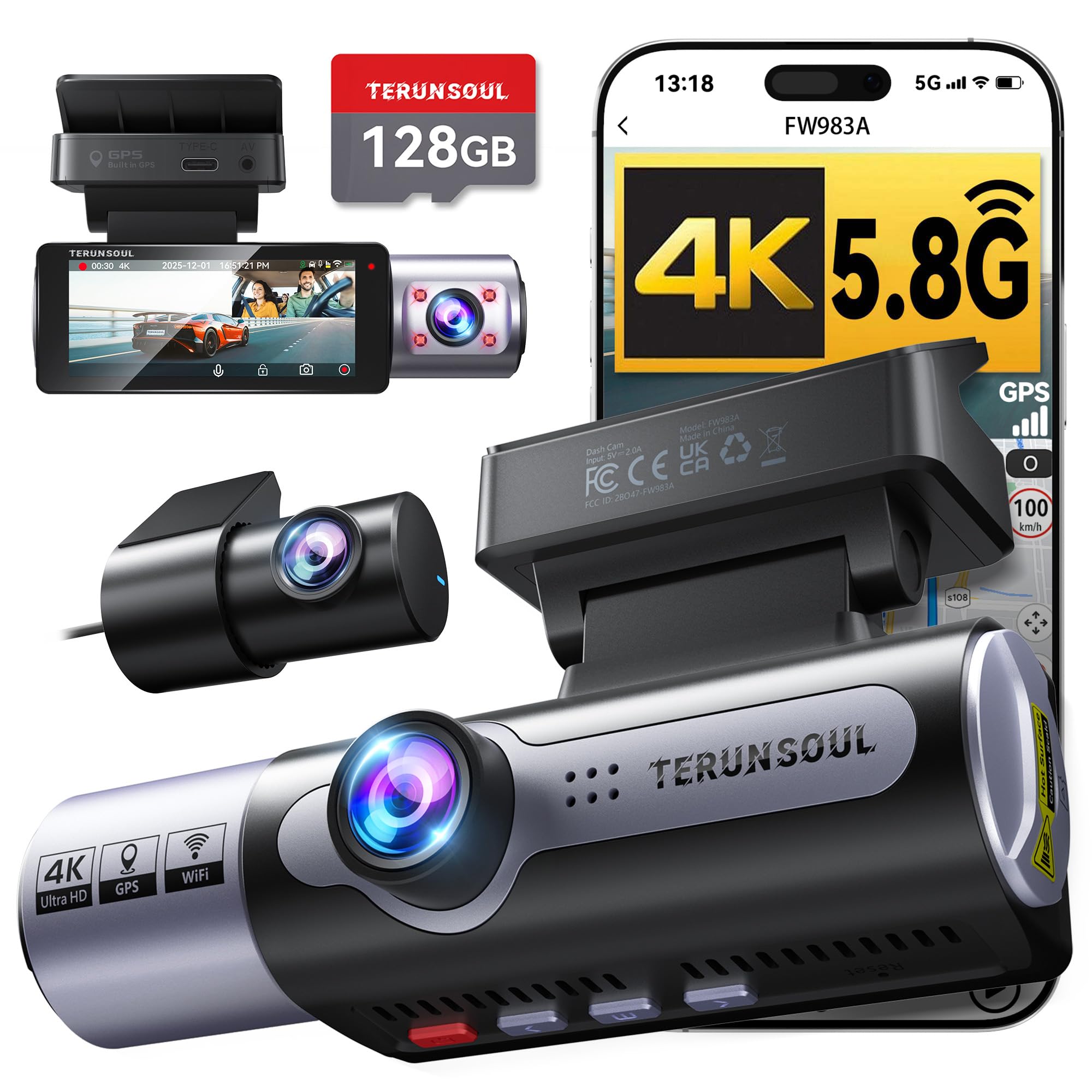
1. TERUNSOUl 4K Dash Cam Front and Rear (3-Channel)
Our pick — over 4.5★ from 300+ verified ratings; the strongest balance of quality and price.
Three angles, one tiny mount, and night footage that reads plates.
This is the full-coverage champion. It records simultaneously in 4K front, 1080P rear, and 1080P cabin — that’s a near 360° view for rideshare drivers or anyone wanting to capture a break-in from inside the car. The front camera uses a 170° ultra-wide angle, while the rear and cabin both offer a 165° field of view, at 165° versus the Coolcrazy’s 150°.
On the wireless side, the built-in 5.8GHz and 2.4GHz WiFi connects to the TERUNSOUl app for live preview and downloads. The included 128GB card means you are ready to record immediately. The starlight-grade five-layer lens with an F1.6 aperture (12% larger than the F1.8 on the WOOLAACOO) is what transforms night driving from a blur into evidence-grade footage, as buyers report “clear day/night video” and reliable GPS tracking.
What Owners Praise Most
- Four-button menu and GPS combine for easy setup and route tracking.
- The F1.6 aperture lets in enough light for sharp low-light captures.
- Plenty of cable length and clips make installation clean and hidden.
One Honest Trade-Off
- The hardwire kit for parking mode (24-hour continuous recording) is sold separately — a standard industry reality across nearly all models.
The right fit: Rideshare drivers, fleet operators, or families wanting interior monitoring along with front and rear coverage.
Skippable if: You only need front-and-rear recording and want the smallest unit possible — the 3.07-inch height makes this taller than the ultra-compact WOOLAACOO.
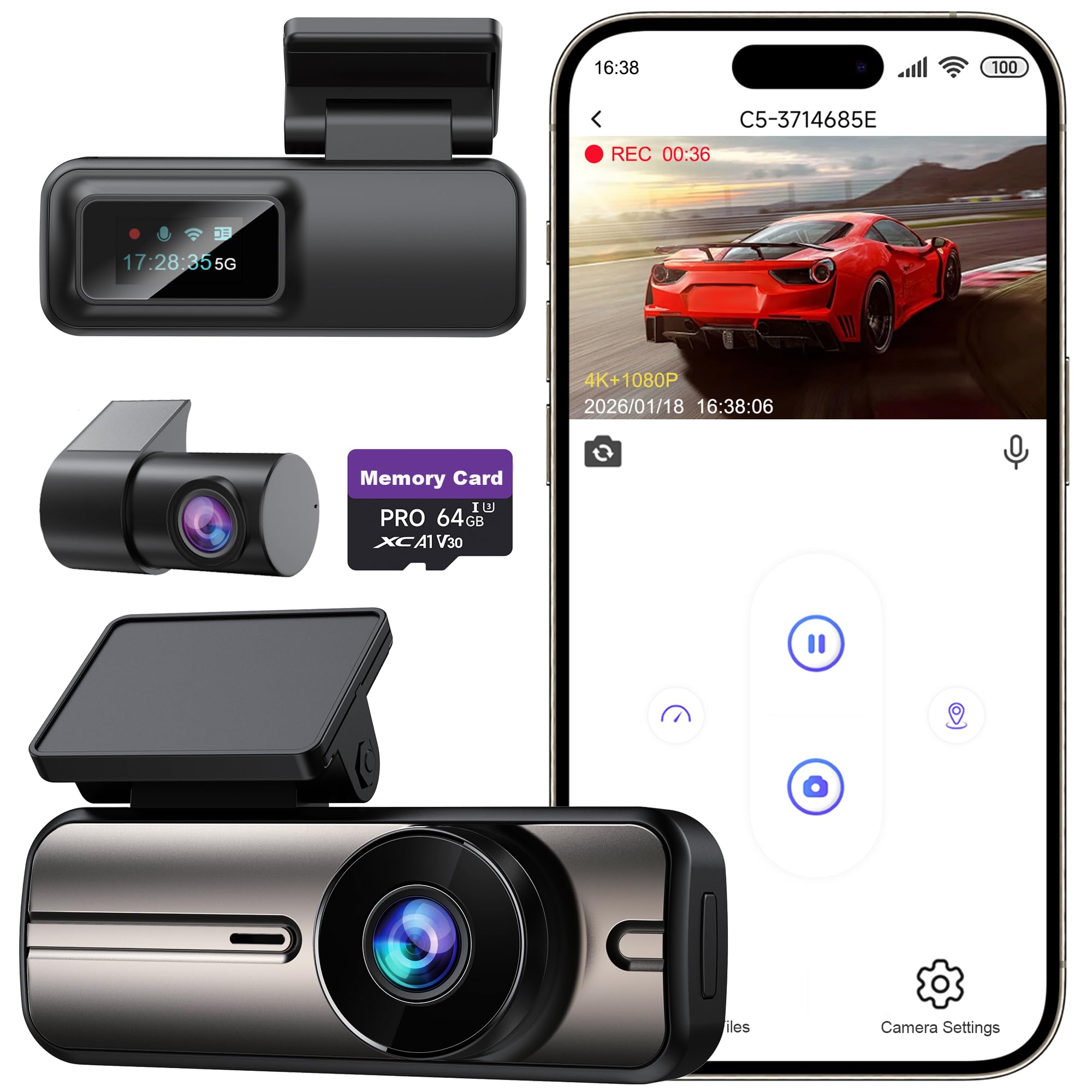
2. WOOLAACOO C5 Dash Cam Front and Rear
The smallest body on this list, yet it punches up in video clarity.
Measuring just 0.78 inches deep, the C5 is barely bigger than a matchbox, making it perfect for cars where windshield real estate is tight. The front records in 4K, and the rear captures 1080P, while the F1.8 aperture helps in less-than-perfect light. The dedicated app is a standout — owners mention it is “pretty easy to use” and allows for quick downloads to your phone. A 64GB card is pre-installed, so no separate purchase is needed. The compact design means it can tuck behind the rearview mirror without blocking your view.
Why It Works
- Ultra-compact dimensions (3.35 x 1.18 x 0.78 inches) fit in any car without blocking sightlines.
- 5GHz WiFi connects reliably for easy in-car clip transfers.
- Loop recording and a G-sensor (a small motion sensor) automatically lock crash footage.
The Small Limitation
- The rear camera is not accessible via the app in live view, though recorded footage works fine.
Reach for this if: You are a first-time buyer who wants a small, affordable dual-cam with a proven app experience.
Look elsewhere if: You need cabin/interior coverage or a high-speed Wi-Fi 6 connection for massive file transfers.
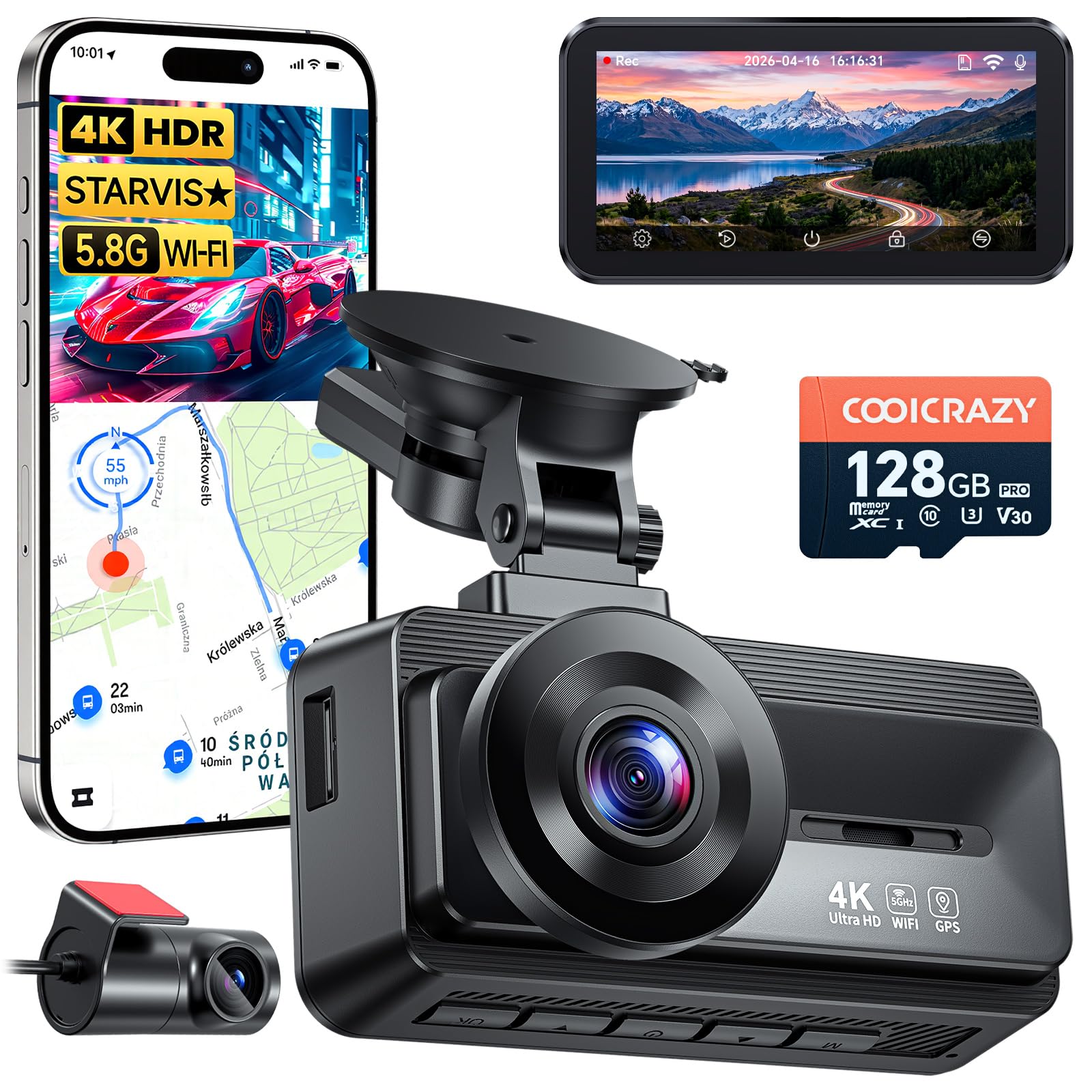
3. Coolcrazy N8 4K Dash Cam Front and Rear
A STARVIS sensor that sees in the dark, plus 60fps to catch motion at speed.
The N8 uses a STARVIS starlight night vision sensor combined with WDR technology (Wide Dynamic Range) to reduce glare from oncoming headlights and boost details in shadows. This is the pick for highway drivers who need to read a plate at 70 mph — the front camera records at 60fps (frames per second), at 60fps versus the typical 30fps on most rivals. The front 170° and rear 150° ultra-wide lenses give you a full sweep. The included 128GB card (versus the 64GB included with the WOOLAACOO) offers plenty of storage for long trips. The built-in 5GHz WiFi allows for high-speed connections, and GPS tracking embeds location data right onto the video file.
Standout Benefits
- 60fps front recording provides smooth, blur-free capture during high-speed drives.
- STARVIS sensor and large-aperture WDR produce usable footage on rainy nights and in parking garages.
- Comes with a comprehensive kit including a suction cup mount, 11.8ft power cable, and 128GB card.
The Catch
- The mobile app is noted as “could be more responsive” — less snappy than brand-dedicated apps like ROVE’s.
Best for: Drivers who need to catch fast movement on dark roads — the 60fps and STARVIS sensor are a powerful combo.
Not ideal for: Users who want a zero-fuss, hyper-responsive app for daily downloads.
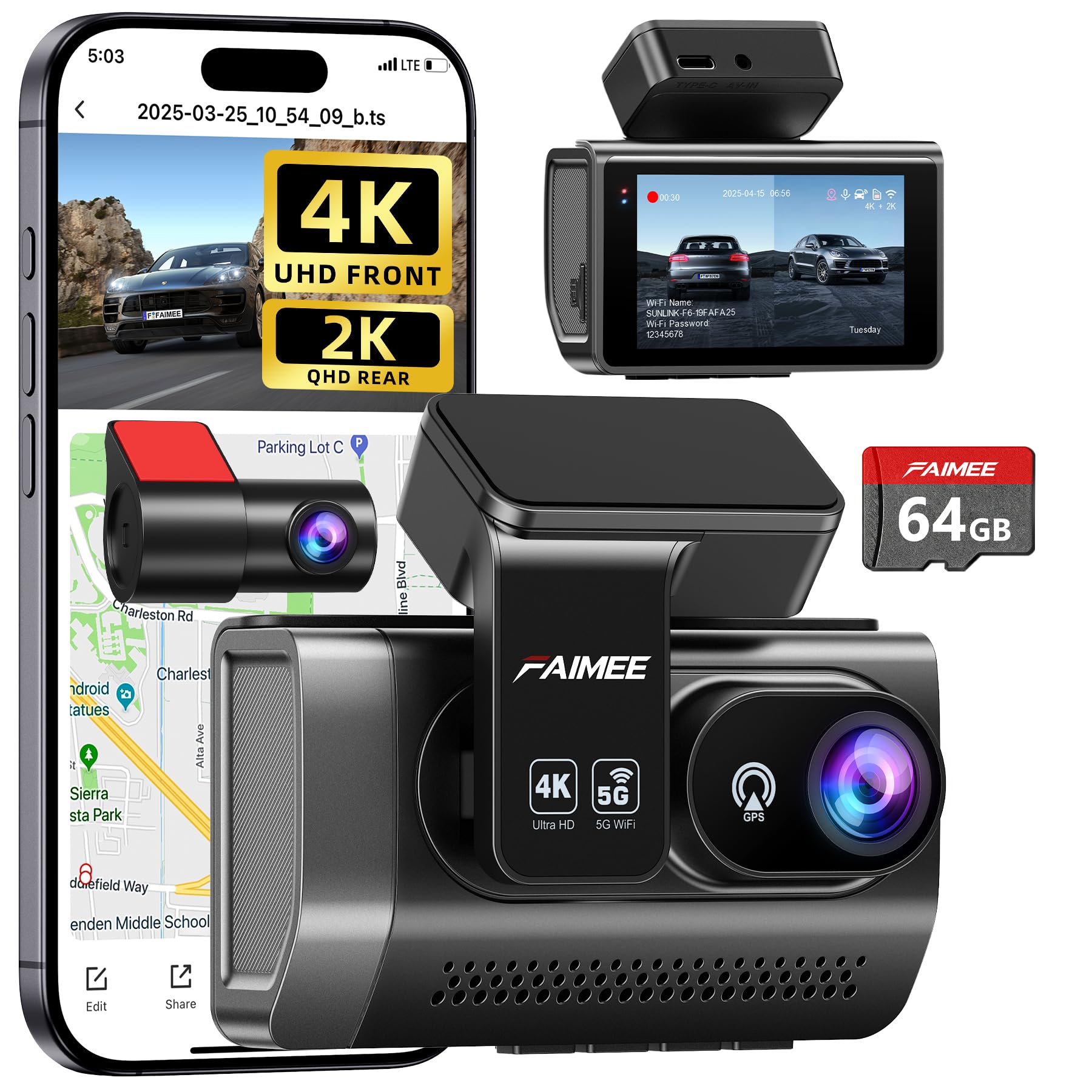
4. FAIMEE F6 4K+2K Dash Cam Front and Rear
The only model here that gives you 2K (not 1080P) on the rear camera.
Most dual-cams drop the rear to 1080P while the front shoots 4K. The FAIMEE F6 keeps the rear at a sharper 2K resolution (2304x1296P), which makes a real difference when you need to read a plate or a bumper sticker from the car behind you. The front shoots 4K (3840x2160P) at 30fps with an F1.8 aperture. The dual-band WiFi (5.8GHz/2.4GHz) offers a stable connection to the FAIMEE app for instant downloads and live view. It ships with a 64GB card, supports expansion up to 256GB, and includes a 18-month warranty. Owners consistently call the app “user friendly” and report the video is “crisp.”
Strengths
- 2K rear resolution is a genuine step up in detail compared to the 1080P rear cameras in most rivals.
- Discreet 3-inch IPS screen tucks behind the mirror for a clean look.
- Time-lapse parking mode (continuous surveillance via a condensed overview) offers low-power 24-hour protection with a hardwire kit.
Limitation
- The 64GB included card fills up fast at 4K+2K recording; upgrading to a larger card is recommended for heavy users.
Who it serves best: Drivers who want high-quality footage from both cameras, especially if you rely on rear-view captures for parking lot dings or tailgating disputes.
Who should think twice: Rideshare drivers who need interior cabin recording — this model is front-and-rear only.
5. 70mai T800E 4K Dash Cam Front, Rear & Inside

Wi-Fi 6 for downloads that are genuinely fast, and voice commands keep your hands on the wheel.
The T800E is a true 3-channel system: 4K front, 1080P interior, and 1080P rear. The interior camera has switchable infrared (IR) recording, so you can turn on IR for crisp night footage inside the cabin for Uber or Lyft safety. The 70mai app connects via Wi-Fi 6, which the brand claims delivers file transfers up to 5 times faster than standard Wi-Fi 4, hitting speeds of up to 10 MB/s. Voice control lets you say commands like “Take Photo” or “Lock Video” without tapping a button. The super capacitor design (not a lithium battery) handles extreme temperatures from 14°F to 140°F without swelling or risk. The quality of the build and the video output are the aspects owners praise most, with ease of use running a close second.
Why It’s a Top Contender
- Switchable IR for the interior camera gives professional-grade night clarity for rideshare safety documentation.
- Wi-Fi 6 and app integration provide a smooth, modern user experience.
- Super capacitor construction ensures long life and safety in hot parked cars.
Honest Drawbacks
- The app can be “tricky and unreliable” for initial connection, according to some feedback.
- Some customers note mixed reliability, with occasional units having connectivity or recording issues.
Perfect for: Uber, Lyft, or taxi drivers who need interior recording with IR for passenger safety, plus fast downloads via Wi-Fi 6.
skip it if: You want a dead-simple, 100% reliable first-time connection experience from the start.
6. Pelsee S12 Pro Mirror Dash Cam

A full rearview mirror replacement with a STARVIS 2 sensor for true night mastery.
This is a 12-inch mirror dash cam, meaning it straps over your existing rearview mirror and turns it into a live 4K screen. The front camera uses the latest STARVIS 2 sensor, which delivers superior low-light performance — balancing bright headlights and dark shadows better than standard sensors. The rear records in 1080P and automatically switches to a reversing view with dynamic parking guidelines when you shift into reverse. The 5.8GHz Wi-Fi 6 pushes transfer speeds up to 20MB/s. It also includes ADAS (Advanced Driver Assistance System) alerts, which give voice warnings for lane departure, forward collision, and pedestrian detection. Video quality and overall build quality are the aspects owners praise most by a wide margin.
Where It Excels
- STARVIS 2 sensor makes night footage remarkably clear, as confirmed by owners who call it “excellent.”
- 12-inch full screen offers a huge, bright rear view that replaces a dim factory mirror.
- Voice commands like “Take Picture” or “Lock the Video” keep you focused on the road.
Areas to Check
- The rear camera cable is 19.6 ft — enough for most cars, but may be short for full-size SUVs and trucks.
- It may not fit mirrors shorter than 6.3 inches or with irregular shapes; check compatibility before buying.
Best for: Drivers of minivans, SUVs, and trucks who want a massive, clear rear view and a modern upgrade over a basic mirror.
Not for: Compact car owners with very small or oddly-shaped mirrors who cannot confirm the fit.
7. ROVE R2-4K Dual Dash Cam Front and Rear

The most-reviewed dash cam on this list, trusted by thousands of drivers for a reason.
The ROVE R2-4K Dual has amassed over thirteen thousand ratings, making it the crowd-vetted standard. It packs a Sony STARVIS 2 IMX675 sensor for the front, recording 4K at 30fps with a wide F1.5 aperture, and a 1080P rear camera with an F1.8 aperture. The 5GHz WiFi supports download speeds up to 20MB/s. The included 128GB ROVE PRO microSD card is pre-tested for 4K reliability. The custom-designed parking mode offers three options (1fps time-lapse, motion detection, and collision detection) — and gives a voice alert when you start the car if an event occurred. Owners describe the video quality as “best they have seen in dash cams” and the installation as a 20-minute job even on large vehicles like a Ford F-250.
Why Thousands Buy It
- Sony STARVIS 2 sensor with F1.5 aperture sets a standard for low-light performance that rivals cost more.
- Comes with everything: 128GB card, suction mount, sticky mount, trim tool, and dual USB car charger.
- Built-in supercapacitor extends lifespan and handles temperature swings without battery swelling.
The Only Fine Print
- Parking mode requires a separate hardwire kit, and the standard USB connection will not support 24-hour monitoring.
Top choice for: Any driver who wants a proven, high-value system backed by thousands of verified owners.
Consider something else if: You need a front-and-rear system that also records the cabin interior — this is a two-channel (front/rear) only.
8. REDTIGER F7N Touch Dash Cam Front and Rear
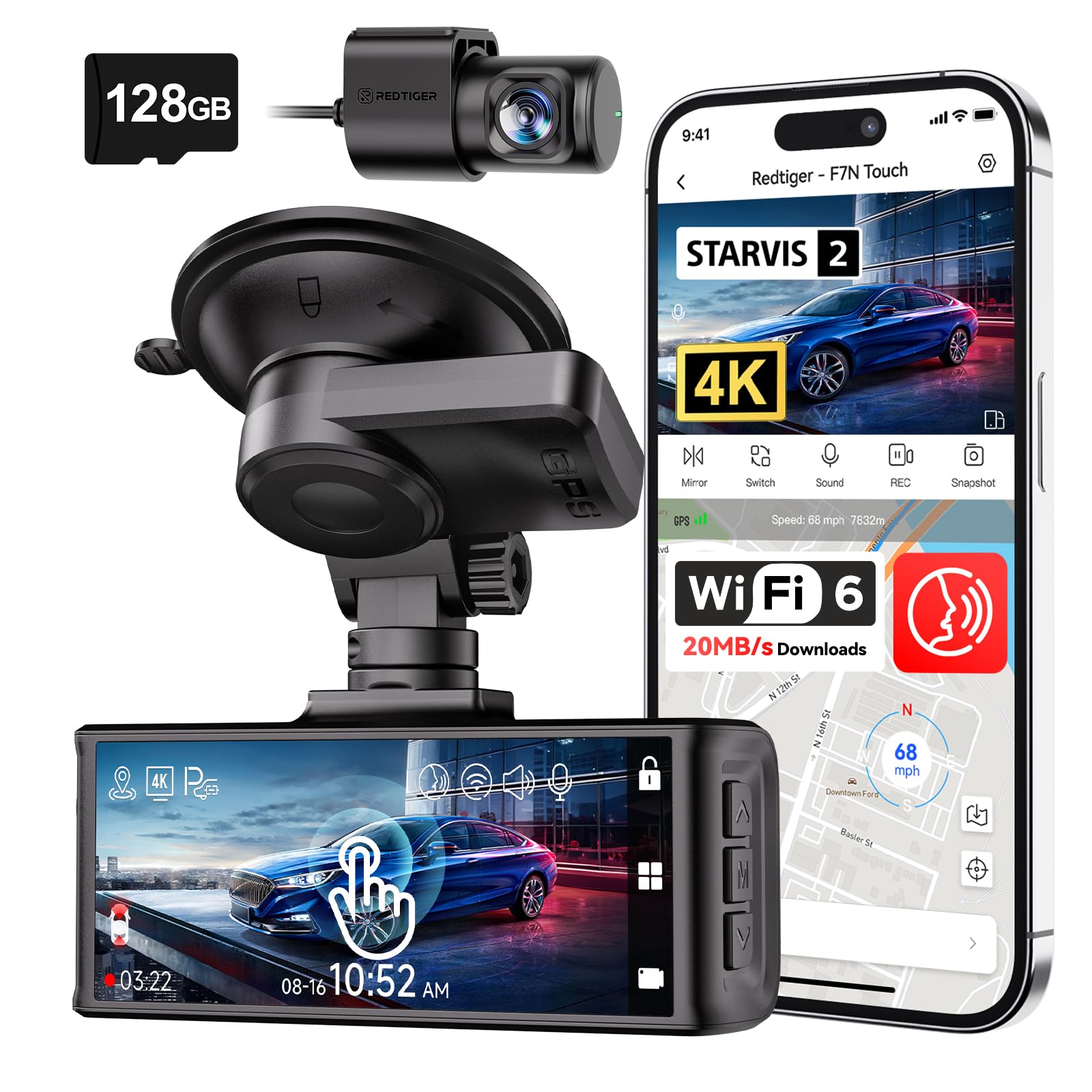
Tap the screen to lock footage or switch views — no button hunting while driving.
The F7N Touch is built around a smart touchscreen interface that lets you lock an emergency video, enable WiFi, or capture a scenic view with a single tap. It also retains physical buttons so you have a backup. The front camera uses a STARVIS 2 sensor with 170° wide-angle and WDR/HDR technology to handle glare and low light. The rear camera records 1080P at a 140° angle. Voice control is included for hands-free operation. It comes with a 128GB card, and the built-in 5.8GHz WiFi connects to the REDTIGER Cam app for downloads at up to 20MB/s. Owners who bought multiple units for their whole fleet say it is “very simple” to set up and use.
Key Advantages
- Touchscreen interface makes on-device navigation the easiest of any model on this list.
- Voice commands and physical buttons give you three control options for any scenario.
- Long rear camera cable (21.3 ft) is generous for larger vehicles like minivans and trucks.
One Consideration
- Some units have shown issues in extreme heat (like an Arizona summer), where the SD card may need to be removed when parked in direct sun.
Ideal for: Non-techy drivers who prefer a visual touchscreen setup over a multi-button menu system.
Less suited for: Drivers in very hot climates who cannot consistently shade their windshield from direct sun exposure.
9. ROVE R2-4K Dual PRO Dash Cam Front and Rear
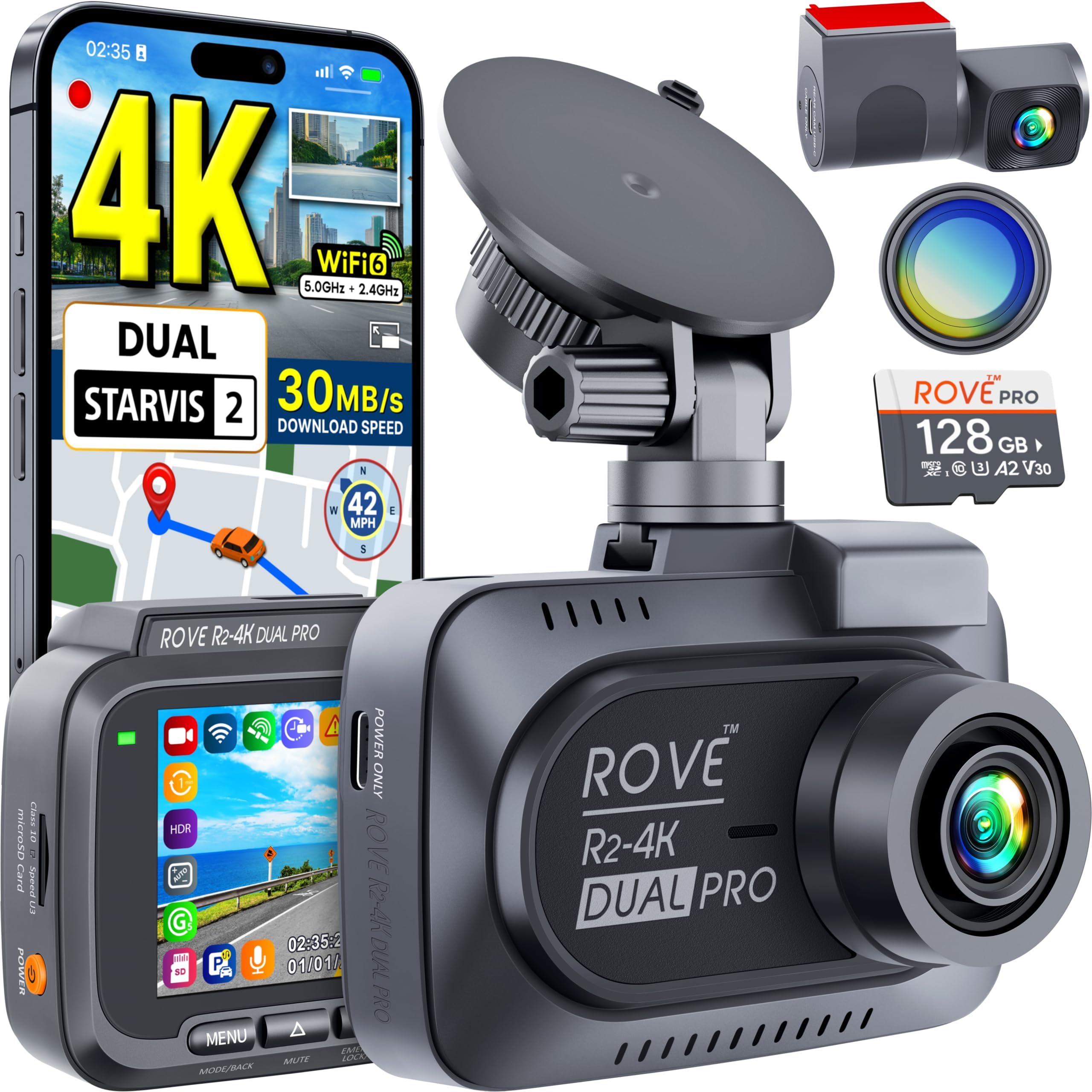
Dual STARVIS 2 sensors front and rear, plus Wi-Fi 6 that moves 4K video at 30MB/s.
This is the spec-sheet ruler. The R2-4K Dual PRO is the only model here that uses Sony’s two top-tier STARVIS 2 sensors — an IMX678 (8MP) for the front and an IMX675 (5MP) for the rear. The front records 4K at 30fps, and the rear records a sharp 2K (1440P) at 30fps, which is double the resolution of most rear cameras on this list. The F1.7 front and F1.55 rear apertures pull in maximum light. The Wi-Fi 6 connectivity (5GHz and 2.4GHz) supports download speeds up to 30MB/s, the fastest on this list, making a 1-minute 4K clip ready to share in seconds. It also includes a 128GB ROVE PRO card and a CPL filter (polarizing lens) to cut windshield glare. The Quad-Mode GPS locks onto GPS, BEIDOU, GALILEO, and GLONASS satellites for precise location data. What wins people over is the sheer clarity of the video, which owners confirm is “excellent day/night” with “visible plates.”
The Premium Edge
- Dual STARVIS 2 (IMX678 + IMX675) provides class-leading light sensitivity and reduced noise in dark conditions.
- Wi-Fi 6 at 30MB/s makes it the fastest wireless download option here.
- The CPL filter and comprehensive mount kit (suction + sticky) add value and reduce installation compromises.
The Premium Price
- The rear camera cable may be too short for large SUVs and full-size trucks; some reviewers point out needing a longer cable.
Perfect for: Enthusiasts and professionals who demand the absolute best night video from both cameras and want the fastest possible wireless file transfers.
Overkill for: Basic commuters who just need a reliable record of daytime drives and can live with standard 1080P rear cameras.
Understanding the Specs
STARVIS and STARVIS 2 Sensors
Think of the sensor as the camera’s eye. A standard sensor struggles in low light, producing grainy, unusable footage. A STARVIS or STARVIS 2 sensor (made by Sony) is built for exactly this problem — it pulls in more light and reduces noise, so your night footage actually shows a license plate, not a blurry glow. The difference is dramatic when you compare the F1.5 or F1.6 apertures on these sensors versus a basic F1.8.
WiFi Standards: 2.4GHz vs 5GHz vs Wi-Fi 6
A dash cam’s WiFi is how you get clips onto your phone. The old 2.4GHz standard is slow — think 3-5 MB/s, which makes a 100MB video take 20+ seconds. 5GHz WiFi hits 20 MB/s, cutting that wait to about 5 seconds. Wi-Fi 6 is the latest, reaching up to 30 MB/s. If you ever plan to send a clip to your insurance agent from your phone in a parking lot, the faster WiFi is a genuine time-saver.
FAQ
Do I need a hardwire kit for parking mode?
Will a 4K dash cam drain my car battery?
What memory card speed do I need for 4K recording?
Can I use a wireless dash cam without a phone app?
What is the difference between Loop Recording and G-Sensor?
How long does the included 128GB card record for?
Can I hide the wires for a clean installation?
What does ADAS mean on a dash cam?
Is a STARVIS 2 sensor worth paying extra for?
Will my dash cam work in extreme summer heat?
Final Thoughts: The Verdict
Across the board, the best wireless dash camera for car winner is the TERUNSOUl 4K 3-Channel because it covers every angle (front, rear, and cabin) with a wide F1.6 aperture and 5.8GHz WiFi, backed by solid GPS tracking and a pre-installed 128GB card. If you want record-setting night performance and the fastest downloads, the ROVE R2-4K Dual PRO leads on Dual STARVIS 2 sensors and Wi-Fi 6 speed. For those on a tighter budget who still want excellent 4K front and 1080P rear recording, the WOOLAACOO C5 is a surprisingly capable tiny unit with a great app.
How We Picked
We do not accept paid placement. Every pick is matched to a real buyer and a real use-case; we do not hands-on test units.
Sources & Methodology
Specifications: manufacturer listings and product documentation. Review insights: verified customer reviews, as of July 2026. Pricing: not shown on this page (it changes often); check the current price via the retailer link.
As an Amazon Associate, GoCarLife earns from qualifying purchases. This does not affect which products we feature.