
Our readers keep the lights on and the garage heater humming. As an Amazon Associate, I earn from qualifying purchases.
Specs are compiled from manufacturer listings and verified buyer reviews and can change over time — please confirm the key details on the product page before buying.
A wireless backup and dash cam takes the biggest worry out of parking and protecting your car — you see exactly what is behind you when you reverse, and every mile you drive is recorded automatically. The catch is that not all of them do both jobs well: some have fuzzy rear video, others drop the Wi-Fi connection when you need to pull a clip. This guide narrows it down to the nine setups that actually deliver clear 4K front footage, a reliable rear view for backing up, and a painless wireless experience — without forcing you to hardwire anything.
I’m Mo Maruf — the founder and writer behind GoCarLife. This guide is built by comparing the manufacturers’ published specifications and the patterns across verified customer reviews, so you get each pick’s real strengths and trade-offs instead of marketing spin.
Whether you drive a compact car, a full-size SUV, or run a rideshare operation, these are the best models that pair a true wireless backup camera with a dependable dash cam, giving you a single device that handles parking safety and continuous recording with zero guesswork — the defining picks for any wireless backup and dash cam buyer in 2025.
Our Picks at a Glance

How To Choose The Best Wireless Backup and Dash Cam
Choosing the right wireless backup and dash cam hinges on three factors: camera resolution for evidence, Wi-Fi ease for footage access, and rear-camera parking assistance without a wired monitor. Here is what to look for in each area.
Front and Rear Camera Resolution
The front camera should be at least 4K (3840×2160) if you want to read a license plate from a few car lengths away. Rear cameras are often 1080p, which is fine for backup visibility, but some higher-end models now offer 2.5K or 1440p for sharper detail when reviewing a rear-end incident. 4K front and a good 1080p or 2.5K rear is the balance.
Wireless Connectivity and App Experience
A dual-band 5.8GHz and 2.4GHz Wi-Fi connection is what you want. 5.8GHz is faster for downloading clips to your phone, while 2.4GHz travels further and works better in areas with lots of interference. If the camera only has 2.4GHz, transferring a 4K video can be painfully slow. The app should offer live view, easy file downloads, and simple settings adjustments without needing a PC.
Parking Mode and Power Source
Almost all models offer some form of parking monitoring, but nearly all require a separate hardwire kit (sold separately) to function 24/7. Without a hardwire kit, the camera powers down when the car is off. Look for a model with buffered motion detection or time-lapse recording while parked. Also consider if the camera uses a super capacitor over a lithium battery, as super capacitors handle extreme heat and cold much better under a parked car’s windshield.
Quick Comparison
| Model | Best For | Front Resolution | Wi-Fi Standard | Included Card | Amazon |
|---|---|---|---|---|---|
| TERUNSOUl 4K 3CH★ Best Overall | Best Overall | 4K UHD | 5.8GHz/2.4GHz | 128GB | Amazon |
| FAIMEE F6Best Value | Best Value | 4K UHD | 5.8GHz/2.4GHz | 64GB | Amazon |
| 70mai T800ERideshare Ready | Rideshare Ready | 4K UHD | Wi-Fi 6 | 64GB | Amazon |
| Pelsee S12 Pro | Mirror Upgrade | 4K @25fps | 5.8GHz Wi-Fi 6 | 64GB | Amazon |
| IIWEY iK11 | CarPlay Combo | 4K | Wireless CarPlay | 64GB | Amazon |
| AZDOME M550 Max | Triple Channel | 4K | Wi-Fi | 64GB | Amazon |
| WOLFBOX G850 PRO | ADAS Safety | 2160P | 5.8GHz | 64GB | Amazon |
| WOLFBOX G900 PRO | Premium Clarity | 4K (3840*2160) | 5.8GHz | 128GB | Amazon |
| Vantrue N5S | Full 360° Coverage | 2.7K | 5GHz | — | Amazon |
In‑Depth Reviews
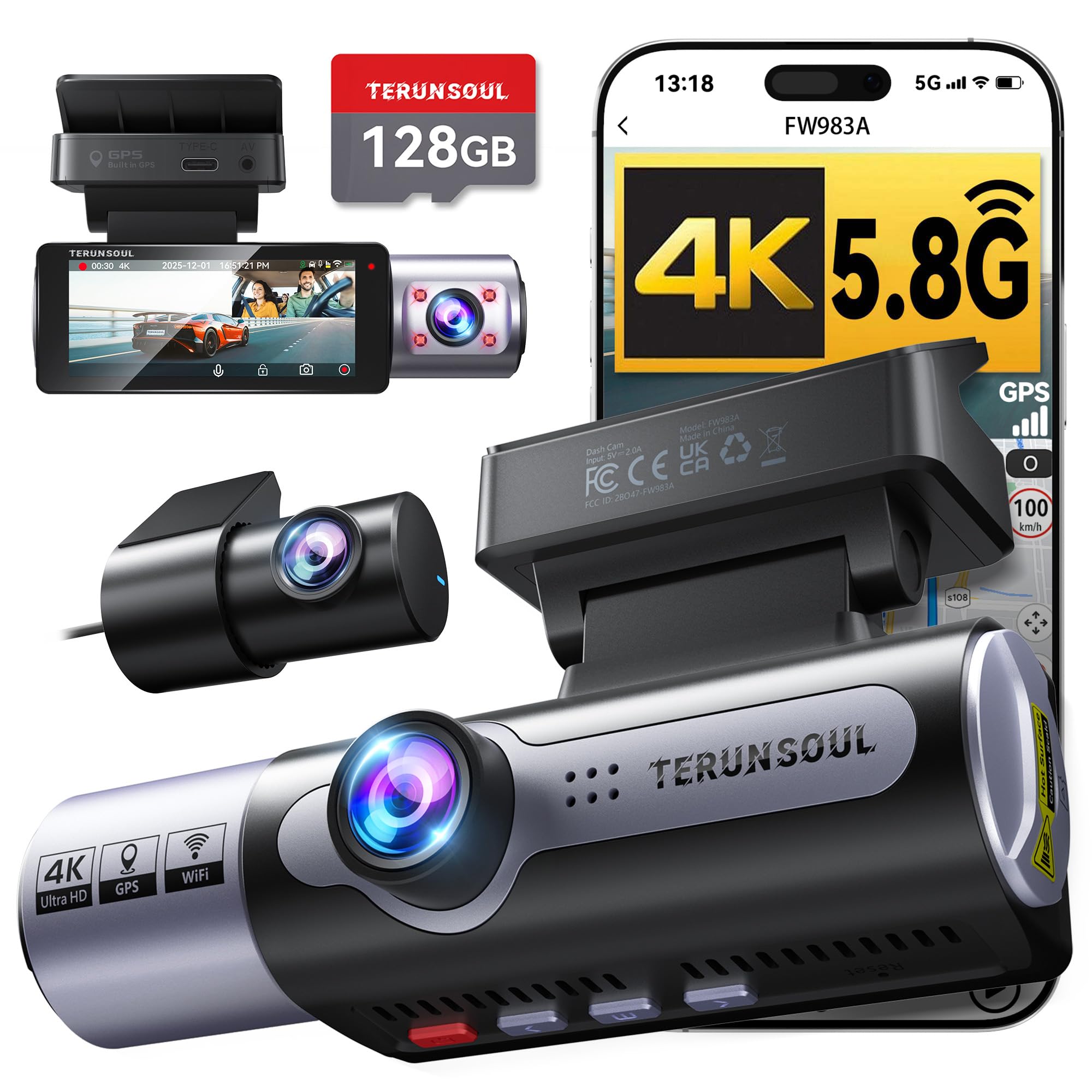
1. TERUNSOUl 4K Dash Cam Front and Rear, Full HD 3 Channel
Our pick — over 4.5★ from 300+ verified ratings; the strongest balance of quality and price.
The triple-channel setup captures crisp evidence from every angle.
You get a 4K front camera, a 1080p rear camera, and another 1080p cabin camera all running at once. The front uses a 170-degree ultra-wide lens (the data says 165 degrees for the rear and cabin, so the front actually catches more road) while the rear and cabin each have 165-degree coverage — meaning near 360-degree panoramic recording without any gaping blind spots. The pre-installed 128GB memory card is a generous head start, and you can swap it for a card up to 512GB if you want more storage space before the loop recording overwrites the oldest clips.
Built-in GPS logs your driving route, speed, and location right into the video file itself. You review that footage through a free GPS player on your computer or through the TERUNSOUl app. The 5.8GHz dual-band Wi-Fi means downloading a clip to your phone at up to 20MB/s is genuinely fast — not the painful wait you get with older 2.4GHz-only cams. A collision sensor (a G-sensor, a tiny accelerometer that feels a bump) automatically locks the footage so it is never overwritten. Owners consistently say the day and night video is sharp, that the setup is straightforward, and that the parking mode works as expected.
The only catch is parking mode: you must buy a separate hardwire kit (ASIN: B0G4LLMKG8) to use it. Without that kit, the camera shuts off when the car is off. For the price, you get an exceptionally complete package — 128GB memory, GPS, dual-band Wi-Fi, and a cabin camera — that most competitors charge more for.
What wins drivers over
- UHD 4K front plus 1080p rear and cabin coverage captures every side of an incident.
- 5.8GHz Wi-Fi lets you pull a 20MB/s clip to your phone in seconds, not minutes.
- Built-in high-precision GPS embeds speed and route data directly in the video.
One thing to plan for
- Parking mode requires a separately sold hardwire kit; the camera powers off when the car is off without it.
Reach for it if: you want the highest-rated all-rounder package — a 4K three-channel system with a 128GB card and GPS ready to go from the start — at a mid-range price.
Think twice if: you are not comfortable buying and installing a hardwire kit for parking mode, or you only need two cameras and want to save a few dollars.
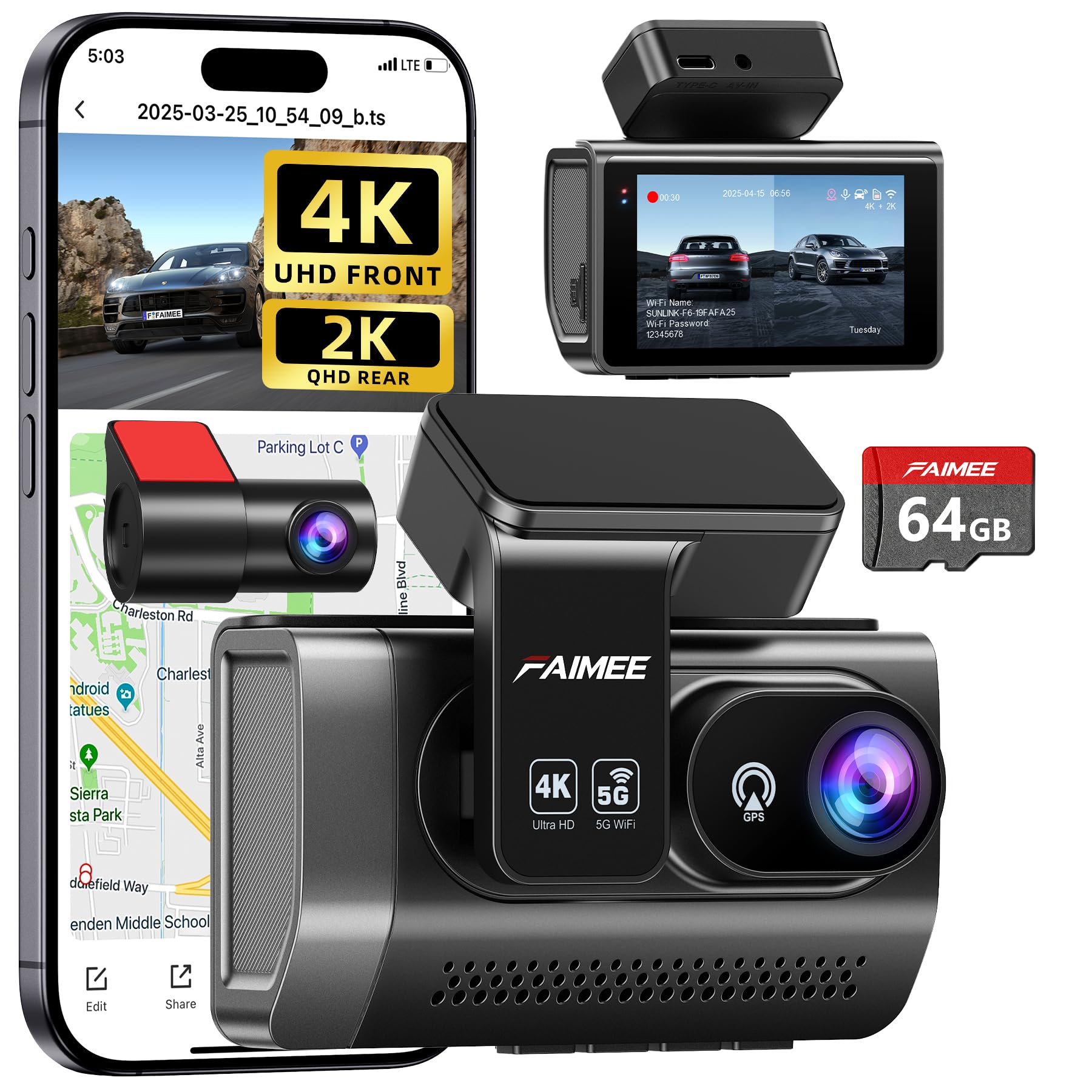
2. FAIMEE 4K Dash Cam Front and Rear with Memory Card
A 4K front and 2K rear combo at an unbeatable price.
FAIMEE pairs a 4K UHD (3840×2160) front camera with a sharper-than-average 2K (2304×1296) rear camera, which is a step up from the common 1080p rear. The 170-degree wide-angle lenses cover up to six lanes of traffic, making it easy to capture a merging incident or a parking lot sideswipe. The included 64GB memory card gets you started immediately, and the camera supports cards up to 256GB if you need more space. Comparing the two, the TERUNSOUl above includes a 128GB card from the start and can take a 512GB card but the FAIMEE has a slightly wider field of view at 170 degrees versus 165 degrees.
The built-in GPS tracks your speed, route, and real-time location. The dual-band Wi-Fi (5.8GHz and 2.4GHz) connects to the FAIMEE app for live view, instant downloads, and easy sharing of dash cam clips. A G-sensor automatically locks footage when it detects a collision so that critical video is never overwritten by the loop recording. Buyers report that it works as designed, with straightforward downloading and installation, and one long-term user notes it has been reliable for over two months with no issues.
Time-lapse and 24-hour parking monitoring are available, but as with most models at this price, you need a separate hardwire kit to use them. The 3-inch IPS screen is compact enough to sit discreetly behind the rearview mirror. This is the best bang-for-your-buck pick if you want a 4K front and a 2K rear without paying a premium.
Why it is a steal
- 4K front and 2K rear is a rare resolution pairing at this price point; the rear is noticeably sharper than 1080p.
- Dual-band 5.8GHz Wi-Fi makes pulling video to your phone fast and stable.
- Built-in GPS embeds speed and location data directly into your footage.
Compromise worth knowing
- Parking mode needs a separately sold hardwire kit, and the included 64GB card fills up quicker with 4K recording.
Grab it for: the best-value 4K + 2K dual setup that gives you a sharper rear view than most competitors at the same cost.
Look elsewhere if: you need a cabin camera too (this is a two-channel system), or you want a larger included memory card right from the start.
3. 70mai 4K Dash Cam Front and Rear Inside, 3 Channel (T800E)
The three-channel system built for Uber and Lyft drivers needing cabin recording.
The 70mai T800E records in 4K on the front, 1080p in the cabin, and 1080p on the rear — a full three-channel setup designed specifically for rideshare drivers or anyone who wants in-car coverage alongside road footage. An F1.55 aperture lens pulls in more light for better low-light recording, and the cabin camera has switchable infrared (IR) LEDs, so you can record clearly inside the vehicle even in total darkness, or turn them off when privacy matters. The front camera uses HDR (High Dynamic Range) to balance bright headlights and dark shadows on the road, and 3D noise reduction helps clean up video grain at night.
This is the only pick in the roundup with Wi-Fi 6, which is up to five times faster than standard Wi-Fi 4, reaching transfer speeds up to 10 MB/s through the 70mai App. Voice control lets you snap a photo or lock a video without touching the screen. The built-in five-mode GPS tracks location and speed with extra accuracy. A notable build difference: this camera uses a super capacitor instead of a lithium battery, which the maker says holds up in extreme temperatures from 14°F to 140°F — good news if you live where summers are hot or winters are freezing. The included 64GB SD card is enough to start, and you can expand up to 512GB.
The honest trade-off is that while many owners praise the video quality and ease of use, some report mixed experiences with reliability and occasional connectivity drops. If you want a dedicated three-channel setup with Wi-Fi 6 and infrared cabin recording, this is the strongest contender at its price tier. Compared to the FAIMEE above, the 70mai adds a cabin camera and Wi-Fi 6, while the FAIMEE offers a sharper 2K rear camera.
Strengths at a glance
- Three-channel 4K front + 1080p cabin + 1080p rear is ideal for rideshare and family safety.
- Wi-Fi 6 transfers clips up to 10 MB/s — noticeably faster than standard Wi-Fi options.
- Switchable IR on the cabin camera gives you clear night recording inside the car.
Things to note
- Reliability and connectivity get mixed feedback from some owners, and the app connection can be inconsistent.
- Parking monitoring requires a hardwire kit (sold separately).
The right fit for: rideshare drivers (Uber, Lyft) who must have an interior cabin camera with infrared night vision and want the fastest possible Wi-Fi transfer in this price range.
Not the best choice if: you only need front and rear coverage (saving money and complexity with the FAIMEE above), or you are wary of potential app-reliability quirks.
4. Pelsee Mirror Dash Cam with STARVIS 2 Sensor

Replaces your factory rearview mirror with a 4K dash cam and full-time rear camera.
The Pelsee turns your rearview mirror into a 12-inch IPS display that shows a live feed from the rear camera all the time, meaning there is never a blind spot from headrests or cargo. The front camera records in 4K at 25fps, and the rear records in 1080p at 25fps. A STARVIS 2 sensor handles low-light conditions by balancing bright headlights and dark shadows, and the AI-powered full-color night vision keeps the rear view in true color even in dim light — rather than switching to grainy black-and-white like older mirror cams. The 160-degree wide-angle lens on the rear camera gives you a broad view for reversing and parking.
Voice commands let you lock a video or take a picture without tapping the screen. Advanced ADAS (Advanced Driver Assistance System) gives audible alerts for lane departure, forward collisions, and pedestrian detection. The 5.8GHz Wi-Fi 6 transfers clips at up to 20 MB/s to the Pelsee app. When you shift into reverse, the screen automatically shows the rear view with dynamic parking guidelines and an audible obstacle warning. The included 64GB memory card is ready to use, and you can expand storage up to 256GB.
One honest sizing note: the unit measures 11.81 inches long and may not fit vehicles with rearview mirrors shorter than 6.3 inches or thicker than 5.91 inches. The rear camera cable is 19.6 feet long, which works for most cars but may fall short in larger vans, SUVs, or trucks — an extension cable (ASIN: B0BKQ6MPWS) is sold separately. A few owners found the rubber mounting straps too short for bulky factory mirrors. The video quality and STARVIS 2 performance are what people praise most, with that sensor being the clear highlight.
Why owners love it
- STARVIS 2 sensor delivers excellent low-light capture, keeping the rear view clear and colorful at night.
- The 12-inch IPS mirror display eliminates the traditional blind spot from rear headrests.
- 5.8GHz Wi-Fi 6 hits up to 20 MB/s downloads, and voice commands give you hands-free control.
Check before buying
- Sizing is not universal — the large mirror may not fit smaller or oddly shaped rearview mirrors.
- The rear camera cable may be too short for full-size SUVs, vans, or trucks.
Ideal for: drivers who want a smooth digital rearview mirror that doubles as a 4K dash cam, especially in larger vehicles where rear visibility is often blocked.
Check fit first if: you drive a compact car with a small or irregularly shaped rearview mirror, or you own a full-size van or truck that needs a longer rear camera cable.
5. IIWEY 11″ Extra Large Wireless Apple CarPlay Screen with 4K Dash Cam

An 11-inch CarPlay display that also records 4K dash cam footage — two upgrades in one.
This is not a mirror dash cam; it is a standalone 11-inch touchscreen with 1280×800 resolution that sits on your dashboard or windshield, adding wireless Apple CarPlay and Android Auto to any car — even older vehicles without built-in infotainment. Alongside the smart connectivity, it includes a built-in 4K front dash cam and a separate 1080p backup camera. The rear camera activates automatically when you shift into reverse, showing dynamic parking guidelines that you can adjust to your vehicle’s dimensions. A pre-installed 64GB memory card handles the footage storage.
Voice control via Siri or Google Assistant lets you manage navigation, calls, and media hands-free. The screen connects to your car’s speakers through Bluetooth audio, FM transmission, or a AUX cable. The included suction cup mount and adhesive mount make installation wire-free and straightforward. Owners consistently highlight how easy it is to set up, how responsive the touchscreen is, and how much they appreciate having a large GPS display alongside a dash cam and backup camera in one device. The 11-inch screen is the standout feature, making maps and rearview footage much easier to see than a phone mount could.
One size caveat: in compact cars, the 11-inch dashboard mount may partially block visibility. The maker recommends using the extended suction cup mount or opting for the smaller iK7 model if space is tight. A small number of owners noted that the included stand may not hold the heavy screen firmly on rough roads, and that the AirPlay function is blocked by DRM for most movie apps.
What stands out
- 11-inch 1280×800 touchscreen with wireless CarPlay/Android Auto is a massive upgrade over a phone mount.
- Integrated 4K dash cam and 1080p backup camera with dynamic parking guidelines in one device.
- Fast wireless CarPlay connection and clear picture quality get consistent praise from owners.
Before you mount it
- The 11-inch screen on the dashboard may obstruct visibility in small cars; the iK7 model is a better fit for compact vehicles.
- The included stand may not stay secure on bumpy roads due to the screen’s weight.
Perfect for: upgrading an older car with wireless CarPlay, a large GPS screen, and a dash cam all at once — without replacing your stereo or running permanent wiring.
skip it if: you drive a compact car where a dashboard screen would block your view, or you only need a dedicated dash cam and already have a factory infotainment system.
6. AZDOME M550 Max 4K 3 Channel Dash Cam
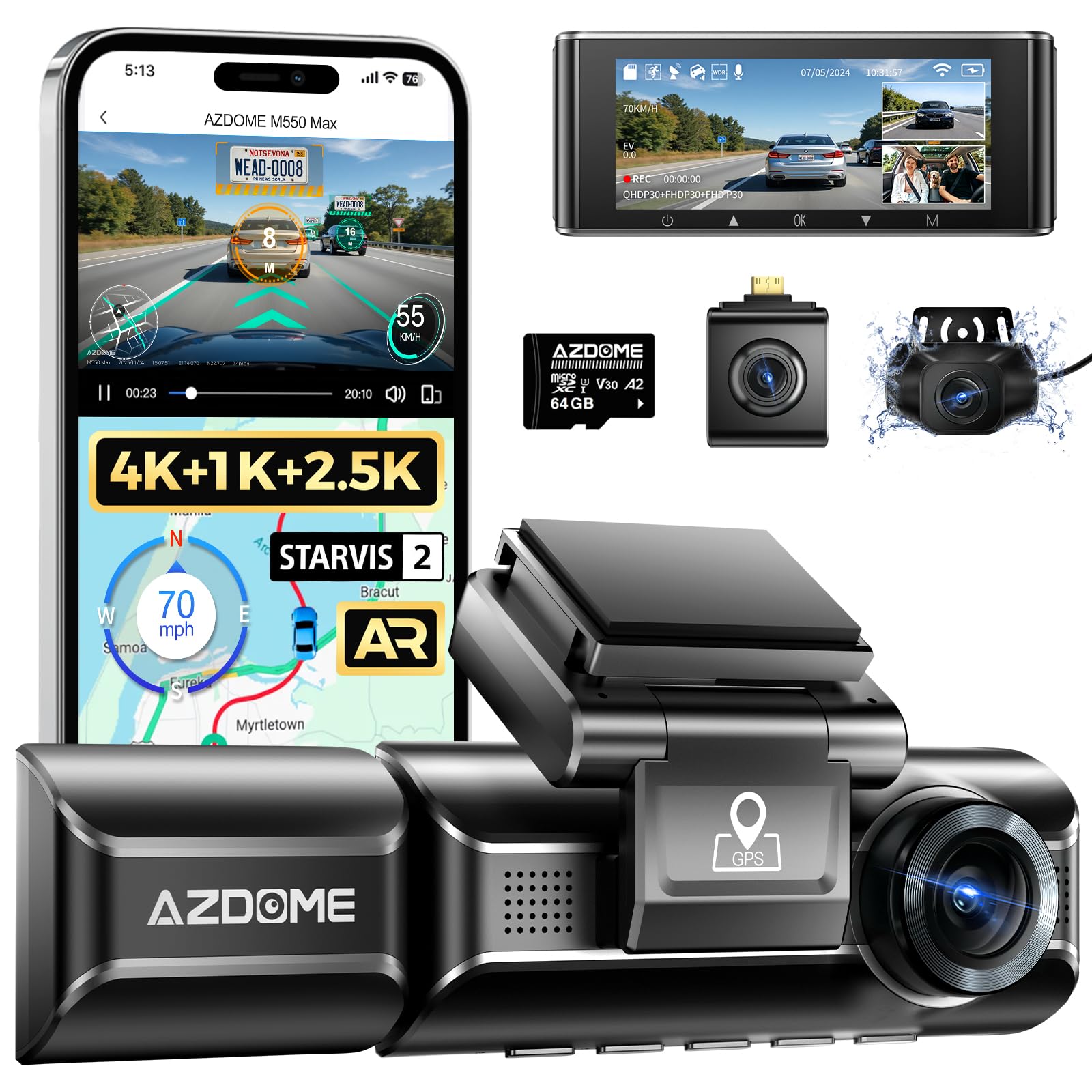
Triple-channel recording with a sharper 2.5K rear camera and dual STARVIS 2 sensors.
The AZDOME M550 Max records in 4K on the front, a higher-than-average 2.5K on the rear, and 1080p inside the cabin. That 2.5K rear (upgraded from standard 1080p) gives you more detail when reviewing rear-end incidents or tailgating situations. Both the front and rear cameras use STARVIS 2 sensors (IMX675 and IMX662 support), which the maker says improve clarity in low light, backlit roads, and changing lighting conditions like garage exits. The interior camera has infrared (IR) night vision for clear cabin recording in the dark.
Parking mode options include motion detection, collision-triggered recording, and time-lapse recording, all designed to capture activity around your car while you are away. A magnetic mount lets you quickly remove the dash cam from the base when you park in a sketchy area. The IP68-rated rear camera is fully weather-sealed, making it more durable in rain and road spray than many competitors. The 3.19-inch LCD screen is large enough to review footage without squinting. AZDOME’s app includes timeline playback, route map review, and OTA (over-the-air) firmware updates. The included 64GB card works right away, and you can expand storage to 512GB.
A few owners found that the front camera angle was too high on some vehicles with steep windshields (like the Ford Fusion), though customer support provided replacement parts to fix it. The app also has occasional bugginess according to some feedback. The fatigue driving reminder is a thoughtful feature for long trips, and the triple-channel setup with a 2.5K rear gives it an edge over standard 1080p rear cams. You will need a hardwire kit for parking mode.
Where it excels
- Dual STARVIS 2 sensors (IMX675 & IMX662) on both front and rear provide strong low-light clarity.
- 2.5K rear camera is a step above the common 1080p, capturing sharper detail in rear incidents.
- Magnetic mount makes removing the camera fast for security or transfer between vehicles.
Watch out for
- The front camera angle may need adjustment on vehicles with steep windshields; support can help.
- The app has some buggy moments, and parking mode requires a hardwire kit (sold separately).
A good call for: drivers who want a triple-channel system with the best possible rear detail and dual STARVIS 2 sensors for all-around night performance.
Not the top pick if: you want a simpler two-channel setup or prefer a model with fewer potential angle-adjustment issues from the start.
7. WOLFBOX G850 PRO 4K Mirror Dash Cam with ADAS and BSD

A 12-inch mirror dash cam that adds blind-spot detection to your existing rearview mirror.
The WOLFBOX G850 PRO replaces your rearview mirror with a 12-inch LCD display that shows a live 4K front recording and a 1080p rear feed. what separates it is the built-in Advanced Driver Assistance System (ADAS) and a Blind Spot Detection (BSD) algorithm. The ADAS gives voice alerts for forward collisions, pedestrian detection, lane departure, lead vehicle start, and distance monitoring. The BSD watches both your blind spot and the following car, plus it issues rear collision alerts — essentially adding safety features that older cars never had. The front camera records 2160P (2560×1440) at 30fps, and the rear records 1080P at 25fps.
Upgraded 5.8GHz Wi-Fi connects to the WOLFBOX App for fast video downloads and sharing. Twelve voice commands let you operate the camera hands-free. The 64GB card is included, and you can expand storage up to 256GB. The 170-degree wide-angle lenses on both front and rear use WDR (Wide Dynamic Range) and HDR (High Dynamic Range) to balance shadows and sunlight. Owners of Jeep Wranglers and trucks particularly appreciate this model because it solves the rear visibility problem completely, regardless of roof type. It is also a notable upgrade path for those who own an older WOLFBOX model and can reuse the existing wiring.
The honest trade-off is that while the video quality and safety alerts are strong, the screen brightness can be distracting at night, and the large 12-inch mirror may obstruct the driver-side sun visor in some trucks. The lane departure warnings are hit-or-miss on accuracy, according to some feedback. Parking monitoring also needs a separate hardwire kit. The G850 PRO is a safety-focused mirror dash cam that adds blind-spot and collision alerts to your daily drive.
Safety highlights
- ADAS with forward collision, pedestrian, lane departure, and lead-vehicle start alerts.
- Blind Spot Detection (BSD) monitors your blind spot and the following car.
- 12-inch full IPS touchscreen with a clear 4K front view and 170-degree wide-angle coverage.
Room for improvement
- The 12-inch mirror can partially block the driver-side sun visor in some trucks and SUVs.
- Screen brightness at night gets mixed feedback, and lane departure alerts are not always accurate.
Choose it if: you drive a truck, SUV, or Wrangler where rear visibility is naturally poor and you want ADAS and blind-spot warnings as a bonus.
Pass on it if: you find extra driving alerts distracting or you need a less bulky mirror that does not interfere with your visor.
8. WOLFBOX G900 PRO Mirror Dash Cam with STARVIS IMX678
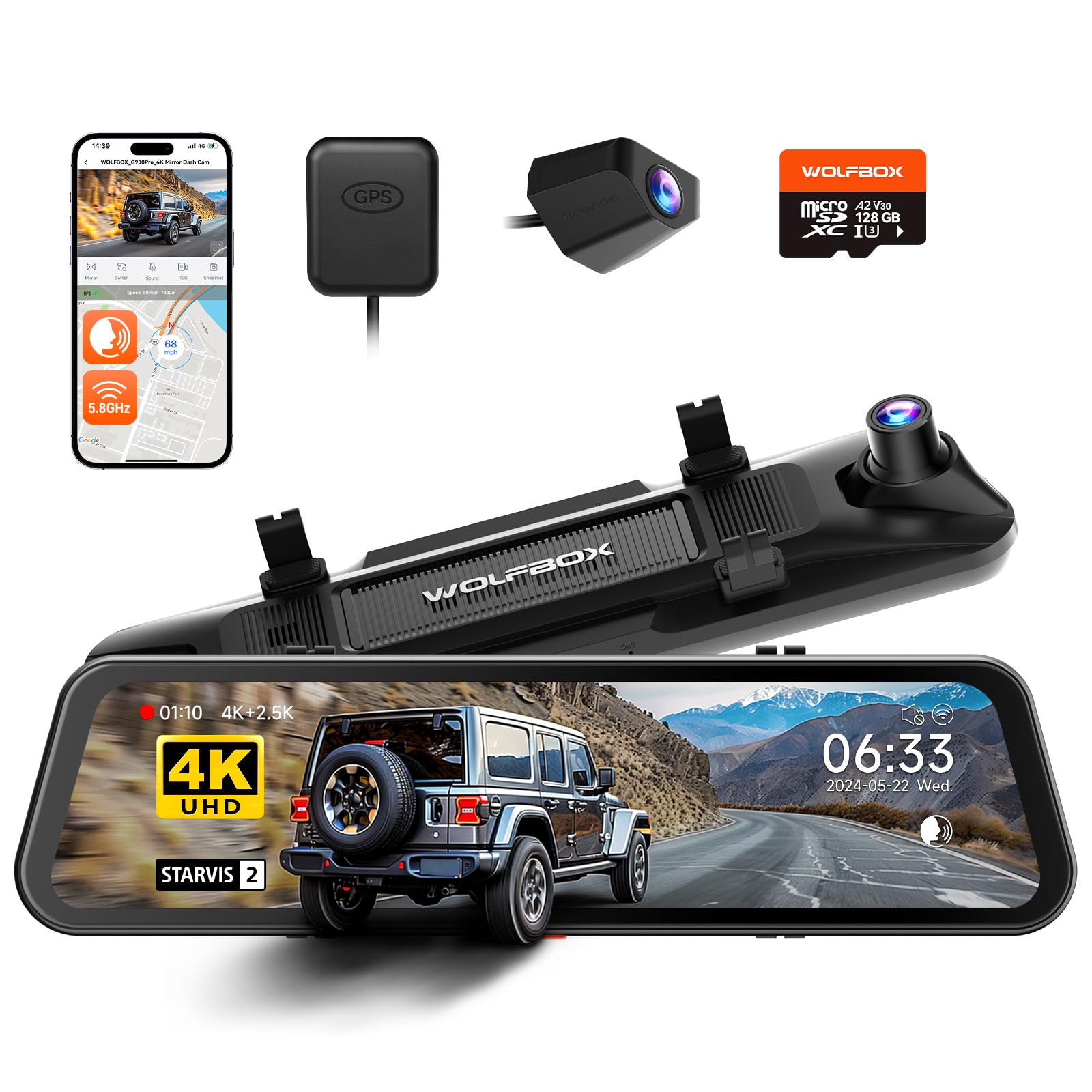
The premium mirror dash cam with a STARVIS 2 IMX678 sensor for next-level night detail.
The G900 PRO is the step-up sibling to the G850 above, and the main difference is the sensor. It uses a STARVIS 2 IMX678 sensor (8MP) on the front camera, which WOLFBOX says delivers superior low-light performance with a 7-glass lens. The front records true 4K at 3840×2160 at 30fps (8MP), while the rear records 2.5K at 2560×1440 at 30fps (4MP) — a noticeable upgrade from the G850’s 1080p rear. A 128GB card is included right in the box, and you can expand storage up to 512GB. The 12-inch LCD mirror display is the same size as the G850, but the image is noticeably sharper and the rear view is significantly brighter, with owners comparing it to 90% of the brightness of a Toyota factory digital mirror.
5.8GHz Wi-Fi connects to the WOLFBOX App for fast file transfers. Voice commands allow hands-free operation. The external GPS antenna logs your speed and route. The rear camera connects via USB-C, and the included 21.3-foot rear cable is generous for larger vehicles. The camera comes with a full one-year guarantee. the real-world reward is a meaningfully sharper, brighter rearview feed with a 2.5K rear camera and a high-end STARVIS 2 front sensor — worthwhile if you do a lot of driving after dark.
The primary limitations are shared with the G850: the large mirror can block the sun visor in some trucks, and it takes about ten seconds to turn on after you start the car. One owner of a Toyota Corolla Cross noted compatibility issues with the factory mirror accessories. The occasional random split-screen switch has been reported but is rare. If you want the best possible camera clarity in a mirror dash cam and are willing to pay for it, the G900 PRO is the one.
What justifies the price
- STARVIS 2 IMX678 sensor and 7-glass lens deliver exceptional night-time video clarity.
- Front 4K (3840×2160) and rear 2.5K (2560×1440) is the highest resolution combination in the mirror category here.
- Includes a 128GB card from the start with support up to 512GB.
Things to consider
- The large mirror body can interfere with the sun visor in trucks and compact cars.
- Boot-up time of about 10 seconds and occasional split-screen glitches are minor annoyances.
Spring for it if: night driving is a big part of your routine and you want the best low-light clarity and sharpest 2.5K rear view available in a mirror-style dash cam.
Save your money if: you drive mostly during the day or you are happy with the 1080p rear resolution of the G850 PRO — the core features are similar at a much lower price.
9. Vantrue N5S 4 Channel 360 Degree 2.7K Dash Cam
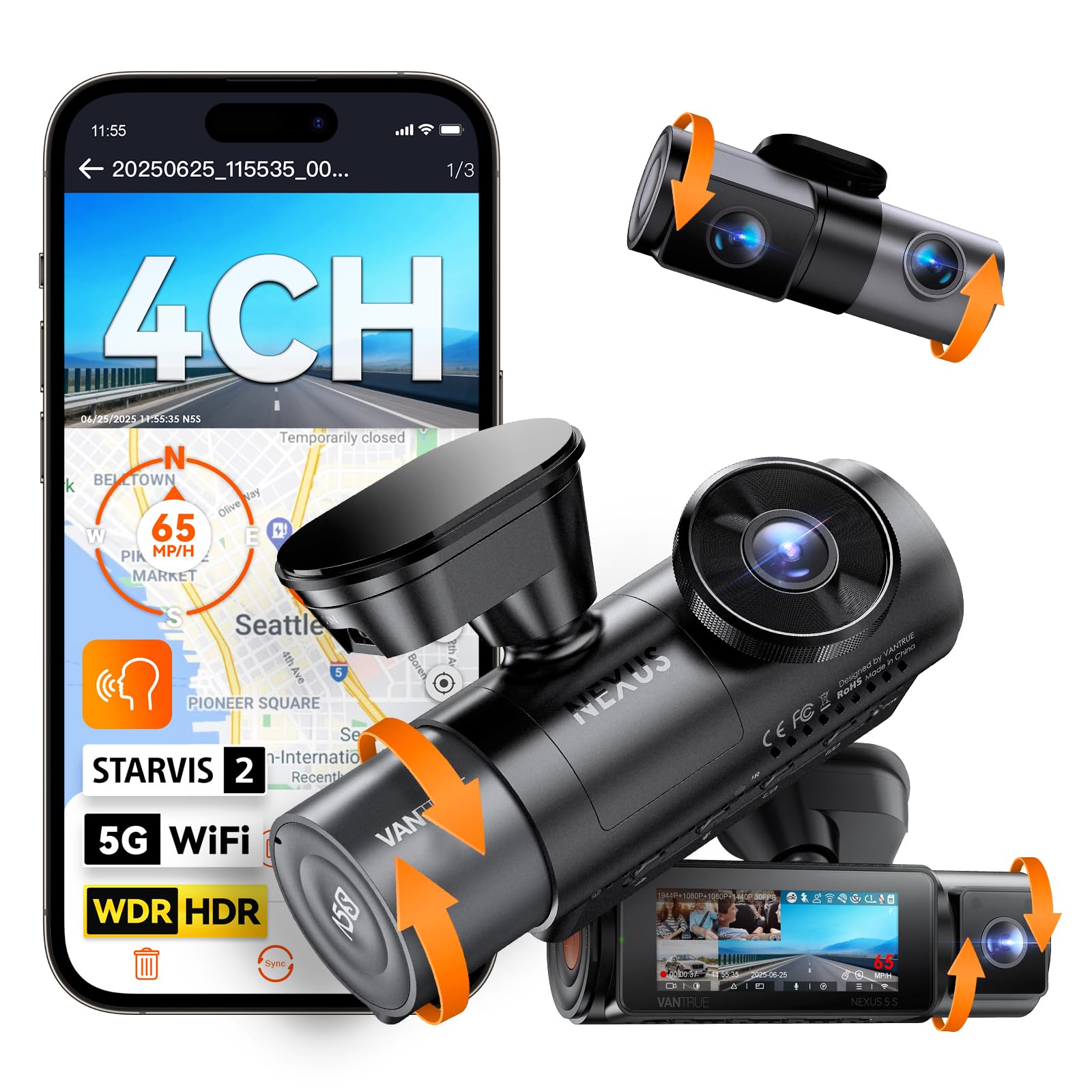
The four-camera system that watches the road, the cabin, and both sides of your car.
If you want the most comprehensive coverage available, the Vantrue N5S records on four channels simultaneously: a 2.7K front camera, a 1440P rear camera, and two 1080P interior cameras (one for the front cabin, one for the rear cabin). Every single one of those four cameras uses a STARVIS 2 sensor, so low-light performance is consistent no matter which angle you review. The flexible recording modes (1CH, 2CH, 3CH, or 4CH) let you switch between configurations depending on your driving situation.
The free Vantrue app includes OTA (over-the-air) firmware updates, so the camera stays current without removing the memory card. Dual-system GPS (GPS and GLONASS) provides accurate positioning and generates mileage reports. The N5S supports microSD cards up to a massive 1TB, which is the highest capacity in this roundup and provides up to 40 hours of continuous four-channel recording. The super capacitor construction handles temperatures from -4°F to 140°F, making it suitable for extreme climates. The interior cameras also have infrared lights for recording in pitch-black cabin conditions.
The honest feedback from owners is that the video quality and 360-degree coverage are outstanding, but reliability gets mixed reviews — a minority of owners mention units that stop working. The 5GHz Wi-Fi has also been reported as unreliable by some. This is a complex system with a detailed menu, so expect a learning curve during setup. For the ultimate in four-camera surround-view protection with STARVIS 2 on every lens, the N5S is unrivaled, but your experience will be smoother if you are technically comfortable with dash cam installation and troubleshooting.
class-leading coverage
- Four-channel recording (2.7K front, 1440P rear, two 1080P cabins) eliminates virtually every blind spot.
- All four cameras have STARVIS 2 sensors, ensuring consistent low-light performance across every angle.
- 1TB max storage capacity is the highest in this guide, supporting up to 40 hours of continuous recording.
Be aware
- Reliability and 5GHz Wi-Fi connectivity get mixed feedback from some owners, with a minority reporting units that fail.
- The menu system is detailed and potentially overwhelming; installation and initial setup take more time than a two-channel cam.
Reach for it when: you want the absolute maximum level of protection — four cameras, STARVIS 2 on every lens, and the highest possible storage capacity — for a large vehicle or confidence.
Think twice if: you prefer a simpler set-and-forget device, or you are concerned about the mixed reliability reports and the steeper learning curve.
Understanding the Specs
Front Camera Resolution
The front camera resolution determines how clearly you can read license plates and road signs in your footage. 4K (3840×2160) is the current balance — it gives you enough detail to enlarge a frame and still read a plate from a few car lengths ahead. 2.7K or 1080p cameras are more affordable, but you may lose plate detail in low light or at speed. Most of the picks here are 4K for exactly that reason.
STARVIS Sensors and Night Vision
A STARVIS sensor is a type of image sensor from Sony that is designed to perform well in low light. STARVIS 2 is the newer generation, offering even better detail in dim conditions. A camera with a STARVIS or STARVIS 2 sensor will capture usable footage in near-darkness or when headlights are glaring — a key spec if you drive often at night or park on unlit streets. Look for this sensor if night-time clarity matters to you.
Parking Mode and Hardwire Kits
Parking mode lets the dash cam keep recording while your car is parked and turned off. It usually works in one of three ways: time-lapse (takes a frame every few seconds), motion detection (starts recording when something moves near the car), or collision detection (starts when something bumps the vehicle). Almost all parking modes require a hardwire kit (a separate cable that connects the camera to your car’s fuse box for constant power). The camera does not use its own battery for this — without the hardwire kit, parking mode shuts off when the car does.
Included Memory Card and Max Capacity
The memory card size determines how much footage you can store before the loop recording overwrites the oldest clips. A 64GB card typically holds 4-6 hours of 4K footage. A 128GB card doubles that. The max supported capacity (often 256GB, 512GB, or even 1TB on high-end models) tells you the largest card the camera can handle for long trips without worrying about overwrites. Faster cards (U3 or V30 speed class) are recommended for reliable 4K recording.
FAQ
Do I need to hardwire a wireless backup and dash cam for parking mode?
What does wireless mean for a backup and dash cam?
Will any of these dash cams drain my car battery overnight?
Can I use these cameras as a full-time rearview mirror replacement?
What size memory card do I need for 4K recording?
Is 4K front camera resolution always better than 1080p?
Do I need a dedicated GPS module or is it built-in?
How does the G-sensor protect my footage?
Final Thoughts: The Verdict
For most drivers, the top pick is the wireless backup and dash cam from TERUNSOUl, which packs a 4K three-channel system, a 128GB memory card, 5.8GHz Wi-Fi, and built-in GPS into one very strong package at a mid-range price. If you want the best value with a sharper 2K rear camera, grab the FAIMEE F6. And if you drive for Uber, Lyft, or need cabin recording with the fastest Wi-Fi transfer speed in its class, the 70mai T800E is the one to reach for.
How We Picked
We do not accept paid placement. Every pick is matched to a real buyer and a real use-case; we do not hands-on test units.
Sources & Methodology
Specifications: manufacturer listings and product documentation. Review insights: verified customer reviews, as of July 2026. Pricing: not shown on this page (it changes often); check the current price via the retailer link.
As an Amazon Associate, GoCarLife earns from qualifying purchases. This does not affect which products we feature.