
Our readers keep the lights on and the garage heater humming. As an Amazon Associate, I earn from qualifying purchases.
Specs are compiled from manufacturer listings and verified buyer reviews and can change over time — please confirm the key details on the product page before buying.
If you have ever fought a safety wire twist with basic pliers, you already know the pain — the wire slips, the twist is uneven, and fingers ache before the job is halfway done. Wire twisting pliers solve that mismatch entirely: they grab, lock, spin, and cut in a single tool, a manual twist might take ten minutes, versus about thirty seconds with dedicated pliers.
I’m Mo Maruf — the founder and writer behind GoCarLife. This guide is built by comparing the manufacturers’ published specifications and the patterns across verified customer reviews, so you get each pick’s real strengths and trade-offs instead of marketing spin.
With so many options claiming aerospace-grade performance at budget prices, the best wire twisting pliers must lock securely, spin freely, and cut cleanly — and this list separates the tools that deliver from those that frustrate.
Our Picks at a Glance


How To Choose The Best Wire Twisting Pliers
The simple-looking plier actually hides a few make-or-break details. Focus on the lock’s bite comfort, the maximum wire gauge it can twist and the cut, and whether the handle allows a natural grip under extended use. A plier that looks solid in the photo but refuses to latch under wire tension will waste more time than a cheap set ever saves.
Locking Integrity and Jaw Grip
The whole point of a wire twister is the lock. A poor latch lets the wire slip mid-spin, forcing you to reset the tool. Look for a plier whose locking slide engages firmly even with a thin wire (0.5 mm) between the jaws. Metal-to-metal lock faces with deep teeth hold best.
Wire Capacity — Twist vs. Cut
Every plier states two numbers: the maximum diameter it can twist and the maximum it can cut. These are often different (a 1.5 mm twist limit and a 2.5 mm cut limit, for example). If your work mixes thick industrial wire with fine safety wire, a single-capacity tool may fail at one end of the range.
Ergonomics and Handle Feel
A stiff spring or a poorly shaped handle turns a quick job into a hand-cramping chore. The best handles use a contoured grip that lets you squeeze and lock without repositioning your fingers. Painted or rubberized coatings reduce slipping when hands are oily.
Quick Comparison
| Model | Best For | Length | Max Twist Capacity | Material | Amazon |
|---|---|---|---|---|---|
| Draper 250mm★ Best Overall | Aerospace & defence reliability | 250mm | 1.5mm | Chrome Vanadium Steel | Amazon |
| Bonsicoky 6 InchBudget Champion | Budget starter with wire included | 6″ | — | High Carbon Steel | Amazon |
| Noxtren 6-Piece Drill SetDrill-Powered Combo | Power-drill wire twisting | — | 9 – 22 AWG | 40Cr Alloy Steel | Amazon |
| NACHEE 6 Inch | Entry-level with included wire spool | 6″ | 0.032″ | High Carbon Steel | Amazon |
| Honoson 9 Inch | Long-reach twisting at a value price | 9″ | 0.3 – 0.7 mm | High-carbon Steel | Amazon |
| Honoson 6 Inch | Compact multi-use wire work | 6″ | 0.3 – 0.7 mm | High Carbon Steel | Amazon |
| Mudder 2-Piece Set | Two sizes in one buy | 6″ & 9″ | 0.3 – 0.7 mm | High Carbon Steel | Amazon |
| Honoson Set (9″ & 6″) | Versatile pair for varied jobs | 6″ & 9″ | 0.3 – 0.7 mm | High Carbon Steel | Amazon |
| WCS 10.5 Inch | One-pull action for light gauge | 10.5″ | — | Stainless Steel | Amazon |
In‑Depth Reviews
1. Draper 250mm Wire Twisting Pliers
Our pick — 4.5★ from 250+ verified ratings; the strongest balance of quality and price.
The chrome-vanadium steel plier that sets the reliability benchmark for safety-critical work.
If you are wiring lock fasteners on aircraft, defence gear, or race cars, the one thing you cannot tolerate is a tool that fails mid-twist. This Draper is forged from chrome vanadium steel — hardened and tempered so the polished faces maintain precision over years, not months. It twists wire up to 1.5 mm in diameter and cuts up to 2.5 mm, covering the two most common safety-wire gauges in one 250 mm body.
The handle feel earns genuine praise — the ergonomic grip and the spring-back action let you work repeatedly without fighting the tool. Buyers consistently call the construction first-rate, noting they recommend it over alternatives with poor track records. It ships from England, which some view as an assurance of build quality.
A small but real limitation: the tool is sized at 250 mm, and at least one owner found it a touch large for tight-access spots. And while the spec says it twists 1.5 mm, a separate buyer reported being unable to use it on 1.5 mm wire — a reminder that batch consistency can vary even on well-regarded tools.
Benchmark build: Draper’s chrome-vanadium construction and polished spiral screw assembly give this plier a lifespan that budget steel units cannot match — the thing everyone raves about is the grip and the confident lock.
Reach for this for: any job where safety-wire integrity is non-negotiable — aviation, racing, military locking.
Look elsewhere if: you need a compact 6-inch tool for cramped engine bays; this 250 mm plier is long for tight quarters.
2. Bonsicoky 6 Inch Safety Wire Pliers
The entry-level gate opener that works well once you learn its quirks.
This Bonsicoky set throws a 50-foot reel of safety wire into the box alongside a 6-inch plier forged from high-carbon steel. Owners find the tool genuinely useful for basic safety-wire tasks on vehicles and machinery — it holds fasteners in place and prevents bolts from backing out. The heavy-duty lock claws are heat-treated for strength, and the polished jaws have deep teeth for bite force.
The honest trade-off: the latch is where this tool stumbles. Several buyers report it does not want to click shut easily, especially with wire between the jaws. You may need two hands or some patience to engage the lock. The spring return works once you are past that initial hurdle, and buyers confirm the twisting mechanism creates a strong, consistent twist once the tool is locked.
For experienced users who need a no-fuss daily driver, the latch frustration pushes them toward a pricier unit. For a first-time wire-twister who is patient and open to a learning curve, this is a very affordable start — complete with the wire you need to practice.
Starter Strengths
- Includes 50 ft of safety wire in the box
- High-carbon steel forging with heat treatment holds up to moderate use
- Genuinely prevents fastener loosening on auto and light aircraft jobs
Latch Limitations
- Locking the slide requires notable force, particularly with wire in the jaws
- A few units arrive with a misaligned latch that never seats smoothly
- Not a grab-and-go tool — expect to practice before it feels fluid
Perfect starting point for: a DIY mechanic or hobbyist who wants one low-cost tool to learn safety wiring on a jetski or ATV.
Not for: a professional who twists 30 sets of wire a day; the latch delay kills speed.
3. Noxtren 6-Piece Wire Twister Tool Set
A drill-driven wire twister that saves your fingers from repetitive strain.
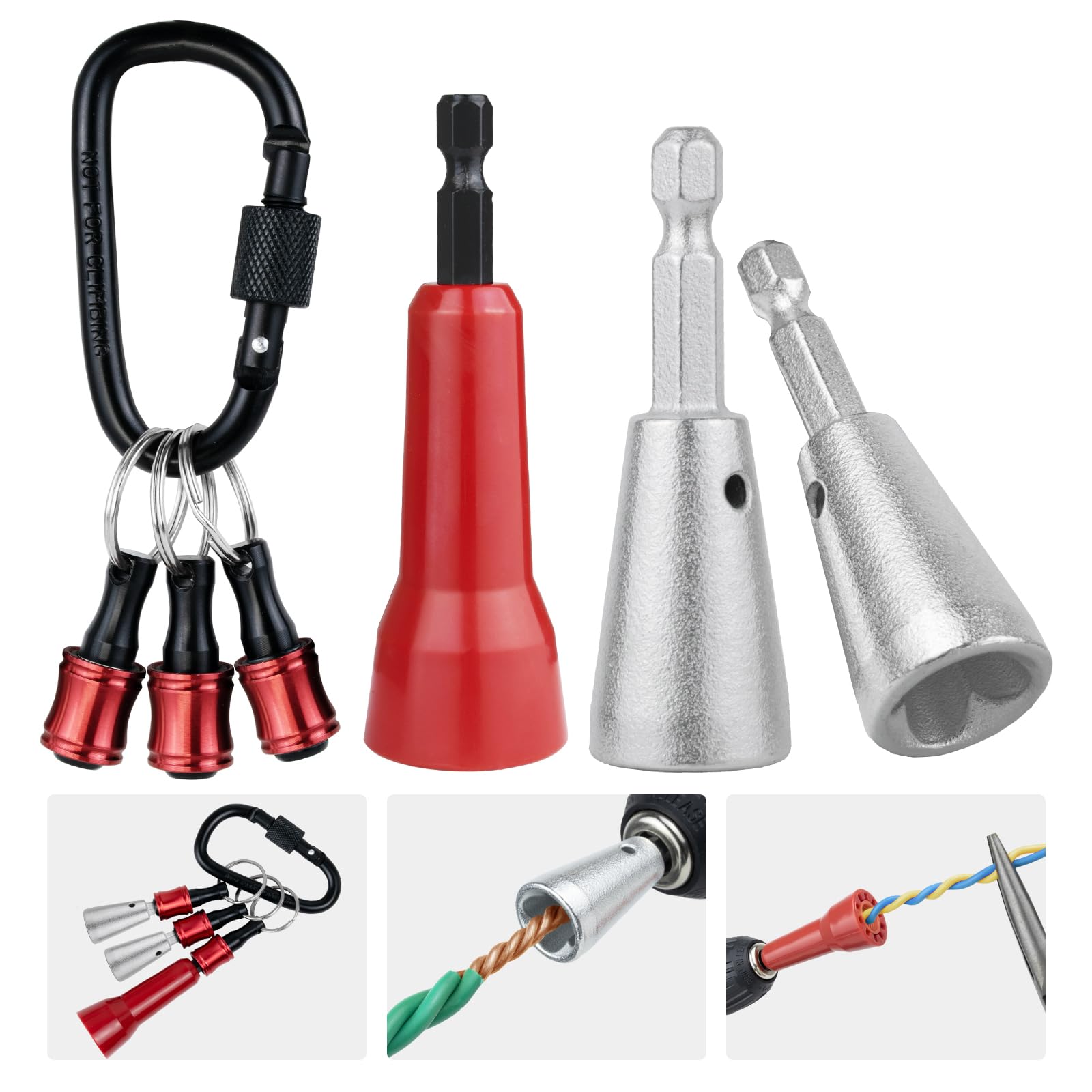
This is not a pair of traditional locking pliers — it is a different approach entirely. The Noxtren set includes two wire twisters and a wire-nut twister with 1/4-inch hex shanks that fit into any standard drill. Instead of pulling a handle back and forth, you chuck the tool in a drill, let the motor spin, and bundle wires evenly without hand fatigue. The included bit-holder keychains with carabiners solve the problem of losing small accessories on a job site.
Build quality draws positive notes. The twister is galvanized 40Cr steel with an electrolytic finish — the 13 owners who commented on quality all call it solid. On the function side, it handles home electrical work and automotive wiring comfortably, working on wire nuts from 9 to 22 AWG. The wire nut twister, though, has a catch: it only grabs wire nuts with wings. If you use standard conical nuts without wings, you may need the other twister tips.
Buyers sum it up: this set saves fingers and speeds up repetitive wiring. The bit holder alone gets repeated praise as a brilliant storage hack — keeping the twisters organized on a carabiner means you are not digging through a toolbox every time you need one.
Fatigue-killer for high-volume jobs: using a drill to twist wires removes the hand strain entirely, and the 40Cr steel construction holds up to frequent site use.
Best for: an electrician or automotive tech who wires multiple junction boxes a day and wants to eliminate repetitive hand motion.
skip it if: you need a traditional lock-wire plier for safety-critical aerospace work — this is a drill accessory, not a lock-twister.
4. NACHEE 6 Inch Safety Wire Pliers

A compact 6-inch starter with a stainless wire spool, but the lock is the weak link.
The NACHEE plier is forged and heat-treated from high-carbon steel, paired with a 25-foot spool of 304 stainless steel wire at 0.032-inch diameter. It meets NASM20995C and ASTM A580 specifications, which is a solid spec for an entry-level tool. The idea is simple: clamp the wire, lock the slide, and pull the handle to spin twists into place for securing bolts, brake rotors, or exhaust screens.
In practice, owners mention a split experience. Some say it works perfectly — one buyer used it to wire RV furnace exhaust screens and calls the results great, while another praises its performance as rivaling pricier tools. But a different set of owners find the tool difficult to lock the slide shut, requiring enormous hand force. The cutters get a similar split review: they work for some and leave visible indentations on wire for others.
The honest word: this is a mixed-effective plier whose success depends heavily on individual unit consistency. It works beautifully from the start for some and frustrates others with a stubborn lock and blunt cutter. If you buy it, expect a 50/50 chance you will have to work the lock loose with lubricant or a light file.
Good-Value Foundation
- Includes 25 ft of 304 stainless steel wire (.032″) in the package
- Forged high-carbon steel with heat treatment delivers solid durability
- Does a clean twist on brake-rotor and exhaust-screen jobs for many owners
Lock & Cutter Caveats
- Locking the slide requires significant force, tiring your hand after a few cycles
- Cutting blades develop indentations on safety wire, per some experiences
- Not the tool for a fast-paced shop — expect a learning curve on the clamp
Works for: the weekend motorcycle owner who wants a single plier-and-wire combo for small fastening jobs.
Not for: the professional who needs consistent one-handed locking every time.
5. Honoson 9 Inch Safety Wire Twisting Pliers

A 9-inch body that reaches deeper, but the lock is a notorious sticking point.
The Honoson 9-inch plier is the budget-conscious choice for anyone who needs extra reach into engine bays or machinery frames without stepping up to a premium brand. It is forged and heat-treated from high-carbon steel, handling steel wire from 0.3 to 0.7 mm in diameter. The package also includes a 10-meter length of 0.5 mm steel wire, so you can start twisting immediately.
Value for money is the most-praised aspect — owners consistently note that the price is fair for what it does. The twist mechanism creates a proper lock-wire spiral once you get the plier engaged. The trouble is the engagement itself: the lock is stubborn to close, and the helix spinner can be very tight, making it difficult on light-gauge wire. Durability concerns also surface — some customers note that the cheap spring-steel lock mechanism feels weak, and the included wire snaps at around four twists per inch (the recommended range is six to eight).
The bottom line: this Honoson works well enough for occasional use if you are willing to fight the lock. For daily professional twisting, the tight mechanism wears on patience and productivity quickly.
Decent for infrequent use: the 9-inch length and included wire make it a practical starter, but the stiff lock and tight spinner limit it to lighter workloads.
Choose it for: a home mechanic or occasional twist job where the 9-inch reach saves crawling under the vehicle.
Think twice if: you twist wire daily for a living — the lock resistance will slow you down.
6. Honoson 6 Inch Safety Wire Pliers

A short 6-inch body that aims for versatility, but the lock stiffness is a repeating story.
The smaller sibling in the Honoson line measures 6 inches and weighs 10.4 ounces, making it handier in tighter spots than the 9-inch model. It uses the same formula — forged and heat-treated high-carbon steel, a 3-in-1 design (wire cutter, strand cutter, plier core), and compatibility with 0.3 to 0.7 mm steel wire. It also comes with a 10-meter reel of 0.5 mm wire.
Value is the headline. Many owners call it a solid tool for the price, noting that once you learn the technique it works well for safety wiring bolts on aircraft or automotive fasteners. The wire occasionally slips when locked, and the lock itself is stiff out of the package — but some report it eases with use after a few cycles. A minority find the handles so stiff that they cannot squeeze the lock slide at all, making the tool unusable fresh from the start.
This is a decent second-tier tool for someone who already has a reliable primary plier and wants a compact backup. As a first and only tool, the known lock inconsistency makes it a gamble.
Compact Value
- 6-inch length fits in crowded engine compartments and small panels
- Heat-treated carbon steel body with a 3-in-1 design covers cut, twist, and hold
- Includes 10 m of 0.5 mm stainless wire for a complete starter pack
Stiff Lock Syndrome
- Lock slide can be extremely hard to engage, especially on first use
- Wire slips out occasionally under tension if the latch is not fully seated
- Some units arrive unusable — handles too tight to squeeze to lock
Best as: a compact backup or a weekend-project tool when you already have a go-to plier.
Not the one if: you need a tool you can rely on for daily professional safety-wire work straight from the start.
7. Mudder 2-Piece Aircraft Safety Wire Twisting Pliers

Two pliers for the price of one premium unit, but the spring tension is aggressive.
Mudder packages a 6-inch and a 9-inch safety-wire plier in a single set, both forged from heat-treated high-carbon steel with a 3-in-1 design. The idea is smart: grab the small one for confined spaces and the larger one for leverage on heavier wire. Both are compatible with 0.3 to 0.7 mm wire, and the red paint makes them easier to spot in a crowded drawer.
The crowd verdict is split. Supporters say the set is a great starter for occasional use — maybe 25 to 30 safety-wire jobs per year — and that with practice it works well. One owner even dropped a pair from a 200-foot height with no damage. The recurring complaint is that the spring tension is too strong. The lock can pop back open mid-twist if you do not ride the plunger, and the high spring pressure tends to snap thinner wire. Some buyers also report the knob loosens during use; blue Loctite is a common fix.
Build quality draws the sharpest criticism. Several owners describe the metal body as porous and the handles as unsmoothed. Compared with the Draper above, the Mudder set feels exactly like what it costs — functional for light use, but not a professional-grade tool.
Reliable for low-volume work: the two-size set covers most access scenarios, but the heavy spring and occasional lock release limit it to non-critical or hobbyist use.
Good for: a garage tinkerer who needs both sizes and does not twist wire every day.
Avoid if: you work in aviation maintenance or any field where a spring-back open up during twisting could ruin a locking job.
8. Honoson Safety Wire Pliers Set (9″ & 6″)

Two sizes plus wire, but the locking and twisting friction is a known friction point.
Honoson repeats its formula in a set: a 6-inch and a 9-inch plier plus 32 feet of 0.5 mm steel wire. Both pliers are forged and heat-treated from high-carbon steel and claim a 3-in-1 function (cutter, strand cutter, plier). The set is aimed at aircraft, automotive, and industrial use, and the two sizes give you the flexibility to pick the reach you need for each job.
Owners who have used military-grade versions note that these Honoson pliers function similarly once you accept a few quirks. The latch is hard to lock — a common refrain across this price tier — and the center barrel requires noticeable effort to slide back. On the plus side, once locked, the clamping force is secure. The twisting screw itself feels stiff right from the start; several buyers expect it to loosen with use, but there is no guarantee of when or how much.
Quality holds up for occasional use. The tool has worked on model turbine fuel tubing and 4 to 8 mm gas tubing without issue. But a non-trivial number of reviewers point out early failure — one says the plier had issues within two months. At this price for a two-plier set, you trade consistency for versatility.
Set Flexibility
- Two sizes in the box — the 6-inch fits tight spots, the 9-inch offers leverage
- Heat-treated high-carbon steel with secure clamping when the lock engages
- 32 feet of included 0.5 mm wire means you are ready to twist immediately
Known Friction Issues
- Center barrel and latch both require notable effort to operate
- Twisting screw is very tight initially, may not loosen predictably
- A small but real portion of shoppers say failure within two months of use
Works for: the hobbyist model-maker or occasional automotive user who wants two sizes in one purchase.
Not for: a shop where the plier must twist thousands of times without the lock mechanism wearing out early.
9. WCS 10.5 Inch Safety Wire Pliers

An aerospace-grade tool that works well for light-gauge jewelry and small wire — but has durability questions.
This WCS Wire Twister measures 10.5 inches and is built from stainless steel with an aerospace-grade rating. Unlike most pliers on this list, it uses a one-pull-action mechanism: you clamp the wire, lock the jaws, and a single pull of the handle spins the twist. It is marketed for aircraft and industrial settings, and the stainless steel body is meant to stand up to rigorous use.
Where it excels is light-gauge wire. Buyers who use it for jewelry making praise it enthusiastically. The grip holds securely and produces a clean, consistent twist — much more convenient than dragging out a heavy drill. The versatility of doubling as pliers and cutters also gets positive mentions. But the tool draws heavy criticism on build quality and durability. The jaw release slide requires extreme force to operate; some owners need a screwdriver to move it. Jaws arrive misaligned on some units, making it impossible to close and lock again.
The cutter is another weak spot — many report it is poor, leaving jagged edges instead of clean cuts. The twisting mechanism can work loose if you do not help it spin by hand. Overall, for thin wire in a low-volume setting (jewelry, small electronics), it is a functional tool. For heavy aerospace or automotive safety-wire work, the probability of early failure is too high.
Best for light, creative use: when the wire is thin and the volume is low, the one-pull action creates uniform twists — but the cutter and lock reliability keep it off a pro’s bench.
Ideal for: a jewelry maker or light electronics work where consistent thin-wire twists are the daily task.
Not for: aviation maintenance, auto shops, or any setting where the lock must engage every time without fail.
Understanding the Specs
Maximum Twist vs. Maximum Cut
These are two separate numbers that often get confused. The maximum twist diameter is the thickest wire the plier can grab and spin into a safety-wire twist. The maximum cut diameter is the thickest wire the built-in cutter can snip. A tool may twist 1.5 mm wire but cut 2.5 mm wire — if you use 2 mm wire, you can cut it but not twist it. Always check both numbers against the wire gauge you work with.
Locking Slide Mechanism
This is the sliding collar that forces the jaws shut and holds them closed during twisting. On a good tool, it slides forward smoothly and clicks into place with one-handed pressure. On a poor tool, it sticks or requires a secondary tool to move. The lock is the single most important part of a wire-twisting plier — if it fails to engage, the wire slips and the twist is useless.
FAQ
Do I need two different sizes of wire twisting pliers?
Can wire twisting pliers cut the wire they twist?
Will these pliers work on stainless steel safety wire?
What does 3-in-1 mean on a wire twisting plier?
Why is the lock so hard to engage on budget pliers?
Can I use a drill-mounted wire twister for safety wire?
What wire gauge is 0.5 mm in AWG?
How do I maintain a wire twisting plier?
Final Thoughts: The Verdict
For the majority of shoppers, the best wire twisting pliers winner is the Draper 250mm because its chrome-vanadium steel, polished spiral screw, and reliable lock make it the only tool on this list that feels built for daily professional use without compromise. If you want to start cheap and learn the technique, the Bonsicoky 6 Inch gives you a functional plier plus enough wire to practice. And for repetitive electrical work that would wreck your hands with a manual twister, the Noxtren drill-powered set is the fatigue-killer the other picks cannot match.
How We Picked
We do not accept paid placement. Every pick is matched to a real buyer and a real use-case; we do not hands-on test units.
Sources & Methodology
Specifications: manufacturer listings and product documentation. Review insights: verified customer reviews, as of July 2026. Pricing: not shown on this page (it changes often); check the current price via the retailer link.
As an Amazon Associate, GoCarLife earns from qualifying purchases. This does not affect which products we feature.