
Our readers keep the lights on and the garage heater humming. As an Amazon Associate, I earn from qualifying purchases.
Specs are compiled from manufacturer listings and verified buyer reviews and can change over time — please confirm the key details on the product page before buying.
You are stuck in mud, snow, or a ditch, and the one thing standing between you and freedom is a thin length of wire rope. The wrong choice snaps, rusts, or turns into a deadly projectile. The right one pulls you out, time after time, without you ever having to wonder if it will hold. This guide cuts through the technical noise to show you exactly which wire rope for a winch delivers real-world strength, safety, and value — whether you drive a side-by-side, a full-size truck, or a weekend recovery rig.
I’m Mo Maruf — the founder and writer behind GoCarLife. This guide is built by comparing the manufacturers’ published specifications and the patterns across verified customer reviews, so you get each pick’s real strengths and trade-offs instead of marketing spin.
You will find nine carefully chosen options below, from budget-friendly synthetic ropes for light ATVs to heavy-gauge galvanized steel cables built for full-size trucks. This is the definitive guide to finding the best wire rope for a winch for your exact vehicle and recovery style.
Our Picks at a Glance

How To Choose The Best Wire Rope for a Winch
Picking the right winch rope depends on three things: what you drive, where you drive, and how much weight you need to pull. A rope that is too thin snaps under load; one that is too thick won’t spool enough length on the drum. Here is what to look at before you buy.
Breaking Strength vs. Vehicle Weight
The single most important number is the breaking strength — the force at which the rope is designed to part. A good rule is to pick a rope whose breaking strength is at least 1.5 times the gross vehicle weight. A 10,000-lb breaking strength rope works for a 3,333-lb ATV, while a full-size truck near 7,000 lbs needs a rope rated above 15,000 lbs. Never match the rating exactly to the vehicle weight; you need the safety margin for shock loads from a stuck vehicle.
Material: Synthetic vs. Steel
Synthetic ropes made from Ultra-High Molecular Weight Polyethylene (UHMWPE — a dense, super-strong plastic fiber) are lighter, float on water, and do not store the dangerous snap-back energy of steel cable if they break. Steel cable is more abrasion-resistant against rocks and sharp edges, and it handles heavy loads without stretching. For daily trail riding where safety is the priority, synthetic wins. For heavy construction, logging, or extreme rock-crawling where sharp edges are constant, steel is still the standard.
Diameter and Drum Capacity
A 1/4-inch rope is standard for ATVs and light UTVs. A 3/8-inch or 1/2-inch rope belongs on full-size trucks and heavy recovery rigs. Thicker rope is stronger but fills the winch drum faster, meaning you get less usable length. Always check your winch’s drum capacity chart in the owner’s manual before buying a longer rope. Many buyers are surprised to find a 100-foot rope does not fully spool onto a small winch drum.
Quick Comparison
| Model | Best For | Breaking Strength | Diameter | Length | Amazon |
|---|---|---|---|---|---|
| VEVOR Synthetic 1/4″★ Best Overall | Best Overall | 10,000 lbs | 1/4 in | 50 ft | Amazon |
| DAYDOOR Synthetic 1/4″Most-Praised Quality | Most-Praised Quality | 10,000 lbs | 1/4 in | 50 ft | Amazon |
| AXSIPEIX Blue 1/4″Best Value | Best Value | 10,000 lbs | 1/4 in | 50 ft | Amazon |
| METOWARE Orange 1/4″ | Reliable Budget Pick | 10,000 lbs | 1/4 in | 50 ft | Amazon |
| Carforu 5/16″ Synthetic | Mid-Size Rig Upgrade | 13,000 lbs | 5/16 in | 50 ft | Amazon |
| SPARKWHIZ Kit 1/4″ | Complete Kit with Fairlead | 10,000 lbs | 1/4 in | 50 ft | Amazon |
| VEVOR Galvanized Steel 3/8″ | Heavy-Duty Steel Cable | 15,200 lbs | 3/8 in | 50 ft | Amazon |
| X-BULL Synthetic 1/2″ | Max Strength Recovery | 32,000 lbs | 1/2 in | 85 ft | Amazon |
In‑Depth Reviews
1. VEVOR Synthetic Winch Rope, 1/4 Inch x 50 Feet
Our pick — over 4.5★ from 600+ verified ratings; the strongest balance of quality and price.
The kit that out-pulls its price tag by a country mile.
This VEVOR synthetic rope is the crowd favorite for a reason: a 10,000-lb breaking strength in a 1/4-inch diameter that is perfectly matched to vehicles under 3,333 lbs. The rope is made from 12-strand high molecular polyethylene (a type of UHMWPE — a dense plastic fiber that is stronger than steel pound-for-pound) with a PU coating for abrasion resistance. What really wins owners over is the forged Ram’s Horn hook, rated at 9,700 lbs, and the 5-foot nylon protective sleeve that shields the line from rough fairlead edges. The 6-foot orange warning sleeve at the end tells you exactly when to stop unspooling — a detail that saves your rope.
Owners consistently call this rope a “rock-solid” value that spools well, feels lightweight compared to steel, and handles serious off-road recovery without drama. The hook’s damper prevents it from slamming into the winch drum, and the included pull strap lets you feed the line out without burning your fingers. A few buyers mention that an occasional kit arrives missing a small piece, but the overwhelming consensus is that the quality and completeness here beat ropes costing three times as much. The rope’s 4.7-star rating across hundreds of owners is the highest in this lineup.
The trade-off is simple: this is a 1/4-inch rope built for ATVs, UTVs, and small pickups. If you drive a heavy-duty truck or plan on recovering vehicles near 10,000 lbs, you need the 5/16-inch or 3/8-inch options below. But for the vast majority of weekend trail rigs, this is the one to buy.
Affordable synthetic rope
- Forged hook rated at 9,700 lbs with a damper to protect the winch.
- Double sleeve design — 5 ft of nylon protection plus a 6 ft orange warning zone.
- PU coating on the 12-strand UHMWPE adds toughness without the weight of steel cable.
Shorter length limits
- Rated for vehicles up to 3,333 lbs — not for heavy-duty truck recovery.
- An occasional unit arrives with a missing Allen wrench or stopper.
Budget pick: The VEVOR 1/4-inch synthetic is the right choice for any ATV, UTV, or light-pickup owner who wants a complete, drop-in kit with a forged hook and real protective sleeves — all at a price that leaves budget options in the dust.
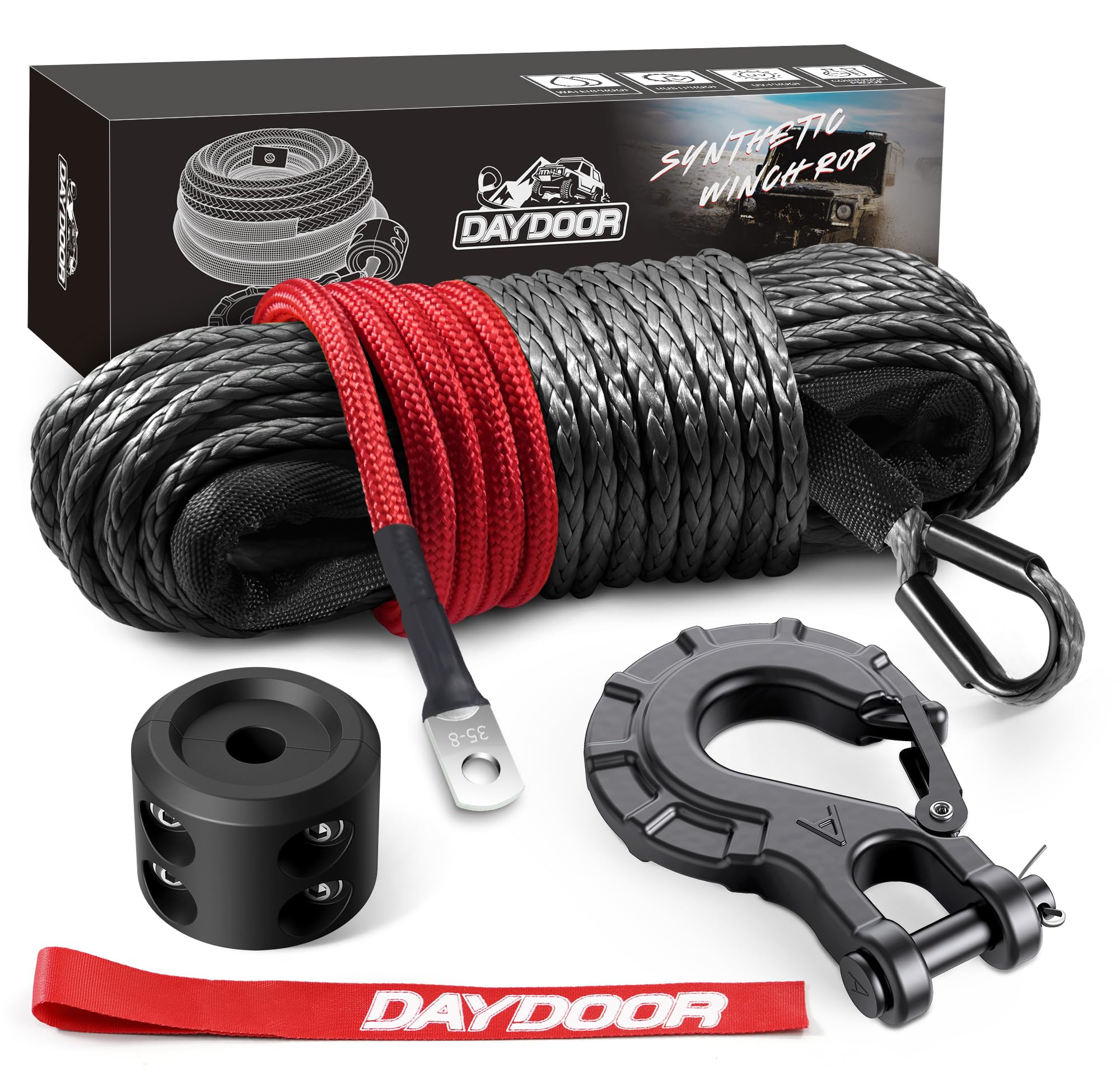
2. DAYDOOR Synthetic Winch Rope, 1/4in x 50ft
Quality is the headline here — owners praise it more than any other aspect.
DAYDOOR takes the same 1/4-inch x 50-foot formula as the VEVOR but wraps it in a gray UV-resistant polyester jacket and throws in a lifetime warranty. The rope is built from 12-strand UHMWPE (Ultra-High Molecular Weight Polyethylene — a long-chain plastic fiber that resists stretching) with less than 5% stretch under load. That low stretch means you get more direct pulling force and less “bungee” effect during recovery. The included forged steel hook carries a 13,500-lb breaking strength, giving you a solid 3,500-lb safety margin over the rope itself. The rubber stopper is dense and flexible, designed to absorb shock when the line tightens.
Quality is the thing owners talk about most — with dozens of buyers specifically calling it out as better than expected for the price. The rope works well as a direct cable replacement on Smittybilt and Warn winches. A few owners note that the rope frays easily when cut, so you need a hot knife or a torch to seal the end cleanly before installation. The recurring suggestion is to use a soft shackle instead of the hook for safer connection points, and a few mention swapping the cotter pin on the hook for a removable pin. The lifetime warranty is a genuine safety net — rare at this price point.
The honest limitation: this is another 1/4-inch, 10,000-lb rope, so it is aimed at ATVs and UTVs under 3,200 lbs. The hook is heavy, and the protective sleeve is functional rather than premium. For the same diameter, the VEVOR offers a more complete kit with the damper and double sleeves at a slightly lower cost. Pick the DAYDOOR if the lifetime warranty and the specific gray UV coating matter more to you.
Bare rope: you want a solid replacement rope with a lifetime warranty and high owner confidence in its quality. The DAYDOOR is for buyers who read reviews obsessively and want the most positive consensus on build.
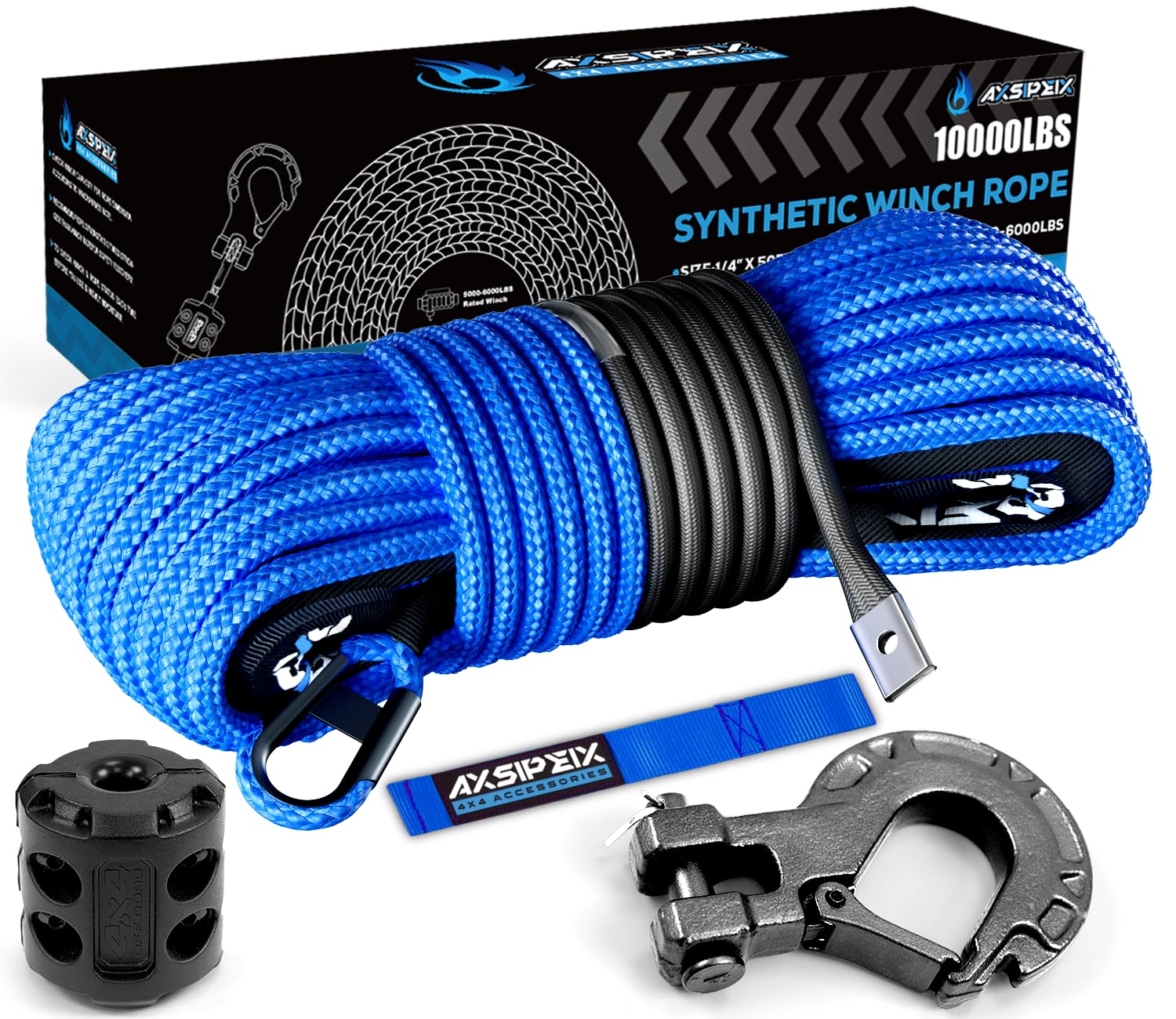
3. AXSIPEIX Synthetic Winch Rope Kit, 1/4″ x 50ft
A bright blue rope with a 17,200-lb hook that punches above its class.
The AXSIPEIX kit matches the standard 1/4-inch x 50-foot, 10,000-lb break strength formula but pairs the rope with a noticeably oversized 5/16-inch forged hook rated at 17,200 lbs — more hook than any other rope in this diameter. The 12-strand UHMWPE construction with a polyester coating is the same trusted recipe used across the category. What sets this kit apart is the manufacturer’s claim that the rope is up to 85% lighter and 30% stronger than traditional steel cable of the same diameter. The 5-foot sliding protective sleeve and colored warning jacket for the recovery distance limit are standard but well-executed.
Buyers report that the rope feels well-made and replaces steel line easily on 2,500-lb to 5,000-lb winches. One reviewer noted that the crimped metal end on the synthetic cable was too wide to fit through the spool hole on a 2,500-lb Warn winch, so they cut the tab and tied a knot instead — something to be aware of if you have a compact drum. The blue color is a nice touch for visibility on the trail. Durability gets mixed notes: some owners find it strong during first use, while a small number report the rope snapping on initial pulls. With a 1-year manufacturer warranty backing it, the risk is low.
The catch: the usable rope length after spooling and tying off is roughly 42 feet, not the full 50. A buyer pointed this out, advising that for a full-size winch drum, a longer rope like the 100-foot HOKINETY below would be the wiser buy. For ATV and light UTV use, this is a great value kit with the hook being the standout component.
Kit starter: ATV and UTV owners who want an upgrade path — the heavy hook is ready for more demanding recovery if you upgrade the rope later. The bright blue also makes it easy to spot in a mud pile.
4. METOWARE Synthetic Winch Rope Kit 1/4″ x 50ft

No frills, no fuss — just a solid rope that does the job.
METOWARE keeps things simple: a 1/4-inch x 50-foot synthetic rope, a stainless steel forged hook, and a rubber stopper. The breaking strength is the standard 10,000 lbs, and the rope is made from polyethylene with a waterproof, wear-resistant coating. The kit omits the extra pull strap and fairlead that some competitors include, which keeps the price low and the package compact. Stainless steel on the hook is a smart material choice — it resists corrosion better than electro-galvanized or powder-coated steel, especially if you regularly winch through saltwater or mud.
Owners mention that this rope is a “great replacement for the old cable” and praise its strength and ease of installation. One owner put it to work pulling four pontoon boats off a trailer — proof of the 10,000-lb rating being honest. The rope does not kink like steel wire, splices easily if you need to shorten it, and runs smoothly through the fairlead. The 30-day manufacturer warranty is shorter than the 1-year or lifetime options on other picks, but for the price, the risk is minimal. A few owners note the hook is “heavy duty” and well worth the money.
Who should skip it: if you want a complete turnkey kit with a pull strap, fairlead, and protective sleeves all included, the VEVOR or SPARKWHIZ options provide a better bundle. The METOWARE is for the buyer who already has a fairlead and just needs a bare-bones rope-and-hook combo that works.
Mid-range kit: experienced winch owners replacing an old or damaged rope on a budget. If you already own the accessories, this is the most direct route to a fresh line.
5. Carforu Synthetic Winch Rope 5/16” x 50ft

the balance between ATV line and full-size truck cable.
The Carforu rope steps up to a 5/16-inch diameter with a 13,000-lb breaking strength (roughly 5,897 kg in the specs), making it the right starting point for mid-size SUVs and light trucks. The hook is a 35,000-lb forged steel unit — far stronger than the rope itself, which is the correct design philosophy so the hook is never the failure point. The rope is lightweight, so handling and spooling are noticeably easier. The 19.69-inch protective sleeve prevents fraying at the fairlead contact point, and the rope resists water, rust, and chemicals naturally.
Owners put this rope through real punishment. One review describes pulling a 6,700-lb truck backwards “with ease” — a load well within the 13,000-lb rating. Another buyer recovered a sunk Jeep from 3 feet of mud using a 9,000-lb winch, reporting the rope held up perfectly. The main fitment note is that the 5/16-inch rope takes more drum space than a 1/4-inch line, so winding evenly is critical to avoid bunching. A few owners mention that the nylon protective sleeve began separating from the rope during installation on a tight drum; the general advice is to measure twice, cut once, and tension the spool with a vehicle pull before relying on it.
The honest trade-off: fit is mixed. Some buyers find it perfect for their Ramsey or Warn winch, while others have to adjust the mounting because the 5/16-inch rope is thicker than the factory steel cable. If your winch drum is sized for 1/4-inch line, confirm the drum’s capacity for 5/16-inch before ordering.
Heavy pulls: you drive a mid-size SUV, light truck, or heavy UTV and want more pulling power than a 1/4-inch rope provides without jumping to the bulk and cost of a 3/8-inch line. The 13,000-lb break strength handles 4WD duties confidently.
6. SPARKWHIZ Synthetic Winch Rope Kit 1/4″ x 50 ft

Everything you need to swap from steel to synthetic in one box.
The SPARKWHIZ kit includes a 1/4-inch x 50-foot synthetic rope, a 3/8-inch G70 forged steel hook, an aluminum alloy fairlead, a rubber stopper, and all necessary mounting hardware — 8 pieces total. The 10,000-lb breaking strength suits ATVs, UTVs, and light SUVs. The aluminum fairlead is the key addition: it resists corrosion (unlike steel fairleads that rust) and provides a smooth, low-friction surface for the synthetic rope to run across. The G70 hook is a premium grade with a scratch-resistant coating, and the Stopper absorbs shock during tensioning.
Buyers praise the easy installation and report that the rope pulled a Can-Am Commander Max 1000R without issue. One owner noted that the fairlead is actually sized for a UTV, not a compact ATV winch — it is too wide for some smaller ATV mounting plates. The same reviewer admitted it was their fault for not checking dimensions before ordering. The rope itself holds up to repeated use; one owner logged 6 pulls with zero issues. Durability gets mixed feedback across the board, with some finding it “super strong” and a small number reporting breakage during heavy use.
The bottom line: this is the most complete package for someone converting a winch from steel cable to synthetic rope. You do not need to buy a fairlead separately, which saves time and shipping costs. Just verify your ATV’s fairlead mounting plate dimensions before you commit — if the plate is too small, the included fairlead won’t fit.
High visibility: the first-time synthetic convert who wants a single order that includes everything needed for the swap. The SPARKWHIZ eliminates the “what else do I need?” question.
7. VEVOR Galvanized Steel Winch Cable, 3/8 Inch x 50 Feet

When only carbon steel will do, this is the cable to trust.
This is the only steel cable on the list, and it serves a specific purpose. Built from 7 strands of carbon steel (6 wires spiraling around 1 central wire), the 3/8-inch diameter carries a 15,200-lb breaking strength — suitable for vehicles up to 5,033 lbs. The hot-dip galvanized surface resists corrosion and abrasion without leaving oily residue on your hands. The self-locking swivel hook is a genuine standout: it snaps shut automatically, rotates 360 degrees to release twist and tension, and carries a 20,988-lb breaking strength — a full 5,788 lbs stronger than the cable itself. The 6-foot orange paint warning stripe at the end is your visual cue that the drum is about to run empty.
Owners describe this cable as “heavy duty” and “quality built.” One crew used it to install a well pump with multiple snatch blocks, cutting about 20 feet off without fraying issues. The hot-dip galvanization keeps hands clean — a real improvement over oiled steel cables. The swivel hook is widely appreciated for preventing the cable from twisting under load.
The catch: at 13.23 pounds, this is significantly heavier than any synthetic rope. It also stores dangerous snap-back energy if it breaks — never stand in line with a steel cable under tension. The hook is not removable, so if you want to use a different connection method, you are stuck with the swivel hook. And the 3/8-inch cable is overkill for anything smaller than a mid-size SUV or truck. That said, for construction, logging, or extreme rock-crawling where abrasion is constant, steel is still the standard for a reason.
One honest comparison: the VEVOR steel cable’s 15,200-lb breaking strength is 5,200 lbs higher than the 10,000-lb synthetic ropes, making it the choice for heavier rigs. But it weighs 13.23 lbs compared to around 2-3 lbs for a 1/4-inch synthetic.
Abrasion resistant: truck owners, construction recovery, and anyone who works around sharp rocks or metal edges regularly. The steel cable sacrifices safety convenience for abrasion resistance and raw strength.
Rust worry: you drive an ATV or care about weight. The 13.23-lb cable is overkill for a 3,000-lb vehicle, and a synthetic rope at half the price would serve you better.
8. X-BULL Synthetic Winch Rope 1/2″ X 85ft

The brawn of the group — 32,000 lbs of pulling power in a 1/2-inch line.
The X-BULL synthetic rope is the heaviest lifter in the lineup: a 1/2-inch diameter, 85-foot length, and a 32,000-lb tensile strength. The rope is constructed from 12 strands of UHMWPE (Ultra-High Molecular Weight Polyethylene). The forged steel hook is heat-hardened and carries a 36,000-lb rating — 4,000 lbs stronger than the rope itself. The 5-foot sliding protective sleeve covers the section most likely to rub against the fairlead, and the safety pull strap makes feeding the line out less dangerous. The polyester coating protects the fibers from UV damage and chemical exposure.
Owners praise the quality and the heavy-duty feel. One buyer tested the rope on a 12,000-lb Mile Marker winch, using it to pull trees — heavy, repeated pulls with no signs of wear. The bright orange color improves visibility on the trail, and the packaging drew compliments for being protective and well-organized. One owner needed to enlarge the drum hole to 3/4-inch to fit the rope end on a Badlands winch, which is common with thick-diameter synthetic ropes. A few buyers noted that the braiding on the eye splice was only 7 inches buried, not the 25-36 inches they expected for a 32,000-lb rating — a point to check before trusting it at maximum load.
The honest trade-off: this is a heavy, bulky rope. At 85 feet and 1/2-inch thick, it takes up significant drum space. Confirm your winch drum can handle a 1/2-inch rope before buying. The breaking strength between the box (30,000 lbs) and the listing (32,000 lbs) is inconsistent, which gives some buyers pause. But for serious recovery where you need the highest safety margin, the X-BULL delivers the most tensile strength of any rope on this list.
Versus the HOKINETY 3/8-inch rope, the X-BULL 1/2-inch provides 5,000 more pounds of breaking strength (32,000 vs 27,000) but trades it for a shorter length (85 feet vs 100 feet) and thicker diameter that demands a larger drum.
Maximum strength: serious off-road recovery with heavy trucks, tractors, or construction equipment. If your winch drum can handle 1/2-inch rope and you need the absolute highest break strength, the X-BULL is your pick.
Weight sensitive: anyone with a compact ATV or UTV winch drum. The 1/2-inch rope will not fit most small drums, and the strength rating far exceeds what a 3,000-lb vehicle needs.
Understanding the Specs
Breaking Strength vs. Working Load
Breaking strength is the absolute force required to snap the rope in a straight, steady pull — it is the upper limit a rope can theoretically handle in perfect conditions. Working load, which is often not printed on the rope, is typically 1/3 to 1/5 of the breaking strength and represents what you can safely pull repeatedly. A 10,000-lb breaking strength rope has a safe working load closer to 2,000-3,000 lbs. The industry standard is to never exceed 1/3 of the breaking strength during a recovery. For a 10,000-lb rope, that is about 3,333 lbs — which is exactly why the VEVOR and DAYDOOR ropes are recommended for vehicles under 3,200 lbs.
UHMWPE: Why It Replaced Steel for Most Users
Ultra-High Molecular Weight Polyethylene (UHMWPE) is a specialized long-chain plastic fiber that is 8 to 15 times stronger than steel on a weight-for-weight basis. It floats, does not rust, and has very low stretch (typically under 5% elongation at break, compared to steel’s near-zero stretch). The critical safety advantage is that a UHMWPE rope does not store the dangerous snap-back energy of steel cable — if it breaks, it simply drops to the ground instead of whipping back toward the vehicle. The trade-off is lower abrasion resistance; a synthetic rope can be cut by sharp rocks or a damaged fairlead, which is why a protective sleeve is essential.
Forged vs. Cast Hooks
A forged hook is made by heating a steel billet and hammering it into shape under extreme pressure, aligning the grain structure and eliminating internal voids. A cast hook is made by pouring molten metal into a mold, which can trap air bubbles that weaken the hook. Forged hooks are stronger and more reliable under shock loads. Every hook in this guide is forged steel except where noted. The 35,000-lb and 36,000-lb ratings on the Carforu and X-BULL hooks are significantly higher than the 9,700-lb rating on the VEVOR hook, which means those hooks are designed to outlast the rope itself.
Galvanized vs. Stainless Steel for Cable
Galvanized steel cable is coated with a layer of zinc through hot-dip galvanization — the zinc corrodes first, protecting the underlying steel. Stainless steel cable is an alloy containing chromium that forms a passive oxide layer. Galvanized cable is typically stronger (same diameter, higher tensile grade) but heavier. Stainless resists corrosion better in saltwater environments but is more expensive. The VEVOR 3/8-inch galvanized cable uses hot-dip galvanization, which provides a thicker, more durable coating than electro-galvanized steel. Both are resistant to rust, but stainless would be the better choice for a winch that lives on a saltwater boat.
FAQ
Can I use a synthetic winch rope on any winch drum?
Will a 1/4-inch synthetic rope work on a 10,000-lb winch?
How long does a synthetic winch rope last?
What is the advantage of a longer rope like 85 or 100 feet?
Does a synthetic winch rope stretch under load?
What is the difference between a hook stopper and a rubber bumper?
Can I attach a synthetic rope to a winch drum without a bolt?
Is it safe to use a synthetic rope on a winch with a steel fairlead?
What is the best way to cut a synthetic winch rope?
Final Thoughts: The Verdict
For most buyers, the wire rope for a winch thatwinner is the VEVOR Synthetic 1/4-inch x 50-foot because it delivers a forged hook, double protective sleeves, and a 10,000-lb breaking strength that fits the vast majority of ATV and UTV owners — all at a price that undercuts almost every competitor on this list. The 4.7-star rating and hundreds of positive owner experiences confirm it is the most trusted option. If you want a complete swap kit with an aluminum fairlead included, grab the SPARKWHIZ Kit. And for maximum pulling power in a full-size truck recovery, the X-BULL 1/2-inch x 85-foot rope provides the highest breaking strength (32,000 lbs), while the HOKINETY 3/8-inch x 100-foot rope offers the longest reach (100 ft).
How We Picked
We do not accept paid placement. Every pick is matched to a real buyer and a real use-case; we do not hands-on test units.
Sources & Methodology
Specifications: manufacturer listings and product documentation. Review insights: verified customer reviews, as of July 2026. Pricing: not shown on this page (it changes often); check the current price via the retailer link.
As an Amazon Associate, GoCarLife earns from qualifying purchases. This does not affect which products we feature.