
Our readers keep the lights on and the garage heater humming. As an Amazon Associate, I earn from qualifying purchases.
Specs are compiled from manufacturer listings and verified buyer reviews and can change over time — please confirm the key details on the product page before buying.
A subwoofer that rumbles one minute then goes quiet the next — or worse, a constant humming noise even when the system is off — is almost always a cable problem, not a subwoofer problem. The right wire for the job keeps your deep bass punchy and noise-free, and with so many gauges, conductor materials, and connector types on the market, picking the wrong one can turn your theater rig into a headache.
I’m Mo Maruf — the founder and writer behind GoCarLife. This guide is built by comparing the manufacturers’ published specifications and the patterns across verified customer reviews, so you get each pick’s real strengths and trade-offs instead of marketing spin.
The cleanest bass you have ever felt starts with the right cable, and this roundup of the best wire for subwoofer options cuts through the noise so you can pick the one that fits your setup perfectly.
Our Picks at a Glance

How To Choose The Best Wire for Subwoofer
A subwoofer wire does one job: carry a low-frequency audio signal from your receiver or amplifier to the sub without losing energy or picking up electrical noise. The wrong cable introduces hum, buzz, or a thin, weak bass response. Here is what to look at before you buy.
Conductor Material — OFC vs CCA
Oxygen-free copper (OFC) contains at least 99.99% copper and offers the lowest resistance, which means the signal arrives at the sub as intended. Copper-clad aluminum (CCA) wraps a thin copper layer over an aluminum core. CCA is lighter, more flexible, and costs less, but it has higher resistance — fine for short runs or modest power, but not ideal for long cable paths or high-wattage subs.
Wire Gauge — Why 12 AWG Is the balance
Thicker wire (lower AWG number) delivers less resistance over distance. For subwoofer runs, 12 AWG is the most common recommendation because it handles the power without audible loss. A 14 AWG or 16 AWG cable works for very short distances, but for any run over 15 feet, 12 AWG keeps the bass tight.
Shielding — The Hum Killer
Subwoofer signals are analog and unamplified, so they are vulnerable to electromagnetic interference from power cables, Wi-Fi gear, and other electronics. A dual-shielded cable with a braided copper layer blocks that interference. Look for double-braid shielding or a foil-plus-braid design if your sub sits near a power strip or a wall wart.
Connector Type — RCA vs Bare Wire
Powered subwoofers (the most common home theater type) use an RCA connection — a male-to-male cable with a 24K gold-plated plug at each end. Passive subs that connect to a separate amplifier use bare speaker wire or banana plugs. Know which type your sub and receiver expect before you pick a cable.
Quick Comparison
| Model | Best For | Length | Conductor Material | Shielding | Amazon |
|---|---|---|---|---|---|
| KnuKonceptz Kord 12 AWG★ Best Overall | Audiophile-grade sound | 50 ft | OFC (99.99% copper) | Unshielded (speaker wire) | Amazon |
| Kinter 12 AWG CCABest Value | Heavy-duty home theater | 100 ft | CCA | Unshielded (speaker wire) | Amazon |
| EMK Subwoofer RCAHum Killer | Affordable hum-free RCA | 15 ft | Copper-clad center | Dual-shield + nylon braid | Amazon |
| PUDKLE 12 AWG CCA | Budget-friendly long runs | 100 ft | CCA | Unshielded (speaker wire) | Amazon |
| DS18 SW-12GA-100RB | Flexible car audio installs | 100 ft | CCA | Unshielded (speaker wire) | Amazon |
| NVX XWS1225 | Silver-tinned OFC quality | 25 ft | Silver-tinned OFC | Unshielded (speaker wire) | Amazon |
| Blue Jeans LC-2 | Premium hum elimination | 10 ft | Bare copper braid | Double bare-copper braid | Amazon |
| AudioQuest Black Lab | High-end subwoofer RCA | 2 m | Solid LGC copper | Metal noise-dissipation system | Amazon |
| GEARit In-Wall 12 AWG | In-wall & ceiling installs | 100 ft | OFC | Unshielded (CL2 rated) | Amazon |
In‑Depth Reviews
1. KnuKonceptz Kord Speaker Cable 12 Gauge OFC — 50 ft
Our pick — over 4.5★ from 750+ verified ratings; the strongest balance of quality and price.
Audiophile-grade oxygen-free copper that lays flat the second it uncoils.
This is the cable that owners call “beautiful sounding pure OFC” — and the specs back it up. The conductor is 99.99% oxygen-free copper, which means resistance stays lower than any copper-clad alternative. That translates to cleaner signal flow and better bass definition for your sub, especially on longer runs. With 294 strands per conductor, the cable is surprisingly flexible for a 12 AWG wire — the Ultra Flex PVC jacket lets it snake under carpet or along baseboards without kinking.
Home theater and car audio owners both praise its sound quality. One buyer using it with banana plugs noted improved dynamics and channel separation compared to other 12 AWG wires. The 50-foot length gives you room for a front-of-room sub without needing a splice. The catch? This is bare speaker wire, not a pre-terminated RCA cable — so you need a passive sub or a separate amplifier with binding posts. For powered subs, you will add RCA plugs or choose a dedicated RCA cable instead.
What Wins Owners Over
- Genuine 99.99% OFC copper — lowest resistance for this gauge
- Ultra-flexible jacket lays flat and hides easily without coiling
- Audiophile-grade clarity — buyers report better imaging and deeper bass
The Trade-Off
- Bare speaker wire only — no RCA termination for powered subs
- 50 ft may be overkill for small rooms; no shorter spool in this color
Reach for this if: you run a passive sub or a separate amp and want the purest 12 AWG OFC wire at a fair price.
Look elsewhere if: your sub uses RCA inputs — pick a terminated cable instead.
2. Kinter 12-Gauge CCA Speaker Wire — 100 ft
Serious thickness and a 100-foot spool for heavy-duty setups on a budget.
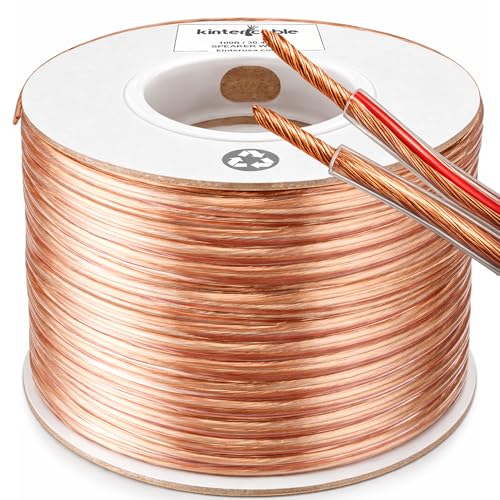
Quality is the most-discussed aspect of this Kinter wire — 55 owners single it out — and for a CCA cable at this price point, that is impressive. The 12 AWG copper-clad aluminum construction delivers good conductivity for subwoofer runs under 20 feet, and the 0.2-inch OD (outer diameter) gives it a sturdy, extension-cord feel that resists wear. The clear PVC jacket has a red polarity stripe, so keeping positive and negative straight is simple.
Buyers using it with bookshelf speakers and 100W-per-channel amps report excellent value. “Very thick and stiff, like an extension cord,” one reviewer notes — that makes it durable but also harder to hide in tight spaces. If you need a 100-foot run for a long ceiling or wall path, the stiffness becomes a manageable trade-off. The spool is recyclable and dispenses cleanly.
Why It Stands Out
- 100 ft of heavy-duty 12 AWG wire at an entry-level price point
- 105-strand count with tough PVC insulation that resists fraying
- Clear polarity marking for fast, error-free hookups
Consider This First
- CCA construction has higher resistance than OFC — not ideal for very long runs
- Very stiff jacket can be hard to route around tight corners
Best for: budget-conscious home theater builders who need a 100-foot spool and understand CCA’s limits for short-to-moderate sub runs.
Skip if: your sub is 30+ feet from the amp or you want flexibility — go OFC or a thinner gauge.
3. EMK Subwoofer Cable RCA — 15 ft
A budget-friendly RCA cable that banishes phantom hum for good.
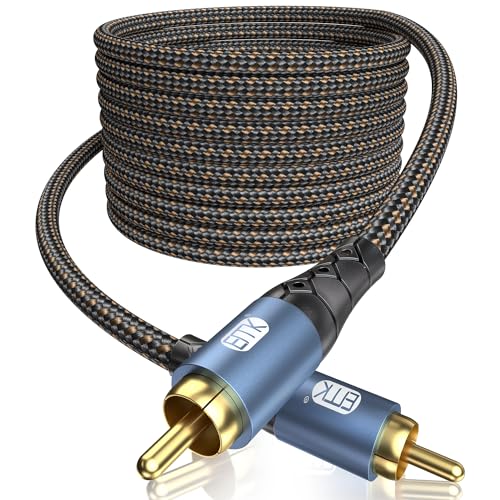
Owners of Klipsch subwoofers and other powered subs report a specific win with this cable: it eliminates the low-frequency rumble that appears even when the system is off. The dual shielding — a copper-clad center conductor wrapped in dielectric insulation and a nylon braided jacket — blocks RF and EM interference that standard RCA cables let through. That 24K gold-plated connector resists corrosion and maintains a solid connection over time.
The 15-foot length is enough for most mid-size rooms, though some owners mention it is “barely long enough” for larger spaces. At this price, the build quality punches above its class: the braided jacket protects against kinks while remaining flexible enough for tight cabinet routing. One owner described it as “good quality cord that eliminated the phantom rumble” — a strong recommendation for anyone fighting ground-loop hum.
What Makes It Work
- Dual-shielded construction stops hum from power cables and electronics
- Nylon braided jacket is flexible and protects against kinks
- 24K gold-plated RCA plugs resist corrosion for long-term signal integrity
Watch For
- 15 ft is the longest option — longer-run buyers may need two cables and a coupler
- Length perception is mixed: some owners wish it were a few feet longer
Ideal for: powered subwoofer owners dealing with hum, especially in medium-size rooms with a 15 ft or shorter run.
Not for: runs longer than 15 ft — look at a 25 ft cable or a quality coupler setup.
4. NVX True Spec 12 Gauge OFC EnvyFlex — 25 ft
Silver-tinned OFC construction that outperforms standard 12 AWG in head-to-head tests.
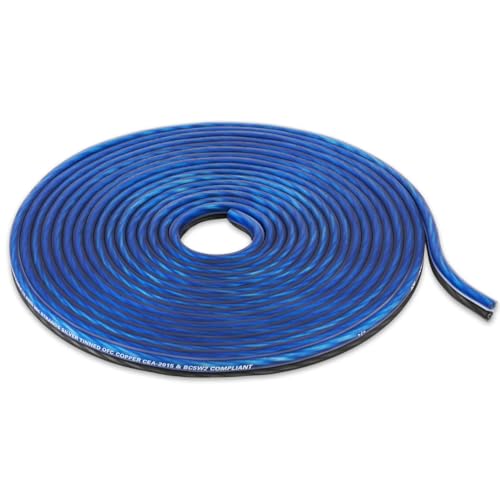
This NVX cable uses silver-tinned oxygen-free copper — a step above standard OFC because the tinning protects against corrosion while maintaining excellent conductivity. In one test, a 10-foot run of this cable outperformed a 2-foot run of 99.9% OFC 12 AWG using the same banana plugs, which points to the real-world advantage of fine-strand tinned copper. The EnvyFlex jacket is rubberized and highly pliable, making it easy to snake through tight car audio channels or behind a home theater rack.
The crowd favorite quality rating — 54 mentions — backs up the spec-sheet story. One audio enthusiast calls it “the speaker wire you want” for maintaining signal integrity from amp to speaker. The single 25-foot length is perfect for a single sub run or a near-far pair of speakers. Keep in mind this is single-conductor wire per spool; you need two spools for a stereo speaker pair, but for a single subwoofer, one spool is all you need.
Standout Strengths
- Silver-tinned OFC resists corrosion and improves conductivity over plain copper
- Exceptionally flexible rubberized jacket — easy to route in tight spaces
- Owner-tested: outperformed standard OFC in side-by-side listening
One Drawback
- Only 25 ft length — not ideal for long room crossovers
- Ease of use gets mixed feedback: some find the square insulation awkward to strip
Who it suits: audiophiles running a passive sub at under 100W who want tinned-copper quality without paying premium audiophile prices.
Who might skip: anyone needing a 50 ft+ run or a pre-terminated RCA cable for a powered sub.
5. DS18 SW-12GA-100RB Ultra Flex Speaker Wire — 100 ft

Soft, bendable CCA wire that wraps around corners without fighting you.
You can route this wire under dashboards and through door panels without fighting stiff plastic — DS18 calls it “ultra flex” because the rubber coating is noticeably softer than standard 12 AWG PVC jackets. Despite the soft feel, customers note it holds up well even after months of use in multiple vehicles. The 100-foot roll covers a full car audio system with plenty to spare.
Quality is the top praise with 63 mentions, and flexibility is close behind at 24. The CCA construction keeps the price down, and for 12V car audio systems running subs inside the cabin, the higher resistance of CCA over a 10-15 foot run is negligible. One owner running it for all his speakers says “100 feet is more than enough for multiple projects, and multiple cars.” The 10-strand construction provides solid current transfer without excessive stiffness.
Best Bits
- Ultra-soft rubber jacket bends easily around tight corners
- 100 ft length covers a whole car system or a home theater in one roll
- High owner satisfaction — 63 call out the quality
Heads Up
- CCA means higher resistance than OFC — not the best for very high-power subs
- Wire is thick for a CCA cable; some found it “still a little big gauge” for small terminals
Grab this for: car audio subs where flexibility is critical and the run is under 20 ft.
Skip for: high-wattage home theater subs that demand the lowest resistance — go OFC.
6. PUDKLE 12 AWG CCA Wire — 100 ft
A full 100-foot spool of 12 AWG CCA that delivers exactly what it promises.
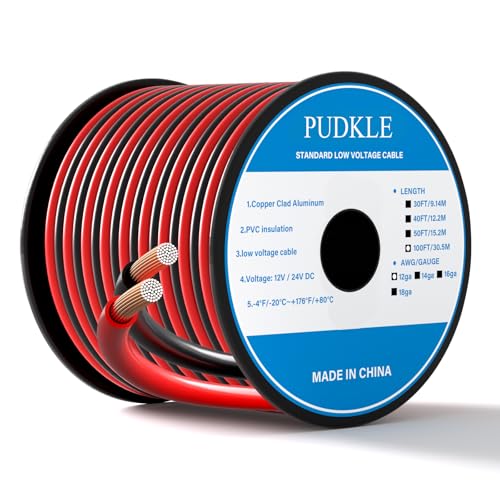
If you are wiring a subwoofer across a large room or a garage and need 100 feet without spending on premium OFC, this PUDKLE wire gets the job done. It is copper-clad aluminum — lighter and cheaper than pure copper — and the PVC jacket is flame retardant and resistant to acids and moisture. The operating temperature range of -20°C to 80°C makes it suitable for outdoor or automotive use as well.
Buyers praise the flexibility and quality for the price: one used it for a long solar project and called it “great quality.” The red and black polarity markings combined with numbered foot markers simplify cutting and connecting. At 3.1 pounds for the full spool, it is easy to handle. Just keep in mind that for a dedicated subwoofer run longer than 30 feet, the higher resistance of CCA vs OFC starts to matter, so it is best for shorter or lower-power subwoofer installations.
High Points
- 100 ft of 12 AWG wire — enough for the longest sub runs or multiple rooms
- Flame-retardant, moisture-resistant jacket for indoor or outdoor use
- Numbered markings and polarity colors for fast cutting
Limitation
- CCA construction has higher resistance than OFC — avoid very long runs
- Wire diameter is 2.05 mm — may feel thin compared to other 12 AWG CCA cables
Perfect for: budget builders wiring a single sub in a medium room or a 12V automotive system.
Not for: audiophile systems where every fraction of a decibel matters — invest in OFC instead.
7. Blue Jeans Cable LC-2 Subwoofer Cable — 10 ft
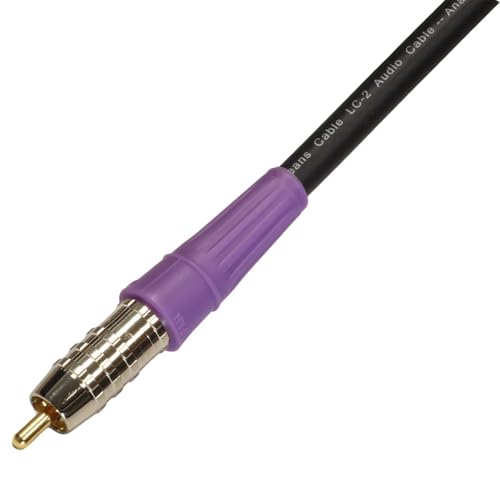
Engineered from the ground up to kill hum with double bare-copper braid shielding.
Blue Jeans Cable did not grab a stock cable and rebrand it — the LC-2 was designed specifically for unbalanced RCA analog audio. The key trick is two high-coverage bare copper braids laid directly over each other, which blocks induced noise and lowers the shield resistance enough to reduce ground-loop hum at its source. The capacitance sits at a low 12 pF/foot thanks to the foamed polyethylene dielectric with a wide gap between shield and center conductor.
The effect is real: owners replacing expensive Monster and SVS-branded cables report dramatically tighter bass and zero hum. One reviewer noted it eliminated loud humming from a turntable/receiver setup and called it “well worth the money.” The Taversoe RCA plugs use a circular leaf spring for firm grip without damaging the jack. The cable is thick but surprisingly flexible for its size, and it is built in Seattle, Washington. The 10-foot length suits most sub-to-receiver distances, though larger rooms may need a longer option.
Why It Excels
- Double copper braid shielding — top-tier hum and interference rejection
- Ultra-low 12 pF/foot capacitance preserves signal integrity over the run
- Taversoe RCA leaf-spring plugs grip firmly without damaging jacks
Considerations
- 10 ft is on the shorter side; larger rooms may need a longer or custom order
- Thick cable requires 2-inch clearance for the RCA connector barrel
Pick this if: persistent subwoofer hum has defeated other cables and you want a purpose-built solution.
Look elsewhere if: your run is over 15 ft — Blue Jeans cables are available in longer lengths but cost more.
8. AudioQuest Black Lab RCA Cable — 2 m
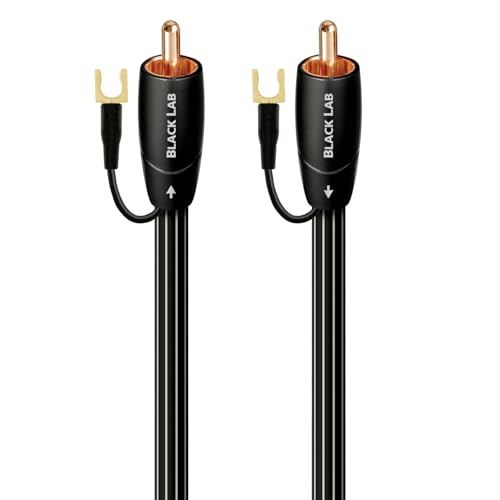
Solid long-grain copper that delivers cleaner bass and kills ground noise cold.
AudioQuest’s Black Lab uses solid LGC (Long-Grain Copper) conductors — a step up from standard OFC because the copper crystal structure is longer, reducing distortion at the grain boundaries. The symmetrical coaxial geometry and foamed polyethylene dielectric keep the capacitance low, while the metal Noise Dissipation System (NDS) absorbs and scatters RF interference before it reaches the signal path. The cold-welded, gold-plated terminations form a molecular bond with the copper, so there is no mechanical compression to degrade the connection over time.
Reviewers point out that it fixes subwoofer hum where standard RCA cables failed — one buyer with a Klipsch sub had an “increasingly annoying hum when the system was off” that the Black Lab eliminated completely. Another noted “a noticeable improvement in sound quality and the punch of the subwoofer” after switching from a basic cable. At 2 meters (roughly 6.6 feet), it is best for setups where the sub sits close to the receiver. A small number of owners felt it was overpriced for what is ultimately a short RCA cable.
Strengths
- Solid LGC copper reduces grain-boundary distortion for cleaner signal transfer
- Metal NDS absorbs noise that standard foil shields let through
- Gold-plated cold-weld plugs resist corrosion and maintain a lasting connection
Trade-Offs
- 2 m length is short — only works if your sub is near the receiver
- Solid-core construction is less flexible than stranded alternatives
Great for: high-end home theater owners with a sub within 6 ft of the receiver who want premium build and noise rejection.
Skip if: you need a longer run or prefer stranded copper for flexibility.
9. GEARit In-Wall Speaker Wire 12 AWG OFC — 100 ft
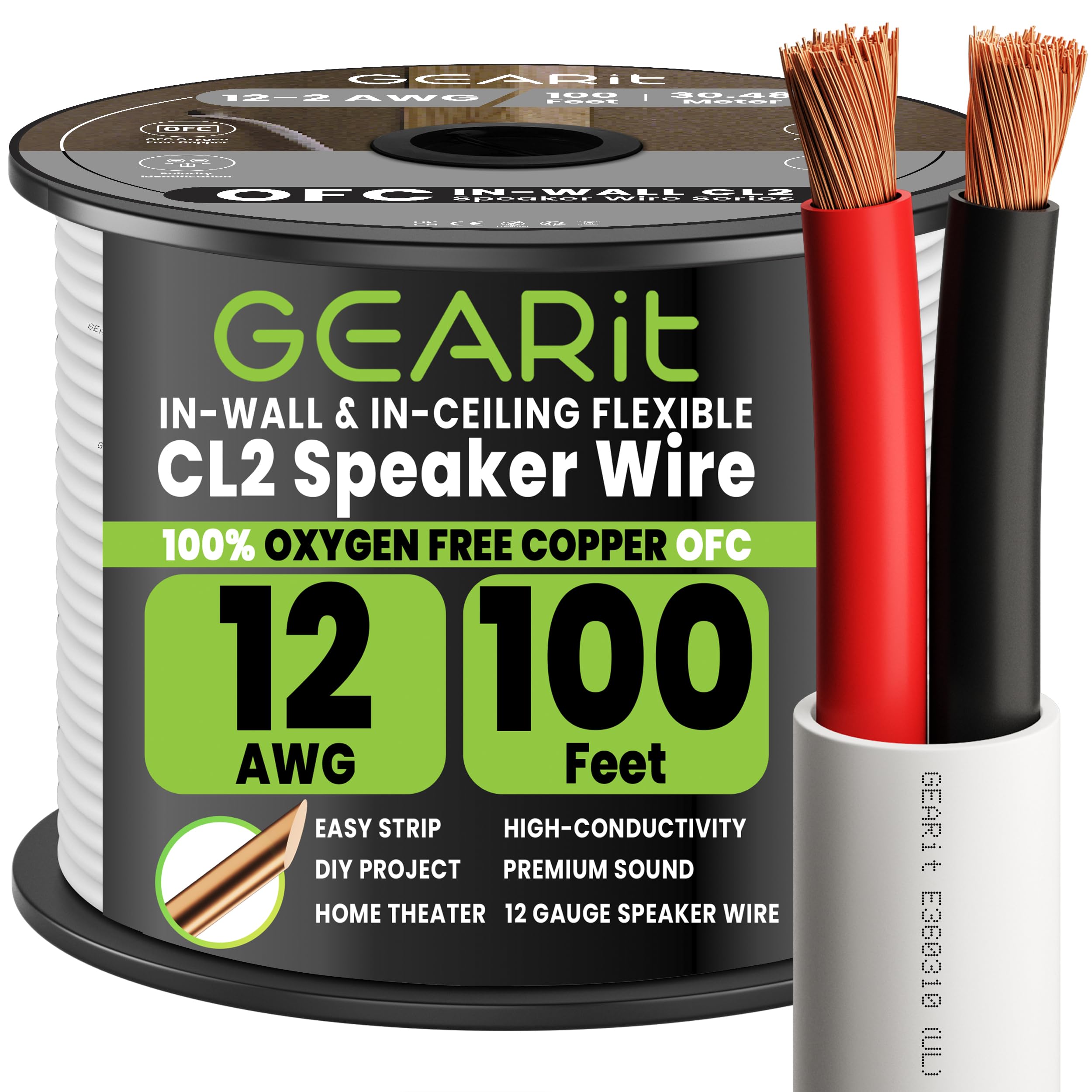
UL-listed OFC that meets in-wall code requirements and pulls through studs like butter.
If you are running wire inside walls or through a ceiling, the GEARit 12 AWG OFC is the one to reach for. It is UL Listed and CL2 rated — that means it passes flame-retardant and environmental safety tests required for in-wall residential and commercial installations. The white jacket blends into trim and ceilings, and the foot markers printed right on the insulation let you measure and cut without a tape. The 100-foot spool covers a full 5.1 or 7.1 system with leftovers.
Oxygen-free copper is the conductor here, which gives you lower resistance than any CCA alternative — a meaningful advantage for long in-wall runs that go through attic spaces. Owners using it in boat audio systems and home theaters alike praise the easy-strip construction and clean copper strands. The only consistent complaint involves the spool itself, which some found flimsy and prone to breaking during use. If you work carefully, the cable inside is excellent.
Key Advantages
- UL Listed and CL2 rated — meets code for in-wall and ceiling installations
- True OFC conductor resists corrosion and delivers lower resistance than CCA
- Printed foot markers and red/black polarity coding eliminate measuring time
Potential Annoyance
- Spool is flimsy and can collapse during use, causing tangling
- 12 AWG may be too thick for spring-clip speaker jacks that cannot accept banana plugs
Choose this for: in-wall, ceiling, or attic subwoofer installations where code compliance matters.
Skip if: you are wiring a surface-mount setup and want a more rigid spool — buy a shorter length or a metal spool.
Understanding the Specs
OFC vs CCA — What It Means for Your Sub
Oxygen-free copper (OFC) is at least 99.99% pure copper with almost no oxygen trapped in the metal. That gives it the lowest electrical resistance of any standard conductor material, which means more of your amplifier’s power reaches the subwoofer driver. Copper-clad aluminum (CCA) wraps a thin copper skin around an aluminum core. CCA is lighter and cheaper, but aluminum has about 60% higher resistance than copper. For a short run under 20 feet, CCA works fine. For long runs or high-power subs, OFC is worth the extra cost.
AWG Gauge — Thicker Is Not Always Better
AWG stands for American Wire Gauge (the number gets smaller as the wire gets thicker). A 12 AWG wire is the most common choice for subwoofers because it balances current capacity with flexibility. A 14 AWG wire is thinner and easier to route but adds resistance over long distances. A 10 AWG wire handles very high power but is stiff and hard to work with. For almost any home subwoofer, 12 AWG is the balance — enough copper for clean bass without the wrestling match of thicker wire.
RCA vs Speaker Wire — Two Different Jobs
A powered subwoofer (the kind with its own amplifier inside) uses an RCA cable — a shielded line-level connection that carries a low-voltage signal from the receiver to the sub. A passive subwoofer (no built-in amp) uses bare speaker wire to carry the amplified signal from a separate amplifier to the sub’s driver. If you buy the wrong type, the sub either gets no signal or the signal is too weak. Check your sub’s input panel before choosing: one or two RCA jacks means you need a shielded RCA cable; binding posts or spring clips mean speaker wire.
Shielding — The Difference Between Rumble and Silence
Analog audio signals are sensitive to electromagnetic interference from nearby power cables, Wi-Fi routers, transformers, and even dimmer switches. Shielding wraps the signal conductor in a conductive layer (foil, braided copper, or both) that absorbs that interference and sends it to ground. A subwoofer cable with dual shielding — two layers of braided copper, or a foil-plus-braid combo — gives you the best hum rejection. Unshielded speaker wire works fine for amplified signals (the voltage is high enough to overpower most noise), but for line-level RCA runs, good shielding is essential.
FAQ
Can I use regular speaker wire for a subwoofer?
What is the difference between CCA and OFC subwoofer wire?
Does subwoofer wire gauge really affect bass quality?
How long can a subwoofer RCA cable be without signal loss?
Will a better subwoofer cable fix humming?
Is 12 AWG too thick for a subwoofer?
Can I run subwoofer wire through walls?
What does “dual shielding” mean in a subwoofer cable?
Do gold-plated RCA connectors matter for subwoofers?
Which is better for a subwoofer — bare wire or banana plugs?
Final Thoughts: The Verdict
For most people, the best wire for subwoofer is the KnuKonceptz Kord 12 AWG OFC because it delivers genuine 99.99% oxygen-free copper at a fair price with flexibility that makes installation painless. If a powered sub is humming through a standard RCA cable, grab the EMK Subwoofer RCA for an affordable fix. And for in-wall installations that need code compliance, the GEARit CL2-rated OFC is the reliable choice. With over 4.8 stars across hundreds of owners, this crowd favorite proves that quality wire is the cheapest upgrade your sub will ever get.
How We Picked
We do not accept paid placement. Every pick is matched to a real buyer and a real use-case; we do not hands-on test units.
Sources & Methodology
Specifications: manufacturer listings and product documentation. Review insights: verified customer reviews, as of July 2026. Pricing: not shown on this page (it changes often); check the current price via the retailer link.
As an Amazon Associate, GoCarLife earns from qualifying purchases. This does not affect which products we feature.