
Our readers keep the lights on and the garage heater humming. As an Amazon Associate, I earn from qualifying purchases.
Specs are compiled from manufacturer listings and verified buyer reviews and can change over time — please confirm the key details on the product page before buying.
A window tint machine — a vinyl plotter — is the centerpiece of any serious tinting or sign shop. The wrong one delivers crooked cuts, chewed-up edges, and a roll of wasted film that eats your profit on every job. The right machine locks tracking, dials pressure, and traces curves precisely, letting you load a 50-yard roll, press cut, and walk away. This guide breaks down nine plotters by what actually matters to a working installer: cut width, motor type, pressure range, and the real-world reliability that keeps your jobs moving.
I’m Mo Maruf — the founder and writer behind GoCarLife. This guide is built by comparing the manufacturers’ published specifications and the patterns across verified customer reviews, so you get each pick’s real strengths and trade-offs instead of marketing spin.
The consensus among thousands of owners points to a clear truth: the best window tint machine is not always the most expensive model, but the one that pairs a steady feed mechanism with a motor and software you can trust for the long haul.
Our Picks at a Glance


How To Choose The Best Window Tint Machine
Every plotter in this category is designed to do one thing: feed a roll of film forward and back while a blade moves side to side. But the quality of that motion, the build of the frame, and the software that drives it vary enormously. Here are the factors that separate a daily workhorse from a soon-to-be-replaced headache.
Motor Type — Stepper vs Servo
This is the single biggest performance decision. A stepper motor (common on budget and mid-range machines) moves in fixed increments and can lose steps under heavy rolls or fast direction changes — causing a shift that throws off every subsequent cut. A servo motor (found on premium units) uses a feedback loop to self-correct position in real time. Servo machines cost more, but they stay accurate over long runs of 24-inch-wide film.
Cutting Width and Paper Feed
A 28-inch model gives you a maximum cut width around 24.8 inches — enough for most automotive side windows and many flat-glass jobs. A 34-inch machine handles 30.7 inches of cut width, letting you split full sheets and run larger commercial pieces. The paper feed number tells you the total space between the front and rear pinch rollers; bigger feed means better control on heavy rolls.
Cutting Pressure
Measured in grams (g), this is the downward force the blade applies. Standard tint film needs roughly 100-200g depending on thickness. Many machines go up to 500g or 750g, which lets you cut thicker materials like paint protection film (PPF) or sandblast stencil. Too much pressure cuts through the backing liner; too little leaves an uncut edge. Adjustability on the fly is a major plus.
Software Compatibility
The included software often determines whether a beginner can start cutting immediately or must pay extra for vectorizing and design tools. Some machines bundle a full design-and-cut program; others include bare-bones drivers that require a third-party upgrade. Windows compatibility is standard; Mac support is less common and should be confirmed before purchase.
Build Quality and Support
An aluminum frame resists flex and keeps the grit rollers aligned. The pinch rollers (two or four) grip the vinyl edges and prevent drift. Metal rollers and steel rollers outlast plastic components on high-use machines. US-based lifetime phone support, offered by USCutter, is a real safety net that several owner reviews point to as a deciding factor when something goes wrong.
Quick Comparison
| Model | Best For | Cut Width | Max Pressure | Motor Type | Amazon |
|---|---|---|---|---|---|
| USCutter 34″ MH Series★ Best Overall | Best Overall / Daily Workhorse | 30 in | 500g | Stepper | Amazon |
| VEVOR 28″Budget Champion | Budget Entry-Level | 630mm (24.8″) | 500g | Stepper | Amazon |
| VEVOR 34″ BundleBudget-Wide Format | Budget-Wide Format | 780mm (30.7″) | 500g | Stepper | Amazon |
| Siser Romeo Pioneer | SMB & Craft Business | 609mm (24″) | — | Servo (Advanced) | Amazon |
| USCutter Titan 28″ | Entry-Level Production | — | 510g | Stepper | Amazon |
| USCutter Titan 2 (28″) | Quiet Precision Production | — | 750g | Servo | Amazon |
| USCutter Titan 3 (28″) | ARMS Contour Cutting | — | 750g | Servo | Amazon |
| Roland GS-24 | Premium Brand Reliability | — | — | — | Amazon |
In‑Depth Reviews
1. USCutter 34-inch Vinyl Cutter Plotter with Stand
Our pick — over 4★ from 200+ verified ratings; the strongest balance of quality and price.
A ten-year bestseller earned through owner loyalty and free US-based phone support.
Year after year, owners vote this model the top pick: 4.4 stars across hundreds of reviews, with quality as the most-praised trait. The 34-inch feed and 30-inch cut width give you serious room to handle full window tint rolls and large signage without repositioning. That 47-pound frame and three fully adjustable pinch rollers keep even the longest runs on track — one owner switching from a smaller machine described it as “plugged this in and I haven’t had an issue yet.” The free VinylMaster Cut software handles vectorizing and basic design, though if you need auto-paneling for designs wider than the bed you will have to upgrade to the pro version. Buyers report an honest caveat: the feed motors feel underpowered with a heavy 24-by-150-foot roll — you may see accuracy errors near the end of the roll. But the free lifetime phone support (US-based) gives you a real safety net that no budget machine offers.
What owners love
- Reliable tracking even on long runs — the ball-bearing dual roller system keeps vinyl steady.
- Quality is the most-cited strength; owners say it cuts precisely and feels well-built.
- Free VinylMaster Cut software saves you the instant upgrade cost.
The honest trade-off
- Heavy rolls can overwhelm the feed motors — some report drift or accuracy errors on 150-foot jobs.
- The software lacks auto-paneling for designs wider than the cut window unless you pay for the pro tier.
Reach for this if: You want a proven 34-inch machine with the safety net of US-based lifetime support and a track record that tens of thousands of owners have helped build.
Think twice if: You regularly run full 150-foot heavy vinyl rolls and need a servo-grade feed system — the stepper motor here has limits.
2. VEVOR Vinyl Cutter 28 Inch
A surprisingly capable machine once you budget extra time for setup and tuning.
VEVOR’s 28-inch plotter feeds 720mm of paper and cuts 630mm (24.8 inches) of that width — essentially the same usable space as the USCutter 28, but at a notably friendlier price point. The illuminated LCD screen and large control panel make the digital adjustments (10-500g pressure, 10-800mm/s speed) intuitive. Owners mention that the included sign-making software is decent and that the machine works reliably with Flexi and other pro programs. The built-in 128K-2M cache memory and D-typed motherboard let the cutter store long jobs offline. A few customers note a non-functional unit from the start (ribbon cable shorting on a metal clip, a stepper motor failure). But the same owners who had to insulate a cable and fix a motor say that after those tweaks the machine “cuts great” and is “worth the money.” For the price, you get a cutter with solid cutting precision of +/-0.01mm, spare blades, and a floor stand — though VEVOR does not offer the same US-based lifetime support that USCutter provides.
Setup fuss is real: The stand ships unsecured, the roll bars are oversized, and an occasional unit arrives with a motor issue. But if you are comfortable with basic tinkering, the cutting performance once dialed in matches plotters costing twice as much.
Who it is for: A side-hustle sign shop or a tinter who wants a second dedicated machine for small-to-medium film runs and has the patience for initial calibration.
Right for you if: You are budget-conscious, comfortable with minor setup work, and need a machine that cuts well once tuned.
Not for you if: You cannot risk an out-of-box quality issue or need immediate phone support with zero troubleshooting.
3. VEVOR Vinyl Cutter 34 Inch Bundle
A wide 34-inch cut width for less, but reliability concerns are real — read the fine print carefully.
This VEVOR bundles the Signmaster design-and-cut software and includes extra supplies, making it an appealing turnkey kit for someone moving into wide-format cutting for the first time. The 870mm (34.3-inch) paper feed and 780mm (30.7-inch) maximum cut width match the USCutter 34, and the cutting precision is 0.01mm. Owners who had a good experience describe it as “amateur-friendly” with “flawless performance.” But the concern here is not subtle — the product summary from Amazon flags cutting performance and reliability as mixed, and multiple reviewers point out a machine that “died at 6 months + 1 week (burning smell)” with loose screws inside and melted circuitry. The included vinyl rolls are described as poor quality, and the basic Signmaster tier lacks vectorizing (a upgrade to add it). For the price, you get a big cutting window and some useful extras, but you are trading long-term trust for upfront width.
Wide cut, narrow trust: If you need a 34-inch machine right now and the budget is tight, this will cut film capably for months. But the pattern of early failure and melted components shown in the owner feedback makes it a risk if you depend on a single machine for revenue.
Budget the safety net: Consider a third-party extended warranty (like Assurion) if you go this route. And plan on replacing the bundled vinyl with a quality brand like Oracal 3M immediately.
Grab it if: You need an immediate wide-format starter kit and are willing to buy an extended warranty alongside it.
Step away if: You need a machine that can run daily for years without electrical failure or constant software upgrades.
4. Siser Romeo Pioneer Bundle (24″)
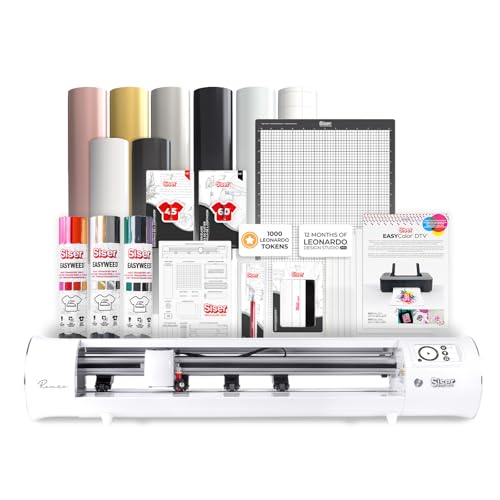
The quiet, fast, hyper-accurate machine pro crafters are switching to — but skip it for continuous rolls over 40 inches.
The Romeo is a different breed from the rest of this list. It uses a high-definition cutting engine with a servo-type advanced motor that owners consistently describe as “faster and quieter than a Cricut Maker 3” and “extremely accurate for sticker cutting.” The 24-inch cutting area is smaller than the 28 or 34-inch plotters, but it is a fully professional-grade machine with an intuitive touchscreen interface, adjustable pinch rollers, and matless loading. Owners praise the performance more than any other aspect — 45 people single it out — and the speed, noise level, and cutting accuracy all receive positive consensus. The Romeo runs on Windows and Mac (Wi-Fi compatible) and comes with the Leonardo Design Studio software. There is a genuine limit: for HTV runs over 40 inches, the material creeps because the machine lacks the feed tension of a heavy-duty plotter. For tint and PPF cutting on sheets or reasonable roll lengths, it is a dream. For continuous 50-yard window film rolls, it is the wrong tool.
What stands out
- Performance is the most-praised feature — 45 owners call it out for precision and quiet speed.
- Faster and quieter than the Cricut Maker 3 and Cameo 4, per verified owner tests.
- Matless loading gives you the full 24-inch bed without wasting material.
Know before you buy
- Not a continuous-feed production machine — material creeps over 40 inches.
- Leonardo software has a steep learning curve and poor documentation.
- Pro features require a subscription, which some owners dislike.
Best for: A sign shop or craft business that cuts stickers, heat transfer, and shorter tint jobs and values speed, silence, and extreme accuracy above a wide feed bed.
Not for: Anyone who runs continuous 50-yard tint rolls or needs a machine that feeds heavy film without creep.
5. USCutter Titan 28 inch Vinyl Cutter

An aluminum-framed production cutter with laser contour registration — but do not expect a quiet room.
USCutter’s Titan series starts here with a 28-inch machine built around a metal aluminum frame and internal components rather than plastic. The stepper motor delivers 510g of downforce and a cutting speed of 31.5 inches per second. It handles vinyl, cardstock, sandblast stencil, and more. The inclusion of laser-guided print-and-cut contour cutting is a real bonus — the machine reads registration marks and cuts around printed designs like stickers or labels. Owners who rate it highly call it “impressive” and say it is “very nice for the price” and “works fantastic.” The consensus negatives are clear: the stepper motors are loud, the included software struggles with SVG and AI imports (preferring PNG and JPEG), and the stand is frustrating to assemble (screws too long, wrong tools included, no instructions). One owner spent two days on assembly alone. For the price, you get a sturdy aluminum cutter with the contour feature and lifetime phone support, but the noise and assembly headache are real costs.
Solid foundation, noisy operation: The aluminum build gives you a machine that stays aligned over years of use. The stepper motor is the weak link in terms of noise — owners describe it as “loud.” If your shop tolerates mechanical noise or you wear hearing protection, this is a non-issue. The roller bracket design has a flaw that can let vinyl unwind; be ready to manage that with a simple workaround.
Choose it for: The aluminum frame, laser contour cutting, and lifetime phone support in an entry-level production machine.
skip it if: Noise matters in your workspace or you need a stand that assembles in 20 minutes with clear instructions.
6. 28-inch USCutter Titan 2

The quiet, servo-driven upgrade that one owner calls a “money maker” — and the numbers back that up.
Stepping up from the base Titan, the Titan 2 swaps the loud stepper motor for a quiet servo that pulls 750g of downforce and moves at 37 inches per second. That is a 240g increase in cutting pressure over the base Titan — enough to cut thicker PPF and stencil without hesitation. The servo motor is the defining upgrade here: it stays quiet and maintains position even on long runs, which is critical for tint and decal work. The aluminum frame and high-quality pinch and grit rollers are carried over. Owners upgrading from the older MH series report the Titan 2 handles tiny details more accurately and is “easy to weed.” The included VinylMaster Cut V4 software is well-regarded. The trade-off: no dust cover and only a single 60-degree blade included. One owner points out that a newer version was released shortly after their purchase. If you are producing decals or tint cuts daily and the noise of a stepper machine grates on you, this servo upgrade justifies its premium position.
Servo makes the difference: The Titan 2’s 37 in/sec speed and 750g downforce, combined with quiet operation, make it the production choice for shops that run hours of cuts every day. The closer grit roller placement (compared to the older MH series) means you can use scrap vinyl more efficiently.
What you give up: A dust cover is absent, and the single included blade means you will be ordering replacements immediately. The stand assembly remains the same frustrating experience as the base Titan.
Your machine if: You cut daily, need servo-level precision and quiet, and want 750g of force for heavier materials.
Reconsider if: Your budget is tight enough that the base Titan is a stretch — the servo is worth it, but it is a real jump.
7. 28″ USCutter Titan 3

ARMS auto contour cutting with laser guidance — a powerful feature that comes at a premium price.
The Titan 3 is USCutter’s most advanced 28-inch model, distinguished by its ARMS (Automatic Registration Mark System) that prints and cuts contour shapes using laser guidance. This is a production-level feature for shops that print stickers, labels, or heat transfers and need the machine to read registration marks and cut around each design automatically. The servo motor provides the same 750g downforce and 37 in/sec speed as the Titan 2. The frame is aluminum with quality rollers. The star rating here sits at 3.8 — the lowest in the lineup — primarily because of two issues: one owner calls it “extremely overpriced” and notes the lack of a vacuum hold-down, while another could not find assembly or calibration instructions and had to resort to YouTube. The Titan 3’s ARMS system is genuinely useful if you do print-and-cut work daily, but the value proposition compared to the Titan 2 (which lacks ARMS) is debated by owners who do not need that specific feature.
The standout feature
- ARMS laser-guided contour cutting is automatic and fast — ideal for sticker and label production.
- Servo motor provides 750g of quiet downforce with 37 in/sec cutting speed.
The catch
- No vacuum hold-down, which disappoints users who expected more from the premium tier.
- Minimal documentation — no printed assembly or calibration instructions included.
- At this price point, some owners question the value compared to the Titan 2 for non-contour work.
Right for: A sticker or label shop that needs automated contour cutting with laser registration every day.
Not for: A tint installer who does not use print-and-cut features — save the money and get the Titan 2 or the MH series.
8. Roland GS-24 Vinyl Cutter

A legendary name in vinyl cutting that delivers reliable daily cuts — if you can justify the premium over the competition.
Roland’s CAMM-1 GS-24 is the machine many professionals learned on. It carries a 3-year manufacturer warranty, CutStudio software, and the brand recognition that comes from decades in the sign industry. Owners who have used it daily for decals and vehicle designs call it an “amazing cutter” that cuts fast with “smooth lines.” One owner said that after reading the instructions and watching a YouTube video, a cutter force of 50 gave them the perfect first cut. The GS-24 does not come with a stand (sold separately), which is a real additional cost and a point of frustration. Some shoppers say motor errors when running heavy 50-yard rolls, noting that the roll barely fits the separately purchased stand and falls off during operation. The setup difficulty also earns low marks — one owner gave up after a week. For a shop that does moderate-volume, high-quality work and values the Roland ecosystem, the GS-24 delivers. But the stand situation, the weight of the machine (51 pounds), and the higher upfront investment mean it is a consider-purchase, not an automatic.
Brand trust has a price: The Roland name opens doors to excellent third-party support, a large user community, and a well-documented machine. The cut quality on thin-film work is genuinely good. But you pay a premium for that badge, and the missing stand and finicky roll handling are not unique to the lower-tier machines in this guide.
Choose it if: You want the confidence of a 3-year warranty, a well-known brand with a large support ecosystem, and you plan to cut moderate-run jobs rather than 50-yard rolls all day.
Think twice if: The separate stand cost pushes the total beyond your budget, or you need to run heavy rolls continuously without motor errors.
Understanding the Specs
Stepper vs Servo Motor
The motor that moves the blade and feeds the film is the heart of your plotter. A stepper motor moves in fixed steps — it is reliable for short runs but can lose steps under heavy rolls or fast direction changes, causing the cut path to shift. A servo motor tracks its position constantly and self-corrects, staying accurate even during hours of unattended cutting. Servo machines cost more but are the standard for any shop that cannot afford to reset a misaligned job halfway through a 40-inch tint cut.
Cutting Pressure (grams)
This is the force pushing the blade through the film and into the carrier sheet. Standard window tint typically cuts at 100-200g. Thicker materials like paint protection film (PPF) or sandblast stencil may need 400-750g. Too little pressure leaves an uncut edge; too much destroys the backing liner. A machine with a wide adjustable range (10g to 750g) gives you the most flexibility across different films.
Maximum Cutting Width and Paper Feed
The cutting width is the actual usable area the blade can reach side-to-side. The paper feed is the total width of the roller mechanism that grips the vinyl. A 28-inch machine typically cuts 24.8 inches of width; a 34-inch machine cuts 30.7 inches. If you mostly do automotive windows, a 28-inch model is often enough. For flat-glass jobs or commercial signage, the extra width of a 34-inch or 53-inch machine saves you from having to rotate the material.
Contour Cutting (Registration Marks)
Laser-guided or ARMS (Automatic Registration Mark System) contour cutting reads printed registration marks on the film and cuts around each design automatically. This is essential for stickers, printed decals, and labels where the blade must follow a printed shape precisely. If you only cut solid-color tint or simple shapes, this feature is unnecessary. If you sell printed graphics that need exact outlines, it is a productivity multiplier.
FAQ
Can a vinyl cutter handle auto window tint film?
Do I need a plotter that works with Mac?
What cutting pressure is needed for ceramic window film?
How long does a vinyl cutter blade last cutting tint?
Is a 28-inch plotter big enough for car windows?
Why do some machines use servo motors and others use stepper motors?
What does the bundled software actually need to do for tint cutting?
Do I need a stand for a vinyl cutter?
What is the difference between a 30-degree and 60-degree blade?
Can I upgrade a budget plotter to a servo motor later?
Final Thoughts: The Verdict
For most people, the best window tint machine is the USCutter 34-inch because it pairs a generous 30.7-inch cut width with the most trusted brand reputation in the budget-to-mid-range tier — backed by free US-based lifetime phone support that no VEVOR or Siser model can match. If you need servo-level quiet and accuracy for a production environment, the USCutter Titan 2 delivers 750g of downforce and 37 in/sec speed without the noise of a stepper. And for smaller shops or craft businesses that prioritize speed and precision over raw width, the Siser Romeo is the one to reach for — just keep your runs under 40 inches.
How We Picked
We do not accept paid placement. Every pick is matched to a real buyer and a real use-case; we do not hands-on test units.
Sources & Methodology
Specifications: manufacturer listings and product documentation. Review insights: verified customer reviews, as of July 2026. Pricing: not shown on this page (it changes often); check the current price via the retailer link.
As an Amazon Associate, GoCarLife earns from qualifying purchases. This does not affect which products we feature.