
Our readers keep the lights on and the garage heater humming. As an Amazon Associate, I earn from qualifying purchases.
Specs are compiled from manufacturer listings and verified buyer reviews and can change over time — please confirm the key details on the product page before buying.
A thin or poorly made cable causes sluggish winch performance, wire overheating, and failed recoveries. This guide highlights heavy-gauge cables that deliver the amps a winch demands and explains why each earns its spot.
I’m Mo Maruf — the founder and writer behind GoCarLife. This guide is built by comparing the manufacturers’ published specifications and the patterns across verified customer reviews, so you get each pick’s real strengths and trade-offs instead of marketing spin.
if you need a full wiring kit for a camper or a short premium lead for a front-mounted WARN, these picks cover the range. Let’s find the winch battery cable that keeps your rig ready for anything.
Our Picks at a Glance


How To Choose The Best Winch Battery Cable
A winch draws hundreds of amps under load — far more current than a car stereo. You need a cable that carries that surge without overheating. Your choice depends on wire material, gauge (thickness), and connection type.
Pure Copper vs. Copper-Clad Aluminum (CCA — An Aluminum Core With a Thin Copper Coating)
Pure copper carries current better and handles heat without breaking down. CCA is lighter and cheaper, but it has higher resistance — it runs warmer than pure copper of the same gauge. For a winch you rely on in a real recovery, pure copper is the safer bet. For a budget build or less demanding use, CCA works if you understand its trade-offs.
Gauge: The Thickness That Matters
Every winch cable uses a heavy gauge — typically 2 AWG (American Wire Gauge) or 1/0 AWG (the lower the number, the thicker the wire). A 2 AWG cable is the standard for nearly all winches on trucks and SUVs; it effectively carries the surge from the battery to the winch motor. A 1/0 AWG cable can carry even more current with less voltage drop over longer runs, making it a good choice for big RVs or long battery-relocation jobs.
Connectors: Fixed Ends or Quick-Disconnect
A fixed cable (lugs on both ends) is simpler and usually cheaper, but it locks you into a permanent install. A quick-disconnect cable uses an Anderson SB175-style plug (a rugged connector designed for high current) that lets you pull the winch off the vehicle when it’s not needed — a massive convenience for anyone who uses a rear-hitch mount or wants to move the winch between trucks. The trade-off is that a poor-quality plug can introduce resistance or come apart on rough trails.
Quick Comparison
| Model | Best For | Material | Gauge | Length | Amazon |
|---|---|---|---|---|---|
| Ruikarhop 1/0 AWG CCA★ Best Overall | Budget long-run and RV projects | CCA | 1/0 AWG | 40 ft | Amazon |
| Venussar 2 AWG CopperAlso Great | Pure-copper full-truck install | Pure Copper | 2 AWG | 24 ft | Amazon |
| Rough Country 2 AWG | Well-rounded quick-disconnect kit | CCA | 2 AWG | 24 ft | Amazon |
| WARN 26405 | Short front-mount premium lead | Pure Copper | 2 AWG | 90 in | Amazon |
| PolePalUSA 2 AWG | Trailer-mounted setups | CCA | 2 AWG | 8 ft | Amazon |
In‑Depth Reviews
1. Ruikarhop 40FT 1/0 Battery Cable Copper Clad Aluminum,0 Gauge Wire with 20pcs Terminal Connectors
Our pick — over 4.5★ from 450+ verified ratings; the strongest balance of quality and price.
A massive 40-foot spool of heavy-gauge cable that rewrites the value equation for budget builders.
This is the cable for the budget-minded builder who needs a lot of length — 20 feet of red plus 20 feet of black, a full 40 feet of 1/0 AWG CCA wire with 20 terminal lugs and heat shrink included. The flexibility of the CCA insulation gets frequent praise; owners say it routes easily through tight spaces in campers and RVs. One buyer wired up a camper with lithium batteries and called it “good quality cable” that definitely won’t burn up under load. Compared to the 24-foot Venussar, you get 16 more feet of wire for a lower cost, but with CCA instead of pure copper.
The material is CCA, not pure copper. That means it runs a bit warmer than a pure 1/0 AWG copper wire, and some reviews note it measures closer to a true 2 AWG equivalent in current-carrying ability. For a camper, a solar array, or a low-current winch setup, this trade-off is completely acceptable. For a high-endurance off-road recovery winch that you rely on in a stuck situation, you may want to step up to pure copper.
Unreal length for the money: 40 feet of 1/0 AWG wire plus 20 connectors and heat shrink for a fraction of what pure copper would cost. Ideal for RV battery relocation, inverter wiring, or long runs.
Know the limit: CCA is not as conductive as pure copper, and the lugs can split if you over-crimp them. The manufacturer rates it at 250 amps — fine for a camper, but a serious winch demands more overhead.
Reach for it if: you are doing a battery relocation in an RV or camper and need a budget-friendly 40-foot finished kit with everything included, and understand CCA’s trade-offs.
Step past it if: this is the main power cable for a 12,000-lb recovery winch — pure copper gives you less heat and more margin in a high-stakes situation.
2. Venussar 24 FT Quick Disconnect Winch Power Cable, 2 Gauge 2 AWG Copper Wiring
The pure-copper workhorse that fits a full-size truck without splicing — and stays cool under load.
This cable delivers pure copper conductivity that copper-clad aluminum (CCA) just cannot match. The Venussar uses 665 strands of 0.25mm copper wire twisted together, and it is rated up to 600 volts (far more than any 12-volt winch needs). Owners on full-size crew cabs with short beds confirm the 24-foot run fits perfectly with about 2 to 3 feet of extra slack, so you can route it cleanly along the frame to a rear hitch winch. That 24-foot length gives you the same reach as the Rough Country but with pure copper instead of CCA — meaning less heat and voltage drop in a heavy recovery.
The quick-disconnect plugs (Anderson-style connectors) are rated for over 10,000 connect/disconnect cycles, and buyers report the disconnect covers stay on securely during driving (though a few suggest taping them for extra confidence). At 4 pounds, the cable is heavy but manageable — this is a straight pure-copper assembly with no shortcuts. Owners mention using it for a year without any heating or voltage issues.
Pure-copper confidence: No CCA guesswork here. The 2 AWG is true-stranded copper, so it runs cool under the high-amperage pull of a recovery winch (keeping number plates readable at night and motor temperatures safe). If you want a long-lasting, no-worry install on an F-150, Ram, or similar crew cab, this is a standout pick.
One honest trade-off: The 24-foot length is generous, but the small pigtail (short lead) is a few feet too short if you are trying to power a winch on a trailer that sits behind a long-bed truck — the cable is really built for a vehicle-mounted winch, not a trailer setup.
Reach for this if: you are installing a front or rear winch on a full-size crew-cab truck and want true pure-copper wiring that supports the full 600-volt rating and connects/disconnects easily.
Look elsewhere if: you need a short pigtail for a trailer-mounted winch where the 24-foot lead creates too much extra cable to manage.
3. Rough Country 2 Quick Disconnect Winch Power Cable | 24 FT – RS108

The plug-and-play cable that turns a rear-hitch winch into a 10-minute install — no splicing needed.
Rough Country is a well-known name in off-road gear, and this 24-foot quick-disconnect kit shows why. It comes as a two-piece set — a 2-foot lead and a 22-foot lead — so you can route the long cable from the battery to the rear bumper cleanly and leave the short end at the winch. Customers note it fits the frame of a Ram 1500 without any cutting or splicing, with only about a foot of extra positive wire to tuck away. That two-piece design is a big win compared to the single-piece Venussar cable, which takes more effort to route neatly.
The crowd favorite feature is the high-quality Anderson-style connectors (the SB175 standard): they click together firmly and break apart easily when you want to pull the winch off the truck for storage. Pickup owners running 10,000-lb to 12,000-lb winches report solid performance with no complaints about power delivery. The 10-pound weight tells you this is a serious cable, though the wire itself is CCA rather than pure copper — a common choice at this price point that keeps cost down while still delivering the current a winch needs.
What wins people over
- Two-piece design (2-ft + 22-ft) makes routing on a full-size truck simple, no splicing needed.
- Heavy-duty Anderson-style connectors give a confident click and are easy to separate.
- Strong track record on 10K to 12K winches on F-150 and Ram platforms.
The small gripe
- The black rubber cover on the connection plug tends to slide off during driving; a wrap of tape or a zip-tie is a common fix according to reviewers.
- Cable is CCA, not pure copper — fine for most, but important to know if you need maximum conductivity per gauge.
Stick with this for: a fast, clean install on a rear-hitch winch setup where the 24-foot two-piece kit lets you hide the cable along the frame without extra work.
Think twice if: you want pure copper over CCA — the Venussar above gives you that, though at a higher price point.
4. WARN 26405 Quick Connect Winch Power Cable for Front of Vehicle, 90″ L

The original name in winching — a short, tough, USA-made lead that guarantees a factory fit for WARN winches.
If you need a front-mounted winch cable and you trust the brand that invented the game, this is it. The WARN 26405 is a 90-inch (7.5-foot) lead designed to run directly from your battery to a front winch in a pickup or SUV. At 2.25 pounds versus the Venussar’s 4 pounds — that weight difference comes from the short, single-purpose reach rather than a full 24-foot kit.
Buyers who have used WARN cables across two decades report they have never had a failure or loss of power, even through saltwater boat launches. One owner sums it up: the quality is outstanding and the confidence on the trail is priceless. The cable is a direct fit for the front end of most trucks and powers WARN winches like the 9.6 ti without any fuss. The trade-off is that it does not include dust covers for the connectors (as some have noted in their reviews), and the connector may not mate with non-WARN brands like Champion CPE plugs — check your winch connector first.
Legit USA-made quality: This is a genuine WARN part built in the USA, and the materials are top-tier. If your winch is a WARN and you want a guaranteed factory-fit front lead, this cable eliminates guesswork.
The honest catch: It is expensive for what is essentially a 7.5-foot cable, and it lacks dust covers that many competitors include. The short length also limits it strictly to front-mount winches on standard trucks.
Get this for: a WARN brand loyalist who wants a perfect, no-mod front lead directly from the battery to the winch and values USA manufacturing over raw length.
skip it if: you need a long 24-foot run for a rear-mount winch, or if you are on a budget and can accept a quality aftermarket alternative.
5. PolePalUSA 2-GAUGE-8FT Hi-amp Universal-Quick-Connect-Wiring-KIT-Winch-Dump Trailer
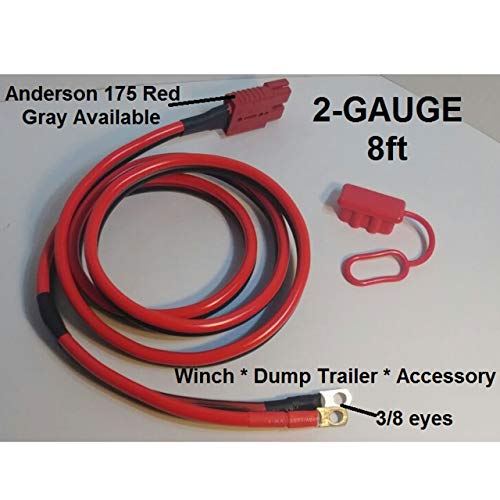
The short, made-in-USA quick-disconnect that a gooseneck trailer needs — with a weather-tight seal that matters in mud and snow.
At just 8 feet, this kit is purpose-built for a specific job: running power from the battery of a truck to a winch mounted on a trailer, dump bed, or gooseneck. The cable is dual CCA in 2 AWG with an ultra-flex coating that stays pliable even in cold weather. The end lugs are hydraulic-crimped and covered with adhesive-lined heat shrink for a waterproof seal — a detail that matters when you are working in mud, rain, or snow. Unlike the 24-foot Rough Country kit, this 8-foot cable keeps things tidy for a trailer where the battery is right next to the winch.
The reviews are almost universally positive. One owner used two of these kits to hook up a 1500W inverter in an RV, valuing the quick-disconnect feature that lets him pull the inverter out for portable use. Another buyer called the American-made quality undeniable, noting the box arrived with a thank-you note and work gloves. The Anderson SB175-style connectors are the industry standard, and the 800-amp capacity gives you plenty of headroom for even a powerful winch. The one limitation is the 8-foot length: this is a short reach, so you need your battery and winch to be close together or you will need an extension.
Standout details
- Hydraulic-crimped lugs with adhesive heat shrink provide a lasting, weather-tight connection.
- Made in the USA by a small company that includes personal touches like a thank-you note and gloves.
- 800-amp capacity on the Anderson SB175 connector handles big winches and jump-start use.
The main limitation
- 8 feet is short — adequate for a trailer-mounted winch where the battery is nearby, but not enough to route from a front battery to a rear winch without extra cable.
- CCA wire rather than pure copper, though the hydraulic crimp and coating make the most of it.
This fits best for: a trailer, dump truck, or gooseneck setup where the battery and winch are close together and you want a pre-assembled, waterproof quick-disconnect lead made in the USA.
Not your pick if: you are wiring a rear winch on a pickup — you will need a much longer cable or an extension kit to cover the full chassis length.
Understanding the Specs
Wire Material: Pure Copper vs CCA
Pure copper is the gold standard for winch cables. It conducts electricity much better than CCA, which means less voltage drop under the high-amperage load of a winch motor and less heat buildup in the wire. CCA is lighter and cheaper, but it has to be thicker to carry the same current. If you are building a serious off-road recovery rig, pure copper is worth the premium. For a budget project or a camper conversion where the load is lower, CCA is a perfectly acceptable choice.
Gauge (AWG): What the Numbers Mean
AWG stands for American Wire Gauge, and in this category the lower number means a thicker wire. A 2 AWG cable is the standard for almost all winch battery cables on trucks and SUVs. A 1/0 AWG (pronounced “one-ought”) cable is even thicker and can carry more current with less voltage drop over a long run, such as from a front battery to a rear winch. Never use anything smaller than 2 AWG for a winch — the winch will struggle to pull its rated load and the wire may overheat.
FAQ
Can I use a regular jumper cable for a winch power cable?
How long of a winch battery cable do I need for a rear-mount winch?
Is copper-clad aluminum (CCA) good enough for a winch cable?
Will a WARN 26405 cable work with a non-WARN winch?
What does the quick-disconnect feature on a winch cable do?
Do I need an inline fuse or circuit breaker on a winch battery cable?
How do I know if a cable is pure copper or copper-clad aluminum?
Can I cut a 24-foot winch cable shorter if I do not need all the length?
Final Thoughts: The Verdict
For the majority of shoppers, the winch battery cable winner is the Venussar 24 FT Pure Copper because it gives you true pure-copper conductivity at the right 24-foot length for a full-size truck, with quick-disconnect plugs rated for thousands of cycles. If you want the plug-and-play convenience of a two-piece kit at a moderate price, grab the Rough Country 24 FT. And for a short, US-made front lead that pairs with a WARN winch from the start, the WARN 26405 is the one to reach for. The crowd favorite across the board is the Rough Country for its balance of length, connector quality, and value, but the Venussar edges ahead for anyone who prioritizes pure copper for long-term reliability on a full-size rig.
How We Picked
We do not accept paid placement. Every pick is matched to a real buyer and a real use-case; we do not hands-on test units.
Sources & Methodology
Specifications: manufacturer listings and product documentation. Review insights: verified customer reviews, as of July 2026. Pricing: not shown on this page (it changes often); check the current price via the retailer link.
As an Amazon Associate, GoCarLife earns from qualifying purchases. This does not affect which products we feature.