
Our readers keep the lights on and the garage heater humming. As an Amazon Associate, I earn from qualifying purchases.
Specs are compiled from manufacturer listings and verified buyer reviews and can change over time — please confirm the key details on the product page before buying.
A backup alarm is one of those things you don’t think about until you’re rolling backward in a parking lot and someone walks right behind your bumper. The white sound backup alarm is a smarter take on the old beeper — it makes a directional “shhh” noise that pedestrians can locate instantly, without the ear-piercing shriek that makes neighbors close their windows. The key trade-off is getting enough volume to be safe without crossing into obnoxious territory, and the right pick does exactly that.
I’m Mo Maruf — the founder and writer behind GoCarLife. This guide is built by comparing the manufacturers’ published specifications and the patterns across verified customer reviews, so you get each pick’s real strengths and trade-offs instead of marketing spin.
Whether you drive a pickup, van, or forklift, these three picks represent the strongest options for a quiet-but-effective best white sound backup alarm that keeps everyone around you aware without making you dread every reverse.
Our Picks at a Glance

How To Choose The Best White Sound Backup Alarm
Choosing a backup alarm depends on a few key specs that separate a smooth install from a frustrating one.
Decibel Level: Loud Enough vs. Too Loud
The volume is measured in decibels (dB). A 97 dB alarm is about the same as a busy city street — noticeable but not painful. At 100 dB, you are at the edge of what counts as comfortable for bystanders. If you park in a quiet neighborhood at night, a lower setting matters. If you drive in a noisy job site, you need the higher end. Some alarms let you adjust before installation, which is a huge advantage.
Voltage and Vehicle Fit
Most backup alarms work on 12V or 24V DC systems. That covers standard cars, pickups, vans, and medium-duty vehicles like forklifts. Check your vehicle’s electrical system before buying — a 12V-only alarm will struggle or fail on a 24V system, and vice versa. Wiring is simple: tap into the reverse light circuit so the alarm activates only when you shift into reverse.
Build Quality and Weather Resistance
This alarm lives under your vehicle, exposed to rain, snow, mud, and road salt. A proper white sound backup alarm should be waterproof and built for harsh environments. Also look for something that copes with temperature extremes — some units are rated from -40°C all the way up to 75°C, which covers basically any climate on earth.
Quick Comparison
| Model | Best For | Volume (dB) | Voltage | Weight | Amazon |
|---|---|---|---|---|---|
| YUESONIC Adjustable 85–100dB Alarm★ Best Overall | Custom volume for any setting | 85–100 dB | 12–24V | 12.7 oz | Amazon |
| YUESONIC 12-24V White Noise Backup Alarm | Premium safety with light warning | 97 dB | 12–24V | 13.1 oz | Amazon |
| Shkalacar Parking Radar System | Distance display + buzzer | — | — | 15.1 oz | Amazon |
In‑Depth Reviews
1. YUESONIC White Noise Reversing Alarm – Adjustable 85/90/95/100dB
Our pick — over 4★ from 70+ verified ratings; the strongest balance of quality and price.
The only one that lets you dial in exactly how loud you want to be.
This is the adjustable champion — you use a screwdriver to turn a selector switch on the housing before installation, choosing 85 dB, 90 dB, 95 dB, or 100 dB. That flexibility is rare in this category, and it solves the biggest tension: a quiet neighborhood driveway needs a different volume than a busy construction yard. At 100 dB, it has the highest decibel rating in the lineup — the premium pick above is 97 dB. At 85 dB, it is barely above conversation level.
Customers note that it produces a soft “psh psh psh” white noise that alerts without startling people. As one experienced driver put it, “makes enough noise to warn people in the market parking lot from stupidly walking in back of your car when in reverse. Not so loud to wake up neighbors when backing from the garage.” The build is waterproof and designed for pickups, vans, and forklifts with a 12–24V system. It comes with a 24-month warranty.
The trade-off: volume is set before mounting, so you cannot adjust it later without uninstalling the unit. Most owners pick a setting and forget about it, but if your parking situation changes (moving from a rural lot to a tight city garage), you will need to re-access the alarm. Also, a small number of buyers found it barely audible at the lower settings — fine for a carport, maybe not enough for a noisy job site at 85 dB.
Custom-volume flexibility: This is the pick for anyone who lives between two worlds — quiet at night, active during the day — and wants to pick their volume without buying two alarms.
Best for: owners of pickups, vans, or forklifts who park both in residential areas and commercial lots and need one alarm to do both without being a nuisance.
Think twice if: you want a light warning built in — this unit is sound-only — or you dislike having to unscrew the alarm to change the volume later.
2. YUESONIC 12-24V White Noise Backup Alarm and Light Warning
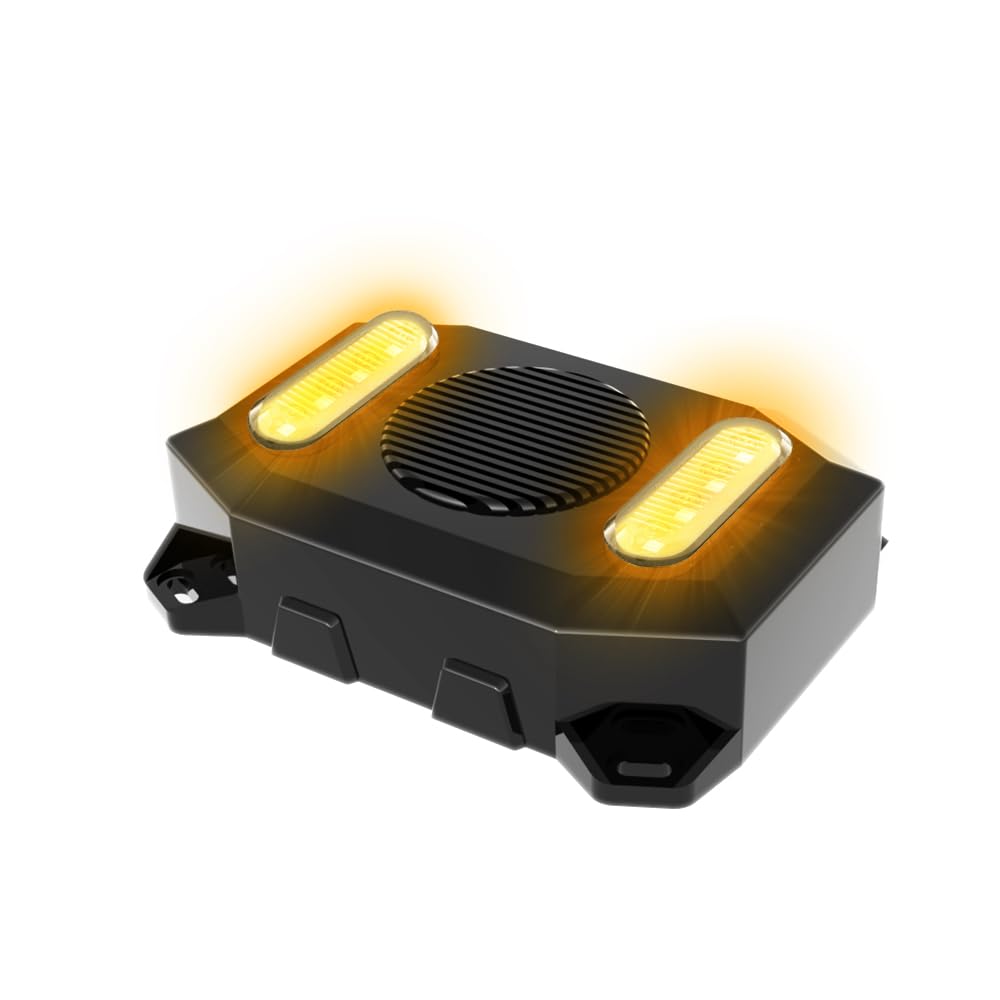
The one that backs up its warning with bright LEDs for daytime visibility.
This alarm combines two warning methods in one unit: a 97 dB white noise sound plus a bright LED light that flashes when you reverse. The dual approach means someone distracted by a phone still catches the flash in their peripheral vision. It works on both 12V and 24V systems, so it fits everything from a work van to a heavy truck. At 13.1 ounces, it is slightly heavier than the adjustable model below, but it packs more utility into the same compact body.
The durability numbers here are serious — it is rated from -40°C to 75°C and carries CE certification (a European safety and compliance mark). That covers arctic cold and desert heat without the alarm going silent or distorting. The wiring is simple: buyers report connecting it to the backup lights and having it run flawlessly. As the review pages sum it up, “the buzzer is loud enough to alert pedestrians but not excessively loud.”
The only honest caveat: a minority of units have failed after about a month, with the noise changing or stopping. That is not the typical experience — the majority of owners mention easy installation and reliable performance — but it is note if you are pushing the alarm in extreme conditions daily.
Dual-warning advantage: You get both a bright flashing light and a directional white noise sound, so people hear and see you at the same time — safer than a buzzer alone. The 97 dB output (decibels, the loudness unit) is loud enough to cut through engine rumble but not so loud it annoys neighbors.
Reach for this if: you want the most complete safety setup — sound plus a visual alert — and you need it to survive extreme temperatures.
Look elsewhere if: you need adjustable volume levels; this alarm is fixed at 97 dB with no tuning screw.
3. Shkalacar Car Reverse Parking Radar System with 4 Sensors

The only pick that tells you exactly how far away that obstacle is.
This system works differently — instead of just playing white noise, it uses four ultrasonic sensors (sensors that send out sound waves to measure distance) mounted into your rear bumper, a digital LCD display (liquid-crystal display screen), and a buzzer that beeps faster as you get closer. It detects objects from 30 centimeters (about 1 foot) all the way out to 250 centimeters (about 8 feet), and the display shows a color-coded LED bar — green, yellow, red — so you see the distance at a glance without taking your eyes off the road.
The dual CPU design (two processing chips working together) gives quick reaction time, and there is a self-check feature that warns you if a sensor fails. That is useful because drilling four holes in your bumper is a commitment — knowing a sensor is dead before you rely on it is a real safety net. At 15.1 ounces, it is heavier than the YUESONIC adjustable alarm (12.7 ounces), which makes sense given the extra hardware.
The catch: this is not a true white noise alarm. The buzzer makes a “BiBiBi” tone that gets faster, not the directional “shhh” of a white sound unit. Some reviewers point out the backup volume as “basically nonexistent” and the build quality as cheap, with a few receiving defective sensors from the start. If your goal is purely a white sound alarm to alert pedestrians, pick one of the YUESONIC options above. But if you want actual distance measurement to avoid scraping a trailer hitch or bumping into a low wall, this system gives you a concrete number.
Distance-measuring advantage: If tight parking, low walls, or trailers are your daily reality, the centimeter-level display is more useful than any buzzer tone — you know exactly how much room you have left.
Reach for this if: you want precise distance readings and are comfortable drilling into your bumper for a permanent install.
Look elsewhere if: you want a true white sound alarm — the buzzer here is a traditional beep — or if you prefer something with fewer installation steps and no bumper holes.
Understanding the Specs
Decibels (dB) — What the Number Means
Decibels measure how loud a sound is. A normal conversation sits around 60 dB. A lawnmower is about 90 dB. A backup alarm at 97 dB is comparable to a busy city street — you hear it clearly, but it does not hurt your ears. At 100 dB, you are at the threshold where prolonged exposure starts to require hearing protection. That is why adjustable alarms are useful: you can dial down to 85 dB for a quiet residential street and crank to 100 dB for a noisy construction lot.
12–24V Compatibility — Will It Fit Your Vehicle?
The voltage refers to your vehicle’s electrical system. Most cars and light trucks run on 12V. Larger commercial trucks, some RVs, and certain forklifts use 24V. An alarm labeled “12–24V” works on both without extra parts — it automatically handles the voltage range. If the alarm only says “12V,” do not connect it to a 24V system; you risk damaging the electronics. Wiring is straightforward: find the reverse light wire in the taillight harness, splice the alarm’s positive wire into it, and ground the negative to the chassis.
FAQ
What is a white sound backup alarm and how is it different from a regular beeper?
Can I install a white sound backup alarm myself?
Will a 97 dB alarm be loud enough for a noisy job site?
Do these alarms work on both cars and trucks?
Is the white noise alarm louder than a traditional backup beeper at the same dB?
How weather-resistant do these alarms need to be?
What does the LED light add on the YUESONIC backup alarm?
How do I adjust the volume on an adjustable white sound alarm?
Can a parking sensor system replace a white sound backup alarm?
What should I check if my alarm stops working after installation?
Final Thoughts: The Verdict
For most buyers, the best white sound backup alarm is the YUESONIC 12-24V White Noise Backup Alarm and Light Warning because it pairs directional white noise with a bright flashing light at a solid 97 dB — and it works in extreme temperatures from -40°C to 75°C (-40°F to 167°F) without failing. If you want to adjust the volume from quiet to loud, choose the YUESONIC Adjustable 85–100dB Alarm. And if you need to know exactly how close you are to an obstacle, the Shkalacar Parking Radar System measures distance down to the centimeter — though its buzzer is not true white noise.
How We Picked
We do not accept paid placement. Every pick is matched to a real buyer and a real use-case; we do not hands-on test units.
Sources & Methodology
Specifications: manufacturer listings and product documentation. Review insights: verified customer reviews, as of July 2026. Pricing: not shown on this page (it changes often); check the current price via the retailer link.
As an Amazon Associate, GoCarLife earns from qualifying purchases. This does not affect which products we feature.