
Our readers keep the lights on and the garage heater humming. As an Amazon Associate, I earn from qualifying purchases.
Specs are compiled from manufacturer listings and verified buyer reviews and can change over time — please confirm the key details on the product page before buying.
An oil pressure gauge that matches your dashboard is easy to find. One that delivers a true, trustworthy reading at a glance — that is the real hunt. You need a 2-inch white face, a black pointer, and a 0-100 PSI scale that tells you immediately whether your engine is happy or in trouble. This guide covers the four strongest contenders that fit that exact description, from a budget-friendly mechanical unit that installs in half an hour to a premium electric gauge with customizable lighting.
I’m Mo Maruf — the founder and writer behind GoCarLife. This guide is built by comparing the manufacturers’ published specifications and the patterns across verified customer reviews, so you get each pick’s real strengths and trade-offs instead of marketing spin.
You need an oil pressure gauge that fits a 2-inch dash hole, reads 0-100 PSI, and has a white face with a black pointer. The right one warns you before low oil pressure damages your engine. Here are the best options, sorted by reliability and ease of installation.
Our Picks at a Glance

How To Choose The Best White Face Black Pointer 2-Inch 0-100 Oil Pressure Gauge
An oil pressure gauge tells you if your oil pump is working and if your engine bearings are getting enough lubrication. If pressure drops, you can shut the engine down before it damages itself. You need to match the gauge type to your car’s electrical system and your own skill level.
Mechanical vs. Electrical: Which Operation Type Fits Your Build
Mechanical gauges use a nylon tube that feeds engine oil directly into the gauge’s internal mechanism. They are simple, require no electrical hookup for the reading, and are a favorite for older vehicles or hot rods where a “direct line” approach feels right. The trade-off is routing the oil line into the cabin — one small leak or a kink in the wrong place can make a mess. Electrical gauges use a sending unit threaded into the engine block. The sender converts oil pressure into an electrical signal, and a wire carries that signal to the gauge. Installation is cleaner because you only run a wire through the firewall, not oil. The catch is that the sending unit can fail or drift over time, which is why electrical accuracy sometimes gets mixed reviews.
Sweep Angle and Readability: The 270-Degree Advantage
Not all gauge needles swing the same distance. A 270-degree sweep means the needle travels almost a full three-quarters of a circle — opening up the scale so that every 10 PSI has more space between marks. This makes it easier to spot a small drop or rise in pressure without staring. A 90-degree sweep packs the same 0-100 PSI range into a tight quadrant. It works, but the numbers are closer together, so you need a quicker glance to read accurately. A 60-degree sweep is the tightest of the three — it is the least readable at a glance, but it can work for a secondary monitoring role.
Thread Size and Fittings: Making Sure It Screws In
The standard thread size for most American engines and gauge kits is 1/8 NPT (National Pipe Thread). That is the most common fitting you will find on the gauge itself and on the adapter that goes into the engine block. Some vehicles may require a bushing or reducer if the port in the block is a different size. Always check the thread style listed on the gauge — NPT is the universal standard for aftermarket automotive gauges. If the gauge comes with multiple thread adapters, that is a strong signal it is designed to fit a wider range of engines.
Quick Comparison
| Model | Best For | Type | Sweep | Weight | Amazon |
|---|---|---|---|---|---|
| Bosch SP0F000044★ Best Overall | Quick install, classic look | Mechanical | 270° | 8 oz | Amazon |
| Equus 8244 | Tough off-road / trail use | Mechanical | 270° | 9.6 oz | Amazon |
| Bosch SP0F000041 | Clean electrical install | Electrical | 60° | 10.4 oz | Amazon |
| Equus 8264 | Customizable backlight color | Electrical | 90° | 11.2 oz | Amazon |
In‑Depth Reviews
1. Bosch SP0F000044 Style Line 2″ Mechanical Oil Pressure Gauge
Our pick — over 4★ from 200+ verified ratings; the strongest balance of quality and price.
The quickest route to a working gauge you will find — buyers report a 30-minute install.
The Bosch SP0F000044 is the crowd favorite for a reason: it is a simply honest mechanical gauge that does exactly what it advertises. It comes with 72 inches of high-temperature nylon tubing and both 1/8 and 1/4 NPT thread fittings, so it adapts to most engines without a trip to the hardware store. The 270-degree sweep — the widest needle travel you can get — spaces out every 10 PSI mark, making it dead simple to read pressure changes at a glance. An old-guy-friendly gauge, as the review pages sum it up: “easy to see and read.”
Functionality is the aspect owners praise most, followed closely by build quality. The chrome bezel and removable chrome mounting panel give it a clean, OEM-plus look that fits right into a 1990s Ford OBS or a classic build. The mechanical operation means zero concern about sender drift or wiring gremlins — the needle is driven directly by oil pressure, full stop. At just 8 ounces, it is also noticeably lighter than the premium electrical options, which helps when you are mounting it in a thin plastic or fiberglass panel.
Straightforward and fast: If you want a gauge that arrives, installs quickly, and gives you a true mechanical reading with the best sweep angle available, this is it. The only thing to plan for is routing the nylon tubing away from exhaust heat — one owner flagged that as the one care point.
Reach for this if: you want the easiest install path with the most readable dial — the 270-degree sweep and included fittings make it a no-brainer for most builds.
Look elsewhere if: you prefer an electrical hookup to avoid running an oil line into the cabin, or you need a multi-color backlight for a themed dashboard.
2. Equus 8244 2″ Mechanical Oil Pressure Gauge, White with Aluminum Bezel
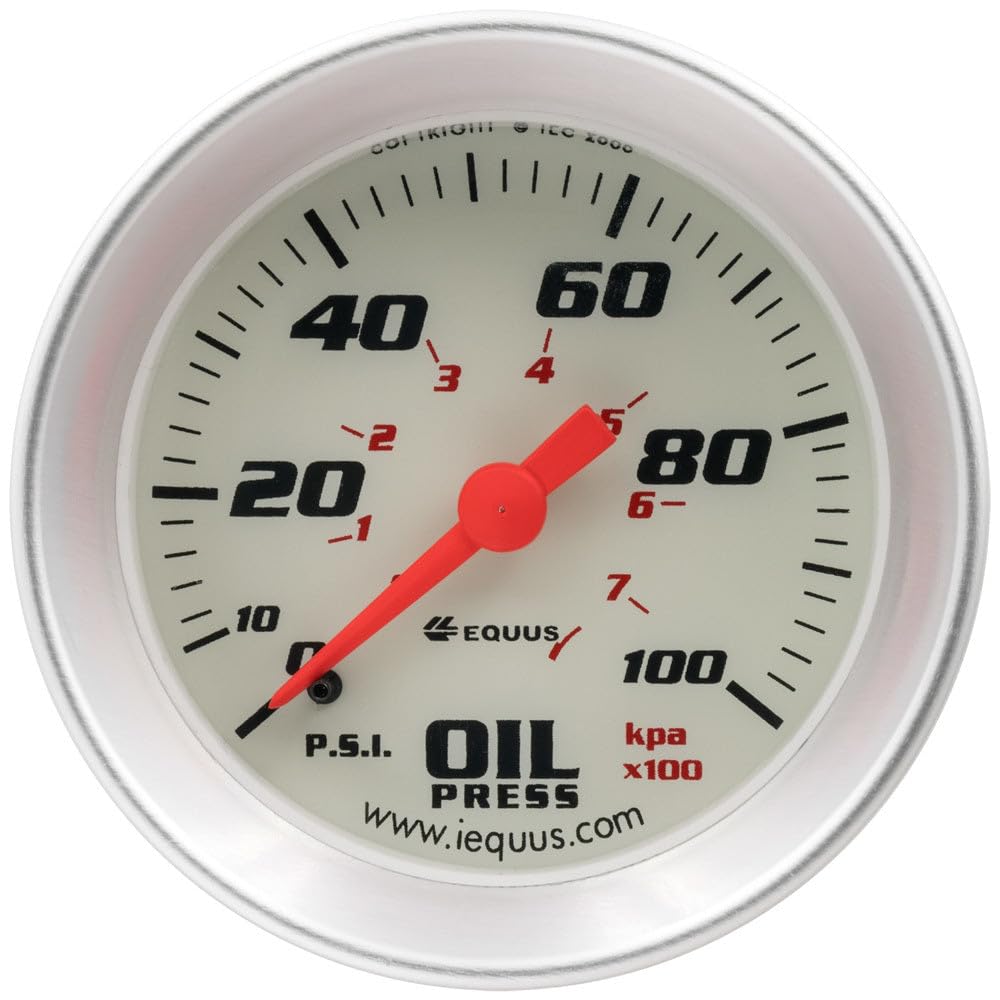
A brushed aluminum face that feels premium and survives the mud — literally.
The Equus 8244 matches the Bosch on type (mechanical) and sweep (270 degrees), but it brings a genuinely different look and a tougher construction. The bezel is actual aluminum — lightweight and brushed — rather than chrome-plated plastic. That matters when the gauge is mounted in a trail rig that sees mud, water, and vibration. One owner installed it in a mudding Jeep CJ-7 and called it durable, which tracks with the overall quality rating owners give it most.
What sets the Equus apart is the backlight kit. It includes red, green, blue, and yellow bulb covers, so you can match the gauge’s glow to the rest of your dash lighting. At 9.6 ounces it is slightly heavier than the Bosch, but still well within the range of a standard dashboard mount. Accuracy and value for money are the other top positive aspects, with a strong consensus that it punches above its price point. The one honest caveat: the chrome bezel on earlier versions was reported as thin plastic by one buyer, but the current brushed-aluminum construction appears to address that.
What owners love
- Quality construction with a real aluminum bezel
- 270-degree sweep for easy reading
- Multiple colored bulb covers for dash-matching
- Proven tough in off-road use (Jeep CJ-7 owner)
One honest note
- The bezel is not thick metal — treat it gently when tightening the mounting ring
Best for: the off-road or trail builder who wants a mechanical gauge that looks high-end and can take a beating — and wants to color-match the backlight.
Think twice if: you prefer the clean look of a chrome-plated bezel or need the absolute lightest gauge on the list.
3. Bosch SP0F000041 Style Line 2″ Electrical Oil Pressure Gauge

A simple two-wire hookup for a clean install — no oil line to route.
The Bosch SP0F000041 delivers the same clean white dial and chrome bezel look as its mechanical sibling, but it swaps the nylon tube for a sending unit and a single wire. That makes installation much easier in tight cabins or modern dashes where you do not want oil near your wiring. It is designed only for 12-volt negative ground systems, so double-check your car’s polarity before ordering. The installation is what owners praise most — several note it was cleaner and easier than the electrical gauge it replaced.
The trade-off is the sweep. Where the mechanical Bosch offers a 270-degree arc, this electrical version uses a 60-degree sweep — the tightest on this list. At 10.4 ounces, it is also heavier than the mechanical Bosch by a notable margin. Accuracy on this gauge gets mixed feedback, and one owner reported a sender failure that caused the needle to stick at 25 PSI even though actual pressure was higher. That is an occasional issue with electrical senders, and it is worth knowing if you rely on the gauge for engine-health decisions under high load.
Install-first design: If a clean wire-through-the-firewall setup matters more than having a wide sweep angle, this is your gauge. The value-for-money and appearance scores are strong — just verify the 12-volt negative ground compatibility and be aware that sending-unit accuracy is worth testing after installation.
Ideal for: the restomod builder who values a simple, clean electrical hookup and likes the Bosch style, particularly in a classic truck like a 1955 Chevy that already saw a retrofit.
skip it if: you want a wide, fast-reading needle sweep — the 60-degree arc is the tightest here and makes the 0-100 range harder to parse at a glance.
4. Equus 8264 2″ Electric Oil Pressure Gauge with Multi Color Back Light

Four backlight colors in one gauge — pick your mood or match your dash.
The Equus 8264 is the most feature-rich electrical gauge on this list. It comes with removable red, green, and blue bulb covers (the review pages sum it up: “includes red, green, blue bulb covers”), plus the standard bulb, giving you four distinct color options for the backlight. That alone makes it the pick for anyone building a custom interior, a hot rod, or a show car where dashboard lighting is part of the aesthetic. The 90-degree sweep is a solid middle ground between the Bosch mechanical’s wide arc and the Bosch electrical’s tight sweep — readable without being massive.
Quality and functionality are the top positive aspects, with owners calling it a decent gauge that works great at a good price. The rear twist-on ring mount makes installation simple; you just drill the hole, twist the ring on from behind, and hook up the 12-volt power and ground wires. It includes all necessary hardware and adapters for most foreign and domestic vehicles. The gauge face is described as “slightly off-white” by one owner, which is a tiny detail but note if you need a pure white match to an OEM cluster. At 11.2 ounces, it is the heaviest gauge here, which makes sense given the added color-change hardware.
Why it stands out
- Three colored bulb covers plus standard bulb for four lighting options
- Lightweight aluminum bezel construction
- Rear twist-on ring mount for tool-free install
- Includes hardware and adapters for broad fitment
Small trade-off
- Gauge face is slightly off-white, not pure white
- At 11.2 oz, it is the heaviest pick here
Reach for this if: you are building a show car or hot rod and want the ability to match the gauge backlight to your dashboard theme — the color flexibility is unique here.
Look elsewhere if: you need a mechanical direct-reading gauge for a daily driver, or your dash requires a strict pure-white color match.
Understanding the Specs
Mechanical vs. Electrical Operation
A mechanical gauge uses a nylon tube that feeds engine oil directly to the gauge mechanism inside the cabin. The needle moves by physical oil pressure, so there is no sensor to fail — but you have to route the oil line away from heat and moving parts. An electrical gauge uses a sending unit on the engine block. The sender converts oil pressure into a voltage signal and sends it up a wire to the gauge. Installation is simpler (just a wire through the firewall), but the sender itself can occasionally drift or fail, which is why accuracy on electrical gauges sometimes draws mixed feedback.
Sweep Angle (270° vs. 90° vs. 60°)
The sweep angle tells you how far the needle travels from zero to 100 PSI. A 270-degree sweep — used on both top mechanical picks here — spreads the scale over nearly a full three-quarter circle. That gives you wider gaps between 10-PSI marks and makes small pressure changes easier to spot. A 90-degree sweep (like the Equus electrical) fits the same range into a quarter-circle, which saves space but packs the numbers tighter. A 60-degree sweep (the Bosch electrical) is the tightest: functional, but harder to read quickly at a glance — a detail that matters if you monitor pressure during hard acceleration.
FAQ
Will a 2-inch gauge fit a standard 2-1/16-inch dashboard opening?
Can I use a mechanical gauge in my daily driver without leaking oil?
What does 1/8 NPT mean for my oil pressure gauge?
How do I wire an electrical oil pressure gauge to my 12-volt system?
What is the difference between a 60-degree and a 270-degree sweep?
Does the face color match between different brands?
Which is better for a classic car restoration — mechanical or electrical?
How do I change the bulb or bulb cover on an Equus gauge?
Can an electrical gauge give a false reading?
Final Thoughts: The Verdict
For most buyers, the white face black pointer 2-inch 0-100 oil pressure gauge winner is the Bosch SP0F000044. It has the widest 270-degree sweep (a needle that moves across three-quarters of a circle), so you see pressure changes at a glance. Its simple mechanical design installs in under an hour, and buyers consistently praise its build quality. If you want a rugged trail-ready look with color-matched backlighting, choose the Equus 8244. For a clean wire-only hookup that avoids running oil into the cabin, the Equus 8264 with its four-color backlight is the one to reach for.
How We Picked
We do not accept paid placement. Every pick is matched to a real buyer and a real use-case; we do not hands-on test units.
Sources & Methodology
Specifications: manufacturer listings and product documentation. Review insights: verified customer reviews, as of July 2026. Pricing: not shown on this page (it changes often); check the current price via the retailer link.
As an Amazon Associate, GoCarLife earns from qualifying purchases. This does not affect which products we feature.