
Our readers keep the lights on and the garage heater humming. As an Amazon Associate, I earn from qualifying purchases.
Specs are compiled from manufacturer listings and verified buyer reviews and can change over time — please confirm the key details on the product page before buying.
Choosing the wrong whip aerial antenna sacrifices range, clarity, and battery life while adding unwanted static. This guide breaks down the nine best options for 2025, from the compact pocket whip to the towering 102-inch stainless steel legend, so you know exactly which one pairs with your radio and your real-world use.
I’m Mo Maruf — the founder and writer behind GoCarLife. This guide is built by comparing the manufacturers’ published specifications and the patterns across verified customer reviews, so you get each pick’s real strengths and trade-offs instead of marketing spin.
Whether you are running a handheld Baofeng, a base-station CB, or a marine VHF setup, the right best whip aerial antenna will transform your signal from frustrating to reliable — and this guide shows you exactly where to put your money.
Our Picks at a Glance


How To Choose The Best Whip Aerial Antenna
A whip antenna is the most common way to get your voice out of a handheld or mobile radio, but the details change everything. Here are the three things that separate a good purchase from a regret.
Connector type: SMA-Male vs. SMA-Female
This is the single easiest mistake to make. Your radio port needs to match the antenna pin. An SMA-Male antenna (the pin is on the antenna) fits radios like Yaesu, Vertex, and TYT. An SMA-Female antenna (the socket is on the antenna, pin on the radio) fits BaoFeng and BTECH. Order the wrong one and you will need an adapter before you get on the air.
Gain (dBi) and length
Gain, measured in dBi, tells you how much the antenna focuses your transmit power. Higher gain sounds appealing but it narrows the pattern — great for flat terrain, less useful in hilly country. A 3 dBi whip like the Nagoya NA-771 is a balanced everyday performer, while a 3.5 dBi model like the NA-24J pushes a touch further on the 2-meter band. Longer whips also deliver more gain, but they become impractical on a handheld where you are walking around.
SWR — why it matters
SWR, or Standing Wave Ratio, measures how well your antenna matches your radio. A lower SWR means more power goes into the air rather than bouncing back into your transmitter. An SWR of 1.5:1 or below is excellent; anything above 2.5:1 risks damaging your radio over time. Pre-tuned antennas are convenient, but many buyers find they still need to trim a quarter-inch to dial in the lowest SWR on their specific vehicle or mount.
Quick Comparison
| Model | Best For | Gain | Length | Connector | Amazon |
|---|---|---|---|---|---|
| Nagoya NA-771★ Best Overall | Handheld VHF/UHF range | 3 dBi | 15.6 in | SMA-Male | Amazon |
| Nagoya NA-24JTop Performer | Ultra-flexible BaoFeng whip | 3.5 dBi | 16.2 in | SMA-Female | Amazon |
| Prostick 3-ft Fiberglass CBBudget Champion | Fixed CB station entry | — | 3 ft | PL-259 | Amazon |
| Prostick 4-ft Fiberglass 1000W | High-power CB mobile | — | 4 ft | PL-259 | Amazon |
| Nagoya CB-72 Kit | Magnetic-mount CB road trips | — | 28 in | PL-259 | Amazon |
| Tram 1600-HC Marine | Marine VHF (boat mast) | 6 dB | 35 in | PL-259 | Amazon |
| Wilson T2000 Trucker | Heavy-duty CB semi-truck | — | 49 in (whip) | PL-259 | Amazon |
| Browning BR-78 | High-power base / mobile CB | — | 63 in | 3/8 x 24 stud | Amazon |
| 102-Inch Stainless Whip | Pure quarter-wave CB range | — | 102 in | 3/8 x 24 stud | Amazon |
In‑Depth Reviews
1. Nagoya NA-771 SMA-Male 15.6-Inch Whip VHF/UHF Antenna
Our pick — over 4.5★ from 700+ verified ratings; the strongest balance of quality and price.
The most trusted aftermarket whip for Yaesu, Kenwood, and any SMA-Male radio.
The Nagoya NA-771 redefined expectations for handheld antenna range. The Nagoya NA-771 delivers a measured 3 dBi of gain across both the 2-meter and 70-centimeter bands, and buyers report the improvement is immediate — one buyer on a Kenwood TH-D71A noted it “adds range and clarity” compared to the stock rubber duck. The real-world proof comes from a field test at 6,100 feet: with a BaoFeng and a Kenwood, range jumped from 30 miles to 92 miles toward Mount Wilson, hitting repeaters the stock antenna could not touch. Its 15.6-inch profile is longer than the stubby factory whip, but the flexibility means it bends rather than breaks when you accidentally whack a door frame. At just 40 grams, it barely changes the balance of your handheld. The fit is dialed in for Yaesu, Vertex, TYT, and Wouxun radios, and owners consistently praise both quality and performance. The only recurring note of caution is the SWR — it is good on the 2-meter band but mixed on 70cm, so check it with a NanoVNA if you plan to transmit heavily on UHF.
Range hero: This is the crowd favorite for anyone who wants to hear and be heard further on a handheld. The Nagoya NA-771 consistently outperforms the stock antenna, and at 3 dBi it hits the balance between gain and pattern width.
The practical catch: The 15.6-inch length can tip your radio over when set on a table, and dropping it risks breaking the antenna connector — so unthread it when you are not actively using it.
Reach for this if: you own a Yaesu, Kenwood, or TYT with an SMA-Male port and you want a proven, immediate range upgrade without changing your radio.
Look elsewhere if: you need a 360-degree flexible whip for daily pocket carry (the 15.6-inch length is too long for most pockets) or if your radio uses an SMA-Female connector.
2. Authentic Genuine Nagoya NA-24J 16.2-Inch Ultra Whip VHF/UHF
The highest-gain flexible whip for BaoFeng radios delivers 3.5 dBi in a 16.2-inch package.
The NA-24J is the go-to upgrade for the massive community of BaoFeng and BTECH owners, and it delivers a tangible 17 percent more gain than the already-popular NA-771. That extra half-decibel translates into real reach: owners mention solid connectivity 25 miles away on the 2-meter band and 2.6 miles on the 70-centimeter band, even with 200-foot hills blocking line of sight, all using a standard 5-watt BaoFeng UV-B5. The ultra-flexible whip design is the standout feature here — it springs back to straight after being bent into a loop, making it the most durable choice for outdoor work where branches and brush are unavoidable. Performance is the most-praised aspect among owners, and the SWR on both bands is notably positive, with one builder measuring a clean 1.5:1 on 2 meters. The only consistent complaint is that the base threads can feel slightly crooked on a small number of units, though it rarely affects performance.
The ranging edge: The NA-24J beats the NA-771 by 0.5 dBi and a half-inch of length, which makes it the best pure distance play for the SMA-Female crowd. Customers note a roughly 30 percent signal increase over the stock antenna on GMRS-V1 radios.
The one caution: Do not forget to install the included O-ring before tightening — without it, the connection can loosen over time and degrade your SWR.
Reach for this if: you run a BaoFeng or BTECH and you want the maximum flexible whip length your handheld can take without a pigtail adapter.
Look elsewhere if: your radio uses an SMA-Male connector (this antenna is SMA-Female) or if you need a short antenna for concealed carry.
3. Prostick 3-Foot Fiberglass CB Radio Antenna
A pre-tuned fiberglass CB whip that works right from the start.
If you want to get on CB without messing with trimming and tuning, the Prostick 3-footer is the no-fuss entry. It is pre-tuned for the 26–29.5 MHz CB range and built around a fiberglass mast joined to a nickel-plated brass ferrule. The VibraSorb anti-breakage design helps it survive the vibration of a truck or SUV, though the fiberglass is not as indestructible as stainless steel. Buyers confirm it works well for reception, but the key detail here is that it is not tuneable — one owner reported a 1.7 to 2.4 SWR across all channels, which is acceptable for receive but less than ideal for extended transmit. Quality and functionality are the top positives. Because the antenna lacks an SWR adjustment mechanism, you live with whatever SWR your mount and location produce.
Install-and-forget: This is the cheapest way to get a full-size CB whip on a vehicle or base station. The pre-tuned element handles basic communication well, and the nickel-plated brass ferrule resists corrosion better than plain steel.
The trade-off: The non-tuneable design means you cannot dial in a perfect 1:1 SWR if your setup is non-standard. It is fine for listening and occasional transmitting, but not for high-power rigs where every watt counts.
Best for: the first-time CB user who wants a functional, affordable antenna and does not want to cut or tune anything.
skip it if: you run a high-power amplifier or need a perfectly flat SWR across all 40 channels — get a tuneable stainless model instead.
4. Prostick 4-Foot Fiberglass 1000-Watt CB Antenna
A 4-foot fiberglass whip rated for 1000 watts, built for serious CB mobile use.
Taller than the 3-foot Prostick and rated for up to 1000 watts of input power, this model is built for the CB operator who runs an amplifier. It is pre-tuned for the 26–29.5 MHz CB band and uses the same VibraSorb anti-breakage base, but buyers quickly discovered a key caveat: the antenna ships electrically too long for the CB band. Most owners had to trim roughly 1.5 inches off the tip to bring SWR down to the 1.2–1.3 range on channels 1 and 40. Once tuned, it is impressively durable — one trail rig owner reported the whip surviving “severe bending beyond 45 degrees” and tree slaps without breaking. Performance and quality are the top positives by a wide margin. The fiberglass construction is sturdy but not spring-loaded, so forgetting it is on the truck and driving into a low garage will snap it.
High-power ready: The 1000-watt rating is the real deal — this antenna handles amplified CB rigs that would melt a budget whip. The fiberglass mast with a nickel-plated brass ferrule keeps the signal clean.
The essential first step: Plan on trimming and tuning. from the start, SWR can exceed 6:1. With a NanoVNA and a pair of wire cutters, you can get it down to 1.1 on your favorite channel. Skip the tuning step and you risk damaging your radio.
Best for: the mobile CB user who runs an amplifier and wants a tough, tall fiberglass whip that performs after a simple trim.
pass on it if: you want instant plug-and-play without a tuning session — the Nagoya CB-72 kit is a better no-trim option.
5. Nagoya CB-72 28-Inch CB Antenna Kit with Magnetic Mount

An all-in-one CB kit with a magnetic mount secure at 75 mph and an 18-foot coax cable.
The Nagoya CB-72 is designed for the CB user who wants a clean install without drilling holes. The 3.5-inch heavy-duty magnetic mount holds the antenna securely at highway speeds, and the 18-foot RG-58A/U coaxial cable gives you enough length to route through a truck cab or SUV interior. The antenna is pre-tuned for the full 40-channel CB band, so no trimming is required — you screw it on, place the mount, and start talking. Functionality and the magnetic mounting system are the top positives among buyers, and one owner confirmed their SWR was reasonable with central roof placement. The build quality, however, receives mixed feedback; the loading coil does not appear to be fully sealed, so leaving the antenna on through a car wash or heavy rain can cause issues. A few owners reported an off-the-chart SWR from the start, likely a QC variance.
Portable CB setup: The CB-72 is the best choice for someone who wants to use CB on multiple vehicles or remove the antenna for theft prevention. The magnet is genuinely strong — one owner drove at 75 mph with no movement.
The honest note: Build quality varies. Some units arrive with excellent SWR, others do not. Budget buyers should test the SWR before a long trip and consider returning if the reading is poor.
Best for: the casual CB user who wants a fast, removable setup for road trips without permanent modifications.
Think twice if: you need a fully weatherproof antenna for daily use in rain, or if you require precise SWR tuning — this is a fixed-length design with limited adjustability.
6. Tram 1600-HC 35-Inch VHF Marine Fiberglass Antenna
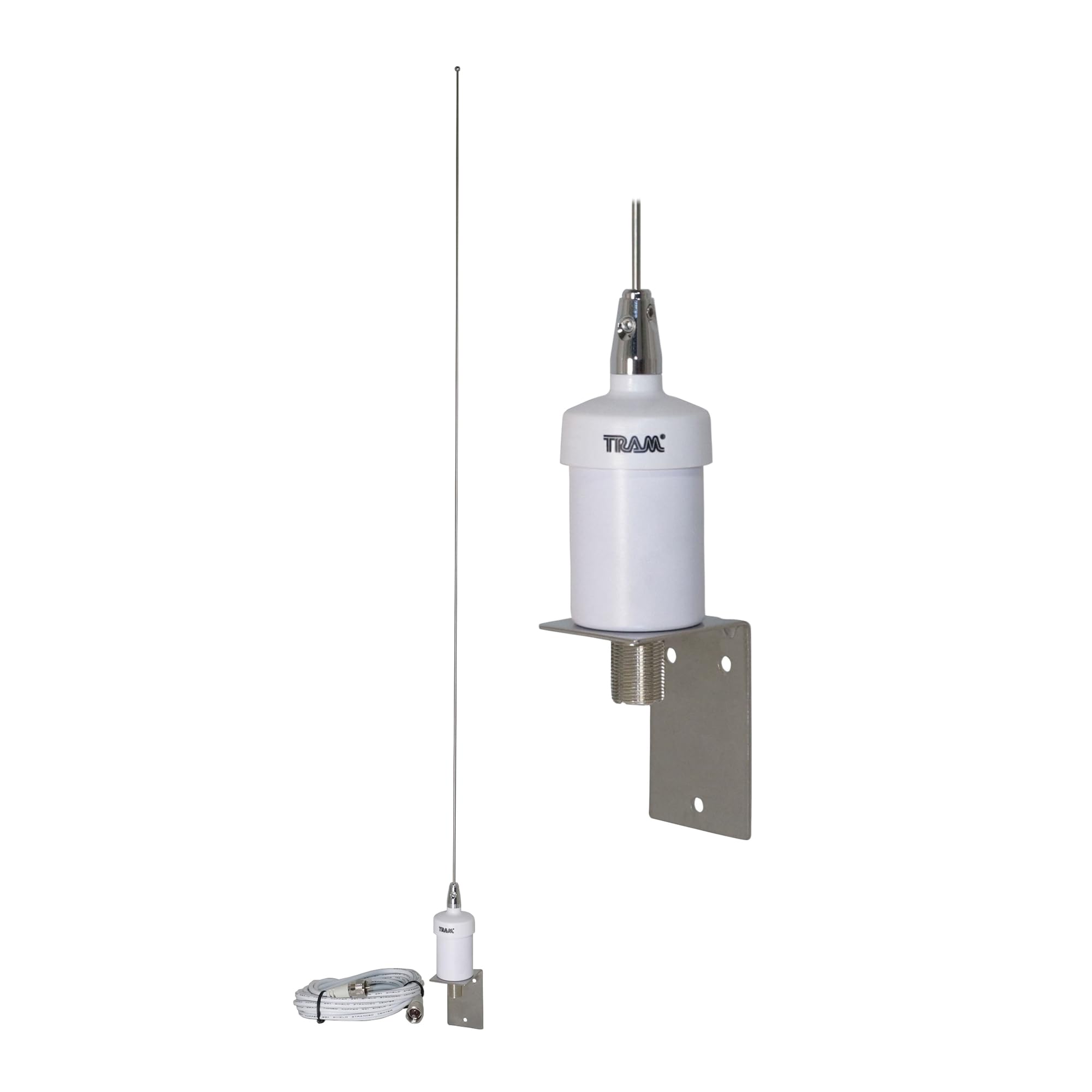
A marine-grade VHF whip with 6 dB gain and a stainless steel whip resistant to saltwater and sea spray.
Boating demands a different type of whip — one that can survive salt corrosion, constant vibration, and the occasional dock strike. The Tram 1600-HC is built for exactly that world. It is a 35-inch bottom-loaded fiberglass antenna with a 17-7 PH stainless steel whip and an L-bracket for mounting on a sailboat mast. The claimed gain is 6 dB, though some owners suspect the real-world figure is closer to 3 dB; regardless, the performance is excellent — one owner on a 10-foot mast 15 feet above sea level reported receiving boats over 5 miles away and clear transmit at 5 miles with an SWR of 1.2. The antenna ships pre-tuned for all marine band frequencies and includes a 15-foot RG-58 coaxial cable with PL-259 connectors. The plastic base housing does yellow after a season in the sun, and the set screw can loosen over time, but a dab of threadlocker solves that. Buyers consistently call it one of the best VHF mobile antennas available for the money.
Marine performance: For a recreational boat or sailboat, this antenna delivers reliable VHF communication at a price well below comparable fiberglass models. The 15-foot coax saves you the hassle of buying cable separately.
The saltwater reality: The stainless whip resists corrosion well, but the plastic base and set screw will need occasional inspection. Plan to add a threadlocker to the set screw during installation.
Best for: boat owners who need a solid VHF antenna for coastal cruising, lake boating, or as a cost-effective backup to a mast-mounted unit.
it’s not for you if: you need a true ocean-rated antenna with a fully sealed base — look at a top-tier Shakespeare model instead.
7. Wilson Antennas T2000 Series 3500-Watt Trucker CB Antenna

Built for the big rig — a 3500-watt trucker antenna with a 49-inch stainless steel whip and a 10-inch shaft.
The Wilson T2000 is the antenna you see on thousands of semi-trucks for a reason: it handles the abuse of long-haul driving and the power of a high-output CB. It is rated for up to 3500 watts and covers the frequency range from 26 MHz to 30 MHz, making it equally at home on the CB band and 10-meter ham band. The 49-inch stainless whip is paired with a larger coil housing that allows increased power handling, and the 10-inch shaft uses the standard 0.38-inch x 24 thread found on most truck mirrors and mounts. Reviewers point out that it rarely needs tuning from the start — one buyer measured an SWR of 1.5 immediately after installation. Quality and functionality are the top positives across hundreds of ratings. The shaft and coil are well-built, and the whip flexes without snapping. The only durability concern flagged by owners is that the antenna can snap at the base if it takes a direct hit at highway speed, which is a risk with any heavy whip.
High-power, low-hassle: The T2000 is designed for amplified CB rigs. At 3500 watts, it handles a serious signal without overheating the coil. The 49-inch whip gives you the height to reach over the roof of a semi.
The installation note: You need a solid mirror mount or stake-pocket mount to support this antenna. A weak mount will flex at speed and change your SWR.
Best for: truck drivers, off-roaders, and anyone running a high-power CB who needs a rugged, reliable whip with minimal SWR fiddling.
look elsewhere if: your vehicle cannot accommodate a 49-inch whip plus 10-inch shaft, or if you only need a low-power entry-level antenna for around-town CB use.
8. Browning BR-78 15,000-Watt CB Antenna, 63 Inches Tall
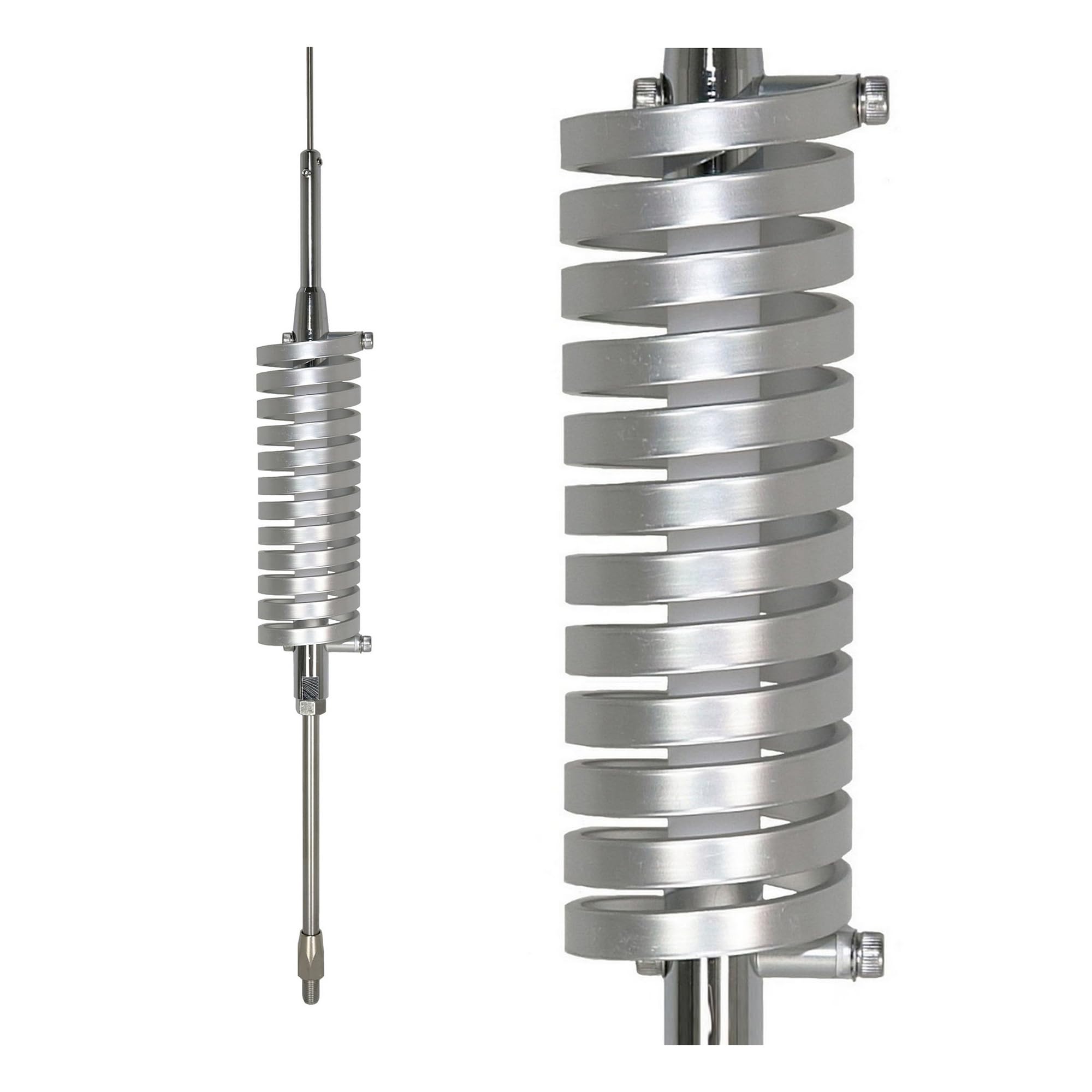
A 63-inch flat-coil monster that handles 15,000 watts — the choice for serious DX and amplifier users.
The Browning BR-78 is not messing around. With a 15,000-watt power rating, it laughs at amplifiers that would melt a standard whip. The antenna uses a flat-coil design with a stainless steel 17-7 PH tempered 3mm tapered whip and shaft, covering 25 MHz to 30 MHz. The full 63-inch height gives it an electrical length close to a half-wave on CB, which translates into excellent range and low take-off angle for skip propagation. from the start, some shoppers say an SWR of 1.2 on the 10-meter ham band and very usable readings on CB — one owner on a 2024 Western Star recorded 1.2 on channel 1 and 1.4 on channel 40 with no trimming needed. Antenna quality and functionality are the top positives, with owners praising its range and construction. The stainless steel whip is far more durable than fiberglass for trail and commercial use. The standard 3/8-inch x 24 thread fits most mounts.
Extreme power rating: The 15,000-watt rating is in a class of its own. This is the antenna for the CBer running a big amplifier and chasing skip from coast to coast. The flat coil design keeps the center of gravity relatively low.
The tuning reality: Budget some time for trimming. While some units are spot-on, many need an inch or more cut from the whip to reach a flat SWR. A NanoVNA or an SWR meter is essential.
Best for: the serious CB operator with an amplifier who wants a tall, high-quality stainless steel whip that will outlast the truck and deliver nationwide receive.
Think twice if: you need a low-height antenna for a garage-kept vehicle — 63 inches plus mount height will not fit in most standard garages.
9. 102-Inch Stainless Steel CB Ham Radio Antenna Whip

The classic quarter-wave — 102 inches of stainless steel that delivers the purest CB signal you can get on a mobile.
There is no coil, no loading, no compromise. The 102-inch whip is a true electrical quarter-wave on the 11-meter CB band, and it outperforms every loaded antenna on the market for raw transmit efficiency. Made from 17-7 PH tapered stainless steel, the whip is both highly flexible and extremely durable — one owner reported hitting “so many different things” and the whip bent rather than snapped, returning to shape each time. The SWR adjustability is handled by a mounting stud, and the antenna fits all standard 3/8 x 24 threaded mounts. Quality and durability are the top positives, with one user noting incredible reception after adding a bonding wire from the mount to the vehicle frame. The lack of a loading coil means there is nothing to heat up or fail, even at legal power limits. The obvious challenge is the height: at 102 inches plus the mount, the total height is over 9 feet, so it will not fit in a garage. It also requires a solid ground plane — mounting it on a plastic bumper without a ground bond will result in poor performance until you run a dedicated RF bonding wire.
Uncompromised efficiency: A full quarter-wave is the gold standard for CB mobile performance. The 102-inch whip offers the cleanest SWR and the broadest bandwidth of any antenna on this list. Owners agree: with a good ground, the performance is “incredible.”
The clearance commitment: You must have a vehicle tall enough and a parking situation that accommodates more than 102 inches of whip. It also needs a proper ground plane to work — a fiberglass roof or plastic bumper will kill the signal without a bonding wire.
Best for: the CB purist who wants the simplest, most efficient mobile antenna possible and has the vehicle height and ground plane to support it.
steer clear if: your truck goes into a garage, you use a fiberglass vehicle roof, or you need a quick-removable antenna — this whip is permanently mounted.
Understanding the Specs
Gain (dBi)
Gain measures how much the antenna focuses your radio’s power into a particular direction. A higher dBi number gives you more reach in that direction, but the trade-off is a narrower beamwidth. For a whip antenna on a handheld, 2–3.5 dBi is the balance — you get noticeable range improvement without making the signal so directional that you have to point the antenna perfectly. For mobile CB use, gain comes from physical height and coil design rather than a dBi rating printed on the box.
SWR (Standing Wave Ratio)
SWR is the ratio of power sent forward to the antenna vs. power reflected back. A perfect match is 1:1. Most radios can handle up to 1.5:1 without issue, and many can tolerate up to 2.0:1. Above that, the reflected power stresses the final amplifier stage in your radio. Pre-tuned antennas aim for 1.5:1 from the start, but the actual SWR depends on your specific mounting location, ground plane, and surrounding metal — so always check it with an SWR meter or a NanoVNA before full-power operation.
FAQ
Will an SMA-Male antenna work on my BaoFeng UV-5R?
Do I need to tune every whip antenna before use?
How does the 102-inch whip compare to a loaded 3-foot CB antenna?
Can I use a VHF/UHF handheld antenna for CB radio?
What does a higher dB gain on a marine antenna actually mean for my boat?
Will the Wilson T2000 antenna fit on a standard pickup truck mirror mount?
Can I use the Nagoya CB-72 antenna permanently on my SUV?
How much wind noise does a 102-inch whip make at highway speed?
Can I use the Prostick 4-foot antenna on a base station at home?
Can I listen to AM/FM radio with a CB antenna?
Final Thoughts: The Verdict
For the majority of shoppers, the best whip aerial antenna to buy right now is the Nagoya NA-771 because it combines proven 3 dBi gain with broad SMA-Male compatibility and a performance record that thousands of ratings affirm. If you own a BaoFeng and want the highest-gain flexible whip available, grab the Nagoya NA-24J with its 3.5 dBi edge and ultra-flexible design. And for the serious CB operator running an amplifier who demands maximum range and a rugged steel whip, the 102-Inch Stainless Whip is the uncompromised quarter-wave legend — just make sure you have the height and ground plane to do it justice.
How We Picked
We do not accept paid placement. Every pick is matched to a real buyer and a real use-case; we do not hands-on test units.
Sources & Methodology
Specifications: manufacturer listings and product documentation. Review insights: verified customer reviews, as of July 2026. Pricing: not shown on this page (it changes often); check the current price via the retailer link.
As an Amazon Associate, GoCarLife earns from qualifying purchases. This does not affect which products we feature.