
Our readers keep the lights on and the garage heater humming. As an Amazon Associate, I earn from qualifying purchases.
Specs are compiled from manufacturer listings and verified buyer reviews and can change over time — please confirm the key details on the product page before buying.
Putting new wheels on your car or grabbing a set from a junkyard can go wrong fast. A tiny difference between bolt patterns — like 5x112mm versus 5×114.3mm (the diameter of the circle your lug nuts sit on) — makes a wheel useless. A wheel stud pattern tool ends that guesswork in seconds, before you spend a cent. You will find seven top picks below, from pocket-size plastic templates to heavy-duty steel simulators, so you know what fits your garage and your budget.
I’m Mo Maruf — the founder and writer behind GoCarLife. This guide is built by comparing the manufacturers’ published specifications and the patterns across verified customer reviews, so you get each pick’s real strengths and trade-offs instead of marketing spin.
Whether you are a weekend DIYer, a full-time mechanic, or a custom-wheel builder, the right wheel stud pattern tool saves you time, money, and the frustration of a wheel that does not sit flush.
Our Picks at a Glance
![JEGS Wheel/Stud Bolt Circle Template [SAE 5-Lug]](https://m.media-amazon.com/images/I/61kzHy1AREL.jpg)
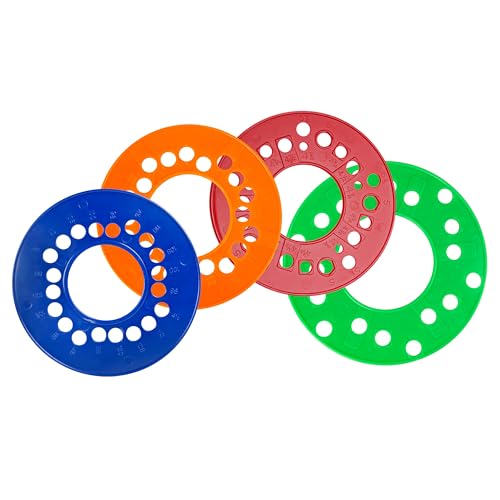
How To Choose The Best Wheel Stud Pattern Tool
Your first decision depends on the job you need to do. A quick bolt-pattern check at a swap meet needs a different tool than mocking up an entire custom wheel setup in your garage. These three specs separate the right fit from the wrong one.
Template vs. Adjustable Caliper
Fixed templates — disc-shaped guides with cutouts for 4, 5, and 6 lugs — are the fastest option. You place one against the wheel’s bolt holes, and the pattern is right there in the cutout. That gives you an instant answer. Adjustable sliding calipers work like a ruler with moving arms: you slide the arms until they sit over opposite studs and read the metric or imperial scale. Templates are instant and very reliable for common patterns. Calipers cover a wider range, including rare or 8-lug patterns, but you must line the tool up correctly each time, which takes a little more care.
Material: Plastic vs. Steel
Nearly every budget and mid-range tool is made from high-impact ABS plastic (a tough, impact-resistant plastic that resists cracking). That is fine for occasional use — a plastic template is light, will not rust, and fits easily in a glove box. Steel tools, like the simulators at the premium end, are laser-cut from 10-gauge (roughly 3.5mm thick) sheet metal. They are much heavier and more rigid. A steel tool can support the weight of a tire and wheel assembly while you check brake-caliper clearance. If you only need to measure a bolt pattern, plastic saves weight and money. If you need to test-fit a whole wheel, you need steel.
Which Lug Patterns and Vehicle Types You Work With
Most tools cover 4, 5, and 6 lugs for passenger cars, trucks, and SUVs. Some also handle 8-lug patterns for heavy-duty trucks and trailers. Check the included bolt circles — a list like 5×100, 5×112, and 5×114.3 tells you the tool was designed with modern vehicles in mind. If you work on classic cars or European imports, look for metric patterns (mm) and SAE patterns (inches, the standard used on American vehicles) printed on the scale. Dual-scale tools remove the mental unit conversion and reduce errors.
Quick Comparison
| Model | Best For | Type | Lug Patterns | Weight | Amazon |
|---|---|---|---|---|---|
| JEGS Wheel/Stud Bolt Circle Template★ Best Overall | Quick 5-lug ID | Fixed Template (1) | 5 only | 1.6 oz | Amazon |
| AOQIVIS Wheel Bolt Pattern Template ToolAlso Great | Precision template work | Fixed Template Set (4) | 4, 5, 6 | — | Amazon |
| eaacaa 4Pcs Wheel Bolt Pattern Measuring Guides | Trailer & truck patterns | Fixed Template Set (4) | 4, 5, 6 | 7 oz | Amazon |
| FIRSTINFO PCD Wheel Bolt Pattern Gauge | Heavy-duty shop use | Sliding Caliper | 4, 5, 6, 8 | 11.3 oz | Amazon |
| Kingdder 2 Pcs Wheel Stud Rim Bolt Pattern Measuring Tool | Budget multi-pattern checks | Sliding Caliper (2-pk) | 4, 5, 6, 8 | 9.6 oz | Amazon |
| Speedway Motors WheelWise Simulator | Full wheel mock-up | Steel Simulator | 5 only | 7 lb | Amazon |
| maXpeedingrods Wheel Fitment Tool | Budget wheel mock-up | Steel Simulator | 5 only | 6.5 lb | Amazon |
In‑Depth Reviews
1. JEGS Wheel/Stud Bolt Circle Template [SAE 5-Lug]
Our pick — over 4.5★ from 60+ verified ratings; the strongest balance of quality and price.
Tucked into a pocket, this 1.6-ounce disc answers the five-lug question every time.
This is the simplest tool for anyone who mainly works with SAE 5-lug wheels — the pattern used on most American trucks, classic cars, and muscle cars. It is a single plastic disc machined in the USA with four cutouts: 5×4.5″, 5×4.75″, 5×5″, and 5×5.5″. You lay the disc over the studs, and the correct cutout lines up immediately. Owners confirm it “tells you what bolt pattern your working with” exactly as advertised — no interpretation needed.
At just 1.6 ounces, it is about 6 times lighter than the Kingdder sliding caliper. That portability is its defining advantage: it slips into a shirt pocket or glove box and stays there until you need it. The big trade-off is that this tool does exactly one job. It recognizes 5-lug SAE patterns only. A 6-lug trailer wheel or a metric-pattern import will leave you guessing. But for the mechanic, hot-rodder, or truck owner who only touches 5-lug domestic wheels, this single-disc template is the cheapest and fastest way to be certain.
Why you would buy it
- Weighs barely anything — easy to always carry
- Instant pattern match with no sliding or adjustment
- Made in USA from durable engineered plastic
- Perfect for 5-lug domestic trucks, muscle cars, and hot rods
What it leaves out
- Covers SAE 5-lug patterns only — no metric, no 4-lug, no 6-lug
- Single disc (JEGS offers other templates sold separately)
- Not useful for modern import vehicles
Reach for this if: You are a classic-car guy, hot-rod builder, or fleet mechanic who only touches American 5-lug wheels and wants the simplest possible verification.
Look elsewhere if: Your daily work includes imports, trailers, or anything beyond four SAE bolt circles.
2. AOQIVIS Wheel Bolt Pattern Template Tool
Instant pattern confirmation with dual-scale precision that cheap tools miss.
This four-piece template set gives you the most accurate fixed-gauge readings on the list — and buyers confirm that. The key advantage is the dual SAE (inches) and Metric (mm) scale. It lets you measure the Pitch Circle Diameter (PCD, the diameter of the imaginary circle your lug nuts sit on) in both units at the same time. That matters when you are sorting through a pile of junkyard wheels and need to tell a 5x112mm pattern from the nearly identical 5×114.3mm pattern. A plastic caliper can blur that difference; the dedicated cutout here resolves it instantly. You get separate templates for 4, 5, and 6 lugs, four pieces total.
The material is high-impact ABS plastic (a tough, durable plastic) that buyers report feels precise and solid in the hand. The tradeoff is readability in dim light: the embossed numbers can fade in a shadowed workshop. A few owners fix this by hitting them with a silver paint marker — a five-minute mod that turns it into a permanent tool-drawer staple. The verdict from dozens of verified buyers is clear: this is “way more precise than any regular bolt pattern measuring tool.” That makes it sharper for pattern identification than the JEGS disc, which only covers 5-lug patterns and lacks the dual-scale.
Why it owns the top spot
- Dual SAE & Metric scales eliminate conversion errors in tight pattern comparisons
- Measures the entire pattern at once — no sliding or zeroing required
- Four-piece set covers nearly every passenger car and light truck
- Owner consensus calls it high-quality, precise, and easy to use
The catch
- Embossed markings are hard to read in poor light
- Plastic construction feels less durable than a steel tool
- Does not cover 8-lug patterns
The instant-fit pick: If you regularly swap wheels, pull parts at junkyards, or just want one tool that never misreads a pattern, this is the set to grab.
Think twice if: You work almost exclusively on heavy-duty trucks with 8-lug wheels — the sliding calipers below will serve you better.
3. eaacaa 4Pcs Wheel Bolt Pattern Measuring Guides
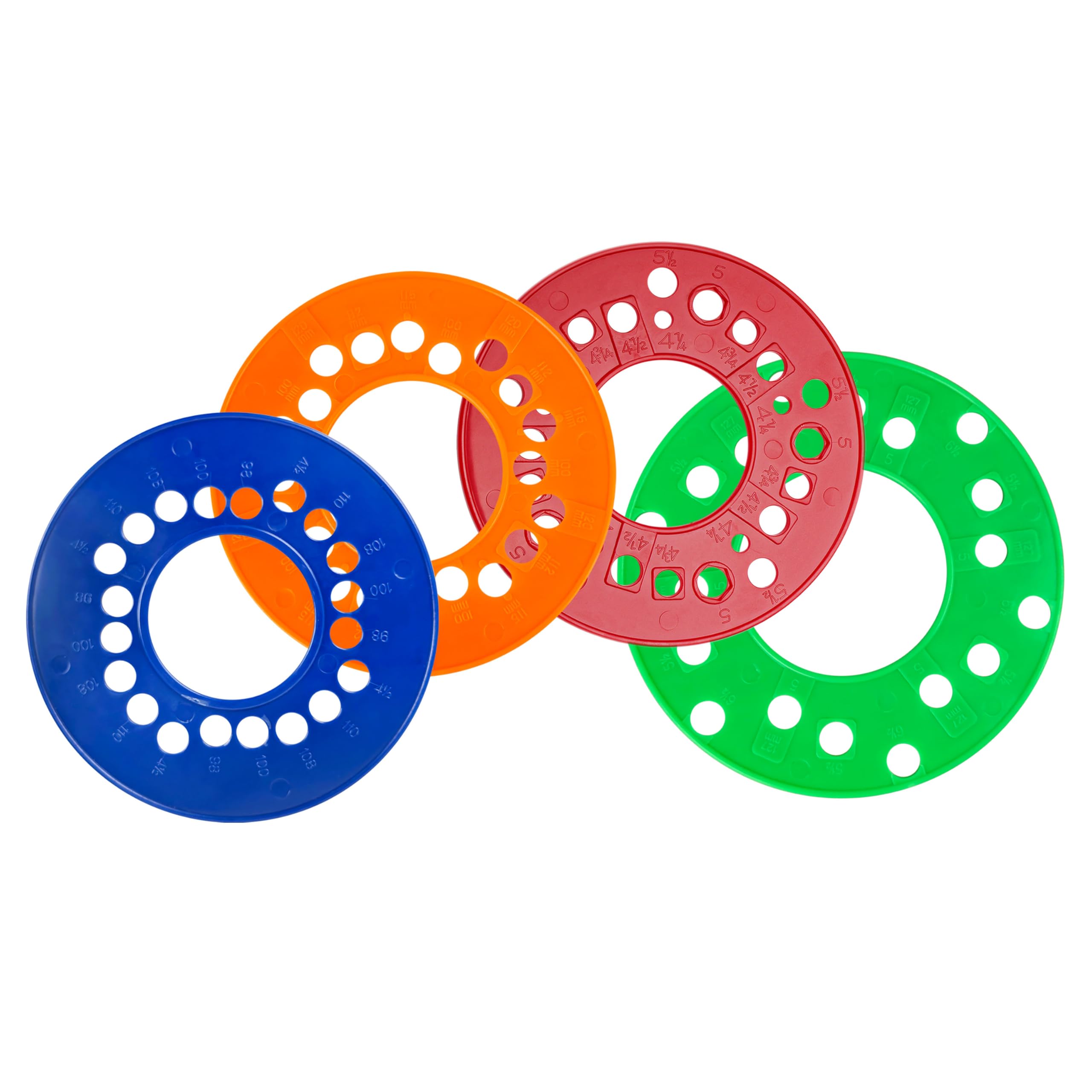
A four-piece set that slims down to a quarter-inch thick — perfect for a toolbox or a pocket.
This eaacaa set is nearly the same idea as the AOQIVIS set above: four dedicated templates for 4, 5, and 6 lugs with dual SAE (inches) and Metric (mm) scales. The real difference is the size — at just 0.71 inches thick and weighing only 7 ounces, it is slightly more compact, fitting easily into a narrow toolbox drawer. Owners mention using it on both trailers and trucks, with one noting it produced “accurate bolt pattern measurements on trailer and truck” and removed the hassle of measuring with a tape and caliper.
The plastic construction feels solid, though a few owners wished for a storage bag or clip (at this price, a small tool pouch is a smart add-on). The templates themselves are well-made, and the markings are clear enough in a well-lit shop. What this set nails is the value: you get the same dual-scale, multi-lug coverage as the top pick for the same price, just from a newer brand with a slightly lower review count. If you need a second set for your trailer toolbox or roadside kit, this is a no-brainer.
Compact pattern detective: Same template-style functionality as the top pick but in an even more space-efficient package — a smart buy for the shop that needs a dedicated tool for each bay.
Grab this set if: You want the precision of fixed templates for 4/5/6 lug patterns and prefer the slightly thinner profile for tight storage spots.
Consider something else if: An 8-lug pattern is in your regular rotation — this set tops out at 6.
4. FIRSTINFO PCD Wheel Bolt Pattern Gauge
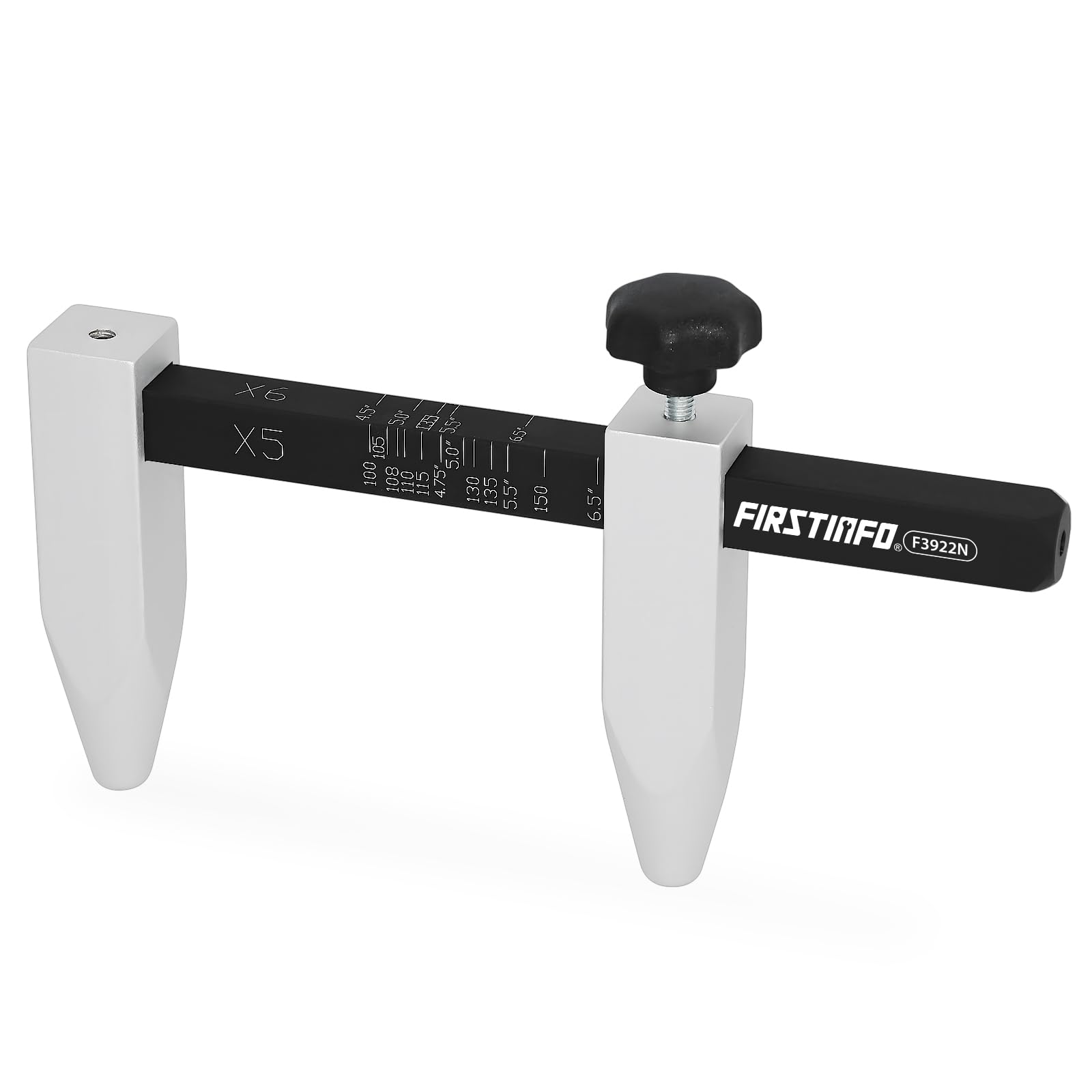
The sliding caliper that handles 4, 5, 6, and 8-lug wheels — and still fits in your tool kit.
This is the first adjustable caliper on the list, and it earns its place by covering four lug counts instead of three. The sliding ruler design lets you measure 4, 5, 6, and 8-lug patterns with a single tool. That is critical if you work on heavy-duty trucks, box trailers, or commercial vans alongside passenger cars. The scale is designed to be read easily, and owners call it a “standout” for shopping at the junkyard — the ability to quickly confirm compatibility across different vehicles saves real money. It covers the widest pattern range here, including 8-lug patterns that the AOQIVIS template set cannot touch.
What separates this from plastic template tools — and from the Kingdder caliper below — is the build. It weighs 11.3 ounces and uses a more rigid frame that customers note is “far superior to plastic versions with sticker measurements.” One owner noted it accurately confirmed a 5x110mm pattern where a plastic tool was ambiguous. The catch is the design: it cannot slip over a stud end the way a thin template can, so you need to slide it onto the studs from the face of the wheel, not the back. For most garage work that is a minor extra step; for production shops it may slow you down. Made in Taiwan with a 12+10-month warranty via registration, this is the tool a busy shop trusts.
What makes it a shop essential
- Adjustable slider covers 4, 5, 6, and 8-lug patterns — the widest range here
- Sturdy build is more accurate and durable than budget plastic tools
- Easy-read scale with clear markings for fast identification
- Backed by an extended 12+10 month warranty from a Taiwan-based tool maker
One trade-off to know
- Cannot slip over stud ends — must be used from the wheel face
- Heavier than a set of plastic templates at 11.3 ounces
- Requires correct alignment each use (unlike drop-on templates)
Best for the pro shop: If 8-lug trucks and trailers are part of your daily work, this is the only tool on the list that has them covered without buying a separate gauge.
Probably overkill if: You only ever deal with 4, 5, and 6 lugs — the template sets above are faster and cheaper.
5. Kingdder 2 Pcs Wheel Stud Rim Bolt Pattern Measuring Tool
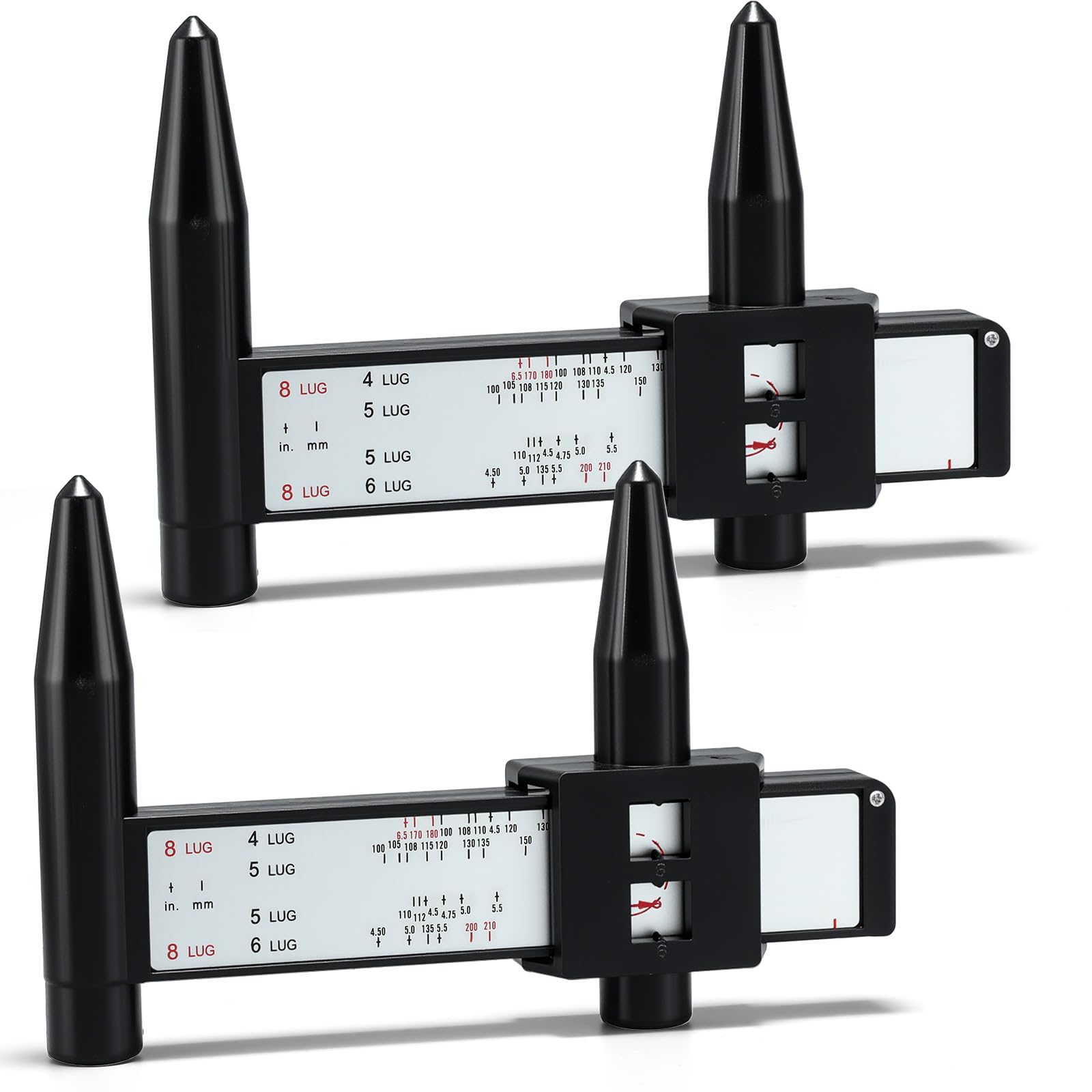
Two calipers for the price of one single — and they cover 4, 5, 6, and 8 holes.
A pack of two identical sliding calipers means you can keep one in the garage and one in the truck, or hand one to a buddy. Each caliper covers a long list of specific patterns: from the common 5×114.3mm to the large 8x210mm. The dual metric and imperial scale on the ABS plastic body is simple to use — slide it to the correct stud position and read the PCD (Pitch Circle Diameter) in either unit. For the price, the value per caliper is excellent, and it includes 8-lug patterns like 8×165.1, 8×170, 8×180, 8×200, and 8×210 that the FIRSTINFO gauge also covers.
The tool is functional but not polished. Owners describe the finish as “a bit rough” and note the plastic feels basic compared to a metal gauge. But those same buyers also say it “can be handy if you buy/sell a lot of wheels” and that “so far it hasn’t been wrong.” That is the real takeaway — it is accurate enough for non-professional use, and getting a spare caliper included makes it an easy choice for the DIYer who wants to stop guessing. The finish is rougher than the smoother FIRSTINFO gauge, but you get a backup tool for less.
The pragmatic grab: Two calipers, ultrawide pattern coverage, and a price that leaves room in the budget for other tools — but expect a rough-and-ready feel rather than precision-instrument finish.
Pick this pack if: You need emergency pattern verification for an 8-lug trailer or commercial truck and want a backup tool you can toss in the glove box.
Maybe not if: You want a single premium tool that feels substantial in hand — the FIRSTINFO gauge above is a clear step up in material quality.
6. Speedway Motors WheelWise Wheel Fitment Simulator
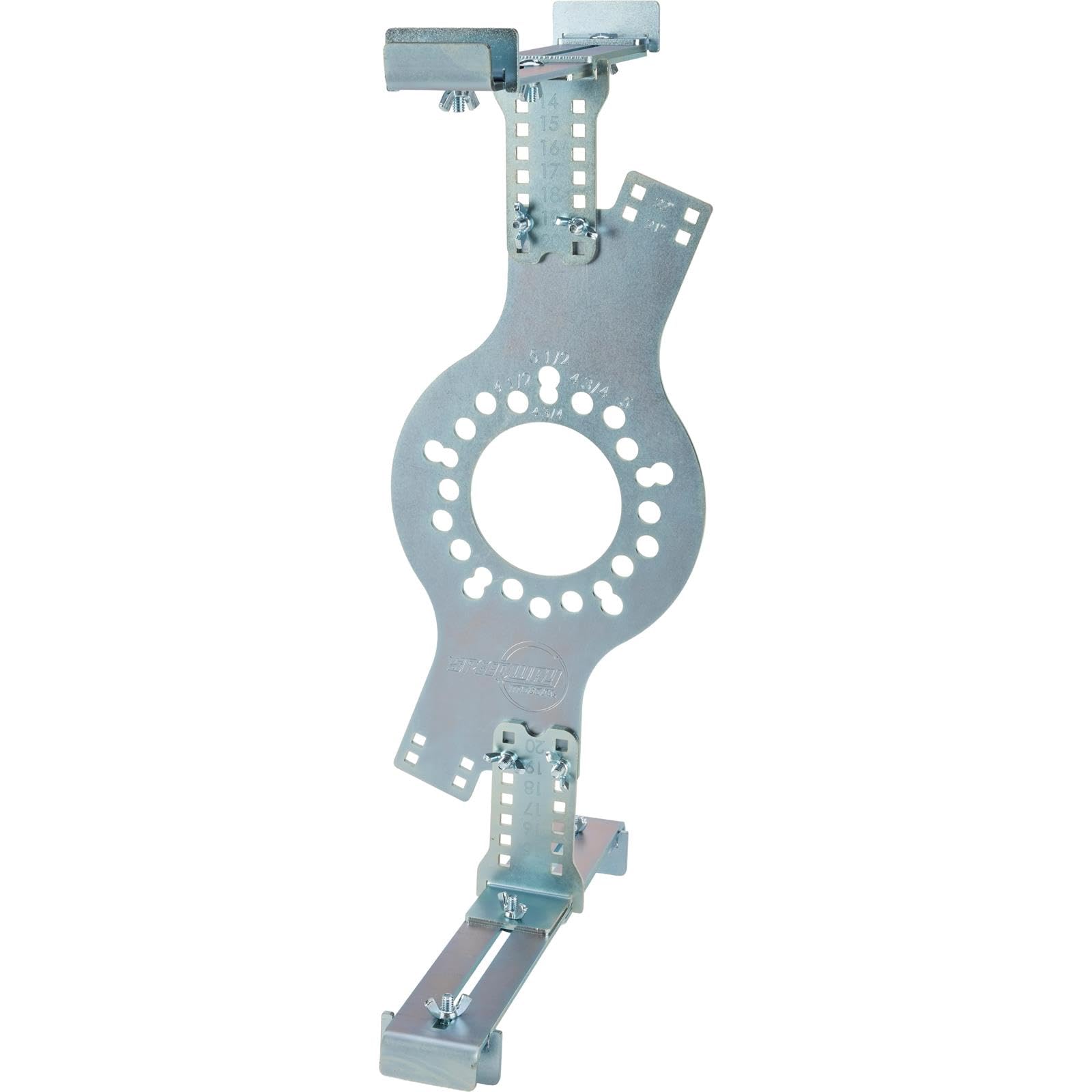
A 7-pound steel chassis that mock-fits a 22-inch tire before you buy a single rim.
This tool is completely different from the templates and calipers above. It is a full wheel simulator — a laser-cut and press-bent 10-gauge (roughly 3.5mm thick) steel assembly that mounts inside an actual tire to check clearance against the body, chassis, and suspension. The WheelWise supports rim diameters from 14 to 22 inches and tire widths from 7 to 17 inches, so it works for everything from a classic Mini to a lifted F-250. The lug pattern array covers the five most common 5-lug fitments: 5×4.5″, 5×4.75″, 5×5″, and 5×5.5″.
The biggest advantage over plastic tools is structural. The 7-pound steel frame is strong enough to hold a tire off the ground while you cycle the suspension to check for rubbing. Owners confirm it “works well to get backspacing” and is “more durable than plastic alternatives.” It uses 1/4-20 carriage bolts and wing nuts for tool-free adjustment, so you can dial in width and offset in minutes. The trade-off is the learning curve: this is a precision mock-up tool, not a quick-look gauge. Getting accurate results requires careful assembly and attention to the adjustment sliders. For a full custom wheel build, nothing else on the list comes close to its capability — the maXpeedingrods simulator is the closest alternative but has a less refined adjustment mechanism.
Why the serious builder needs one
- 10-gauge steel construction is the most durable tool on the list
- Full mock-up capability for 14″–22″ rims and 7″–17″ tire widths
- Checks clearance to brakes, suspension, and fenders before buying wheels
- Tool-free adjustments with carriage bolts and wing nuts
What it asks of you
- Heavy at 7 pounds and bulkier than any template set
- 5-lug only — no support for 4, 6, or 8 lug patterns
- Requires assembly and careful setup for accurate readings
- Not a quick-check tool; it is purpose-built for design and fitment work
The investment for custom builders: If you are fabricating suspension, ordering custom backspacing, or fitting wide tires under tight wheel wells, this is the tool that prevents a thousand-dollar mistake.
Too much tool if: You just need a five-second bolt-pattern check — grab a template instead and save the garage space.
7. maXpeedingrods Wheel Fitment Tool and Simulator
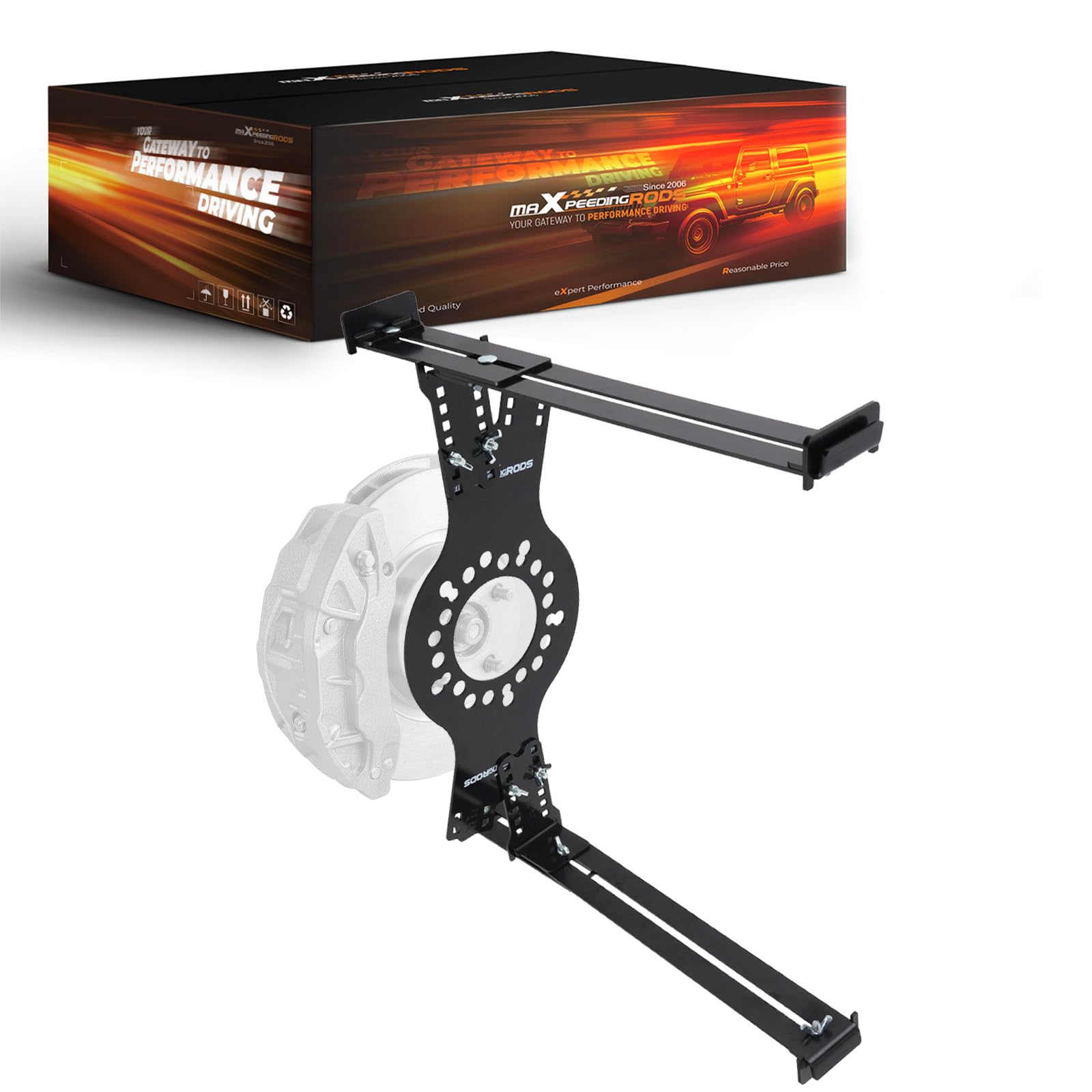
The same 10-gauge steel concept as the premium mock-up, at a lower price and a lower consistency.
The maXpeedingrods simulator mirrors the Speedway Motors unit in core specs: it supports 14″–22″ rims, 7″–17″ tire widths, and the same 5-lug bolt patterns (5×4.5″, 5×4.75″, 5×5″, and 5×5.5″). It is also laser-cut from 10-gauge steel and powder-coated for corrosion resistance. At 6.5 pounds it is half a pound lighter than the WheelWise, and the price is significantly lower. For a budget-conscious custom builder, that difference matters.
This tool demands consistency. One owner says it is “nice and heavy duty” and believes it will last a lifetime. Another notes the hardware “doesn’t stay in place” during adjustment, and a third found a 0.25-inch measurement discrepancy with 22-inch tires. The pattern across reviews is clear: the steel structure itself is solid, but the adjustment hardware can be finicky. Some owners fix it by replacing the included hardware with their own bolts from the local hardware store. If you are willing to do that small upgrade, this simulator becomes a real bargain. If you expect precision straight from the start, the extra cost of the Speedway unit buys you the confidence that the tool is ready to use immediately.
The upside
- 10-gauge steel construction at a lower price than the premium mock-up
- Powder-coated finish for rust resistance
- Broad adjustment range from 14″ to 22″ rims and 7″ to 17″ widths
- Accurately visualizes wheel width and offset for clearance checks
The caveats
- Hardware can loosen during use — a DIY fix may be needed
- Some reviewers point out dimensional accuracy issues at the 22-inch extreme
- Not as refined from the start as the Speedway Motors alternative
- 5-lug only (same limitation as the premium mock-up)
A pick for the tinkerer: If you are comfortable replacing a few bolts to get a steel simulator for a great price, this saves a significant amount over the premium option.
skip it if: You need a tool that works flawlessly from the start without any modifications — the Speedway WheelWise is the safer choice.
Understanding the Specs
Pitch Circle Diameter (PCD)
This number tells you the diameter, in millimeters or inches, of the imaginary circle that passes through the center of each lug hole. Common examples are 5×114.3mm (many Honda and Nissan vehicles) and 5×4.75″ (some older GM trucks). A tool that prints both SAE (inches) and Metric (mm) scales lets you measure any wheel without converting units in your head — just line up the gauge and read whichever scale matches your vehicle’s spec sheet.
Fixed Template vs. Adjustable Caliper
A fixed template has specific cutouts for common bolt circles. You place it on the studs and the correct pattern is obvious. This is the fastest method but limited to the patterns the manufacturer chose to cut. An adjustable caliper spans a wider range of patterns in a single tool, but you must slide the arms to the correct stud positions yourself. The caliper is more versatile; the template is more simple to use for the patterns it covers. Choose by how many different lug counts you encounter.
FAQ
How do I use a wheel stud pattern tool on a car with the wheel still mounted?
What is the difference between 5×114.3mm and 5×4.5 inches?
Can I use a 5-lug template on a 6-lug wheel?
Why do some tools weigh 1.6 ounces and others weigh 7 pounds?
Will a sliding caliper work on wheels that already have brake rotors installed?
Do any of these tools measure offset or backspacing?
How long does a plastic wheel stud pattern tool last?
Can I identify a wheel bolt pattern with just a tape measure?
Are all plastic bolt pattern tools the same quality?
What if my vehicle has an unusual bolt pattern not on the gauge?
Final Thoughts: The Verdict
For the majority of shoppers, the wheel stud pattern tool winner is the AOQIVIS Wheel Bolt Pattern Template Tool because it marries dual-scale precision with the speed of a fixed template that the crowd trusts. If you work across 4, 5, 6, and 8-lug patterns in a shop environment, the FIRSTINFO PCD Gauge gives you class-leading durability and the widest pattern range. And for the custom builder mapping out a full wheel-and-tire fitment, the Speedway Motors WheelWise Simulator is the only tool on the list that can mock up a tire and verify clearance before you drop money on custom wheels.
{“@context”: “https://schema.org”, “@graph”: [{“@type”: “ItemList”, “name”: “7 Best Wheel Stud Pattern Tool”, “url”: “https://gocarlife.com/best-wheel-stud-pattern-tool/”, “numberOfItems”: 7, “itemListElement”: [{“@type”: “ListItem”, “position”: 1, “name”: “JEGS Wheel/Stud Bolt Circle Template [SAE 5-Lug]”, “url”: “https://gocarlife.com/best-wheel-stud-pattern-tool/#product-2”}, {“@type”: “ListItem”, “position”: 2, “name”: “AOQIVIS Wheel Bolt Pattern Template Tool”, “url”: “https://gocarlife.com/best-wheel-stud-pattern-tool/#product-1”}, {“@type”: “ListItem”, “position”: 3, “name”: “eaacaa 4Pcs Wheel Bolt Pattern Measuring Guides”, “url”: “https://gocarlife.com/best-wheel-stud-pattern-tool/#product-3”}, {“@type”: “ListItem”, “position”: 4, “name”: “FIRSTINFO PCD Wheel Bolt Pattern Gauge”, “url”: “https://gocarlife.com/best-wheel-stud-pattern-tool/#product-4”}, {“@type”: “ListItem”, “position”: 5, “name”: “Kingdder 2 Pcs Wheel Stud Rim Bolt Pattern Measuring Tool”, “url”: “https://gocarlife.com/best-wheel-stud-pattern-tool/#product-5”}, {“@type”: “ListItem”, “position”: 6, “name”: “Speedway Motors WheelWise Wheel Fitment Simulator”, “url”: “https://gocarlife.com/best-wheel-stud-pattern-tool/#product-6”}, {“@type”: “ListItem”, “position”: 7, “name”: “maXpeedingrods Wheel Fitment Tool and Simulator”, “url”: “https://gocarlife.com/best-wheel-stud-pattern-tool/#product-7”}]}, {“@type”: “Product”, “position”: 1, “name”: “JEGS Wheel/Stud Bolt Circle Template [SAE 5-Lug]”, “image”: “https://m.media-amazon.com/images/I/61kzHy1AREL.jpg”, “brand”: {“@type”: “Brand”, “name”: “JEGS”}, “url”: “https://www.amazon.com/dp/B078WHTW1N/?tag=gclmin-20”, “offers”: {“@type”: “Offer”, “url”: “https://www.amazon.com/dp/B078WHTW1N/?tag=gclmin-20”}}, {“@type”: “Product”, “position”: 2, “name”: “AOQIVIS Wheel Bolt Pattern Template Tool”, “image”: “https://m.media-amazon.com/images/I/41cR4nj+gRL.jpg”, “brand”: {“@type”: “Brand”, “name”: “AOQIVIS”}, “url”: “https://www.amazon.com/dp/B0F5QDST1V/?tag=gclmin-20”, “offers”: {“@type”: “Offer”, “url”: “https://www.amazon.com/dp/B0F5QDST1V/?tag=gclmin-20”}}, {“@type”: “Product”, “position”: 3, “name”: “eaacaa 4Pcs Wheel Bolt Pattern Measuring Guides”, “image”: “https://m.media-amazon.com/images/I/71-8V5OsXJL.jpg”, “brand”: {“@type”: “Brand”, “name”: “eaacaa”}, “url”: “https://www.amazon.com/dp/B0FL84HG22/?tag=gclmin-20”, “offers”: {“@type”: “Offer”, “url”: “https://www.amazon.com/dp/B0FL84HG22/?tag=gclmin-20”}}, {“@type”: “Product”, “position”: 4, “name”: “FIRSTINFO PCD Wheel Bolt Pattern Gauge”, “image”: “https://m.media-amazon.com/images/I/51M3alhuNbL.jpg”, “brand”: {“@type”: “Brand”, “name”: “FIRSTINFO”}, “url”: “https://www.amazon.com/dp/B0GJSFWRMB/?tag=gclmin-20”, “offers”: {“@type”: “Offer”, “url”: “https://www.amazon.com/dp/B0GJSFWRMB/?tag=gclmin-20”}}, {“@type”: “Product”, “position”: 5, “name”: “Kingdder 2 Pcs Wheel Stud Rim Bolt Pattern Measuring Tool”, “image”: “https://m.media-amazon.com/images/I/61dd+Xzc8BL.jpg”, “brand”: {“@type”: “Brand”, “name”: “Kingdder”}, “url”: “https://www.amazon.com/dp/B0F7X2ZF2W/?tag=gclmin-20”, “offers”: {“@type”: “Offer”, “url”: “https://www.amazon.com/dp/B0F7X2ZF2W/?tag=gclmin-20”}}, {“@type”: “Product”, “position”: 6, “name”: “Speedway Motors WheelWise Wheel Fitment Simulator”, “image”: “https://m.media-amazon.com/images/I/51JR8w3ZIuL.jpg”, “brand”: {“@type”: “Brand”, “name”: “Speedway”}, “url”: “https://www.amazon.com/dp/B0B83T3LWX/?tag=gclmin-20”, “offers”: {“@type”: “Offer”, “url”: “https://www.amazon.com/dp/B0B83T3LWX/?tag=gclmin-20”}}, {“@type”: “Product”, “position”: 7, “name”: “maXpeedingrods Wheel Fitment Tool and Simulator”, “image”: “https://m.media-amazon.com/images/I/61vFb8UkA7L.jpg”, “brand”: {“@type”: “Brand”, “name”: “maXpeedingrods”}, “url”: “https://www.amazon.com/dp/B0F7Y19J8T/?tag=gclmin-20”, “offers”: {“@type”: “Offer”, “url”: “https://www.amazon.com/dp/B0F7Y19J8T/?tag=gclmin-20”}}, {“@type”: “FAQPage”, “mainEntity”: [{“@type”: “Question”, “name”: “How do I use a wheel stud pattern tool on a car with the wheel still mounted?”, “acceptedAnswer”: {“@type”: “Answer”, “text”: “You cannot use a template or caliper directly on mounted studs because the wheel covers them. Remove the wheel and place the tool against the exposed brake rotor or hub studs. For a quick on-car check, measure the distance between two adjacent studs (center-to-center) on the uncovered hub using a ruler, then multiply by 1.155 for 5-lug or refer to a bolt-pattern conversion chart.”}}, {“@type”: “Question”, “name”: “What is the difference between 5×114.3mm and 5×4.5 inches?”, “acceptedAnswer”: {“@type”: “Answer”, “text”: “They are the same physical dimension. 5×114.3mm is the metric expression of 5×4.5 inches (114.3 millimeters equals 4.5 inches). Many Japanese and Korean cars list the pattern in millimeters while American vehicles use inches. A dual-scale tool shows both so there is no math or confusion.”}}, {“@type”: “Question”, “name”: “Can I use a 5-lug template on a 6-lug wheel?”, “acceptedAnswer”: {“@type”: “Answer”, “text”: “No. The template cutouts are specific to the lug count. A 5-lug template has five slots at specific angles; it will not align with the six bolts of a 6-lug wheel. You need a dedicated 6-lug template or a multi-pattern set (like the AOQIVIS or eaacaa kits above) that includes separate guides for 4, 5, and 6 lugs.”}}, {“@type”: “Question”, “name”: “Why do some tools weigh 1.6 ounces and others weigh 7 pounds?”, “acceptedAnswer”: {“@type”: “Answer”, “text”: “Weight tells you the tool’s job. Plastic templates (1.6–9.6 ounces) are for measuring the bolt circle only — you hold them to the studs to confirm the pattern. Steel simulators (6.5–7 pounds) are for mocking up an entire wheel and tire assembly; their weight comes from the rigid steel frame that supports the rubber, checks suspension clearance, and measures backspacing accurately. They are not interchangeable.”}}, {“@type”: “Question”, “name”: “Will a sliding caliper work on wheels that already have brake rotors installed?”, “acceptedAnswer”: {“@type”: “Answer”, “text”: “Yes. A sliding caliper (like the FIRSTINFO or Kingdder) is placed over the exposed studs on the hub or brake rotor. The arms slide outward until they contact the studs, and you read the PCD from the scale. It works with rotors and drums as long as the studs are accessible and the tool clears the center hub.”}}, {“@type”: “Question”, “name”: “Do any of these tools measure offset or backspacing?”, “acceptedAnswer”: {“@type”: “Answer”, “text”: “The plastic templates and sliding calipers in this guide measure bolt pattern only — they do not tell you offset or backspacing. The steel simulators (Speedway Motors WheelWise and the maXpeedingrods unit) are designed for full mock-up, so they let you measure both backspacing (distance from the mounting surface to the wheel’s inner edge) and clearance to suspension components.”}}, {“@type”: “Question”, “name”: “How long does a plastic wheel stud pattern tool last?”, “acceptedAnswer”: {“@type”: “Answer”, “text”: “Plenty of years for a home garage tool. High-impact ABS plastic resists cracking from occasional drops and is unaffected by oil or brake cleaner. The main failure mode is the scale markings wearing off after repeated scrubbing. A light paint marker refresh restores readability. Commercial shop use would favor a steel caliper like the FIRSTINFO for longer scale life.”}}, {“@type”: “Question”, “name”: “Can I identify a wheel bolt pattern with just a tape measure?”, “acceptedAnswer”: {“@type”: “Answer”, “text”: “You can, but it is slower and more error-prone. For a 4-lug wheel, measure from the center of one stud straight across to the center of the opposite stud. For 5-lug wheels, you measure from the outer edge of one stud to the center of the stud two steps away — then consult a conversion chart. A dedicated tool eliminates the chart lookup and the measurement-inaccuracy risk, especially on patterns that are only 2.3mm apart (like 5x112mm vs 5×114.3mm).”}}, {“@type”: “Question”, “name”: “Are all plastic bolt pattern tools the same quality?”, “acceptedAnswer”: {“@type”: “Answer”, “text”: “No. The difference is in mold precision and material grade. Higher-quality tools use high-impact ABS that resists warping and maintains dimensional accuracy over years. Cheaper tools may use recycled plastic that feels greasy or has flash (excess plastic) around the cutouts, reducing fit accuracy. The AOQIVIS and JEGS tools on this list are known for clean mold work; budget generic tools from unknown brands are a gamble on precision.”}}, {“@type”: “Question”, “name”: “What if my vehicle has an unusual bolt pattern not on the gauge?”, “acceptedAnswer”: {“@type”: “Answer”, “text”: “A sliding caliper is your best bet here. Because it is adjustable, it can measure any PCD within its range — even patterns that do not appear on a fixed template. Measure two opposite or skipped studs, read the scale, and you have the exact pattern regardless of whether the manufacturer planned for it. This is why shops that see a wide variety of vehicles (European, classic, commercial) prefer a caliper over templates.”}}]}]}