
Our readers keep the lights on and the garage heater humming. As an Amazon Associate, I earn from qualifying purchases.
Specs are compiled from manufacturer listings and verified buyer reviews and can change over time — please confirm the key details on the product page before buying.
If the steering wheel shudders at highway speed, the machine sitting in your garage is only half the story. A wheel balancer that can’t hold calibration makes the smoothest tire feel like a bent rim, and picking the right one is about accuracy and coverage, not just horsepower. This guide breaks down the real specs, the honest trade-offs, and the exact machines that earn their floor space in a home garage or a busy shop.
I’m Mo Maruf — the founder and writer behind GoCarLife. This guide is built by comparing the manufacturers’ published specifications and the patterns across verified customer reviews, so you get each pick’s real strengths and trade-offs instead of marketing spin.
Balancing weights, clamp ranges, and cycle times are what separate a usable unit from a frustrating one, and we cover all of it for the best wheel balancer machine on the market.
Our Picks at a Glance

How To Choose The Best Wheel Balancer Machine
Before you commit to a machine, you need to match its clamping range to the vehicles you actually work on. A balancer that tops out at a 24-inch rim is perfect for sedans and most SUVs, but the moment a lifted truck or a heavy-duty 42-inch tire rolls in, you will be back to paying a shop to do the job.
Balancing Accuracy and Modes
The heart of any balancer is how precisely it can place weights. Look for an accuracy rating of -1g to +1g, which means the machine can detect a weight imbalance as small as a single gram — the difference between a smooth drive and a persistent shake. Multi-mode units that handle standard dynamic, static, and ALU (alloy wheel) settings give you the flexibility to work on steel and aluminum rims without guesswork.
Cycle Time and Workload
Cycle time is the span it takes the machine to spin the wheel and calculate where the weights go. A faster cycle time of 4-7 seconds keeps a busy bay moving, while a 6-9 second cycle is fine for a home garage doing a handful of tires a month. Be honest about your volume before you spend — a weekend enthusiast does not need the same throughput as a tire shop rotating dozens of tires daily.
Quick Comparison
| Model | Best For | Max Wheel Diameter | Balancing Accuracy | Cycle Time | Amazon |
|---|---|---|---|---|---|
| XK Tire Changer & Balancer Combo★ Best Overall | Best Overall Value | 44″ (1117mm) | -1g to +1g | 6-9 seconds | Amazon |
| Mayflower Heavy Duty BalancerBest Value | Light Duty Home Use | — | — | — | Amazon |
| CHIEN RONG Tire Machine & Balancer Combo | Faster Cycle Times | 44″ (1117mm) | -1g to +1g | 4-7 seconds | Amazon |
| KATOOL ME-T500 & ME-B620 Combo | Starter Shop Setups | — | — | — | Amazon |
| KATOOL KT-T830 + KT-B700 | High Volume Shops | — | — | — | Amazon |
| KATOOL KT-T835 & KT-B760 | Auto Measuring Features | — | — | — | Amazon |
| TRIUMPH NTC-950 & NTB-550 | Large Truck Rims | 43″ | — | — | Amazon |
In‑Depth Reviews
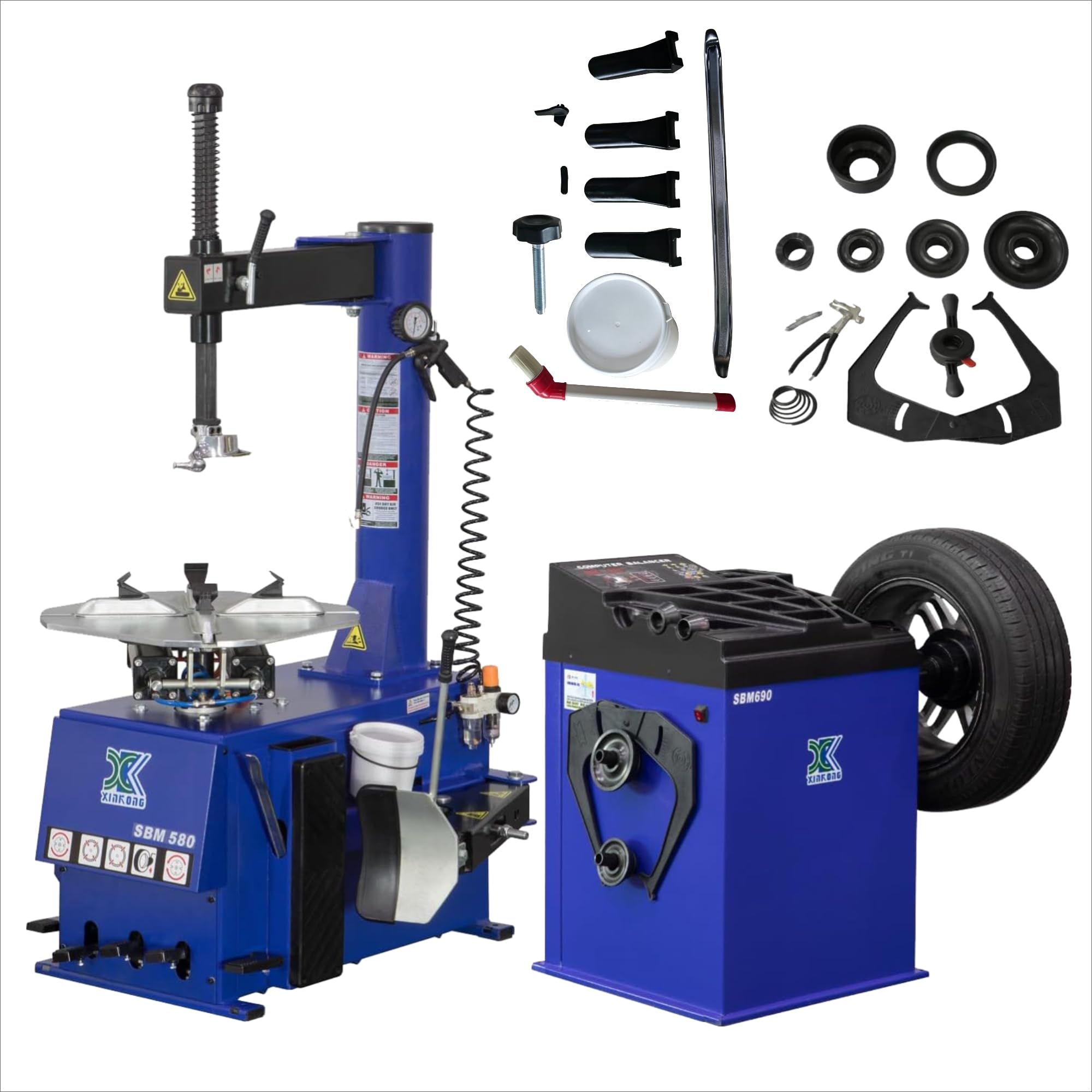
1. XK Tire Changers Machine and Wheel Balancer Combo
Our pick — over 4.5★ from 150+ verified ratings; the strongest balance of quality and price.
The heavy-duty combo that pairs a 44-inch balancer with a 2.0HP changer for weekend warriors and light shops
This XK combo lands as the best overall because it nails the balance between capability and cost. The 690 balancer handles a max wheel diameter of 44 inches (1117mm) and a max wheel weight of 155 lbs, so even the big stuff fits on the spindle. Balancing accuracy of -1g to +1g means the machine can place weights precisely enough to kill that highway-speed shiver.
Buyers report it shines for the home garage doing 20-30 tires a year, with the tire changer running flawlessly and the balancer easy to use. The 2.0HP motor and 580 tire changer add real muscle — the bead break force of 5600 lbs pops stubborn tires loose. Cycle time runs 6-9 seconds, which is fine for moderate use, and the rim clamping covers 10″-18″ outside and 12″-20″ inside.
At 800 pounds shipping weight, this is a permanent fixture, not a roll-around toy. The 36-month part replacement warranty backs it, and the blue powder coat finish shrugs off shop grime. The pedal control makes operation smoother than reaching for a lever, and the included 4 clamp protectors and steel mount head mean you are not hunting for extras on day one.
What Wins People Over
- Balancing accuracy of -1g to +1g for a smooth ride
- Handles wheels up to 44 inches and 155 lbs
- Bead break force of 5600 lbs for stubborn tires
What to Know Before Buying
- Weighs 800 pounds — needs a permanent spot and bolting down
- Cycle time of 6-9 seconds is slower than some rivals
- Not built for daily tire shop volume
Reach for this if: you want a do-it-all combo that handles a wide range of wheels while staying affordable.
Look elsewhere if: you run a high-volume shop and need faster cycle times all day long.
2. Mayflower Heavy Duty Wheel Balancer 800 Red Edition
The bolt-it-down-and-go balancer that handles a wide rim range without needing a tire changer
The Mayflower 800 is for the person who already has a tire changer or just needs to balance wheels. It runs on standard 110V, so it plugs into a normal garage outlet, and the setup is straightforward: mount it to the floor, calibrate it, and you are balancing. Rim diameter coverage runs 10″-24″ with a rim width of 1.5″-20″, which spans most cars, trucks, and SUVs.
Owners mention balancing 100+ tires over years, including Jeep setups on 42-inch and 38-inch wheels, without issues. The machine ships preset to American standard measurements, so no metric conversion headaches. It includes four balancing modes — standard dynamic, static, ALU 1-3, and motorcycle — giving you the tools for a variety of wheels right out of the crate.
The red powder coat finish adds a bit of personality to the shop, and the centering cones plus quick release wing nut make mounting a wheel faster. The 1-year full warranty is the selling point here, and the quality comes in much higher than expected at this level, as owners put it.
Strong for home users: if you want a dedicated balancer that just works on a standard outlet and covers everyday rims, this is the one.
Consider the learning curve: a handful of owners hit calibration trouble, so follow the setup steps carefully and you should be fine.
3. CHIEN RONG Tire Machine and Tire Balancer Combo
The faster-spinning combo that cuts cycle time to 4-7 seconds for a busier bay
This CHIEN RONG combo beats the XK on speed — its cycle time of 4-7 seconds versus the XK’s 6-9 seconds. That matters when you have a line of vehicles waiting. The balancer still delivers -1g to +1g accuracy, and the noise rating stays under 70 dB, so it will not drown out the shop radio or your thoughts.
The 2.0HP motor handles the tire changing side, with a bead break force of 5600 lbs and a max tire diameter of 37 inches. Rim clamping runs 10″-18″ outside and 12″-20″ inside. The balancer covers rim diameters of 10″-24″ with a rim width of 1.5″-20″, matching the XK’s reach. It runs on 110/220V at 50/60HZ with a max power draw of 180-250W.
Customers note the tire machine works great once you memorize the pedal layout, and the whole package ships in very good crates with solid communication from the company. The trade-off is the balancer’s calibration setup, which owners find more detailed than the instruction book suggests. Weighing 690 pounds, it is lighter than the XK’s 800 pounds, and the 39 x 30 x 34.6 inch footprint is compact enough for most garages.
The speed pick: if faster cycle times and lower noise matter more to you than the XK’s slightly larger wheel weight capacity, this combo delivers.
Plan for setup: the calibration process is fiddly, so budget extra time on day one.
4. KATOOL ME-T500 Tire Changer and ME-B620 Balancer Combo
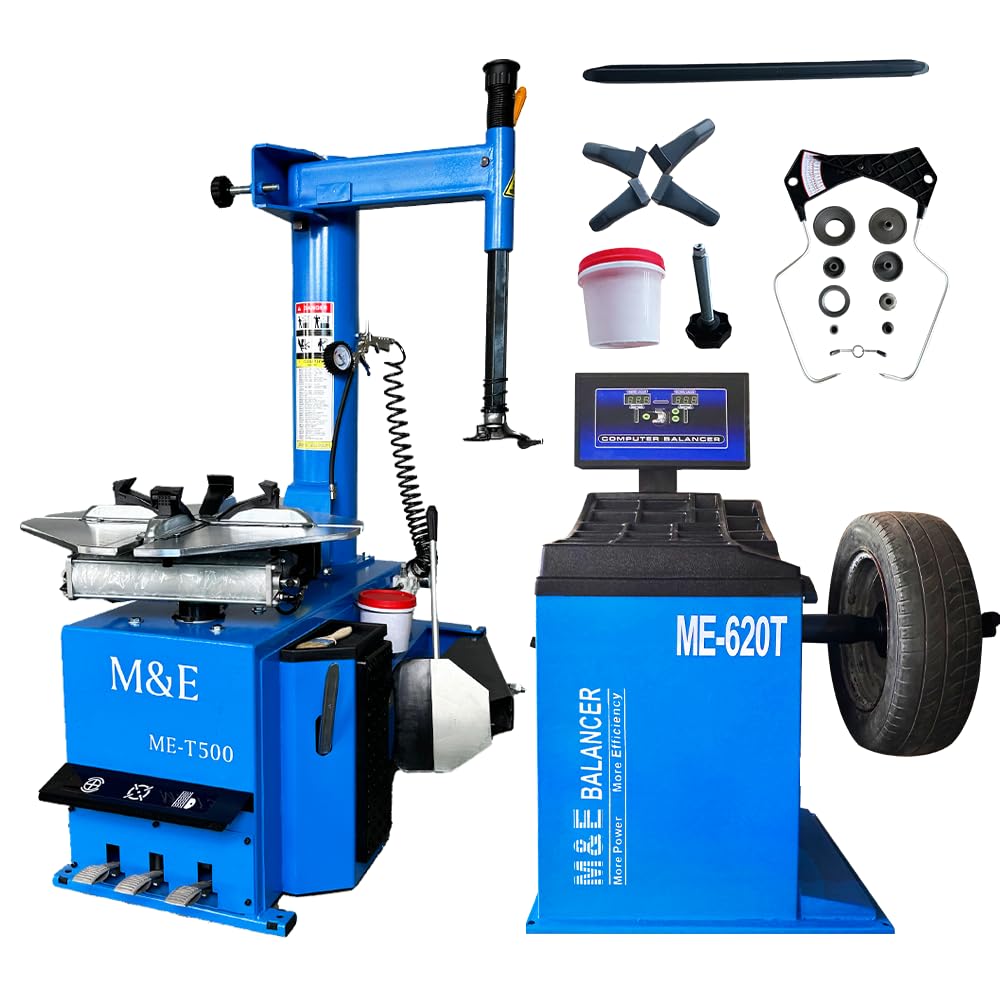
The cast-steel pedal combo with self-calibration to ease a beginner into shop work
The KATOOL ME-T500 and ME-B620 combo is designed for someone learning the trade or starting a small shop. The balancer includes a built-in fault diagnosis and self-calibration program, so you do not need to memorize parameters to get accurate reads. The three cast steel pedals on the changer are built to last longer than stamped metal versions.
The 2.0HP motor on the tire changer has plenty of power to mount and dismount tires without stalling, as reviewers point out. Rim clamping covers 14″-24″ inside and 12″-22″ outside with adjustable clamps for varied tire sizes. The center auxiliary arm design leaves more space to work, which makes positioning a wheel less of a fight. The balancer handles rim diameters of 10″-24″ and wheel widths of 1.5″-20″.
The recurring note from owners is that the balancer instructions are not great when you buy the two units as a kit, so expect to lean on YouTube for the finer points of calibration. The machine itself works great, and the cast steel pedals give a solid, durable feel underfoot.
Why It Works
- Self-calibration program removes guesswork for beginners
- Cast steel pedals stand up to repeated stomping
- 2.0HP motor handles tires without stalling
The Hiccup
- Balancer instructions are weak in the kit version
- Learning curve for the pedal layout
5. KATOOL KT-T830 Tire Changer and KT-B700 Balancer Combo
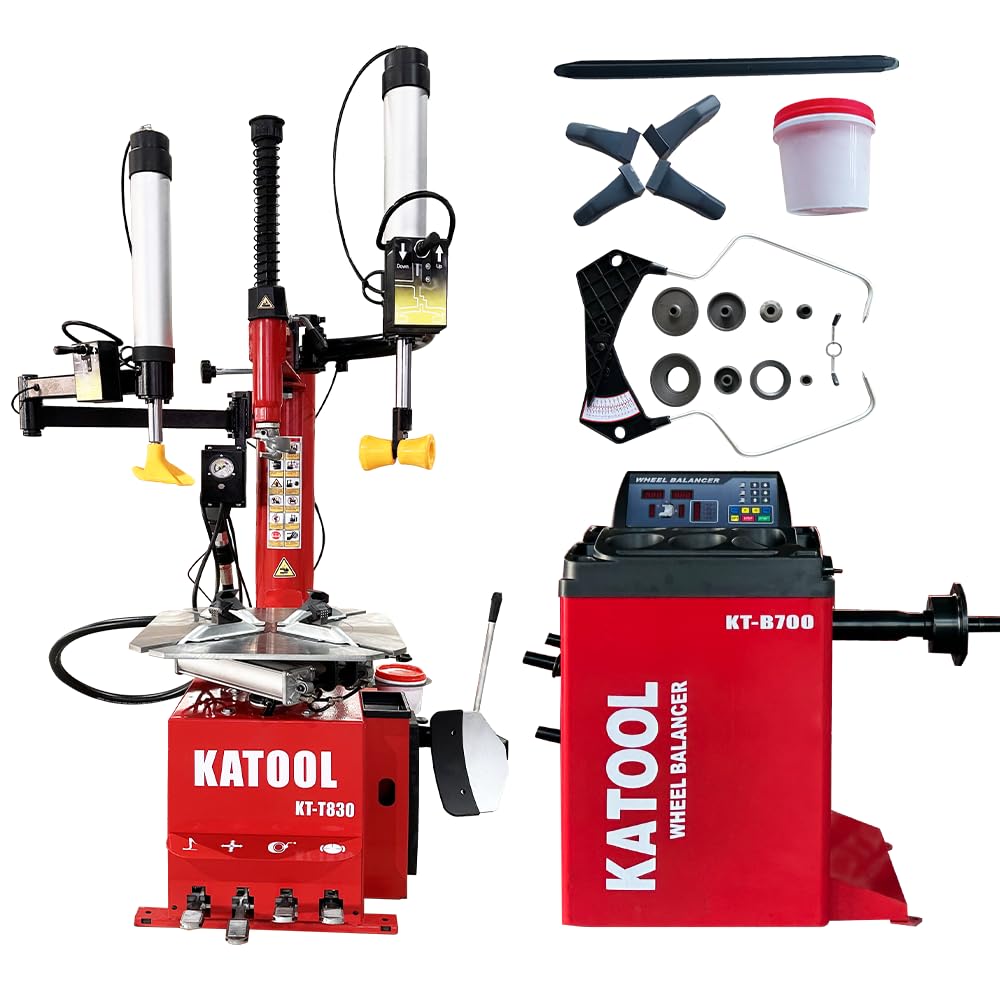
The high-volume combo with a bead blaster and hardened jaws for daily shop punishment
This KATOOL combo justifies its premium tier with features aimed at shops turning over serious volume. The bead blaster seats stubborn tire beads fast, reducing the physical strain on operators. The outside clamp fits 12″-24″ rims and the inside clamp fits 14″-26″, so the range stretches to bigger truck wheels than the entry combos above.
The alloy steel jaws undergo interface carburization to 0.8-1.1mm depth with full quenching, giving inner toughness and outer hardness for extended life. Soft jaw covers protect alloy and custom rims from contact damage. The fully closed body keeps dirt, grease, and shop debris away from internal parts, cutting maintenance needs. The mounting head is made from solution-treated stainless steel with a plastic cover to safeguard rims.
Shoppers say the balancer stays smooth at 70 mph and handles everything from 22-inch wheels and 285 low-profile tires to stretched setups. One high-volume shop owner reported the combo paid for itself within a week of daily use. The honest caveat is assembly — the parts are solid and the packaging is great, but the assembly instructions are thin, so expect to use YouTube to get it together.
Built for the bay: this is the combo for a working shop that wants professional-grade results without the big-brand price tag.
Budget for setup time: you will spend an hour or so assembling, and you may want to swap the air fitting.
6. KATOOL KT-T835 and KT-B760 Balancer Combo

The laser-guided combo that auto-measures wheel dimensions to cut manual input errors
This combo steps up the convenience factor with an auto measuring ruler and laser pointing on the balancer. Instead of typing in every dimension manually, the machine reads the wheel and shows you exactly where the weights go — a real time-saver when you are juggling multiple vehicles. The bead blaster seater with a φ186mm stainless bead breaker cylinder handles the tough seating jobs.
The 2.0HP motor’s pure copper winding dissipates heat fast and has a low defect rate per spec. The pull-type pedal control system makes changing and maintenance easier, and the inflation gauge with pedal control and a high quality spade cover helps prevent rim damage. It is built for North America at 120V/1ph/2.0HP.
The jaw design mirrors the pro-grade KT-T830 — alloy steel with 0.8-1.1mm interface carburization and full quenching, plus a jaw cover to protect rims. Buyers call it a great setup for adding tires to a shop, with the machines performing well for the price. The honest split in owner feedback is real: some found it awesome and easy, while others hit low build quality and missing hardware, so inspect the crate carefully on arrival.
The convenience pick: as owners mostly report, “way easy” sums up the appeal — the auto-measuring and laser guidance reduce the mental load of balancing.
Inspect on delivery: check for missing bolts and hardware immediately, since a few crates have arrived incomplete.
7. TRIUMPH NTC-950 and NTB-550 Combo Package
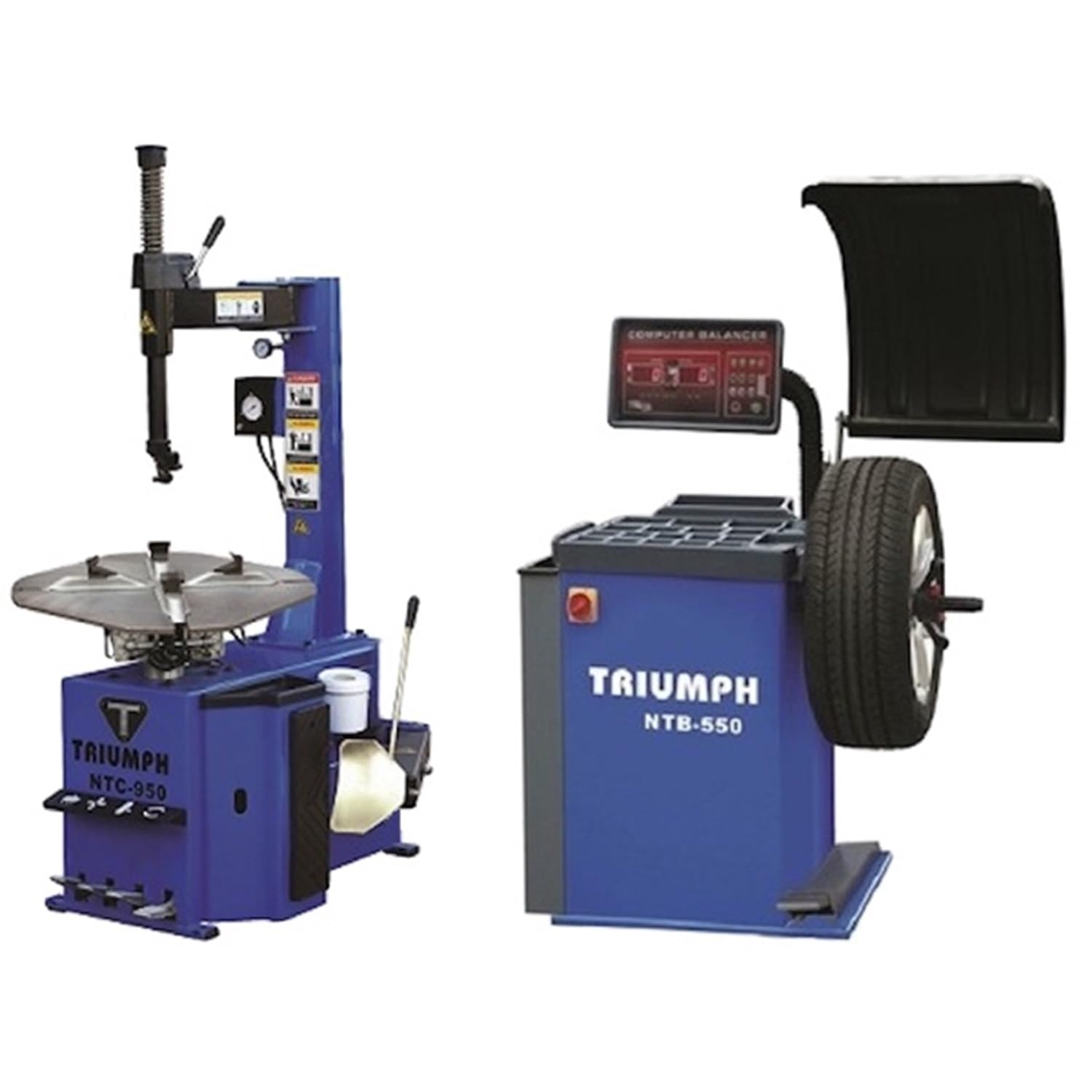
The top-tier combo with the widest clamping range for trucks and oversized tires
The TRIUMPH combo is the most expensive pick here, and it earns the premium with the biggest coverage figures in the lineup. Max tire diameter hits 43 inches, with an inside clamping distance of 15″-28″ and outside clamping of 13″-26″. If you regularly handle heavy trucks, trailers, or oversized tires, this is the only machine in the group that stretches that far.
The max wheel width of 15 inches and rim width coverage of 1.5″-20″ give it the headroom for wide wheels that choke smaller balancers. Buyers report delivery via lift gate truck and pallet jack straight to the garage floor, which saves you from renting equipment to unload. The assembly is straightforward, and there are plenty of videos online to walk you through operation, per owners.
The catch is the same one that comes with most heavy equipment: no instruction manual in the crate, so you will be figuring out some steps on your own. A few owners note it is easy to assemble if you have mechanical sense, and the machines perform as hoped. This is a real investment in shop capability, and the high rating reflects that buyers feel they got a great value for the capability.
Pick this for: the widest wheel and tire range in the group, purpose-built for trucks and oversized rubber.
Think twice if: you only work on standard cars — the extra reach costs a lot more than you would use.
Understanding the Specs
Balancing Accuracy
This tells you how precisely the machine can place weights, measured in grams. A rating of -1g to +1g means it can detect an imbalance as small as a single gram. Closer to zero means a smoother highway ride; a few grams off still vibrates through the wheel.
Cycle Time
This is how long the machine takes to spin the wheel, measure the imbalance, and show you where to stick the weights. Faster cycle times, like 4-7 seconds, keep a busy shop moving more vehicles per hour. Slower times of 6-9 seconds are perfectly fine for a home garage doing a handful of tires a month.
FAQ
What does balancing accuracy of -1g to +1g actually mean?
Do I need a tire changer to go with a wheel balancer?
What rim clamping range do I need for my vehicles?
How long does a wheel balancer machine last?
What is the difference between dynamic and static balancing modes?
Is a higher cycle time rating better for balancers?
Can these balancers handle alloy or aluminum rims safely?
What power supply do I need for these machines?
Final Thoughts: The Verdict
For most buyers, the wheel balancer machine winner is the XK Tire Changer and Balancer Combo because it pairs a 44-inch balancer, a 2.0HP changer, and -1g to +1g accuracy at a value that fits a home garage. If you want faster cycle times, grab the CHIEN RONG combo. And for heavy trucks and oversized tires, the TRIUMPH combo is the one to reach for.
How We Picked
We do not accept paid placement. Every pick is matched to a real buyer and a real use-case; we do not hands-on test units.
Sources & Methodology
Specifications: manufacturer listings and product documentation. Review insights: verified customer reviews, as of August 2026. Pricing: not shown on this page (it changes often); check the current price via the retailer link.
As an Amazon Associate, GoCarLife earns from qualifying purchases. This does not affect which products we feature.