
Our readers keep the lights on and the garage heater humming. As an Amazon Associate, I earn from qualifying purchases.
Specs are compiled from manufacturer listings and verified buyer reviews and can change over time — please confirm the key details on the product page before buying.
Welding a car frame is a different beast than welding fence posts. Car metal is thin, often rusty, and unforgiving if you dump too much heat into it — you will blow holes before you lay a proper bead. The right machine balances low-end amperage for thin panels with enough output to weld thicker frame sections.
I’m Mo Maruf — the founder and writer behind GoCarLife. This guide is built by comparing the manufacturers’ published specifications and the patterns across verified customer reviews, so you get each pick’s real strengths and trade-offs instead of marketing spin.
From featherweight portables to multi-process shop machines, these are the top options for anyone hunting the best welder for a car frame that delivers clean, penetration-rich beads on thin automotive steel without emptying your bank account.
Our Picks at a Glance

How To Choose The Best Welder for a Car Frame
Frame work demands a welder that can dance between thin sheet metal and thick structural steel. A machine that only runs hot will frustrate you on quarter panels, while one that lacks power will leave weak joints on actual frame rails. You need a balance, and these are the specs that create it.
Look for Low-End Control First
The lowest amperage setting is what saves your car’s body panels. A synergic MIG welder automatically matches wire feed speed to your voltage when you select metal thickness, which means you can dial in a clean puddle on 18-gauge metal without a physics degree. Manual control matters too, so you can fine-tune when a patch panel is rust-thinned and needs less heat.
Decide Between Gas and Gasless
Flux-core wire has a built-in shielding agent, so it welds fine outdoors where a breeze would blow away your shielding gas. Solid wire with gas like argon/CO2 gives a cleaner, prettier bead for indoor shop work. Many of the top picks here do both, which is the most flexible setup for car work that moves between garage and driveway.
Match Power to Your Outlet
A 110V/120V machine plugs into a standard household outlet, making it perfect for light repairs and patching. A 220V/240V circuit delivers the higher amperage needed to weld thicker frame sections and suspension brackets. Dual-voltage machines give you both options, letting you run on household power at home and step up to a dryer outlet or shop circuit when a job needs more heat.
Quick Comparison
| Model | Best For | Max Output | Processes | Weight | Amazon |
|---|---|---|---|---|---|
| Lincoln 90i FC★ Best Overall | Portable patch work | 90A | Flux Core | 15 lbs | Amazon |
| YESWELDER 160ABest Value | Beginner first buy | 160A | MIG/Flux/Stick/TIG | 27.5 lbs | Amazon |
| FEMEROL 250AMost Versatile | Aluminum & steel | 250A | 6-in-1 | 32.6 lbs | Amazon |
| Bestarc MIG165 | Value 4-in-1 | 165A | MIG/Flux/TIG/Stick | 22.8 lbs | Amazon |
| VEVOR MIG-270 | Field repairs | 270A | MIG/TIG/Stick | 30 lbs | Amazon |
| Forney 140 MP | Entry-level 3-in-1 | 140A | MIG/Stick/TIG | 25.8 lbs | Amazon |
| ARCCAPTAIN MIG200 | Garage auto repair | 200A | 6-in-1 | — | Amazon |
| Lincoln 90i MIG | Compact MIG/flux | 90A | MIG/Flux Core | 19.8 lbs | Amazon |
| YESWELDER 250A | Heavy fabrication | 250A | 6-in-1 | 37.7 lbs | Amazon |
| ARCCAPTAIN MIG250 | Pro-grade shop use | 250A | 6-in-1 | 32.7 lbs | Amazon |
| Weldpro Omni210 | Full multi-process | 200A | 6-in-1 + Pulse TIG | 81.8 lbs | Amazon |
In‑Depth Reviews
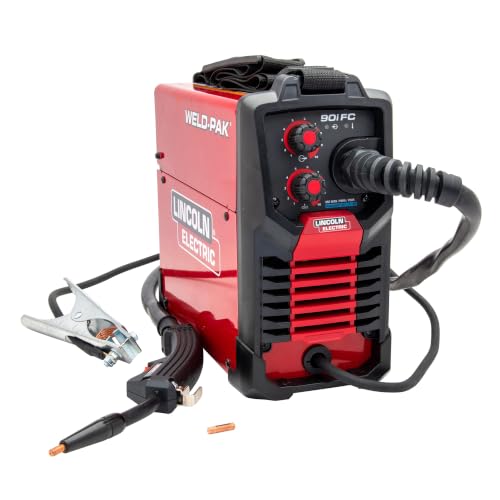
1. Lincoln Electric 90i FC Flux Core Wire Feed Weld-PAK Welder
Our pick — over 4.5★ from 550+ verified ratings; the strongest balance of quality and price.
The shoebox-sized inverter that tucks under your arm and welds thin steel like a champ.
The 90i FC is the definition of a car-guy’s portable. At 15 pounds with a shoulder strap in the box, you can carry it up a driveway, under a lift, or across a farm without breaking a sweat. It runs on standard 120V household power and welds up to 1/4″, which covers patch panels, floor sections, and lighter frame work.
Owners who normally run big 220V machines keep reaching for this one on thin metal. The lower power is exactly what you want for 14-18 gauge stainless and sheet steel, so you don’t have to swap wire spools or fight to keep a hot arc from blowing holes. The infinite 1-10 voltage dial gives you fine control that non-inverter flux-core welders just can’t match, and the result is noticeably less spatter and near-perfect beads.
What wins people over is the performance — a compact unit that genuinely penetrates, with one owner reporting it pushed halfway through 1/2″ plate on a single pass despite its rating. The trade-off is a 1-pound spool limit and flux-core-only operation, so no gas MIG option.
compact flux core: Performance and weld quality dominate the feedback. Owners describe it as tiny yet powerful, with exceptional value for money.
wire feed quirks: No gas MIG mode and a 1-lb spool limit mean frequent spool changes on long jobs.
small jobs: you want the most portable, easiest-to-learn flux-core welder that nails thin automotive steel.
heavy plate: you need gas MIG for clean shop work or plan to weld more than 1/4″ plate regularly.
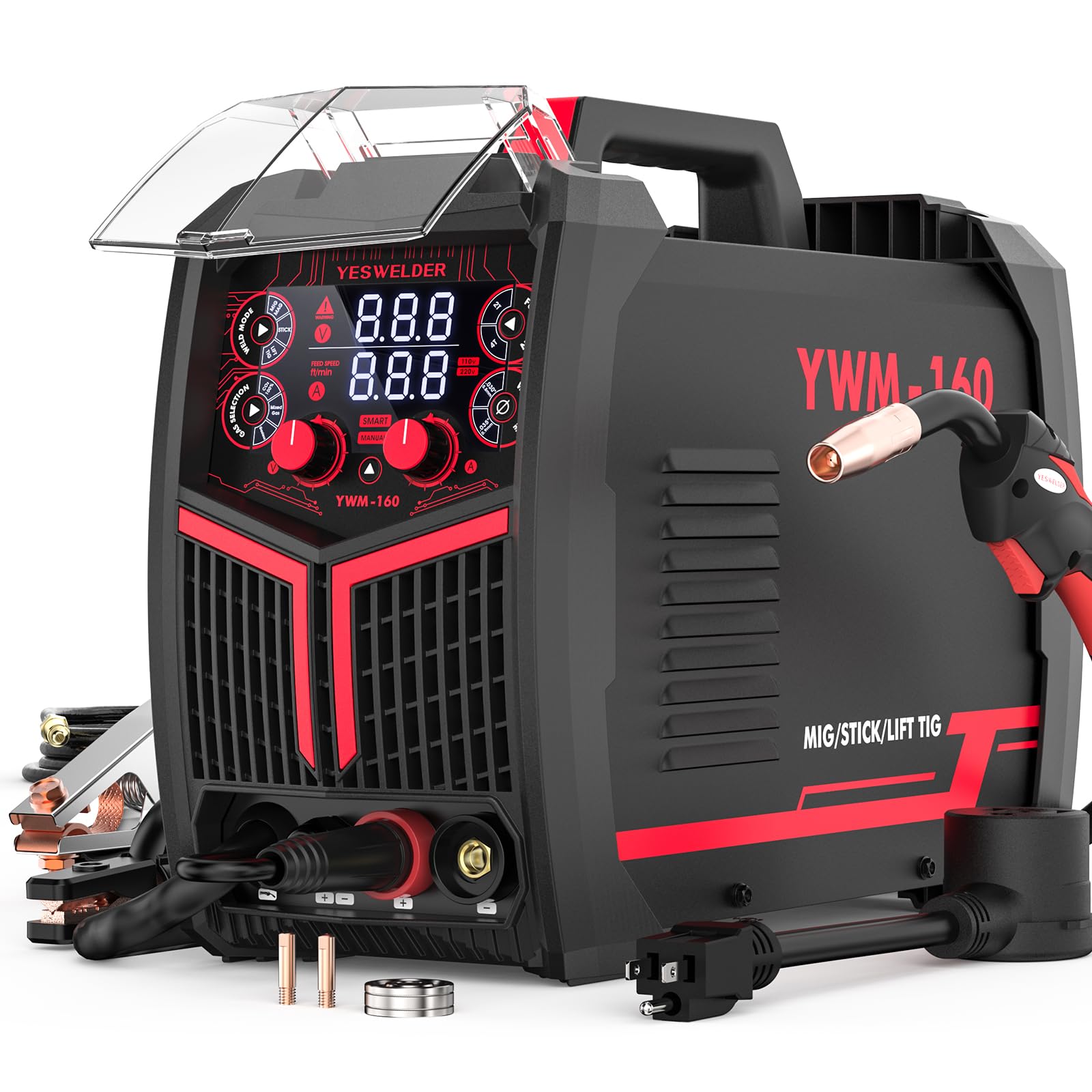
2. YESWELDER 160A MIG Welder
The crowd-pleasing 4-in-1 that proves you don’t need deep pockets for clean beads.
The YESWELDER 160A is the welder that gets beginners hooked. Its synergic smart control automatically sets the recommended voltage and wire feed speed when you pick a material thickness, which removes the most intimidating part of learning to weld. Run it on 220V in smart mode and it handles 1/4-inch steel flawlessly — exactly what one elated amateur reported after years of staying away from welding.
It’s a true 4-in-1: gas MIG, gasless flux core, stick, and lift TIG (with a separate torch purchase). That flexibility is the biggest reason shop owners praise its functionality. Two years of daily use in one fabrication shop produced zero failures, with owners calling the arc smooth and the setup quick on both 110V and 220V.
The recurring complaint is durability — some units develop wire-feed issues after heavy use, and a few owners note the heat runs hot. Weigh that against a machine that costs a fraction of a big-brand equivalent and still delivers professional-grade results for home, fabrication, and light construction.
budget friendly
- Synergic control makes first welds easy on 220V
- 4 processes in one box for under
- Handles 1/4-inch steel cleanly on smart mode
duty cycle short
- Some units develop feed issues after heavy use
- Heat output can run hotter than expected
- Short lead length annoys owners
hobby use: a first welder that grows with you from patch panels to mild fabrication.
pro shops: if you’ll weld daily for years, the budget components may eventually need attention.
3. FEMEROL 250A 6-in-1 MIG Welder
A six-process workhorse that welds aluminum and steel without swapping machines.
The FEMEROL 250A is for the builder who wants one machine that does it all. Beyond standard gas MIG and gasless flux core, it adds stick, spot welding, lift TIG, and spool gun compatibility (guns sold separately) — so aluminum body work and steel frame rails are both on the menu. The 250A rating lets it weld mild steel up to 14.0mm plate, which is serious structural capacity.
This unit weighs 32.6 pounds, a notable 2.2x heavier than the featherweight Lincoln 90i. That bulk buys you output and features, with owners measuring roughly 230A in real-world testing and praising the spot weld function and 9.5-foot cables. It’s the machine that beat comparable multi-process units at a lower price, delivering smooth MIG arcs and clean 1/4-inch butt welds.
Quality and performance earn the most owner praise, with experienced welders calling it the best affordable multiprocess option they’ve found. The downsides are its loud continuous fan and an undersized 120V plug that benefits from an upgrade. A two-year warranty backs it up, and support reportedly responds within the hour.
six process range: True aluminum capability in a sub-premium price tier — two ways to run it, via Teflon liner or spool gun.
learning curve steep: Quality and performance dominate feedback. Experienced welders rate it above costlier rivals.
multi metal: you want aluminum welding plus every common process in one box.
quick setup: a loud fan in a small shop or an undersized stock plug would bother you.
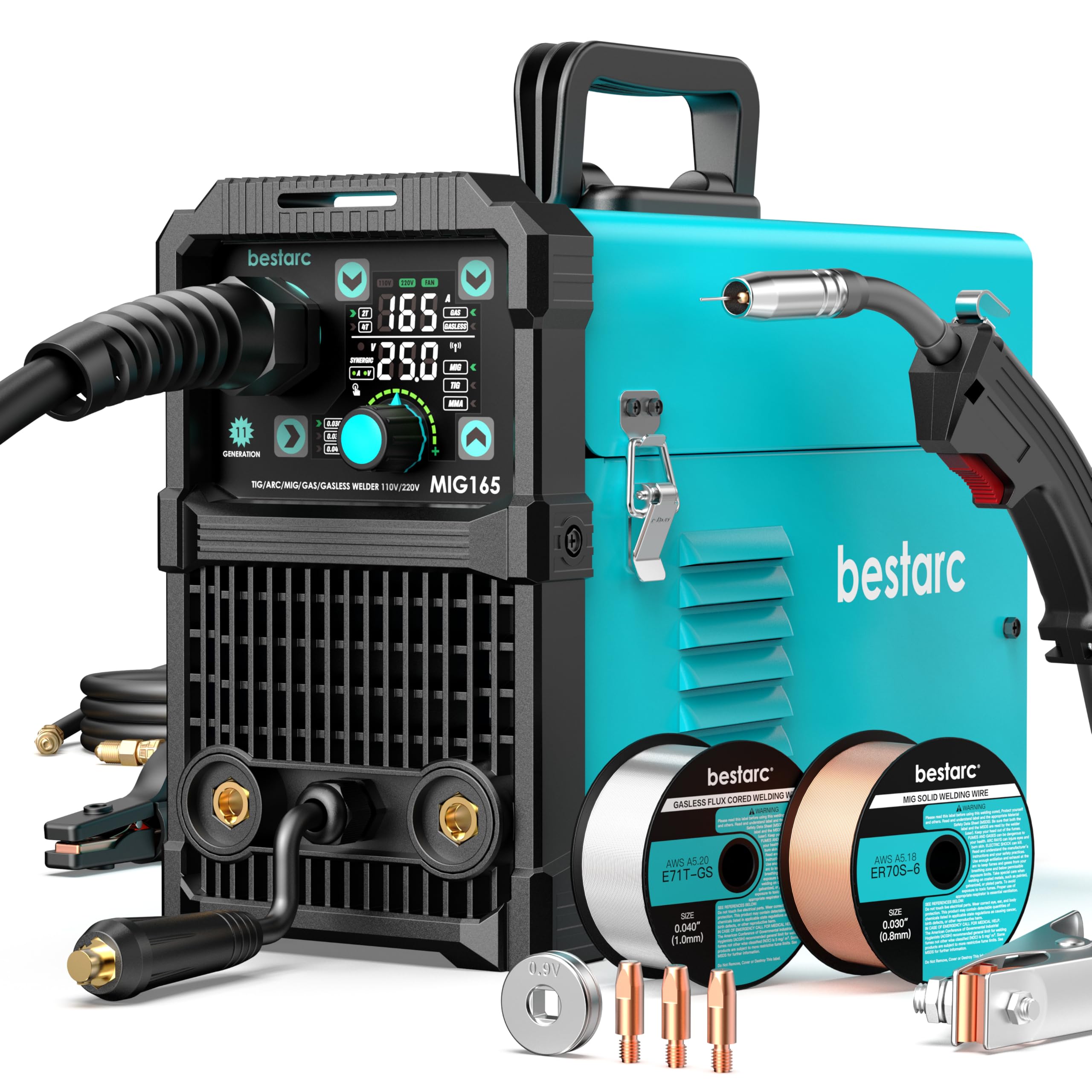
4. Bestarc MIG165 4-in-1 Welder
A compact 110V-friendly rig that makes hobby repairs feel pro-grade.
The Bestarc MIG165 is the answer for the occasional welder who doesn’t want to learn a complicated machine. Its synergic control automatically matches voltage and wire speed to the wire you feed, and you can fine-tune voltage within a -3V to +3V window when you want more control. Running on 110V, it still pushes enough heat that owners call it a “little beast” for small repairs.
This 165A unit covers gas MIG, gasless flux core, lift TIG, and stick in one 22.8-pound package. Owners upgrading from old transformer welders report their first weld felt professional, with the auto feed speed adjusting itself for material thickness. It’s ideal for the person who welds a few times a year, does patch work, and wants a machine that’s ready when they are.
The biggest wins are quality and value, owners say. The honest gripes are a cheap spindle holder and a top handle that could be sturdier. It’s a value-first pick, not a daily-production machine — but for car guys fixing panels and brackets, that’s exactly the right trade.
four in one: Sturdy, easy setup, and genuine value for money. Perfect for both hobby and light professional work.
spool gun absent: Quality is praised, but a minority report functionality issues — it’s a budget build, not a pro workhorse.
versatility: the DIYer who wants a capable 110V flux-core welder without spending big.
aluminum work: daily production welding or anyone who expects premium components at this price.
5. VEVOR MIG-270 3-in-1 Welder

The 21.7-pound grab-and-go that tackles rusty farm and road equipment.
The VEVOR MIG-270 is built for outdoor and field repairs where rust and grime are the norm. Its 270A output with IGBT inverter technology delivers a stable arc on carbon steel, iron, and stainless, and owners say it runs high heat even at a low 12.2V setting. A steady string of 8-10 inch continuous welds on 3/8-inch material with.035 wire came off without a skip — serious credibility for frame work.
As a 3-in-1, it handles MIG, MMA stick, and lift TIG, with the LCD display keeping settings readable at a glance. The IP21 rating means it resists splashing water, so light drizzle or a damp barn won’t stop you mid-repair. It handles wire spools up to 11 pounds, cutting down on changeovers during long jobs.
Owners consistently praise the functionality and quality, with a 30-year pro calling it a great budget grab-and-go that handles light-duty MIG effectively. The one recurring gripe: the included gas regulator is junk and worth replacing immediately. Once swapped, the welder itself delivers penetration that surprises people on 220V.
high amperage: Easy setup, strong performance on both voltages. A great value that rivals pricier big-name rigs.
welding wire jams: The bundled regulator and nozzle are weak points — budget for replacements.
thick steel: you need a portable machine for farm, trailer, and road-equipment repairs.
thin gauge: you want a turnkey setup with quality accessories straight from the start.
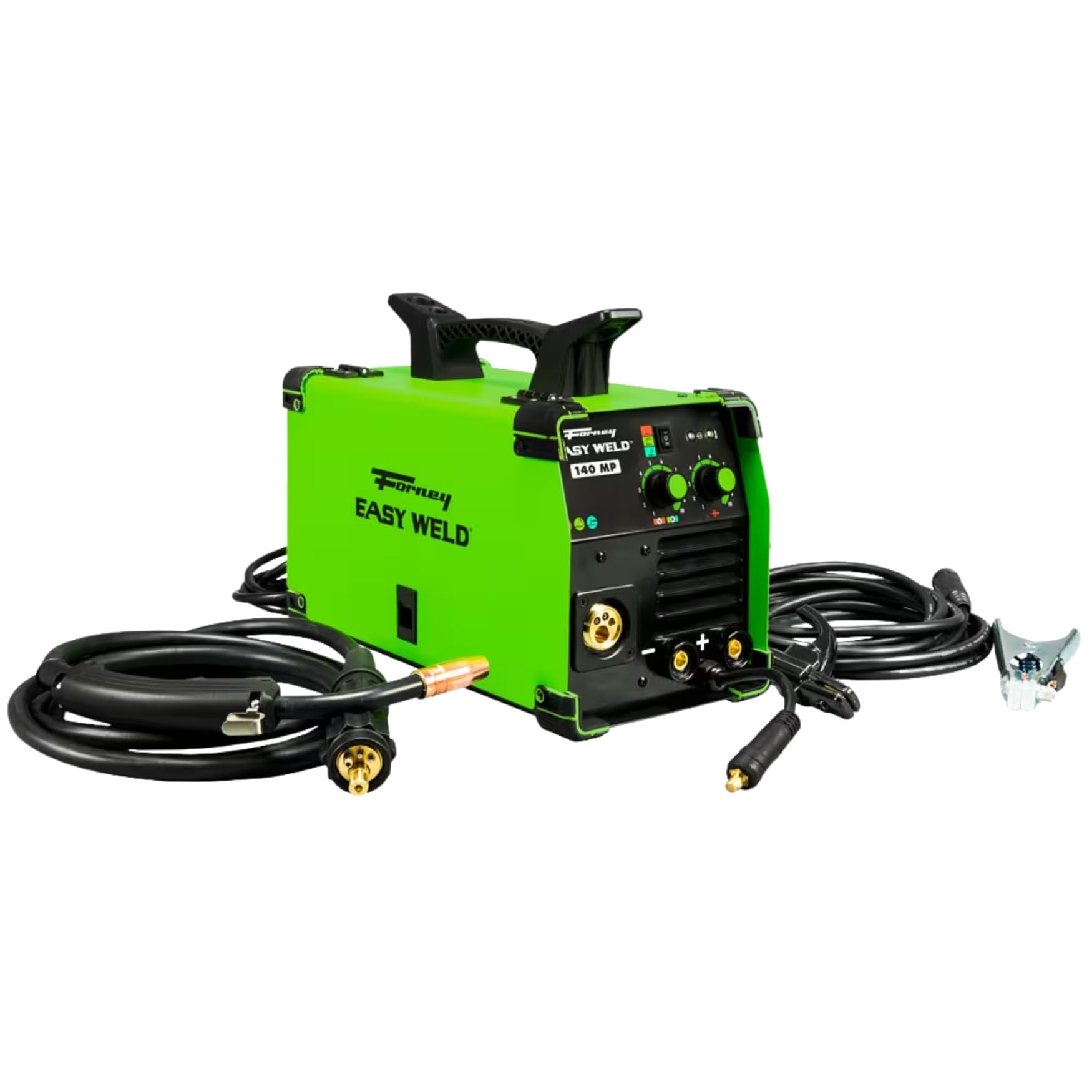
6. Forney Easy Weld 140 MP Multi-Process Welder
The all-metal 120V machine that teaches beginners without punishing them.
The Forney 140 MP is the entry point that serious hobbyists recommend to friends. It’s a 3-in-1 (stick, MIG, DC TIG) running on standard 120V, with a simple start feature and a 3-position switch that makes switching processes painless. Infinite voltage and wire feed adjustments let you dial in the exact bead — a huge plus when you’re learning on 1/8-inch steel.
It’s an all-metal build that “dials in the guess work,” as one owner put it, producing solid beads on 1/8-inch steel with 6013 rods and smooth, low-spatter MIG arcs with gas. Owners who upgraded from 30-year-old machines were blown away by the improvement, and the 25.8-pound weight keeps it easy to haul around a garage or job site.
For stick and MIG welding on 3/16-inch and smaller material, this thing shines — quality, performance, and value are its most-praised traits. The catch is power: it needs a dedicated 25-30A 110V circuit to perform at its best, and it runs anemic on a shared household line. First-time welders getting serious results make this a favorite among the three machines owners say they own.
easy start
- Smooth arc with low spatter on gas MIG
- All-metal case built for daily abuse
- Beginner-friendly infinite adjustments
low power output
- Needs a dedicated circuit for full power
- Best kept to 3/16″ and thinner material
light repairs: you’re a novice who wants a forgiving, versatile 120V machine with room to grow.
heavy welding: you routinely weld thicker than 3/16-inch or lack a dedicated shop circuit.
7. ARCCAPTAIN 200A MIG Welder
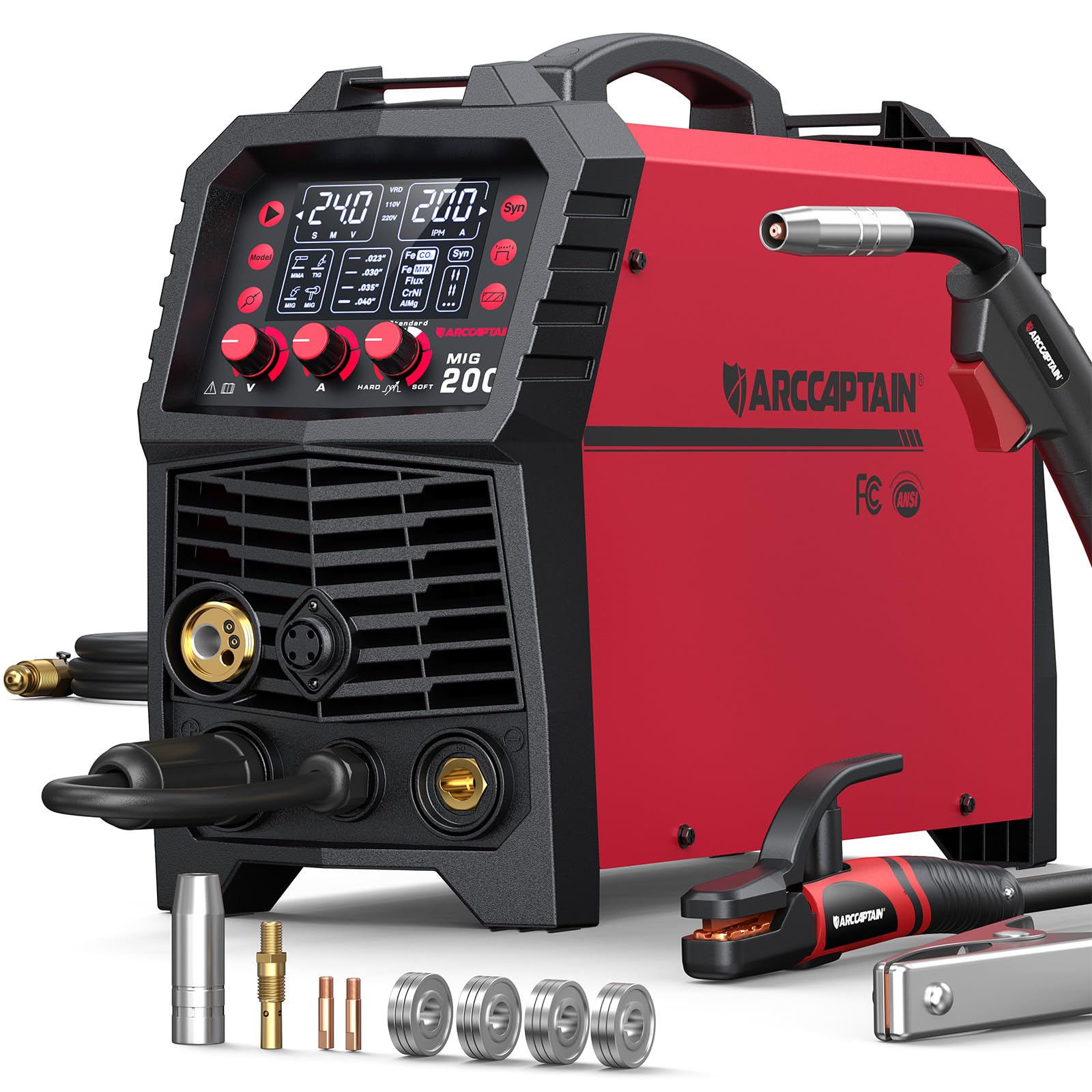
A 200A multi-process unit with a big LED screen that keeps you in the groove.
The ARCCAPTAIN MIG200 is the garage welder that feels like a shop machine. It’s a 6-in-1 covering gas MIG, gasless flux core, stick, spot welding, lift TIG, and spool gun support (guns sold separately), so it’s ready for everything from patch panels to thicker frame repairs. The synergic mode auto-matches current and feed speed, and you can save 10 preset parameter groups per mode to jump straight back into familiar jobs.
Owners upgrading from bigger, costlier machines were impressed — the welder works great with.035 flux core and produced clean spot welds right from the start. The large LED display is readable without lifting your helmet, and a smart fan runs only when needed, so there’s no constant buzzing in a small garage. It also ships with a shoulder strap for moving between locations.
Quality and functionality lead the owner feedback, with the build feeling sturdy for its price. The known nits: the power cable runs thin and gets hot quickly under load, and the adapter cable between 110V and 220V has a questionable design. Cool it between heavy passes and the MIG200 is a dependable all-rounder for automotive work.
dual voltage: Does everything it’s supposed to and holds up nicely. A strong value for the money.
torch length short: The thin power cable heats up fast — give it a break between long welds.
portability: the home mechanic who wants one versatile machine for body, frame, and general shop repairs.
large projects: nonstop production welding where a thicker factory power cable matters.
8. Lincoln Electric 90i MIG and Flux Core Weld-PAK

The name-brand twin that adds gas MIG to Lincoln’s beloved portable platform.
The Lincoln 90i MIG takes the same portable, 120V platform as the flux-core version and adds real MIG capability. That means you can run flux-cored wire up to 1/4-inch thick or switch to solid MIG wire for cleaner beads up to 3/16-inch. It’s the flexible small-jobs machine that goes wherever 120V power exists — home workshops, construction sites, or a friend’s driveway.
Owners love the compact size, with one noting their welding helmet is bigger than the machine. Set it up on gas and it does a great job on lighter materials, which is where the 90i MIG excels. The included kit is thorough: dual-track drive rolls for both MIG and flux core, a Harris gas regulator, and contact tips in multiple sizes.
The size and performance earn the most praise, and it’s the rare portable that both beginners and pros enjoy. Where it splits opinion is power — it’s a 90A machine, so heavy frame sections are beyond it, and pushing full power on a 15A breaker can trip it after about an inch of weld. For sheet metal, patch panels, and small repairs, it’s a gem; for thick structural welds, it’s not the tool.
brand reliability: Excellent for beginners, compact, and easy to use. Small enough to take anywhere power exists.
single process: Power output is modest — you’ll trip a 15A breaker on long full-power welds.
trusted brand: you want a trusted-brand portable that does both flux-core and gas MIG for small jobs.
multi process: your frame work involves thick structural sections that need a 200A+ machine.
9. YESWELDER 250A MIG Welder
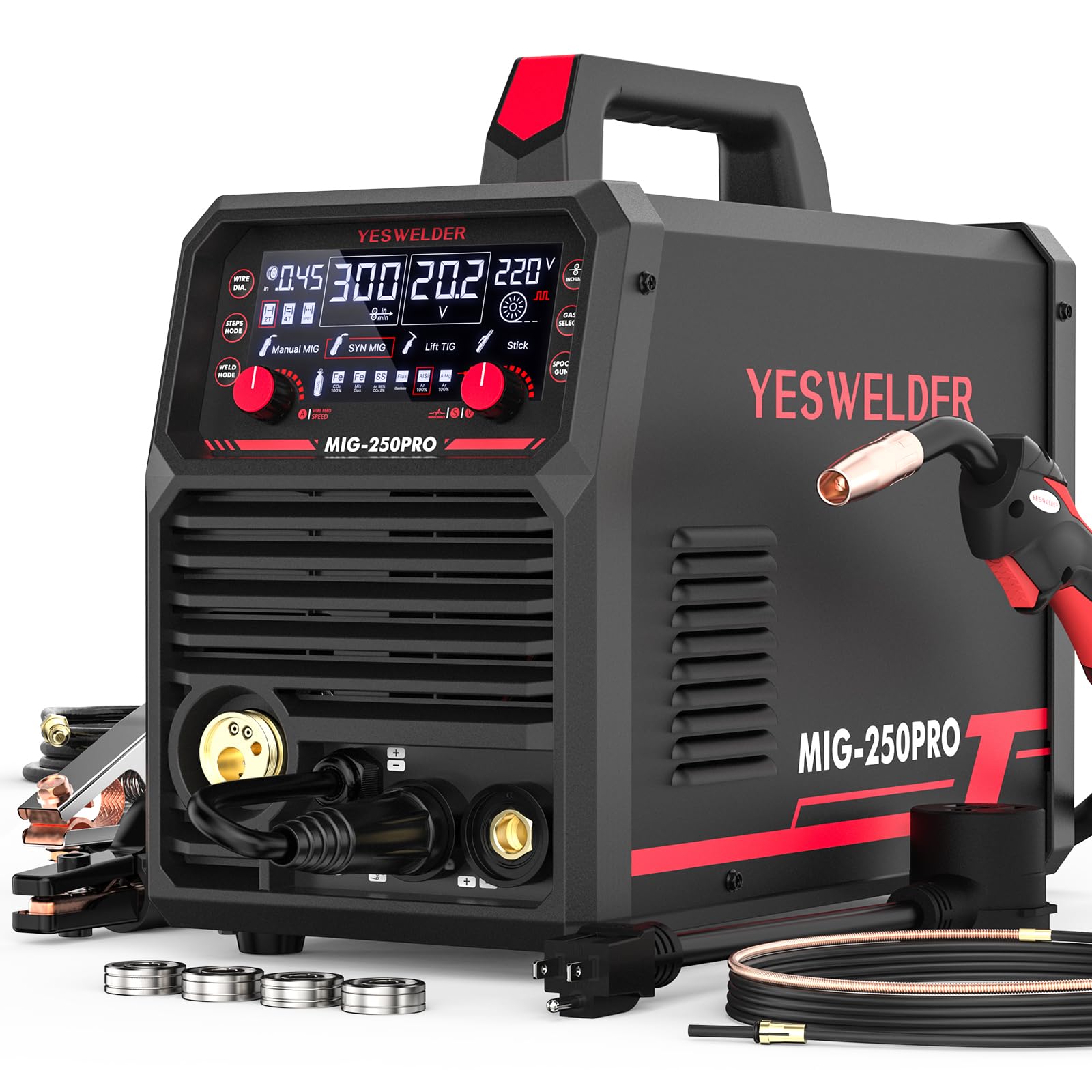
A 250A 6-in-1 that chews through 1/2-inch steel and keeps the arc smooth.
The YESWELDER MIG-250 PRO is for the builder taking on serious fabrication. Its 250A output on dual 110V/220V covers automotive, construction, and heavy DIY, and the dynamic arc control lets you set the bead crisp or soft to match the job. It handles solid and flux core wire plus spool gun MIG with.035/.045 aluminum wire for body panels and specialized work.
Owners who ran it professionally were stunned — one called it smoother and more powerful than a shop’s ESAB Rogue on flux core, laying down 8 hours of rail welds without a single bird’s nest and building a 3-ton hoist with it. It runs a 100% duty cycle at 193A, so long frame passes won’t force you to stop and cool down.
The performance keeps owners happy for years, but durability is the watchword. A few units arrive dead on arrival, and the wire feed can fail mid-project — though support replaces faulty units. The stock gun and clamp feel cheap; owners recommend the Tweco euro gun upgrade. It’s a lot of machine for the money, but you’re rolling the dice on long-term reliability.
high capacity
- Smooth, powerful arc on 1/2-inch steel
- 100% duty cycle at 193A for long rails
- Spool gun MIG for aluminum work
fan noise loud
- Occasional DOA units and feed failures
- Stock gun and clamp are mediocre
long sessions: you need serious output for thick steel and aluminum without a premium price tag.
quiet spaces: you can’t afford downtime from the occasional component failure.
10. ARCCAPTAIN 250A MIG Welder
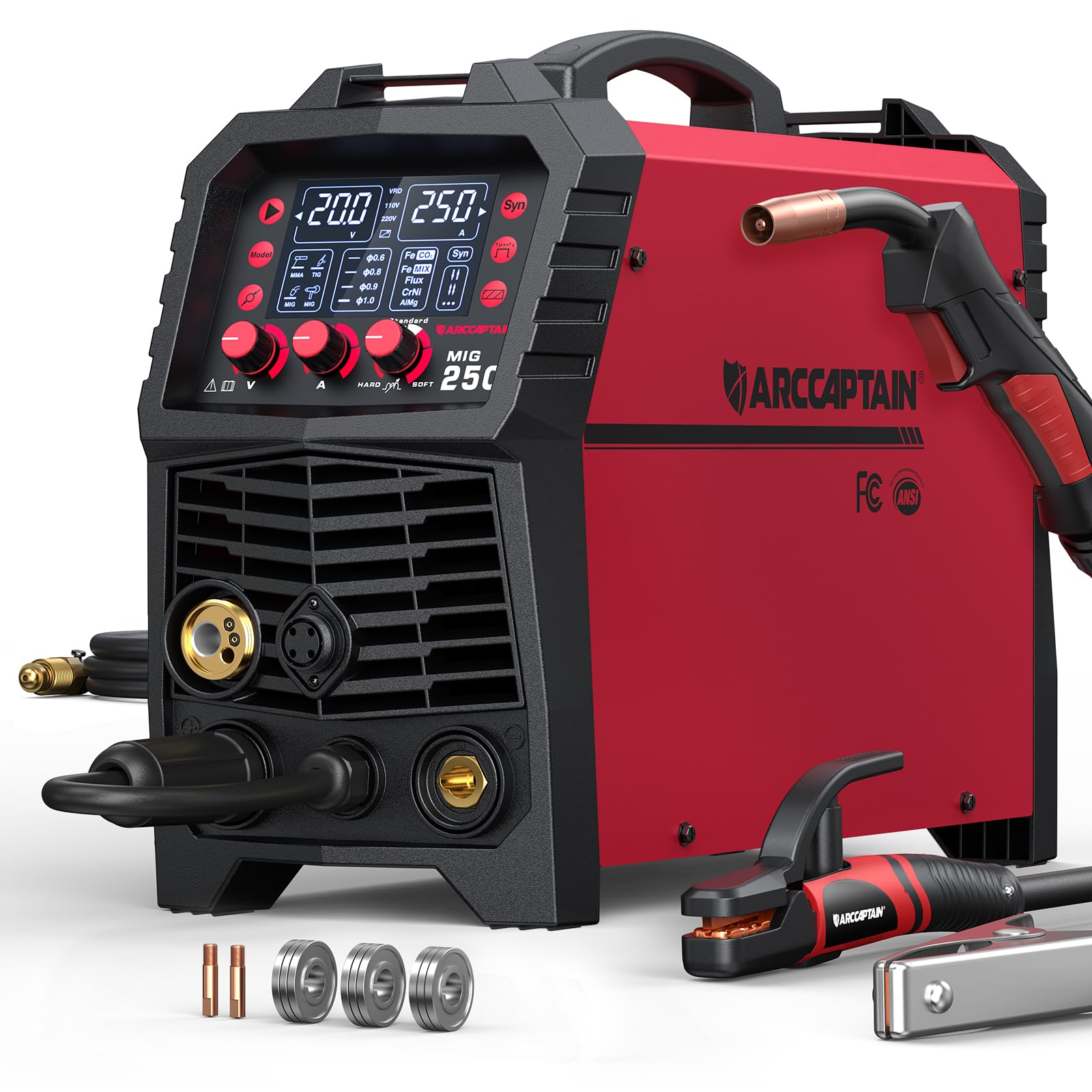
A fully digital 250A rig that veteran welders call great with zero complaints.
The ARCCAPTAIN MIG250 is the premium pick that earns its keep. It’s a fully digital 6-in-1 machine with an MCU-based circuit design for stable performance, covering gas MIG, gasless MIG, lift TIG, MMA stick, spot, and spool gun (guns sold separately). It welds mild steel, carbon steel, stainless, and aluminum — a full menu for the serious car builder.
Veteran welders with decades of experience found it impressive. “I’ve been a welder for many years. This machine is great! Absolutely no problems,” is exactly the kind of feedback that builds confidence. The synergic and manual MIG modes give beginners auto-settings while pros can fine-tune everything, and the intelligent fan speeds up heat dissipation to extend the machine’s life.
Performance and weld quality top the owner feedback. The package arrives ready to work: a 10-foot MIG torch, earth clamp, stick holder, contact tips, three wire feed rollers, and a 220V-to-110V adapter. It works even on 110V, with owners confirming solid performance on both 110V and 240V. The main thing to respect is the power-on sequence — wait for the screen to turn off and the fan to stop before switching voltages.
strong arc: Works way better than expected for the money. Great arc quality and simple setup.
accessories cheap: Follow the shutdown sequence before switching voltages to protect the electronics.
power users: the serious builder who wants digital precision and full multi-process capability in a shop-grade machine.
casual use: someone who won’t read the manual — this one rewards proper operating habits.
11. Weldpro Omni210 Multi-Process Welder
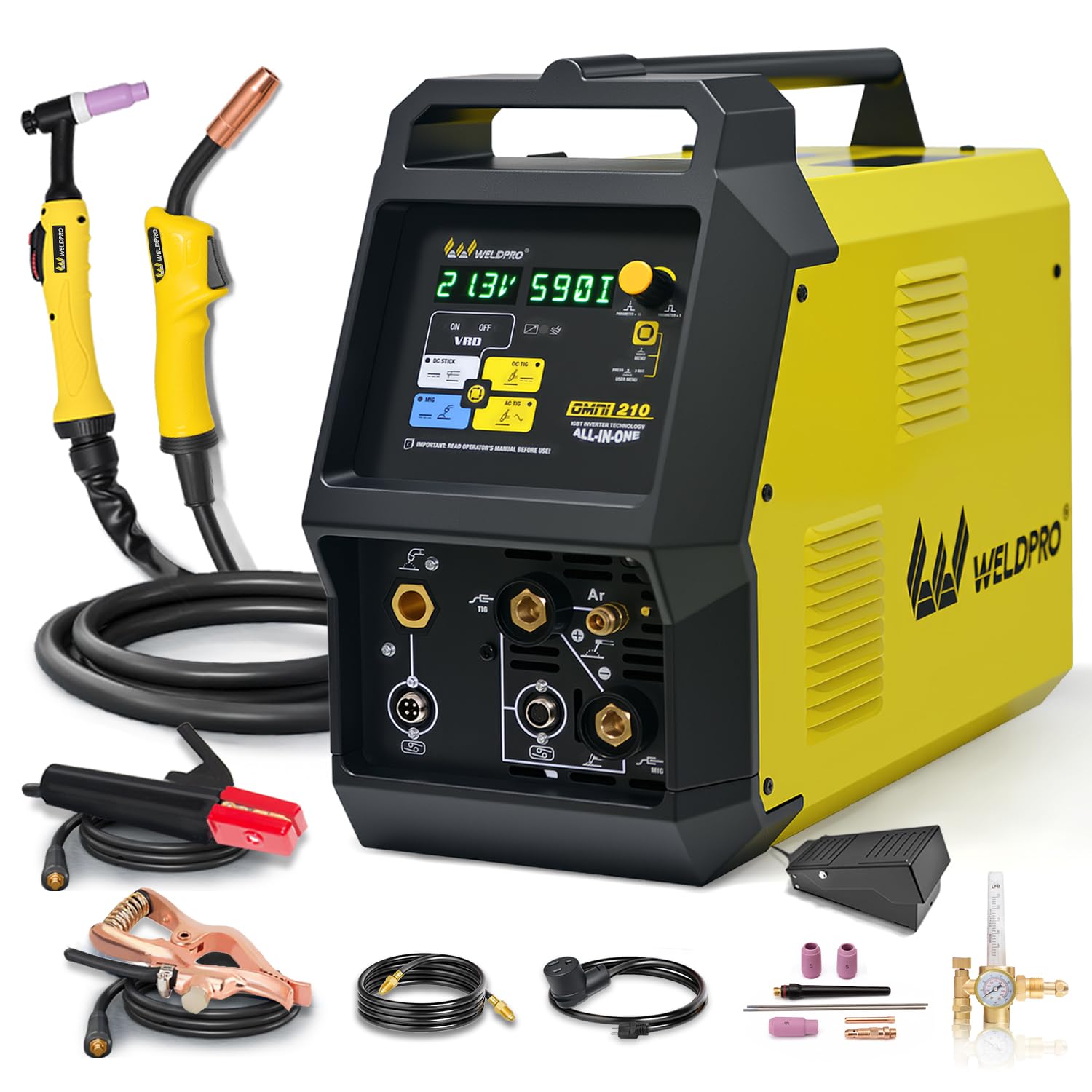
The 81.8-pound do-everything shop anchor with AC/DC pulse TIG included.
The Weldpro Omni210 is the machine you buy once and never outgrow. It’s a 6-in-1 that adds AC/DC HF TIG with pulse to the standard MIG, flux core, stick, and spool gun lineup — and it ships with a KT26 TIG torch and a proper foot pedal in the box. At 200A across MIG, TIG, and stick, it handles everything from aluminum body panels to heavy structural work.
Owners are impressed by the build and performance, with AC aluminum TIG welds described as amazing and the machine running quietly with a fan that auto-shuts off. Buyers loved it so much they purchased a second unit — one for the shop, one for the barn. The preprogrammed settings get beginners started, then you adjust as you learn.
The 81.8-pound weight tells you this is a stationary shop machine, not a carry-around. Quality and performance lead the feedback, with a digital display offering VRD, hot start, and arc force settings to refine stick welding. The catch: TIG mode isn’t beginner-friendly — it’s a professional feature that takes practice — and one owner’s included argon gauge failed early. This is the flagship choice for the welder who wants every process in one premium box.
flagship features
- Real AC/DC pulse TIG with foot pedal included
- 12 lbs wire spool capacity for long jobs
- Quiet operation with auto-shutoff fan
premium price
- Heavy 81.8 lbs — it stays on the cart
- TIG takes practice for beginners
serious welders: you want one premium machine that does MIG, stick, and true AC/DC TIG without compromise.
tight budgets: you need portability — this is a shop anchor, not a grab-and-go welder.
Understanding the Specs
Duty Cycle
This is how long a welder can run at a given amperage before it needs to cool down. It’s usually written as a percentage over a 10-minute window — 60% at 250A means 6 minutes of welding, then 4 minutes of rest. For long frame rails, a higher duty cycle keeps you moving. For quick patch jobs, even 20% is plenty.
Synergic Control
This is an automatic setting that matches your wire feed speed to the voltage when you select a material thickness. Instead of guessing at two separate knobs, you pick the metal and the machine does the math. You can still override it manually for fine control, which is why welders love it on thin automotive steel that tends to burn through.
FAQ
What’s the difference between flux-core and gas MIG for car frames?
Can a 110V welder handle a car frame?
What is synergic control and do I need it?
How much power do I need to weld a car frame?
Can these welders handle aluminum car body work?
What’s a duty cycle and why does it matter?
Is stick welding better than MIG for a car frame?
How heavy is too heavy for a portable car welder?
Final Thoughts: The Verdict
If you want one dependable pick, the welder for a car frame winner is the Lincoln Electric 90i FC because it delivers that rare combination of genuine portability and precise low-heat control that thin automotive steel demands. If you want a single budget-friendly machine that grows with you from patch panels to mild fabrication, the YESWELDER 160A is the one to beat. And for the builder tackling aluminum body work and heavy structural sections, the FEMEROL 250A adds real multi-process muscle without the premium price tag.
How We Picked
We do not accept paid placement. Every pick is matched to a real buyer and a real use-case; we do not hands-on test units.
Sources & Methodology
Specifications: manufacturer listings and product documentation. Review insights: verified customer reviews, as of August 2026. Pricing: not shown on this page (it changes often); check the current price via the retailer link.
As an Amazon Associate, GoCarLife earns from qualifying purchases. This does not affect which products we feature.