
Our readers keep the lights on and the garage heater humming. As an Amazon Associate, I earn from qualifying purchases.
Specs are compiled from manufacturer listings and verified buyer reviews and can change over time — please confirm the key details on the product page before buying.
If you ride with a partner, you already know the problem: shouting over engine noise, wind, and traffic while trying to keep your eyes on the road. The gear that fixes this isn’t a handheld radio you have to grab mid-ride — it’s a hands-free communication system built right into your helmet. This guide breaks down the top options for staying in clear contact on two wheels, separating the helmet-mounted headsets that handle wind noise from the classic walkie-talkies that work anywhere.
I’m Mo Maruf — the founder and writer behind GoCarLife. This guide is built by comparing the manufacturers’ published specifications and the patterns across verified customer reviews, so you get each pick’s real strengths and trade-offs instead of marketing spin.
From feather-light helmet intercoms to rugged waterproof radios, here is the honest breakdown of the best walkie talkie for bike riding to keep you and your riding buddies connected safely at speed.
Our Picks at a Glance

How To Choose The Best Walkie Talkie for Bike Riding
The first decision is design: a Bluetooth headset that clips onto your helmet versus a traditional walkie-talkie you stash in a pocket. For constant two-way chatter on a ride, the helmet unit wins every time — your hands never leave the bars. A classic radio makes more sense for group rides where riders spread out or when you want gear that also works hiking and camping.
Understand your actual range needs
Advertised miles assume wide-open flat land with zero obstacles. On a tree-lined trail or in a city full of buildings, that figure drops dramatically. For a riding partner a few dozen yards away, a short-range unit is plenty. If you split up on climbs or ride with a larger group, look for a longer open-terrain range and treat the number as a best-case ceiling, not a promise.
Prioritize wind and noise handling
Speaking into the wind is the hardest test for any comms gear. Some units use dual microphones with beam forming — technology that focuses on your voice and cancels surrounding noise — to keep your words clear. A button-press-to-talk system lets you control when you transmit, which helps in gusts, while voice-activated options keep you fully hands-free.
Quick Comparison
| Model | Best For | Type | Range | Talk Time | Amazon |
|---|---|---|---|---|---|
| Roamee Bluetooth Kit★ Best Overall | Riding Pairs | Helmet Headset | 300 meters | 8 hours | Amazon |
| Sena BiKom 20Top Performer | Cycling Purists | Helmet Headset | 0.5 mile | 7 hours | Amazon |
| EJEAS V6 Pro | Group Rides | Helmet Headset | 1200m | 18 hours | Amazon |
| Midd Kacy | Rugged Versatility | Handheld Radio | 6 mile | 120 hours | Amazon |
| Retevis RT20 | Lightweight Carry | Handheld Radio | FRS | 12 hours | Amazon |
| T-M9 Mini | Discreet Commuting | Handheld Radio | 2 mile | 48 hours | Amazon |
| Cobra RX180 | Budget Utility | Handheld Radio | 18 mile | — | Amazon |
In-Depth Reviews
1. Roamee Bluetooth Hands-Free Kit
Our pick — 4.5★ from 100+ verified ratings; the strongest balance of quality and price.
The helmet-mount headset that keeps your voice crisp while your hands stay glued to the bars.
When you are riding side-by-side with a partner, this unit is the gold standard of the list. Its 2-way intercom lets you chat with one other rider across 300 meters of open ground, and the dual microphone “beam forming” plus full duplex tech means you talk and listen at the same time, no push-to-talk button needed. Buyers report clear sound even in windy conditions, with one rider measuring roughly 800-900 feet of clear range before the signal got garbled at 1000 feet.
The open-ear design keeps you aware of traffic around you — a real safety win that in-ear buds can’t match. That ear comfort pairs with sweatproof build and an 8-hour battery that survives long outings on one charge. Installation is the real a neat extra: the spec sheet promises a “5 seconds” setup using self-adhesive holders and strong magnets, giving it a universal fit on almost any bicycle helmet.
The honest catch is the magnet strength itself. The speakers detach easily when you handle the helmet, and some riders ended up adding tape to keep them seated. The units also don’t auto-connect on power-up, so expect to re-pair manually at the start of each ride — a small ritual for the clearest ride-to-ride chat here.
Why riders love it
- Beam-forming mics cut wind noise for calm conversations at speed
- Open-ear fit keeps traffic sounds audible for safer riding
- Fully hands-free intercom for 2 riders up to 300 meters apart
The trade-offs
- Speaker magnets are weak and can detach during helmet handling
- Must re-pair manually each time you power it on
Reach for this if: you ride mostly with one partner and want true hands-free chat with wind-proof clarity.
Look elsewhere if: you need a group radio for scattered riders or want gear that doubles for camping and hiking.
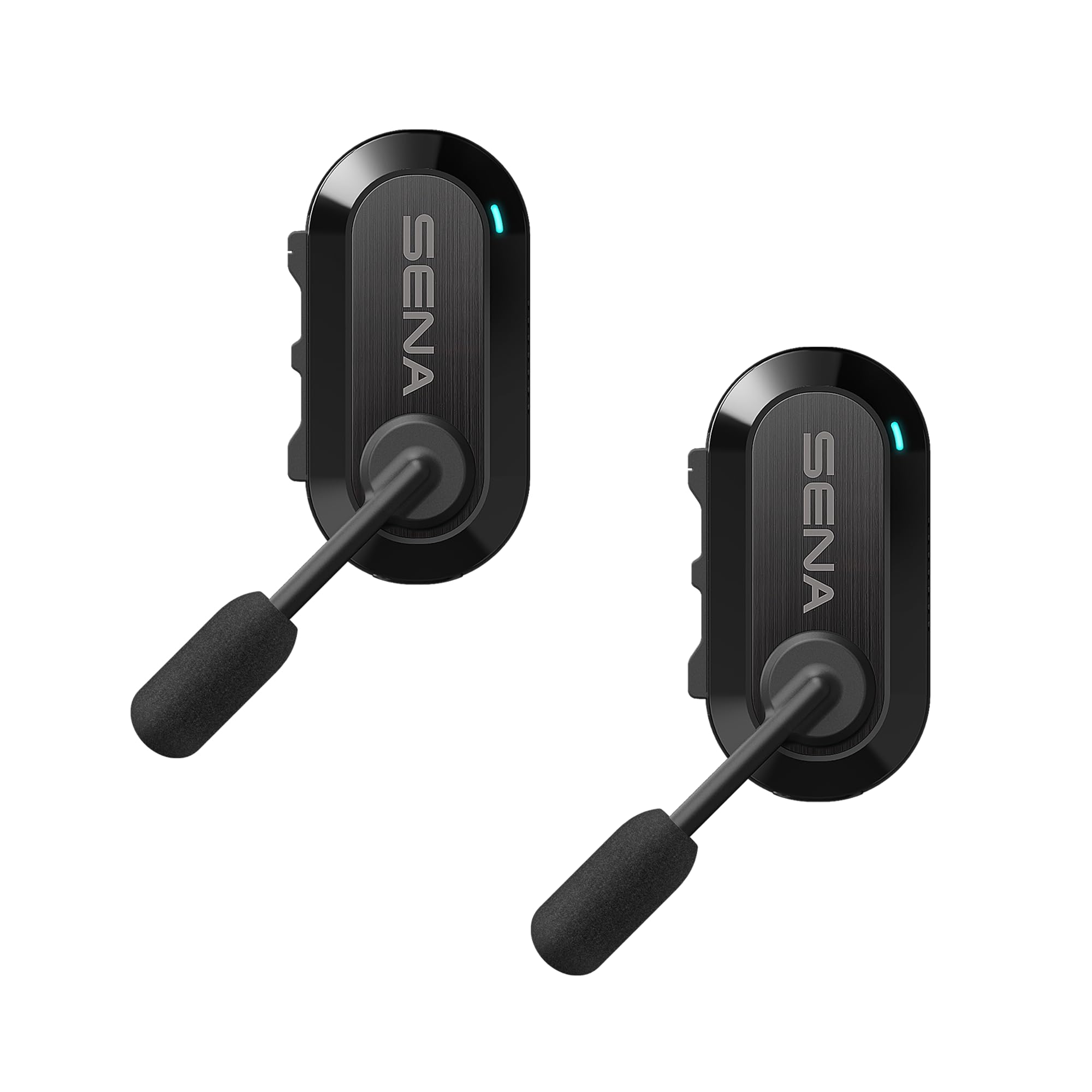
2. Sena BiKom 20 Cycling Communication System
The featherweight 20-gram headset from a cycling comms specialist that simply disappears on your helmet.
Weighing only 20 grams, this unit is barely noticeable the moment it clips onto your helmet strap — a stark contrast to the bulkier EJEAS headset above. That lightness is the headline, but the talk time matters too: you get up to 7 hours of effective communication with a 0.5-mile range, more than enough for casual loops with a partner. The balanced armature driver is a talking point here — it is a speaker type prized for accuracy — and it delivers some of the clearest voice reproduction in this lineup.
Advanced Noise Control keeps your voice audible in noisy environments, which owners confirm with clear conversations even riding into headwinds. The unit works with virtually unlimited users across 6 communication channels, so it scales well beyond a two-rider setup. App and voice controls plus Over-The-Air firmware updates mean the software stays current without plugging into a computer.
The catch is on the value side for many buyers. At this level, the 7-hour battery is shorter than the Roamee’s 8 hours and a fraction of the EJEAS’s 18 hours, and the 0.5-mile range is conservative for the premium price. The Bluetooth 4 standard is also older than the 5.x versions on rival headsets, which may matter for multi-device pairing.
The strengths
- Ultra-light 20-gram build disappears on the helmet
- Clear voice reproduction even in windy conditions
- 6 communication channels support multiple riders
What gives pause
- 7-hour battery trails rivals at this price level
- 0.5-mile range is modest for the premium cost
Grab it for: the rider who wants a barely-there, wind-resistant headset from a trusted cycling brand.
Think twice if: you plan all-day epics, where the longer battery of the EJEAS V6 Pro beats it.
3. EJEAS V6 Pro Bluetooth Communication System
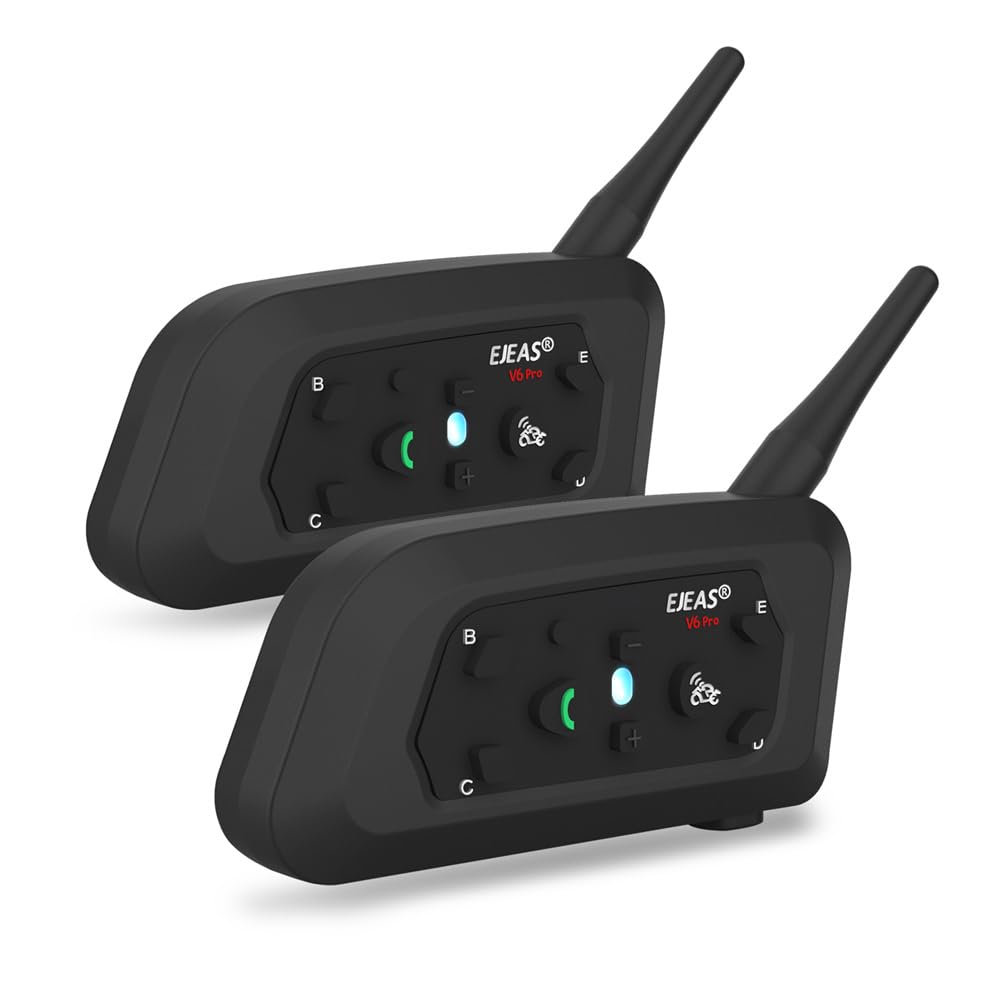
The motorcycle-grade headset that brings group intercom and serious weatherproofing to your bike rides.
This is the pick when you ride in a pack, not just a pair. Its full-duplex intercom pairs up to 6 riders at once, with the host switching between 5 channels — so a whole group can chatter simultaneously rather than taking turns. The 1200m open-terrain range is the best in the helmet-headset class here, beating both the Roamee’s 300 meters and the Sena’s 0.5 mile when you look at the numbers side by side.
The battery is the other standout. An 850mAh cell delivers 18 hours of talk time or 25 hours of music, with a 3-hour fast charge when you’re between rides. Around that you get Bluetooth 5.1, which connects two phones at once and handles GPS prompts, music sharing, and hands-free calls. The IP65/IP67 waterproof rating means rain, snow, and dust won’t kill it mid-ride, and it fits full-face, half-face, and modular helmets.
The nuance: some owners find the voice quality slightly tunnel-like, understanding every word but noticing the audio could be richer. The 120km/h wind-noise claim is strong on paper, though real-world clarity at speed will vary with helmet fit. Still, for group rides over varied terrain, this packs the most capability per gram of any unit here.
What stands out
- 6-rider simultaneous intercom with host switching across 5 channels
- 18-hour talk time and 25-hour music playback from an 850mAh battery
- IP65/IP67 waterproofing shrugs off rain, snow, and dust
What to note
- Voice can sound slightly tunnel-like to some ears
- Heavier and more complex than featherweight cycling headsets
Choose this for: group rides of 3 or more where simultaneous talk and all-day battery matter most.
Skip it for: solo commuters who want the lightest possible clip-on device.
4. Midd Kacy 60-Channel GMRS Radio
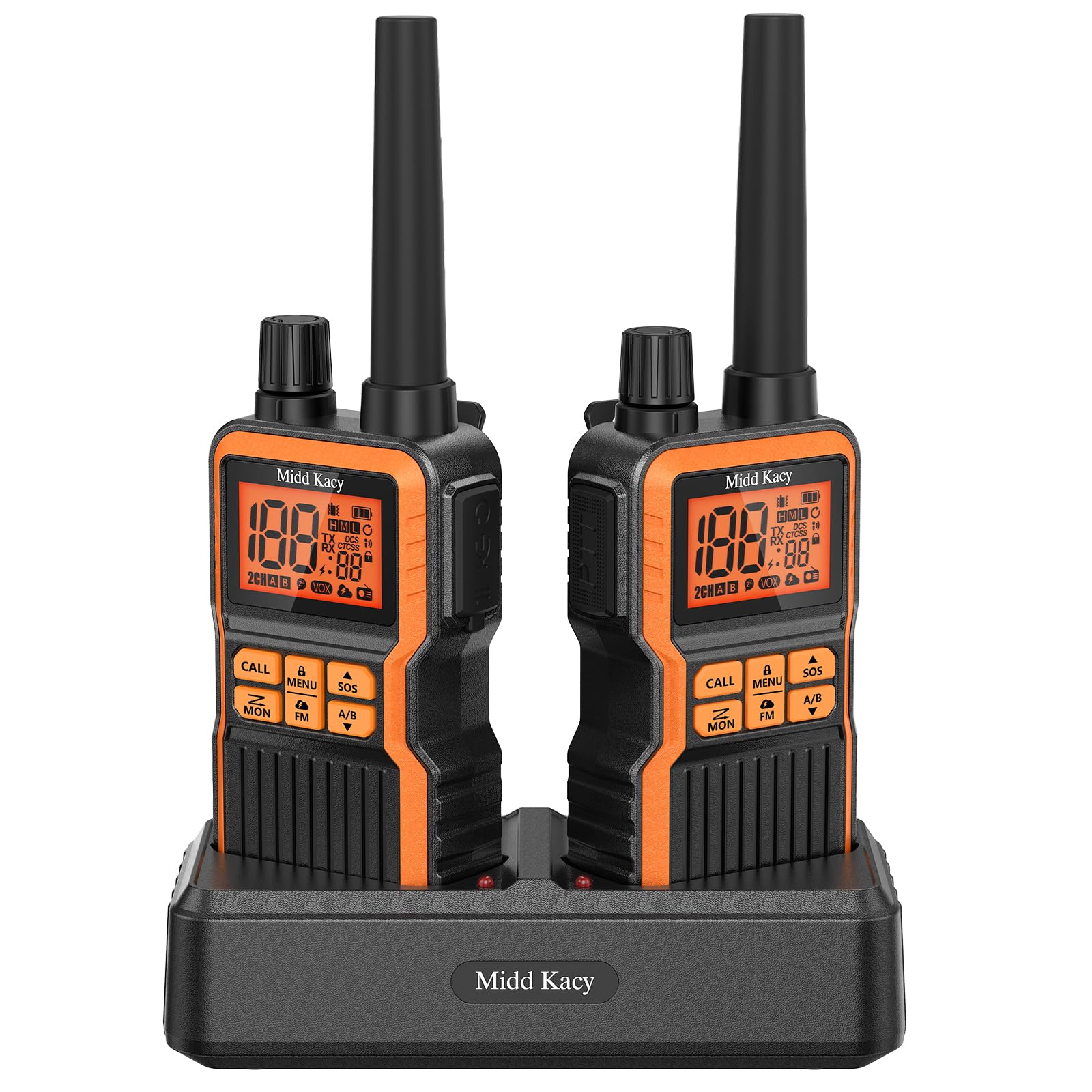
The rugged handheld that bridges bike rides, camping trips, and farm work with one tough radio.
Unlike the helmet headsets above, this is a proper handheld radio — and that is exactly its appeal. Its 60 FRS channels with 121 privacy codes let you talk with any other FRS radio regardless of brand, so your riding group can mix gear freely. The company claims a 6-mile range in open areas like rural roads or the seaside, dropping to 3-5 miles in towns, and owners confirm solid reception with minimal static on multi-car trips.
Ruggedness is the second headline. The strong shell is waterproof, anti-drop, and dustproof, so it survives a tumble from a bike mount or a sudden downpour without complaint. The real showstopper is battery life: an 1800mAh Li-ion pack can run 4-7 days of normal use, with owners reporting a full weekend still above 50% charge. Four power-saving modes let you stretch it even further. Throw in NOAA weather alerts, SOS, and a backlit orange LCD screen for night riding, and you have a genuinely multi-sport device.
The trade-off is physical. At 8.5 inches tall with a belt clip, it is bulkier than the sleek headsets, and you will need to pull it from a pocket or mount to talk — you cannot be hands-free on the bars. The range figure also depends heavily on terrain, so treat 6 miles as an open-field ceiling. But if you want one radio that works on the trail and at the campsite, this is the one.
The build: drop-proof and weatherproof, with a strong shell meant for harsh outdoor conditions.
The endurance: 1800mAh battery with 4 power-saving modes that owners say lasts an entire weekend with more than half the charge left.
Best for: riders who also camp, hike, or farm and want one waterproof radio for everything.
Not for: anyone who wants constant hands-free chatter on the bike without grabbing the unit.
5. Retevis RT20 Wearable Walkie Talkie 3-Pack

The 0.2-pound wearable radio that hides under a shirt and delivers clear sound for a full day of riding.
At just 5.92 ounces for a 3-pack, each RT20 is featherlight — and the included blue rope lets you hang it around your neck so it won’t fall off mid-ride. That translates to a sub-0.2-pound load per unit, roughly four times smaller in volume than the bulkier Cobra RX180 when you compare their dimensions. The compact 3.5-inch-tall body means it slips under a jersey or into a small pocket without any bulk.
Owners consistently highlight the clear, loud sound and simple layout, where every front button has a blue logo printed on it — a thoughtful touch for riders wearing gloves. An 8-level independent volume adjustment handles a quiet trail or a busy city street, and the key lock function stops accidental channel changes while you ride. The 1000mAh battery delivers roughly 10-12 hours of normal use, and USB-C charging means you top it up with the same cable as your phone.
The realistic limits: this is a push-to-talk radio, so it needs a button press rather than true hands-free operation. Range over rolling terrain is the recurring caveat, with clear transmission in open areas but signal dropping off in a mile or less when hills get involved. If your group mostly stays within shouting-then-some distance, it is a superb value in a 3-pack.
Strong points
- Ultra-light 5.92-ounce 3-pack with neck lanyards that prevent drops
- Loud 8-level volume control with color-coded glove-friendly buttons
- USB-C charging and 10-12 hour battery from a 1000mAh cell
Watch out for
- Range fades over rolling terrain beyond about a mile
- Push-to-talk only, so no hands-free operation while riding
Pick this up if: you want three ultralight radios for a small group at a budget-friendly price.
Steer clear if: you need wind-resistant, hands-free helmet communication on long road rides.
6. ELIDAIP T-M9 Super Mini Walkie Talkies with Earpieces
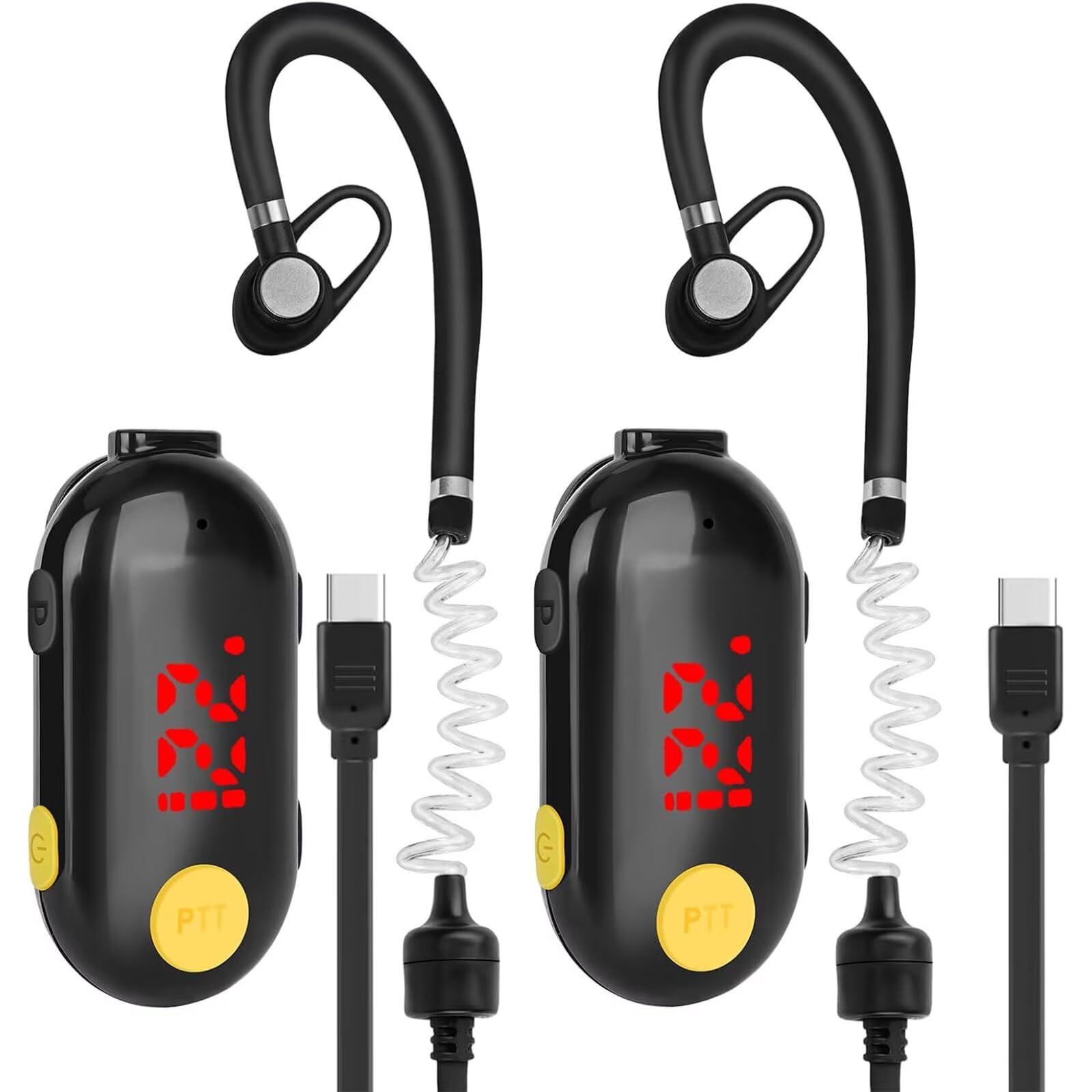
The 17-gram earpiece radio that’s lighter than a keychain and clips right onto your collar.
At 17.01 grams per unit, this is the lightest radio in the entire roundup — lighter than several pairs of sunglasses. The defining feature is the G-shaped ear hook design with a 360-degree rotating headset, so the earpiece fits comfortably on either your left or right ear. The radio body itself clips onto your collar, keeping the whole kit hands-free while you ride.
Riders who tested it for bike communication found it works well, though it requires a button press to transmit rather than voice activation. The smart LED display shows channel, volume, and charge status at a glance, and the security lock prevents accidental button pushes — genuinely useful when you’re gloved up. USB-C charging delivers about 8-12 hours of continuous use, with a 48-hour standby, and the open-air claim is a 2-mile talking range.
The mixed reality is wind distortion. Owners note that while the sound is clear around the house, wind noise at motorcycle speeds garbles it — a reminder that earpiece-in-ear design doesn’t shield the mic from gusts. The earpieces also fit large ears well but sit loose in smaller ears. This is best treated as a casual, ultralight comms option rather than a serious wind-fighting ride system.
The perks
- Featherweight 17.01-gram build with a rotating ear hook
- 2-mile range in open flat areas with noise-reduction tech
- USB-C fast charging with 48-hour standby time
The limits
- Wind distorts sound at higher speeds
- Requires button press — it lacks voice activation
Suits: casual riders who want a barely-there, affordable radio for close-range chatter.
Doesn’t suit: fast road riders who need wind-proof voice clarity at speed.
7. Cobra RX180 Walkie Talkies (2-Pack)

The no-frills two-pack from a 50-year radio brand that covers the basics for any outdoor excursion.
This is the classic entry-level pick, backed by Cobra’s half-century in the radio business. The headline spec is an 18-mile advertised range across 22 preset channels, designed to work with other FRS devices. Around that you get a built-in LED flashlight with an SOS function, 10 selectable call tones, and a channel scan — genuinely handy for camping, biking, or hiking where you might need light or an emergency signal fast.
The VOX feature is worth highlighting for riders: it transmits automatically when you speak, so your hands stay free on the bars in working conditions. The NOAA weather channels add 24/7 access to 10 different weather bands, which is a real safety net if a ride heads into changing skies. The compact body runs on 3 included AAA batteries with a battery-strength indicator, and a Micro-USB “Y” charging cable means both units charge from one cable.
Set expectations honestly on range. Owners mention mixed real-world performance, with clear communication on road trips but a noticeable drop-off in built-up areas where the honest effective range can shrink to about 100 feet. Battery life also draws the most negative feedback in reviews, with daily charging reported under heavy use. For the price, it is a dependable budget companion — just don’t expect the sticker range in a city.
Good value bits
- 18-mile advertised range across 22 channels with VOX hands-free
- NOAA weather alerts and LED flashlight with SOS
- Two radios charge from one Micro-USB “Y” cable
The realities
- Real-world range can shrink dramatically in built-up areas
- Battery life draws the most complaints from owners
Good for: budget-conscious groups who want a basic, feature-filled radio for mixed outdoor use.
Not for: riders who demand consistent long-range coverage in hilly or urban terrain.
Understanding the Specs
Range: the most inflated number
Every walkie-talkie quotes a maximum range, but that figure assumes flat, open land with zero obstacles. Trees, hills, and buildings all eat into it fast. For two riders side by side, even 300 meters is plenty. For a group spread across a valley, you want the biggest open-terrain number you can find — then halve it for real-world expectations.
Battery life and charging
Talk time varies wildly, from 7 hours on a featherweight headset to a claimed 120 hours on a handheld radio with power-saving modes. Check how you charge too: USB-C is the modern convenience, while some budget units still rely on Micro-USB or AAA batteries. A headset that dies at mile 30 is worse than a heavier radio that lasts all week.
FAQ
Will a walkie-talkie work while I’m riding a bike?
What is the difference between a helmet headset and a handheld radio?
How far apart can two riders actually talk?
Do I need a license to use these radios?
Why can’t I hear my partner clearly in the wind?
What does an open-ear design do for cycling safety?
How long does the battery last on a ride comms system?
Can I connect my phone to these devices for music or GPS?
Which is better for a large group ride?
Are these devices waterproof for riding in the rain?
Final Thoughts: The Verdict
For most riders, the walkie talkie for bike riding winner is the Roamee Bluetooth Kit because it pairs wind-resistant, hands-free clarity with a universal helmet fit and a genuinely useful 300-meter range. If you want a barely-there clip-on with top-tier voice quality, grab the Sena BiKom 20. And for group rides of three or more where battery life and weatherproofing rule, the EJEAS V6 Pro is the one to reach for.
How We Picked
We do not accept paid placement. Every pick is matched to a real buyer and a real use-case; we do not hands-on test units.
Sources & Methodology
Specifications: manufacturer listings and product documentation. Review insights: verified customer reviews, as of August 2026. Pricing: not shown on this page (it changes often); check the current price via the retailer link.
As an Amazon Associate, GoCarLife earns from qualifying purchases. This does not affect which products we feature.