
Our readers keep the lights on and the garage heater humming. As an Amazon Associate, I earn from qualifying purchases.
Specs are compiled from manufacturer listings and verified buyer reviews and can change over time — please confirm the key details on the product page before buying.
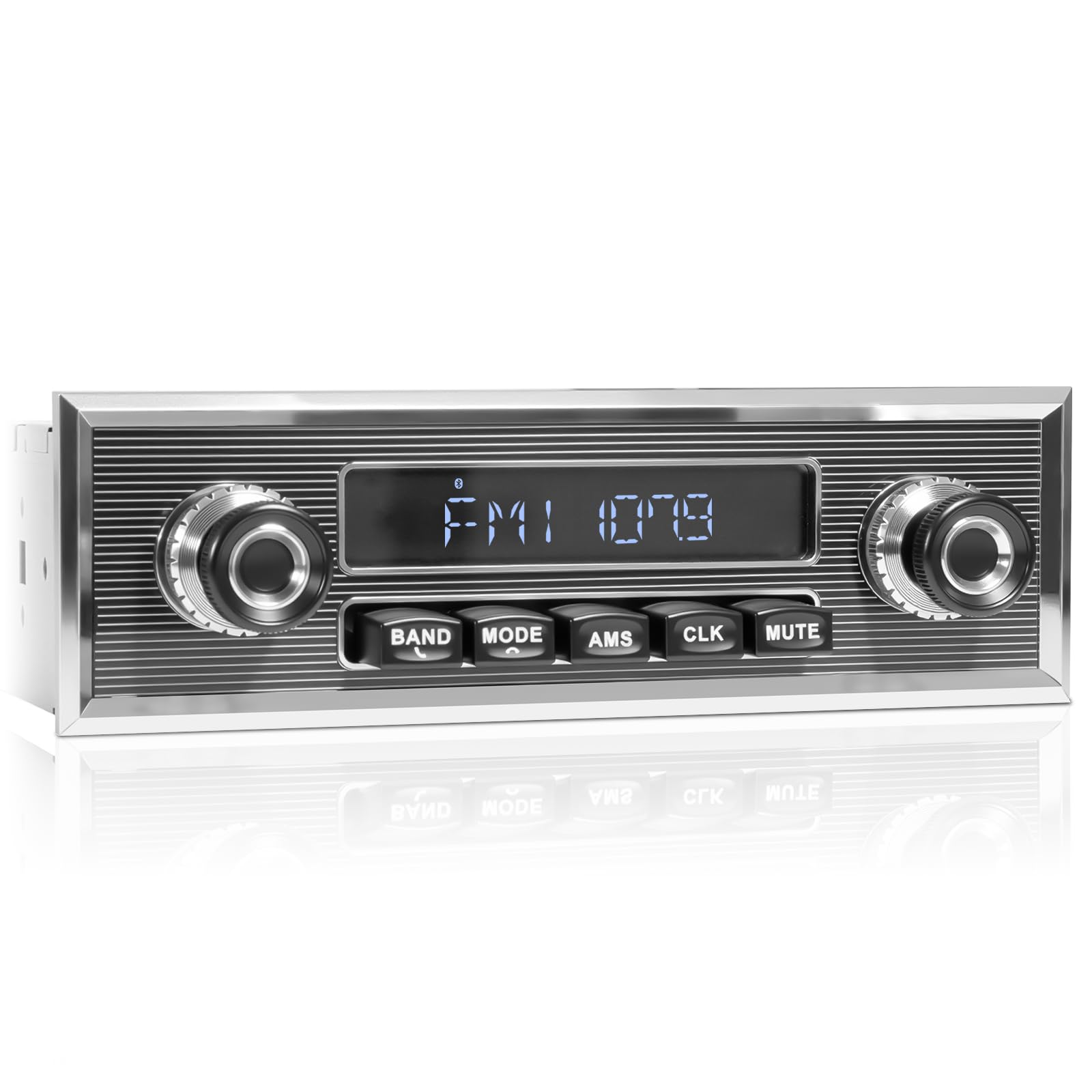
You love your classic car’s soul, but not its ancient tape deck. The good news is you don’t have to choose between vintage style and modern convenience—a Vintage Bluetooth Car Radio gives you the retro knobs and glowing display you miss, plus the wireless phone streaming your daily drive demands. The wrong pick can mean cutting your dash or losing your subwoofer output, so match the unit to your car’s opening and audio setup.
I’m Mo Maruf — the founder and writer behind GoCarLife. This guide is built by comparing the manufacturers’ published specifications and the patterns across verified customer reviews, so you get each pick’s real strengths and trade-offs instead of marketing spin.
We’ve matched each radio to the classic car it fits best, from 1980s Mercedes to 1990s Jaguars, so you can find the vintage bluetooth car radio that upgrades your sound without ruining your dashboard’s character.
Our Picks at a Glance

How To Choose The Best Vintage Bluetooth Car Radio
Match the radio’s size to your dash opening, its outputs to your sound system, and its styling to your car’s era.
Measure your dash opening and radio depth first
Most classic cars use a standard single DIN opening, which is about 7 inches wide and 2 inches tall. A true single DIN radio will slide in with minimal fuss. Some 1950s and 1960s vehicles have smaller or odd-shaped openings, though, and several owners of those cars found they needed to cut the dash to make a standard radio fit. Measure your opening and check the radio’s depth, since some units are too deep for shallow dashes.
Plan for the yellow/red wire swap and RCA pre-outs
Retro radios often need a small wiring adjustment: swapping the yellow (constant power) and red (switched power) wires so the unit powers down with the ignition. If you plan to run an external amplifier or subwoofer, you need RCA pre-outs on the back of the radio, not just speaker wire outputs. Most modern single DIN radios include them, but not all do, so it’s a spec worth confirming.
Decide between FM/RDS and DAB based on your area
Choose DAB if you’re in a strong digital signal area; otherwise, FM with RDS suffices. Some premium retro models include DAB, while others stick with standard AM/FM and Radio Data System (RDS), which shows station names and song info on the display. Pick DAB for more stations and cleaner reception in strong digital signal areas.
Quick Comparison
| Model | Best For | Power Output | Weight | Connectivity | Amazon |
|---|---|---|---|---|---|
| VDO Continental TR7412UB-OR★ Best Overall | OEM-style swaps | 25W RMS | 2 pounds | USB, RDS | Amazon |
| SOUNDKITS RS-10Budget Champion | Budget retro vibe | 300W peak | 1.2 pounds | USB, AUX, RCA | Amazon |
| ABSOSO Retro | Value with sub pre-outs | 4 x 75W peak | — | USB, SD, AUX | Amazon |
| aboutBit Classic | Bluetooth 5.3 stability | 4 x 75W peak | 1.4 pounds | USB, AUX, RCA | Amazon |
| RetroSound Hermosa | Direct-fit classic look | 25W x 4 | 4 pounds | USB, 2x AUX | Amazon |
| Blaupunkt Bremen SQR 46 | 80s Euro style + DAB | — | — | USB, SD, AUX, DAB | Amazon |
| Blaupunkt Frankfurt RCM 82 | 90s German cars | — | 1.8 pounds | USB, 3.5mm, DAB | Amazon |
In‑Depth Reviews
1. VDO Continental TR7412UB-OR
Our pick — over 4★ from 500+ verified ratings; the strongest balance of quality and price.
The OEM-lookalike that slides into 80s and 90s dashes with zero visual compromise
You get a factory look and Bluetooth in one unit, and this radio is the crowd favorite for exactly that reason. Owners rave about how convincingly it mimics an original unit, with the orange display matching the period-correct look of cars like a 1987 Mercedes 420 SEL or a 1994 Ford F150.
Sound quality is a genuine highlight, delivering crisp highs and full-bodied lows even through original stock speakers, according to review patterns. Installation is straightforward, but you’ll need to swap the yellow and red wires so it powers down with the ignition; one owner noted the radio doesn’t turn off with the car until you make that change. The built-in mic handles hands-free calls, and the USB and SD inputs give you plenty of music options beyond your phone.
Buyers report its Bluetooth connects easily and the display stays readable in both daylight and at night. The main trade-off: it lacks pre-outs for amplifiers and subwoofers, so if you run an external amp, this isn’t the unit for you. It also only supports FM, MW, and LW bands — there’s no DAB tuner here.
Why owners stick with it
- OEM-style look that makes your dash appear untouched
- Reliable Bluetooth that pairs easily
- Straightforward install with included AC111 wiring loom
The honest limits
- No RCA pre-outs for amps or subwoofers
- USB port charges nothing
- Configuration menu is complex with unexplained terms
Reach for this if: you want a period-correct look with dependable Bluetooth and don’t plan to add an external amp.
Look elsewhere if: you need subwoofer pre-outs or a radio that powers off without a wire swap.
2. SOUNDKITS RS-10 Retro Radio
A featherlight 1.2-pound retro head unit that punches way above its price in sound
At just 1.2 pounds, this is the lightest unit in the lineup — a 67% weight gap versus the VDO Continental above — and it feels it. The plastic body is clearly entry-level, but owners are consistently blown away by the output: pairing it with aftermarket speakers yields strong, amp-like sound, with one owner driving Skar speakers to impressive volume. The high-resolution LCD stays readable even in bright sunlight, and the rotary knob plus large push-buttons deliver exactly the classic control feel you want.
Bluetooth pairs quickly and the built-in mic handles hands-free calls, while the rear-mounted USB port plus two auxiliary inputs give you plenty of ways to play MP3, WMA, and FLAC files. The AM/FM RDS tuner offers 30 presets and basic EQ presets like pop, rock, and classic. What wins people over is the value — it delivers a proper vintage look and strong sound for a fraction of what premium retro units cost.
The catch is fitment. Several owners mention it doesn’t fit their vehicles properly without cutting the dash, and one buyer had to enlarge the cutout in a classic car. The included connectors also drew criticism, with one owner finding a power plug defective and needing to take a pin from a speaker connection to get it working. If you’re comfortable with basic wiring and some dash work, this is a bargain; if you want a true drop-in, look higher up the list.
Best for: budget-minded owners who already have aftermarket speakers and don’t mind light dash modification.
Known trade-off: the connectors are the weakest link — treat them gently during install.
3. ABSOSO Retro Classic Car Radio

Chrome-knobbed retro charm with four-channel punch and a dedicated sub output
For the hot rodder who wants old-school knobs but refuses to give up deep bass, this radio is the balance. The chrome knobs and large buttons deliver the nostalgia, while the front, rear, and subwoofer pre-outs let you connect a 4-channel amp or a dedicated sub for serious output. The claimed 4 x 75W peak power is optimistic — one owner measured the real output closer to 50-70W RMS — but it still gets plenty loud in a small car.
Bluetooth pairs in seconds and automatically reconnects and resumes playback after startup, making it nearly smooth for daily drives. The install size is a standard 7″ x 2″ single DIN, so it fits most classic dashes without modification, though the non-removable front panel has a distinctly plastic feel. Owners praise the easy Spotify streaming and appreciate that the knobs control pause and skip.
Reliability is the honest if mixed note here: some units work flawlessly, while others fail after a couple of months of use. One owner reported the clock randomly resets while driving, and another found the output wire gauge thinner than expected. If you buy this, do so knowing it’s a value play, not a lifetime purchase.
Who it beats: budget units without subwoofer pre-outs — this one has them and sounds great doing it.
Who should pass: anyone needing long-term reliability or premium build quality, since the plastic face and mixed durability are real.
4. aboutBit Single Din Classic Stereo
The newest Bluetooth 5.3 chip in the bunch for rock-solid calls and wireless streaming
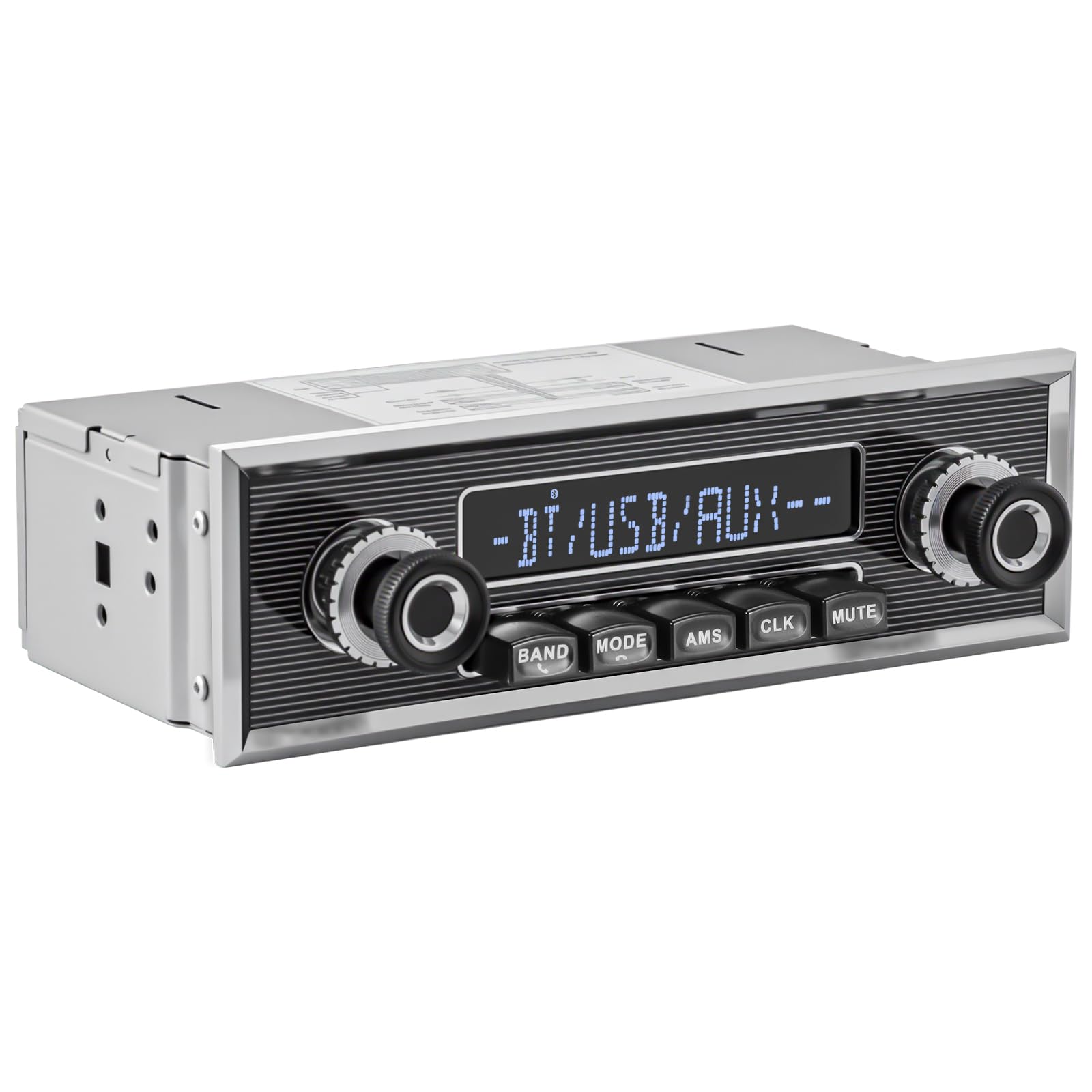
This unit stands out with the newest wireless standard in this lineup — a Bluetooth 5.3 chip that delivers a faster, more stable connection than the older versions used elsewhere. That means hands-free calls stay clear and your Spotify playlists stream without dropouts, even in a bouncing classic truck. The internal microphone picks up your voice well enough to keep your eyes on the road.
The HD LCD display is readable in daylight and at night, and the big retro knobs make the vintage aesthetic easy to match. It packs 30 presets across AM and FM, plus wired USB and auxiliary inputs for flexible playback. The single DIN install size of 7″ x 2″ fits standard classic dashes, and the four RCA plugs plus separate subwoofer output deliver 4 x 75W max power for aftermarket speakers and amps.
Sound quality gets high marks — one owner says it sounds just like any modern device, with no audible difference. The recurring issue is longevity and fit: it needs dash cutting for some square-body trucks, and one owner reported failure after 7 months of use. It also arrived without a mounting sleeve for some buyers, so be prepared to source one.
Standout spec: Bluetooth 5.3 — the most modern wireless connection in this whole list.
Honest caveat: check your mounting sleeve situation before you buy, and treat longevity as unproven.
5. RetroSound Hermosa HC-216-03-73

The no-cut solution for owners who refuse to touch their dash with a saw
If preserving your dashboard is non-negotiable, this is the radio that owners consistently describe as the answer. The RetroSound Hermosa is built as a direct-fit unit, and buyers repeatedly chose it specifically because they didn’t want to cut their dash — one owner installed it with Memphis 6x9s and 5.25s and was “highly impressed” with how loud and clean it sounds. The authentic push-button styling and chrome face give it a period-correct look that fits classic interiors beautifully.
Inside, it packs a built-in 25 watts x 4 channel amplifier, plus RCA pre-outs so you can add external power later. The dual-color display switches between white and green to match your dashboard lighting, and the USB port plus two auxiliary inputs give you solid connection options. Bluetooth handles both hands-free calls and wireless audio streaming without fuss.
The honest trade-offs: at 4 pounds it’s the heaviest unit here, and the included mounting rod bends too easily, per owner feedback. Some buyers found the knobs blocked the screen in certain vehicles and swapped in smaller ones. It’s a premium-priced unit with a few rough edges, but for a true no-cut install in a classic car, it’s tough to top.
The no-cut advantage
- Direct-fit design saves your dash from modification
- Dual-color display matches interior lighting
- RCA pre-outs allow future amp upgrades
Where it stumbles
- Mounting rod is soft metal that bends easily
- Knobs may block parts of the display in some cars
- Heaviest unit at 4 pounds
Choose this for: a clean, drill-free install in a classic car you refuse to modify.
Think twice if: you’re on a strict budget or have oversized factory knobs that will block the screen.
6. Blaupunkt Bremen SQR 46 DAB

A legendary 1980s nameplate reborn with DAB radio and modern Bluetooth inside
Blaupunkt has been making car audio since 1924 in Germany, and the Bremen SQR 46 is a loving reinterpretation of its 80s-era classic. It pairs that iconic retro look with genuinely modern tech — including a DAB tuner that pulls in clear digital radio stations alongside standard FM with RDS. Owners praise how perfectly it fits 1990s interiors, with one installing it in an IROC-Z and another in a 1982 BMW E21, noting the adjustable display color matches interior lighting.
The built-in equalizer gives you extensive sound shaping, and the subwoofer output lets you connect a dedicated bass box. The LCD display keeps things readable, and Bluetooth handles your phone for both music and calls. The design is compact for easy installation in most cars, and the wiring harness makes the swap straightforward.
Expect to pay a premium for the badge and the look — owners themselves call it pricey, though they say it’s worth it for the fit, style, and user interface. The honest mixed notes: the display can be hard to see in direct daylight, and volume levels vary between different inputs. Build quality gets mixed feedback too, with some calling it excellent and others describing it as cheaply made for the price. As the review pages sum it up: it’s a big upgrade over stock if you value the aesthetic.
Who it’s for: 80s and 90s car owners who want DAB digital radio and a badge with genuine heritage.
The catch: the premium price doesn’t guarantee premium build in every unit — inspection on arrival is wise.
7. Blaupunkt Frankfurt RCM 82 DAB

The era-perfect upgrade for 1990s Porsches and Jaguars that demand a factory look
This is the radio for the serious classic German car owner. Designed as a reinterpretation of the 90s 1-DIN original, the Frankfurt RCM 82 DAB fits a 1998 Porsche or a 1994 Jaguar XJS with an OEM-level precision that owners repeatedly call “period perfect.” The Bluetooth connects fast and strong, working flawlessly with older iPhones, and the sound quality earns high praise — one owner even says it sounds better than the Becker units it replaced.
Installation is straightforward with a standard harness, though you may need to reverse the yellow and red wires for certain Porsches. It delivers DAB digital radio, USB, and a 3.5mm jack for flexible playback, and the adjustable illumination can match your dashboard lighting, like the red LEDs in a BMW E30. At 1.8 pounds, it’s a solid-feeling unit that installs cleanly in most cars.
The honest caveat: reliability is genuinely mixed, with some units working flawlessly while others randomly shut down by themselves. One owner found the Bluetooth audio quality poor for calls and noted cheap-feeling buttons, while another said after a year the sound went flat. And it’s the priciest pick here — several owners call it overpriced at the premium level, even as they keep it for the perfect fit.
Best for: 90s German and British classics where a factory-precise fit matters more than price.
Not for: anyone on a budget or drivers who rely heavily on Bluetooth call quality, which draws mixed reports.
Understanding the Specs
Single DIN Sizing
Single DIN is the standard radio size that fits most cars built from the 1970s through the 2000s — about 7 inches wide and 2 inches tall. A true single DIN radio drops into the factory opening with minimal fuss. The catch is that some 1950s and 1960s vehicles have smaller or oddly shaped openings, which is why several owners of those cars ended up cutting their dashes to force a standard unit in. Measure your dash opening before you buy, and note the depth too, since some radios are too deep for shallow dashes.
RCA Pre-outs and Subwoofer Outputs
RCA pre-outs are the round red-and-white jacks on the back of the radio that send an audio signal to an external amplifier or subwoofer. If you plan to run amplified speakers or a sub, you need these outputs — without them, you’re limited to the radio’s built-in amplifier, which typically delivers 25W to 75W per channel. Budget retro units sometimes skip pre-outs entirely, so if bass is your priority, confirm the radio has a dedicated subwoofer output before ordering.
FAQ
Will a vintage Bluetooth car radio fit my classic car without cutting the dash?
What does the yellow and red wire swap do on a retro car radio?
Why do I need RCA pre-outs for a subwoofer?
Is DAB radio worth paying extra for on a retro unit?
Can I use a vintage Bluetooth radio with my aftermarket amplifier and speakers?
How long do these retro Bluetooth radios typically last?
Will the orange display of the VDO Continental match my 80s dashboard?
What is RDS on a car radio and does it matter?
Final Thoughts: The Verdict
For most classic car owners, the vintage bluetooth car radio winner is the VDO Continental TR7412UB-OR because it nails the OEM look with dependable Bluetooth and solid sound at a reasonable price, earning the loyalty of a large owner base. If you’re running an amp and a sub without cutting your dash, the RetroSound Hermosa is the direct-fit pick. And if budget rules the day and you don’t mind a little wiring work, the SOUNDKITS RS-10 delivers the retro vibe for a fraction of the cost.
How We Picked
We do not accept paid placement. Every pick is matched to a real buyer and a real use-case; we do not hands-on test units.
Sources & Methodology
Specifications: manufacturer listings and product documentation. Review insights: verified customer reviews, as of August 2026. Pricing: not shown on this page (it changes often); check the current price via the retailer link.
As an Amazon Associate, GoCarLife earns from qualifying purchases. This does not affect which products we feature.