
Our readers keep the lights on and the garage heater humming. As an Amazon Associate, I earn from qualifying purchases.
Specs are compiled from manufacturer listings and verified buyer reviews and can change over time — please confirm the key details on the product page before buying.
If your rear visibility is blocked by headrests, cargo, or a dark tint, a video rearview mirror replaces your factory glass with a live camera feed that sees everything behind you. The biggest choice you will make is between a strap-on model that fits over your current mirror and a full OEM-style replacement that looks factory-installed, so start there before you compare resolution or screen size.
I’m Mo Maruf — the founder and writer behind GoCarLife. This guide is built by comparing the manufacturers’ published specifications and the patterns across verified customer reviews, so you get each pick’s real strengths and trade-offs instead of marketing spin.
Focus on rear camera resolution, low-light sensor quality, and the rear lens field of view. This video rearview mirror roundup sorts the best options by real-world driving needs, from budget-friendly upgrades to premium dual-camera systems that record front and rear.
Our Picks at a Glance


How To Choose The Best Video Rearview Mirror
All of these mirrors replace your factory glass with a live rear camera feed on an in-mirror screen. Your choice hinges on mounting style, night vision capability, and whether it doubles as a dash cam.
Strap-On vs. OEM Replacement
You can get a live rear view two ways. Strap-on mirrors use rubber bands to hold over your existing mirror, so they install in minutes and work on nearly any car. OEM-style replacements remove your factory mirror and mount a bracket in its place, which looks cleaner but demands a bracket that fits your specific vehicle — most brands include four adapters to cover a wide range, and some offer free custom brackets if yours does not fit.
Camera Resolution and Night Sensors
The rear camera matters more than the front for daily reversing, so prioritize its resolution and low-light performance. Look for a STARVIS sensor, which is built to perform in low light, and check whether the rear camera is 1080P or the sharper 2.5K. Pair that with a wide-angle lens of 140 to 170 degrees to shrink blind spots on both sides of your bumper.
Recording, Parking, and Connectivity
Most mirror cams record continuously on a loop, overwriting old files when the card fills, and a built-in G-sensor locks footage when it detects a collision. If you want the camera to watch your car while you are parked, you must buy a separate hardwire kit that taps into your fuse box or OBD port. Faster 5.8GHz Wi-Fi makes pulling videos onto your phone noticeably quicker than older 2.4GHz connections.
Quick Comparison
| Model | Best For | Screen Size | Rear Field of View | Rear Resolution | Amazon |
|---|---|---|---|---|---|
| AUTO-VOX OEM 9.35″★ Best Overall | A simple, reliable replacement | 9.35″ | 140 degrees | 1080P | Amazon |
| KOUENOM 12″ Mirror Dash CamFeature King | Smart features and CarPlay | 12″ | 140 degrees | 1080P | Amazon |
| REDTIGER T700Best Value | GPS tracking on a budget | 11″ | 150 degrees | 1080P | Amazon |
| Pelsee S12 Pro | Bright color night vision | 12″ | 160 degrees | 1080P | Amazon |
| WOLFBOX G850 PRO | Blind spot detection alerts | 12″ | 170 degrees | 1080P | Amazon |
| AUTO-VOX V6 | Factory-clean install with CarPlay | 9.36″ | — | 2K | Amazon |
| AZDOME PG17 Pro | Sharp 2.5K rear detail | 12″ | 170 degrees | 2.5K | Amazon |
| WOLFBOX G900 PRO | Top-tier 2.5K rear clarity | 12″ | 170 degrees | 2.5K | Amazon |
| Pelsee P12 Pro Max | Premium dual STARVIS sensors | 12″ | 160 degrees | 2.5K | Amazon |
In-Depth Reviews
1. AUTO-VOX OEM Rear View Mirror Camera with 9.35”1080P Monitor
Our pick — over 4★ from 700+ verified ratings; the strongest balance of quality and price.
A dependable OEM-style replacement that delivers a clear rear view day and night.
If you want your camera to vanish into the cabin and simply function, this is the mirror for you. The OEM bracket replaces your factory mirror entirely, and the package ships with four different adapters that cover the fit of most vehicles — buyers report the result looks like a genuine factory part, with no straps or suction cups cluttering the windshield.
Its 9.35-inch monitor streams a 140-degree rear view in crisp 1080P AHD, readable for signs and plates in daylight. A 0.1 lux rating captures usable images in near-darkness, and auto-brightness prevents headlight glare from washing out the screen.
Unlike reverse-only units, this one runs continuously as a full-time rearview mirror replacement, and owners mention the three-wire install is straightforward for a DIY owner. The recurring feedback is that customer support is exceptional — when owners hit night glare or mirror vibration, the company sent free upgraded cameras and mounts that fixed both. The trade-off is a screen that can wash out slightly in direct sun, and the 30fps refresh rate is noticeable if you are used to a smooth factory digital mirror.
Set-and-forget pick: Its continuous 1080P feed and 140-degree lens make reversing feel genuinely safer.
Who it is not for: If you want CarPlay, voice control, or a 4K front dash cam, this simpler unit is not that; it sticks to the core mirror-camera job.
The crowd favorite: With a 4.4-star average across well over 700 owners, this is the safest bet for most drivers.
One real limit: The screen needs a sunny-day test drive before you commit, since direct glare is the most common owner complaint.
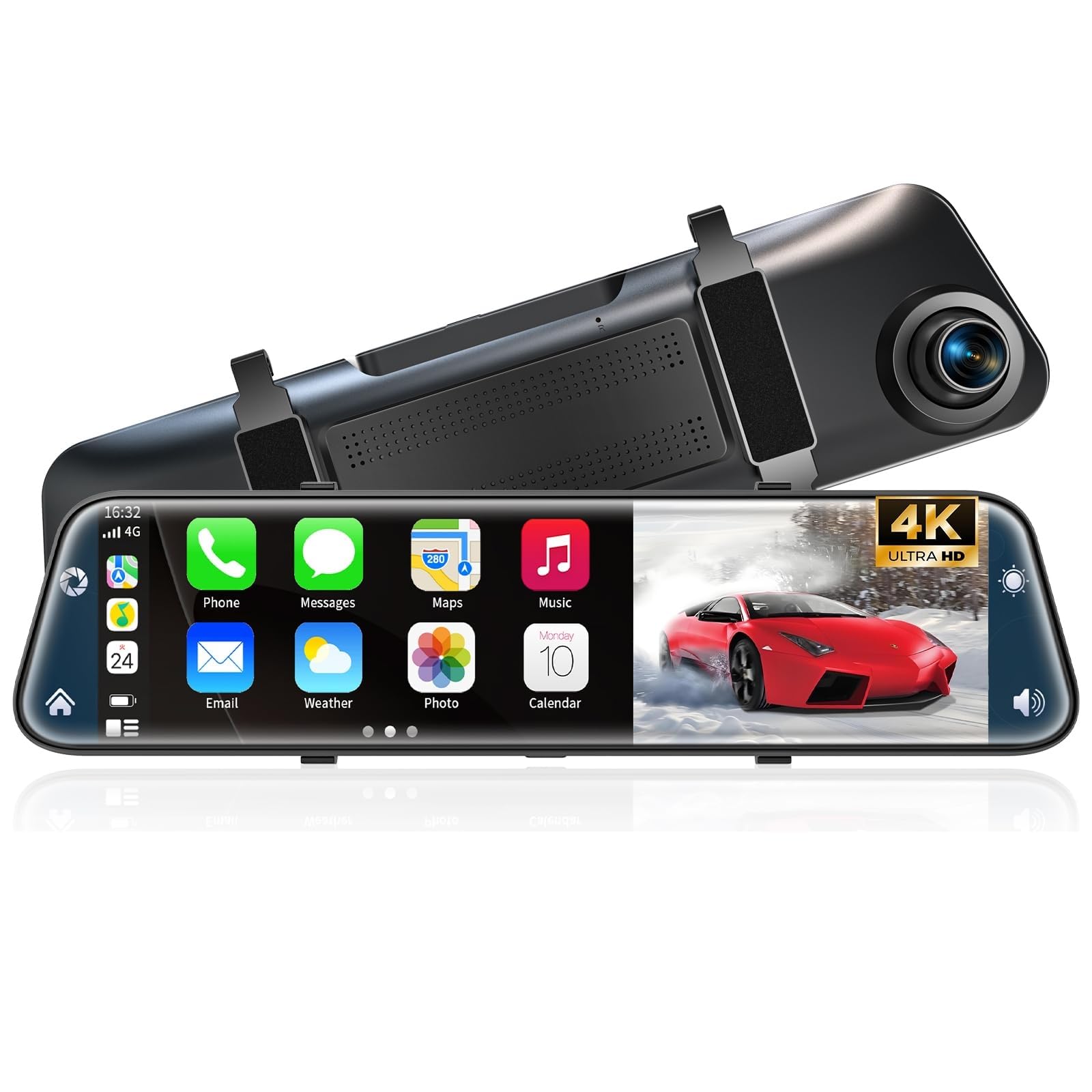
2. 4K Rear View Mirror Camera with Carplay and Android Auto, 12″ Mirror Dash Cam
A 12-inch smart screen that turns your mirror into a CarPlay hub with a 4K front cam.
If you want your mirror to do far more than show the road behind you, this is the most feature-dense option in the lineup. It pairs wireless CarPlay and Android Auto through Bluetooth, so you can pull up maps, music, and calls on a 12-inch IPS touchscreen without ever touching your phone. Voice control lets you keep your hands on the wheel while you navigate or change tracks.
The camera combo is strong: a 4K front unit with a 170-degree view pairs with a 1080P rear camera on a 140-degree lens. Because the screen is far larger than the AUTO-VOX above — 12 inches vs 9.35 inches — you can run split-screen and watch the front and rear feeds at the same time. A built-in G-sensor locks footage on sudden impact, and the included 64GB card starts recording the moment you power on.
Customers note the 4K picture is “just perfect day and night” and that installation took about 15 minutes, made possible by the strap-on design that wraps over your existing mirror. One catch to check before ordering: the product needs a rearview mirror longer than 16cm (6.3 inches) for the straps to grip, and it cannot be used as an ordinary reflective mirror when the screen is off. The rear fisheye effect is extreme enough that you will still rely on your side mirrors for judging distance.
Swiss-army mirror: The combination of a 4K front cam, wireless CarPlay, and a backup cam on one large screen is genuinely hard to match at this level — ideal for older cars lacking a factory screen or camera.
Watch the details: Measure your mirror first, and know that leaving it on a hot power outlet can drain the battery over days; an ignition-switched fuse tap fixes it.
Reach for this if: You want smartphone-style navigation and apps on your mirror, not just a camera feed.
Look elsewhere if: You want a clean OEM factory look — this is a strap-on unit that sits over your current mirror.
3. REDTIGER Mirror Dash Cam Backup Camera 11” UHD 4K
An 11-inch touchscreen with built-in GPS tracking that records speed and location on every trip.
This REDTIGER T700 earns the value spot because it bundles a feature most rivals charge extra for: a GPS module that logs your location, live speed in MPH or KMH, and direction on the recorded footage. If you ever need to prove exactly where and how fast you were driving, that evidence is built into the video, replayable through the dedicated GPS player.
The cameras deliver a 4K 3840*2160P front feed and 1080P rear feed, with a 170-degree front lens and 150-degree rear lens that shrink blind areas on both sides. The 11-inch touchscreen flips automatically to the rear camera when you shift into reverse, with an adjustable parking line you can drag to match your vehicle. Since the rear camera supports a 180-degree flip, you can mount it upside down — a real convenience for pickup trucks and RVs where the factory mount position is awkward.
For low-light driving, the F1.5 aperture and 6-glass lens with WDR and HDR technology keep night footage clear. The free 32GB card handles loop recording from the start, and a G-sensor locks clips on impact. Owners highlight camera quality above all — it is the most-praised feature by a clear margin — and one enthusiastic owner installed a second unit for a side view. The honest downsides: video files sometimes need a system restart to appear in the menu, and the screen buttons vanish after three seconds, which takes getting used to.
The GPS deal: Speed-and-location logging plus 4K front recording at this price is the standout value in the whole list, especially for anyone who wants collision evidence.
Minor friction: The menial menu quirks are real but small — you adapt within a week of daily driving.
Best for: Budget-conscious buyers who want GPS tracking and 4K recording without paying premium prices.
Think twice if: You cannot stand fiddly software — the file-management quirks will bother you more than most.
4. Pelsee Mirror Dash Cam with STARVIS 2 Sensor

Full-color night vision with AI that keeps license plates sharp when other cams go black and white.
Night driving is where this Pelsee separates itself. The STARVIS 2 sensor is engineered for low light, and the AI-powered full-color night vision preserves true color instead of switching to grayscale like ordinary cameras. That means you see vivid, detailed footage during time-lapse parking surveillance — a real security advantage if your car sits outside at night.
The 4K front camera records at 25fps with HDR, and the 1080P rear camera uses WDR on a 160-degree wide-angle lens. When you shift into reverse, the 12-inch screen automatically shows the live rear view with dynamic parking guidelines, and audible alerts warn you about nearby obstacles. It is a strong fit for large vehicles — buyers with a Toyota Sienna report a wide, bright rear view that makes backing a big van noticeably easier.
Beyond the camera, this mirror adds ADAS alerts (advanced driver-assistance systems that warn you about lane departure, forward collision, and pedestrians) plus voice commands like “Take Picture” and “Lock the Video.” The 5.8GHz Wi-Fi 6 connection pushes transfers up to 20MB/s, so pulling footage to your phone via the Pelsee app is fast. The recurring owner praise centers on video quality and how straightforward the install is. Two fit notes: the glossy reflective screen can annoy in bright sun, and if your rearview mirror is bulky the included straps may be too short — the optional OEM bracket solves that.
The night specialist: Color night vision and a STARVIS 2 sensor make this the pick for drivers who regularly navigate unlit roads or park in the dark.
Fit first: Verify your mirror size against the 6.3-inch minimum before buying, or you will need the separate bracket.
Reach for this if: You want the best low-light rear visibility and driver-assist alerts in the mid-range tier.
skip it if: Your mirror is small or oddly shaped — the strap-fit check matters more here than on most rivals.
5. WOLFBOX G850 PRO 4K Mirror Dash Cam

A 12-inch screen with a dedicated blind spot detection algorithm that watches the lane beside you.
WOLFBOX is among the most proven names in mirror cams, and the G850 PRO adds a safety layer most rivals skip: an enhanced BSD (blind spot detection) algorithm. It monitors the area your mirror cannot see during lane changes, alerting you to approaching vehicles and potential rear collisions — buyers with a Jeep Wrangler found this year-round rear visibility a major upgrade over the factory setup.
The camera system records front 2160P (2560*1440) at 30fps and rear 1080P at 25fps, both on a 12-inch IPS touchscreen. The 170-degree front lens is among the widest here, and WDR/HDR keeps details sharp when you pass through shadows or face direct sunlight. A 64GB card is included with loop recording, and the external GPS antenna logs location and speed.
Voice control covers 12 commands like “turn on WiFi” and “lock the video,” so you can manage recording without reaching for the screen. The 5.8GHz Wi-Fi pairs with the WOLFBOX app for quick clips. Owner feedback is consistently strong on image clarity and how easy the plug-and-play install is. The honest notes: the screen can struggle with brightness in strong daylight, and ADAS alerts are sensitive even on the low setting — some owners dial them down to avoid false warnings.
Safest lane-changer: The BSD alerts give this a genuine safety edge over mirrors that only show a picture, making it ideal for highway commuters and larger vehicles.
Not perfect: The daytime brightness ceiling and sensitive ADAS are the two things owners mention most — both are manageable in settings.
Best for: Drivers who change lanes constantly and want active blind spot warnings on top of a clear rear view.
Who it is not for: Anyone who wants a traditional reflective mirror function — this is a screen-first device, and losing the glass mirror takes adjusting.
6. AUTO-VOX Dual 2K OEM Rear View Mirror Camera with Carplay V6
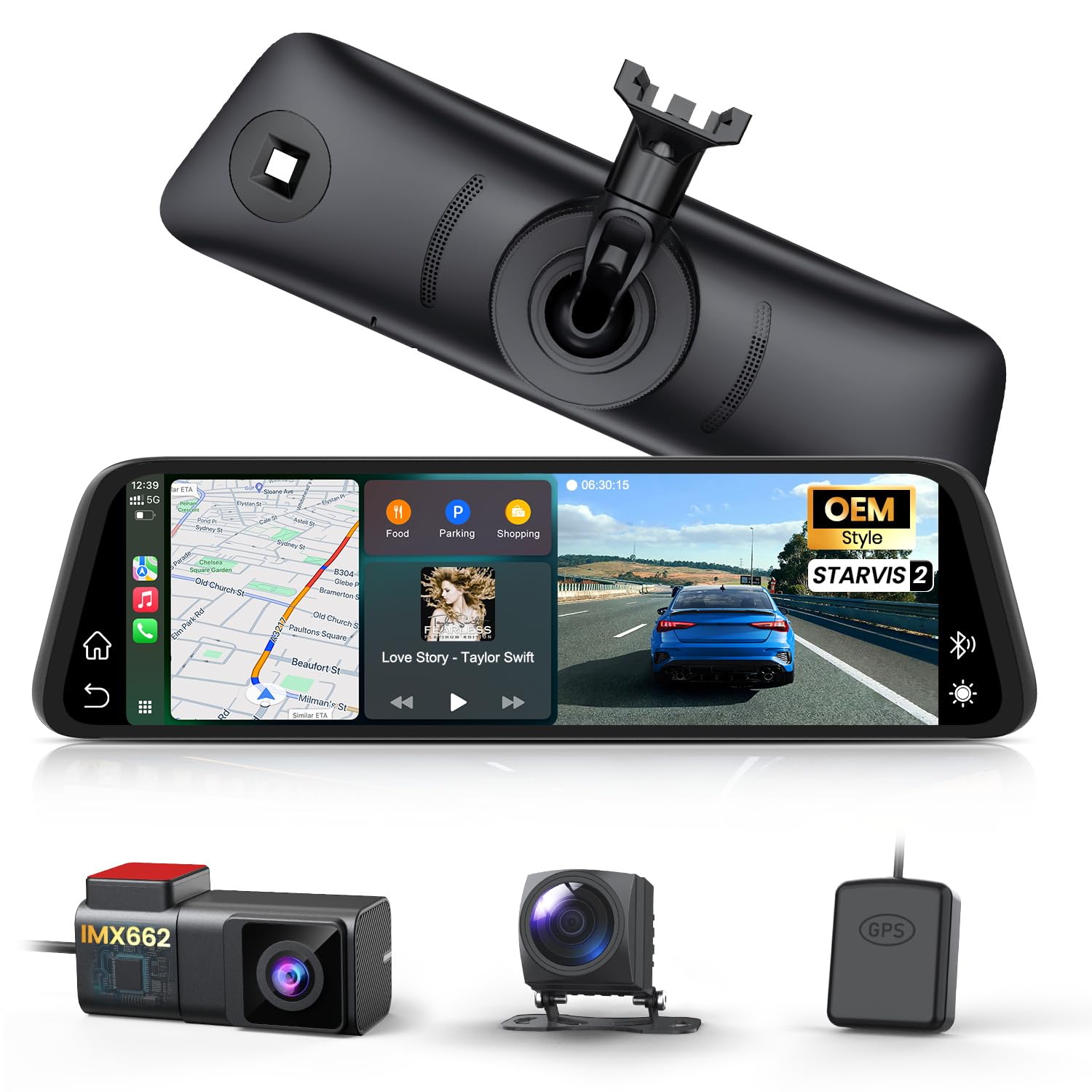
A factory-clean OEM mirror with 2K dual cameras and wireless CarPlay in a no-glare touch screen.
For truck and SUV owners who want the premium factory look, the V6 is the strongest OEM-style option here. It replaces your original mirror in the factory position with no straps or dashboard clutter, and the four included bracket adapters fit most vehicles. This is the cleanest way to add a digital mirror if you cannot stand the strap-on look.
The dual cameras each record crisp 2K video, and the HDR plus WDR processing stops rear headlights from washing out the image at night. Auto brightness adjusts the 9.36-inch touch screen to surrounding light, dimming smoothly after dark to cut glare and eye fatigue. Wireless CarPlay with voice control handles directions, calls, and music without you ever touching the screen.
Unlike most rivals, the V6 uses a separate front camera instead of one built into the mirror body. That split design means the front lens is never blocked by sun visors or mirror housings, so you can place it where the view is natural. Owners praise the build quality and the vibrant, wide-angle picture, and the install is straightforward for a factory-style unit. One note: a few reviewers point out occasional reverse-function quirks, and there is no Wi-Fi app for pulling videos — you remove the SD card to access footage.
Factory feel: OEM mounting plus 2K dual recording plus CarPlay makes this the most polished all-in-one for drivers who care how their cabin looks.
Missing app: If you expect to grab clips over Wi-Fi, the SD-card-only retrieval here will feel dated.
Reach for this if: You want a built-in appearance, 2K recording on both ends, and CarPlay without a phone mount.
Think twice if: You rely on app-based video management — this unit does not stream to your phone.
7. AZDOME PG17 Pro STARVIS 2 Mirror Dash Cam
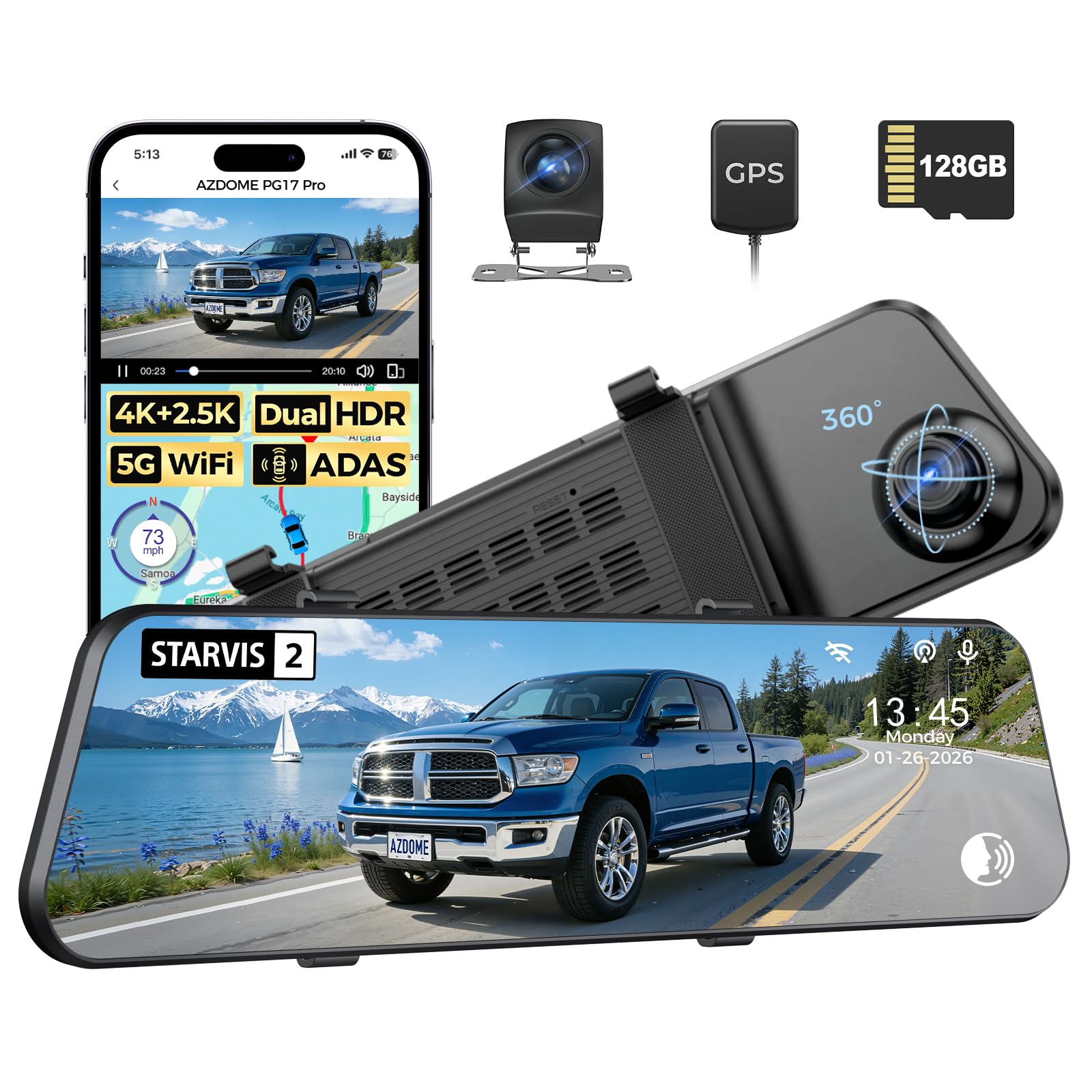
A 4K front and 2.5K rear combo with a STARVIS 2 sensor for premium low-light detail.
The PG17 Pro steps up the rear camera game. While many mirrors cap the rear feed at 1080P, this one records 2.5K HDR from behind — which means sharper detail on number plates and signs when you are backing up. The front camera captures 4K UHD, and both channels use the STARVIS 2 IMX678 sensor to stay bright on dark roads, so you get evidence-grade clarity in low light.
The 12-inch LCD screen covers a 170-degree field of view, and ADAS provides real-time collision and lane-departure warnings as a watchful co-pilot. A 128GB memory card ships in the box, so you are recording immediately, and the 5.8GHz Wi-Fi makes downloading accident footage quick. Voice control lets you snap photos or switch camera views hands-free.
Owners consistently note the large rearview screen and clear picture quality as the highlights, and install is manageable — one buyer had the front clip-on done fast and the rear camera in about 30 minutes total. The mixed feedback centers on visibility: in bright sun, some drivers see glare on the screen, and a couple of owners had trouble pairing Bluetooth with their phone. For the price, sharp rear detail is the defining reason to pick it over a 1080P rear rival.
Detail on backup: The jump from 1080P to 2.5K on the rear camera is the clearest reason to choose this over mid-range mirrors — that extra resolution shows in every reverse.
Glare caveat: Test the screen angle in sunlight before you finalize the install, since glare is the point owners most often flag.
Best for: Drivers who want premium rear-camera sharpness and 4K front recording without paying the very top price.
Skip if: You need flawless Bluetooth phone pairing — connectivity is the least reliable part of the experience here.
8. WOLFBOX G900 PRO Mirror Dash Cam with 8MP STARVIS IMX678
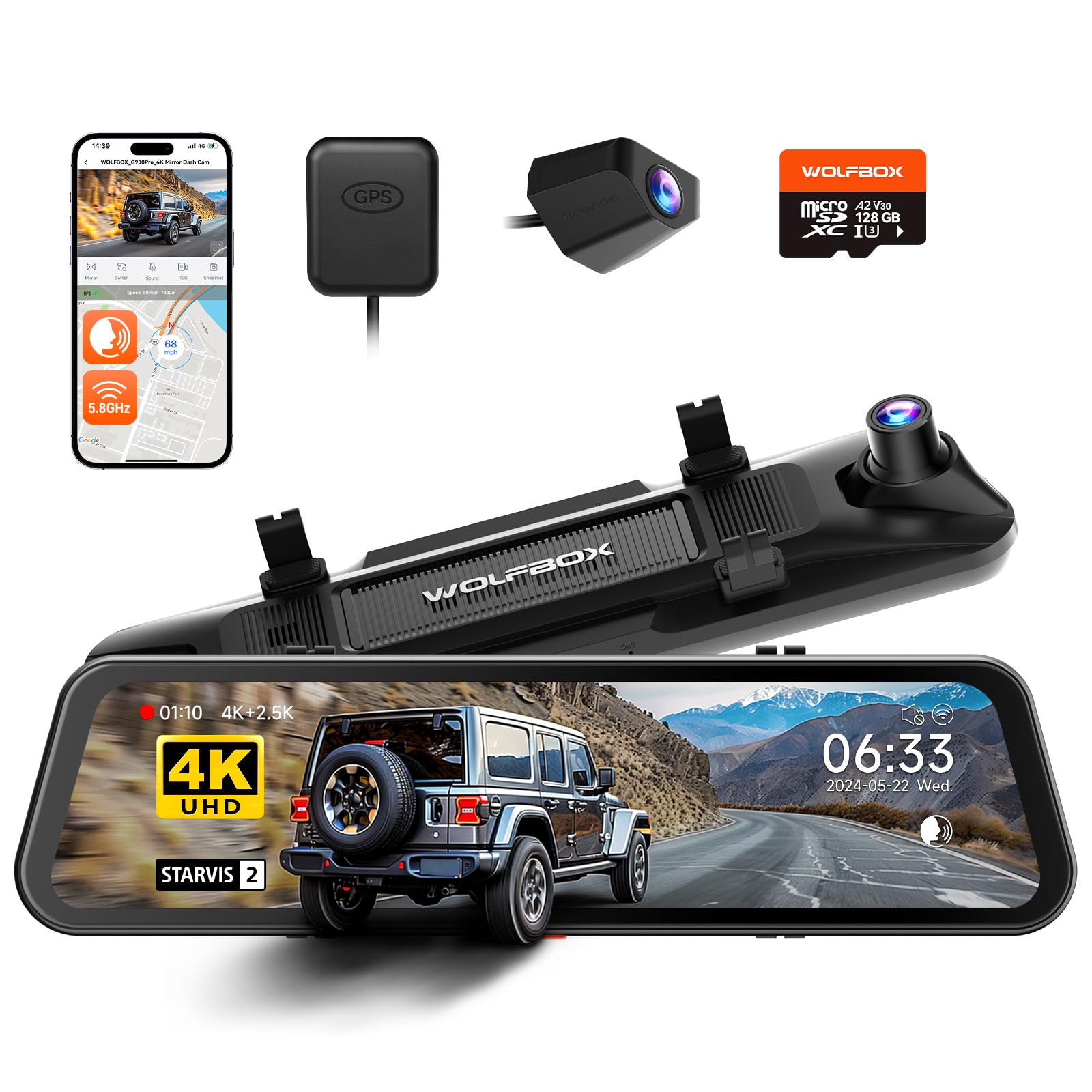
The sharpest rear feed of the WOLFBOX line, with an 8MP STARVIS 2 front sensor for dark-road clarity.
This is WOLFBOX’s top-tier mirror, and the headline is the sensor lineup. The front camera uses an 8MP STARVIS 2 IMX678 sensor — the same low-light champion found on premium dash cams — paired with a 7-glass lens, so night footage stays clear even on unlit highways. The rear camera jumps to 2.5K at 30fps, a meaningful step up in detail from the G850 PRO’s 1080P rear feed.
Both channels are 4K and 2.5K respectively, recording at 30fps, and the 12-inch LCD gives you a wide 170-degree view of the road behind. Shoppers say the rear video feed is noticeably brighter and sharper than the G850, landing close to factory digital mirror quality in the Toyota line. A 128GB card is included, and the unit supports cards up to 512GB if you want more storage.
The 5.8GHz Wi-Fi pairs with the WOLFBOX app for fast downloads, and voice control handles key functions with your eyes on the road. A rear camera with adjustable zoom and angle means you can dial in the exact view you want. The most-praised feature across owners is overall quality, with video clarity close behind. Honest caveats: night footage weakens on pitch-black roads where only headlights exist, zoomed images pixelate, and the depth perception takes adjustment since distances look different than through glass. One owner noted the power cable can be too short for the center console outlet in some vehicles.
The clarity upgrade: The jump in rear sharpness over the G850 makes this the best WOLFBOX for anyone who wants maximum detail behind the car.
Reality check: On fully dark roads, no sensor is magic — expect the footage to rely on your own headlights.
Reach for this if: You want the strongest low-light sensor and the sharpest rear camera WOLFBOX offers.
Look elsewhere if: Your vehicle has a short run to the power outlet — check cable length first to avoid an extension purchase.
9. Pelsee 4K+2.5K Mirror Dash Cam P12 Pro Max
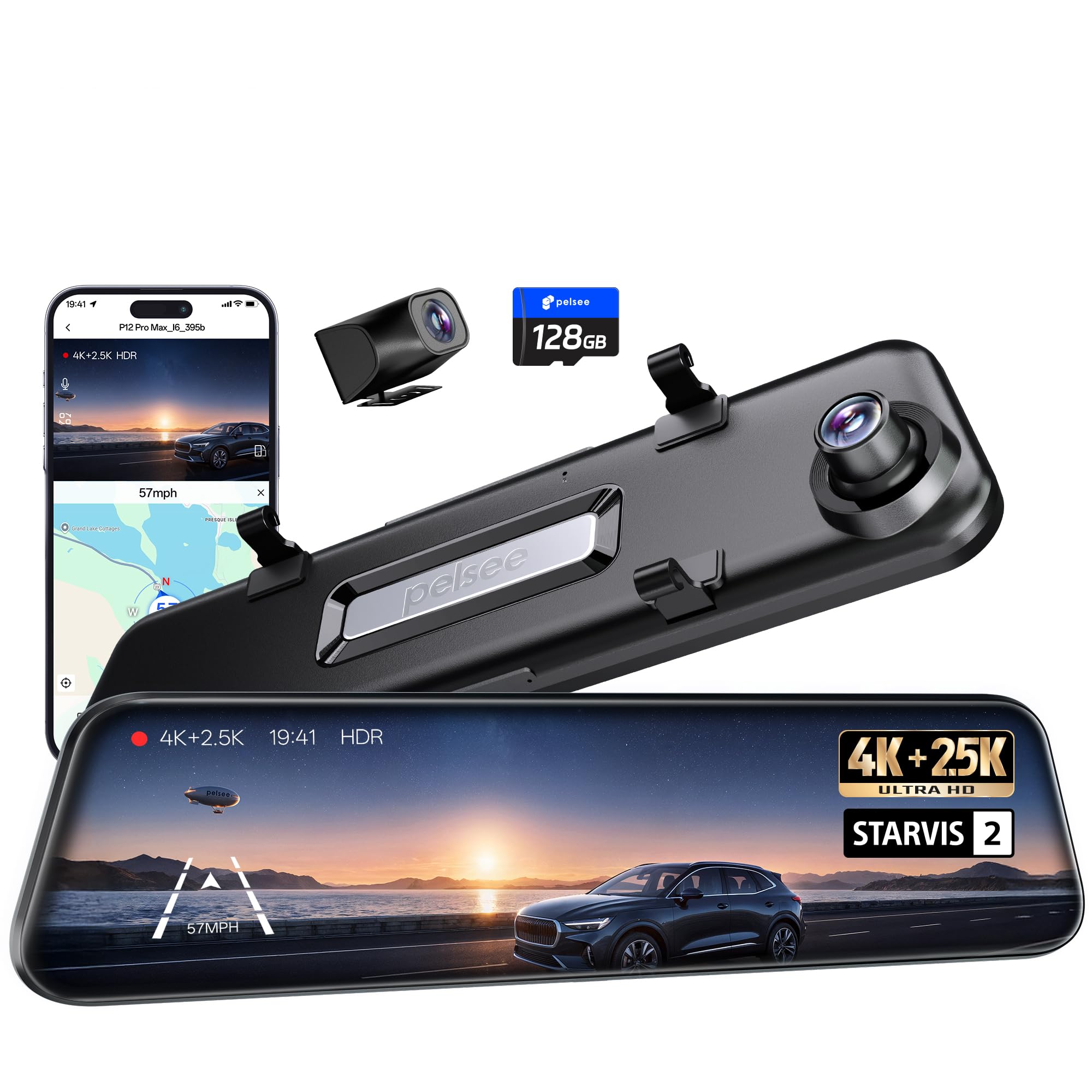
A dual-STARVIS flagship with the OBD hardwire kit included for true 24/7 parking surveillance.
This is the mirror that skips the guessing on parking mode. Most rivals make you buy a separate hardwire kit for 24-hour monitoring — the P12 Pro Max includes the OBD power cable right in the box, plugging into your car’s OBD-II port (the standard diagnostic port under your dashboard) with low-voltage protection so it will not drain your battery. For overnight street parking, that is a meaningful, out-of-the-box advantage.
The sensor pairing is flagship-grade: the front uses the STARVIS 2 IMX678 for true 4K at 30fps, and the rear uses the STARVIS IMX335 to record 2.5K. Both handle brutal light transitions — harsh backlight, tunnel entries — with HDR on the front and WDR on the rear. The factory-look design means when the screen is off, it passes as a normal mirror, which owners say looks like standard equipment.
Beyond parking and sensors, the P12 Pro Max adds BSD blind spot detection with visual and audible alerts during lane changes, plus ADAS warnings for front vehicle start, lane departure, and collisions. A 128GB card is included, and the rear cable runs 33 feet — long enough for big SUVs and trucks without an extension. The 5.8GHz Wi-Fi hits transfer speeds up to 20MB/s. Owners with a 12-passenger Sprinter van found the wide rear view solved their blocked visibility entirely, and the install via the OBD port is notably easy. The rare complaints: an occasional software hiccup that flips the rear camera orientation, and the unit runs warm enough that one reviewer noted a small heatsink.
Plug-and-play parking: The included OBD hardwire kit is the single best reason to choose this flagship — parking surveillance works the day you install it, not after a separate purchase.
Software edge case: The rear-image flip bug is real but rare, and a firmware update addressed it for most owners.
Best for: Drivers who want premium dual-sensor clarity plus immediate 24/7 parking monitoring without buying extra parts.
Think twice if: You want the absolute largest aftermarket ecosystem — this pair of Pelsee flagships is excellent on its own but uses its own mounting standard.
Understanding the Specs
Field of View
This is the width of the scene the rear camera captures, measured in degrees. A 140-degree lens covers a typical lane; 170 degrees stretches wider to show more curb and cross-traffic on both sides. The widest lenses shrink blind spots but can make straight lines look curved, which is why some drivers prefer a narrower view for judging distance. For most people, 150 to 160 degrees hits the balance between coverage and natural perspective.
STARVIS and Low-Light Sensors
STARVIS is a Sony sensor technology built to perform in low light, and STARVIS 2 is the newer generation that captures roughly twice the light of standard sensors. In plain terms, a STARVIS-equipped mirror keeps the rear image bright and colorful on dark streets where an ordinary camera would go grainy or switch to black and white. If you regularly drive at night or park in unlit areas, this is the single most important spec to prioritize.
Parking Monitor and Hardwire Kits
A parking monitor lets the camera keep recording after you leave the car, but the mirror’s cigarette-lighter power shuts off with the ignition. To run 24/7, you need a hardwire kit that taps into constant power — either through your fuse box or an OBD-II port. Some premium models include this kit in the box, while most charge extra. Check for low-voltage protection, which stops the system from draining your battery below a safe level.
Loop Recording and G-Sensor
Loop recording writes video continuously, overwriting the oldest open up files when the memory card fills so you never run out of space. The built-in G-sensor detects sudden impacts from a collision or bump and locks that footage into a protected folder that loop overwriting cannot touch. Between the two, you get endless recording plus guaranteed preservation of the moments that matter most.
FAQ
Will a video rearview mirror fit my car?
Can I use a video rearview mirror as a normal mirror?
What is the difference between a strap-on and an OEM-style mirror?
Do video rearview mirrors record while I drive?
How do I get 24-hour parking monitoring?
What does a wider rear field of view do for me?
Is a 2.5K rear camera worth paying extra for?
Do these mirrors work with CarPlay or Android Auto?
Final Thoughts: The Verdict
For most drivers, the video rearview mirror winner is the AUTO-VOX OEM 9.35” because it is the most dependable, cleanly-installed live rear view with the strongest owner satisfaction in the lineup. If you want smartphone-style CarPlay and a huge 12-inch screen, grab the KOUENOM 4K mirror. And for premium night vision plus included 24/7 parking monitoring, the Pelsee P12 Pro Max is the one to reach for. Across the list, the crowd’s verdict is clear — with well over 700 owners rating the top pick at 4.4 stars, the AUTO-VOX is the safest purchase for most first-time buyers, while power users looking for extra features will find excellent depth at every price tier.
How We Picked
We do not accept paid placement. Every pick is matched to a real buyer and a real use-case; we do not hands-on test units.
Sources & Methodology
Specifications: manufacturer listings and product documentation. Review insights: verified customer reviews, as of August 2026. Pricing: not shown on this page (it changes often); check the current price via the retailer link.
As an Amazon Associate, GoCarLife earns from qualifying purchases. This does not affect which products we feature.