
Our readers keep the lights on and the garage heater humming. As an Amazon Associate, I earn from qualifying purchases.
Specs are compiled from manufacturer listings and verified buyer reviews and can change over time — please confirm the key details on the product page before buying.
A dash cam’s footage can settle an insurance claim in minutes instead of weeks. The best models capture readable license plates, a wide field of view, and clear night footage. This guide ranks the top video cameras for automobiles based on real-world performance.
I’m Mo Maruf — the founder and writer behind GoCarLife. This guide is built by comparing the manufacturers’ published specifications and the patterns across verified customer reviews, so you get each pick’s real strengths and trade-offs instead of marketing spin.
Your car deserves a witness that never blinks, and the best video cameras for automobiles offer sharp 4K footage, reliable night vision, and easy app access to back you up on every drive.
Our Picks at a Glance

How To Choose The Best Video Cameras for Automobiles
Dash cams are built to survive crashes and provide clear evidence. Match the camera’s channel count and night vision to your driving and parking habits.
Count the Channels: Front, Rear, and Cabin
A single front camera is the baseline, but a rear camera captures the car behind you, which is often the guilty party in a rear-end collision. Adding an interior lens covers rideshare drivers, taxi work, and any dispute inside the cabin. Three channels provide near-360° coverage around the vehicle.
Look at the Lens, Not Just Resolution
4K sounds impressive, but the lens’s aperture (how much light it lets in, shown as F-number) and the sensor type control night-time sharpness. A lower F-number like F1.6 or F1.55 lets in more light, so plates stay readable in the dark. Sensors like Sony STARVIS 2 are built specifically for low-light recording.
Decide How You’ll Use Parking Mode
If you street-park or worry about hit-and-runs, parking mode records while the engine is off. The catch is that most dash cams need a hardwire kit (sold separately) wired to your fuse box to run 24/7 without draining the battery. Factor that extra cost and installation effort into your plan.
Quick Comparison
| Model | Best For | Channels | Front Resolution | Night Vision | Amazon |
|---|---|---|---|---|---|
| TERUNSOUl 4K 3CH★ Best Overall | All-around family protection | 3 (Front/Rear/Cabin) | 4K UHD | Starlight F1.6 + HDR | Amazon |
| VIOFO A229 ProTop Performer | Enthusiasts wanting top HDR | 3 (Front/Rear/Inside) | 4K | STARVIS 2 + IR LEDs | Amazon |
| ROVE R2-4K Dual PROPremium Pick | Power users and fleet drivers | 2 (Front/Rear) | 4K | STARVIS 2 + F1.7 | Amazon |
| Milerong X25 | Rideshare and taxi drivers | 2 (Front/Inside) | 1080P | IR lights + WDR | Amazon |
| WOOLAACOO C5 | Value dual-camera buyers | 2 (Front/Rear) | 4K | F1.8 aperture | Amazon |
| 70mai A800SE | Sharp daylight 4K | 2 (Front/Rear) | 4K | F1.55 + Dual HDR | Amazon |
| 70mai T800E | Full 3-channel rideshare | 3 (Front/Rear/Inside) | 4K | Switchable IR + HDR | Amazon |
| FAIMEE F9 | Wide six-lane coverage | 2 (Front/Inside, Rear) | 4K UHD | F1.8 + WDR | Amazon |
| REDTIGER F17 Elite | Full-color night parking | 3 (Front/Rear/Inside) | 4K | STARVIS 2 Color | Amazon |
In‑Depth Reviews
1. TERUNSOUl 4K 3CH Dash Cam
Our pick — over 4.5★ from 350+ verified ratings; the strongest balance of quality and price.
The triple-lens defender that wraps your car in near-360° evidence for family trips, rideshare, or daily commutes.
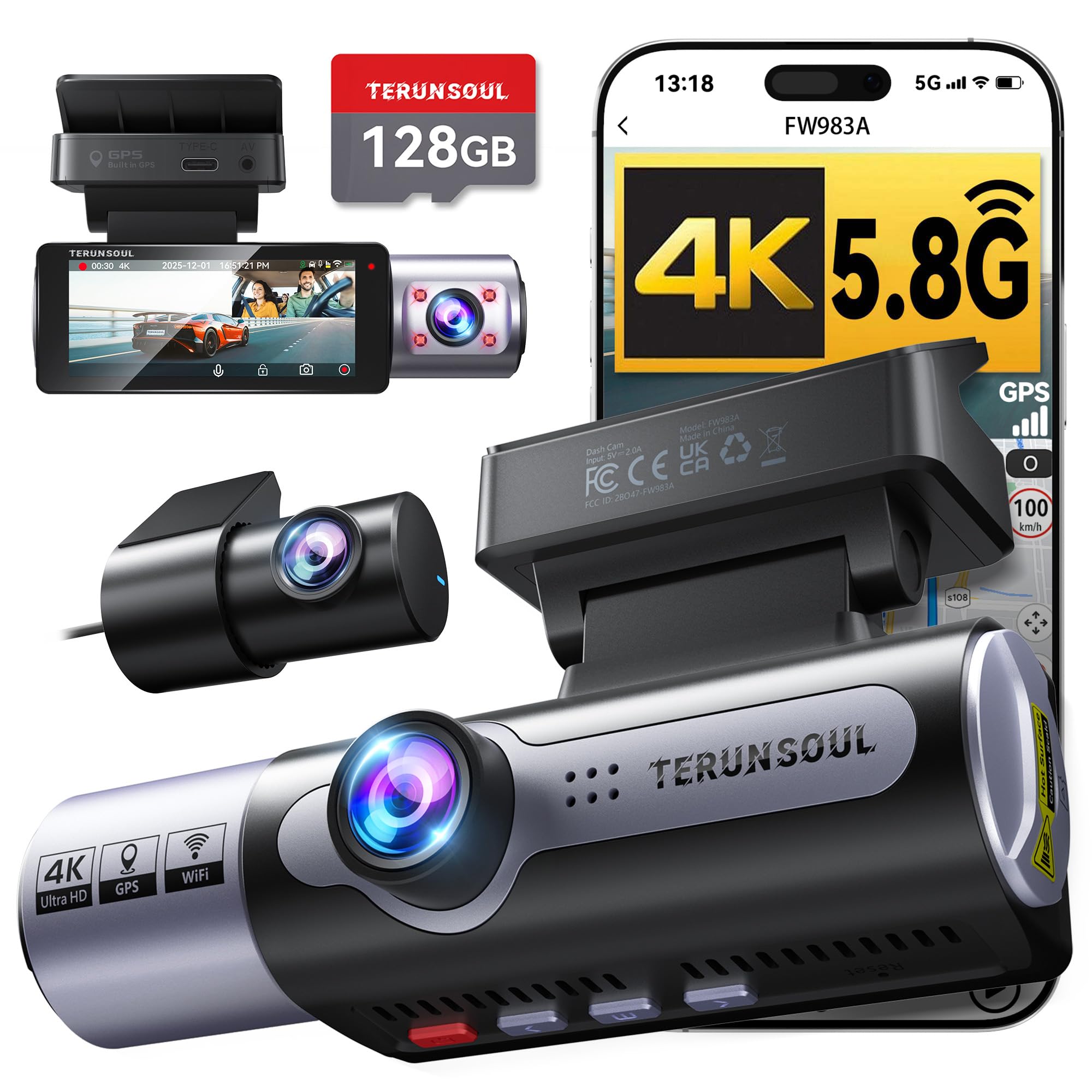
What wins people over here is the three-camera setup firing at once: a 4K front, 1080P rear, and 1080P cabin view. The front camera’s 170° ultra-wide angle pairs with a 165° angle on the rear and cabin lenses, so you capture both the road and what happens inside the car simultaneously.
You get clear footage even on dark roads, because the front lens uses a starlight-grade five-layer design with an F1.6 aperture (a wide opening that lets in more light) plus HDR (high dynamic range, which balances bright and dark areas). Buyers report sharp day and night video, with the three-angle view covering more surroundings.
It ships with a 128GB memory card, built-in GPS that embeds speed, location, and timestamp into footage, and dual-band 5.8GHz & 2.4GHz WiFi for quick app downloads at 20MB/s. The collision sensor auto-locks footage when it detects a severe impact. You will need a separate hardwire kit for parking mode, which is standard for this feature across most dash cams.
Why It Leads
- True triple-channel 4K + 1080P + 1080P recording
- Starlight F1.6 aperture keeps nighttime plates readable
- 128GB card, GPS, and 5.8GHz WiFi all included
Before You Buy
- Parking mode requires a separately-sold hardwire kit
- Rear cable length gets tight in larger SUVs
Reach for this if: you want one complete package covering front, rear, and cabin without hunting for extra parts, all backed by a sharp 4K front camera.
Look elsewhere if: you only need a simple front-and-rear setup and do not value the interior cabin lens for rideshare or family monitoring.
2. VIOFO A229 Pro 4K 3CH
Enthusiast-grade imaging with dual STARVIS 2 sensors and HDR on all three channels, from a brand familiar to dash cam veterans.
The A229 Pro throws two flagship Sony STARVIS 2 sensors — IMX678 and IMX675 — at the problem of clear evidence. You get 4K from the front camera, 2K from the rear, and 1080P from the cabin camera, with HDR tuned across all three for balanced highlights and shadows.
Inside, an IR light sensor flips on four infrared LEDs when the cabin goes dark, capturing sharp black-and-white detail even in complete darkness. A quad-mode GPS module locks onto GPS, BEIDOU, GALILEO, and GLONASS satellites for precise location, speed, and timestamp data when you review footage.
Hands-free control is a highlight — 12 voice commands handle tasks like locking video or toggling WiFi without touching the unit. A CPL (Circular Polarizing Lens) is included and fixes to the front lens to cut glare from glass and road surfaces. Note there is no SD card in the box, so factor in a high-endurance card.
top-tier imaging: The dual STARVIS 2 sensors (Sony’s low-light image chips) with HDR on every channel keep number plates readable even when you’re driving fast, which is a genuine step above most rivals.
One honest caveat: The camera needs its included charger and cable to run reliably, and the screen can be hard to view on a sunny windshield.
Choose this for: maximum video fidelity and the flexibility of three parking modes with buffered event capture.
skip it if: you want a ready-to-run kit straight from the start — you will need to buy an SD card and likely a hardwire kit separately.
3. ROVE R2-4K Dual PRO
The spec-sheet powerhouse pairing Sony’s newest sensors with WiFi 6 transfers that make pulling 4K clips painless.
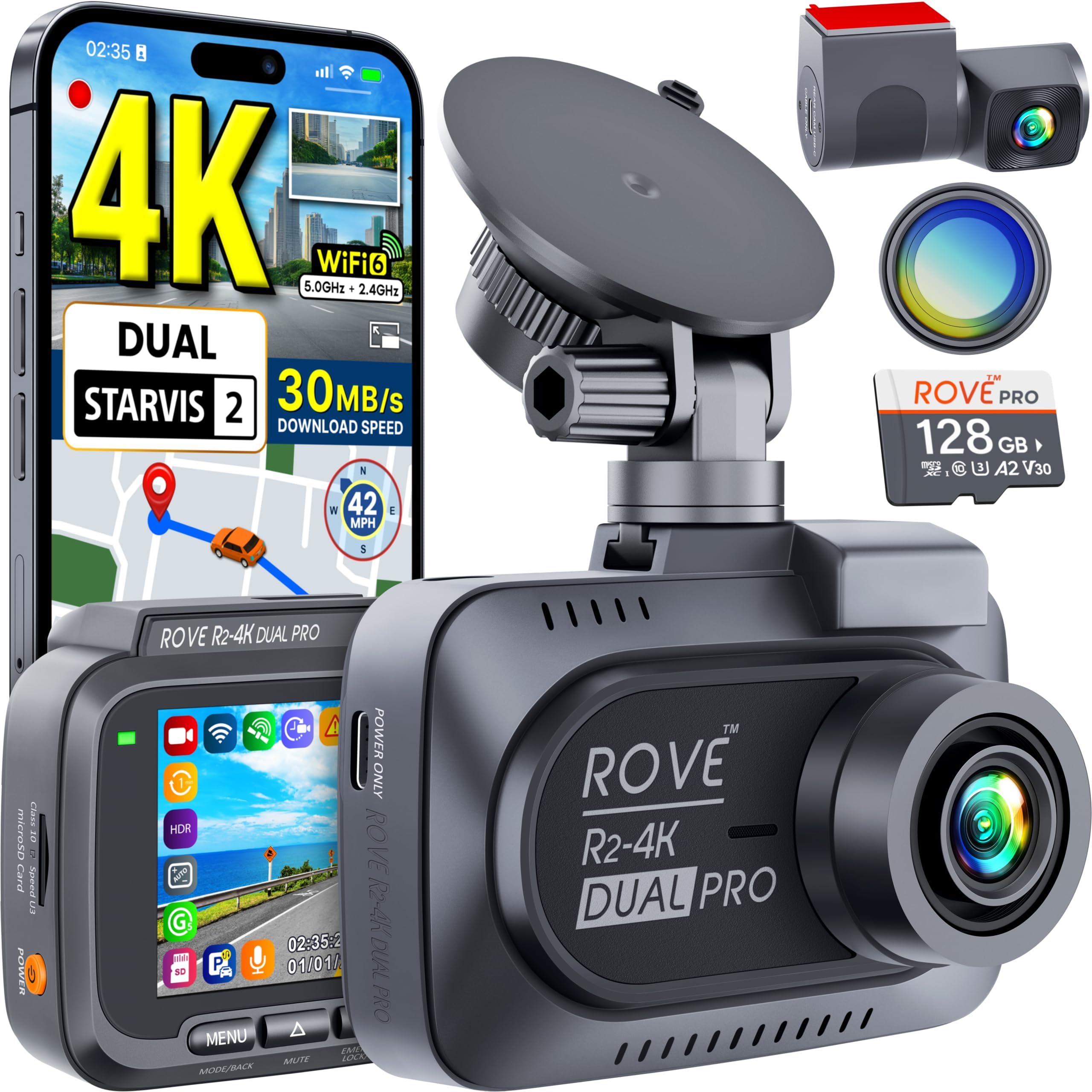
ROVE packs Sony’s IMX678 (8MP) front sensor and IMX675 (5MP) rear sensor into this dual cam, producing 4K front footage at 30fps and 2K rear footage at 30fps. The front lens opens to F1.7 while the rear uses F1.55, both paired with HDR to fight motion blur and glare in tunnels or rain.
Wireless transfer is the standout daily convenience. Dual-band WiFi 6 on 5GHz and 2.4GHz moves videos at up to 30MB/s through the ROVE app, so you are not waiting around in the car to grab a clip. Built-in quad-mode GPS tracks live speed, compass, and timestamp, and the free GPS player replays routes with a full overlay.
The box is generous: a 128GB ROVE PRO microSD card, a CPL filter (a polarizing filter that cuts windshield glare), a suction mount, plus a spare 3M sticky mount. It supports cards up to 1TB, so you can record for days without swapping. Owners praise the crisp day and night footage, especially at night.
Built for heavy use: The 24-hour parking monitor offers time-lapse, motion, and collision detection modes, with a voice alert when you return to the car.
The trade-off: The app takes a little time to learn, and 4K files fill storage fast enough that some owners upgrade beyond the included 128GB card.
Ideal for: drivers who want flagship-grade sensors, fast WiFi, and a complete accessory kit without the need for a separate card or filter purchase.
Not for: buyers who never review footage — the premium price only pays off if you actually pull and use the 4K clips.
4. REDTIGER F17 Elite
The night owl that records in real color after dark, not the grainy black-and-white most dash cams settle for.
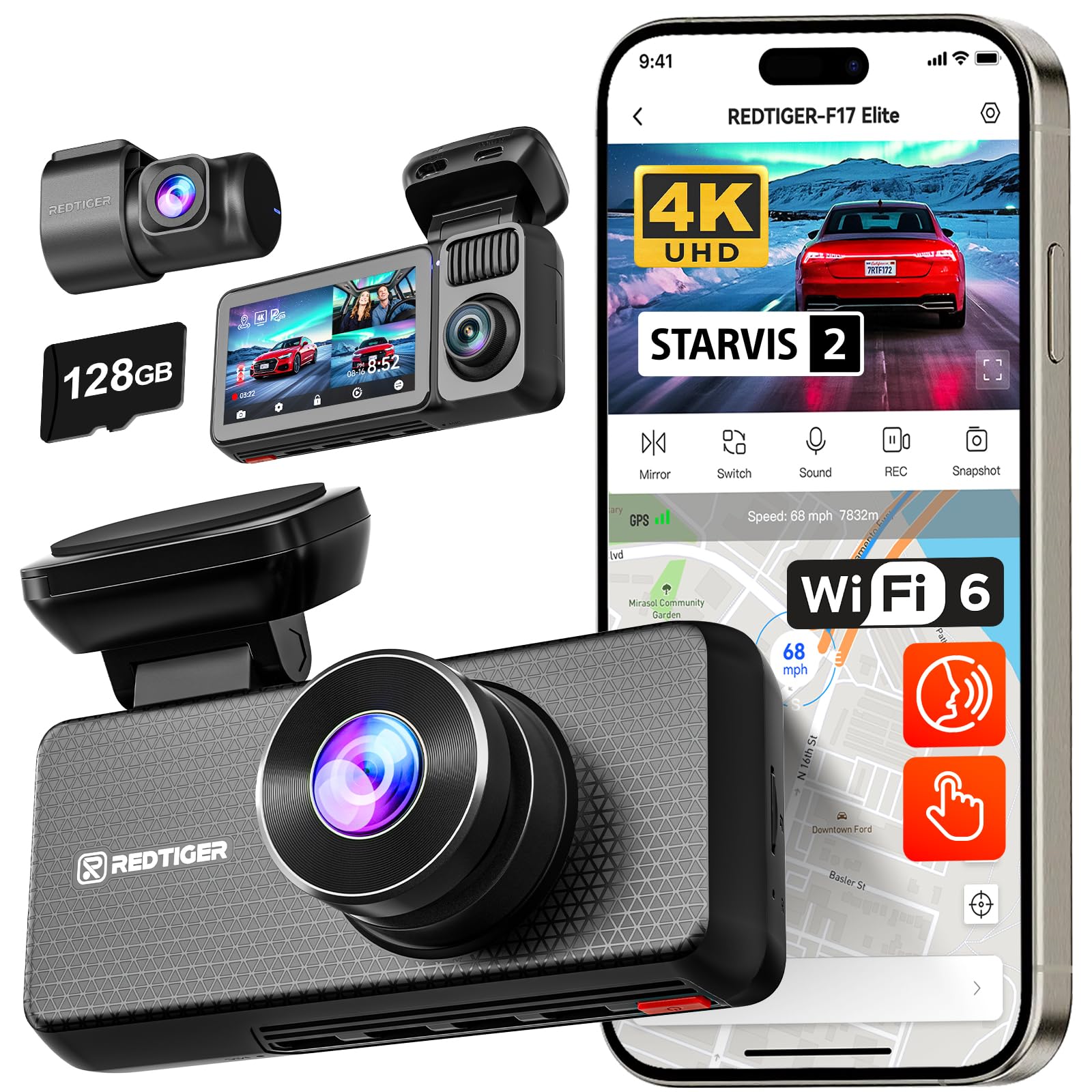
Traditional dash cams flip to monochrome infrared at night, but the F17 Elite keeps full color on both front and cabin cameras. Sony STARVIS 2 sensors — an 8MP IMX678 in the front and 4MP IMX675 in the rear — plus HDR image processing keep low-light footage sharp and colorful instead of washed out.
You get true 4K from the front camera, 2.5K from the rear, and 1080P from the cabin camera across three channels. A 128GB microSD card ships pre-installed, and the unit supports expansion up to 512GB. A super capacitor handles extreme temperatures better than lithium batteries.
Control comes through voice commands, a touchscreen, or the app over 5.8GHz WiFi 6 with downloads up to 30MB/s. A customizable in-car camera toggle lets you maintain privacy when you want it. The 24/7 full-color parking mode needs a hardwire kit, and some owners note the unit may auto-shutdown in extreme heat when parked with windows closed.
What stands out: Full-color night vision is a genuine differentiator — faces and plates stay visible in color rather than grayscale IR.
Worth noting: A few owners mention reliability issues in very hot environments, so heat-prone climates warrant caution.
Best for: rideshare and fleet drivers who need to identify people and plates in color after sunset, with full cabin coverage.
Think twice if: you park in extreme heat for long stretches, as the auto-shutdown protection may interrupt recording.
5. 70mai T800E 3-Channel

A three-camera system built for Uber and Lyft work, with switchable infrared for crisp cabin footage at night.
This 70mai captures a 4K front view, a 1080P interior view, and a 1080P rear view simultaneously. The interior camera features switchable infrared recording — turn it on for clearer night footage inside the vehicle, or off when not needed. Ultra-wide lenses with an F1.55 aperture help visibility day and night.
Built-in 5-mode GPS tracks location, speed, and routes with high accuracy, while WiFi 6 moves files through the 70mai App up to 5× faster than standard WiFi 4, reaching speeds up to 10 MB/s. Hands-free voice control lets you snap photos, start recording, or lock footage without taking your eyes off the road.
It ships with a 64GB SD card and supports expansion up to 512GB. A super capacitor keeps it stable from 14°F to 140°F, avoiding the swelling risks of lithium batteries. Buyers consistently praise the build quality and ease of use, though the app connection can occasionally be finicky.
The defining feature: Quality is the most-praised aspect here — owners call the video clear and the value strong for a three-channel setup.
The catch: All three cameras can fill the 64GB card in under half a day of continuous driving, so plan on a larger card or frequent transfers.
Reach for this if: you drive for hire and need front, cabin, and rear evidence in one tidy unit with voice commands.
Look elsewhere if: you only drive a regular commute — the interior camera adds cost you may never use.
6. 70mai A800SE 4K Dual
Sharp 4K daylight footage with a flexible rear camera that can watch the cabin or the road behind you.
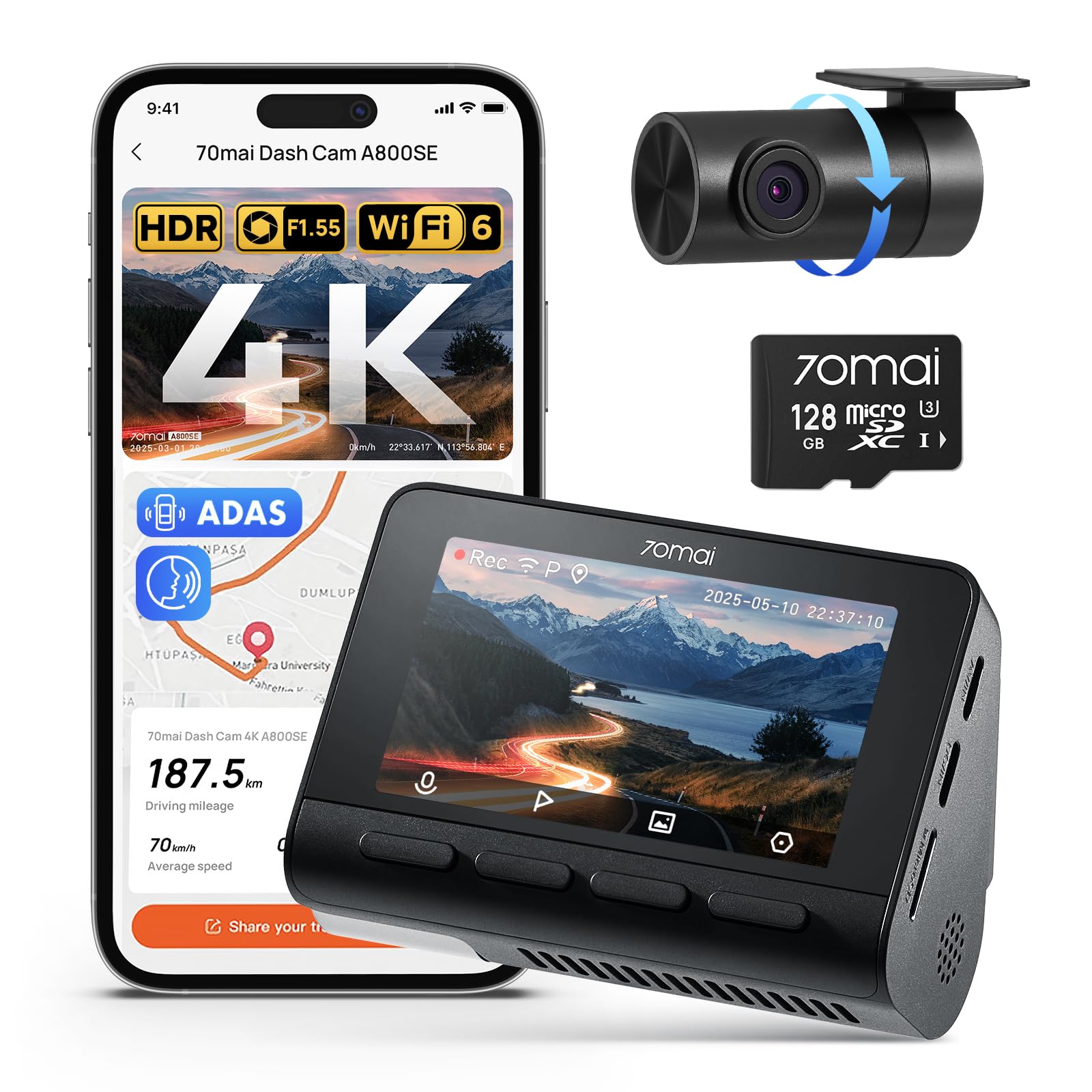
The A800SE’s rear camera has an adjustable lens, so you can aim it at the cabin for rideshare work or out the back window for standard rear coverage. The front camera captures 4K, and the rear records in 1080P, with a 7-layer glass lens and F1.55 large aperture plus Dual HDR to brighten footage in tunnels, rain, and glare.
A free 128GB microSD card is included, and the unit supports cards up to 512GB. Built-in G-sensor emergency lock and loop recording keep critical moments safe, and optional 24-hour parking surveillance monitors the car while parked. WiFi 6 provides transfer speeds up to 5× faster than traditional WiFi dash cams through the 70mai app.
ADAS (Advanced Driving-Assistance System) provides lane departure and forward collision alerts with real-time voice warnings, plus OTA updates keep the system tune. Customers note the daytime 4K is excellent with readable plates, while night footage is softer — a common trade-off at this price point.
The smart buy: Strong daytime clarity, a flexible rear lens, and ADAS alerts at a price that undercuts most premium rivals.
Be realistic: Night plate reading is not its strength, despite the Super Night Vision marketing — expect soft footage after dark.
Best for: daytime commuters and rideshare drivers who want 4K sharpness, ADAS safety alerts, and cabin-or-rear flexibility.
pass on it if: night-time clarity is your top priority — the higher-tier REDTIGER or ROVE handle darkness better.
7. FAIMEE F9 4K+2K
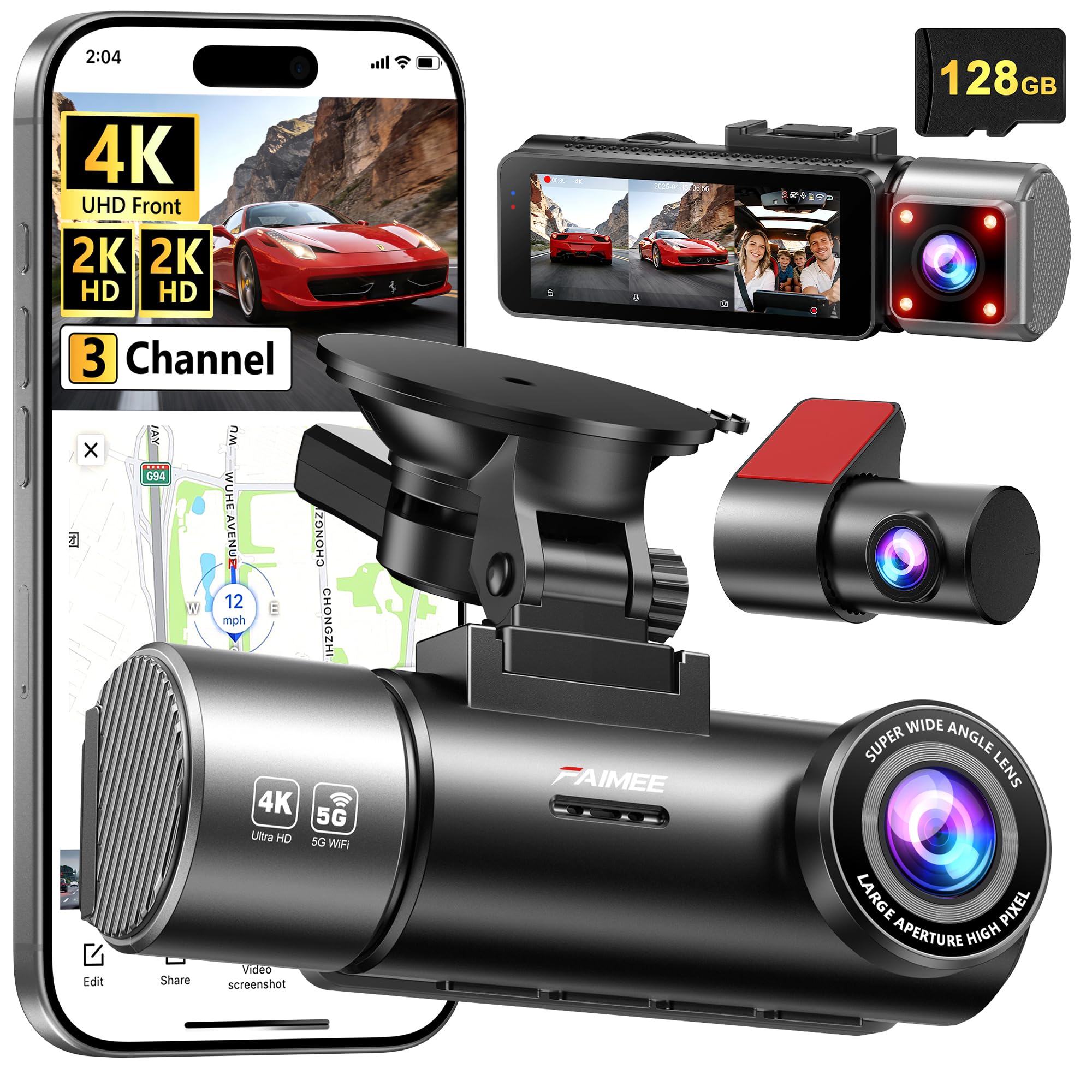
Six lanes of coverage with a 170° front lens and a 2K rear camera, all controlled through a stable dual-band app.
The defining spec here is the 170° wide-angle front lens, which captures up to six lanes of traffic in one frame. The front records 4K UHD at 3840×2160P while the rear shoots 2K at 2304×1296P, both using an F1.8 ultra-large aperture with WDR (Wide Dynamic Range) to balance high-contrast scenes like oncoming headlights.
Storage starts working the moment you unbox it — a high-endurance card is included, and the unit supports expansion up to 256GB. smooth loop recording overwrites the oldest footage, and the G-sensor (a small motion sensor that detects a bump) locks the current clip when it detects a sudden collision, so you don’t lose evidence.
Built-in GPS logs real-time speed, route history, and location coordinates. Upgraded dual-band WiFi (5.8GHz/2.4GHz) connects to the FAIMEE app for live view, instant downloads, and social sharing. The compact IPS screen unit installs discreetly behind the rearview mirror in minutes.
Why it wins: A truly wide field of view that catches more of the road, plus a 2K rear camera that holds its own.
Minor gripes: The manual is sparse and there is no PC settings interface, so initial configuration demands patience.
Choose this for: maximum road coverage per camera and a straightforward, feature-dense system with app control.
Not for: anyone who hates menu-diving — setup takes longer than the plug-and-play competition.
8. WOOLAACOO C5 4K Dual
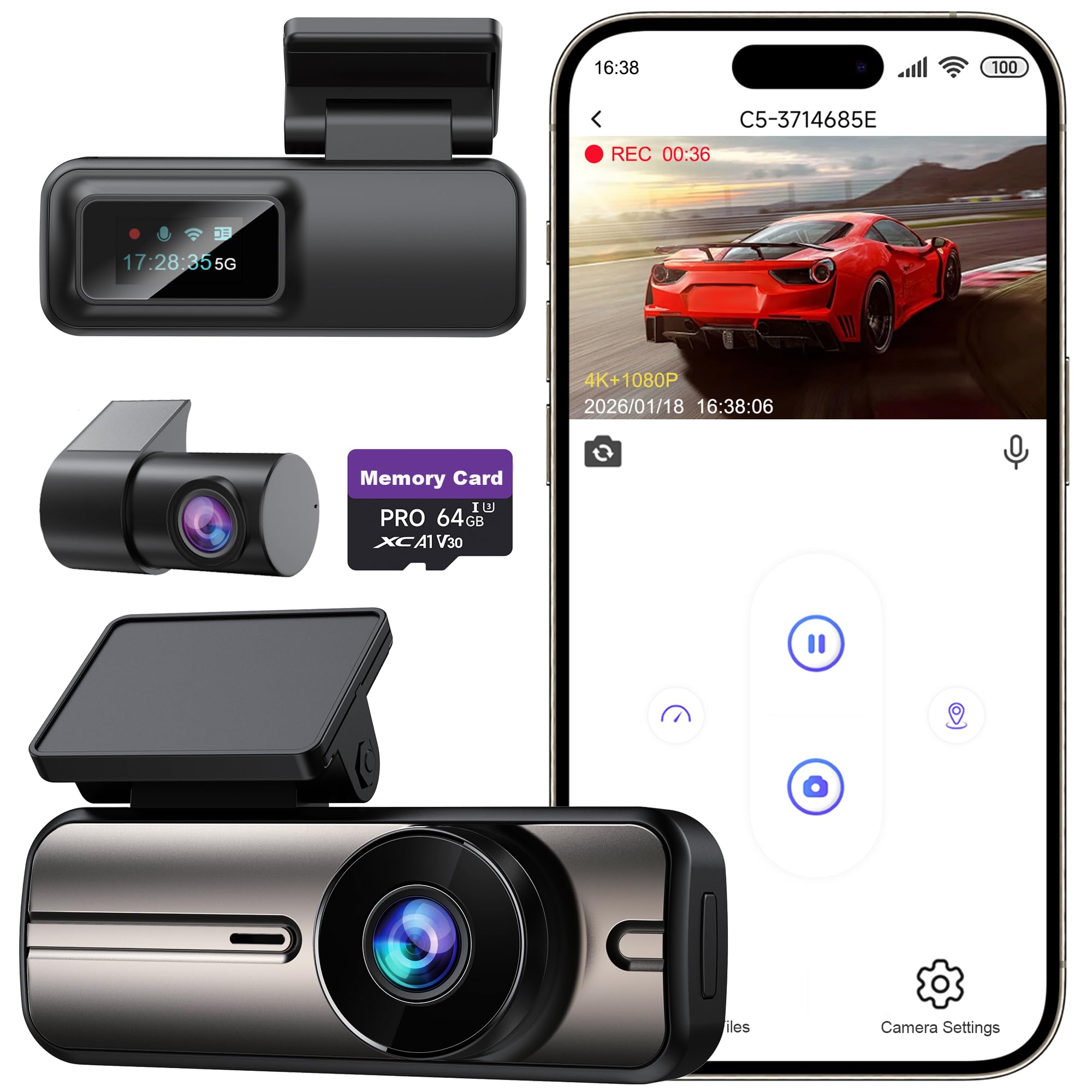
A featherweight 65-gram dual cam that disappears behind the mirror while still pulling sharp 4K details like plates and signs.
Weighing just 65g, the WOOLAACOO C5 is one of the lightest dual cams you will mount, and its compact design keeps your windshield view clear. Despite the size, the front camera records in 4K ultra-high-definition while the rear captures 1080P — enough to read road signs, license plates, and lane markings.
Built-in 5GHz WiFi connects to a dedicated iOS/Android app for viewing, downloading, and sharing recordings. Note the WiFi range is limited to 3-5 meters, so you need to be in or beside the car. The F1.8 large aperture aids night vision, capturing details in darkness or rainy conditions.
A 64GB SD card ships pre-installed, with support for cards up to 256GB. The G-sensor locks critical footage on collision, and 24/7 parking mode (with a separately-sold 3-lead hardwire kit) offers both collision-triggered recording and low-power time-lapse. A bonus USB port lets you charge your phone while recording.
The appeal: Genuine 4K front clarity, a ready-to-go 64GB card, and app control at a budget-friendly price the reviews call a great deal.
The limitation: It has no battery-based parking option and no wireless — it must stay plugged in to operate, and the app connection is short-range only.
Reach for this if: you want 4K front recording and a clean, unobtrusive install without spending premium money.
Look elsewhere if: you need long-range app access or plan to use parking mode without a hardwire install.
9. Milerong X25 Dual Cam

The no-frills cabin cam for taxi and rideshare drivers who need clear interior footage without apps, WiFi, or subscription fuss.
The Milerong X25 is deliberately simple: no WiFi, no app, no GPS, no Bluetooth. You get a front cam and an inside cabin cam, both recording 1920×1080 at 30fps, with a 170° front angle and 140° cabin angle on a 2-inch IPS screen. A 64GB card is included, so there is nothing to buy separately.
Its a neat extra is the interior night vision. An F1.8 large aperture plus 4 infrared lights plus WDR (Wide Dynamic Range) captures the driver and passengers even in complete darkness. The IR view turns the cabin feed grayscale at night for clarity, and you can toggle that shooting sound on or off.
The package is complete from the start with a suction cup mount and car charger, and power from the cigarette lighter means it records automatically when the car turns on. Reviewers point out a strong suction cup even in commercial vehicles and crisp video with crisp sound.
The Honest Strengths
- Expert-IR cabin coverage in total darkness for rideshare safety
- Everything included — 64GB card, mount, charger, no subscription
- Installs in minutes with a suction cup that holds strong
The Real Limits
- Video lacks the sharpness to reliably read plates or street signs
- No wireless or app — you transfer files via USB cable
- Must stay plugged in; no built-in battery for extended use
Made for: budget-conscious Uber, Lyft, and taxi drivers who need dependable cabin footage at night without paying for smart features.
Not ideal for: anyone who wants app access, wireless transfer, or camera clarity sharp enough to identify plates.
Understanding the Specs
Channels and Coverage
A “channel” is one camera lens. A 1-channel cam records only the front, a 2-channel adds the rear or cabin, and a 3-channel records all three at once. More channels mean more angles of evidence, which matters most for rideshare drivers, families, and anyone who wants to prove what happened behind or inside the car.
Night Vision and Aperture
The aperture number (like F1.6 or F1.8) tells you how much light the lens lets in — lower is better for dark conditions. Sensors like Sony STARVIS 2 are engineered for low-light clarity. If you drive at night or park in dim areas, these two specs matter more than raw resolution for reading plates.
Parking Mode and Hardwire Kits
Parking mode records while the engine is off, but most cameras need a hardwire kit (sold separately) connected to your fuse box to run 24/7 without draining the car battery. Some offer time-lapse at 1FPS to save storage, while others trigger on motion or collision detection and lock the event clip.
Memory Cards and Loop Recording
Loop recording overwrites the oldest footage when the card fills, so you never run out mid-drive. A G-sensor (a small motion sensor that detects a bump) automatically locks the current clip when it feels a collision, protecting that evidence from being overwritten. High-resolution 4K files eat storage fast, so a larger card helps.
FAQ
Do dash cams record while my car is parked and turned off?
Will a 3-channel dash cam drain my car battery overnight?
How much storage do I need for 4K footage?
Is a 1080P dash cam good enough, or do I need 4K?
What does the F-number on the lens mean for night recording?
Can I control a dash cam with my phone?
Will a dash cam work in extreme heat or cold?
Do I need a rear camera, or is front-only fine?
Final Thoughts: The Verdict
If you want one dependable pick, the video cameras for automobiles winner is the TERUNSOUl 4K 3CH because it pairs a sharp 4K front with rear and cabin coverage, starlight night vision, and an included 128GB card at a mid-range price. If you want the ultimate in image sensor technology and HDR across every channel, grab the VIOFO A229 Pro. And for budget-minded rideshare drivers who need dependable cabin footage overnight, the Milerong X25 delivers the essential security without the app-based extras.
How We Picked
We do not accept paid placement. Every pick is matched to a real buyer and a real use-case; we do not hands-on test units.
Sources & Methodology
Specifications: manufacturer listings and product documentation. Review insights: verified customer reviews, as of August 2026. Pricing: not shown on this page (it changes often); check the current price via the retailer link.
As an Amazon Associate, GoCarLife earns from qualifying purchases. This does not affect which products we feature.