
Our readers keep the lights on and the garage heater humming. As an Amazon Associate, I earn from qualifying purchases.
Specs are compiled from manufacturer listings and verified buyer reviews and can change over time — please confirm the key details on the product page before buying.
An overheating engine can ruin your day fast, and a dying radiator fan is usually the reason. You need a replacement that fits your car without a fight, moves enough air to keep temps steady, and doesn’t roar under the hood. This guide compares the manufacturer specs and verified customer reviews to show you which fan actually earns its spot.
I’m Mo Maruf — the founder and writer behind GoCarLife. This guide is built by comparing the manufacturers’ published specifications and the patterns across verified customer reviews, so you get each pick’s real strengths and trade-offs instead of marketing spin.
When your factory fan gives out, these picks are the best ventilador de radiador options to keep your engine cool and reliable for the long haul.
Our Picks at a Glance

How To Choose The Best Ventilador De Radiador
Picking a radiator fan is about matching three things: your vehicle’s exact fit, the airflow you need, and how much noise you can tolerate. You want a part that bolts on without fighting it, moves enough air to cool the engine at idle, and doesn’t drown out your radio on the freeway.
Direct-Fit vs. Universal: Know the Difference
A direct-fit fan assembly is built to match the stock part for a specific model, like a 2006 Pontiac Vibe or a 2007 Honda Accord. These use the same connectors and mounting holes, so installation is usually a bolt-on swap. Universal fans are more flexible — they fit a range of radiators with adjustable mounting kits, but they often require you to wire the harness yourself and sometimes trim the housing to fit.
CFM and Why It Matters Most
CFM (cubic feet per minute) is the volume of air the fan can push in one minute. A higher number means more cooling capacity. A small 12-inch fan might move around 800 CFM, while a big 16-inch unit can push 3000 CFM. For a street car that just needs normal cooling, you want enough airflow to keep temps stable at idle — too little air and the engine will climb past the needle on hot days.
Pusher vs. Puller: The Airflow Direction
Fans either push air through the radiator from the front, or pull air through it from the engine side. Most engine bays use a puller setup mounted behind the radiator. A reversible fan is the most versatile because you can flip the blades and swap the wiring leads to use it either way, making it an easy fit for custom builds or swapped engines.
Quick Comparison
| Model | Best For | Airflow (CFM) | Max RPM | Noise (dB) | Amazon |
|---|---|---|---|---|---|
| Dorman 620-546★ Best Overall | Direct-fit OEM swap | — | 2000 | — | Amazon |
| Auto Dynasty 10″ (2-Pack)Twin Pack | Budget dual-fan setup | 1250 | 2250 | 50 | Amazon |
| PartsFlow 620-225 | Honda Accord fit | — | — | — | Amazon |
| MONOKING 14″ | High airflow universal | 2000 | 2250 | 70 | Amazon |
| GESEXI 12″ | Quiet universal slim | 800 | 2000 | 30 | Amazon |
| A-Team 16″ | Maximum airflow | 3000 | 3000 | 30 | Amazon |
| PartsFlow 620-843 | VW Jetta fit | — | — | — | Amazon |
In‑Depth Reviews
1. Dorman 620-546 Engine Cooling Fan Assembly
Our pick — over 4.5★ from 300+ verified ratings; the strongest balance of quality and price.
The bolt-on replacement that puts a 20-year factory fan’s workload back in one afternoon.
Your old fan lasted two decades, and you want the same reliability without the dealership price tag. This Dorman assembly is precision-engineered to match the fit and performance of the stock fan for specific Pontiac and Toyota models, and it comes as a complete package with the motor and blades already mounted. It’s a true plug-and-play swap—buyers report the whole job takes “only a few minutes.” The 5-pound assembly spins at 2000 rpm, matching the stock fan’s cooling output for the original duty.
Owners consistently single out performance and fit as the top reasons they bought it, and the value is a recurring theme — many mention it saved them “a couple of hundreds” versus the dealer alternative. The factory-style plastic housing and tested motor give it that trustworthy feel, with one owner hoping it lasts another 200k miles like the original Denso unit did. Quality and ease of installation round out the praise, so it scores strongly on the things that actually matter in a daily-driver fan.
Unlike the universal fans further down this list, there’s no wiring harness to figure out and no brackets to jury-rig — it’s designed for your exact vehicle. The honest catch is alignment: a handful of owners note the bolt holes don’t always line up perfectly, so you might need a little persuasion to get everything seated. It’s a minor frustration on an otherwise smooth replacement, and the 4.7-star crowd favorite status (with over 300 ratings) says most buyers never hit that snag.
What owners praise most
- Perfect factory-style fit for Vibe/Corolla/Matrix
- Complete assembly — no separate motor to buy
- Minutes-long installation, no special tools
The trade-off to know
- Bolt holes occasionally need slight realignment
- Only fits specific Pontiac/Toyota models
Grab this if: you own a Pontiac Vibe, Toyota Corolla, or Matrix and want the closest thing to a factory fan without the dealer markup.
Think twice if: your vehicle isn’t on the compatibility list — a universal fan will fit more applications.
2. Auto Dynasty 10″ Universal Electric Radiator Cooling Fan Kit (2-Pack)
Two slim 10-inch fans that share the cooling load for a cleaner, quieter engine bay.
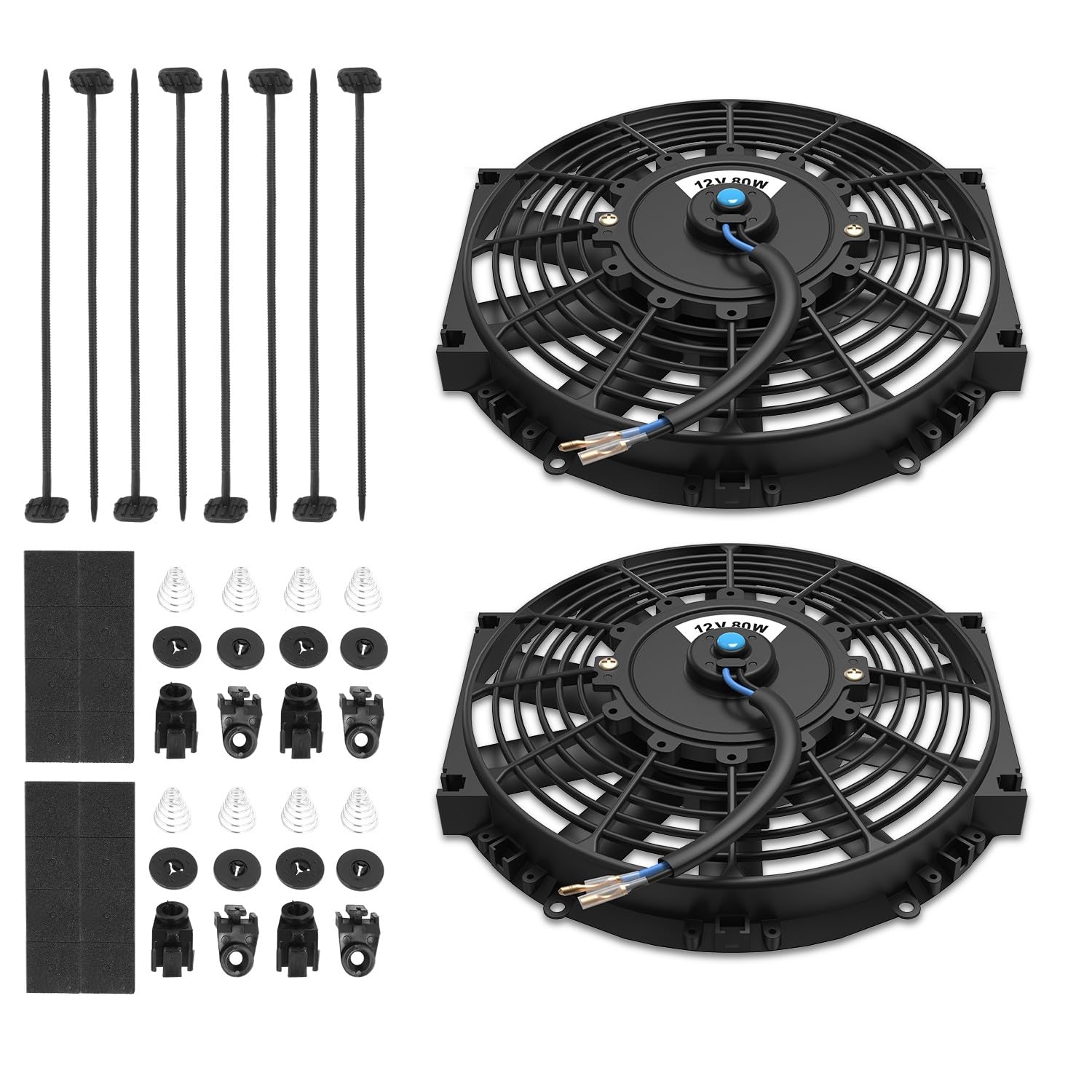
You get two separate fans in this kit, which lets you spread airflow across the radiator face instead of relying on one big spinning disc. Each 10-inch fan pushes 1250 CFM (cubic feet per minute — the volume of air moved each minute) at 2250 rpm, and the 2.5-inch-thick blades keep the profile slim for tight engine bays. The ABS plastic housing and sealed motor are built to handle the heat, and the included mounting tabs let you zip-tie them into place without custom brackets.
The bang-for-buck angle is what wins people over here — owners compare the function and build to pricier 12-inch fans and find this pair just as capable for a fraction of the cost. One autocross owner ran them through high-rpm pulls then 25 minutes of idling in 95-degree heat and reported the engine stayed cool the whole time. At 50 dB (decibels, the loudness level), it’s a middle-ground fan — audible but not obnoxious.
The thing to check before buying is the airflow reality: while many owners say these move “a lot of air,” a fair number report the actual output feels lower than the spec suggests. Durability is also a mixed bag in the long run, with some pairs still going strong and others faltering early. For a weekend car or a mild daily driver, it’s a smart, wallet-friendly way to get dual-fan coverage — just keep your expectations measured on the extreme end of performance.
Why it’s a smart buy
- Two fans for the price of one single unit
- Slim 2.5″ design clears tight engine bays
- Zip-tie mounting makes install fast
Before you commit
- Real-world airflow can run below the 1250 CFM spec
- Long-term durability is hit or miss
Reach for this if: you’re on a budget and want dual-fan redundancy for a street car or light track use.
Look elsewhere if: you need guaranteed high-pressure airflow for a heavily modified or high-horsepower build.
3. PartsFlow Radiator Cooling Fan Assembly (Honda Accord 2003-2007)

A factory-grade swap for the 7th-gen Accord that cools hard and bolts on without drama.
If you drive a 2003-2007 Honda Accord with the 2.4L engine, this PartsFlow assembly is built specifically for your car, matching the original part numbers (620-225, 19020PND003, and more) so you know the fit is right. It’s constructed from metal and plastic to OE (original equipment) standards, meaning the mounting points and connectors line up the way Honda intended. Fit is the top thing owners praise here — it’s a clean, no-modifications swap.
The 2-pin plug connects straight to your factory harness, and owners mention stable temps even in heavy traffic with the AC on, plus a quiet motor that doesn’t drone at stoplights. One owner even ran it on a 2012 Toyota Venza and found it a perfect fit with “no mods” needed, which speaks to how well the shroud is shaped. Quality and performance get near-universal thumbs up, and the value is hard to argue against versus a dealer part.
There are two honest caveats to weigh. Noise is split — most call it very quiet, but a few say it’s “a little loud.” Durability is the bigger watch-point: a handful of customers note failures within six months, which is worth knowing even though the majority are still running strong. If you want the certainty of an OEM-matched fan for your Accord without the dealership price, this is the one — just be aware the quality-control lottery exists.
What wins people over: the fit is the standout — owners repeatedly call it a perfect, easy installation on the Accord, with strong airflow and a quiet motor.
The fine print: an occasional unit fails within half a year, so keep your old fan as a backup during the return window.
4. MONOKING 14″ Universal Slim Pull Push Electric Radiator Fan

A universal 14-incher that out-pulls the stock mechanical fan on older trucks.
This MONOKING fan is for the guy with a truck, van, or RV who wants serious airflow from a single universal unit. It swings 2000 CFM at 2250 rpm — that’s 12% faster than the Dorman assembly’s 2000 rpm, and 2.5 times the airflow of the 12-inch GESEXI fan below it. The 90-watt motor and 8 S-curved blades are built for heavy duty, and the slim 2-5/8-inch thickness means it fits between the radiator and engine without eating your bay space.
Owners love how it transforms older vehicles — a 2005 F-150 owner says it cools the motor “better than stock” and calls it the “easiest fan install” with simple wiring. Another mounted it as an exhaust fan for the RV fridge and found it perfect for that job. It’s billed as a puller from the start, but you can flip the blades and reverse the leads to make it a pusher, which makes it a genuine flex part for custom builds.
The noise is the trade-off: at 70 dB (decibels, hearable as a clear whir), it’s noticeably louder than the near-silent 30 dB fans elsewhere in this guide. That’s the price of moving that much air. Also, a few buyers found the 14-inch diameter too big for their install location, so measure your radiator opening before ordering. If you want max airflow for a pickup or trailer and don’t mind the fan noise, this is the strongest single-fan universal on the list.
What it does brilliantly
- 2000 CFM of raw airflow beats the stock clutch fan
- Reversible — use it as puller or pusher
- Simple wiring, easy install on trucks/vans
What to consider
- 70 dB is loud enough to notice inside the cab
- 14″ diameter may be too large for some radiators
Your pick if: you drive a truck, van, or RV and want a single universal fan that out-cools the factory mechanical unit.
Pass if: you need near-silent operation or have a tight radiator opening under 13 inches.
5. GESEXI 12″ Slim Fan Push Pull Electric Radiator Cooling Fan

The slim 12-inch fan that’s almost silent, pulling just 800 CFM where space is tight.
This is the fan for tight spots and light duty, where every inch of clearance counts. The 12-inch diameter with a 2.5-inch thickness slides into cramped engine bays, and at 30 dB (decibels — about the level of a quiet library) it’s one of the quietest fans you can bolt on. The 12V 80W motor turns 10 blades at 2000 rpm and moves 800 CFM, which is a 2.5x gap in airflow below the MONOKING 14-inch but plenty for a small car, tractor, or non-automotive cooling job.
The versatility is the real story. Owners have used it for attic cooling, greenhouse ventilation, and even a tractor AC boost — one farmer added it to his tractor’s AC and reported lower running temps. It’s reversible too, so you can switch it from pusher to puller by swapping the power cord and flipping the blade over. The 3-pin connector and included mounting brackets keep installation simple without a pile of special tools.
Just know the limits: at 800 CFM, it won’t carry a big-block muscle car or a heavily loaded truck. Also, while many call it quiet, a few owners found the noise level higher than expected, so treat the 30 dB rating as a best-case figure. And the plastic corners may need a little trimming to fit some vents and shrouds, as one owner noted. For a compact car, a custom exhaust, or any non-auto cooling need that values silence, this is a gem.
The thing everyone loves: the quiet, smooth-running motor — owners describe it as a “quiet fan” that’s “well made” and perfect for solar-powered shed use.
Keep it real: airflow is modest at 800 CFM, so it’s not the choice for big engines or heavy cooling demand.
6. A-Team Performance Universal 16″ Electric Radiator Fan Assembly

The muscle-car monster that dumps 3000 CFM into the radiator and keeps temps pinned at 190.
This is the heavy hitter for classic cars and big-block swaps. The 16-inch diameter fan with 8 reversible S-blades moves a massive 3000 CFM (cubic feet per minute) at 3000 rpm — more airflow than any other fan in this guide, and 3.75 times the output of the little GESEXI 12-inch. Yet it manages a 3.26-inch thickness that fits most vehicles, and the sealed ball-bearing motor keeps it running at a claimed 30 dB (decibels, quiet office level).
The proof is in the owners’ stories. A 1968 GTX owner replaced the old metal fan clutch assembly, hooked this up as a puller, and reported the car “cools properly and stays 190-195” even in traffic. Forklift owners vouch for it too, and one buyer has run his for 5 years straight without a failure. The 3-pin connector and assembly kit cover most installs, and the value proposition is strong — owners compare the motor to pricier SPAL/Zirgo units and find it on par for less money.
The honest downsides: noise is polarizing — some call it “amazingly quiet,” others say it’s clearly audible. And the included mounting kit is weak; one owner flatly said the kit is “no good” and recommends zip ties and washers instead. The shroud also runs larger than some competitors, which can complicate fit on certain radiators. If you need raw, unstoppable airflow for a classic or high-horsepower build and don’t mind a bit of DIY mounting, this is the one.
Why it rules the top end
- 3000 CFM at 3000 rpm — class-leading airflow
- Keeps muscle cars at stable temps in traffic
- Reversible S-blades for push or pull duty
Real talk
- Included mounting kit is flimsy — plan to DIY
- Noise level splits owners down the middle
Choose this for: classic cars, muscle cars, or any build demanding maximum cooling airflow from a single fan.
skip it if: you want a bolt-on factory-style install with no extra fabrication.
7. PartsFlow Radiator Cooling Fan Assembly (VW Jetta/Golf 2005-2013)
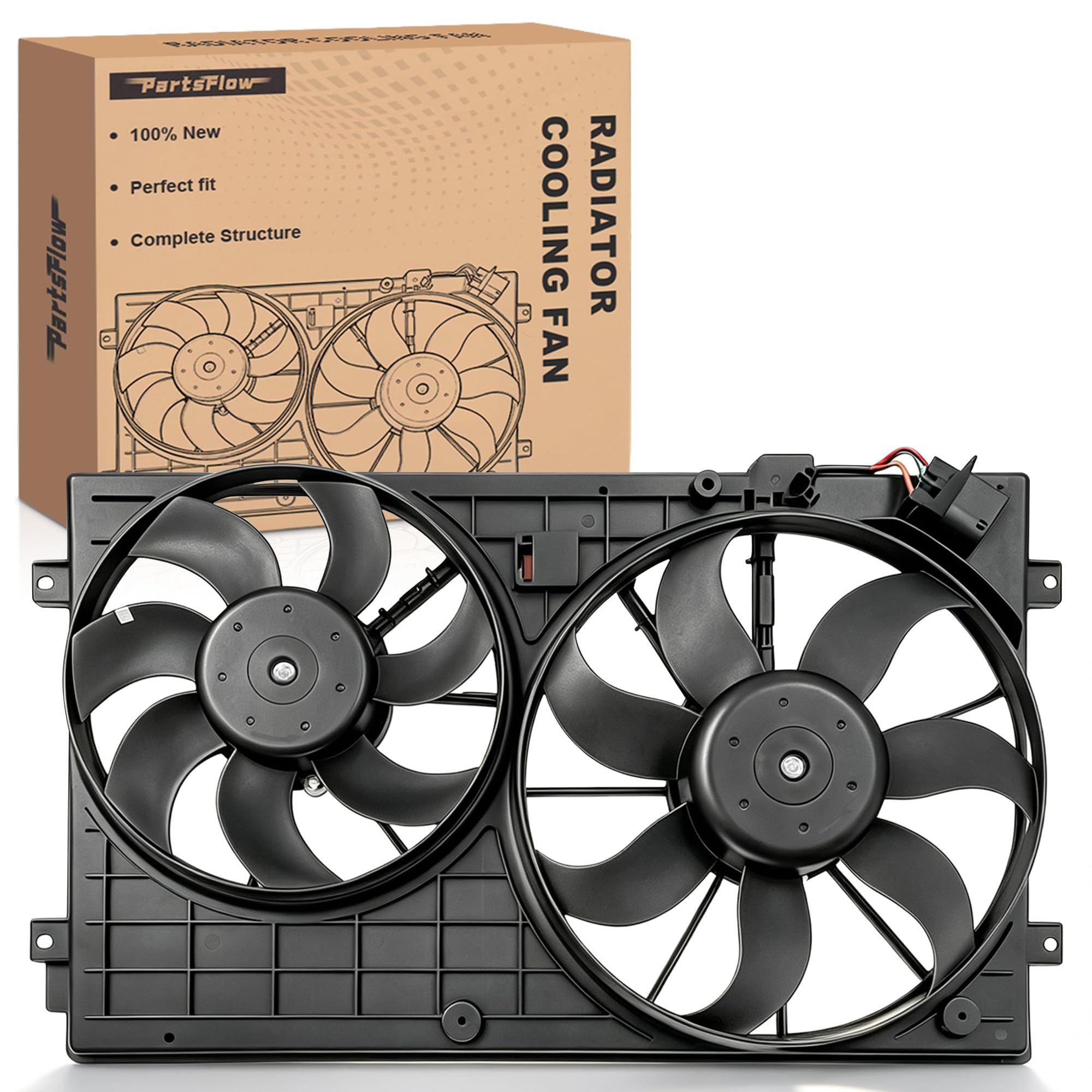
An OE-standard VW swap that owners say fits and works as it should, right from the start.
German cars are picky about parts, and this PartsFlow assembly is built to satisfy that. It’s matched to the 2005-2013 VW Jetta, 2006-2009 Rabbit, 2010-2013 Golf, and 2012-2013 Beetle/Passat, with the original part numbers (620-843, 1K0959455EA, and more) listed so you can verify compatibility. The all-metal construction gives it a sturdy feel, and the 3-pin connector matches the factory harness for a straightforward install.
Owners are direct about the experience: “perfect fit, works as it should” and “great quality fit” are the recurring notes, with one even running it successfully on a Dodge 1500. Performance and fit are the two most-praised aspects by a wide margin, and at this price point it undercuts the dealer while matching OEM specs. The value-for-money angle is strong, and the build feels like it belongs on a German engine bay.
The caution flags are real, though. Cooling performance draws mixed feedback — some report overheating after install, which suggests a possible unit defect or airflow mismatch. Durability is the bigger concern: multiple reviewers point out the fan arriving broken, and installation isn’t always the plug-and-play dream the listing promises. If you get a good unit, it’s excellent — but you may want to test it immediately on arrival and know your return options before you tear out the old fan.
What owners rave about: the fit is spot-on for VW models, with strong performance and a quality metal build that feels OE.
The honest warning: a noticeable share of units arrive damaged, so inspect and test yours the day it shows up.
Understanding the Specs
CFM (Airflow)
CFM, or cubic feet per minute, tells you how much air the fan pushes in one minute. This is the single most important number for cooling — more CFM means more air across the radiator fins, which means lower coolant temps. A small 12-inch fan might do 800 CFM, while a 16-inch brute can hit 3000 CFM. Match the CFM to your engine size and driving habits, not just to the fan diameter.
dB (Noise Level)
dB, or decibels, measures how loud the fan is when running. The scale isn’t linear — 30 dB (decibels) is about a quiet room, while 70 dB is more like a vacuum cleaner. High-CFM fans often cost you in noise, so decide if you want a silent mover for a daily driver or a loud brute for a track car.
FAQ
Will a universal radiator fan fit my car?
What is the difference between a pusher and a puller fan?
How many CFM do I need for my engine?
Can I install a radiator fan myself?
Will a louder fan mean better cooling?
What does RPM mean for a radiator fan?
How do I know if a fan is compatible with my specific car model?
Why is my new fan louder than expected?
Final Thoughts: The Verdict
For most people, the ventilador de radiador winner is the Dorman 620-546 because it is the closest thing to a factory replacement — a direct fit, tested motor, and a quick swap that earns its 4.7-star reputation with hundreds of satisfied owners. If you want maximum cooling airflow for a truck or muscle car, grab the MONOKING 14″ with its 2000 CFM rating. And for a budget-friendly twin-fan setup on a street car, the Auto Dynasty 2-pack delivers solid dual-fan coverage while staying affordable.
How We Picked
We do not accept paid placement. Every pick is matched to a real buyer and a real use-case; we do not hands-on test units.
Sources & Methodology
Specifications: manufacturer listings and product documentation. Review insights: verified customer reviews, as of August 2026. Pricing: not shown on this page (it changes often); check the current price via the retailer link.
As an Amazon Associate, GoCarLife earns from qualifying purchases. This does not affect which products we feature.