
Our readers keep the lights on and the garage heater humming. As an Amazon Associate, I earn from qualifying purchases.
Specs are compiled from manufacturer listings and verified buyer reviews and can change over time — please confirm the key details on the product page before buying.
If you’re hunting for the right vehicle polisher buffer, the real question isn’t which one looks the most powerful. It’s whether you can lay a flawless, glossy finish without accidentally grinding a hole straight through your clear coat. The single biggest fear for any first-time buyer is “burning” the paint with a spinning rotary disc.
I’m Mo Maruf — the founder and writer behind GoCarLife. This guide is built by comparing the manufacturers’ published specifications and the patterns across verified customer reviews, so you get each pick’s real strengths and trade-offs instead of marketing spin.
You’ll leave this guide knowing exactly which orbital motion, pad size, and variable-speed range fits your skill level, your car’s paint condition, and your garage. We will help you cut through the noise so your first correction job ends in a mirror-like shine instead of an expensive repaint.
Our Picks at a Glance


How To Choose The Best Vehicle Polisher Buffer
The right polisher for you depends entirely on how the machine moves its pad. That motion dictates how aggressive the cut is, how much heat builds up, and how likely you are to harm the paint. Let’s break down the two main types.
Dual-Action (DA) vs. Rotary Motion
A dual-action polisher spins the pad while simultaneously moving it in a small random orbit. This combination keeps the pad moving across the surface rather than digging into one spot, which is why it’s far less likely to burn or leave holograms on your clear coat. It’s the go-to for beginners and serious hobbyists who want correction with a safety net.
A rotary polisher spins the pad in a single fixed direction at high speed. This is a more aggressive cut that removes deeper scratches and oxidation much faster, but it requires practiced technique. If you let a rotary sit still on a panel, the friction will quickly heat the paint and burn through it. Always keep a rotary moving.
Power Draw and Motor Strength
Look at the wattage or amperage to understand how much work the motor can handle without bogging down. A motor with higher wattage will maintain its speed when you press the pad into a panel, which is critical for consistent cut. If the motor stalls under pressure, you’ll leave uneven results and tire your arm out faster.
Variable Speed and Why It Matters
A variable-speed dial lets you match the pad’s speed to the job at hand. Low speeds are for spreading wax and sealant, medium speeds for polishing and light correction, and high speeds for cutting through oxidation and deep swirls. Having that range on a dial you can adjust mid-job gives you immense control over heat and finish.
Quick Comparison
| Model | Best For | Motor Power | Speed Range | Pad Size | Amazon |
|---|---|---|---|---|---|
| DEWALT 7/9-Inch★ Best Overall | Heavy-duty pro correction | 12 A | Variable | 7-9 inch | Amazon |
| AVID POWER 5/6-InchBest Value | Value-packed beginner DA | 5 A | 2700-6500 OPM | 5-6 inch | Amazon |
| SILVEL 7/6-InchMost Versatile | Versatile kit with wool pads | 1600 W | 500-3300 RPM | 6-7 inch | Amazon |
| GEVEELIFE 6/7-Inch | Lightweight 4.5 lb workhorse | 1600 W | 1000-3500 RPM | 6-7 inch | Amazon |
| SPTA Mini 3-Inch | Confined spaces and bikes | 780 W | 2000-5500 OPM | 3-4 inch | Amazon |
| SPTA 7-Inch Rotary | Aggressive oxidation removal | 1200 W | 500-3000 RPM | 3-7 inch | Amazon |
| BATOCA DA Buffer | Complete starter kit | 1100 W | 2500-5500 RPM | 6 inch | Amazon |
| Griot’s Garage G9 | Smooth, safe correction | 1000 W | 2000-6400 OPM | 5-6 inch | Amazon |
| Milwaukee M18 15mm | Cordless pro freedom | Battery (M18) | 2650-5100 RPM | 15mm throw | Amazon |
In‑Depth Reviews
1. DEWALT Variable Speed Polisher
Our pick — over 4.5★ from 950+ verified ratings; the strongest balance of quality and price.
The pro-grade brute that eats 8-hour days without flinching.
When your paycheck depends on a flawless finish, this polisher won’t let you down. It draws 12 A from the wall, which is 2.4 times the 5 A you get from most entry-level dual-action (DA) polishers, so it keeps spinning strong even on tough clear coat. That extra torque is why professional boat detailers rely on it daily.
The variable speed is controlled through a thumb dial, and buyers report the machine holds its speed exactly where you set it, down to a crawl around 600 RPM and up from there. For a rotary, that low-end control is what lets you finesse a motorhome or boat without generating dangerous heat. It arrives with a 2-position side handle and a backing pad, so you can choose the grip that fits your stance.
The honesty check: heavy is the recurring word in the owner data. This is not a one-hand tool, and you’ll feel the weight by the end of a full correction session. Another detail worth repeating — one boat detailer notes it’s built for daily pro abuse, but you’ll want to keep the vents clean and change the carbon brushes every 3 months to see a year-plus of life.
Built for the Long Haul
- Smooth, predictable torque with a feathering trigger — owners mention controlled passes even under load.
- Speed stays locked where you set it, which is critical for consistent correction.
- Accepts different heads and backing plates for flexibility across jobs.
Know Before You Buy
- It’s a heavy tool; arm fatigue is the trade-off for pro-grade power.
- Carbon brushes are a wear item you’ll need to monitor and replace periodically.
Reach for it if: you’re a working professional or heavy hobbyist who needs a rotary that holds its speed through 8-hour days without breaking a sweat.
Think twice if: you’re a first-timer with no rotary experience — this aggressive motion has a steeper learning curve than a dual-action.
2. AVID POWER Dual Action Polisher Kit
The runaway budget favorite that restores boats on a shoestring.
This is the starter kit that proves you don’t need to spend big to save big. One boat owner landed a stunning result — restoring a 10-year-old gel coat and dodging a shop quote — all for the price of this single tool. That’s the kind of “wow, it works” experience that dominates the owner feedback here, especially for a machine using only a 5 A motor.
The dual-action motion is the safety net. Unlike a rotary, the pad both spins and orbits, which drops the risk of “burning” through the paint dramatically. A 6-level speed dial runs you from 2700 to 6500 OPM — low speed for waxing, medium for polishing, high for digging out defects and oxidation. Beginners get a forgiving learning curve, while pros find it plenty capable on a normal car.
What’s in the box is half the value: a 5″ and 6″ backing plate, four foam pads, two foam discs, a detachable D-handle that adjusts to 5 positions, plus a rubberized body that resists sliding on a table. It’s a complete package. The one recurring knock is durability after heavy use — some units have had issues, so think of it as a fantastic entry point rather than a forever tool.
Value verdict: The crowd favorite here is the value — owners routinely call it a fantastic deal that feels like a far pricier machine. If you need a do-it-all kit on a budget, start here.
Best for: the smart-money buyer who wants a forgiving dual-action with everything needed to polish a daily driver.
Look elsewhere if: you’re chasing heavy pro-duty reliability; durability is a mixed note in the owner data.
3. SILVEL Buffer Polisher
A 1600 W workhorse whose kit covers everything from boats to trucks.
When a tool restores the shine on a 5-year-old boat and a fleet of trucks — wiping out water spots and scratches — you know it has real cutting power. The SILVEL leads with a 1600 W motor, and the owner consensus is that quality and versatility are its anchors. The variable speed dial is the star feature: adjust from 500 to 3300 RPM without stopping the machine, which gives you total control over how aggressive the pass is.
The kit is genuinely complete — buyers get two backing discs, six 6-inch foam pads, three 7-inch wool pads, ten sanding discs, both a D-handle and a side handle, two spare carbon brushes, and a carry bag. That’s a modular system for everything from compounding to final wax. Owners note it’s easy to control thanks to the ergonomic front grip and curved body that resists fatigue.
Where it shines brightest is the included accessories — having wool pads plus foam pads in one box lets you cut and finish without buying extras. The trade-off is the learning curve; some beginners wished for more usage tips in the manual, so be ready to watch technique videos. Speed control and raw power draw mixed feedback, so ease into the higher settings.
The takeaway: Owners sum it up as a good tool that works well — paint problems disappear when you pair the right pad with the right compound.
Choose this if: you want one machine that can jump between cars, boats, and trucks with the right pad already in the box.
skip it if: you’re a pure beginner who wants hand-holding guidance in the manual — you’ll rely on YouTube here.
4. GEVEELIFE Buffer Polisher

A featherlight rotary that holds pro power in a nimble 4.5 lb frame.
Most rotoaries this capable leave your forearms screaming by the third panel. The GEVEELIFE weighs just 4.5 lbs, and “lightweight, comfortable in my hand” is the recurring refrain from owners who notice the difference immediately. But this isn’t a weakling — the upgraded 1600 W motor handles oxidation, scratches, and stains on cars and boats, and owners say it feels solid while doing it.
A 7-speed dial delivers 1000-3500 RPM, so you can dial down for waxing delicate paint or crank up for serious decontamination. A built-in constant-power control board keeps it chugging for extended hours without overheating — a small detail that matters on a full car. The safety switch lock keeps your speed steady and cuts fatigue.
Owners love the kit — carrying bag, sponge pads, wool pads, sandpaper — and one even called it a bargain compared to a cordless Milwaukee they were considering. At this weight with a 2-year warranty, it’s the rare rotary that’s genuinely beginner-approachable. The main caveat from the data: durability is mixed over the long term, so treat it as a fantastic value rather than an heirloom.
The standout: Customers note seeing a clear difference in their paint after just a couple of uses — the kind of immediate satisfaction that wins people over.
Pick it for: a smaller-framed user or anyone who wants rotary power without the usual back-breaking weight.
Pass on it if: you need a do-all daily pro unit with a proven years-long track record.
5. SPTA Mini Orbital Polisher

The little 3-inch DA that slips into the pockets a full-size pad can’t reach.
The difference between a “fine” detail job and a “flawless” one usually lives in the tight spots — mirror housings, door jambs, bumpers, and the curved panels around a motorcycle. The SPTA Mini’s 3-inch pad (with 4-inch options in the kit) is what makes it genuinely useful; owners specifically call out how well it works in hard-to-reach places and on bikes, where a 6-inch pad simply won’t fit.
Don’t mistake the small size for weakness. The 780 W motor powers a 6-speed dial from 2000 to 5500 OPM, and the dual-action motion keeps it safe on paint. Owner feedback pegs build quality and performance as the twin anchors — reviewers point out it’s hefty yet powerful, with low vibration, and it delivered a professional glossy finish when used for cut-and-buff after a repaint.
The kit overflows: three polishing pads, wool pads, scratch remover, microfiber towels, sanding discs, a pad conditioning brush, an apron, and a tool bag. One owner noted it’s a Rupes-style clone at half the price with great correction results. The honest gripes are the weight, the loud operation (ear protection advised), and a lock-on button some find stiff.
The verdict: Owners found it perfect for cut-and-buff work after painting a car, delivering a smooth, powerful pass with no fatigue and a pro-quality gloss.
Reach for it if: you detail motorcycles, tight engine bays, or any spot a big pad awkwardly covers.
Look elsewhere if: you only polish large flat panels — a 6-inch DA will cover that ground faster.
6. SPTA 7-Inch Rotary Polisher

The “tank” of the lineup, built to strip oxidation and speed up pro detailing.
“This thing is a tank” is how owners describe the SPTA rotary after hammering it on small and large projects for about a year with zero complaints. It’s a 7-inch rotary running a 1200 W all-ball-bearing motor, and the digital screen on the 6-speed dial is a differentiator — you see your exact RPM (500-3000) rather than guessing. Detailing companies use this for heavy wash-and-wax volume.
The kit is remarkably deep: three polishing pads in 3″, 5″, and 6″ sizes, three wool pads in 5″, 6″, and 7″, four different backing plates, 24 sanding discs, two compounds, microfibers, and an apron. Between the wool pads for cutting and foam for finishing, it’s a complete correction station in one bag. Shoppers say it removes oxidation effectively and leaves vehicles shining.
Be honest about the trade-offs. It’s heavier than many rotaries, and because it’s a true rotary, splatter is a real thing — owners recommend a soft rubber guard. Technique is everything here; one detailing company owner calls it sturdy and easy to use, but the speed control and long-term functionality drew mixed feedback, with an occasional unit failing early. If you need to cut through years of neglect fast, this is your machine.
The bottom line: Owners call it a fantastic entry-to-mid-level hobbyist or professional tool that executes the job perfectly with proper technique.
Best for: the detailer who needs to remove serious oxidation as efficiently as possible and isn’t afraid of a real rotary.
pass on it if: you’re a beginner — you’ll want a dual-action safety net first.
7. BATOCA Dual Action Polisher
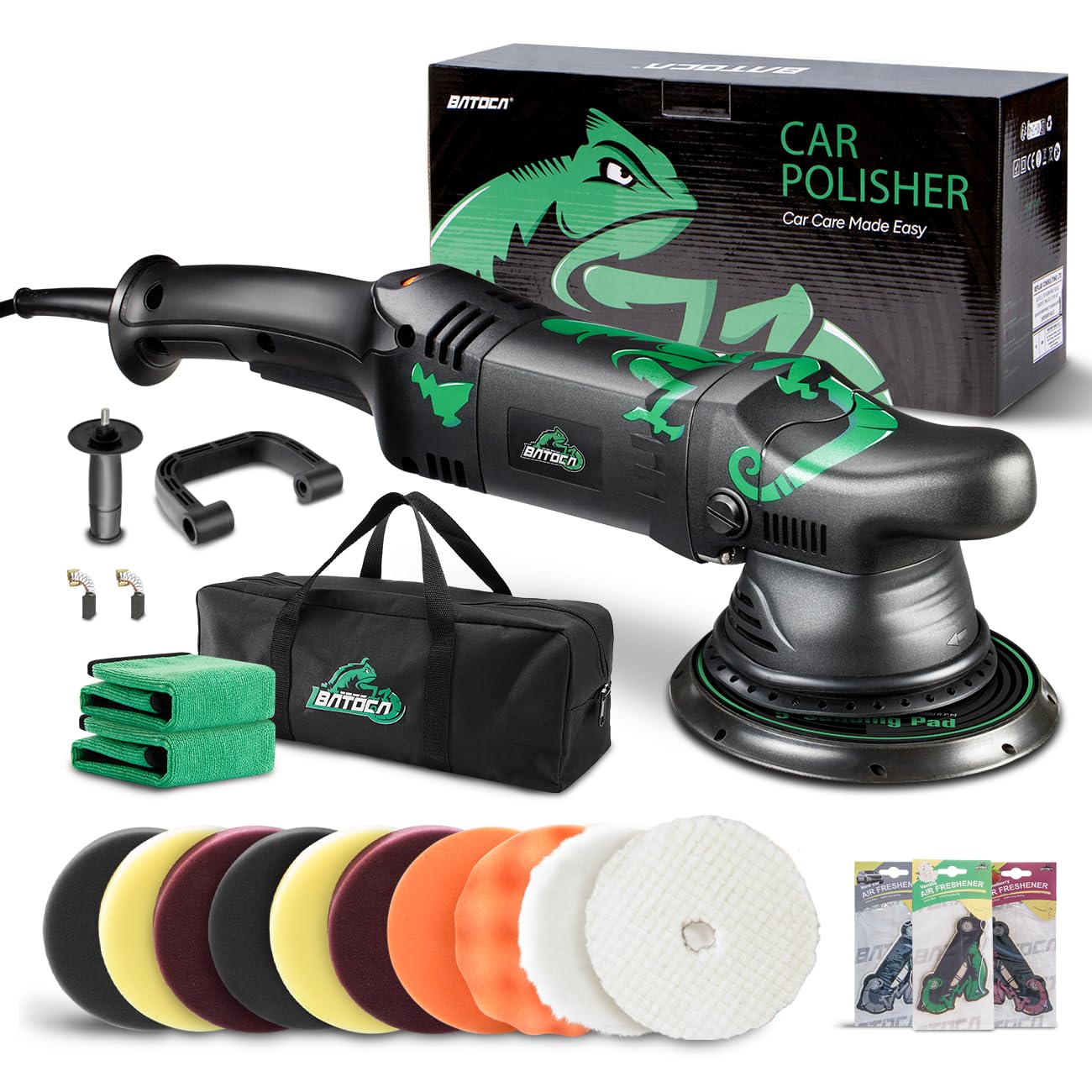
A beginner’s all-in-one with an eccentric shaft design that won’t hurt paint.
The BATOCA is built for beginners. Its eccentric shaft creates an orbital motion that presses wax deep into the paint while protecting the clear coat, and owners say it’s easy to use right from the start. Reviewers report it doesn’t overheat even after detailing three cars over eight hours, so it earns both “starter” and “heavy duty” labels.
A 6-speed dial runs 2500-5500 RPM, covering low-speed waxing to high-speed defect removal. The green chameleon graphic circling the body is a unique touch that owners genuinely enjoy. Weighing in at 8 pounds, it’s substantial, but the balance and low vibration get praise — “good balance with the vibration levels” is a recurring compliment that matters on a long session.
What wins people over is the completeness of the kit: 6-inch foam pads, wool pads, polishing bonnets, sanding papers, a microfiber towel, and a tool bag, plus a pair of carbon brushes for the 6-month replacement interval. The one clear gripe from an experienced detailer is that the included pads start stiff and need breaking in, but soften up nicely after. Head durability drew a rare mixed note, so it’s a fantastic value, not a forever-pro tool.
The takeaway: Owners call it a great product that’s easy to set up and swap pads on — “if you need a good starter this is your product, it can take you very far.”
Choose this if: you want an out-of-the-box complete DA kit that lets you start polishing the same afternoon it arrives.
Pass on it if: you demand pro-grade long-term durability — treat it as a strong entry tool.
8. Griot’s Garage G9 Random Orbital Polisher

The beginner’s dream DA that corrects deep scratches without ever burning paint.
The G9 is built around a specific promise: a 1000 W motor with a 9mm orbit throw that removes scratches, swirls, and oxidation, paired with a fan-cooled counterbalance so it stays smooth instead of rattling your hands off. That’s the engineering story, and the owner data backs it up — minimal vibration is a named strength, and first-time users report no fear of burning paint, which is the exact anxiety that keeps people from trying correction.
Six speed settings span 2000-6400 OPM, and the dial is accessible from both the right and left hands — a thoughtful touch most machines skip. It arrives with a 6″ vented backing plate, and you can convert it to a 5″ system with an optional plate, letting you pick between covering ground and working tighter areas. The 10-foot quick-connect power cord means less extension-cord juggling.
Owners also note it’s not super loud, and the double-shot rubber grip keeps it comfortable for extended sessions. The honest critique: some users found it corrects deep defects a bit slower than expected while using 6″ pads — but the easy-for-novice character and quality construction are the consensus wins. This is the safest path from “never touched a polisher” to “great results” this list offers.
The verdict: Owners call it a quality machine that’s easy to use without worrying about burning paint — the ideal confidence-building first DA.
Reach for it if: you want a forgiving dual-action that pros respect and first-timers can’t easily mess up.
Think twice if: you need maximum cutting speed on heavily neglected paint — a rotary’s aggression wins there.
9. Milwaukee M18 Fuel 15mm Random Orbital Polisher

The cordless pro tool that burns through a full car on one battery charge.
Cut the cord and keep the power. The Milwaukee M18 Fuel is the premium pick for anyone already invested in the M18 battery system — it’s a bare tool, so you’ll need your own batteries and charger. The payoff is a 15mm throw (the distance the pad orbits) that owners say gives an efficient, smooth, professional finish with no swirls left behind.
You get dual speed control: an 8-speed dial spanning 2650 to 5100 RPM plus a variable-speed trigger for fine adjustments mid-pass. The premium electronic motor feedback keeps speed and power steady even when you lean into the panel, and the lock-on switch cuts fatigue on long sessions. Buyers report impressive battery life — one detailing session per car on a 6.0Ah battery, and all-day work with two batteries in rotation.
Owners consistently praise its professional-grade results, strong performance, and light yet sturdy build with minimal vibration. It suits semi-pro detailers and serious enthusiasts who value portability. The trade-offs: it’s the most expensive pick here, you’ll need to buy batteries separately if you don’t already own M18 tools, and removing heavy defects may take extra passes. If you want cordless freedom without hunting for an outlet, this is your finish line.
The highlight: Owners describe it as a powerhouse performer — flawless finishes with minimal vibration, and the M18 battery interchangeability makes it a smart expansion of an existing toolkit.
Pick it for: the detailer who hates fighting extension cords and already owns M18 batteries.
it’s not for you if: you’re on a strict budget or starting from a cordless ecosystem — add battery cost first.
Understanding the Specs
OPM vs. RPM — What’s Being Measured
You’ll see two different speed units on polishers. OPM stands for orbits per minute — how many times per minute the pad swings in its random orbit. This applies to dual-action machines, and it’s the safest metric to focus on for beginners. RPM stands for revolutions per minute — how fast the pad spins on a rotary. A higher number in either unit means a more aggressive cut, so match it to your paint condition.
Orbit Throw and Backing Plate Size
Orbit throw is how far the pad moves in its orbital path, usually measured in millimeters (like 9mm or 15mm). A longer throw covers more surface area per pass, making correction faster and more efficient. The backing plate size determines which pads you can use — a 6-inch plate balances coverage and control, while a 3-inch plate is essential for tight areas. Choose the plate to match the panels you polish most.
FAQ
What is the difference between a dual action polisher and a rotary polisher?
How does the 15mm throw of the Milwaukee compare to other dual action machines?
What speed setting should I use for waxing versus polishing?
Is a cordless polisher powerful enough to correct paint?
What does the angle, ‘burning the paint’, mean in practical terms?
How many pads and accessories do I actually need in a kit?
Why is a smaller 3-inch pad useful for car detailing?
What makes a polisher safer for a first-time user?
Final Thoughts: The Verdict
For most buyers, the vehicle polisher buffer winner is the AVID POWER Dual Action Kit because it pairs a forgiving dual-action motion with a full pad kit at a price that’s tough to top — a crowd favorite that restores cars and boats without the risk of burning paint. If you want a smoother first machine with premium vibration control, choose the Griot’s Garage G9. And for pro-grade power that never bogs down, the DEWALT 12 A Polisher is the one to grab.
How We Picked
We do not accept paid placement. Every pick is matched to a real buyer and a real use-case; we do not hands-on test units.
Sources & Methodology
Specifications: manufacturer listings and product documentation. Review insights: verified customer reviews, as of August 2026. Pricing: not shown on this page (it changes often); check the current price via the retailer link.
As an Amazon Associate, GoCarLife earns from qualifying purchases. This does not affect which products we feature.