
Our readers keep the lights on and the garage heater humming. As an Amazon Associate, I earn from qualifying purchases.
Specs are compiled from manufacturer listings and verified buyer reviews and can change over time — please confirm the key details on the product page before buying.
That hollow “thud” when you close your door, the drone on the highway, and the rattles when you turn up the bass all come from thin metal panels vibrating. The fix is a butyl-based sound deadener (a rubber-like adhesive mat) that adds mass to the panel and stops the resonance at its source. This guide ranks the best options by what they actually do once stuck to your car.
I’m Mo Maruf — the founder and writer behind GoCarLife. This guide is built by comparing the manufacturers’ published specifications and the patterns across verified customer reviews, so you get each pick’s real strengths and trade-offs instead of marketing spin.
To quiet your cabin, you only need to compare three numbers: thickness, coverage, and adhesion. The vehicle noise insulation picks below are ranked by how well they deliver on those three specs.
Our Picks at a Glance


How To Choose The Best Vehicle Noise Insulation
Every sound deadener on this list works on the same principle: a layer of heavy, sticky butyl rubber glued to a metal panel turns that panel’s vibration into heat instead of noise. The differences that matter are thickness, how much area you get, and how well the adhesive holds on curved surfaces.
Thickness and the 80 mil baseline
Thickness is measured in mils, where 1 mil is one-thousandth of an inch. An 80 mil mat (about 2 mm) is the standard starting point for doors and panels, while a 120 mil or 200 mil mat adds more mass and kills lower-frequency resonance that thin sheets leave behind. Thicker also means heavier, so a full-vehicle job with 200 mil material adds real weight to your car.
Coverage math for your project
Coverage is sold in square feet, and the number you need depends on the job. Doors alone often take 10–15 sq ft, a full floor and firewall can swallow 40–50 sq ft, and a trunk or cargo area adds another 10–20 sq ft. Measure your panels before you buy so you do not run out mid-install.
Adhesion is the make-or-break detail
A mat that does not stick is useless, so surface prep matters more than brand. Clean the panel with alcohol or a solvent, press the mat down with a roller, and work in warm weather so the butyl flows into every contour. Skip the roller and you get air pockets that let the mat peel off later.
Quick Comparison
| Model | Best For | Thickness | Coverage | Material | Amazon |
|---|---|---|---|---|---|
| KILMAT 80 mil★ Best Overall | Full-vehicle value | 80 mil | 36 sq ft | Butyl & Foil | Amazon |
| VOISEN 157 mil FoamHeat Shield Pick | Heat blocking | 157 mil | 36 sq ft | Closed-cell PE Foam | Amazon |
| Dynamat Xtreme Hex | Small precise patches | 79 mil (2 mm) | 4 sq ft | Butyl Rubber | Amazon |
| CUKWUYBY 80 mil | Easy peel-stick install | 80 mil | 36 sq ft | Butyl & 8-wire Foil | Amazon |
| Second Skin Damplifier Pro | Professional-grade damping | 79 mil (2 mm) | 5 sq ft | Butyl & Annealed Foil | Amazon |
| Siless Max 120 mil | Thick panel damping | 120 mil (3 mm) | 30 sq ft | Butyl Rubber | Amazon |
| Siless Hybrid 3in1 | All-in-one barrier | 200 mil (5 mm) | 25 sq ft | Butyl, PE Foam & Mass Loaded | Amazon |
In‑Depth Reviews
1. KILMAT 80 mil 36 sq ft Butyl Mat
Our pick — over 4.5★ from 26,000+ verified ratings; the strongest balance of quality and price.
The 17-pound box covers a whole car for less than premium brands charge for a fraction of the area.
If you want one product that handles a full vehicle without breaking the budget, the KILMAT 80 mil is the pick. Its 36-square-foot coverage and 80 mil thickness (about 2 mm) cover the doors, roof, floor, and firewall of a typical car, and the very sticky self-adhesive butyl and foil combination is genuinely DIY-friendly for a first-time installer.
Buyers report this mat costs roughly 5x less than Dynamat while performing “only slightly worse,” and the numbers back that up: you get 36 sq ft here versus just 4 sq ft in a single Dynamat sheet, a 9x coverage gap. On a Mazda truck, one layer on the doors and roof, two on the back wall, and three on the floor/firewall produced a “silent” cabin that killed the drum effect entirely. The foil has a special embossing that tells you the mat is seated correctly once you roll it smooth.
The trade-off is that 80 mil is the thinner end of the spectrum, so it will not tame the deepest low-frequency boom the way a 120 mil or 200 mil mat can. A few owners note the foil edge can be sharp and that it is best on already-quiet vehicles rather than a cure-all for serious engine noise. The crowd verdict is clear though — nearly 27,000 owners have pushed it to a 4.8-star rating, making it the most-trusted value play in this category.
What wins people over
- 36 sq ft covers a whole car for one low price
- Sticks firmly and cuts easily with a box cutter
- Special embossing confirms a correct install
Where it gives ground
- Thinner than premium 120 mil options
- Foil edges can cut if you press hard
- Won’t fix heavy engine noise on its own
Reach for this if: you want the best coverage-per-dollar for a full-vehicle deadening project and you are willing to roll every piece properly.
Think twice if: you are chasing the last bit of low-frequency silence and would rather pay more for a thicker 120 mil mat.
2. VOISEN 157 mil 36 sq ft Closed-Cell Foam
A 4 mm foam layer that fights heat and rain noise, not just panel vibration.
This VOISEN roll is a different tool in the sound-deadening kit. Instead of butyl, it is a 4 mm (157 mil) closed-cell polyethylene foam with a sticky backing and a backing paper, and its job is to block heat and airborne noise rather than damp vibration. It blocks 98% of radiant heat, making it ideal for summer cabin heat and thin-sheet-metal roofs and doors.
Owners mention a “noticeable drop in road noise, vibration, rattles” and cleaner audio and bass with the 157 mil mat (a mil is one-thousandth of an inch, so this is about 4 mm thick). The easy peel-and-stick application is the most-praised trait by far — over 25 owners single it out. It holds well to curves and even to 30-year-old painted metal, making it a strong candidate for older vehicles. One review even notes it sticks better than the Siless foam alternative.
The catch is in the mixed adhesion reports: the backing paper tears if you rush, the adhesive gets messy in heat, and the 4 mm thickness makes it noticeably heavy. It is also not meant for floors, and it should stay out of the engine compartment because it is not heat-resistant. Pair it over a butyl mat for the classic two-layer setup rather than using it alone for vibration.
Best layered: this is a heat and noise barrier, so stack it on top of a butyl damper for the full quiet-and-cool cabin effect.
Plan placement: the strong adhesive means you should position each piece carefully the first time, because repositioning is messy.
Grab it for: the roof, doors, and firewall where summer heat and rain drumming are the real problem rather than panel resonance.
Leave it if: you only need to kill door rattles and bass vibration, where a butyl mat does the job alone.
3. Dynamat Xtreme Single Sheet Hex Pack 10425

The original name in sound deadening, sold in a single 18-by-32-inch sheet for surgical fixes.
Dynamat is the brand that defined this category, and this Hex Pack gives you one 18″ x 32″ sheet (4 square feet) of the Xtreme formula that has been made at the company’s Ohio headquarters since 1989. It is the pick when you need a precise, small-area fix — one loud panel, a rattling rear deck, or a single door — rather than a full-vehicle supply. The 2 mm butyl blend is famously tacky, described by owners as “incredibly tacky,” and it stays put.
Because the same coverage costs far less elsewhere, Dynamat’s real appeal is its versatility on odd jobs. Customers note using it to wrap a loud aluminum cold-air intake and “reduce the roar enormously,” and another used it on a 2013 Accord rear deck to dramatically improve bass from JL Audio coax speakers — “like adding an amp.” The 16-ounce sheet is thin and flexible enough to press into complex curves with a towel or roller, and it is genuinely odor-free, something many cheaper mats cannot claim.
The honest limit is the math: 4 sq ft is a fraction of the 36 sq ft you get from the budget rolls above, so a full car would need multiple packs and the cost adds up fast. But for a targeted fix or for someone who wants the most trusted name and USA-made quality, this is a clean, no-stink solution that buyers consistently describe as effective and easy to cut.
Use it for: one door, a rear deck, or any single panel that rattles, where 4 sq ft is exactly the right amount.
Skip it for: whole-vehicle projects, where the per-square-foot cost is hard to justify against the big rolls.
The surgeon’s choice: pick this when you want the original, odor-free, USA-made mat for a precise spot and you are happy to pay for the name.
The value seeker: pick the KILMAT roll instead if you are covering a whole car and do not need the brand badge.
4. CUKWUYBY 80 mil 36 sq ft Butyl Mat (33 pcs)
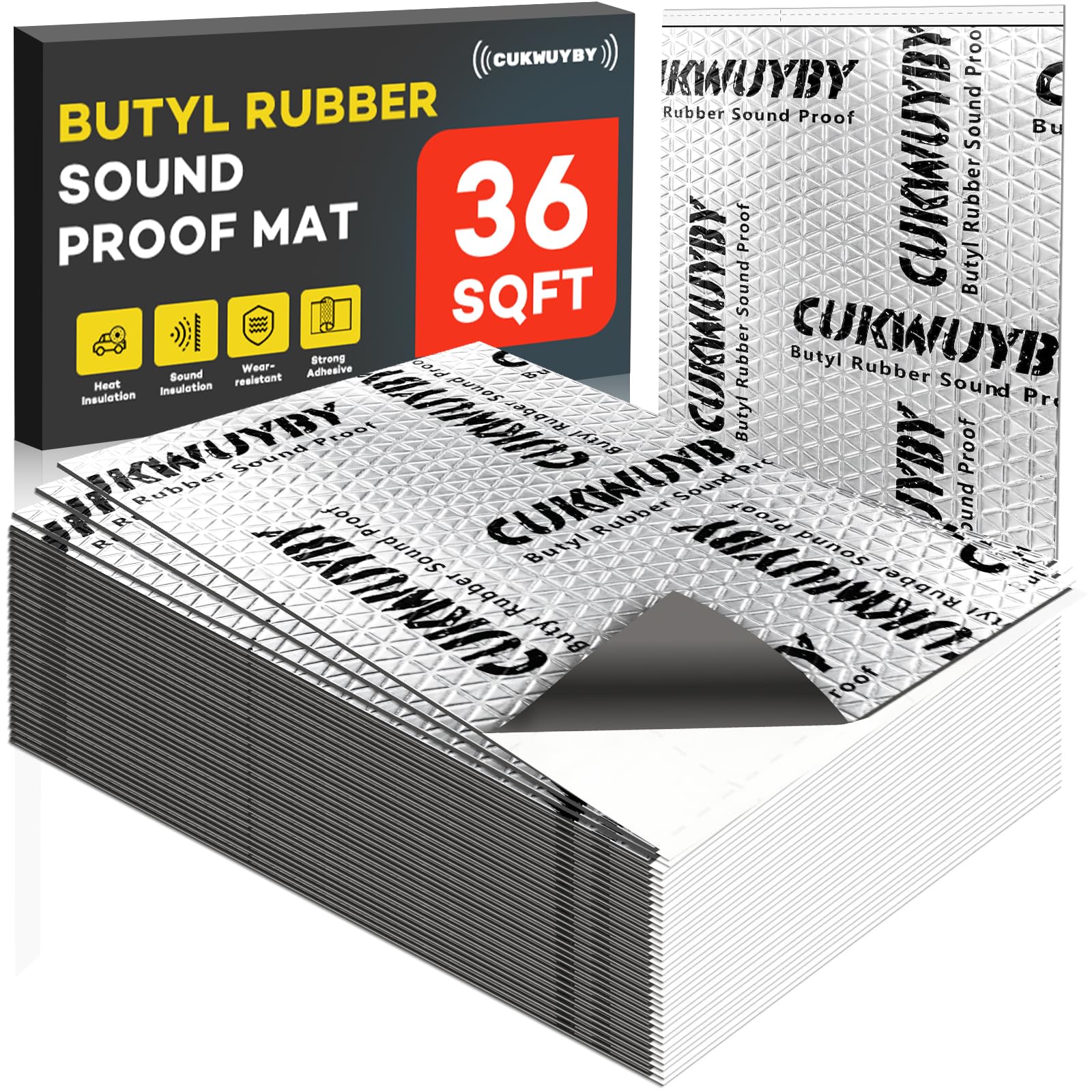
A 33-piece kit with grid-line backing that makes cutting and placement almost simple to use.
This CUKWUYBY kit uses the same 80 mil (2 mm) butyl formula as the KILMAT above but adds two practical twists: 33 separate pre-cut sheets and a backing paper printed with grid lines that make straight, tidy cuts simple. The 3-layer build — 8-wire aluminum foil over a butyl core over high-strength adhesive — is waterproof and durable for doors and trunks.
The most-praised trait in the reviews is build quality, with quality and adhesiveness earning the top two mention counts. Reviewers point out it eliminates severe rattling from aftermarket audio in a 2018 Durango with one box covering the rear gate and all doors, and a Ford F-150 owner reports “great results” after an easy install. The adhesive holds well even in 20-degree weather, according to the customer consensus, and one camper owner raves that it “made a hell of a difference” and stays exactly where you put it.
The thickness gets mixed feedback — some owners note it is not the thickest option, which is fair for an 80 mil mat. The foil can lift on tight radii, so plan your seams on flat surfaces, and the adhesive is strong enough to remove paint if you ever pull it off. For a solid, easy-rolling install at a value price, this is a very capable middle-ground pick.
Why the grid wins: the printed cutting lines on the backing remove the guesswork and make clean, precise panels quick to produce.
The honest limit: at 80 mil it sits at the entry-level thickness, so deep bass and heavy resonance are better served by a 120 mil mat.
Choose it for: a DIY-first installer who wants pre-cut tiles and grid lines to keep cuts clean and installation simple.
Pass on it if: you want maximum low-frequency damping and are okay paying more for a thicker 120 mil material.
5. Second Skin Damplifier Pro 2 mm (5 sq ft, 6 Tiles)

A matte-black constrained-layer damper that professionals repeatedly rank above the big-name brands.
Second Skin’s Damplifier Pro is the enthusiast-grade option in this list, and the reviews read like a who’s-who of hard-to-please owners saying it beats Dynamat. The 2 mm butyl and annealed foil tiles carry a 450°F heat rating, are RoHS compliant, and come in a 5-sq-ft pack of six 12″ x 10″ tiles. Owners describe it as thicker, heavier, and better-adhesive than Dynamat, with a matte black foil that is less likely to slice your hands during install.
The praise is specific and consistent: a 2023 Bronco owner says one box covers the whole cargo area and damps resonance well, a 2024 Honda Accord owner says the cabin got “much quieter” the moment the material went in, and a 2013 Accord owner used it on the rear deck with dramatic bass results. Buyers also note it outperforms brands like Resonix, Stinger Roadkill, NVX, and Murdermatt on build quality and ease of application. The best practice, per owners, is to cover just 25–35% of a panel rather than every inch — this is a vibration damper, not a full noise blocker.
The trade-off is value in the literal sense: 5 sq ft is a small amount for the price, and covering a whole car takes several boxes. It also does not block airborne noise on its own, so a full quiet-cabin build pairs it with mass loaded vinyl and foam. But for vibration and resonance damping — the thing that makes doors feel heavy and solid — owners say this is the best in the business.
The pro move: apply in 25–35% coverage strips on problem panels and let the constrained-layer design do the damping work.
The cost reality: the small 5 sq ft pack means a big job adds up, and this is not the budget route to a quiet car.
Pick this when: you want the best vibration damping money can buy and you value build quality and a 450°F heat rating over coverage volume.
Look elsewhere if: you must cover a full vehicle on a budget, where the 36 sq ft rolls deliver far more material per dollar.
6. Siless Max 120 mil 30 sq ft Butyl Mat

A 120 mil butyl mat that turned a 10-year-old Civic into a Lexus-like ride.
When 80 mil is not enough and you still want real coverage, the Siless Max 120 mil (3 mm) mat is the balance. It is 120 mil thick versus the 80 mil entry-level mats, which translates directly into more vibration and resonance killed, and the 30-square-foot roll still covers a substantial portion of a car. The Bmastic formulation earns near-universal owner praise for its damping performance.
The 4.8-star rating across roughly 770 owners makes this among the most trusted picks here, and the reviews are full of concrete wins. An F-150 and Civic owner reports reduced exhaust noise and a tighter sound system, a Ford Ranger owner used it to fix a tinny door noise completely, and a 10-year-old Civic became a “Lexus-like ride” with no offgassing or smell. The heat-dissipating aluminum coating is a bonus, and owners note the material cuts easily with scissors and molds into place well.
The honest cautions are minor. The installer’s knack matters — owners stress that a roller is essential for proper adhesion, and the mat is easier to handle when the outside temperature is above 70 degrees so it stays flexible. For most panel-damping jobs, this is the thickness-to-coverage balance most buyers end up happiest with.
The thickness payoff
- 120 mil thickness for deeper damping
- Aluminum coating sheds heat in summer
- Cuts cleanly with scissors and molds well
Installation needs
- A roller is required for proper adhesion
- Best worked when temps climb above 70°F
- 30 sq ft covers less than the 36 sq ft budget rolls
Best for: the buyer who wants noticeably thicker damping than 80 mil without stepping up to the all-in-one composite price.
Not for: anyone who wants to skip the roller, since this material demands a proper rolling to seat correctly.
7. Siless Hybrid 3in1 200 mil 25 sq ft Mat

The 200 mil composite tackles vibration, heat, and low-frequency noise in one heavy layer.
If you want the closest thing to a one-material solution, the Siless Hybrid 3in1 is it. At 200 mil (5 mm) thick, it is the heaviest mat on this list, and its three-layer build — butyl mastic, PE foam, and a mass-loaded butyl membrane — tackles panel vibration, exhaust heat, and low-frequency drone simultaneously. That makes it the choice for floors, firewalls, and full-vehicle jobs where you want a single install instead of stacking separate products.
The noise-level reduction is the most-praised trait by far — it is the top aspect with over 90 mentions — and shoppers say dramatic results. One user says 40–50 sq ft “cut cabin noise drastically” and made the exhaust “barely audible,” while a professional installer praised how easily it cuts, conforms, and rolls on a Bronco. A Fiesta ST owner calls it “top quality” with reduced road noise and no odor.
The recurring caveat is the adhesive strength: owners say it is almost too sticky, especially in hot weather, and the backing can be hard to peel if the material warms up. The advice is to let it cool in the A/C first and to seal seams with aluminum tape for a clean finish. Trade some coverage for a true multi-layer barrier and this is the pick for a serious full-vehicle job.
Why the 3 layers matter
- Damps vibration, blocks heat, and kills low-frequency noise in one layer
- Thick 200 mil build means one pass often does the job
- Cuts easily with scissors and conforms to curves
The sticky challenge
- Adhesive can be too tacky in hot weather
- Backing paper is hard to peel when warm
- 25 sq ft covers less area than thinner rolls
Reach for the Hybrid if: you want one comprehensive layer for the floor and firewall that handles vibration, heat, and drone together.
Opt for a thinner mat if: your project is just doors and you want maximum coverage per dollar without the extra weight.
Understanding the Specs
Mils and millimeters
Thickness is the single most important number in sound deadening. It is measured in mils, where 1000 mils equal one inch (so 80 mil is 2 mm, and 200 mil is 5 mm). Thicker butyl adds more mass to a panel, which means it absorbs more vibrational energy and quiets deeper, lower-frequency noise. Thinner mats like 80 mil are fine for doors and panels, while 120 mil and 200 mil mats are for floors, firewalls, and anyone chasing serious silence.
Coverage in square feet
Coverage tells you how much of your car one package fills. Doors typically need 10–15 sq ft, a trunk or cargo area 10–20 sq ft, and a full floor and firewall can take 40–50 sq ft. The budget rolls offer 36 sq ft for whole-car spread, while the premium mats often trade coverage for thickness — the Siless Hybrid gives you 25 sq ft of 200 mil material, which covers less area but does more per square foot.
FAQ
How many square feet of sound deadening do I need for a car?
What is the difference between 80 mil, 120 mil, and 200 mil mat?
Does sound deadening mat reduce heat in the car?
Can I install sound deadening mat myself?
Should I cover the whole panel or just parts of it?
Is butyl mat better than foam for sound deadening?
Will sound deadening mat work on an older car with lots of rattles?
How long does sound deadening mat last once installed?
Final Thoughts: The Verdict
For most buyers, the vehicle noise insulation winner is the KILMAT 80 mil because it pairs a whole-car 36-square-foot coverage with an 80 mil thickness at a price that undercuts the premium brands by a wide margin. If you want a noticeably thicker 120 mil mat for deeper damping, grab the Siless Max. And for a single-layer solution that handles vibration, heat, and low-frequency drone together, the Siless Hybrid 3in1 is the one to reach for.
How We Picked
We do not accept paid placement. Every pick is matched to a real buyer and a real use-case; we do not hands-on test units.
Sources & Methodology
Specifications: manufacturer listings and product documentation. Review insights: verified customer reviews, as of August 2026. Pricing: not shown on this page (it changes often); check the current price via the retailer link.
As an Amazon Associate, GoCarLife earns from qualifying purchases. This does not affect which products we feature.