
Our readers keep the lights on and the garage heater humming. As an Amazon Associate, I earn from qualifying purchases.
Specs are compiled from manufacturer listings and verified buyer reviews and can change over time — please confirm the key details on the product page before buying.
Blind spots cause countless merging mishaps, and a simple shoulder check is not always enough. The best fix is a system that watches the lane beside you and tells you when it is clear. You can choose a camera-based mirror view or a radar sensor that beeps—either way, the right setup ends the guesswork.
I’m Mo Maruf — the founder and writer behind GoCarLife. This guide is built by comparing the manufacturers’ published specifications and the patterns across verified customer reviews, so you get each pick’s real strengths and trade-offs instead of marketing spin.
These seven units represent the strongest Vehicle Blind Spot Detection options for vehicle blind spot detection, and the breakdown below makes the choice clear.
Our Picks at a Glance


How To Choose The Best Vehicle Blind Spot Detection
The first fork in the road is simple: do you want a camera that shows you the blind spot, or a radar sensor that alerts you when something is there? Camera mirrors replace your rearview mirror with a live feed, while radar systems mount sensors in your bumper and light up a warning LED. Each has a distinct feel behind the wheel.
Camera Mirrors vs Radar Sensors
Camera mirrors give you an actual view, so you see the car in the next lane instead of just a warning light. These are usually dashboard cameras (dash cams) with a rear camera that also acts as a reverse cam. Radar systems detect a vehicle in the blind zone and trigger an LED, flashing faster and beeping with your turn signal. Radar is more like what comes in modern cars, but the camera approach often costs less.
Detection Range and Warning Type
The detection range tells you how far back the system can see. Some 24GHz radar kits cover roughly 1 to 32.8 feet (0.3 to 10 meters), while premium 77GHz systems can reach around 40 feet. The warning type matters too — a simple LED is subtle, but a flashing light with an audible buzzer grabs attention exactly when you need it.
Quick Comparison
| Model | Best For | Detection Tech | Range | Screen | Amazon |
|---|---|---|---|---|---|
| WOLFBOX G850 PRO★ Best Overall | All-in-one mirror + dash cam | ADAS & BSD algorithm | — | 12″ Touch | Amazon |
| BlueDex BSD KitBest Value Radar | Budget radar with beeps | 24GHz Radar | 32.8 ft | — | Amazon |
| EASYGUARD EBS001 | Universal radar for sedans | 24GHz Radar | 12 m | — | Amazon |
| AZDOME PG17 Max | Clear 4K mirror view | BSD & LCA | — | 12″ Touch | Amazon |
| Pelsee 4K Mirror Cam | STARVIS night vision | ADAS & BSD | — | 12″ IPS | Amazon |
| Pelsee P12 Pro Max | Premium dual Starvis | ADAS & BSD | — | 12″ Display | Amazon |
| Brandmotion RDBS-1600 | Factory-like radar install | 77GHz Radar | 40 ft | — | Amazon |
In‑Depth Reviews
1. WOLFBOX G850 PRO 4K Mirror Dash Cam
Our pick — over 4★ from 950+ verified ratings; the strongest balance of quality and price.
The 12-inch mirror that turns your blind spot into a live 4K view.
This smart mirror replaces your rearview mirror with a 12-inch touchscreen, giving you a continuous feed from a 1080P rear camera. The blind spot detection algorithm watches for cars beside and behind you, sending rear collision alerts during lane changes—which is why Jeep Wrangler buyers report the rear cam stays clear where the factory mirror fails with a soft top. The front camera records at 2160P (2560*1440)@30fps, and the rear at 1080P@25fps, so number plates stay readable in direct sun or darkness thanks to WDR/HDR tuning.
Voice control with 12 commands lets you turn on WiFi, snap a photo, or lock footage without reaching for the screen, which is a real safety plus when you are driving. The 5.8GHz WiFi connects to the WOLFBOX App instantly, so downloading and sharing clips takes seconds. It is built for a bus, car, minivan, or truck, and the kit ships with a 64GB card plus a 170-degree field of view camera, so the coverage is genuinely wide.
Owners consistently praise the build quality and the complete package of features. The recurring complaint is that the screen is too bright at night, though it reads well in low light. A few also note that losing the traditional mirror takes adjustment, and the larger size can partially block a sun visor.
What Owners Rely On
- Crisp 4K front + clear 1080P rear in all conditions
- 12-inch IPS touchscreen with simple swipe controls
- ADAS and BSD alerts for collision and lane departure
- Included 64GB card and 5.8GHz WiFi for fast clips
Where To Be Flexible
- Night screen brightness can be distracting
- Larger mirror may obstruct the sun visor
- Parking mode needs a separate hardwire kit
Your best bet if: you want one device that replaces the rearview mirror, records in 4K, and actively warns you of cars in the blind spot during lane changes.
Think twice if: you prefer a traditional glass mirror and find extra brightness at night annoying.
2. BlueDex Blind Spot Monitoring 24GHz Radar Kit
Budget radar that lights up and beeps the moment a car enters your blind zone.
This is the pure blind spot solution—a dual 24GHz millimeter wave radar that detects vehicles approaching from the side or rear, with a detection range of 1–32.8 ft (0.3–10 m). When a car enters the blind zone, the LED warning indicator activates automatically. The real advantage here is the alert logic: with the turn signal off the LED stays lit, with the signal on the LED flashes and the buzzer sounds 3 beeps, and with hazard lights on the LED flashes continuously with 3 beeps for extra awareness.
The kit is designed for sedans, SUVs, and pickups with DC 12V power systems. Since radar sensors cannot penetrate metal surfaces, proper sensor placement is critical — the box includes an installation manual and a radar angle alignment tool to get the angle right. A shop owner called it “fantastic product” that works every single time, unlike other brands they had tried.
The catch is installation: this is the most complex pick to fit, and professional installation is strongly recommended. A Chevy Malibu owner notes that on some cars, the brake and blinker share the same wire, which caused beeps when passing at a stop light. Also expect a fair amount of beeping in heavy traffic — that is the most-cited annoyance, with noise flagged as a recurring complaint.
Radar smarts: the functionality is what wins people over, with the sensor picking up cars effectively and reliably after a proper install.
Fair warning: if wiring is not your thing, add install cost to your budget and expect regular beeps in busy lanes.
3. EASYGUARD EBS001 Blind Spot Monitor System

A universal radar that fits most 12V sedans and lights up your blind area.
This system uses 2pcs 24GHz microwave sensors to probe the rear side of your vehicle for moving objects in the blind area. It monitors closing objects in the neighbor lane within a range of 6-12 meters, so long as the speed difference is over 0.5m/s. When something enters the blind zone, the LED flashes to get your attention; with the turn signal on, it flashes rapidly and the buzzer beeps three times to warn you before you change lanes.
It is a flexible fit for most DC12V sedans, compacts, SUVs, MPVs and pickups — but there is an important limitation. This unit installs on cars with a plastic bumper only, because a metal bumper interferes with the radar sensor. That requirement is easy to overlook, so check your bumper material before ordering. Owners describe the install as straightforward with trim tools, though some found the left/right radar labels reversed and simply swapped them.
Owners praise the straightforward installation and consider the quality solid for the price. The mixed feedback centers on the passenger-side LED: some owners mention it works perfectly while others found it intermittent. Do note the instructions drew negative feedback, and on some cars like a Honda Accord the alarm and power wires run short, needing a few feet of splice extension.
Cost-effective coverage: a genuinely affordable radar upgrade that warns you of approaching cars from the rear sides.
Workaround needed: metal bumpers are a no-go, and a little extra wiring patience goes a long way.
4. AZDOME PG17 Max 4K+2.5K Mirror Dash Cam
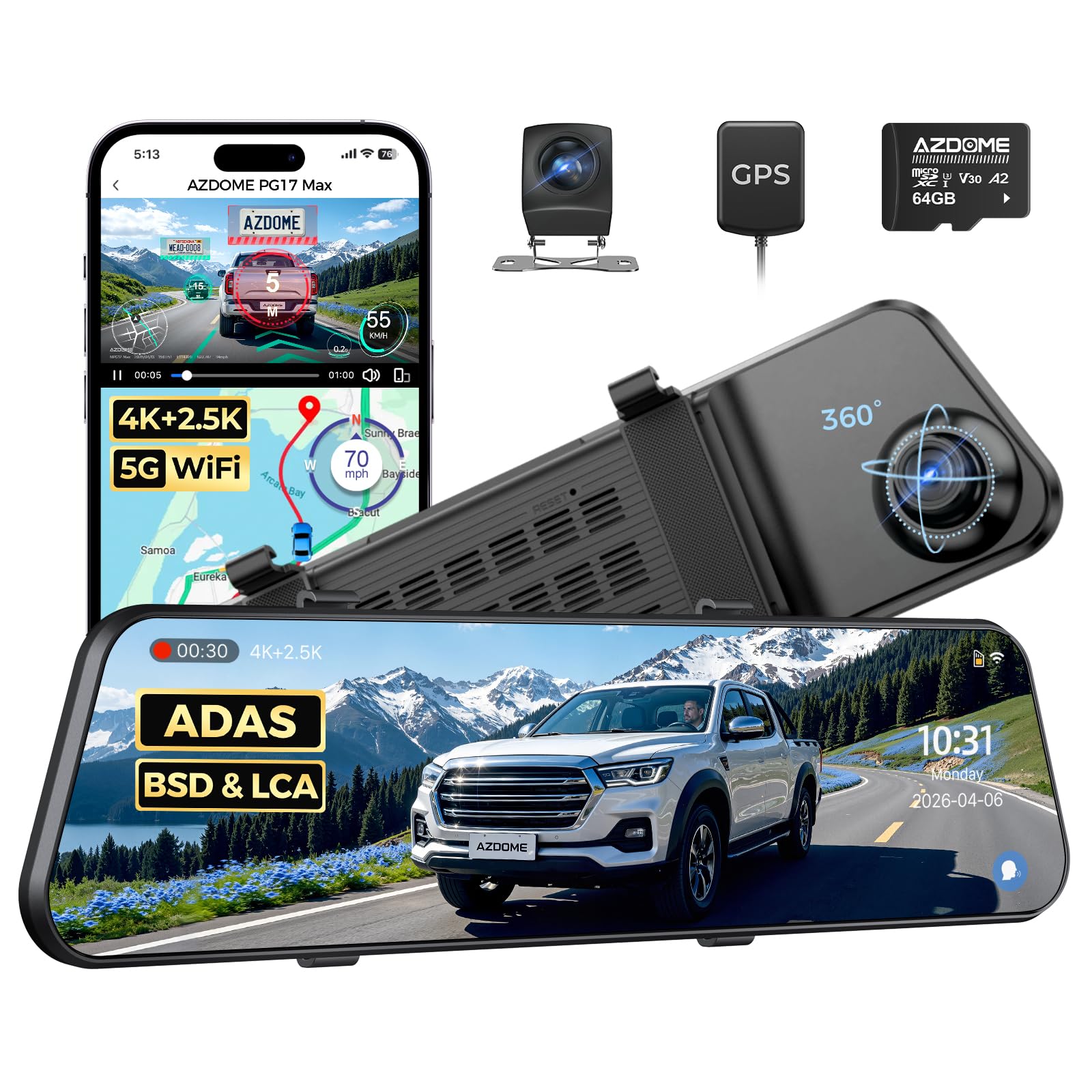
A 12-inch screen with a 150-degree eye that practically erases blind spots.
The defining spec here is the front 4K (3840×2160) at 30fps and rear 2.5K (2560×1440) at 30fps, and owners say the clarity is so strong it “eliminates blind spots entirely.” With a 150-degree field of view and a swipe to toggle front and rear split views, the live rear feed is always visible—no more craning your neck to check the next lane. The enhanced BSD & LCA monitors the sides and rear, alerting you to rear-end collision risks during lane changes.
Buyers praise the genuinely easy setup, with quality and value close behind. The strap-on install needs no adhesive, and the kit includes a pry tool, cleaning wipes, and an anti-glare film. Voice control with 10 commands works well, and the 5.8GHz WiFi connects to the AZDOME app for quick video downloads.
The mixed feedback lands on image quality and the rearview mirror function itself — a small number of owners had the front camera stop after about a year. The touchscreen response lags a little, and a few find the voice alerts hard to understand, though you can turn them off. The included screen protector can blur the mirror view, so try it both ways.
Reach for this if: you want a bright, wide, 4K mirror view that makes blind spots basically disappear, plus an easy install.
Look elsewhere if: you need guaranteed 24/7 parking monitoring — that needs a separately sold hardwire kit.
5. Pelsee 4K Mirror Dash Cam with STARVIS 2

The mirror that sees in the dark, balancing headlights and shadows with STARVIS 2.
Night driving is where this pick shines. The STARVIS 2 sensor delivers superior low-light performance, balancing bright headlights and dark shadows so critical details stay visible 24/7. It records 4K@25fps up front and 1080P@25fps in the rear, with front HDR and rear WDR processing to render number plates and road signs sharply day or night. Owners driving long vans like a Toyota Sienna find it essential for reversing and lane changes, calling the rear view wide, bright, and clear.
The 160-degree wide-angle lens and 12-inch IPS display pair with ADAS voice alerts for front vehicle start, lane departure, forward collision, and pedestrian detection. The 5.8GHz Wi-Fi 6 supports transfer speeds up to 20MB/s, so pulling footage through the Pelsee App is fast. It also switches to a 1080P rear view with dynamic parking guidelines when you shift into reverse, with audible alerts for nearby obstacles.
Owners most often praise the build quality and video clarity, with installation a close third. Brightness gets mixed feedback, and the glossy screen can cause reflections in some light. A 2003 GMC Envoy owner notes night quality diminishes a bit, and the rubber straps may not suit a bulky mirror — zip ties solved that. Rear camera cable is 19.6 ft (6 m), which may fall short in full-size SUVs, trucks, or vans, so an extension cable is sold separately for those.
Darkness specialist: the STARVIS 2 sensor makes night parking and highway merging noticeably easier.
Size it up: check your mirror dimensions and vehicle length — larger vehicles may need extra cable or a bracket.
6. Pelsee P12 Pro Max 4K+2.5K Mirror Dash Cam
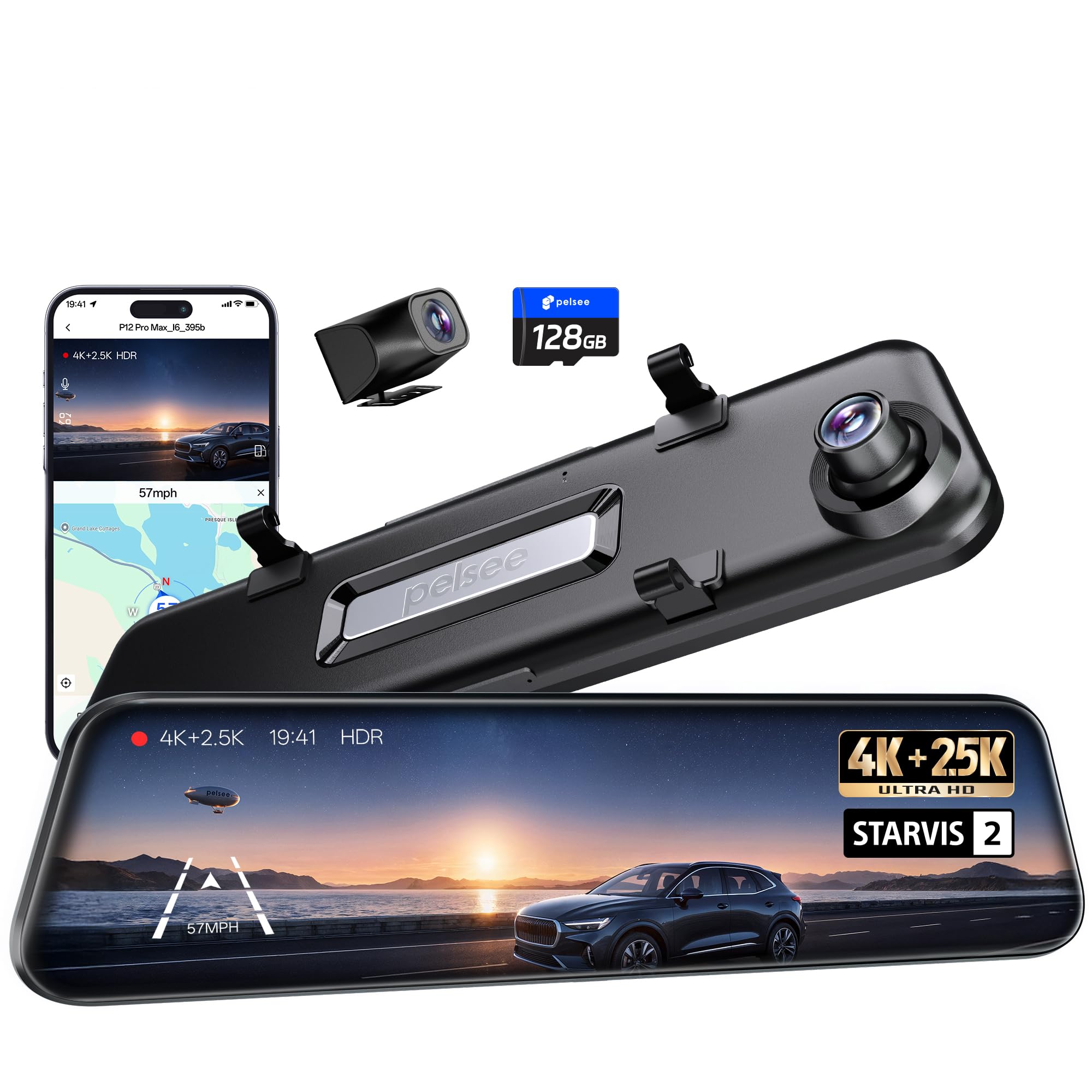
A dual-Starvis flagship with 33 feet of cable and an OBD kit in the box.
This is the top-tier version of the Pelsee mirror, and the headline is true 4K at 30fps from the STARVIS 2 IMX678 front sensor — which captures twice the light of standard sensors. The rear camera uses the STARVIS IMX335 sensor to record in 2.5K, and both are tuned with front HDR and rear WDR so harsh backlight or sudden tunnel transitions stay balanced. The BSD algorithm monitors areas your mirror cannot see, detecting approaching vehicles and sending visual and audible alerts during lane changes.
The included OBD power cable plugs into your car’s OBD-II port for 24/7 parking monitoring, with low voltage protection to prevent battery drain. It also comes with a 128GB card, and the rear camera cable is a generous 33 ft — long enough for big SUVs and trucks without needing an extension. Dual-band Wi-Fi supports both 2.4GHz and 5.8GHz, with transfer speeds up to 20MB/s for fast previews and downloads. A Sprinter van owner says it solves rear visibility completely, with a bright clear rear and side view, and it works as a normal mirror when off.
Owners say this improves on the original with clear 4K video, good night vision, and easy OBD-port installation. One F150 owner found a quirk where time-lapse mode flips the rear camera view, requiring a toggle reset at each start — disabling time-lapse fixed it. The 12-inch display is large but well-liked, and customer service appears responsive when issues pop up.
Choose this if: you want the best available night vision, generous cable reach, and plug-and-play parking monitoring without extra wiring.
Know before buying: the large display needs a custom OEM bracket (sold separately) if your mirror is unusual, and one time-lapse bug may affect you.
7. Brandmotion RDBS-1600 Radar Blind Spot System

The 77GHz radar that behaves like factory equipment, with cross-traffic alert built in.
This is the closest thing to an OEM installation. It uses a 76–77GHz radar and a CAN integration module to monitor the lane next to you, with a detection range of about 40 feet—the upgraded RDBS-1500 “sees” 15 feet further behind your vehicle than the original system. Bright day-night indicators mount cleanly at the bottom of the windshield trim with no exposed wires. It also has a built-in rear cross-traffic alert that senses vehicles approaching from the sides when you back out of a parking spot.
The hard data is impressive: the system accurately monitors the adjacent lane without triggering warnings for vehicles two lanes over. Owners call it OEM quality with no false alarms, working great after a year of daily use. A 2017 Honda Pilot Touring owner says the blind spot and cross-traffic alert work exactly as described. It fits vehicles with plastic fascias (excluding metal pickup truck bumpers) and a CAN-BUS speed signal, model year 2007 and newer — and it is designed for professional installation.
The main trade-off is complexity and cost. Installation is demanding, requiring sensor mounting, wiring, and CAN integration — several owners paid a shop to do it, and a couple found the mounting brackets too short. There are also functional limits: it does not detect vehicles under 15 mph or static objects, and one buyer reports it did not work with a 2007 BMW. A failed unit after an authorized dealer install highlights that this is an expensive gamble if the install goes wrong.
Factory feel: the radar accuracy and cross-traffic alert are the standout wins, with quality being the top praised aspect.
Budget for setup: the price of the unit is only half the story — professional installation is strongly advised, and a tricky vehicle can break the deal.
Understanding the Specs
Radar Frequency and Range
Radar blind spot systems use different frequencies to sense vehicles. The 24GHz millimeter wave radar kits, like the BlueDex and EASYGUARD units, detect vehicles in a range roughly from 1 foot up to about 32.8 feet (0.3–10 meters). Premium systems use a 76–77GHz band, like the Brandmotion, which reaches about 40 feet and can monitor the lane next to you without false alarms for cars two lanes over. A longer range gives you an earlier warning, providing more reaction time.
Warning System: LED vs Buzzer
How a system tells you about a car in your blind spot matters. Most radar kits use an LED indicator that lights up when a vehicle enters the blind zone. When you turn on your turn signal, that LED flashes faster and a buzzer beeps to grab your attention. Camera mirrors, like the WOLFBOX G850 PRO or Pelsee, instead show you the actual view from a rear camera on a 12-inch screen. Some drivers prefer the direct view, while others like the simple light and beep of a radar sensor.
FAQ
Will a blind spot detection system work on my car?
What does detection range mean for blind spot systems?
How is a 24GHz radar different from a 77GHz radar?
Can a mirror dash cam really replace a radar blind spot system?
Do I need professional installation for a radar blind spot kit?
What is the difference between BSD and ADAS?
Will these systems work with large vehicles like vans or trucks?
Do blind spot systems work at low speed or in parking lots?
Final Thoughts: The Verdict
Across the board, the vehicle blind spot detection winner is the WOLFBOX G850 PRO because it combines a 4K dash cam, a 12-inch live rear view, and real blind spot alerts in one easy-to-install package. If you want a pure radar sensor with an audible beep and a wider detection range, grab the BlueDex 24GHz kit for a budget-friendly radar fix. And for the factory-like feel with cross-traffic alert, the Brandmotion RDBS-1600 is the premium route — just budget for professional installation.
How We Picked
We do not accept paid placement. Every pick is matched to a real buyer and a real use-case; we do not hands-on test units.
Sources & Methodology
Specifications: manufacturer listings and product documentation. Review insights: verified customer reviews, as of August 2026. Pricing: not shown on this page (it changes often); check the current price via the retailer link.
As an Amazon Associate, GoCarLife earns from qualifying purchases. This does not affect which products we feature.