
Our readers keep the lights on and the garage heater humming. As an Amazon Associate, I earn from qualifying purchases.
Specs are compiled from manufacturer listings and verified buyer reviews and can change over time — please confirm the key details on the product page before buying.
Picture this: you are out on the trail, the radio is thumping, the winch is ready — and the engine refuses to crank because your accessories drained the starting battery. A vehicle battery isolator is the small, smart relay that stops that from ever happening again by letting your second battery power the fun stuff while keeping the main battery charged and ready to start.
I’m Mo Maruf — the founder and writer behind GoCarLife. This guide is built by comparing the manufacturers’ published specifications and the patterns across verified customer reviews, so you get each pick’s real strengths and trade-offs instead of marketing spin.
You need a vehicle battery isolator that keeps your starting battery from dying while you run accessories, and the right one for your truck, boat, or RV depends on three things: how many amps your biggest accessory draws, how the relay switches, and how much wiring is included.
Our Picks at a Glance

How To Choose The Best Vehicle Battery Isolator
Match the relay to your vehicle’s electrical load. You need enough amperage to run your biggest accessory, and the switching style must work with how your alternator charges.
Match the amperage to your real loads
A winch can surge past 500 amps the moment you pull a heavy load, so a 140A relay feels right for a fridge or lights but gets overwhelmed by a serious winch. Look at the continuous rating first — that is the number your accessories actually draw over time, not the momentary spike.
Understand smart alternators vs older charging systems
Modern vehicles with “smart” alternators vary their voltage constantly to save fuel, so a basic voltage-sensitive relay might cut off your auxiliary power in town. Some kits deal with this better than others, and a few buyers report needing to turn on their headlights to force the alternator to hold a steady output.
Decide between automatic and manual control
An automatic isolator reads the charging voltage and combines or splits your batteries without any input from you — the ideal set-and-forget setup. A manual override button or switch adds a backup path so you can jump-start your own main battery from the auxiliary one if the main ever dies.
Quick Comparison
| Model | Best For | Continuous Amps | Switching Style | Extras | Amazon |
|---|---|---|---|---|---|
| TRUE UTV-SBI-CM★ Best Overall | UTV accessory setups | Voltage-sensing | Automatic | LED volt meter included | Amazon |
| MaySpare 140A VSR KitBudget Champion | Budget dual-battery rigs | 140A | Automatic VSR | Complete wiring kit | Amazon |
| VEVOR Split Charge Relay | Trucks & campers | 140A | Automatic VSR | IP65 waterproof relay | Amazon |
| NVX BIR500 | High-draw audio & winches | 500A | Automatic | 700A surge capacity | Amazon |
| WirthCo Battery Isolator | Vehicles with jump-start needs | 125A | Automatic + override | Manual jump-start button | Amazon |
| Stinger SGP35 | Car audio & winch relays | 500A | Electromechanical | 100,000-cycle life | Amazon |
| Blue Sea Add-A-Battery | Marine & boats | 120A | Automatic + combine | Tin-plated studs, dual switch | Amazon |
In‑Depth Reviews
1. TRUE® UTV-SBI-CM UTV Dual Battery Connect & Monitor Kit
Our pick — over 4.5★ from 750+ verified ratings; the strongest balance of quality and price.
The UTV specialist that pairs a smart isolator with a live voltage display you can actually watch.
This kit earns our top spot because it bundles the True Amalgamated SBI-18 isolator with a 36mm blue LED volt meter that has a dual display — so you see the starting battery and the accessory battery readouts side by side as you ride. It ships with sealed 6-gauge red and black cables that use 6mm lugs, meaning the heavy wiring work is largely done before you even open the box.
Functionality is what wins people over here, and the install stories back it up: owners mention a 30-minute fit on a 2010 Polaris RZR 800, and the same unit handles a Honda Pioneer 1000-5 with zero drama. The smart part is how it behaves after you park — the CTEK-style tender charges the main battery first, then flows to the auxiliary, so you can hammer your accessories without ever flattening the starter.
The listed caveats are minor: a couple of owners skipped the included volt meter because they didn’t want to drill a 29mm dash hole, and others wished the positive and negative cables reached a bit farther across a wide UTV. Neither stops the isolator from working exactly as advertised — one buyer already plans a second unit for his boat and his Jeep.
What wins owners over
- Dual-display LED volt meter shows both battery states live
- Sealed 6-gauge cables with 6mm lugs cut install time
- Charges main first, then auxiliary, protecting your start
Small trade-offs
- Cables could be longer for very wide UTVs
- Volt meter needs a 29mm dash hole some owners skip
The pick for UTV owners: if you run lights, a winch, or a sound bar on a Pioneer, RZR, or Teryx, this is the cleanest drop-in solution.
Think twice if: your rig is a full-size truck where longer cable runs and a larger mounting footprint are non-negotiable.
2. MaySpare Dual Battery Isolator Kit 12V 140Amp VSR
A budget-friendly 140A kit that gets the job done when your alternator behaves predictably.
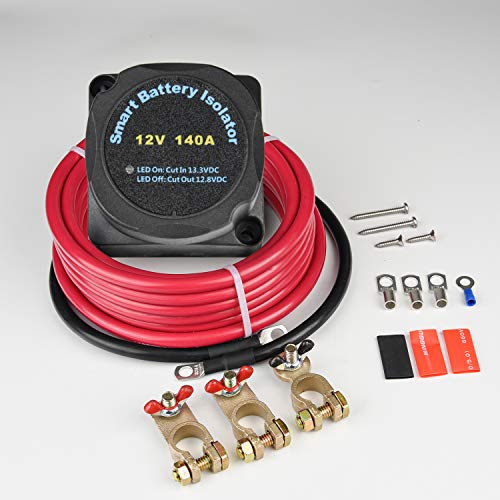
For the money, this MaySpare 140A voltage-sensitive relay package is remarkably complete — buyers install it into a Dodge Caravan for an AGM power box and into an F150 canopy for an inverter, USB ports, and a cigarette lighter without hunting for extra hardware. The relay cuts in at 13.3 volts and cuts out at 12.8 volts, so the main battery stays ready to start while accessories draw from the second.
The honest catch is reliability: while many customers note clean installs and solid performance, the most-discussed theme is mixed. One buyer’s unit failed after two weeks mid-road-trip, forcing a stop at an auto parts store, and owners with Subaru’s smart alternator found the relay drops below 12.5V in town and kills auxiliary power until they force the alternator higher by switching on lights.
If your vehicle has a conventional alternator that holds steady voltage, this kit delivers strong bang for the buck. If you drive something with variable smart-charging, expect to work around it or step up to a unit better suited to that alternator behavior.
Best for simple rigs: a conventional-alternator truck, van, or boat where the 13.3V cut-in threshold lines up with your charging output.
The reliability asterisk: an occasional unit dies early or misbehaves with smart alternators — budget accordingly.
3. VEVOR Split Charge Relay Kit, 6mtr 12V, 140AMP VSR
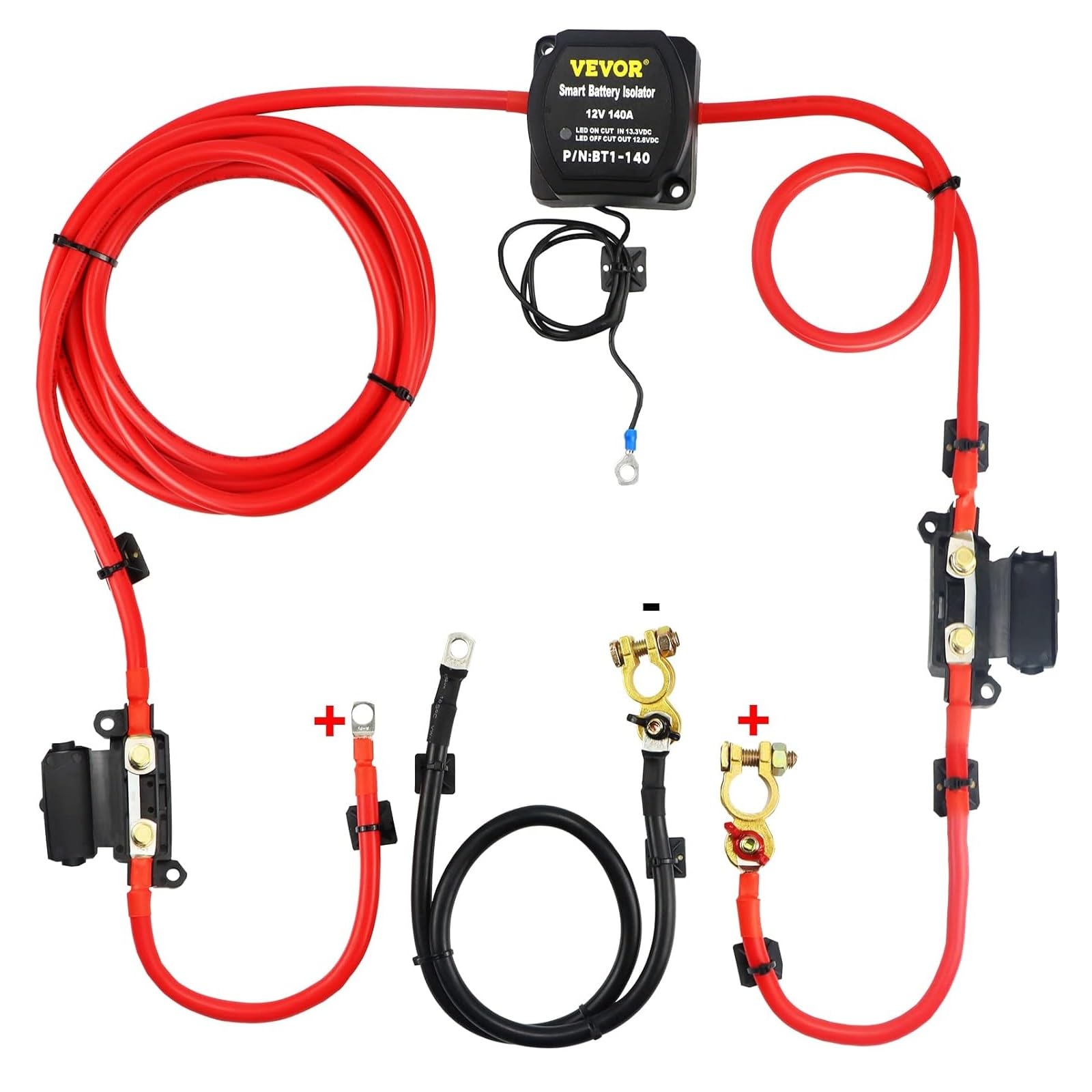
The IP65 waterproof relay that shrugs off dust, spray, and a year of hard use without a hiccup.
VEVOR’s split-charge relay stands apart for its rugged build — the voltage-sensitive relay is rated IP65, meaning it stays secure in dusty, wet, and high-vibration environments that would worry lesser units. The compact 2.66″ x 2.11″ x 2.66″ body fits almost anywhere, and the kit’s 6-meter wiring reaches from an extended-cab Tacoma all the way into a camper shell with room to spare.
Installation gets the loudest applause: owners call it a 1.5-hour job when they work to keep it tidy, and the included hardware covers nearly everything. The reliability story is strong too — a truck owner reports installing it for a secondary battery and running a full year with no problems, and solar users say it keeps chassis batteries charged reliably.
The recurring note is the negative cable for the second battery — a few owners wanted it longer, and one flagged connector quality — but nothing that stops the kit from doing its job. At 140A it pairs perfectly with a fridge, lights, and a modest inverter rather than a hungry winch.
Why it earns its place
- IP65 waterproof relay survives dust, spray, and vibration
- 6-meter wiring reaches most truck-to-camper runs
- Proven one-year-plus reliability in real installs
What to know
- Second-battery negative cable could be longer
- 140A ceiling suits accessories, not heavy winching
Reach for this if: you want a waterproof, dependable 140A split-charge setup for a truck, camper, or 4×4 without paying premium prices.
Look elsewhere if: you are feeding a winch that surges well past 140A.
4. NVX BIR500 500 AMP Battery Relay Isolator

The 500-amp bruiser built for winches and audio systems that spike on demand.
While the 140A relays above handle lights and fridges, the NVX BIR500 steps up to a different league: 500 amps continuous at 12V, with a 700-amp surge rating that covers winch demands. One Jeep owner explains the math simply — winches can surge that high, and you want something designed to protect when they do. In a truck two-battery setup, it charges the second battery on a switch while you run the audio system without touching the primary.
The switching power spans 10 to 16 VDC, which gives it flexibility for varying alternator outputs. Performance is the dominant praise here, holding up through warm and cold months alike, and owners routinely call it the best isolator for the money when the job calls for serious current.
The honest warning from the field: do not over-tighten the terminals — the top is plastic, and one owner snapped a bolt just by moving the wires. Treat the lugs gently and this relay delivers heavy-duty separation that the 140A crowd simply cannot match.
The heavy-duty pick: a 500A continuous relay with 700A surge capacity that honestly handles winch and high-power audio loads the smaller units can’t.
Handle with care: plastic terminal top means snug, not gorilla-tight, when you land the cables.
5. WirthCo Battery Isolator

The smart isolator with a manual jump-start button that can rescue your own dead starter battery.
The WirthCo stands out because it is not just an isolator — it is a smart charger and jump-starter in a compact 4 by 4 by 2 inch housing. Charging kicks in only when the main battery passes 13.4V, so the secondary gets topped off second, and the built-in override button parallels both batteries so the auxiliary can crank the engine when the starting battery is flat, then returns to automatic charging once firing.
Owners run it across serious setups — an Odyssey primary with a Braille AGM secondary feeding a winch, emergency lights, and a siren — and it reliably charges the second battery only after the first is full. Ham radio operators use it to keep a dual-battery station alive, and one buyer replaced a stolen unit with the same model without hesitation. The IP62 water-resistant housing makes it suitable for marine use too.
The one nuance worth knowing: the blue charging light can stay on when an AGM battery is fully charged from solar, which is normal behavior, and the system demands a healthy main battery to begin with. For a 125A continuous rating, it pairs best with a 150A alternator on a V8 rather than a small four-cylinder.
The smart stuff
- Manual override jump-starts your own rig from the aux battery
- Charges secondary only after primary passes 13.4V
- IP62 water-resistant housing suits marine duty
Keep in mind
- Needs a healthy main battery to function properly
- 125A continuous suits a 150A alternator, not small motors
Choose this when: emergency jump-starting yourself is a feature you want, and you run a vehicle with a sturdy alternator.
skip it if: your alternator puts out under 100A — a smaller-rated isolator fits better.
6. Stinger SGP35 High Current 500-Amp Battery Relay & Isolator
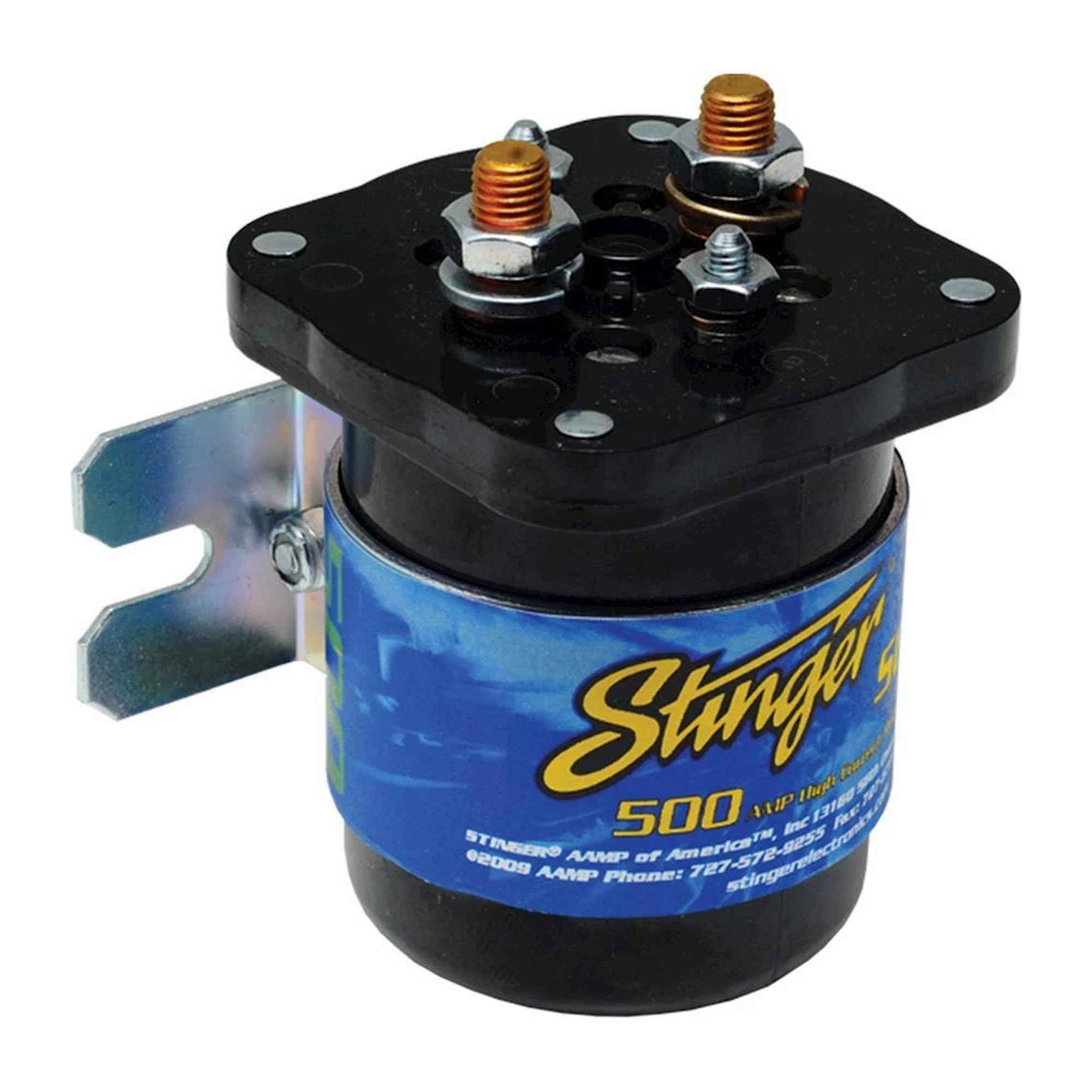
The heavy-duty relay that car audio and winch owners trust for constant-duty current flow.
Stinger built this relay for serious current: 500A continuous and up to 900A surge, with a 100,000-mechanical-cycle life that speaks to its endurance. The water-resistant phenolic plastic construction guards against moisture in marine, powersports, and off-road applications, which is why it shows up on Jeep JLUs running 12K winches wired to factory aux switches.
Owners in commercial trucks and overland rigs call it solid and high-quality, choosing the brand over cheaper alternatives specifically because of fire risk under high-amp loads. As a selenoid interrupt for a newly installed truck winch, it works perfectly, and the 12V coil pairs with any alternator or charging system type.
The one physical note: it is a sizable relay, so owners in small vehicles flag the footprint before buying. For anyone running high-current car audio or a winch that wants real separation between batteries, this is the top relay pick in the lineup.
The constant-duty pick: 500A continuous, 900A surge, and a 100,000-cycle life make it the endurance relay for winches and audio.
Size check: the rugged body is large — measure your mounting space before ordering.
7. Blue Sea Systems Add-A-Battery Kit 120A Dual Circuit System, 7650
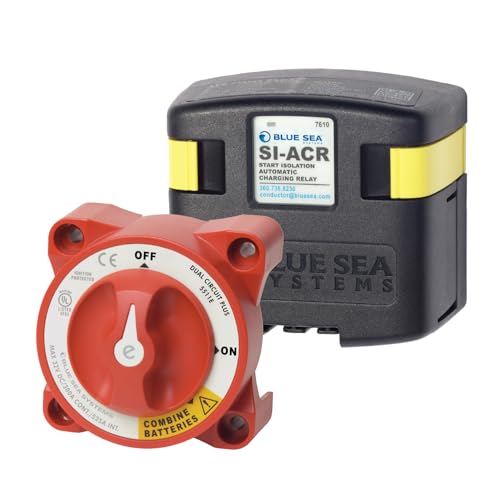
The marine-grade kit that boat owners swear by for keeping both banks charged, automatically.
Blue Sea earns its reputation here with a 120A continuous system built for saltwater: tin-plated copper studs resist corrosion, and the built-in automatic charging relay senses charge voltage, combining batteries while charging and isolating them at rest. The dual-circuit plus switch manages starter and house banks independently, protecting your reserve capacity even when you drain one side dry.
The signature feature is the emergency parallel function — a combine switch that links both batteries so a discharged bank can still crank the engine using the other. Boat owners describe a day of heavy radio and device use ending with an easy start, and one even saved themselves from a tow when the starter battery dropped to 6V; the combine switch started the boat off the isolated second battery.
The 4×4 crowd loves it for a second battery too, with the smart relay charging both banks from alternator or solar. The only recurring gripes are the wiring schematic, which some find tricky to follow, and the fact that you supply your own wiring, fuses, and ground bus. Quality is the dominant praise, and every owner agrees it beats the cost of a failed battery or a tow.
Why it’s a legend
- Tin-plated copper studs resist corrosion in marine environments
- Combine switch emergency-starts from the second battery
- Charges both banks from alternator or solar automatically
Setup notes
- Wiring schematic confuses some first-time installers
- You buy your own wiring, fuses, and ground bus
The boat and 4×4 answer: if you want corrosion-proof, automatic dual-bank management with a self-rescue combine switch, this is the one.
Be ready for: a wiring project rather than a plug-and-play kit.
Understanding the Specs
Amperage vs Surge Rating
Amperage tells you how much current a relay can carry. The continuous rating is what your accessories draw over time — like a fridge pulling a few amps per hour. The surge rating is the momentary burst, like a winch spiking as it yanks. A 140A relay handles lights and coolers, but a winch wants a 500A continuous unit with a 700A or 900A surge cushion.
Voltage-Sensitive Relay (VSR)
A voltage-sensitive relay reads your alternator’s output and decides when to connect your second battery. Most cut in around 13.3 volts — meaning the alternator is actively charging — and cut out around 12.8 volts so the main battery stays preserved. The catch is smart alternators that vary voltage, which can leave a VSR idle in town.
FAQ
What does a vehicle battery isolator actually do?
Why does amperage matter when I pick an isolator?
Will a voltage-sensitive relay work with a smart alternator?
Can I jump-start my own vehicle with a battery isolator?
Is a battery isolator the same as a battery separator or VSR?
How long does a battery isolator installation take?
Can I use a marine battery isolator in my truck or 4×4?
Which battery types work with these isolators?
Final Thoughts: The Verdict
The vehicle battery isolator that fits most UTV and light-accessory builds is the TRUE UTV-SBI-CM, because it pairs proven automatic charging with a live dual-display volt meter that makes your battery state impossible to miss. If you need heavy current for a winch or hard-hitting audio, the NVX BIR500 carries 500A continuous with a 700A surge. And for the boat or 4×4 crowd that wants corrosion-proof, self-rescuing dual-bank control, the Blue Sea Add-A-Battery is the one to reach for — a crowd favorite by every measure, with a quality reputation that shows up again and again in owner stories.
How We Picked
We do not accept paid placement. Every pick is matched to a real buyer and a real use-case; we do not hands-on test units.
Sources & Methodology
Specifications: manufacturer listings and product documentation. Review insights: verified customer reviews, as of August 2026. Pricing: not shown on this page (it changes often); check the current price via the retailer link.
As an Amazon Associate, GoCarLife earns from qualifying purchases. This does not affect which products we feature.