
Our readers keep the lights on and the garage heater humming. As an Amazon Associate, I earn from qualifying purchases.
Specs are compiled from manufacturer listings and verified buyer reviews and can change over time — please confirm the key details on the product page before buying.
Your laptop hits 15% right as the road trip hits hour three, and the only power in the car is a 12V socket that can’t run anything serious. A vehicle AC charger fixes that by turning your car’s 12V battery power into the 110V wall current your laptop, CPAP, or portable TV actually needs. The real question is which wattage, ports, and safety features fit your driving needs.
I’m Mo Maruf — the founder and writer behind GoCarLife. This guide is built by comparing the manufacturers’ published specifications and the patterns across verified customer reviews, so you get each pick’s real strengths and trade-offs instead of marketing spin.
The right unit turns your vehicle into a rolling power station, and this breakdown ranks the best vehicle ac charger options by real-world output, port flexibility, and owner-proven reliability.
Our Picks at a Glance

How To Choose The Best Vehicle AC Charger
Match the inverter’s wattage and ports to the devices you’ll actually plug in. Everything here converts 12V DC from your car into 110V AC for household gear — but the wattage, ports, and build quality decide whether it actually survives daily use.
Match wattage to your device, not your imagination
Continuous wattage is the spec that determines what the inverter can sustain. A 400W model runs a laptop or small TV all day, while a 200W unit is strictly for phones, tablets, and other light electronics. Peak wattage is a short burst for starting motors (like an air compressor) — it’s not a steady-state number. If your device label says 350W, you need a 400W inverter, not a 300W.
USB-C PD is the laptop lifeline
Older inverters made you plug a laptop into the AC outlet, wasting watts on the wall adapter. Modern ones add a USB-C PD port that charges a MacBook directly. The number after “PD” is the power — 65W runs a full-size laptop, while 30W is better for phones and tablets. A 65W PD port future-proofs your laptop charging for the same price as 30W.
Safety protections are the quiet tiebreaker
Every serious inverter packs a fuse and overload shutdown, but the good ones add overheat and undervoltage cutoffs. A built-in cooling fan that turns on with temperature is another layer — a fanless unit gets hot, and heat is the fastest way to kill cheap electronics. Check that the model watches its own temperature before it watches yours.
Quick Comparison
| Model | Best For | Output Power | USB-C PD | AC Outlets | Amazon |
|---|---|---|---|---|---|
| BESTEK 400W★ Best Overall | Overall pick for patrol vehicles and heavy use | 400W | 30W | 2 | Amazon |
| FSATBTNE 400W65W Charging | Fast-charging laptops with a 65W USB-C port | 400W | 65W | 2 | Amazon |
| DrimMek 300WMost Versatile | Multi-device families with a six-port setup | 300W | 65W | 2 | Amazon |
| Pro Chaser 400W | Back-seat reach with a 30-inch cord | 400W | 65W | 2 | Amazon |
| vansoet 400W | Glove-box storage with pure sine wave output | 400W | 30W | 2 | Amazon |
| BESTEK 300W | Tesla and EV owners with wide input voltage | 300W | 65W | 2 | Amazon |
| BYGD 200W | Grandkid-filled cars with four 2.4A USB ports | 200W | — | 2 | Amazon |
In-Depth Reviews
1. BESTEK 400W Car Power Inverter
Our pick — over 4.5★ from 300+ verified ratings; the strongest balance of quality and price.
The brick that patrol officers trust to keep their electronics alive between calls.
This is the workhorse of the group — the one buyers report running “AC power in my patrol vehicle to run various electronics” and finding it works perfect. At 400W of continuous output, it handles laptops, air compressors, and bottle warmers without breaking a sweat. The dual 110V AC outlets sit beside a USB-C PD 30W port and a USB-A QC 3.0 port, so you can run a wall-powered device and fast-charge a phone at the same time.
Owners consistently praise the 12V plug’s grip. “I was very surprised at how the 12v plug stays tight in the outlet,” one report reads — a detail that matters when you’ve dealt with cheap adapters that wiggle loose over bumps. The unit is iPhone-sized for stashing in a door pocket, and the built-in 40-amp fuse plus overheating and short-circuit protection keeps the safety side covered under a 12-month warranty.
The main complaint is that two wide AC plugs may not fit side-by-side. Despite the tight outlet spacing, it holds a 4.6-star rating across 300+ owners.
Why owners stick with it
- 400W continuous output runs real appliances, not just phones
- 12V plug seats tight and stays put on rough roads
- Two USB ports (PD 30W + QC 3.0) speed up everyday charging
- Compact build slips into a glove box or door pocket
The one squeeze
- Side-by-side AC plugs may not both fit wide adapters
- USB-C tops out at 30W — full laptop charging goes to the AC outlet
Reach for this if: you need a dependable 400W workhorse for laptops, tools, or medical gear in a truck, patrol car, or RV.
Look elsewhere if: you want one-port USB-C laptop charging — the 30W PD port is for phones and tablets, not a MacBook Pro.
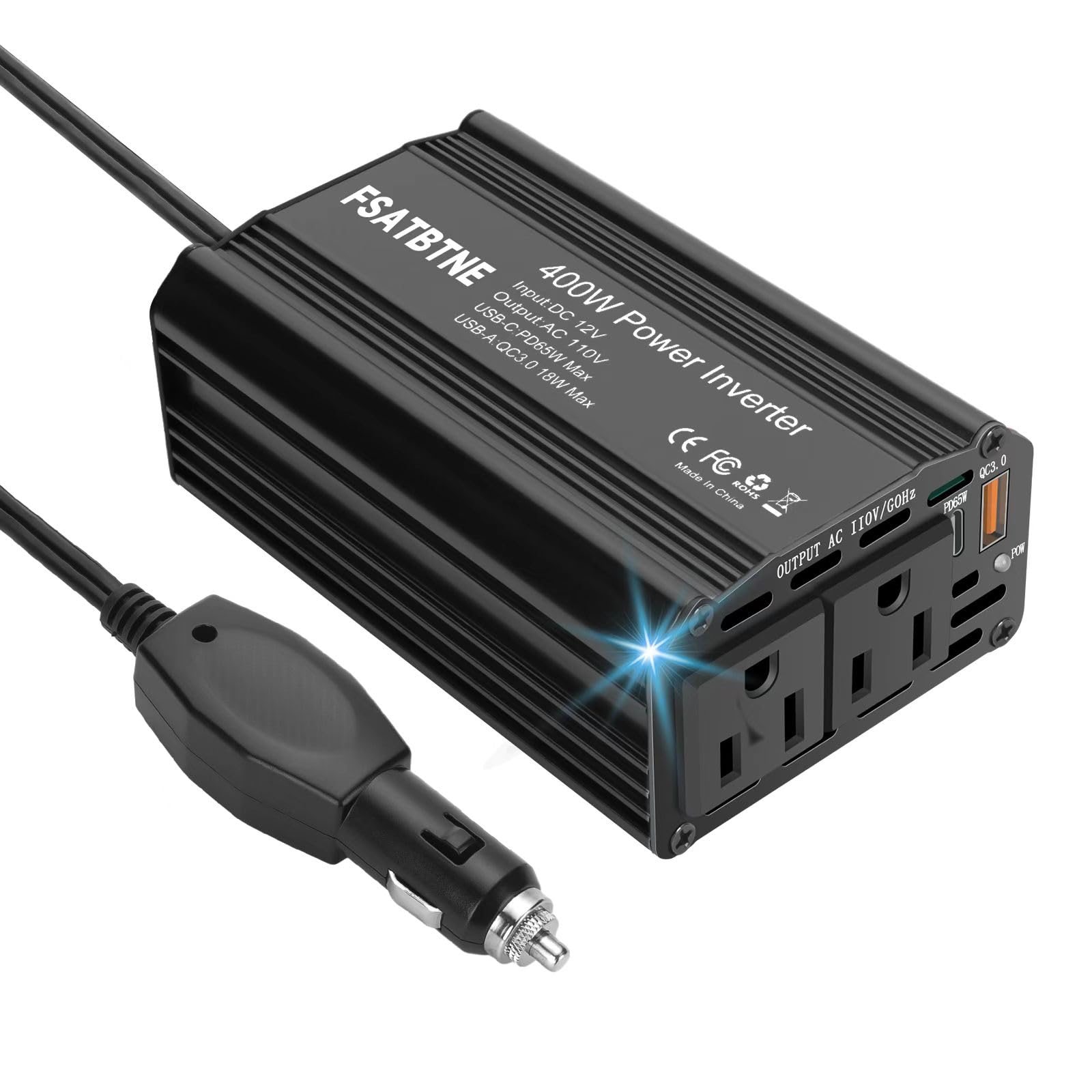
2. FSATBTNE 400W Power Inverter
The aluminum-shelled speedster that charges a MacBook Pro 14 to 50% in just 37 minutes.
If your laptop is your office, the FSATBTNE 400W earns its spot with a 65W USB-C port — more than double the 30W on the BESTEK above, a 2.2x gap in USB-C power delivery. The spec sheet says it will charge a MacBook Pro 14″ to 50% in just 37 minutes, a number buyers verify in practice. One owner sums it up: “Works great for small electronics in the car and we use it on the boat too.”
The aluminum alloy housing does double duty — it protects the guts and dissipates heat far better than plastic. A smart cooling fan with a temperature sensor adjusts its own speed, so it stays quiet when load is light and spins up only when needed. For a 400W unit, the noise level gets consistent praise in owner feedback, with the signature being how unobtrusive it is. The 24-inch cigarette lighter plug gives reach, and you can also hardwire it to a 12V battery or a 12.8V LiFePO4 battery for camping setups.
What wins people over is the quality feel and the 800W peak headroom for brief surges. Heat is the caveat: owners mention it runs warm under sustained load, with a few noting very high temperatures. The group consensus on reliability runs mixed, so this is a pick for someone who wants extreme charging speed and is willing to watch the temp gauge on long hauls.
What earns the praise
- 65W PD USB-C charges full-size laptops directly
- Aluminum housing sheds heat and shrugs off abuse
- Temperature-sensing fan stays silent under light load
- Dual power modes: 12V plug or direct battery connection
What runs warm
- Heat build-up gets mixed feedback under sustained load
- Reliability questions appear in a slice of long-term reviews
Best for: laptop-toting travelers who need 65W USB-C speed and a housing that can take camping knocks.
Not for: anyone who pushes 400W continuously for hours — keep an eye on the temp on marathon sessions.
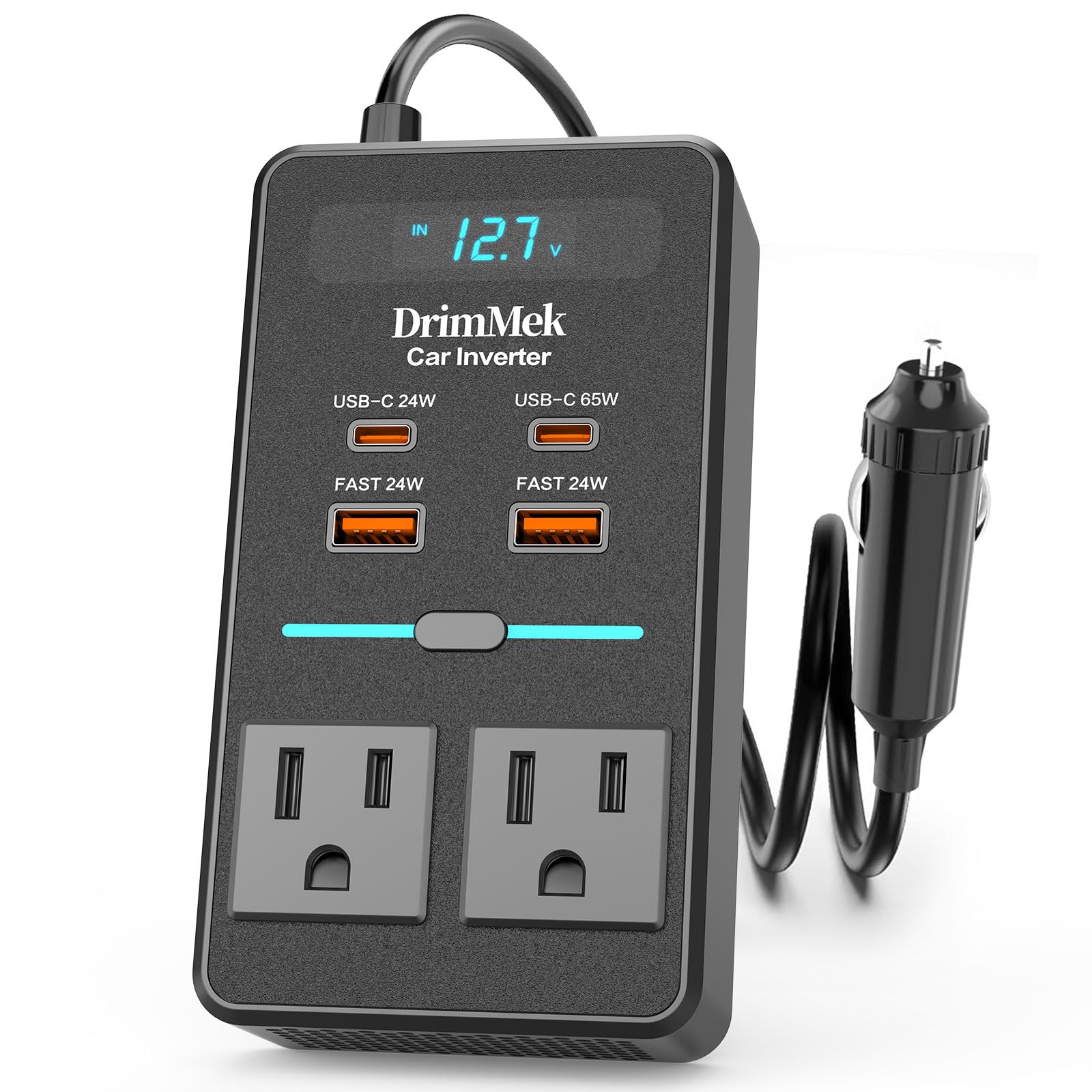
3. DrimMek 300W Car Power Inverter
A six-port family hub that keeps phones, laptops, and game systems charged at once.
If you’re hauling a car full of kids with grabby hands for every charger, this is the pick. The DrimMek crams two AC outlets, two USB-C ports (a 24W and a 65W), and two USB-A 24W ports into a unit that weighs just 8 ounces. Customers note it “kept phones, laptops, game systems charged on family trip,” which is the exact scenario this box was built for. The 300W continuous output covers laptops and small appliances, while the LED display shows battery voltage at a glance.
The quiet fan and plug-and-play design mean you jam it into the 12V socket and forget it’s there. Overload, short-circuit, overheat, and low-voltage protection are all built in, and the one-year replacement-only warranty removes the usual repair headache. Charging is the most-praised aspect by a wide margin — owners love that the 65W USB-C port runs a laptop while the rest of the family charges on the other five ports.
The trade-off is durability: a subset of reviewers point out fuses blowing. But for a family road-trip machine, the port count is unbeatable.
Six-port winner: the port layout is the story here — two AC, two USB-C, and two USB-A means nobody’s ever fighting over the adapter.
Keep expectations set: some units hit fuse issues, and 300W won’t stretch to high-draw tools or kitchen gear.
4. Pro Chaser 400W Power Inverter
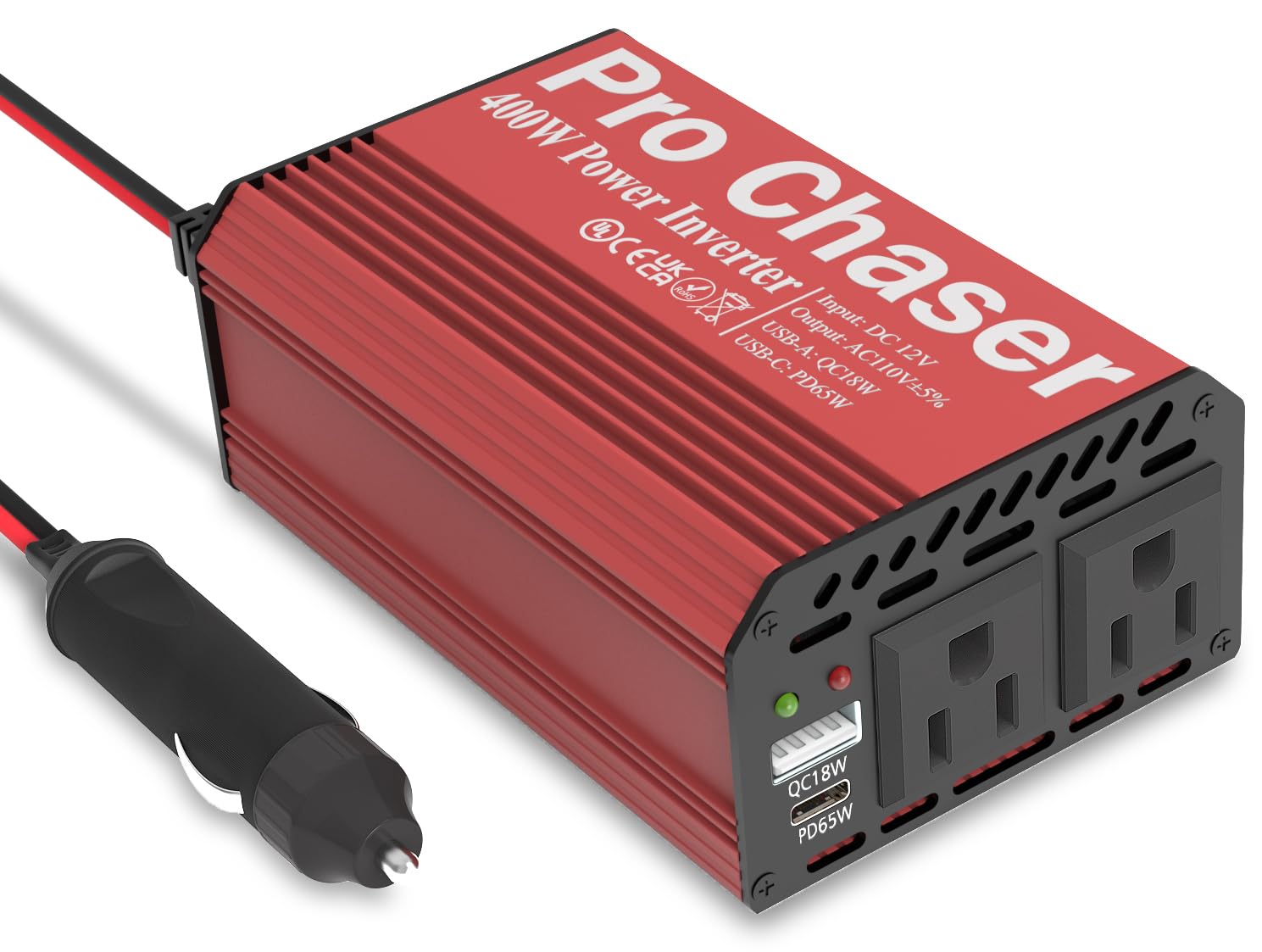
The reach-extender with a 30-inch cord for back-seat laptop work sessions.
Most inverters are stuck within arm’s reach of the dashboard. This Pro Chaser breaks that with a 30-inch (75 cm) cord that reaches into the back seat — a lifesaver for mobile workers or parents whose kids need a laptop on long hauls. It matches the top-end 65W PD USB-C and 18W QC USB-A ports alongside dual 110V AC outlets, delivering 400W continuous and 800W peak power.
Owners call it quiet, compact, and easy to operate, with one noting it “doesn’t get super hot when used.” The cooling fan kicks in automatically at 113°F (45°C), which keeps the unit cool without spinning up constantly. The built-in fuse guards against short circuits, overloads, low voltage, overvoltage, and overheating. The cellphone-sized body and secure lighter-socket fit make it a strong glove-box candidate.
The catch on this one is smart: the maker explicitly warns that running the 65W PD port together with the AC socket may exceed the vehicle socket’s limit. So you get big fast-charging capability, but you use it one high-power device at a time. It’s a fair limitation, not a flaw — the unit simply asks you to respect the 12V socket’s ceiling.
The practical wins
- 30-inch cord puts power where the passengers are
- 65W PD USB-C runs laptops directly
- Fan stays quiet until the 113°F threshold
- Compact red shell is easy to spot in a console
Mind the limits
- High-power USB-C plus AC at the same time may trip the socket limit
- Adhesive backing on the base is weak — owners improvise mounting
Grab this for: mobile workers and back-seat passengers who need AC power more than arm’s length away.
Pass if: you plan to run the 65W USB-C and an AC appliance at full tilt simultaneously — the 12V socket has a ceiling.
5. vansoet 400W Car Power Inverter
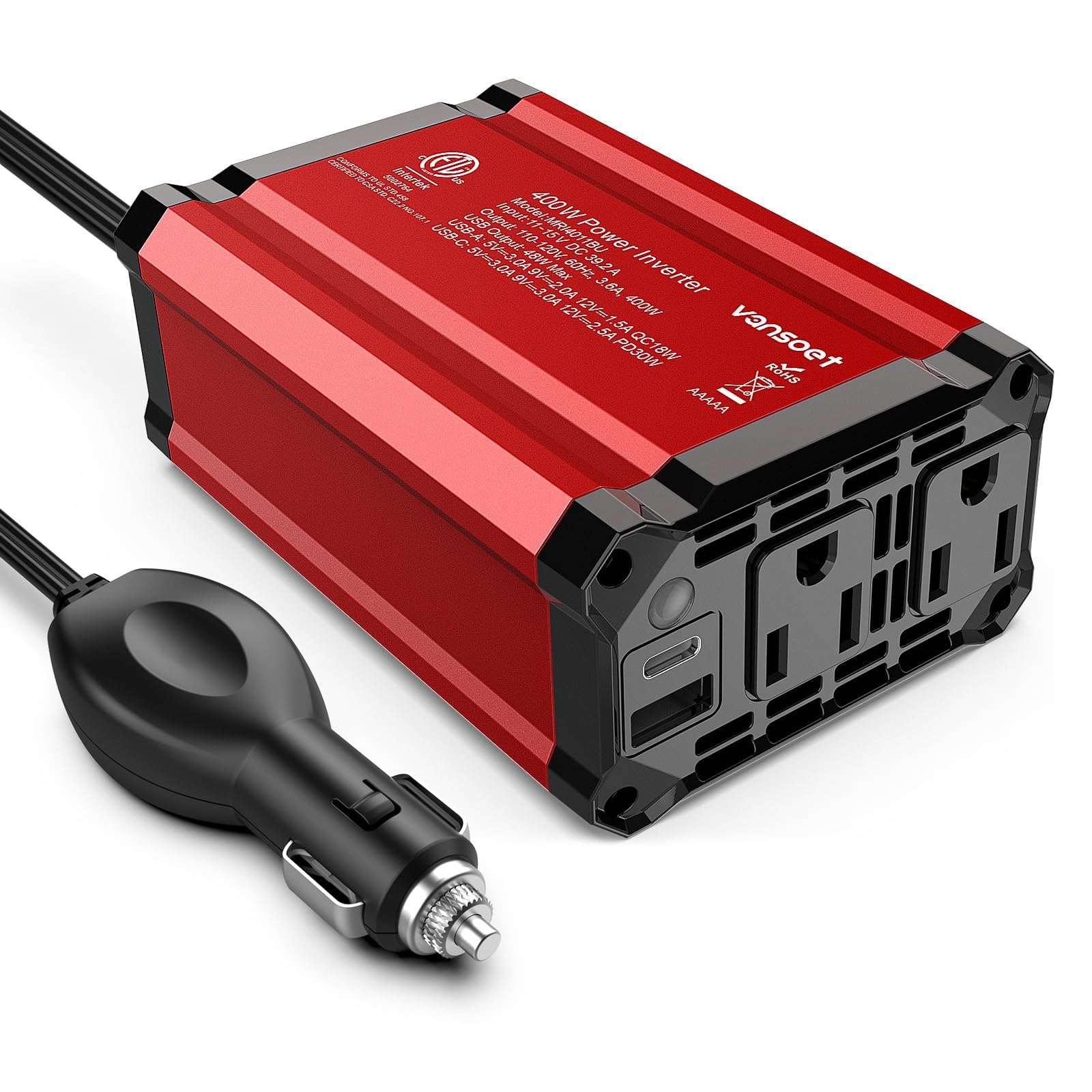
The only pick here with pure sine wave — smoother power for sensitive medical gear.
Every other inverter in this list puts out modified sine wave, but this vansoet delivers pure sine wave — cleaner electricity that sensitive devices like CPAP machines, nebulizers, and certain medical equipment prefer. It’s a meaningful difference if you’re powering anything with a delicate power supply. At 400W continuous and 800W instantaneous, it also runs an air compressor, breast pump, or car vacuum without strain.
Buyers in the trades appreciate it most: “I was in need of an inverter for my working truck and this product met all my needs.” The dual AC outlets pair with a 30W PD USB-C port and an 18W QC USB-A port, and the aluminum housing keeps things light and cool. A digital display shows battery voltage, and an on/off switch means you don’t have to unplug it between uses. Shoppers say it charges a phone from 10% to 100% in about an hour.
The 30W PD port handles phones and tablets, but large laptops need the AC outlet. Some owners also note the 110V outlets sit close together, so two wide plugs may not fit side-by-side. For glove-box storage and sensitive-gear safety, though, pure sine wave is the differentiator.
Clean-power edge: pure sine wave output makes this the safe choice for CPAP machines and other sensitive electronics on the road.
Not for: single-port laptop charging — the 30W USB-C is for smaller devices; big laptops live in the AC outlet.
6. BESTEK 300W Power Inverter

The EV-compatible inverter with an 11-17V input range for Teslas and new energy vehicles.
Most car adapters assume a standard 12V system, but EVs and some new energy vehicles run different voltages. This BESTEK accepts a wide 11V-17V input, which the maker says makes it “fully compatible with Tesla and new energy vehicles” — confirmed by owners running it from a Tesla Y’s 12V outlets. It converts to 110V AC at 300W continuous output with 700W instantaneous peak, and the 65W PD USB-C port charges a MacBook Pro 13″ or iPad at full speed.
The reliability story is strong — reliability tops the aspect list with owners praising how it “charges devices at lightning speed.” It also powers RV TVs, and one gamer reports it ran a Steam Deck and tablet for an entire road trip. The ETL certification and 5-year warranty are the standout trust signals here; few units in this category back themselves for half a decade. A 24-inch plug and iPhone-sized aluminum body keep it glove-box friendly.
Heat is the watch-item: one owner reported the unit “gets really hot after a long use” and smelled of burning plastic at first. It’s an occasional note, not a pattern, and the automatic cooling fan is designed to manage it. If you drive an EV or want the longest warranty in the class, this is your unit.
Why it stands apart
- 11-17V input range works in Teslas and standard vehicles
- 5-year warranty is the longest protection in this guide
- 65W PD USB-C runs full-size laptops
- ETL certification backs the safety claims
The watch-item
- Long sustained use can produce significant heat in some units
- 300W ceiling won’t stretch to power tools or high-draw appliances
Choose it for: EV owners and anyone who values a 5-year warranty plus ETL certification over raw wattage.
Think twice if: you need 400W for tools — this tops out at 300W continuous.
7. BYGD 200W Car Power Inverter

The four-USB charging station that ends sibling fights over outlets.
If your problem is “everyone needs a charge and I only have one socket,” this BYGD 200W is the answer. It’s the only pick here with four 2.4A USB ports plus a Type-C port on top of dual 110V AC outlets — enough capacity for a full car of grandkids. One owner describes it perfectly: “Perfect for when I have my granddaughters in the car with me and everyone needs to be charging something.” At 200W continuous, it’s strictly for light electronics — phones, tablets, DVD players, cameras — not laptops under load.
The inline shape fits between seats, and the 35.5-inch cable gives real reach from the cigarette lighter. A long-press power button (3 seconds) toggles it on and off, and the silent automatic cooling fan manages heat without noise. The ABS fire-resistant housing and isolating transformer add a genuine safety layer between your devices and your car’s electrical system.
The gripes are minor: the power switch isn’t a physical toggle, so you’ll manually reset it after ignition cycles, and it’s a bit tricky to locate by feel. For the lowest wattage in this guide, it’s also the most basic — no PD fast charging, no digital display. But for a family taxi at a budget-friendly price, the four-USB layout is the real win.
Why it’s a family pick
- Four 2.4A USB ports plus a Type-C charge everyone at once
- 35.5-inch cable reaches from the socket to the back row
- ABS fire-resistant shell with an isolating transformer
- Silent fan keeps it cool without droning
Where it’s basic
- 200W ceiling won’t run laptops or power tools
- No PD fast-charging on the USB-C port
- Software-style power button needs a manual reset after ignition
Reach for it when: the whole crew needs a charge and light AC power for a DVD player or camera is all you need.
Step up if: you plan to run a laptop or anything over 200W — this budget unit has a hard ceiling.
Understanding the Specs
Continuous vs. Peak Wattage
Continuous wattage is what the inverter delivers hour after hour — it’s the number to match against your device’s label. Peak wattage is a brief surge for starting motors, like an air compressor’s first spin. A 400W inverter with 800W peak can start a motor that needs 700W briefly, but it can’t sustain that draw. Always size to continuous watts.
USB-C PD Explained
PD stands for Power Delivery, a fast-charging standard over USB-C. The number after PD is the maximum watts — 65W runs a full-size laptop, while 30W tops out at phones and tablets. Using the 65W port means you skip the laptop’s bulky wall adapter and plug the USB-C cable straight into the inverter. It’s the single biggest convenience upgrade in modern inverters.
Modified vs. Pure Sine Wave
Modified sine wave is what most inverters output — it’s fine for laptops, phone chargers, and simple electronics. Pure sine wave is smoother, cleaner power that sensitive gear like CPAP machines, audio equipment, and some medical devices prefer. If your device has a sensitive power supply, pure sine wave is the safer bet; for everyday charging, modified is more than adequate.
The Cigarette Lighter Fit
The 12V plug that goes into your car’s socket is the most abused part of any inverter. A plug that seats tight stays put over bumps and rough roads; a loose one cuts power mid-use and can arc. Owners judge this immediately — a snug fit is the first sign of a quality build, and a loose one is the first complaint. Check the plug’s construction before you commit.
FAQ
Will a 400W inverter drain my car battery while parked?
Can I charge my MacBook Pro with the USB-C port alone?
What is the difference between 300W and 400W continuous output?
Will this work in a Tesla or other electric vehicle?
Is it safe to run a CPAP machine through a car inverter?
Why does my inverter’s fan run even when I’m just charging a phone?
Can I use an inverter with an extension cord in the car?
How long will a 200W inverter power my devices?
Final Thoughts: The Verdict
For most buyers, the vehicle ac charger winner is the BESTEK 400W because it pairs genuine 400W muscle with the snug 12V plug fit owners rave about — a crowd favorite at 4.6 stars with 300+ owners behind it. If you want the fastest laptop charging on the road, grab the FSATBTNE 400W for its 65W PD USB-C port. And for a family car full of kids fighting over chargers, the BYGD 200W with its four USB ports is the one to reach for.
How We Picked
We do not accept paid placement. Every pick is matched to a real buyer and a real use-case; we do not hands-on test units.
Sources & Methodology
Specifications: manufacturer listings and product documentation. Review insights: verified customer reviews, as of August 2026. Pricing: not shown on this page (it changes often); check the current price via the retailer link.
As an Amazon Associate, GoCarLife earns from qualifying purchases. This does not affect which products we feature.