
Our readers keep the lights on and the garage heater humming. As an Amazon Associate, I earn from qualifying purchases.
Specs are compiled from manufacturer listings and verified buyer reviews and can change over time — please confirm the key details on the product page before buying.
Living the van life hinges on one daily question: will the batteries survive the night? A solar setup that actually keeps your fridge cold and your phone charged is the difference between freedom and a dead-end parking lot. This guide cuts through the marketing watts to the real-world output, kit completeness, and charging smarts that matter on the road.
I’m Mo Maruf — the founder and writer behind GoCarLife. This guide is built by comparing the manufacturers’ published specifications and the patterns across verified customer reviews, so you get each pick’s real strengths and trade-offs instead of marketing spin.
Here’s the short version: for most builds, the Renogy 400W kit is the crowd favorite, and the best van life solar panels balance efficiency, a true MPPT controller, and a complete parts list.
Our Picks at a Glance

How To Choose The Best Van Life Solar Panels
Before you buy a single panel, you need to know how much power you actually use. A 100W panel is great for trickle charging, but it won’t run a 12V fridge all day. Think about your daily consumption in watt-hours (the total power you use), then size your solar array to replace that energy.
MPPT vs. PWM Charge Controllers
The charge controller is the brain of your system. An MPPT (Maximum Power Point Tracking) controller is more efficient, pulling more usable power from the panels, especially in cold or cloudy conditions. A PWM (Pulse Width Modulation) controller is simpler and cheaper, but it wastes some of the panel’s potential, especially when the battery is low.
Rigid, Portable, or Flexible?
Rigid panels are the most efficient and durable, perfect for permanently mounting on a van roof. Portable foldable panels are great for parking in the shade while your panels bake in the sun, but they take up storage space. Flexible panels are ultra-light and can conform to curved roofs, but they are more prone to heat issues and can be less durable.
Quick Comparison
| Model | Best For | Wattage | Controller | Weight | Amazon |
|---|---|---|---|---|---|
| Renogy 400W Kit★ Best Overall | Complete off-grid power | 400W | 40A MPPT | — | Amazon |
| Rvpozwer 200W KitBest Value | Budget-friendly efficiency | 200W | 30A | 20.4 lbs | Amazon |
| Go Power 130W PortableTop Performer | Flexible portable power | 130W | 10A | 28.7 lbs | Amazon |
| JJN 200W Kit | Starter-friendly install | 200W | 30A PWM | 36 lbs | Amazon |
| ECI Power 100W Kit | All-in-one small system | 100W | 10A PWM | — | Amazon |
| DOKIO 300W Foldable | Lightweight travel power | 300W | PWM | 15.2 lbs | Amazon |
| XINPUGUANG 200W Flex | Curved roof flexibility | 200W | 20A | 2.2 kg | Amazon |
| ExpertPower 200W Kit | Pre-programmed simplicity | 200W | 20A PWM | — | Amazon |
| SereneLife 200W Briefcase | Rugged portable durability | 200W | 20A PWM | 36.6 lbs | Amazon |
| ECI Power 200W MPPT Kit | Advanced lithium charging | 200W | 20A MPPT | 12.8 lbs | Amazon |
| ACOPOWER 400W Kit | High-end complete build | 400W | 40A MPPT | 54.8 lbs | Amazon |
In‑Depth Reviews
1. Renogy 400 Watt 12 Volt Premium Kit
Our pick — 4.5★ from 550+ verified ratings; the strongest balance of quality and price.
The complete power station for a serious off-grid build, with smart charging and all the pieces.
This is the kit you graduate to. The four 100W monocrystalline panels combine with a 40A MPPT charge controller to grab maximum energy from the sun, even on cloudier days. The included Bluetooth module lets you check your system’s health from your phone, a feature that makes monitoring your power feel easy.
What makes this kit stand out is its completeness and what owners do with it. One full-time traveler reports it keeps a 12V fridge running all day with power to spare, while another powers lights and power tools in a shed, recharging a battery bank in 4-6 hours. Buyers report the real-world output—one measured a “336W max on ground mount; works as advertised”—which is excellent for a 400W array.
It’s not without quirks. The panel leads are short for some series/parallel configurations, and the included instructions are minimal. The quality of the components is praised in the most reviews, though some owners had concerns about long-term durability. If you want a dependable, expandable foundation for your van’s electrical system, this is the benchmark.
What the Installs Praise
- The 40A MPPT controller boost power harvest efficiently.
- Bluetooth module makes system monitoring simple from your phone.
- Quality components and cables that inspire confidence.
Real-World Caveats
- Panel-to-controller cables are short for some layouts.
- No clear setup manual beyond the controller guides.
- Durability over years is a lingering question for some.
Your endgame kit: This is the pick if you want a reliable, high-output system that can run a fridge all day and expand later.
Think twice if: You need plug-and-play instructions or have a tiny roof with no room for four 41.8″ panels.
2. Rvpozwer 200W N-Type Single Panel Kit
A single, high-efficiency panel that saves roof space and simplifies wiring.
This budget-friendly option tackles the biggest van-life constraint: roof space. Instead of two bulky 100W panels, it’s one 200W N-Type panel with a 25% conversion rate. That means more power per square foot, and because there’s no inter-board connection, you avoid the power loss that comes with linking panels. The maker claims 12% more power than dual 100W kits.
At 20.4 pounds, it’s manageable for a solo installer. The included 30A charge controller and 10AWG cable get you running, but the focus here is the efficient panel. One happy owner uses it to keep a canvas tent powered all winter, calling it the best deal they could find. The power output and value for money are consistently praised.
Honesty check: the effectiveness does get mixed feedback, and one user found it couldn’t keep a refrigerator going for more than three hours. The charge controller is also described as basic and likely not long-lasting. This is a fantastic panel for the price, but you may want to budget for a better controller later.
Efficiency-first panel: You’re buying the high-tech N-Type cell here, not the controller. It’s a smart way to get 200W of quality power without the premium price tag.
Controller caveat: The included controller is the weak link; plan to upgrade it to an MPPT if you rely on this daily.
3. Go Power GP-PSK-130 130W Portable Kit
Portable power with adjustable legs that chase the sun and park anywhere.
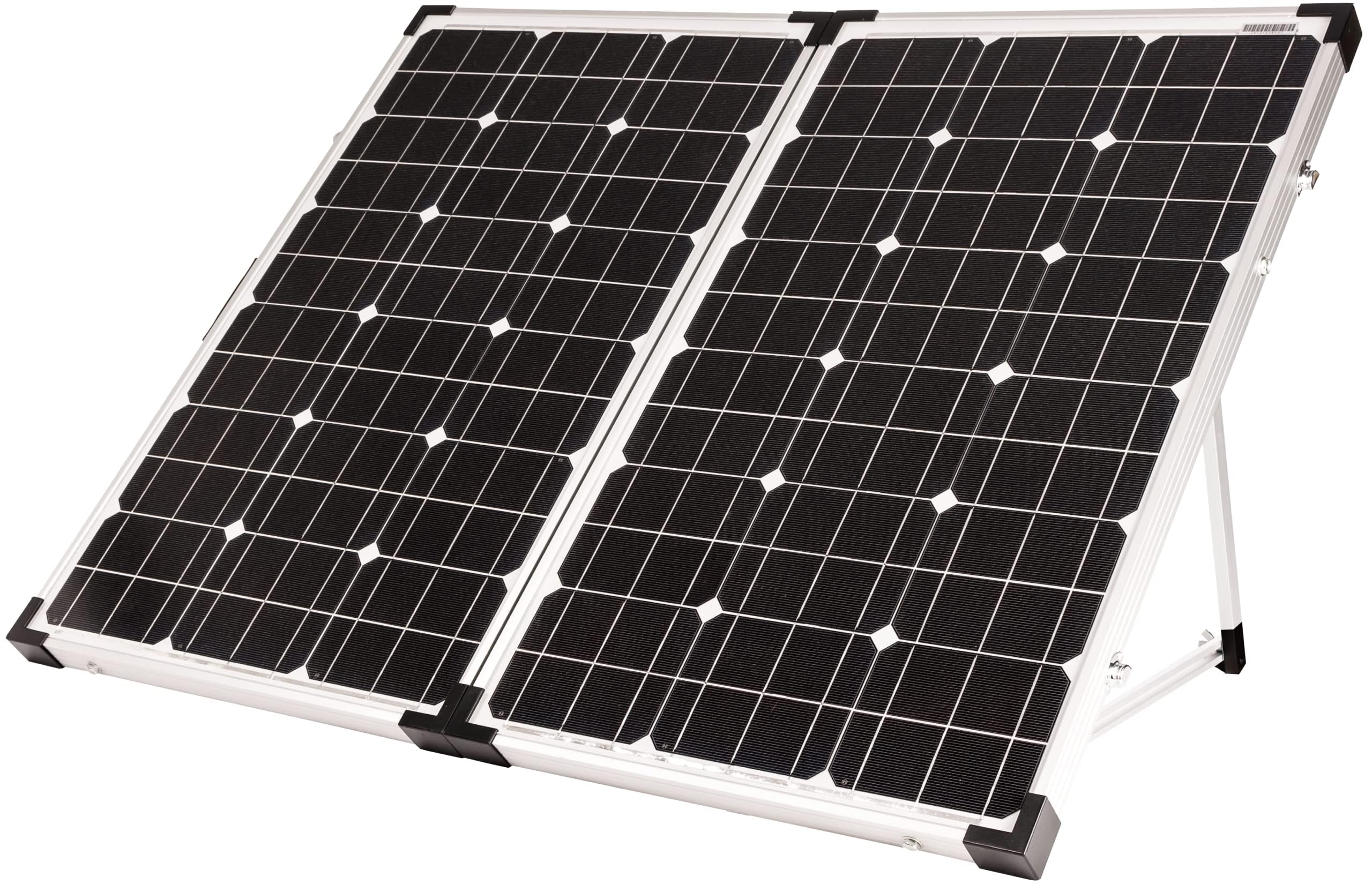
While the Renogy kit is for the roof, this Go Power unit is your mobile companion. It folds into a manageable package for storage, and the built-in adjustable legs let you angle it perfectly for maximum sun. It’s not small at 28.7 pounds and nearly 40 inches long, but it’s portable in a way a rigid roof panel never is.
The real benefit is its flexibility. It comes with Anderson, SAE, XLR, ring terminals, and battery clamps, so you can plug it into a portable power station or clamp it directly to your battery. Owners mention it works flawlessly right from the start. One used it to augment a roof panel so effectively that their batteries “never dipped below 79%” during a hot Utah summer, even with fans running non-stop.
The consensus is that it performs admirably, even on overcast days, charging a group 27 battery from two-thirds to full in two hours. The recurring gripes are the slightly weak legs and wing-nuts, and the fact that it’s not waterproof, so it’s not a permanent roof solution. For supplementing your system or for short trips, it’s a champion.
Portable powerhouse: The thing everyone raves about is how well it performs in real conditions, making it a perfect supplement to a fixed roof array.
Not a roof panel: Its strength is portability; leave it parked on the ground and treat the hardware gently.
4. JJN 200 Watt 12V Solar Panel Kit
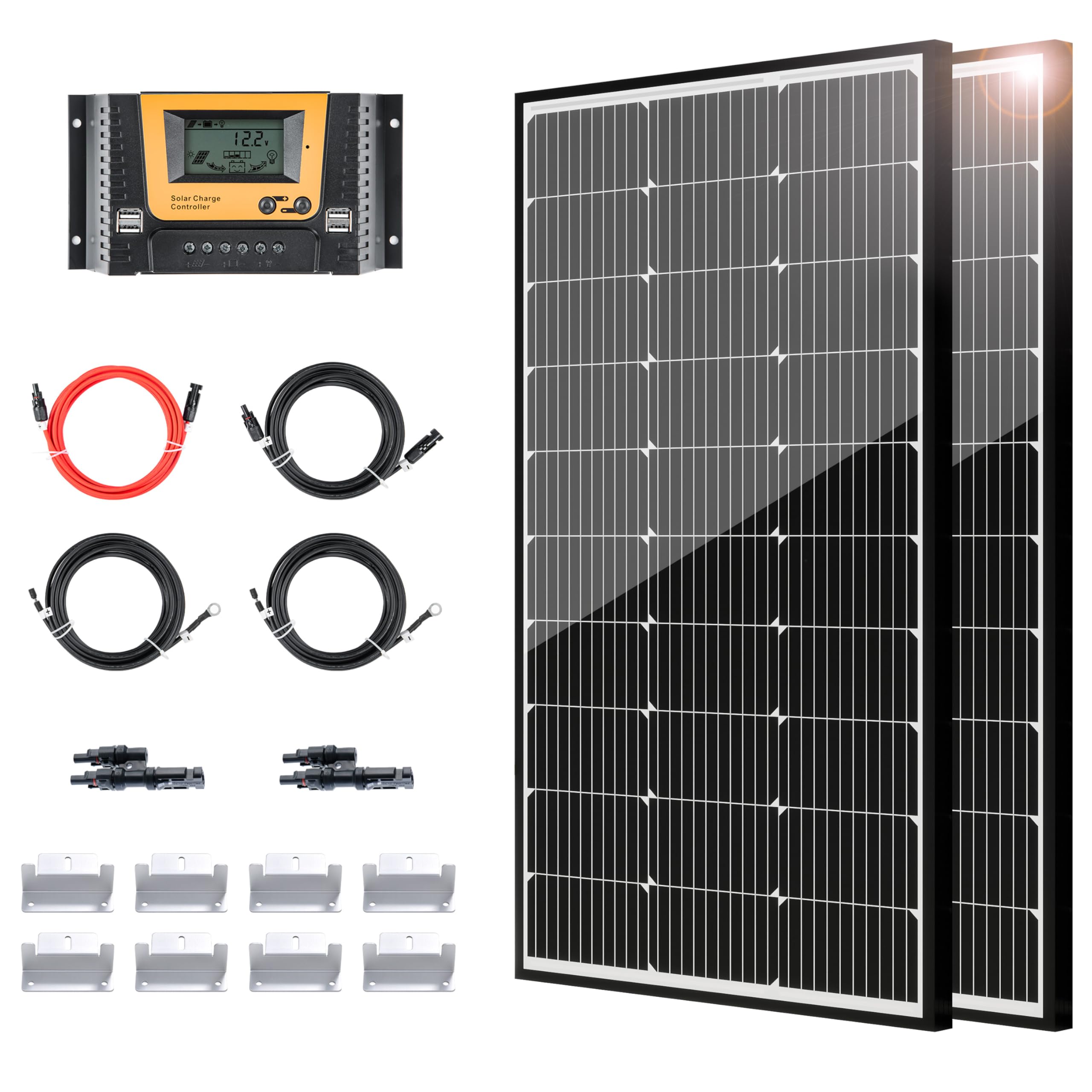
A beginner-friendly kit with modern half-cut cells and everything pre-wired.
This kit feels designed for someone’s first solar install. The panels use half-cut cell technology, which reduces power loss and helps performance when part of the panel is shaded. The pre-drilled holes and included Z-brackets make mounting straightforward, and the included 30A PWM controller is compatible with a wide range of 12V batteries, from AGM to gel to lithium.
The 200W output is solid for a mid-range starter system. It can provide about 500 Wh of electricity per day per panel in good sun, which is enough for lights, fans, and keeping a small fridge going. Owners are happy with the build quality and the value, with one noting it “reached up to 16v for battery charge,” confirming solid output.
There are two honest caveats. The first is the charge controller, which is a basic PWM unit—one repeat buyer noted the cables in the latest kits seem cheaper than before. The second is that the frame is a bit thin. The JJN kit won’t win any durability awards, but as a friendly, effective entry point, it does exactly what it promises.
Why Beginners Like It
- Half-cut cells keep output stable even with partial shade.
- Pre-drilled holes and included brackets simplify mounting.
- The controller supports wet, gel, EFB, and AGM batteries.
What to Watch
- The PWM controller is functional, not high-end.
- The panel frame feels thin and is not built for highway mounting.
Reach for this if: You want a simple, complete 200W kit that’s forgiving for a first-time solar installer.
Look elsewhere if: You need the ruggedness of a heavy-duty frame for daily highway travel.
5. ECI Power 100W All-in-One Kit

A true turnkey system—panel, battery, and controller working together from the start.
This is the simplest way to get started. Instead of buying a panel and a battery separately and hoping they work, ECI Power includes a 12V 20Ah LiFePO4 lithium battery, a 100W monocrystalline panel, and a 10A PWM controller. The controller is programmed to boost the LiFePO4 battery’s life, and a digital display shows your state of charge and battery health.
The included 20Ah LiFePO4 battery is lab-tested and guaranteed for 2000 cycles. This kit is perfect for running a few lights, a fan, or charging devices. The reviews are consistently positive, with users highlighting how easy it is to install and how well it works. One owner used it as a learning tool before expanding to power most of their home.
The trade-off is clear: at 100W, this “doesn’t produce enough power for anything big,” as one buyer put it. It’s best for small projects or a van with very low power needs. The included battery is not meant for extreme temperatures, so keep it indoors for the best lifespan.
Ideal starter system: Everything works together instantly, which is its greatest strength for a newbie.
Power ceiling: It tops out at a light or a fan, so don’t expect to run a large fridge on this alone.
6. DOKIO 300W Foldable Panel Kit

A featherlight powerhouse that folds slim and slides behind a van seat.
This is the panel for people who value flexibility over a permanent install. At just 15.2 pounds and folding down to 19.3 x 37.4 inches, it’s slim enough to tuck away easily. The 300W rating is ambitious, and real-world output is closer to 100-118W in a standard test, but that’s still valuable portable power.
The kit includes a PWM controller and a 9.85 ft cable, so you can keep the controller in the shade while the panel bakes in the sun. It also has dual USB ports for directly charging phones and small gear from a 12V battery. For topping up a power station on a trip, it’s incredibly convenient.
Owners love its portability and how well it performs, especially on overcast days. The recurring theme is that it performs better than expected for the price. However, the flexible panels are sensitive to shading and can be flimsy, and the included PWM controller is often the first thing upgraded to an MPPT for better efficiency.
The Portability Wins
- Folds incredibly slim and weighs only 15.2 lbs.
- Works well for topping up batteries on overcast days.
- Dual USB ports add convenience for charging small devices.
The Trade-Offs
- Real-world output is far below the 300W rating.
- The panels are sensitive to shading and feel less durable.
Who it suits: Van dwellers who park in the shade and want a stowable panel to chase the sun, rather than mounting panels to the roof.
Who should skip: Anyone expecting a true 300W output or a rugged, permanent install.
7. XINPUGUANG 200W Flexible Panel Kit

A bendable, featherweight panel that conforms to the curves of your van’s roof.
If your van has a rounded roof, a rigid glass panel won’t work. This flexible kit is the answer. Each of the two 100W panels weighs just 4.0 pounds and is only 0.098 inches thick, and they can be bent up to 260°. That makes them ideal for mounting on fiberglass roofs, boats, and other uneven surfaces where a standard panel won’t sit flat.
They’re built for the outdoors with an IP67 waterproof rating, meaning they’re protected against dust and temporary immersion. They’re also rated to withstand heavy snow loads up to 5400 Pa and high winds up to 2400 Pa. The kit includes a 20A charge controller, making it a complete solution for a curved roof setup.
Owners find them very easy to install and appreciate the quality and value. One complete beginner was relieved that they “didn’t want to drill a hole in my RV roof” and found this kit a perfect workaround. The major caveat is that power output can be inconsistent; one owner reported it only produced 20% of the rated output on their setup. They’re best for low-profile charging rather than being your primary power source.
Solution for curved roofs: This is the pick when you need solar that conforms to a non-flat surface and weighs almost nothing.
Efficiency risk: Flexible panels run hotter and can underperform; treat them as a supplement, not a guarantee.
8. ExpertPower 200W 12V Solar Power Kit

This kit takes the guesswork out of charging—the smart battery decides when and how to top up your van’s power, so you don’t have to babysit the system.
This kit combines two 100W panels with a 12V 20Ah LiFePO4 battery and a 20A PWM controller. The controller’s smart technology automatically regulates charging based on ambient temperature, protecting against overcharge and over-discharge. This protects your battery investment and extends its life.
The included 20Ah LiFePO4 battery lasts 10 years and delivers 2500-7000 cycles. It has a built-in Battery Management System (BMS) that guards against common failure points. Because it comes pre-programmed, it’s essentially plug-and-play. Owners of this kit, like one using it to run a wildlife pond motor, appreciated that it “came already pre programmed.”
The kit has a small but satisfied following. The main complaint is the lack of detailed written instructions, which can be intimidating for a complete beginner. The controller also received a blunt “controller is poo” from one owner, suggesting it’s the weakest part of the system. If you want a dependable, low-maintenance setup with a quality battery, this is a strong contender.
Set-and-forget power: The intelligent BMS and pre-programmed controller mean you don’t have to fiddle with settings.
Learning curve: Be prepared to research installation, as the included instructions are picture-only.
9. SereneLife 200W Portable Briefcase Kit
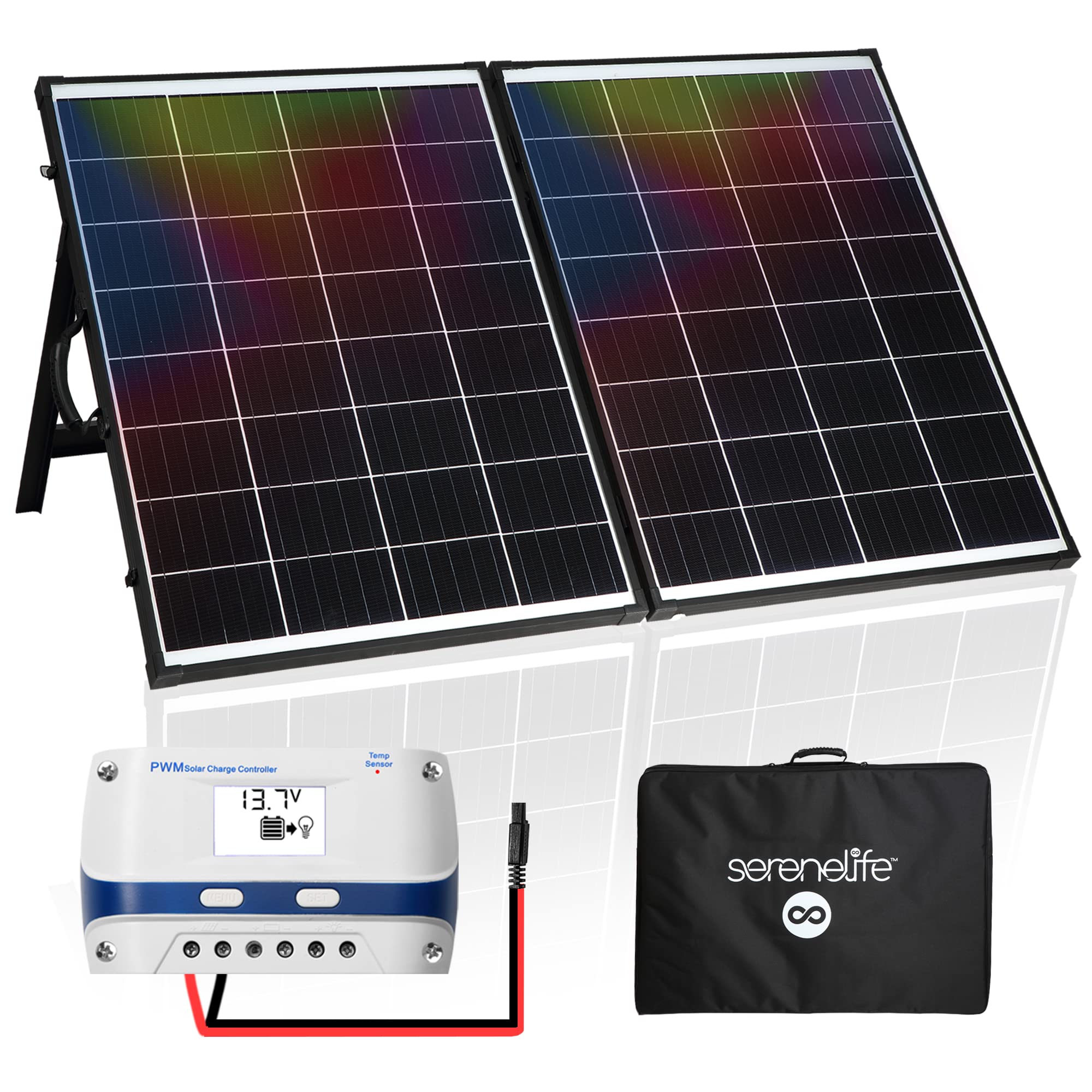
A heavyweight briefcase built like a tank, designed to survive years of tossing in the back.
Unlike most portable panels that rely on fabric and plastic, this SereneLife briefcase uses a full metal frame and metal hinges, so it can take a beating on the road. The trade-off is weight—at 36.6 pounds, it’s hefty, but that heft means you won’t worry about it cracking or bending like lighter foldable panels.
In real-world use, this sturdiness pays off. Owners use it to keep dual RV house batteries charged, even running a nightly CPAP machine on a 10-day trip without needing a generator. Its IP65 rating means it’s dust-tight and water-resistant, so you won’t worry about a little dew. It’s a kit that feels like it will last.
The downsides are all about portability. At 36.6 lbs, it’s not something you’ll want to carry far, making it less of a “hiking” panel and more of a “set up at camp” panel. The included 20A PWM controller also lacks some refinement, but it works. If durability trumps weight for you, this is a clear winner.
The Durability Factor
- All-metal frame and hinges are far sturdier than fabric competitors.
- Dust-tight and water-resistant for low-maintenance outdoor use.
- Consistently keeps batteries charged in demanding scenarios.
The Weight Penalty
- It is very heavy at 36.6 lbs, making it awkward to move.
- The controller feels a bit cheap compared to the rugged panels.
Buy it for: Full-time van lifers who prioritize a bomb-proof design over a light load and will use it as a permanent camp setup.
Buyer beware: If you plan to haul it to a remote beach campsite, the weight will become a burden.
10. ECI Power 200W MPPT Kit with 2 Batteries
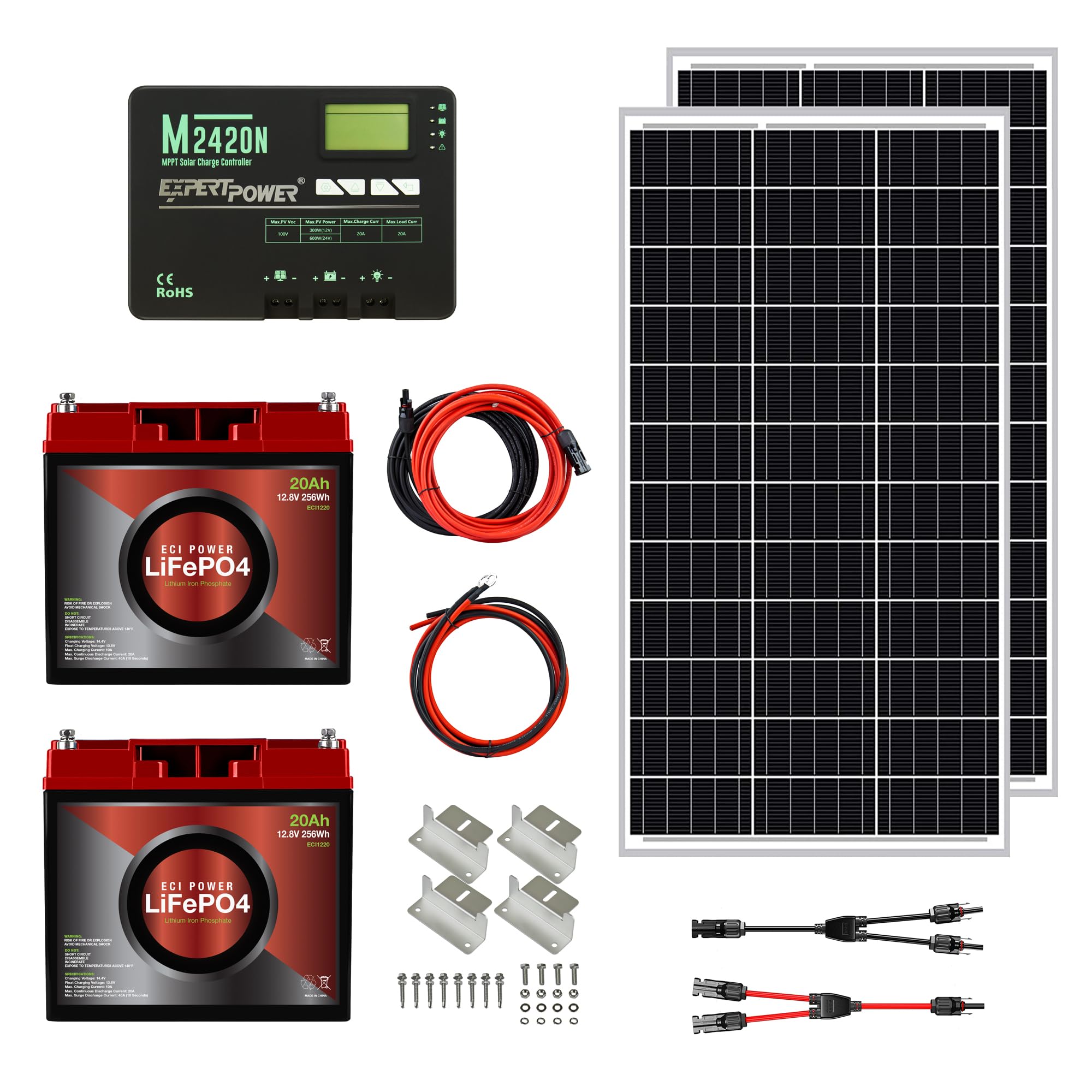
Smart MPPT charging and dual batteries for a step up in stored energy.
This kit is all about smarter charging and more storage. It steps up from the standard PWM controller to a 20A MPPT controller with a Bluetooth adapter. The MPPT controller boosts power generation by over 20% versus PWM, especially in cloudy conditions.
The kit includes two 12V 20Ah LiFePO4 batteries, giving you double the storage of a single-battery kit. This is a great option for a van build that needs a little more overnight capacity. The MPPT controller also auto-detects 12V and 24V systems, which is nice for future flexibility.
The response is mixed, though. While some find it “very satisfied” and easy to assemble, others are frustrated by a lack of connectors to properly use both batteries. One owner reported the system wasn’t enough to run a recommended motor but kept their battery at 100% charge for a pump. It’s a smart system with a frustrating parts-list issue that you may need to solve with an additional purchase.
Smart upgrade path: The MPPT controller is a genuine upgrade for efficiency, and dual batteries offer good capacity.
Completeness issue: Be ready to buy extra connectors, as the kit doesn’t come with enough to wire both batteries.
11. ACOPOWER 400 Watt Premium RV Kit
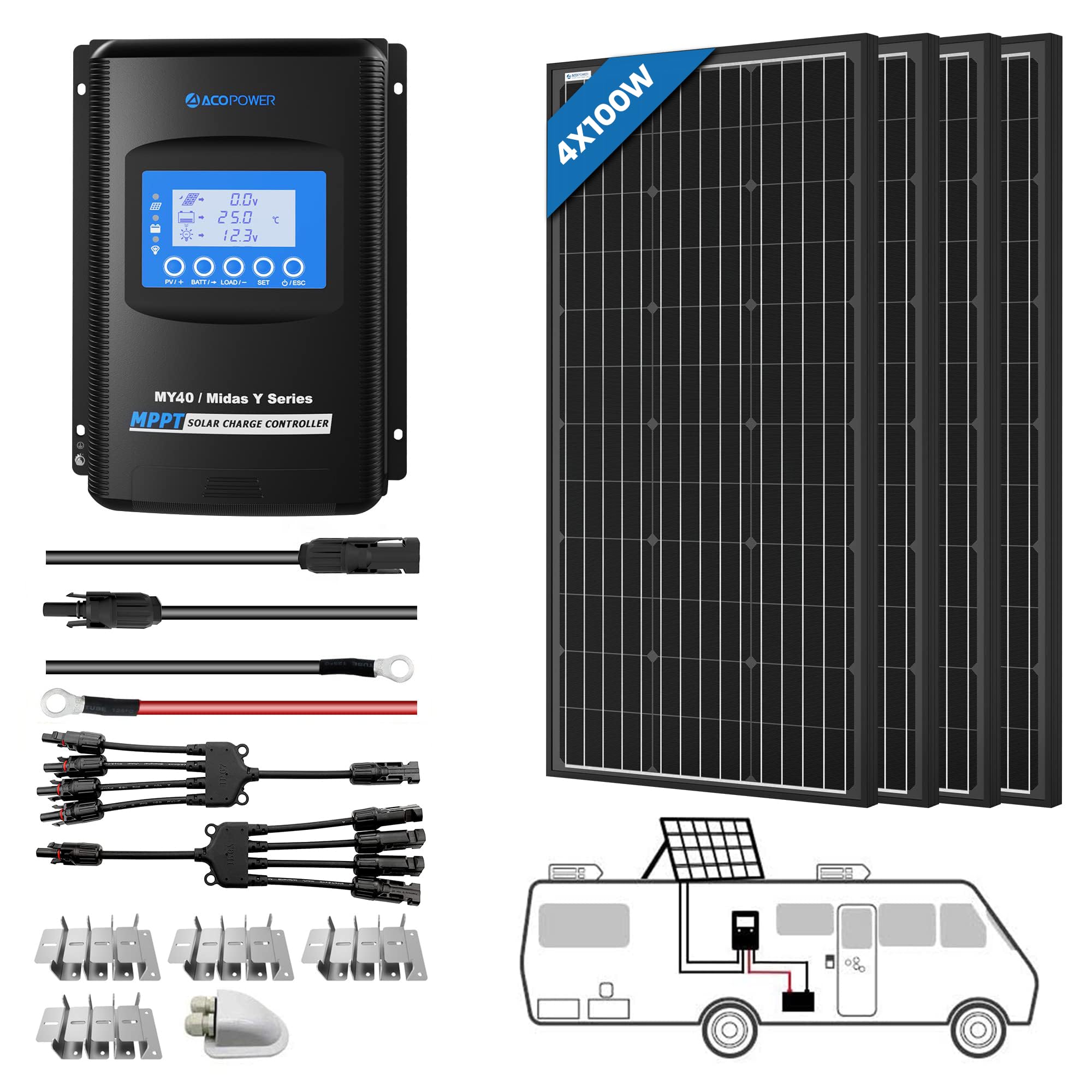
High-efficiency cells and a premium MPPT controller for a top-tier off-grid setup.
This premium kit is designed for those who want maximum performance from day one. The four 100W panels use A+ cells at 23% efficiency, producing 2-2.5kWh daily. The 40A MPPT controller achieves 99.5% tracking efficiency for maximum power harvest.
It’s built for the long haul, with an IP67 waterproof rating and corrosion-resistant aluminum frames. The panels are designed to withstand 2400 Pa winds and 5400 Pa snow loads, giving you confidence for year-round living. One full-time RVer found installation easy, completing it in under a day and eliminating their need for a generator.
Buyers who track actual output are impressed—one reported a max of 415W from the system, enough to run a fridge, lights, and devices simultaneously. The catch: installation takes patience, because the stiff wire is hard to route, and you’ll need to buy extra MC4 connectors (the standard solar cable plugs) and sealant separately. If you want a rugged, high-output kit that can handle a full van setup, this one earns its spot—just budget time for the install.
Premium performance: The 23% efficient cells and 40A MPPT controller combine to deliver serious, reliable power.
Installation effort: This is not a 15-minute job; plan for a careful, deliberate install with additional supplies.
Understanding the Specs
Wattage and Real Output
Wattage is the raw power rating, but it’s a peak number. In real life, you’ll get less due to angle, heat, and clouds. Look for a panel’s efficiency (like 25%)—a higher percentage means it generates more power from the same amount of sunlight. It’s better to over-spec your wattage to cover your daily usage on cloudy days.
MPPT vs. PWM Controllers
The charge controller manages the flow from panel to battery. MPPT (Maximum Power Point Tracking) is the premium option; it converts extra voltage into more charging amps, making it significantly more efficient in cold or cloudy weather. A PWM (Pulse Width Modulation) controller is cheaper and simpler but wastes some potential power. For a serious van build, an MPPT is a wise investment.
FAQ
How many watts of solar do I need for a van?
Is an MPPT controller worth the extra money?
Can I mount flexible panels on a curved van roof?
What is a 12V system and why is it important?
How long will a LiFePO4 battery last?
Is a 100W solar panel enough to keep a fridge running?
What does IP67 waterproof rating mean for solar panels?
Should I buy a solar kit with a battery included?
Final Thoughts: The Verdict
The winner for most is the renogy 400w kit because it offers the best combination of a high-quality MPPT controller, complete components, and the wattage needed to run a fridge all day. If you’re after a smart, efficient upgrade with modern technology, the Rvpozwer 200W Kit delivers excellent performance per dollar on a single panel. And for a durable portable solution that can also sit on the ground, the heavy-duty SereneLife 200W Briefcase is the one to reach for. Whichever you choose, sizing your system to your real power needs is the biggest step toward genuine freedom on the road.
How We Picked
We do not accept paid placement. Every pick is matched to a real buyer and a real use-case; we do not hands-on test units.
Sources & Methodology
Specifications: manufacturer listings and product documentation. Review insights: verified customer reviews, as of August 2026. Pricing: not shown on this page (it changes often); check the current price via the retailer link.
As an Amazon Associate, GoCarLife earns from qualifying purchases. This does not affect which products we feature.