
Our readers keep the lights on and the garage heater humming. As an Amazon Associate, I earn from qualifying purchases.
Specs are compiled from manufacturer listings and verified buyer reviews and can change over time — please confirm the key details on the product page before buying.
A slow leak or a sudden blowout is the difference between a roadside hassle and a dangerous situation, especially when you’re hauling thousands of pounds. A valve stem tire pressure monitor puts a live pressure and temperature reading for every tire right on your dash or phone, so you spot trouble while it’s still a fixable problem. This guide ranks the best valve stem tire pressure monitors by sensor accuracy, alarm modes, charging method, and tire count.
I’m Mo Maruf — the founder and writer behind GoCarLife. This guide is built by comparing the manufacturers’ published specifications and the patterns across verified customer reviews, so you get each pick’s real strengths and trade-offs instead of marketing spin.
We’ve matched each system to the vehicles and driving styles it serves best, from single-car commuters to multi-axle RV owners. The result is a clear, honest ranking of the best valve stem tire pressure monitor options on the market today.
Our Picks at a Glance


How To Choose The Best Valve Stem Tire Pressure Monitor
Before you buy, match the monitor’s range and sensor count to your vehicle’s size and driving habits. A monitor built for a sedan may not reach the rear axle of a long travel trailer, so measure your setup first.
Sensor Count and PSI Range
First, count your tires. A standard car or SUV needs a 4-sensor system, while a tow vehicle and trailer combo might need 8, 10, or more. Next, check the PSI range — passenger tires run around 30-40 PSI, but a heavy truck or RV can need up to 100 PSI or more. Choose a system whose maximum PSI exceeds your highest tire pressure requirement so the sensor doesn’t cap out.
Charging and Power
Your monitor display needs juice, and how it gets it matters for daily use. Solar-powered displays are popular because they top themselves up on the dash, but they can struggle in garages or cloudy climates. A USB charging port is a reliable backup, and battery-powered sensors (like CR1632 or CR2032) generally last months or years before needing replacement.
Alarm Modes and Accuracy
More alarm modes expand the system’s ability to detect different failure types. The essential ones are high/low pressure alerts and fast leak detection, warning you about a rapid puncture instantly. High-temperature alerts are critical for heavy towing, as overheated tires often precede failure. Accuracy, stated in PSI (like ±1.5 PSI), tells you how precisely the sensor reads pressure compared to a manual gauge.
Quick Comparison
| Model | Best For | Max PSI | Sensors | Charging | Amazon |
|---|---|---|---|---|---|
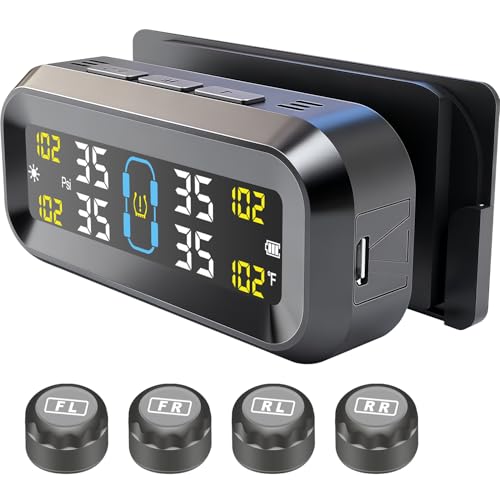
| Masoll 4-Sensor★ Best Overall | RVs & Trailers | 99 PSI | 4 | Solar + USB | Amazon |
| leepee Motorcycle TPMSBike-Specific Pick | Motorcycles | — | 2 | Battery | Amazon |
| Zradnox 4-SensorBest Value | Sedans & SUVs | 99 PSI | 4 | Solar + USB | Amazon |
| Tymate TM8 | Trucks & SUVs | 87 PSI | 4 | Solar + USB | Amazon |
| Marcala 4-Sensor | Large RVs | 98 PSI | 4 | Solar + USB | Amazon |
| Masoll M13 | Trailers & Golf Carts | 87 PSI | 4 | Solar | Amazon |
| Tymate TM3 | 5th Wheels & Trucks | 144 PSI | 4 (Up to 10) | Solar + USB-C | Amazon |
| GUTA GT80 | Commercial Fleets | 188 PSI | 10 | USB-C | Amazon |
| GUTA GT20 | Semi-Trucks & Fleets | 188 PSI | 10 | Battery (15-hr) | Amazon |
In‑Depth Reviews
1. Masoll RV Tire Pressure Monitoring System
Our pick — 4.5★ from 300+ verified ratings; the strongest balance of quality and price.
The RV-ready guardian that caught a nail puncture on the Yukon highway and saved a wheel.
This is the system that earns its keep on the road. The defining feature is its six-alarm suite — high/low pressure, high temperature, fast leak, low sensor voltage, and lost signal — so you get a warning for nearly every failure mode a tire can throw at you. It auto-calibrates to your tire’s pressure when you install the sensors, which means no fiddly manual setup of thresholds, and the alarm range runs from 25% above to 15% below that reference point.
The monitor tops up via a solar panel or a USB cable when the sun isn’t shining, a dual-charging setup that owners say keeps it running through all weather. The 4 sensors are factory-programmed, so installation is a five-minute screw-on job per wheel, and data appears on the screen once the sensors wake up after a short drive. Each sensor runs on a replaceable CR1632 battery with a two-year lifespan and reads pressure within ±1.5psi, so you can trust the numbers when they matter.
Buyers report it works flawlessly on single-axle trailers and 21-foot trailers alike, catching a right-rear tire losing pressure at 100 miles. The one honest catch is the display — the screen can white out in extreme heat until the cabin AC cools it down, and a few find it hard to read in direct daylight. It weighs 8.8 ounces, much beefier than a motorcycle-focused unit like the 3.2-ounce leepee, which makes sense given the larger display and solar panel.
What Wins People Over
- Six distinct alarm modes cover everything from fast leaks to lost sensor signals
- Auto-calibration means zero manual threshold setup — just set your tires to the right pressure first
- Solar plus USB charging keeps the display powered in any weather
- Two-year sensor battery life on a replaceable CR1632
Honest Trade-offs
- Screen visibility in direct daylight gets mixed feedback — it can wash out until the cabin cools
- The dash mount isn’t the most secure, and the max reading caps at 87 PSI in practice for some users
Reach for this if: you tow an RV or trailer up to 38 feet and want automatic alarms without configuring anything.
Look elsewhere if: you drive in extreme heat all day and need a screen that stays readable without AC, or you need to monitor more than four tires.
2. leepee Motorcycle Tire Pressure Monitoring System
Skip the handlebar display — this motorcycle monitor talks straight to your phone.
For two-wheelers, this is a different animal. Instead of a dash-mounted screen, the leepee system uses a free app called “motorcare” on your iOS or Android phone — ideal if you don’t want another gadget bolted to the bars. The 2 external sensors send live pressure and temperature data wirelessly, and the whole package weighs just 3.2 ounces, under half the 8.8-ounce Masoll, a big deal when every gram counts on a bike.
It covers multiple alert conditions: high and low-pressure alarms, air leak detection, high and low-temperature warnings, and a battery level alarm. The sensors are built rugged and waterproof to shrug off mountain and aquatic adventures, and they enter sleep mode after 10 minutes of inactivity to save power, reawakening on vibration. Owners mention the sensors hold up impressively well — one long-term check at the 7-month mark found them still working perfectly with batteries at 74%.
The trade-off is the app experience. The interface is a functional but basic Chinese-translated GUI, and the voice alerts are a recurring annoyance — some owners describe them as irritating, and one wishes for a physical handlebar display instead. The sensors are also chunky at roughly 20mm, which can cause fit issues with dual disc setups. But for the price, riders consistently call it an excellent value and a worthwhile safety addition to any bike.
Best for riders who: want live tire data without a bulky display and are comfortable managing alerts through a phone app.
The real catch: the app’s voice and interface polish lag behind the hardware quality, so it suits riders who prioritize function over finesse.
3. Zradnox Solar & USB TPMS
The budget-friendly four-wheeler system with an IP68-rated shield against the elements.
This Zradnox system packs serious weather protection into a value price. The 4 external sensors carry an IP68 waterproof rating, which means they’re sealed against dust and can handle being submerged, so rain and mud won’t kill your monitoring mid-trip. It uses automotive-grade precision chips for stable data output and longer transmission distances, giving you real-time pressure readings from 0 to 99 PSI across sedans, SUVs, RVs, pickup trucks, and travel trailers.
Charging is handled by both solar and USB, and owners note it keeps its charge even on cloudy days — a strong sign the panel efficiency is better than most at this level. The color LCD display features adaptive backlight adjustment, automatically brightening or dimming for daylight or nighttime reading, and it wakes up automatically when the car starts, then sleeps when parked. The six alarm modes cover rapid leak detection, high and low pressure, high temperature, and low sensor voltage.
The honest caveat is accuracy. While some customers note readings that match a manual tire gauge, others found inconsistent numbers and temperatures reading higher than actual. There’s also a note about uneven nut machining on the anti-theft hardware and a swivel that doesn’t fully tilt, which can cause screen washout at certain angles. The measurement accuracy is stated as ±3.03%, so treat it as a vigilant early-warning system rather than a precision lab instrument.
Where It Shines
- IP68 waterproof and dust-proof sensors handle harsh weather without complaint
- Solar keeps it charged even on overcast days, per owner reports
- Adaptive backlight LCD stays readable in bright sun and at night
Where It’s Soft
- Accuracy gets mixed feedback — some readings don’t match a manual gauge
- Anti-theft nut machining and the display swivel feel less refined
Grab it if: you want uncompromising weather protection on a budget and don’t need laboratory-precision readings.
Think twice if: you need tight accuracy for high-performance driving or frequent trailer switching.
4. Tymate TM8 RV Tire Pressure Monitoring System

A screw-on-and-go system so simple, the PSI pops up on the screen the moment you finish.
The TM8 is built for easy installation and dead-simple operation. It reads tire pressure and temperature with precision up to ±1.5 PSI or ±3°F, so you catch slow leaks before they become problems. The package includes a windshield mount that keeps the monitor in your line of sight without eating dashboard space, and owners describe the setup as “I just screwed it on the valve and the psi showed up on the screen.”
Its six alarm modes cover high and low pressure, rapid air loss, high temperature, low sensor battery, and lost signal, giving you the same protection found on pricier systems. The color LCD screen is bright and easy to read in any lighting, and charging comes from either the solar panel or a USB port. It operates on a 433.92MHz frequency for a strong, stable signal, with a stated sensing distance of 36 feet — though the manufacturer recommends this model for vehicles under 20 feet total length.
Owners praise the accurate pressure and temperature readings compared to manual gauges, and the sensors have held up well past the 3-month mark in some reports. The recurring caveat centers on charging: solar charging can be weak if your windshield has UV film, and the USB charging is slow. It’s also note the monitor only pairs with the specific Tymate TS3 sensor for replacements, so stick with the brand if you need spares. For standard vehicles under 100 PSI, it’s a reliable, straightforward choice.
Who it suits: daily commuters and travel trailer owners who want an accurate, no-fuss system with a clear windshield view.
Who should pass: anyone with UV-tinted windshields (which weaken solar charging) or trailers longer than 20 feet that need a repeater.
5. Marcala Tire Pressure Monitoring System
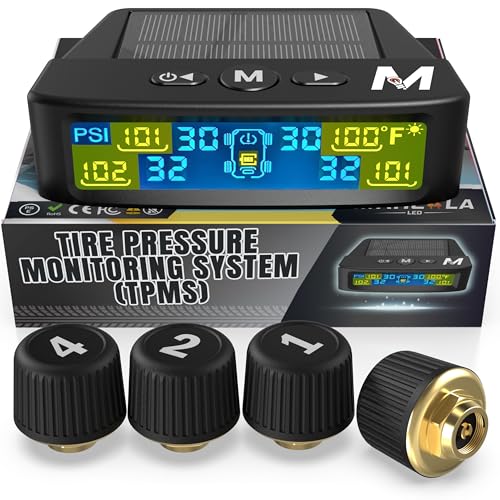
Extended 32-foot range that stays rock-solid at highway speeds for long tow rigs.
Marcala built this system specifically for the range problems that plague long vehicles. New sensors and a hub deliver an extended range up to 32 feet, which owners confirm holds stable at highway speeds — one user runs it flawlessly on a horse trailer behind a Yukon with no signal dropouts. It monitors up to 98 PSI with a stated accuracy of 1 PSI, and each sensor carries an IP67 waterproof rating to keep working in rain or shine.
The system updates pressure and temperature every second while driving for live alerts, then drops to a battery-saving mode when parked. It’s ready to use in under a minute with no tricky setup, and the bright, colorful LCD screen has auto-dimming to preserve battery life. Charging is handled by both solar and USB, and the six alarm modes cover the standard high/low pressure, fast leak, high temperature, and sensor issues. It’s backed by a lifetime replacement policy from an American-owned family business.
The display’s clarity gets strong praise — owners call it crisp and visible at any time of day. The honest downsides: the sensors are bulky and can put stress on valve stems if not installed carefully, and they can throw off wheel balance on lighter vehicles. One owner had a defective unit that reported stuck-high readings, a reminder that occasional duds happen. For RV owners who’ve fought with signal dropouts on long trailers, this range advantage is the whole ballgame.
Why It Stands Out
- 32-foot range is ideal for long RVs, campers, and towing setups
- 1 PSI accuracy for trustworthy pressure readings
- Lifetime replacement policy from an American-owned company
Watch Out For
- Bulky sensors can strain valve stems and affect wheel balance
- Park mode updates slowly to save battery, which can look like the system stopped working
Choose this for: large RVs, campers, and towing setups where long-range signal reliability is non-negotiable.
skip it if: you want a low-profile sensor that won’t add noticeable weight to your wheels.
6. Masoll M13 Tire Pressure Monitoring System

Set your tires once, and the auto-calibration handles the alarm thresholds forever.
The M13 is the “low-maintenance” champion in the Masoll lineup. Its defining feature is auto-calibration: set your tires to the standard pressure, install the sensors, and the system locks that in as the reference point. From there, it alarms when pressure climbs 25% higher or drops 15% lower than that baseline, adjusting itself automatically when you inflate or deflate. Reviewers point out readings that match a manual gauge within 1 PSI, which is reassuring accuracy for a system this hands-off.
It covers pressure detection from 0 to 87 PSI with a high-accuracy built-in chip (1.5 PSI), making it suitable for sedans, SUVs, pickups, RVs, and travel trailers under 38 feet. The solar panel is energy-efficient with overheat and overcharge protection, and the display uses an anti-reflective design with auto-brightness for clear reading in strong light. Smart auto wake-up and sleep power management means it guards you when driving and saves battery when parked. Owners particularly note the sensors lasting a full season of use, and it’s surprisingly popular for golf carts.
The recurring quirks are minor: the sensor lock system is tricky at first, the unit defaults to bar units (needing a manual switch to PSI), and highway driving can trigger false low-pressure beeps from tire heat that reset when you slow down. One owner reported saving money versus a GM factory system by using this instead. If you want a dependable, low-interaction monitor for a trailer or secondary vehicle, this is a very strong pick.
The standout: auto-calibration plus 1.5 PSI accuracy gives you precision without any setup work.
The friction: a finicky sensor lock and a default bar reading require a few minutes of initial attention.
7. Tymate TM3 RV Tire Pressure Monitoring System
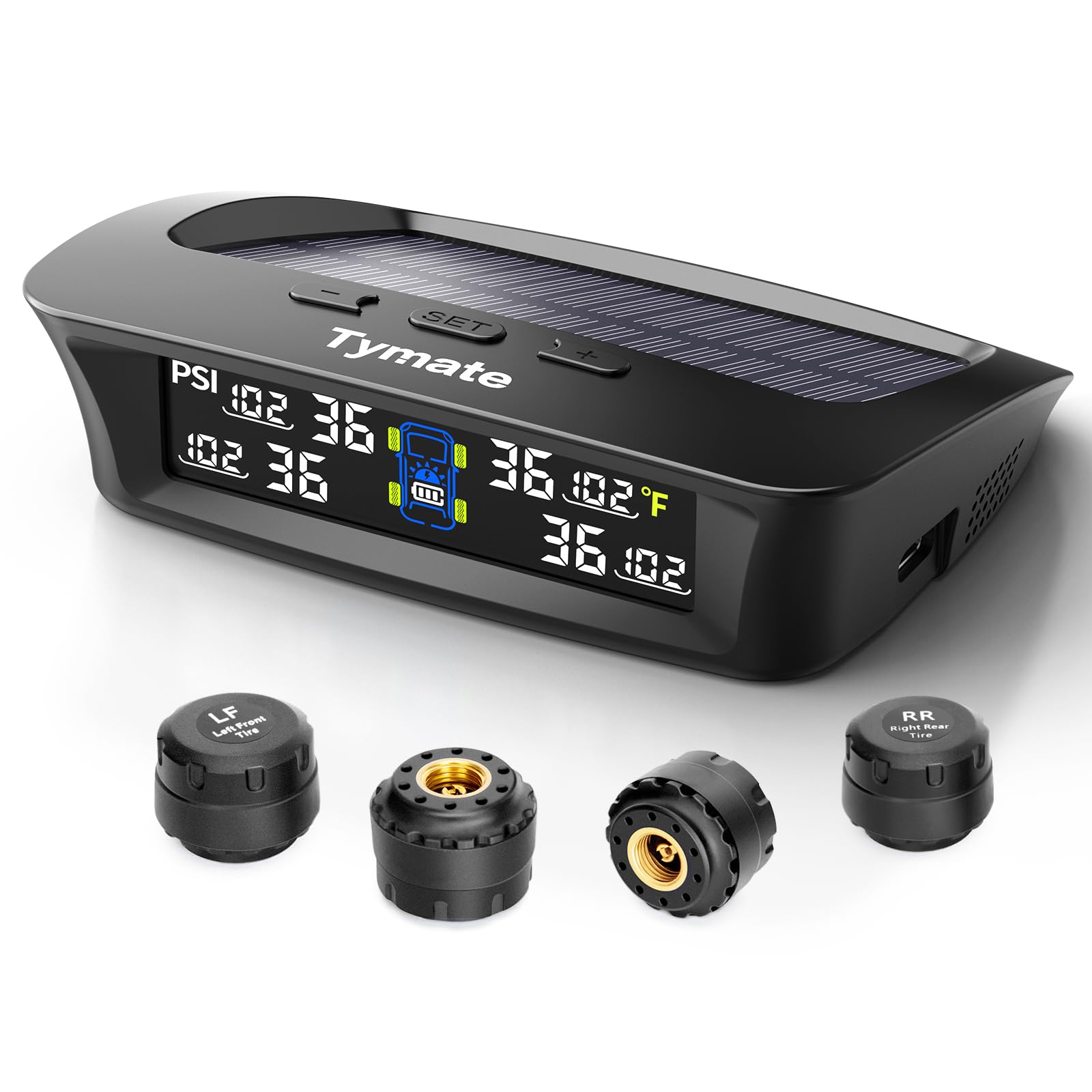
The 144-PSI ceiling and 10-tire capacity make this the choice for heavy-duty tow rigs.
The TM3 steps up meaningfully for serious towers. Its 0-144 PSI range handles the high-pressure tires on heavy trucks and 5th wheels that budget systems can’t read, and it can monitor up to 10 tires when you swap between your tow vehicle and trailer (a separate display swap). It operates at 433.92 MHz for sturdy signal transmission, though the manufacturer recommends adding a repeater for total vehicle lengths of 36 feet or more.
The sensors are factory-paired and pre-labeled, so there’s zero pairing work — just screw them on. Each has a CR1632 battery rated for up to six months of operation with a two-year lifespan, and the IP67 waterproofing makes them suitable for harsh environments. Alarm thresholds auto-set to 25% above and 15% below your reference pressure, and the six alarm modes include rapid leak detection, high/low pressure, high temperature, low sensor voltage, and signal loss. Charging comes via solar or USB-C.
What wins owners over is the functionality — the system is praised for connecting without issues and providing confidence when towing, particularly with fifth-wheel trailers. It’s credited with catching a nail that had dropped a tire by 6 pounds, preventing bead damage. The recognized trade-offs: the display can be hard to read in direct sunlight (the included case helps shade it), the startup beep startles passengers, and it can take 2-4 minutes for all tire readings to appear after startup. Setup also requires airing tires to the right pressure first since it auto-calibrates to that baseline.
The Heavy-Duty Edge
- 0-144 PSI range covers high-pressure truck and 5th wheel tires
- Scales to 10 tires for tow vehicle and trailer combos
- Factory-paired sensors need zero setup — screw on and go
The Compromises
- Display readability in strong sunlight gets mixed feedback
- Slow initial readout (2-4 minutes) and a startling startup beep
Reach for it if: you tow a 5th wheel or heavy trailer and need a high PSI ceiling plus room to expand to 10 tires.
Consider alternatives if: your rig exceeds 36 feet and you’d rather not add a separately sold repeater.
8. GUTA GT80 RV Tire Pressure Monitoring System
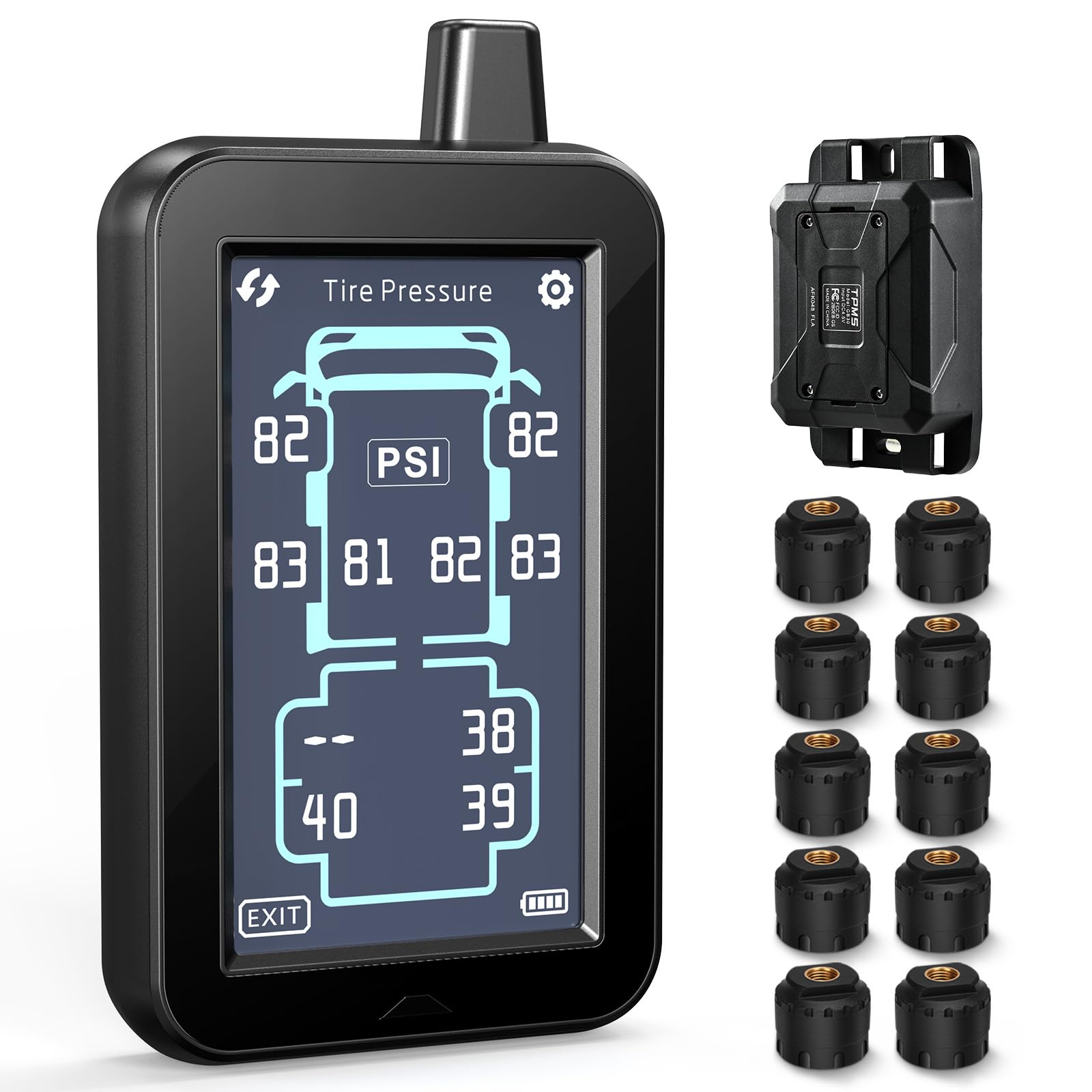
A 4.3-inch touchscreen that tracks up to 22 tires with a 164-foot signal reach.
This is the commercial-grade option in the GUTA lineup, built for fleet managers who juggle multiple vehicles. The headline feature is the 4.3-inch full-color touchscreen, which is more intuitive than button-based systems and lets you view up to 22 tires’ data on a single page. Pressure readings span 0 to 188 PSI and temperatures up to 185°F, making it suitable for the largest RVs and commercial vehicles.
The included signal booster is the key differentiator, delivering stable real-time data up to 164 feet — the longest range in this roundup and a genuine advantage for long trailers and tow vehicles. All 10 sensors are pre-labeled and factory-paired, so installation is as simple as screwing them on and seeing data appear. It switches between 5 vehicle types, offers six alarm modes, and includes a power-saving mode that kicks in after 10 minutes without motion. Regular firmware updates via the GUTA website are supported.
Owners highlight the easy setup, pre-paired sensors, and bright touchscreen as the big wins, with one running an 8-sensor unit across 7 tires plus a spare. The real-world catch is sensor compatibility: there’s a documented issue where new displays don’t work with older sensors, and customer support reportedly required repurchasing sensors in that situation. It’s also recommended to use the included anti-theft nuts, as one owner’s loose sensor triggered a false alarm. For large fleets that need one screen for many tires, the GT80 is powerful — but verify sensor compatibility before expanding.
Who it’s built for: commercial fleets and large RV setups that need one touchscreen to manage up to 22 tires.
The risk to weigh: a silent version change means older sensors may not pair with newer displays, so buy spares with your system.
9. GUTA GT20 RV Tire Pressure Monitoring System
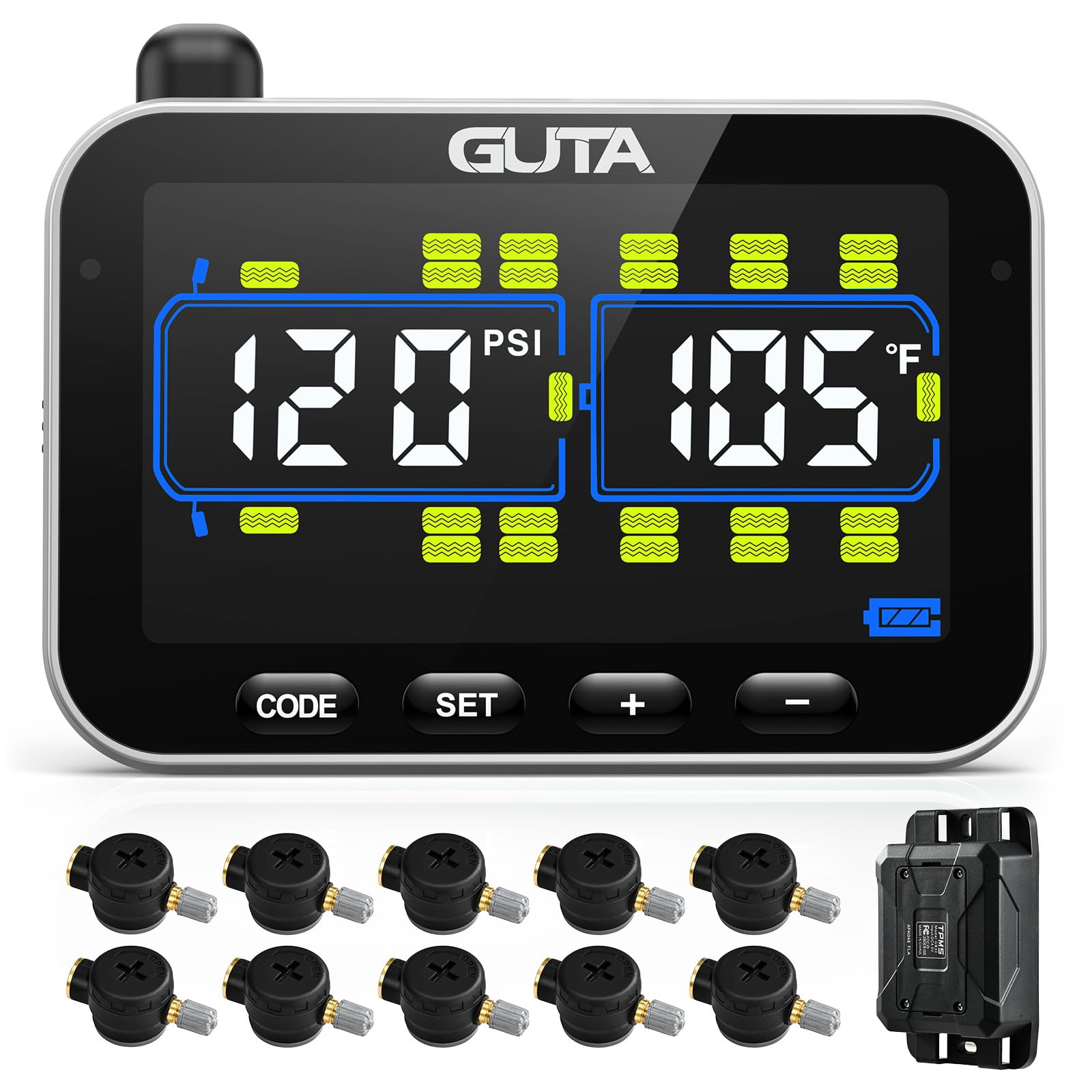
Flow-through sensors let you air up tires without unscrewing anything — a huge win for semis.
The GT20 earns its place with a clever design choice: flow-through sensors. This means you can inflate or deflate your tires directly through the sensor without removing it, a massive convenience for semi-trucks and large trailers where airing up is routine. It monitors 0-188 PSI with a large color LCD and includes a signal booster for transmission up to 100 feet, making it a tool designed for cross-country hauls where consistent signal matters.
The system covers up to 24 tires and auto-scrolls through connected tires, displaying real-time pressure and temperature for 5 seconds at a time with a beeping alarm on abnormal data. The built-in rechargeable lithium battery lasts up to 15 hours on a full charge under high-intensity use, and the monitor enters power-saving mode after 15 minutes of no motion. Sensors are waterproof, dust-proof, anti-theft, and use a user-replaceable CR2032 battery. All 10 sensors come pre-labeled and factory-paired — no pairing steps.
Shoppers say it works reliably on a 37-foot Class A motorhome plus tow vehicle without needing a booster, and that it caught both slow and fast leaks. The display is praised as easy to read, and the flow-through design is specifically called out as much easier for airing tires. The honest caveats: sensor accuracy gets mixed feedback, a few recommend metal valve stems after experiencing flats, and the screen brightness can fluctuate. It’s also noted as a 15-hour battery life system, so you’ll want to top it up between long drives rather than rely on solar.
The Big Advantages
- Flow-through sensors mean no-removal inflating at every air stop
- 15-hour battery keeps the monitor alive for full driving days
- Scales to 24 tires for semi-trucks and commercial fleets
The Fine Print
- Sensor accuracy gets mixed reviews — treat it as an early-warning tool
- Battery-powered (not solar), so you must remember to charge it
Pick this for: semi-trucks and large fleets where flow-through sensors save real time at every air-up.
Look elsewhere if: you want a solar-powered, set-and-forget monitor that never needs a charge.
Understanding the Specs
PSI Range and Accuracy
The PSI range tells you the maximum tire pressure the sensor can read — a sedan needs about 40 PSI, while a heavy truck or RV can require over 100 PSI. Accuracy, stated in PSI (like ±1.5), shows how close the sensor’s reading is to a manual gauge. A tighter PSI margin catches slow leaks earlier, when they’re easiest to fix.
Alarm Modes
Alarm modes are the system’s safety net. High and low pressure alerts flag any tire outside your normal range. Rapid leak detection fires on a sudden pressure drop, warning you about a puncture or blowout in progress. High-temperature alerts catch overheating tires before failure, which is critical when towing heavy loads. More modes provide more ways to warn you before a problem becomes a roadside emergency.
Charging and Power
Your monitor display needs a power source, and the options change your routine. Solar displays top themselves up on the dash for a set-and-forget experience. USB charging (or USB-C) is a reliable backup for cloudy days or garaged cars. Battery-powered monitors like the GT20 need manual charging every so often. Sensor batteries are a separate matter — most use replaceable coin cells (CR1632 or CR2032) that last months to years.
Sensor Count and Signal Range
The sensor count must match your tire count — 4 for a car, 8-10 for a tow vehicle plus trailer. Signal range, measured in feet, tells you how far the sensor signal travels to the display. Standard systems reach 32-36 feet, while booster-equipped units stretch to 100-164 feet for long trailers. If your trailer exceeds the range, you’ll need a repeater or booster to keep the signal strong.
FAQ
Will a valve stem tire pressure monitor fit my vehicle’s existing valve stems?
How long do the sensor batteries last before I need to replace them?
Can I use these monitors on both my tow vehicle and my trailer?
Is a solar-powered monitor reliable in cloudy weather or garages?
What’s the difference between a fast leak alarm and a low pressure alarm?
How accurate are these sensors compared to a manual tire gauge?
Do I need a signal booster or repeater for a long trailer?
Can I monitor more than four tires with a basic system?
Final Thoughts: The Verdict
If you want one dependable pick, the winner for the valve stem tire pressure monitor crown is the Masoll 4-Sensor system because its auto-calibration, six alarm modes, and dual solar/USB charging cover all the essentials with a proven track record on RVs. If you need to scale beyond four tires with a high PSI ceiling, the Tymate TM3 is the premium route with up to 10 tires and 144 PSI. And for fleet-level operations or semi-trucks where flow-through sensors save time at every air stop, the GUTA GT20 is the one to reach for — it’s the pick that turns tire maintenance from a chore into a non-event.
How We Picked
We do not accept paid placement. Every pick is matched to a real buyer and a real use-case; we do not hands-on test units.
Sources & Methodology
Specifications: manufacturer listings and product documentation. Review insights: verified customer reviews, as of August 2026. Pricing: not shown on this page (it changes often); check the current price via the retailer link.
As an Amazon Associate, GoCarLife earns from qualifying purchases. This does not affect which products we feature.