
Our readers keep the lights on and the garage heater humming. As an Amazon Associate, I earn from qualifying purchases.
Specs are compiled from manufacturer listings and verified buyer reviews and can change over time — please confirm the key details on the product page before buying.
That groaning noise when you turn the wheel means air is trapped in your power steering system, and flushing it clean needs a vacuum pump that actually holds suction. Not every tool labeled “brake bleeder” will seal onto your reservoir, so this guide breaks down the real differences between hand pumps, fluid extractors, and shop-grade evacuators.
I’m Mo Maruf — the founder and writer behind GoCarLife. This guide is built by comparing the manufacturers’ published specifications and the patterns across verified customer reviews, so you get each pick’s real strengths and trade-offs instead of marketing spin.
The right tool removes old fluid and air in one pass, leaving you with steering that feels tight again. Here is our breakdown of the best vacuum pump for power steering to keep in your garage.
Our Picks at a Glance


How To Choose The Best Vacuum Pump for Power Steering
Air bubbles in the steering rack make the wheel feel spongy and noisy. A vacuum pump pulls old fluid out through the reservoir and draws new fluid in, purging those bubbles in one smooth operation.
Manual Hand Pumps vs. Fluid Extractors
A dedicated hand vacuum pump with a gauge gives you precise control for bleeding brakes or a small power steering reservoir. A fluid extractor holds several quarts and works through the dipstick tube, making it the better all-around tool if you also change your own oil.
Seal Quality Is Everything
The biggest complaint across every category is hoses that don’t fit snugly on the bleeder screw or reservoir. If the adapter wobbles, you pull air instead of fluid, so look for kits with multiple tapered adapters or dedicated reservoir stoppers.
Quick Comparison
| Model | Best For | Capacity | Operation | Weight | Amazon |
|---|---|---|---|---|---|
| VEVOR 6.5L Extractor★ Best Overall | Best Overall, versatile fluid swaps | 6.5L / 1.74 Gal | Pneumatic + Manual | 5.73 lbs | Amazon |
| Powerbuilt 6.3 Qt ExtractorTop Performer | Manual dipstick extraction | 6.3 Quarts | Manual Pump | — | Amazon |
| Lisle 72070 EVAC KitBest for Reservoirs | Reservoir-specific power steering bleed | — | Manual + Vacuum | 9.6 oz | Amazon |
| JohnDow 6 Gallon Evacuator | Pro shop, high volume | 6 Gallons | Pneumatic Venturi | — | Amazon |
| 8MILELAKE 21pc Set | Versatile adapter coverage | — | Manual Pump | 1.2 kg | Amazon |
| YSTOOL Hand Pump Kit | Aluminum build, portability | — | Manual Pump | 3.67 lbs | Amazon |
| WINMAX 21pc Tester Kit | Pressure and vacuum testing | — | Manual Pump | 3.97 lbs | Amazon |
| SMART JERRY Bleeder Kit | Compact one-person brake bleeding | — | Manual Pump | 1.54 lbs | Amazon |
In‑Depth Reviews
1. VEVOR 6.5L Pneumatic/Manual Oil Extractor Pump
Our pick — over 4.5★ from 400+ verified ratings; the strongest balance of quality and price.
The dual-mode extractor that pulls power steering fluid and engine oil through the dipstick with zero mess.
This is the tool for the home mechanic who wants one device to handle every fluid in the garage. You get a 6.5L tank (1.74 gallons) that works two ways: hook it to an air compressor for fast pneumatic extraction, or pump it by hand when you are away from the shop. Buyers report it pulls 6+ liters of warm oil in minutes, matching the speed needed for a power steering flush.
The kit arrives complete with a main tube, dipstick, two extension tubes, and a suction hose that reaches deep into reservoirs. Owners mention it handles automatic transmission fluid, brake fluid, and power steering fluid equally well — the warm fluid flows faster, so the extraction finishes quicker. The thick plastic body and tight seals are what owners praise most, along with the clean, spill-free operation that beats draining onto your frame.
At 5.73 pounds it is far heavier than a small hand pump like the SMART JERRY kit, but that weight comes from the sturdy tank that prevents toppling while you work. The trade-off is cleaning the inside after use, which owners admit takes a little effort.
What Owners Love
- Pneumatic mode is far faster and easier than manual pumping
- Handles engine oil, gear oil, PSF, and brake fluid
- Thick durable plastic with tight seals, no spills
Watch Out For
- Internal cleaning is somewhat difficult
- Heavier than dedicated hand pump kits
Reach for this if: you want one extractor that handles oil changes, transmission flushes, and power steering bleeding without buying three separate tools.
Look elsewhere if: you only ever bleed a small brake or steering system and want the lightest possible kit — this tank is overkill for that.
2. Powerbuilt Oil and Fluid Extractor 6.3 Quart
The manual workhorse that reaches the bottom of the reservoir through a 42-inch metal probe.
This single-purpose extractor skips the compressor entirely and relies on a hand pump to build vacuum, which keeps it simple and portable. The 6.3-quart capacity means you can fully drain a power steering reservoir and still have room for a transmission or oil change. The wide base lets you hold it steady with your foot while you pump.
You can watch the old fluid flow through the 59-inch transparent main tube, and the flexible 42-inch metal suction probe bends into tight spaces to reach the bottom of the pan. Customers note extracting 4.5 quarts of transmission fluid through the dipstick with no mess., and One long-time user got 13 years of reliable service before the tube and seal wore out.
The honest limitation is speed — expect to pump a lot. Owners note cold fluid took 30 minutes to extract, while warm fluid moves much faster, so warm up the engine first. The pour spout and sealing cap make disposal clean and spill-free.
Solid pick: The most reliable manual-only extractor in the lineup — no compressor needed, just patience. It also disassembles for easy recycling when the hose finally wears out.
3. Lisle 72070 Power Steering EVAC Kit
The purpose-built bleeder that seals directly onto the power steering reservoir with tapered stoppers.
This kit is built for power steering, not generic hand pumps. It includes a large and small tapered stopper that press into the reservoir opening, plus a graduated catch can, two lids, and tubing to route the old fluid. At just 9.6 ounces it is the lightest tool in this guide, so you can hold it in place while you pump.
Owners confirm it works exactly as described for vehicles that require vacuum to bleed air from the steering system — one buyer finally pulled a stubborn vacuum that other tools could not manage. It also works on clutch reservoirs and brakes, adding versatility. The kit comes with three brake bleeder adapters for those other jobs.
The realistic caveat is sealing. One owner on a 2003 Ranger 3.0 could not get a perfect seal but managed well enough, and another noted the reservoir jar does not seal perfectly on its own. You may need to hold the adapter in place until you build partial vacuum.
Specialist tool: If you want the tool designed exactly for this job rather than a multi-purpose kit, this is it — just be ready to hold the adapter snug while vacuum builds.
4. JohnDow Industries 6 Gallon Fluid Evacuator

The shop-grade steel tank that siphons an entire power steering system in under 10 minutes.
If you work on multiple vehicles or run a side business, this is the heavy hitter. The venturi vacuum system (a device that uses compressed air to create suction) works inside a steel tank — far more durable than the plastic pumps in this guide. With 6-gallon capacity, you can evacuate a power steering rack, a transmission, and still have room for an oil change.
A 7-foot suction hose gives you reach across the engine bay, and the six suction probes plus three OE-style adapters handle different reservoir shapes. The self-evacuating design uses a 10-foot quick-disconnect hose to dump the tank fast using air pressure. Reviewers point out it handles hot oil without issues and pays for itself after a few oil changes.
The catch is the compressor requirement — owners note a pancake compressor won’t cut it. A 4-gallon compressor works decently, but a 20-gallon or larger unit runs it best. The steel build is exactly why owners say it beats fragile plastic pumps.
Built to last: The metal tank and venturi system justify the jump in price for anyone who wants professional-grade durability and speed. Just make sure your compressor has the capacity.
5. 8MILELAKE 21pcs Handheld Vacuum Pump Set
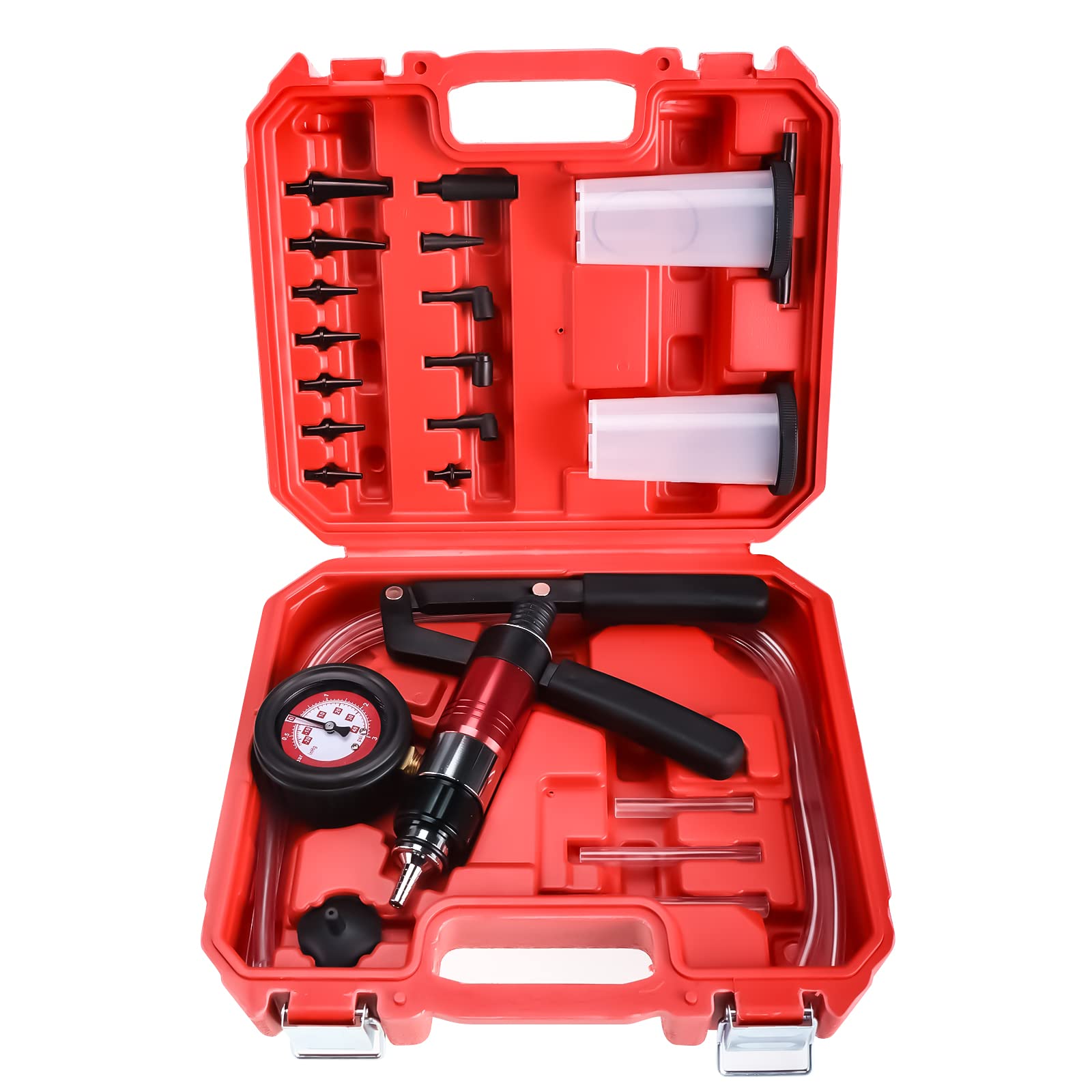
A 21-piece kit with 13 adapters that covers nearly every reservoir and bleeder screw shape.
What owners praise most is the sheer versatility of this set. The 13 different adapter nozzles let you bleed brakes, flush power steering, and test vacuum systems across most vehicles. The gauge reads pressure up to 60 psi and vacuum up to 30 inches, so it doubles as a diagnostic tool for checking valve seals and emission systems.
The pump holds readings for 30+ minutes, which owners found reliable for pressure-testing outboard motor lower units. One buyer used it to find a magnetic drain plug causing water ingress in a Merc 90hp — a perfect seal held pressure through the whole test. The custom storage box keeps all 21 pieces organized.
The honest fit note is that the sealing and vacuum capacity get mixed feedback. Some shoppers say it won’t pull much vacuum and leaks internally, and the case hasps feel fragile. It works best for light automotive work rather than heavy professional use.
Great starter kit: The adapter variety at this price is what wins people over — just don’t expect industrial-grade sealing from the plastic construction.
6. YSTOOL Hand Held Vacuum & Pressure Pump Kit

The anodized aluminum pump that bleeds a full hydraulic system in under five minutes.
YSTOOL stands out in this lineup for its build material — the pump body is high-grade aluminum alloy, anodized for corrosion resistance, rather than the plastic found on most competitors. That makes it feel premium in hand and built for long-term use. The gauge reads 0-30 in Hg and 0-760 mm Hg for accurate vacuum monitoring.
The kit includes a hand pump with gauge, 5 clear hoses, 2 reservoir jars at 4.5 oz each, and 12 adapters, all packed into a portable plastic case. Buyers report it works perfectly for pressure-testing 2-cycle engines and pressurizing boat motors, which tells you the seals hold tight. Operation is straightforward enough that you can bleed a brake, clutch, or steering system solo in minutes.
The mixed feedback centers on material quality — a few owners found the rubber and plastic smell strongly of recycled material and worry about longevity. The instruction manual also has typos and wrong diagrams, but the operation is obvious enough to figure out.
Balanced choice: The aluminum cylinder gives it a durability edge over plastic rivals, and the portability makes it the easy grab-and-go option for the driveway.
7. WINMAX 21pc Hand Held Vacuum Pressure Pump Tester Kit
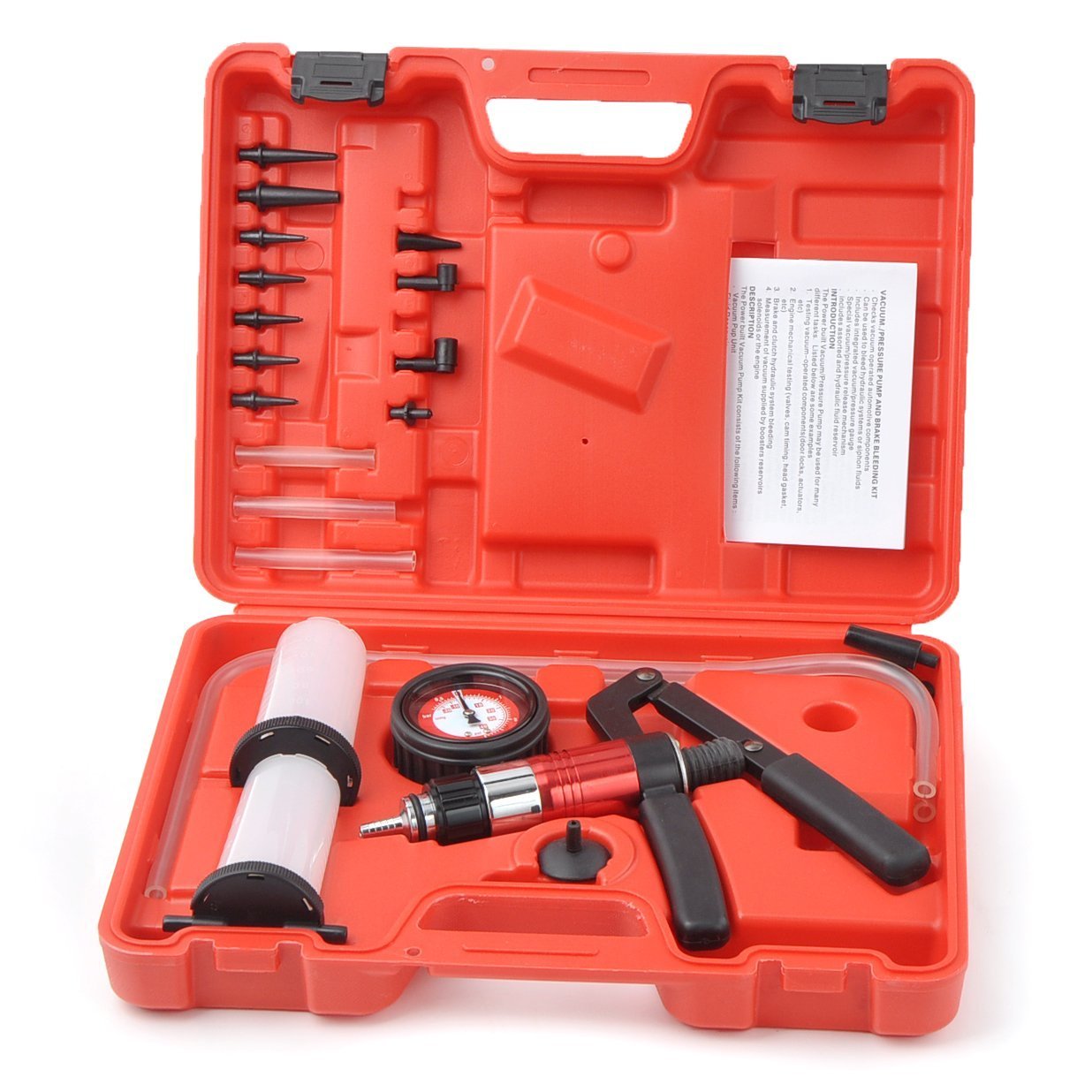
The stainless steel pump that flips between pressure and vacuum for testing and bleeding.
This kit earns its keep as a diagnostic tool as much as a bleeder. The stainless steel construction gives it a solid, heavy feel — owners were surprised at the heft — and the dual-range gauge handles pressure up to 40 psi and vacuum to 26 inHg. You slide the black collar forward for vacuum and back for pressure, which covers brake bleeding, power steering fluid changes, and engine vacuum testing.
Owners mention it works perfectly for pressure and vacuum leak testing on Stihl chainsaws, and the suction power holds well. The 21-piece set covers fuel system inspections, ignition system assessments, and vacuum-operated mechanical checks, making it a genuine multi-tool. At 3.97 pounds it has real substance in hand.
Quality gets mixed feedback — some find it well-built for the price while a few note loose fittings and recommend a premium brand instead. It is best as a light-duty garage tool rather than daily professional use.
Solid all-rounder: “For the price you just can’t beat it” sums up the consensus — the stainless body and dual function make it a smart budget pick for testing and bleeding.
8. SMART JERRY Brake Bleeder Kit with Hand Vacuum Pump
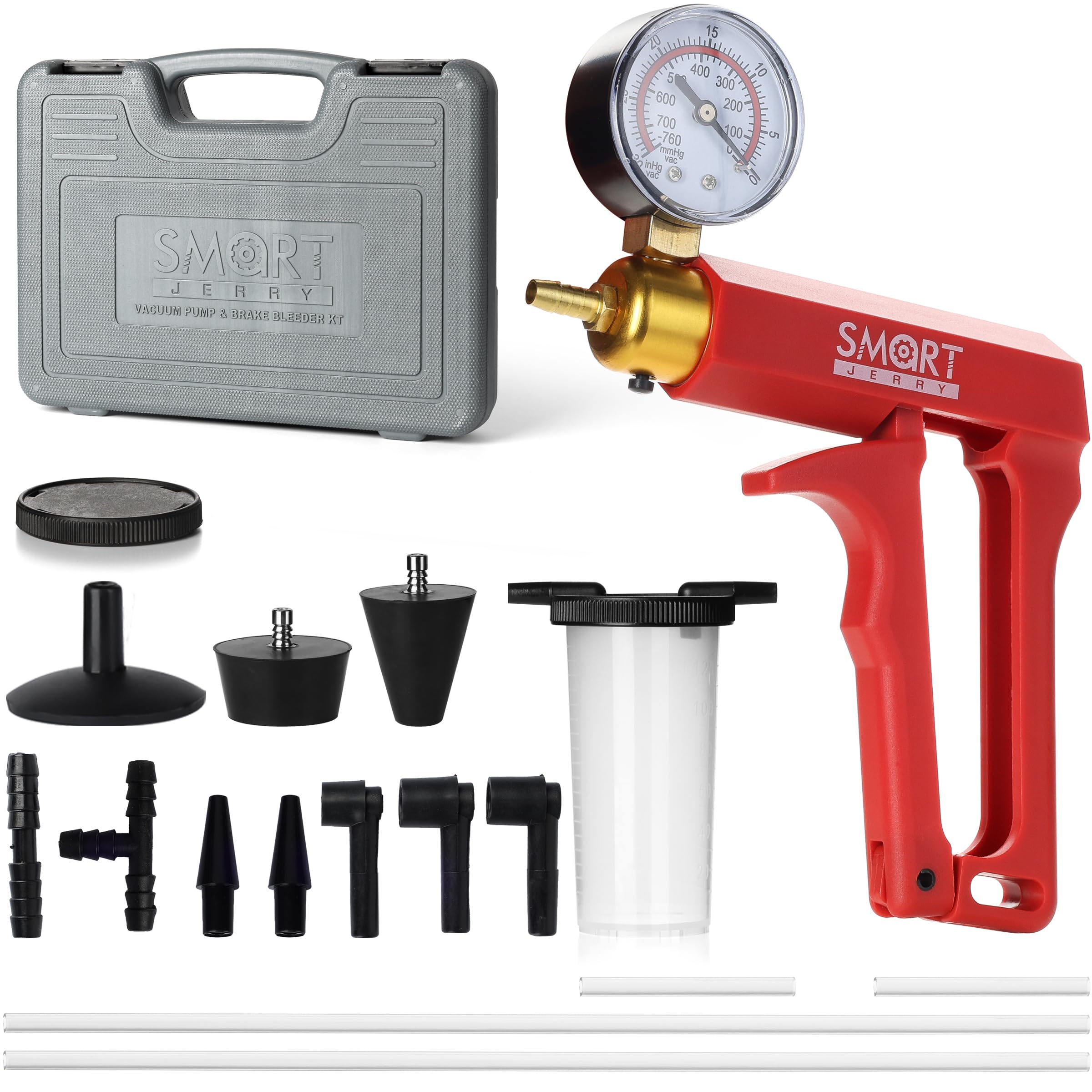
The organized one-person kit that bleeds brakes and steering fluid from a custom-fitted case.
This kit is built around convenience — every accessory sits in a dedicated compartment in a sturdy fitted case, so setup takes seconds instead of hunting for parts. The dual-scale gauge reads both 0-30 in/Hg and 0-760 mmHg, giving you precise control over the vacuum. The upgraded internal rubber sealing rings and reinforced plastic handle are direct responses to earlier buyer feedback about leaks and breakage.
Owners confirm it produces strong vacuum for brake bleeding and works as a multi-use tester for carburetors, fuel petcocks, and vacuum advances. The heat-resistant PVC hoses and clamps prevent leaks during operation, and the 2-in-1 design handles brake fluid, power steering fluid, and other automotive fluids.
The recurring gripe is the hose fit on bleeder screws — one owner found the hoses too large for 90° sleeves, causing air leaks and a loose fit. Durability also earns concern, with some units reported falling apart on first use and case latches failing. At 1.54 pounds it is light and portable, but treat the connections gently.
Best if: you want a tidy, organized one-person kit for occasional brake and steering bleeding and can accept a finicky hose fit.
Think twice if: you need a rugged tool for frequent professional use — the plastic construction and latch durability are the weak spots.
9. VEVOR 15L Pneumatic/Manual Fluid Extractor Pump

The big-bucket extractor with dual-mode operation and four tube sizes for deep reservoirs.
This is the larger sibling of our top pick, swapping the 6.5L tank for a 15L (4-gallon) capacity that handles the biggest jobs without emptying mid-task. The dual-mode operation lets you run it from an air compressor for speed or pump manually when you are away from the shop. Owners praise the heavy-duty build and note the manual function works impressively well.
The kit includes a main tube, dipstick, two extension tubes, and a suction hose — the four sizes reach the deepest parts of the reservoir, leaving tanks dry. It handles engine oil, gear oil, power steering fluid, and brake fluid across cars, motorcycles, yachts, and tractors. At 6.83 pounds it is the heaviest VEVOR in this guide, but that weight comes from the sturdy construction that prevents toppling.
The durability concerns are real — some customers note the body collapsing after a few uses and oil shooting out of the handle on the second use. Fit issues also appear on certain vehicles where the siphon hose cannot enter the oil pan due to baffles, so check your vehicle compatibility first.
Big capacity at a small price: If you need the large tank and dual-mode flexibility without the premium cost, this delivers — just be aware some units have durability and fit issues.
Understanding the Specs
Vacuum vs. Pressure Range
For power steering bleeding, the vacuum range is what matters — it pulls old fluid out. Look for a gauge reading at least 0-25 inHg, with dual-range gauges (showing both vacuum and pressure) letting you also test other systems. Pressure mode is for diagnostics, not extraction.
Capacity and Reservoir Fit
Small hand pumps have no holding tank, so fluid flows into a catch jar. Fluid extractors hold 6 quarts to 6 gallons, meaning fewer stops to empty. The adapters are critical — tapered stoppers and 13-piece adapter sets fit more vehicles than a single universal hose.
FAQ
Can I use a brake bleeder kit for power steering fluid?
How do I bleed power steering with a vacuum pump?
What is the difference between a fluid extractor and a hand vacuum pump?
Do I need an air compressor for a vacuum pump?
How much vacuum do I need to bleed power steering?
Why does my pump lose suction on the reservoir?
Can a vacuum pump extract oil through the dipstick?
How long does a vacuum pump fluid extraction take?
Final Thoughts: The Verdict
For the majority of shoppers, the vacuum pump for power steering winner is the VEVOR 6.5L Extractor because dual-mode operation and 6.5L capacity cover every fluid job in the garage. If you want a reservoir-specific tool without the tank, grab the Lisle 72070 EVAC Kit. And for pro-shop volume, the JohnDow 6 Gallon Evacuator is the one to reach for.
How We Picked
We do not accept paid placement. Every pick is matched to a real buyer and a real use-case; we do not hands-on test units.
Sources & Methodology
Specifications: manufacturer listings and product documentation. Review insights: verified customer reviews, as of August 2026. Pricing: not shown on this page (it changes often); check the current price via the retailer link.
As an Amazon Associate, GoCarLife earns from qualifying purchases. This does not affect which products we feature.