
Our readers keep the lights on and the garage heater humming. As an Amazon Associate, I earn from qualifying purchases.
Specs are compiled from manufacturer listings and verified buyer reviews and can change over time — please confirm the key details on the product page before buying.
Riding a UTV into the backcountry without a dedicated off-road navigator means depending on a phone that loses signal, overheats, and can’t survive a dust storm. A purpose-built UTV GPS fixes that with a glove-friendly touchscreen, rugged waterproofing, and preloaded trail maps that work with zero cell service. This guide breaks down the eight best units by what actually matters on the trail: screen visibility, battery life, map coverage, and how they mount to your machine.
I’m Mo Maruf — the founder and writer behind GoCarLife. This guide is built by comparing the manufacturers’ published specifications and the patterns across verified customer reviews, so you get each pick’s real strengths and trade-offs instead of marketing spin.
If you ride a side-by-side, the best utv gps navigation units combine a sunlight-readable screen with rugged IPX7 waterproofing and preloaded topo maps so you never lose the trail.
Our Picks at a Glance


How To Choose The Best UTV GPS Navigation
You want a UTV GPS that won’t leave you lost, but the right one depends on how you ride. Screen size, battery life, and group tracking all matter, so here’s how to pick the one that fits your trails and your time out.
Screen visibility and size
A bright, sunlight-readable display is the difference between glancing at a turn and squinting at a glare. Look for a glove-friendly touchscreen you can operate with thick riding gloves on, and a screen large enough to read at a glance while bouncing over rough terrain.
Battery life and power
Battery life determines how long you can ride without hardwiring the unit to your vehicle. Handheld models can run 24 hours in GPS mode, while larger dash-mounted navigators typically last around 6 to 7 hours on internal battery and are meant to be powered by your UTV’s electrical system.
Maps and off-road data
The best off-road units come preloaded with topographic maps, U.S. Forest Service roads and trails, and public land boundaries. Some even offer downloadable satellite imagery so you can see overhead views of the terrain before you head out.
Quick Comparison
| Model | Best For | Display Size | Battery Life | Water Rating | Amazon |
|---|---|---|---|---|---|
| Garmin zūmo XT2★ Best Overall | All-terrain versatility | 6″ | 6 hours | IPX7 | Amazon |
| Garmin Montana 710Long-Range Pick | Long battery expeditions | 5″ | 24 hours | IPX7 | Amazon |
| Garmin TreadTrail Specialist | Off-road trail riders | 5.5″ | 6 hours | IPX7 | Amazon |
| Trail Tech Voyager Pro | Ride data monitoring | 4″ | — | — | Amazon |
| Garmin Tread 2 | Premium off-road nav | 6″ | 7 hours | IP67 | Amazon |
| Garmin Tread Group Ride | Group rides and comms | 5.5″ | 6 hours | IPX7 | Amazon |
| Garmin Tread 2 Overland | Overland expeditions | 8″ | 6 hours | IP67 | Amazon |
| Garmin Tread 2 SxS | Serious UTV riders | 8″ | 6 hours | IP67 | Amazon |
In‑Depth Reviews
1. Garmin zūmo XT2 All-Terrain Navigator
Our pick — over 4★ from 350+ verified ratings; the strongest balance of quality and price.
The all-terrain champion that pairs a 6-inch sunlight-readable screen with glove-friendly controls for every ride.
The zūmo XT2 is the most versatile pick here because it balances a large 6″ display with a rugged IPX7 design built to handle weather and handlebar vibrations. It’s a dedicated waterproof GPS for no-cell zones, so you can leave your phone in your pocket and avoid the overheating and cold shutdowns that plague handheld devices off-road.
Buyers report it’s “accurate within 3 feet; easy setup; wired to switch power; Bluetooth pairs with phone and Cardo smoothly.” The visual route planner lets you choose between efficient routing or more thrilling adventures, and group ride support shows other riders’ positions on the display when paired with the Tread smartphone app. According to the review data, it’s ideal for paved riding up to 3,000 miles per month.
The 6-hour battery life means you’ll want to hardwire this to your UTV for long days, but the included motorcycle mount and power cable make that straightforward. What wins people over is the bright daylight viewing — the screen is “truly and easily visible in bright sunshine,” as owners put it.
Why riders love it
- Glove-friendly touchscreen rated for handlebar vibration
- Visual route planner with efficient or adventurous routing
- Pairs with inReach Mini 2 satellite communicator for safety
Where it falls short
- 6-hour battery needs hardwiring for all-day rides
- A few units had touchscreen failures requiring Garmin returns
Reach for this if: you want one navigator that handles paved roads, adventure routes, and group rides with a bright, glove-friendly display.
Look elsewhere if: you need a full day of battery without wiring the unit to your vehicle’s power.
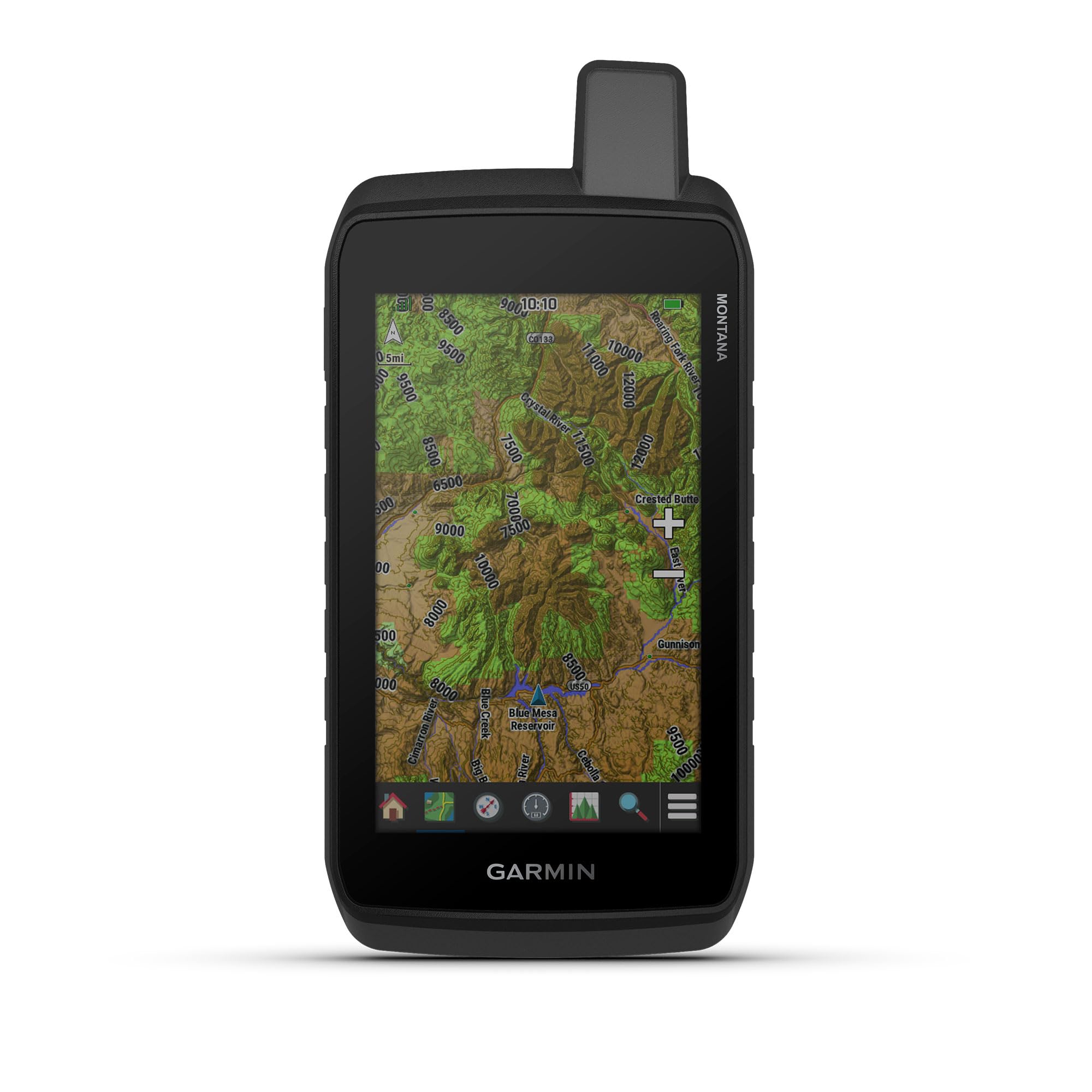
2. Garmin Montana 710 Handheld Navigator
The endurance king with 24 hours of GPS battery life and a 5-inch glove-friendly touchscreen for multi-day trips.
The Montana 710 is the battery champion of this list, delivering up to 24 hours in GPS mode and up to 432 hours in expedition mode between charges. That’s a 4.0x gap over the zūmo XT2’s 6 hours, making it the pick for riders who stay out for days without access to vehicle power.
It’s a rugged handheld rated to MIL-STD 810 for thermal, shock, and vibration, plus IPX7 for water-resistance. The 32 GB memory lets you store additional maps, and the included TopoActive maps cover trails from the start.
Owners mention the “large display is easy to read in all conditions” and that it’s “a great, reliable, and accurate GPS loaded with features.” The built-in ABC sensors — altimeter (measures altitude), barometer (measures air pressure), and 3-axis electronic compass — help you navigate challenging terrain without relying on your phone.
Best on the bars: This is the handheld for ATV riders who want a unit that also works on foot, with battery life measured in days, not hours.
One trade-off: At 14.5 ounces it’s noticeably heavier than dash-mounted navigators, so plan your mounting spot accordingly.
3. Garmin Tread Powersport Off-Road Navigator
A purpose-built off-road navigator with a 5.5-inch ultrabright screen and U.S. Forest Service trail data preloaded.
The Tread Powersport is built specifically for ATV and snowmobile riders, with a 5.5″ glove-friendly ultrabright touchscreen and IPX7 water rating. It comes preloaded with topographic maps of North and Central America, U.S. public and private land boundaries, and U.S. Forest Service roads and trails with Motor Vehicle Use Maps.
What wins people over is the software quality — it’s the most-discussed strength, with stable operation and excellent maps. At 9.28 ounces it’s the lightest dash navigator here, and its compact 5.8″ x 3.5″ footprint fits tight cockpits. The built-in altimeter, barometer, compass, and pitch and roll gauges help you navigate challenging terrain.
The recurring gripe is the high power cable, with several riders reporting issues getting it to work. Also note that the subscription-free BirdsEye Satellite Imagery requires a Wi-Fi connection to download. Trail riders in northern Minnesota report it tracked every trail including dead ends, and rain and river splashes never affected the GPS.
Built for the bush: If you ride Forest Service roads and want a lighter, trail-focused unit, this delivers with stable software and solid maps.
Fit note: Power cabling can be finicky, and off-road mapping is incomplete in some areas, so check coverage for your region.
4. Trail Tech Voyager Pro Kit

The UTV dash that doubles as a gauge cluster, tracking engine temp, RPM, and battery voltage while you ride.
The Voyager Pro is unique here because it integrates with your vehicle using standard Trail Tech sensors to provide vital ride data — engine temperature, RPM, battery voltage, speed, and distance — right on a 4″ color touchscreen. It’s universal for UTVs and side-by-sides, and it comes loaded with North American base maps, topography lines, and hill shading.
What riders praise most is the buddy tracking feature, which lets you see up to 20 other riders’ positions on the display. One owner noted it works reliably at distances over a mile. The Bluetooth connection handles intercom, phone dialing, messaging, and media controls, making it a full communication hub as well as a navigator.
The honest trade-off: battery life and charging get mixed feedback, with some units refusing to charge at all. Owners recommend hardwiring it rather than relying on the internal battery. The screen quality is also mixed, though one owner reports it performs well in direct sunlight — better than a Garmin Montana 610t, in their comparison.
Pick this for: riders who want engine data and buddy tracking in one rugged, waterproof unit instead of separate gauges and a GPS.
Think twice if: you want a large screen — at 4″ it’s the smallest here, and battery quirks mean hardwiring is the safer route.
5. Garmin Tread 2 Powersport Navigator

The 6-inch ultrabright display that riders call the best GPS they’ve ever owned, with IP67 dust and water protection.
The Tread 2 takes the off-road formula and upgrades it with a 6″ high-resolution, ultrabright, glove-friendly touchscreen and an IP67 water rating — one step above the IPX7 on most rivals, meaning it’s fully sealed against dust as well as water. It’s purpose-built to withstand extreme temperatures and weather for rugged off-road adventures.
Owners are emphatic about this one. As one put it, “This is by far the best GPS I’ve ever owned/used.” The turn-by-turn trail navigation covers unpaved roads and trails with OpenStreetMap, U.S. Forest Service Motor Vehicle Use Maps, and Adventure Roads and Trails content. Riders love how it shows property lines and property owners, which is a huge help on public land.
It includes rugged roll tube and handlebar mount options, and supports subscription-free satellite imagery downloads via Wi-Fi. Battery life is 7 hours — the best of the larger dash-mount navigators here. It also pairs with the Tread app for trip planning, GPX file sharing, and live weather radar.
The standout: A bigger, brighter screen with better dust protection than the standard Tread, and owners consistently rate it the best off-road GPS they’ve used.
Worth noting: It’s a premium investment, and a handlebar controller is recommended for easier operation while riding.
6. Garmin Tread with Group Ride Radio

The communicator that tracks up to 20 riders and keeps you talking with push-to-talk radio over 5.5 inches of screen.
This Tread variant is the one for riders who never roll solo. The Group Ride Radio features a push-to-talk fist mic and group tracking for up to 20 riders, all using a Tread navigator. It’s a 5.5″ glove-friendly, ultrabright touchscreen with IPX7 water resistance, and it’s built for ATV and snowmobile use.
The group tracking is what wins people over — owners say it “works great for group rides with other ATV/UTV with communication and tracking,” and it also works mounted on a snowmobile “never any issues in the cold.” The built-in gyroscope and pitch and roll gauges help you read the terrain, and it pairs with select Garmin GPS dog systems to track your dogs from the vehicle.
The push-to-talk onscreen button is hard to reach on motorcycles, so this unit leans UTV-oriented. Battery life is 6 hours, and it comes with a powered mount and wiring harness with tube mount. It pairs with inReach satellite communicators for two-way messaging and SOS when you’re truly off-grid.
Built for the pack: If you ride with a crew and want voice comms plus live tracking of every rider, this is the only navigator here that does both natively.
Fair warning: The on-screen push-to-talk is awkward on two wheels, and it’s one of the pricier options in this lineup.
7. Garmin Tread 2 Overland Edition

An 8-inch off-grid command center with custom street routing for the size and weight of your overland rig.
The Overland Edition is the biggest screen in the Tread 2 family at 8″, purpose-built for off-grid travels in an RV, SUV, or truck. It carries preloaded topographic maps of North and South America with high-definition digital elevation maps, plus City Navigator maps with custom street routing that accounts for the size and weight of your rig.
What makes it special for overlanders is the preloaded directory of Ultimate Public Campgrounds — more than 46,000 camping locations across the U.S. Owners describe it as “your off-road co-pilot that never quits,” with one noting it found a 4×4 trail around a closed mountain road in Moab. It includes a heavy-duty suction cup with a sturdy magnet-assisted locking mount to handle vibration and shock.
The mount lock rattles when the GPS isn’t attached, which is a minor annoyance between rides. Battery life is 6 hours, and the steep learning curve for menus is worth mentioning — it takes time to master, but owners say it’s great once you do. It syncs with inReach devices via the Explore app for spotty-internet situations.
The big-screen pick: For overland rigs and truck campers, the 8″ display and 46,000+ campground directory make it the definitive long-haul companion.
Know before you buy: The magnetic mount lock rattles without the unit attached, and the menu system has a real learning curve.
8. Garmin Tread 2 SxS Edition

The 8-inch SxS specialist with a tube mount kit and high-current power cable for the toughest UTV conditions.
The SxS Edition is the most UTV-specific pick in this lineup, built for side-by-sides and bundled with a tube mount kit and high-current power cable so it’s ready to install on your machine right from the start. The 8″ high-resolution, ultrabright, glove-friendly touchscreen carries an IP67 dust and water rating for the toughest conditions.
Customers note the functionality is excellent, with an accurate display and GPS performance that earns strong praise. The great rides feature lets you discover off-road routes, bookmark them to sync, rate difficulty, and upload photos. It includes built-in sensors — altimeter, barometer, compass, and pitch and roll gauges — for tough-terrain guidance.
The tube mount kit includes a locking magnet-assisted mount and bare wire power cable, and owners say installation is easy. One owner mounted it to the passenger grip bar in a 2018 Roxor and found the mounts hold the device very well. Note that a 12V charger isn’t included if you want to take it to another vehicle.
Built for your SxS: This is the turnkey UTV install — tube mount, high-current power cable, and an 8″ screen that owners say is easy to adjust in any light.
Plan ahead: No 12V charger in the box, so grab one if you’ll want to use it in a second vehicle.
Understanding the Specs
IP Ratings Explained
The IP (Ingress Protection) rating tells you how well a GPS resists dust and water. IPX7 means the unit survives immersion in up to 1 meter of water for 30 minutes, which handles river crossings and heavy rain. IP67 adds full dust protection on top of that water resistance — the 6 means no dust can get in, which matters when you’re riding through clouds of trail dirt.
Battery Life in GPS Mode
Battery life is the biggest spec divide in this category. A handheld like the Montana 710 runs up to 24 hours in GPS mode or 432 hours in expedition mode, because it’s designed to go days without power. Dash-mounted navigators like the Tread series run 6 to 7 hours on internal battery and are meant to be hardwired to your vehicle’s electrical system for all-day rides.
Glove-Friendly Touchscreens
A glove-friendly touchscreen is designed to register inputs through thick riding gloves, so you don’t have to stop and take a glove off to change your route or zoom the map. This is a critical UTV feature because you’re often bouncing over rough trail while trying to glance at the display.
Preloaded Trail Maps and Satellite Imagery
Preloaded topographic maps give you elevation lines, trails, and land boundaries without needing a cell signal. U.S. Forest Service Motor Vehicle Use Maps show which roads and trails are legal to ride. Downloadable satellite imagery provides photorealistic overhead views of terrain, so you can scout a route visually before you commit to it.
FAQ
Will a UTV GPS work without cell service?
Can I use a motorcycle GPS on my UTV?
How long does a UTV GPS battery last?
What does IPX7 waterproof mean for off-road riding?
Can I download satellite imagery to my UTV GPS?
What is group ride tracking on a UTV GPS?
Do UTV GPS units come with trail maps preloaded?
Can a UTV GPS track engine data like RPM and temperature?
Final Thoughts: The Verdict
For most riders, the best utv gps navigation pick is the Garmin zūmo XT2 because it pairs a 6-inch sunlight-readable display with IPX7 waterproofing and glove-friendly controls in one versatile unit. If you need a full day of battery without hardwiring, grab the Garmin Montana 710 with its 24-hour runtime. And for serious side-by-side riders who want an 8-inch screen and a turnkey mount kit, the Garmin Tread 2 SxS Edition is the one to reach for.
How We Picked
We do not accept paid placement. Every pick is matched to a real buyer and a real use-case; we do not hands-on test units.
Sources & Methodology
Specifications: manufacturer listings and product documentation. Review insights: verified customer reviews, as of August 2026. Pricing: not shown on this page (it changes often); check the current price via the retailer link.
As an Amazon Associate, GoCarLife earns from qualifying purchases. This does not affect which products we feature.