
Our readers keep the lights on and the garage heater humming. As an Amazon Associate, I earn from qualifying purchases.
Specs are compiled from manufacturer listings and verified buyer reviews and can change over time — please confirm the key details on the product page before buying.
You need a winch that actually works where you pull — off your truck’s battery in the mud, or from a wall outlet in your shop. A manual come-along (a hand-cranked puller) needs no power at all, a 12-volt electric rig runs off your vehicle, and a 120-volt powerhouse plugs into a standard outlet. This guide compares the real trade-offs so you pick the right tool for your trailer, rig, or dock — not the one with the flashiest marketing.
I’m Mo Maruf — the founder and writer behind GoCarLife. This guide is built by comparing the manufacturers’ published specifications and the patterns across verified customer reviews, so you get each pick’s real strengths and trade-offs instead of marketing spin.
For most buyers, the decision hinges on capacity, power source, and portability — and this review of the best usa made winches breaks down exactly which of those three matters most for your specific pulling job.
Our Picks at a Glance

How To Choose The Best USA Made Winches
The first decision is not which brand — it is which power source fits your real-world job. A 12-volt winch pulls from your vehicle’s electrical system and goes anywhere your truck does. A 120-volt winch needs a wall outlet, so it lives in a garage, shop, or boat slip. A manual come-along needs no power at all, which makes it the most portable and the most patient option.
Match Capacity to Your Heaviest Load
Never buy a winch that exactly matches your vehicle’s weight — you want headroom. A common rule is to look for a rated capacity well above the heaviest load you will pull, because mud, gravel, and incline all add effective resistance. If your rig weighs in at three tons, a three-ton unit leaves you zero margin on a bad day.
Steel Cable vs Synthetic Rope
Steel cable is the classic choice: it resists abrasion and lasts for years, but it is heavy and can be dangerous if it snaps under tension. Synthetic rope is lighter, easier to handle, and stores neatly, but it demands care around sharp edges. Your choice affects daily handling more than raw pulling power.
Quick Comparison
| Model | Best For | Capacity | Power | Cable Length | Amazon |
|---|---|---|---|---|---|
| Wyeth 3 Ton Ratchet Puller★ Best Overall | Off-road recovery & rigging | 3 ton | Manual | 35 feet | Amazon |
| WARN VR EVO 12 | Heavy trucks & large rigs | 6 ton (12,000 lb) | 12V DC | 85 feet | Amazon |
| Dutton-Lainson StrongArm | Trailers, docks & shop pulls | 2,700 lb single-line | 120V AC | 50 feet | Amazon |
In‑Depth Reviews
1. Wyeth 3 Ton Ratchet Puller with Amsteel Blue
Our pick — over 4.5★ from 350+ verified ratings; the strongest balance of quality and price.
The hand-powered brute that never asks for a battery and never runs out of charge.
You can move serious weight without any electricity. This manual ratchet puller (a hand-operated winch that clicks as you crank) is built from ductile iron and steel in the USA, rated for 3 tons, and uses 35 feet of Amsteel Blue rope — a synthetic line lighter than steel cable, so it is far easier to wind and unwind by hand. Owners describe it as a dream to spool out, and the soft rope stores neatly in a truck tool bag between off-road trips.
What wins people over is durability — the solid hinges and stout construction are the first things everyone notices after opening the box. The built-in safety features get real praise too, with experienced users crediting the tool’s design for keeping them out of serious injury during a recovery. It runs on pure arm power, so you can hang it from a hook, anchor it, and pull anywhere on earth without worrying about a drained battery.
The honest catch is the math for heavy vehicles. Buyers report that a 6,700 lb truck is risky for solo recovery with this unit — even with the rope rigged at a 2:1 advantage, the safety factor comes up short. A 3-ton capacity means it suits lighter rigs, trailers, and controlled rigging work better than full-size truck extraction. The rope is strong, but one owner notes rope failure can happen from user error, not the line itself, so understanding working load limits is part of owning it.
What Owners Love
- Amsteel Blue rope is lighter and easier to handle than steel cable
- Solid hinges and heavy-duty USA-made construction
- Safety features drew direct gratitude from owners
The Trade-Offs
- 3-ton rating leaves no margin for 6,700 lb truck recovery
- Paint is dipped, not finished — chips easily; grease before use
Reach for this if: you want a portable, no-power puller for off-road kits and lighter rigging.
Look elsewhere if: you regularly recover a full-size truck — you need more than 3 tons of headroom.
2. WARN VR EVO 12 Electric Winch
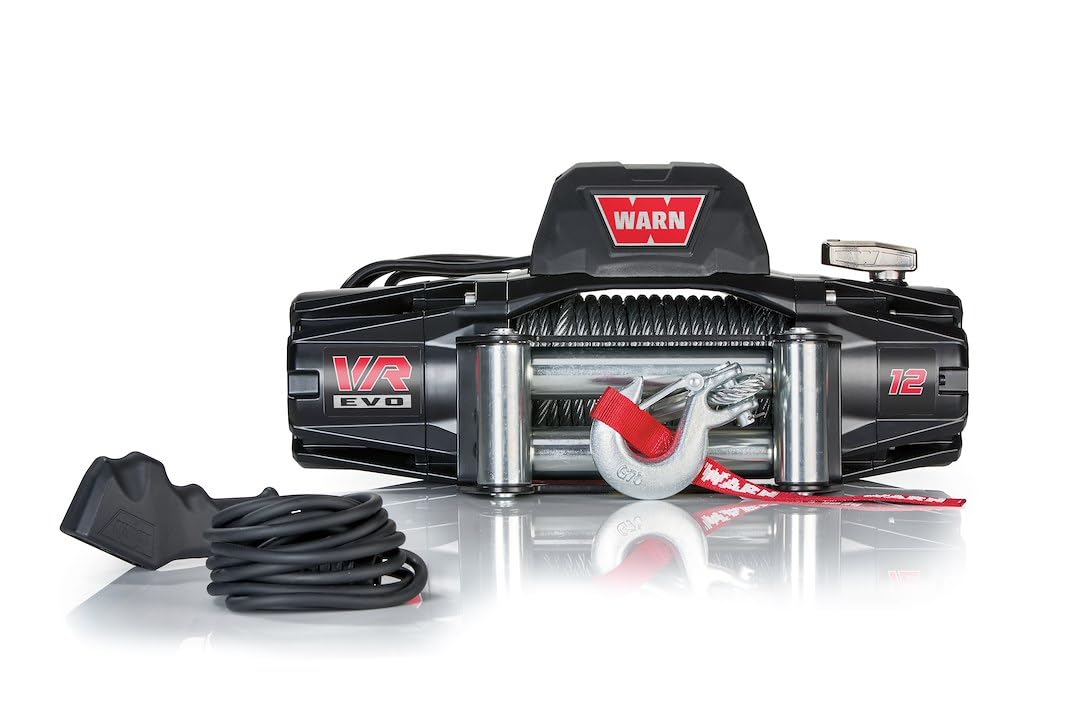
The 12,000-pound truck winch with an 85-foot steel cable and a legendary nameplate.
If your truck is a 3/4-ton or 1-ton rig, this is the winch built for it. The VR EVO 12 runs on 12 volts from your vehicle battery and delivers a 6-ton (12,000 lb) pulling capacity through 85 feet of 3/8-inch steel cable — a 2.4x longer reach than the manual puller above. The series-wound motor and planetary gear train give you faster line speed under load while drawing less current, which matters when you are winching uphill in the dark.
The build is the story here. It comes with IP68-rated waterproof construction, so mud and creek crossings do not kill it, plus an Albright contactor that owners call maximum reliability. The one-piece cast-aluminum tie-plate keeps everything rigid, and the control pack can be relocated for a low-profile install. It is designed, engineered, and tested in the USA, backed by a limited lifetime warranty on mechanical parts and 7 years on electrical components.
Longevity is the theme in the review pages — owners mention owning the previous version since 2011 and running it hard on a 15,000 lb trailer before it finally gave up. The same owner replaced the motor rather than the whole unit and had the new one installed in about an hour. At 88.8 pounds, it is a 3.7x heavier unit than the manual come-along, so you will need a solid bumper or mounting plate — the winch itself does not include one.
Why It Wins
- 6-ton capacity with a fast line speed under heavy load
- IP68 waterproofing survives real off-road conditions
- WARN reliability — owners run these for a decade-plus
Before You Buy
- Needs a compatible bumper or mounting plate, sold separately
- Wireless control earns mixed opinions from owners
Best for: serious off-roaders and large-frame rig owners who want a proven electric winch.
Think twice if: you are mounting to a small truck — this 88.8 lb unit demands a stout bumper.
3. Dutton-Lainson StrongArm SA12015AC
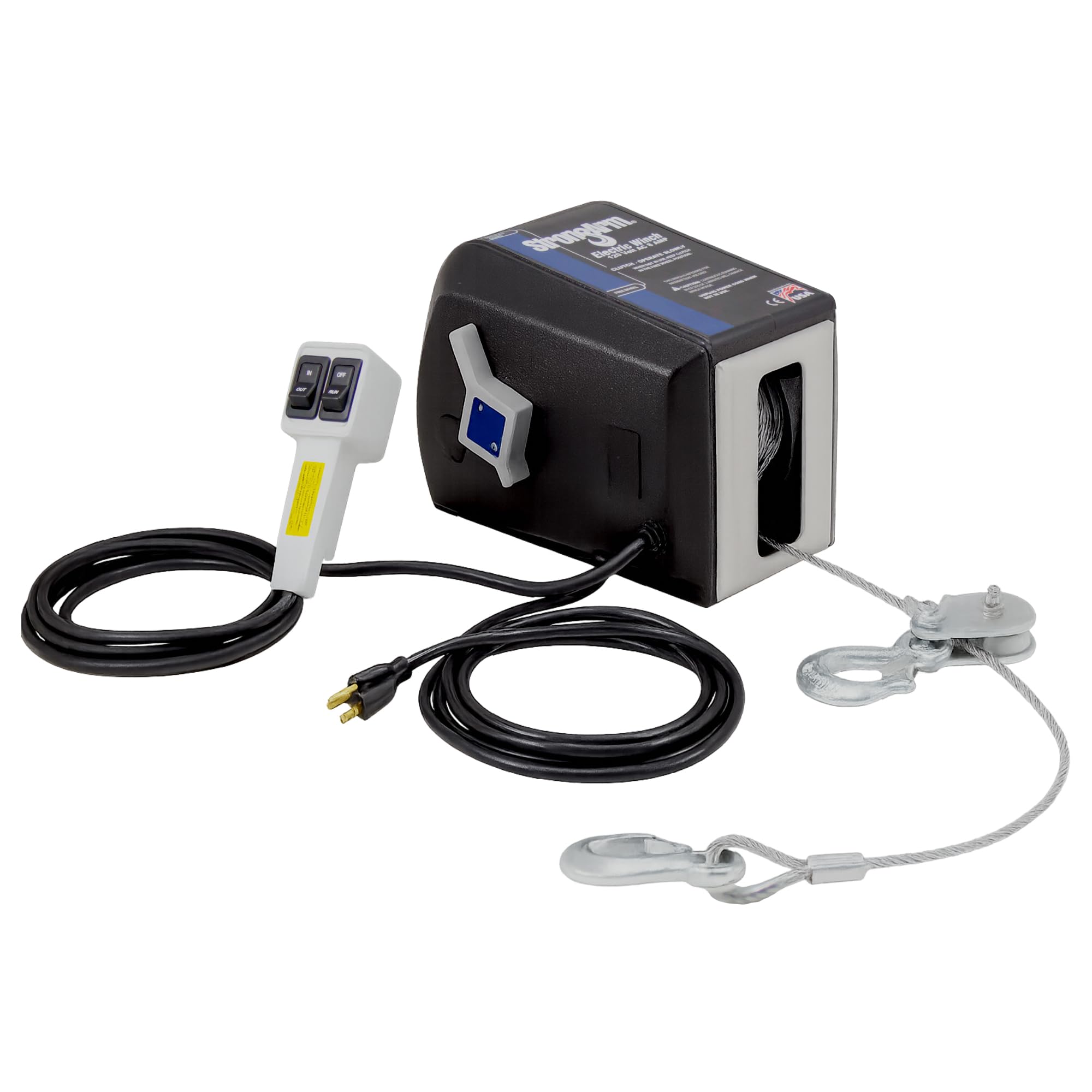
The plug-in puller that lives in your garage and never needs a truck battery.
This is the winch for fixed spots — boat trailers, shop cranes, dock lifts, and horizontal sliding doors. It runs on standard 120-volt AC power from any wall outlet, giving it a 10x voltage advantage over the 12-volt WARN above, which means it never drains a battery and delivers steady, repeatable pulls all day. The StrongArm offers a 2,700 lb single-line capacity and a 4,000 lb double-line capacity using 50 feet of 7/32-inch galvanized aircraft cable.
The control package is genuinely thoughtful. You get a dual-switch handheld remote on a 10-foot cord, a dynamic brake for smooth load control, and a precision clutch lever for easy cable removal. There is even an emergency crank handle so a power outage never strands you mid-pull. The automatic mechanical friction brake and controlled freewheeling clutch add a professional layer of safety, and the included pulley block with snap hook gives you the double-line rigging option right from the start.
Owners trust this unit for real work — pulling two motorcycles into a toy hauler without flinching, hauling a 60-foot dock and pontoon lift out of the lake, and dragging disabled cars. The recurring gripe is speed: it operates extremely slowly, and one owner notes the motor is a bit loud. A single owner reported the unit lasting only 2 years, a durability outlier even among the slow-operation complaints.
Built for fixed spots: the 120V power source makes it a permanent fixture in garages, boat slips, and shops — not a trail tool.
The pace to accept: it is slow and a little loud, but it gets the job done where a come-along would leave you exhausted.
Reach for this if: you need a stationary, battery-free winch for trailers, docks, or shop pulls.
Look elsewhere if: you need speed or trail-side portability — this unit is neither.
Understanding the Specs
Pulling Capacity
This is the rated force the winch can apply, usually stated in pounds or tons. A single-line rating assumes the cable runs straight from the drum to the load. A double-line setup reroutes the cable through a pulley block, effectively doubling the pulling force — that is why the StrongArm jumps from 2,700 lb single-line to 4,000 lb double-line.
Duty Cycle
A winch motor generates heat under load, so it needs rest between pulls. The StrongArm spells this out clearly: a 3-minute run time followed by a 15-minute cool-down. Ignoring that cycle overheats the motor and shortens its life. The WARN’s planetary gear train draws less current, which keeps heat down during hard pulls.
FAQ
What is the difference between a 12-volt and a 120-volt winch?
Will a 3-ton puller recover a full-size pickup truck?
What does double-line capacity mean?
How long does a WARN winch last?
Do I need a mounting plate for a truck winch?
Is steel cable or synthetic rope better for a winch?
Can I use a 120-volt winch outside?
How heavy is a full-size electric winch?
Final Thoughts: The Verdict
For most buyers with a serious truck, the usa made winches winner is the WARN VR EVO 12 because it pairs a 6-ton capacity with waterproof construction and a decade-plus reputation for reliability. If you want a portable, no-power tool for lighter rigging, grab the Wyeth 3 Ton Ratchet Puller. And for a fixed garage or boat-slip setup where a battery is not an option, the Dutton-Lainson StrongArm is the one to reach for.
How We Picked
We do not accept paid placement. Every pick is matched to a real buyer and a real use-case; we do not hands-on test units.
Sources & Methodology
Specifications: manufacturer listings and product documentation. Review insights: verified customer reviews, as of August 2026. Pricing: not shown on this page (it changes often); check the current price via the retailer link.
As an Amazon Associate, GoCarLife earns from qualifying purchases. This does not affect which products we feature.