
Our readers keep the lights on and the garage heater humming. As an Amazon Associate, I earn from qualifying purchases.
Specs are compiled from manufacturer listings and verified buyer reviews and can change over time — please confirm the key details on the product page before buying.
Keeping your engine cool in stop-and-go traffic depends on one simple question: how much air can a fan actually shove through your radiator? The number that settles that argument is CFM (cubic feet per minute) — the measure of raw airflow a fan pushes or pulls — and it is the first spec you should check before anything else. On top of that, you need to know whether the fan is set up as a “pusher” (mounted in front of the radiator) or a “puller” (mounted behind it), because a universal fan can often flip between the two, but the wiring and blade direction have to be reversed to do it right.
I’m Mo Maruf — the founder and writer behind GoCarLife. This guide is built by comparing the manufacturers’ published specifications and the patterns across verified customer reviews, so you get each pick’s real strengths and trade-offs instead of marketing spin.
We lined up seven universal 12V electric fans by airflow, noise, and build so you can match one to your project. Here are our picks for the best universal radiator fan for your ride and your budget.
Our Picks at a Glance
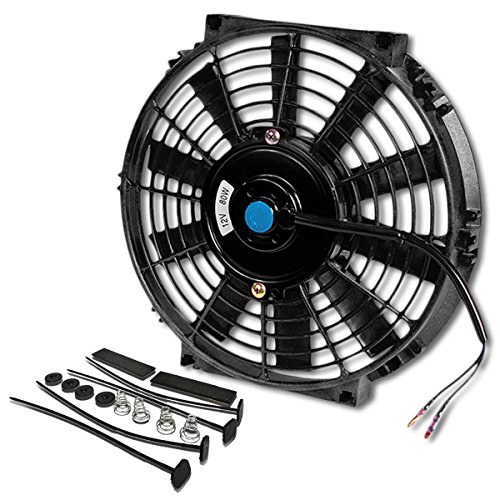

How To Choose The Best Universal Radiator Fan
Swapping a worn-out mechanical fan for an electric one, or adding a second fan to an overworked cooling system, is among the most effective upgrades you can make. Universal fans are designed to fit a huge range of vehicles, but that flexibility means you have to do a little homework to get the right one.
Size Matters: Measure Your Core First
Your radiator’s core — the metal section between the tanks — determines the fan size you can use. You practically need to put a tape measure on it before shopping. The fan’s diameter must cover most of the core without hitting the radiator hoses, pulleys, or the frame. A 10-inch fan fits compact radiators and tight engine bays, while 16-inch units are the standard for full-size trucks and performance builds. Buying a fan that is too large means you are cutting brackets and shroud plastic, which is extra work nobody wants.
Airflow (CFM) vs. Engine Demand
CFM is the amount of air the fan can move in one minute. A stock commuter engine running a single electric fan is generally fine with airflow in the 800–1200 CFM range, but a big-block V8 or a vehicle running heavy loads in summer heat wants more. That is why you will see ratings jump from 800 CFM to 1550 CFM or even 3000 CFM on larger, high-performance units. Bigger engines and harder driving conditions demand more airflow to shed heat, so the heavier your workload, the higher you should aim on this number.
Pusher or Puller: Know Your Mounting Spot
Universal fans ship as reversible, meaning they can work in either orientation. A “puller” mounts behind the radiator and pulls air through it toward the engine, which is generally the more efficient setup. A “pusher” mounts in front of the radiator and pushes air through from the outside. The catch with these universal kits is that reversing airflow isn’t just about flipping the fan over — you have to flip the blades around on the motor hub and reverse the polarity of the DC power wires. Skip either step and the fan will run backwards, moving almost no air.
Noise, Wiring, and the Little Stuff
Decibels (dB) measure how loud the fan is while running, and this is where cheaper fans often show their weakness. A 30 dB rating is whisper-quiet, while 50 dB is clearly audible — fine outside the car, but annoying if you plan to sit in the cab near a greenhouse fan. You also want to check the power connector type (3-pin or 4-pin) to make sure it matches your harness or relay kit, and remember that most universal fans ship without wiring diagrams. If you’re not comfortable tracing wires for a relay, factor that into your decision
Quick Comparison
| Model | Best For | Airflow (CFM) | Max Speed (RPM) | Noise (dB) | Amazon |
|---|---|---|---|---|---|
| DNA Motoring 10″★ Best Overall | Best Overall / Compact builds | 1730 | 2250 | 50 | Amazon |
| EVERESTWAY 10″ 80WBest Value | Best Value / Daily drivers | 800 | 2400 | 50 | Amazon |
| GESEXI 12″ 80W | Quietest operation | 800 | 2000 | 30 | Amazon |
| Auto Dynasty 16″ | Full-size trucks | 1550 | 2250 | 50 | Amazon |
| FSBCGT 2-Pack 12″ | Twin-fan setups | 1730 | 2250 | — | Amazon |
| A-Team Performance 16″ | High airflow + thermostat | 3000 | 2500 | 49 | Amazon |
| Mishimoto 16″ | Premium / Brand trust | 1850 | 1800 | — | Amazon |
In‑Depth Reviews
1. DNA Motoring 10 Inch High Performace Electric Cooling Slim Radiator Fan
Our pick — 4.5★ from 550+ verified ratings; the strongest balance of quality and price.
A 10-inch pocket rocket that shoves out big-block levels of airflow.
You are getting a 10-inch fan, but this one punches like a much bigger unit — its 1730 CFM airflow rating is over double that of the typical 10-inch universal fan, which usually lands around 800 CFM. That kind of airflow makes it a legitimate candidate for engine bays where space is tight but cooling demand is heavy, including ATVs and modified compacts where a 16-inch simply won’t fit. The slim housing design also buys you extra clearance if you’re planning future engine work.
The trade-off is a relatively loud 50 dB operating noise, which is fine at highway speed but noticeable at idle. One warning from the install side: because this is a universal fan, reversing it from a puller to a pusher requires flipping the blade around on the motor hub and swapping the DC power polarity — a step buyers report is easy to miss if you don’t read carefully. The kit includes zip-tie mounting tabs for a fast install, though the occasional unit has arrived short one mounting spike, so check the kit before you start.
Performance is what people rave about most when they write in, with airflow a close second. One common thread is how much air it moves relative to its size, and the fact that it runs quietly for that output.
Why it wins people over
- 1730 CFM airflow — over 2x a standard 800 CFM 10-inch fan
- Slim design boost engine bay clearance
- Durable lightweight plastic construction
- Zip-tie mounting tabs for quick installation
The honest trade-offs
- 50 dB — clearly audible at idle in a quiet garage
- Flip the blade and reverse the wires to switch from pull to push
- No printed instructions included in the box
the balance: If you need big airflow from a compact 10-inch frame — for an ATV, a swap, or a tight bay — this is the value-per-CFM champion.
Think twice if: You want a completely silent fan or a simple plug-and-play wiring harness; this one rewards a little mechanical patience.
2. EVERESTWAY 10 Inch Black Universal Electric Radiator Slim Fan 12V 80W
The budget-friendly 10-inch that delivers dependable airflow without the sticker shock.
This is the fans-for-the-rest-of-us pick: a 10-inch, 80W (watt) unit rated at 800 CFM and 2400 RPM — a full 600 RPM faster than the GESEXI 12-inch rated at the same airflow. For an entry-level universal fan, that speed helps it move a surprising amount of air through a radiator, which is why owners describe it as moving noticeably more air than its price suggests. It ships as a puller from the factory, but the curved-blade design is reversible: flip the blade and reverse the wires and it works as a pusher.
The quality feedback is overwhelmingly positive, with buyers using it on everything from a 1997 F150 with a 4.6L V8 to a mini excavator and a greenhouse. The recurring note is that it’s quiet and well-built — a few owners even call it quiet enough to use as an AC booster fan in traffic. The biggest con is documentation: do not expect installation instructions, which one owner summed up as “nothing google can’t fix.” At roughly 5-7 amps draw, pairing it with a temperature controller like a Hayden 3652 makes a simple standalone circuit for those who want automatic operation.
What wins people over is the combination of performance and build quality for the price. Durability gets slightly more mixed feedback, so treat it as a solid daily-driver fan rather than a race-spec unit.
What you get
- 800 CFM with a quick 2400 RPM spin
- Quiet high airflow in a well-built housing
- Easy install with a 3-pin wiring hookup
- Reversible push/pull blade design
What to watch
- No instructions in the box — bring a phone or a wiring diagram
- Slots are fine for mounting but you may want custom brackets for a clean fit
- Not ideal if you need a whisper-quiet indoor fan
Reach for it if: You want capable, quiet 10-inch airflow for a daily driver, a pickup, or even off-road equipment without spending premium money.
Look elsewhere if: You hate figuring out wiring without instructions — this fan expects you to know your way around a multimeter.
3. GESEXI 12 Inch Slim Fan Push Pull Electric Radiator Cooling Fan Universal High Performance 12V 80W

A silent 12-inch performer that is as happy in an attic as in an engine bay.
The headline spec here is 30 dB — a full 20 dB quieter than the DNA Motoring and EVERESTWAY fans, both of which run at 50 dB. That makes this the quietest fan in this lineup by a wide margin, which is exactly why owners are using it for everything from cooling a tractor’s AC to ventilating a shed off a solar panel. Its 800 CFM and 2000 RPM are modest on paper, but the noise level is the differentiator; it’s the same airflow as the EVERESTWAY but much calmer doing it.
Durability feedback trends more negative than the other picks, so this is best treated as a working fan for low-stress applications rather than a 24/7 race duty part. The 10-blade design runs smoothly, and it switches between pusher and puller by flipping the blade and swapping the power cord — with a specific reminder to apply anti-loosening glue to the fixed nut so it doesn’t back off when you reverse the blade. A couple of owners mention having to trim a little plastic at the corners to perfect the fit on their setup.
Reliability is what owners praise most, which is interesting given the durability reviews — the fans that work well keep working, and the 30 dB noise rating is a big part of the appeal. As owners put it, this one is a “perfect fit for a gable and ridge vent AC to DC motor conversion.”
The big wins
- 30 dB noise rating — easily the quietest pick here
- 10 blades for smooth, vibration-free rotation
- Reversible push/pull with simple mode switching
- Slim 2.5-inch profile fits tight areas
Honest limits
- 800 CFM is on the lower end for big V8 cooling
- Durability reviews are mixed compared to pricier units
- You may need to trim plastic corners for a perfect fit
Best for: Anyone who values near-silent operation — greenhouse, attic vent, tractor cab, or a commuter where fan drone dominates the cabin.
skip it if: You’re cooling a heavy-duty truck engine and need high CFM; this is about quiet airflow, not max output.
4. Auto Dynasty 16 inch Universal 12V Electric Radiator Cooling Fan Kit
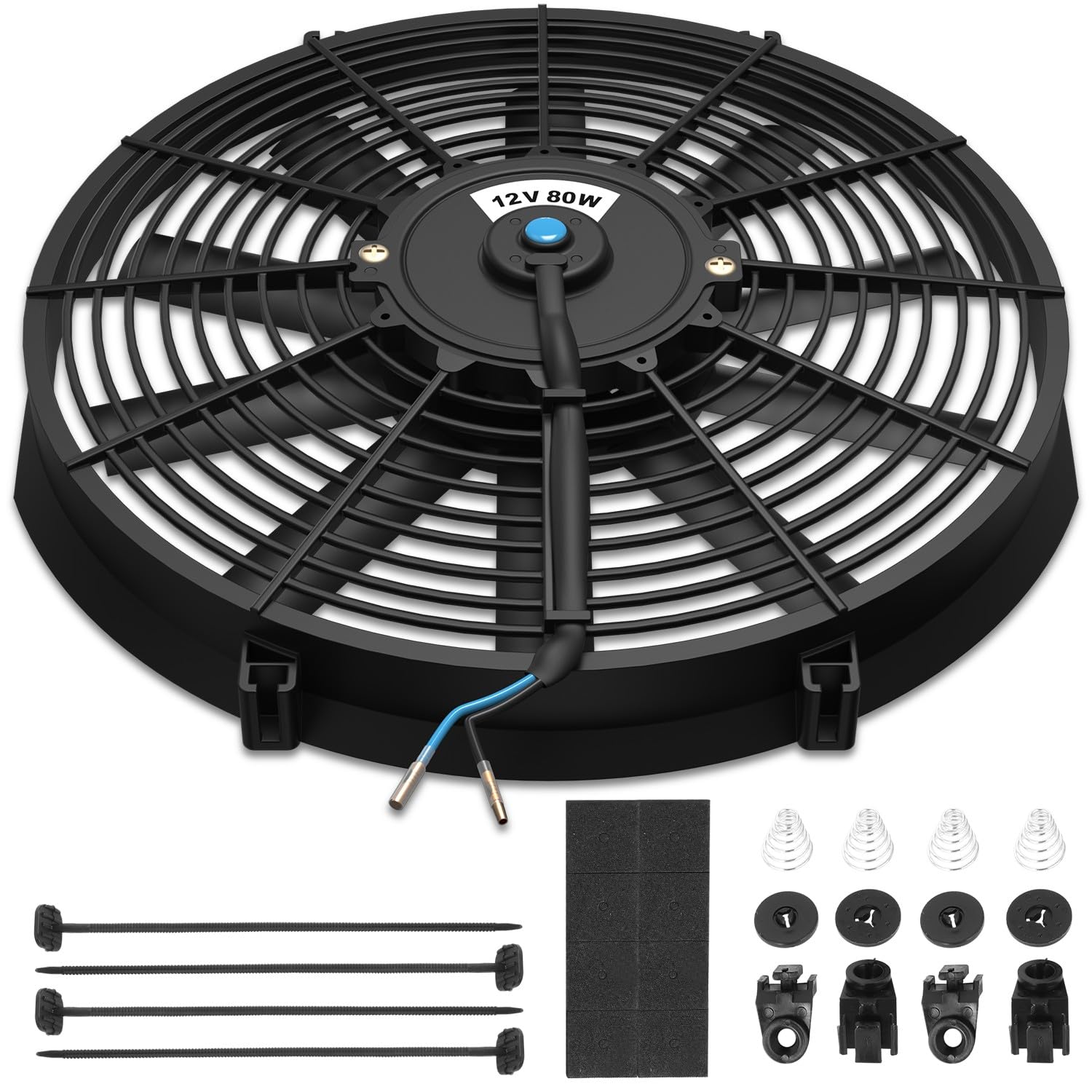
A full-size 16-inch that breathes hard enough to cool an entire engine bay.
Moving up to a 16-inch frame gets you the surface area to actually cover a full-size radiator, and this Auto Dynasty kit delivers 1550 CFM of airflow to match — short of the DNA Motoring 10-inch’s 1730 CFM number, but spread across a much larger core. It spins at 2250 RPM and draws power through a standard 4-pin connector, with a sealed motor and ABS plastic housing designed for a long service life. The included mounting tabs allow a zip-tie install, and it’s marketed as a direct bolt-on OE replacement.
The wiring is where this fan demands your attention. There’s no wiring diagram in the box, and owners mention that figuring out which wire goes where takes some detective work — especially if you want to reverse it from a puller to a pusher, which requires both flipping the cupped blades and reversing polarity. One owner who runs a classic MGB found the dimensions accurate and appreciated that they could keep the stock pusher fan and add this as a pull, but noted the zip ties are one-use only.
Performance gets the most praise here, with quality a close second — most owners are happy with how much air it moves and how well-built it feels. Notes on noise are mixed: some find it acceptable, others say it’s a bit loud at full tilt.
What stands out
- 1550 CFM airflow across a true 16-inch span
- Sealed motor and ABS housing for longevity
- Direct bolt-on fit for many factory setups
- 4-pin connector with flexible push/pull wiring
What to prepare for
- No wiring diagram included — expect to trace wires yourself
- Noise level is mixed, so expect some fan noise at speed
- Zip ties are one-use if you plan to reverse the blades later
The verdict: A solid, powerful 16-inch option for truck and classic-car owners who want full-core coverage and aren’t scared of a wiring diagram — or their phone.
The caveat: If you want a truly quiet fan or a plug-and-play harness, this one will test your patience slightly more than the GESEXI.
5. FSBCGT 2PCS 12 Inch Universal Slim Push Pull Electric Radiator Cooling Fan

Two 12-inch fans that work as a matched pair for a serious cooling shroud.
Sometimes one fan isn’t enough, and this 2-pack is the answer for builders running a dual-fan shroud. Each 12-inch unit is rated for 1730 CFM — exactly matching the DNA Motoring 10-inch single fan’s airflow, but across two fans you get twice the total volume for a wide-core radiator. At 2250 RPM with 10 blades each, they’re built for honest volume, and the wiring instructions are included in the product images, which is a welcome change from the “no instructions” fans above.
The mixed feedback centers on noise and vibration — several people report these run noticeably louder than expected, and an occasional unit has a whine or clicking from the start. One buyer who used four of them in a variable-speed HVAC system found that a misaligned brush on one unit caused clicking, but after repositioning it, the fan ran fine for two years near continuously. That’s the reliability story in miniature: good value and strong cooling, but check each unit on arrival.
Quality is what owners praise most, with cooling performance second — many report their AC blows noticeably cooler after the install. The 4-pin connector and included mounting kit make it a straightforward job, and the slim profile (2.5-inch thickness) fits tight engine bays.
Why buy the pair
- Each fan pushes 1730 CFM — 3460 CFM total across two
- Slim 2.5-inch design for cramped shroud clearance
- Instructions included in the product photos
- Heat and corrosion resistant materials
Read this before buying
- Noise gets mixed reviews — some say it’s very loud
- Vibration issues appear in an occasional unit
- Inspect the brushes on arrival for a smooth start
Reach for this if: You’re building a dual-fan shroud for a big radiator and want maximum total airflow from a two-fan setup.
Look elsewhere if: You need dead-silent operation or want zero risk of a QC hiccup — this pack trades a little polish for a lot of volume.
6. A-Team Performance 16″ Electric Radiator Cooling Fan Kit

The 16-inch powerhouse that brings a factory-style thermostat to the party.
The headline number here is a massive 3000 CFM — nearly double the DNA Motoring 10-inch’s 1730 CFM and the highest airflow rating in this lineup. That puts it squarely in performance-truck and V8 territory, where you need to evacuate serious heat from the engine bay. It comes with a built-in thermostat that turns the fan on at 200°F and off at 180°F, meaning it behaves like a factory unit rather than a constantly-running accessory. The 10 S-curved blades and sealed ball bearings are designed to run smoothly at up to 2500 RPM.
That said, 3000 CFM comes with real compromises. At 49 dB it’s not a quiet fan, and installation feedback is genuinely mixed — while some find it easy, others report missing instructions in the box and a temp sensor that doesn’t play nice with Classic Instruments gauges. One owner running an S10 prefers it for keeping the truck consistently at 185°F, and another replaced a five-year-old unit with this one because the specs matched their existing setup exactly.
Performance is what gets the lion’s share of the praise here, with quality right behind it. The biggest reported limitation is durability, which trends more negative than other fans in this guide, so consider it a high-output tool rather than a set-and-forget part.
The standout specs
- 3000 CFM — the highest airflow in this lineup by far
- Thermostat cycles on at 200°F and off at 180°F automatically
- 10 S-curved blades for smooth and quiet operation
- Sealed ball bearings support long high-performance use
Reality check
- 49 dB — a noticeable hum at full speed
- Missing-instructions reports are common enough to matter
- Temp sensor may not work with all aftermarket gauges
Best for: Performance truck owners and V8 builders who want a complete kit — fan, thermostat, mounting — that can pull serious heat and run itself.
Consider the alternative: If you want a quieter, simpler 16-inch unit without the thermostat wiring, the Auto Dynasty is the lower-maintenance pick.
7. Mishimoto MMFAN-16 Slim Electric Radiator Fan, 16″ Universal Fit

A respected name and a space-saving 2.87-inch profile, backed by a lifetime warranty.
Mishimoto is a known quantity in the cooling world, and this fan is the premium pick for anyone who values brand trust and a safety net. It moves a solid 1850 CFM at a relaxed 1800 RPM — notably slower than the EVERESTWAY 10-inch’s 2400 RPM but pushing more air thanks to its larger 16-inch blade design. The slim profile is the real standout here: at just 2.87 inches thick overall, it’s engineered to fit where a stock fan won’t. It comes with a Mishimoto Lifetime Warranty, which puts the others in this list on notice.
It is easily reversible for push or pull use, and buyers have installed it in everything from a 2002 BMW Z3 to an LS-swapped project, where one owner says it “sounds like a supercharger” and keeps the engine very cool. The included parts are basic — the fan, four mounting tabs, and the warranty — but the two-prong clip plug means you’ll be doing your own wiring regardless, and one buyer found the plastic mounting brackets missing from the box despite the description.
Performance is what owners praise most, with airflow right behind it. Fit is also a strong point, with several people noting it mounts to their shroud perfectly without modification.
What you’re paying for
- 1850 CFM airflow from a respected cooling brand
- Ultra-slim 2.87-inch thickness for tight clearance
- Mishimoto Lifetime Warranty included
- Universal clip mounting tabs fit most shrouds
Worth knowing
- Lifetime warranty doesn’t help if brackets are missing on arrival — check the box
- Two-prong clip connector means custom wiring regardless
- 1850 CFM trails the A-Team’s 3000 CFM for max-output builds
Best for: Enthusiasts who want a slim, trusted, brand-name fan with a warranty solid enough that you buy it once and never worry again.
Think twice if: You need maximum airflow for a huge V8 — the A-Team fan moves significantly more air, just without the badge and warranty.
Understanding the Specs
CFM: The Airflow Number That Matters
CFM stands for “cubic feet per minute,” and it tells you exactly how much air the fan can move in one minute of running. It’s the most important spec on a radiator fan because it determines whether your engine stays cool in traffic or creeps toward the red. A stock commuter can get away with 800 CFM, but a truck or performance build wants 1500 CFM or more. The DNA Motoring 10-inch moves 1730 CFM — more than double the EVERESTWAY’s 800 CFM — which is exactly why its size is less important than the number on paper.
RPM and Noise: Speed vs. Volume
RPM (revolutions per minute) tells you how fast the blades spin, and it often trades off against noise. The EVERESTWAY spins at 2400 RPM and runs at 50 dB, while the GESEXI spins slower at 2000 RPM but drops to a whisper-quiet 30 dB — a 20 dB difference that makes the GESEXI dramatically more pleasant in a cab or greenhouse. Higher RPM usually means more airflow from the same blade size, but also more wind noise. For most people, the balance is a fan that hits their CFM target without burying the sound of the engine.
FAQ
What is the difference between a pusher and a puller radiator fan?
How do I know which size radiator fan I need?
Can I use a 12V universal radiator fan outside of a car?
Do universal radiator fans come with wiring instructions?
How many CFM do I need for my engine?
Is a 4-pin or 3-pin connector better for a radiator fan?
What does a radiator fan’s decibel (dB) rating really mean?
Can I replace my mechanical fan with an electric universal fan?
How do I reverse a universal radiator fan from puller to pusher?
Is the Mishimoto radiator fan worth the higher price?
Final Thoughts: The Verdict
If you want the best all-around universal radiator fan, the DNA Motoring 10-inch is the one to beat — its 1730 CFM airflow in a 10-inch frame is the most impressive performance-per-inch in this lineup, and it holds a strong 4.5-star rating across hundreds of owners. If you want a quieter option for a commuter, greenhouse, or attic, the GESEXI 12-inch delivers 800 CFM at a whisper-quiet 30 dB. And for full-size trucks and performance V8s that need maximum airflow, the A-Team 16-inch with its 3000 CFM and integrated thermostat is the high-output pick that runs itself.
How We Picked
We do not accept paid placement. Every pick is matched to a real buyer and a real use-case; we do not hands-on test units.
Sources & Methodology
Specifications: manufacturer listings and product documentation. Review insights: verified customer reviews, as of August 2026. Pricing: not shown on this page (it changes often); check the current price via the retailer link.
As an Amazon Associate, GoCarLife earns from qualifying purchases. This does not affect which products we feature.