
Our readers keep the lights on and the garage heater humming. As an Amazon Associate, I earn from qualifying purchases.
Specs are compiled from manufacturer listings and verified buyer reviews and can change over time — please confirm the key details on the product page before buying.
Staring down a rust-frozen wheel hub can turn a weekend brake job into a two-day fight with a slide hammer. A universal hub puller converts a stubborn tapered axle into a component that pops free with a few controlled turns or hammer strikes. This guide sorts through the heavy hitters, from the OTC 7394 to budget-friendly kits, so you reach for the right tool the moment a hub refuses to move.
I’m Mo Maruf — the founder and writer behind GoCarLife. This guide is built by comparing the manufacturers’ published specifications and the patterns across verified customer reviews, so you get each pick’s real strengths and trade-offs instead of marketing spin.
Expect honest insight into the jaw capacities and build quality that make a universal hub puller worth owning before you tighten your wrench on the wrong one.
Our Picks at a Glance


How To Choose The Best Universal Hub Puller
The first decision is whether you’re dealing with a tapered axle shaft hub or a modern bolt-on axle hub. A sliding-arm puller grips the hub flange from the outside and is the classic fix for tapered axles and stuck brake drums, while a plate-style buster bolts to the lug studs and pushes the hub off from behind. Matching the tool type to your vehicle prevents forcing a square peg into a round hole.
Check the Bolt Circle and Jaw Capacity
Look for the maximum reach of the arms or plate, often measured in inches across the bolt circle. A puller with a 7-inch jaw capacity covers most classic Jeeps and trucks, but a model reaching 7-1/2 or 7.6 inches gives you breathing room on larger hubs. If your vehicle has a 6 or 8-lug pattern, confirm the tool’s stated bolt circle covers that spread before you commit.
Judge the Build by Threads and Steel
The forcing screw is the heart of any puller, so its threads must survive brutal loads. Heat-treated steel and forged construction signal a tool that handles the force of a 15-ton hydraulic puller’s failure. A striking wrench designed to be hammered, combined with a screw that accepts an impact gun, covers both schools of removal. Weight is a fair proxy for steel thickness; a heavier puller feels less likely to give way.
Quick Comparison
| Model | Best For | Jaw Capacity | Max Bolt Circle | Weight | Amazon |
|---|---|---|---|---|---|
| OTC 7394★ Best Overall | Professional-grade tapered axles & drums | 7 inches | 7-1/2 inches | 9.2 pounds | Amazon |
| JY PERFORMANCE KitBest Value | Bolt-on hubs on cars & light trucks | — | 5, 6 & 8 lug | 14 pounds | Amazon |
| Sunluway 7394Budget-Friendly | Budget tapered-axle removal | — | 7-1/2 inches | 9.99 pounds | Amazon |
| Lupar Buster Kit | Rusty 5, 6 & 8-lug bolt hubs | — | 5, 6 & 8 lug | 13.99 pounds | Amazon |
| Orion Motor Tech | Versatility in a molded travel case | — | 7.6 inches | 12.56 pounds | Amazon |
| Orion Motor Tech Kit | Bolt-on hubs on rust-belt cars & trucks | — | 5, 6 & 8 lug | — | Amazon |
| TruePower 20-2029 | Classic jeeps & vintage drums | — | 7-1/2 inches | 10.14 pounds | Amazon |
| Astro 78830 | Impact-wrench torque on rotors & drums | 14 inches spread | — | 21 pounds | Amazon |
In‑Depth Reviews
1. OTC 7394 Universal Hub Puller Tool with Wrench
Our pick — over 4.5★ from 350+ verified ratings; the strongest balance of quality and price.
The shop-grade force that snaps frozen tapered axles free by hand.
When a 15-ton hydraulic puller gives up, this is the next tool the pros reach for. The all-alloy steel construction and 7-inch jaw capacity refuse to flex under load, and the 360-degree adjustable legs let you position the puller arms to grip a hub without distorting the wheel lugs. An owner who couldn’t budge a hub with a 15-ton setup watched this tool break it free.
The 7-1/2 inch maximum bolt circle clears most classic and modern tapered setups, while the included striking wrench and puller screw cover both hammer and wrench techniques. Real-world tests show it shelling off 68 Jeep hubs in seconds with an impact, and pulling a 16-year-old Corvette axle that had snapped a pricier Kent Moore puller. It comes in at 9.2 pounds, lighter than the 14-pound JY PERFORMANCE kit above it would suggest, but the forged build makes every ounce count.
Even with the higher price, buyers repeatedly call it worth the money because it saves axles and fingers. The only recurring advice is to grease the screw threads before each use, a small ritual that keeps the threads from stripping under extreme force.
What Wins People Over
- Functionality is the top praise, with over 65 owners highlighting how well it works.
- Heavy-duty alloy steel shrugs off jobs that break lesser pullers.
- Built-in striking wrench and puller screw offer two removal methods.
Honest Trade-offs
- Requires an extra arm (sold separately) to pull 4-lug hubs.
- Premium price puts it in the high tier for home mechanics.
- Threads demand greasing before heavy use.
The shop pick: For anyone who works on tapered axles, classic Jeeps, or brake drums regularly, this is the last hub puller you will need to buy.
Think twice if: Your driveway sees only modern bolt-on hubs, where a plate-style buster like the Orion kit does the job for less.
2. JY PERFORMANCE Universal Wheel Bearing Hub Removal Tool Kit
The 14-pound buster that knocks bolt-on hubs loose with a sledge.
If your vehicle runs 5, 6, or 8-lug bolt-on hubs, this kit treats them all with the same heavy-handed respect. The heavy-duty steel construction, reinforced by 3 extra plates, takes a beating that would bend a lesser tool, and the design covers a wide nut range from 1/2-20 up through M14*1.5 flange. Buyers report a 2017 Buick Enclave bearing letting go in 2 hits from a 5lb hammer, and a Hyundai minivan surrendering in 5 strikes from an 8lb sledge without the tool bending.
At 14 pounds, this is the heaviest buster-style kit, and you feel it in your toolbox. Durability draws mixed reactions, with some owners praising it while others report weld failures under extreme force. The efficiency is real, though, and the verdict is that it earns its space in any DIY garage that touches modern cars.
Practical tips from the field: hit the studs with penetrant first, support the suspension so the force transfers cleanly, and keep a 3-legged puller handy for CV joints. The rust-resistant painted finish keeps things neat between jobs, and the ergonomic layout stores flat in a drawer.
Owner verdict: The tool works as a 14-pound persuasion device — what wins people over is how effectively it functions across all lug patterns, and at this price it feels like a steal.
The catch: A few units make it to buyers with weak welds, so inspect the joints before your first sledge swing.
Reach for this if: You do your own bearings on bolt-on axle hubs and want one kit that covers 5, 6, and 8-lug patterns while staying affordable.
Look elsewhere if: You mostly wrench on classic tapered axles where a sliding-arm puller, not a buster, is the right tool.
3. Sunluway Universal 7394 Hub Puller Brake Drum Puller
The entry-price clone that matches the OTC bolt circle on paper.
Priced for the occasional DIYer, this 7394-style puller brings the same adjustable sliding legs, 7-1/2 inch maximum bolt circle, and striking wrench as the pro units. The heat-treated steel and 1-inch drive screw claim up to 20 tons of force, which sounds impressive until you read the field reports. One owner on a 1983 CJ7 found it hard to set up solo but watched it pull the hub free using a 1/2-inch drive in a 1-1/8 socket.
The honest caveat is durability, which earns mixed feedback and is the most-discussed aspect here. A single owner broke it on the first use against a hub that demanded more force, and a 1958 drum that had sat for 40 years took “quite the time” but eventually released without snapping anything. At 9.99 pounds it matches the class weight, but the assembly quality sits a clear tier below the OTC, with one buyer noting issues threading the rod together.
This is the classic case of getting what you pay for. It works and saves money for a single vintage brake drum, but the pricier tools survive a career of seized hubs.
Functionality first: Owners confirm it handles the classic tapered-axle jobs it was designed for, like pulling drums on a 1983 CJ7.
Who it isn’t for: Anyone facing a heavily corroded drum that’s been seated for decades, where the alloy lets go instead of freeing the part.
Best if: You need a one-time puller for a single stuck drum or tapered hub and want to keep the cash in your pocket.
skip it if: You plan to make hub pulling a recurring job, where the OTC’s forged reliability justifies the jump in price.
4. Lupar Wheel Bearing Hub Removal Tools Kit

The salt-belt savior that spares your lug nuts, hub shocker included.
For anyone in the Northeast or any road-salt zone, this kit is built around one promise: a rusty 10-year-old bearing hub coming out in 4 hits. The reinforced hub shocker is engineered to absorb repeated hammer strikes, and the kit ships with its own nuts and bolts so you spare your factory lug nuts during the fight. The anti-corrosion finish holds up to the moisture that causes the problem in the first place.
The 13.99-pound mass and precision design aim to keep the axle shaft and steering knuckle safe while the bearing gives way. A mechanic noted the tool “scratched and dented” on a single rusty extraction but stayed “completely usable,” and at this price, owners frame it as a small investment against garage quotes in the – range. The recurring negative is that the paint sheds easily, and one buyer found the included nuts stripped within 3 hits.
It handles the toughest bolt-on hubs, though an 11-year-old salty car proved too much for the flange.
The Things Owners Rave About
- Functionality is the top praise, with 19 owners confirming it does the job.
- Included nuts and bolts spare your lug nuts during removal.
- Reinforced shocker handles heavy hammer strikes without giving out.
Fair Caveats
- Paint and finish chip easily, leaving bare metal spots.
- Hub removal success is mixed on deeply corroded cars.
- Included hardware can strip under repeated impacts.
Grab it for: A driveway mechanic facing rusty 5, 6, or 8-lug hubs who wants a cheap insurance policy before paying shop rates.
Not for: Perfectionists who want a tool that still looks new after the first salty fight.
5. Orion Motor Tech OMT Universal Hub Puller Tool

The organized all-rounder that pops drums in half a turn.
Some pullers arrive as loose metal; this one shows up in a molded case with the puller wrench, three legs, forcing screw, and center hub all accounted for. The adjustable legs stretch to a 7.6-inch maximum bolt circle, edging out the OTC’s 7-1/2 inches for extra clearance, and the precision-threaded hex-head screw turns smoothly without slipping. An owner who fought a brake drum for 2 days with a different puller watched this one pop it off “about half a turn” later.
Quality is the most-discussed aspect here, and it holds up: the corrosion-resistant finish and heavy-duty steel earned praise for their “awesome” build. A 1980 Jeep CJ5 axle that resisted slide hammers gave way, and a 1946 CJ-2A drum came off cleanly, all with the security of a storage case that keeps the parts from scattering in the truck bed. It weighs in at 12.56 pounds, solid enough for serious force without being a back-breaker to haul around.
The only field note is a fit quirk on some 5-bolt patterns, which owners solve by repositioning the legs, but the tool’s universal design keeps it working regardless. It is a complete, tidy solution for the home mechanic who covers multiple vehicles.
Quality that shows: The finish and fit draw the most praise, and the case makes it the easiest pick to live with between jobs.
The quirk: Some 5-lug patterns need a bit of leg repositioning before the arms bite cleanly.
Best for: The mobile mechanic or hobbyist who wants a universal tapered-hub puller with a proper home for every part.
Pass if: You only turn wrenches on modern bolt-on hubs, where a buster plate serves you better.
6. Orion Motor Tech OMT Wheel Hub Removal Tool Kit
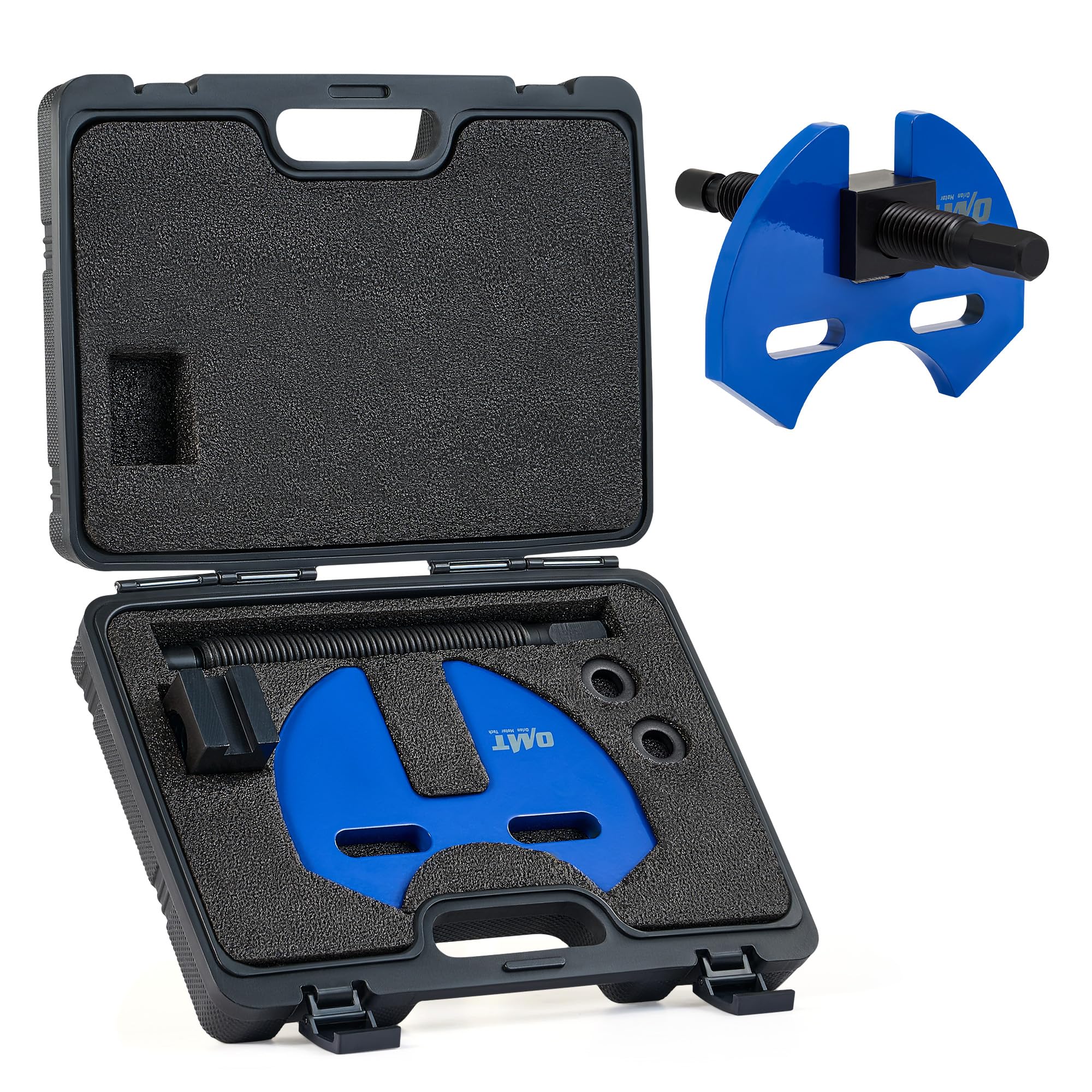
The heat-treated buster that spins rust-belt hubs off with an impact.
Engineered from AISI 1045 and 40Cr steel, this kit is the answer for the modern bolt-on hub that laughs at slide hammers. The heat-treated forcing screw and screw assembly deliver the durability for repeated impact-wrench abuse, and the included remover plate, forcing screw, two washers, and carrying case form a complete package. A rust-belt FWD car with 15 years and 180k miles of corrosion popped its front hubs off easily, rotating each 180 degrees before letting go.
The kit’s compact blow-molded case keeps everything arranged neatly, and the rust-resistant finish holds up where cheaper paint flakes off. Owners mention it handles 5-lug patterns perfectly by default, and a bent dust-shield rim is the only complaint on smaller subcompact hubs like a Subaru Crosstrek, which one buyer solved with a simple spacer. The 1-year warranty covers the occasional manufacturing defect.
It pulls Subaru rear wheel bearings “no problem” and collapses calipers evenly, making it a versatile addition to the garage. For bolt-on hub work, this is the kit that makes the job feel quick and safe.
Engineered strength: The 1045 steel and heat-treated screw shrug off the repeated impacts that strip lesser threads.
Watch for: The plate’s size can interfere with the dust shield on very small hubs, so check your vehicle’s hub dimensions first.
Get this one if: You work on modern cars and trucks with bolt-on hubs and want impact-ready force without paying shop rates.
Skip if: Your fleet is all classic tapered axles, which need the sliding-arm style instead.
7. TruePower 20-2029 Universal Hub Puller

The budget-tier classic that beats multi-hundred-dollar shop tools.
Drop-forged alloy steel gives this puller the strength to handle jobs that make cheaper tools snap, and the adjustable sliding arms reach a 7-1/2 inch diameter bolt circle without distorting wheel lugs. It is the tool that pulled a 1956 Willys CJ5’s frozen hubs free, and an owner put it to work on a rear axle torqued at over 150 foot-pounds, declaring it worked “just like the multi-hundred dollar tool.” The included striking wrench and puller screw round out the kit.
At 10.14 pounds, it sits in the middle of the weight range but carries the confidence of a forged build. A 1953 Chrysler Mopar brake drum let go after about 60 blows from a 3lb hammer, and a rust-frozen drum on a 1970 VW bus surrendered to a 5-foot cheater bar without the tool failing. The most-discussed durability is mixed, with a rare report of breakage on first use, but the overwhelming pattern is one of heavy-duty reliability.
This is the smart-buyer’s alternative to the OTC for classic and vintage work, delivering similar capability without the badge tax. It is a good tool that skips the Snap-on price tag entirely.
Why It Wins Praise
- Functionality is the top aspect, with over 90 owners confirming it gets the job done.
- Drop-forged alloy steel stands up to 5-foot cheater bars.
- Adjustable legs fit classic 5×5.5 lug patterns cleanly.
The Honest Gripes
- Thread durability is the most-discussed negative, so grease before use.
- Ease of use earns mixed reviews from those without a cheater bar.
- The bare metal finish is functional but not pretty.
Standout pick for: Vintage Jeep, Mopar, and VW owners who want professional capability without the professional price tag.
Not the pick for: Bolt-on hub work on modern cars, where a plate-style buster is faster.
8. Astro Pneumatic Tool 78830 Heavy Duty Hub Drum and Rotor Puller Kit

The 21-pound impact-driven brute that pulls with 8.5 tons of force.
This is the top-tier solution for the worst-case scenario: rotors and drums that resist heat, penetrating oil, and a sledgehammer. The forged design is rated for 8.5 tons, built from the same alloy used in Astro’s famous ball joint presses, and it pairs with an impact wrench to rip hubs free in minutes. The three included hub adapters cover most sizes, and the arms spread up to 14 inches wide for big truck components.
Owners pulled stuck 14-inch rotors off a 2014 F-150 4×4 and an entire bolt-in bearing from an Audi A6 Quattro in one shot, where cheaper methods failed. The raised stops on the arms let you wrap a ratchet strap (not included) around particularly stubborn jobs, a trick the review pages say is essential for the toughest pulls. The 1-year warranty and heavy-duty build justify the premium price for anyone doing serious rotor work.
The learning curve is real, with the first attempts needing a strap to keep the arms seated and an impact socket to drive the screw. The case arrived cracked in shipping for a few buyers, and the instructions have a backward illustration, but the tool itself is described as “well built” and “worth every penny.”
The force multiplier: For car and truck owners facing seized rotors, this tool pays for itself in a single brake job versus shop labor.
Expect a setup curve: Plan on a ratchet strap and an impact gun, and read past the confusing manual.
Pick this up for: Professional or serious DIY use on rusted rotors, drums, and stubborn bolt-in bearings where nothing else works.
Pass it by if: Your hubs come free with a simple puller, because 21 pounds of forged steel is overkill for light duty.
Understanding the Specs
Bolt Circle and Jaw Capacity
The key spec is the maximum distance across the wheel studs the tool can grip, measured in inches. A 7-inch jaw capacity fits most classic vehicles, while a 7-1/2 or 7.6-inch circle opens the door to larger truck hubs. For buster-style kits, the lug count matters more, so look for explicit 5, 6, or 8-lug compatibility.
Forcing Screw and Drive Method
The forcing screw is the part that converts your effort into pulling force. A heat-treated screw resists stripping under extreme load, and a hex head lets you drive it with an impact wrench for faster removal. A striking wrench, designed to be hit with a hammer, is the alternative for a more controlled, gradual pull.
FAQ
What is the difference between a sliding-arm puller and a hub buster?
Will a universal hub puller fit my 6 or 8-lug truck?
How do I keep the forcing screw threads from stripping?
Can I use these pullers with an impact wrench?
Is a heavier hub puller always better?
What safety steps should I take before pulling a hub?
How is a hub puller different from a gear puller?
Which puller type works for a tapered axle shaft hub?
Final Thoughts: The Verdict
If you want one dependable pick, the universal hub puller winner is the OTC 7394 because nothing else matches its forged reliability and shop-grade reputation for breaking frozen tapered axles free. If you work on modern bolt-on hubs, grab the JY PERFORMANCE Kit for its budget-friendly coverage of 5, 6, and 8-lug patterns. And for seized rotors and drums that defeat everything else, the Astro 78830 is the one to reach for, turning an impact wrench into an 8.5-ton pulling machine.
How We Picked
We do not accept paid placement. Every pick is matched to a real buyer and a real use-case; we do not hands-on test units.
Sources & Methodology
Specifications: manufacturer listings and product documentation. Review insights: verified customer reviews, as of August 2026. Pricing: not shown on this page (it changes often); check the current price via the retailer link.
As an Amazon Associate, GoCarLife earns from qualifying purchases. This does not affect which products we feature.