
Our readers keep the lights on and the garage heater humming. As an Amazon Associate, I earn from qualifying purchases.
Specs are compiled from manufacturer listings and verified buyer reviews and can change over time — please confirm the key details on the product page before buying.
If your fuel tank can’t breathe, it will either build pressure and push fumes out, or pull a vacuum and starve your engine. A vent valve solves both problems — and the right one also snaps shut if your rig ends up on its roof. Most tanks need a specific thread size or hose barb, so this guide focuses on universal options that fit the widest range of builds.
I’m Mo Maruf — the founder and writer behind GoCarLife. This guide is built by comparing the manufacturers’ published specifications and the patterns across verified customer reviews, so you get each pick’s real strengths and trade-offs instead of marketing spin.
When a rollover happens, the difference between a damaged engine and a fire is often just a small mechanical ball inside a vent. This roundup of the best universal fuel tank vent valve choices focuses on check-ball reliability, thread compatibility, and real-world flow for street and off-road builds.
Our Picks at a Glance

How To Choose The Best Universal Fuel Tank Vent Valve
Every tank vent does the same two jobs: it lets air move in and out as fuel level changes, and it blocks liquid fuel from escaping in a rollover. The key differences are the connection type (thread or hose barb) and the flow rate under hard acceleration.
Threads versus hose barbs
Tanks with a welded bung need a threaded valve, usually 1/2″ NPT or AN flare. Tanks with an existing vent line need a hose barb, most commonly 5/16″ or 5/8″ inside diameter. Measure your connection point before ordering, because these two styles are not interchangeable without adapters.
The check ball is the safety feature
Inside a rollover valve sits a small ball that rolls against a seat when the vehicle tips. That ball seals the vent tube to stop fuel from pouring out in a rollover. Without that internal ball, the valve is only a breather, not a safety device—confirm the listing mentions a rollover check ball before relying on it in a crash.
Mounting angle changes everything
A check ball only seals if it can fall into its seat. Most of these valves must be mounted vertically, with the ball in the bottom fitting, so gravity seats it. A 90-degree bracket can interfere with the valve’s function if it forces the valve off vertical.
Quick Comparison
| Model | Best For | Connection | Hose Fit | Material | Amazon |
|---|---|---|---|---|---|
| Podavelle 6AN Rollover Valve★ Best Overall | Fuel cells & boosted builds | 6AN flare (9/16-18 UNF) | — | 6061-T6 Aluminum | Amazon |
| Alsoyixia Remote Mount (2-Pack)Best Value | Relocated tanks & long vent lines | 5/16″ hose barb | 0.31 inches | Metal | Amazon |
| keehui 90° Marine Vent | Boat & RV water or fuel tanks | 5/8″ hose barb | 0.63 inches | 316 Stainless Steel | Amazon |
| MAD HORNETS NPTF Check Valve | Derby cars & homemade fuel cells | 1/2″ NPTF male | 5/16″ ID hose | Brass | Amazon |
| Jetuplusllc Remote Mount Valve | ATVs, UTVs & off-road rigs | 5/16″ hose barb | 0.31 inches | Aluminum & Steel | Amazon |
In-Depth Reviews
1. Podavelle 6AN Male Fuel Cell Tank Rollover Vent Valve
Our pick — over 4.5★ from 90+ verified ratings; the strongest balance of quality and price.
The boosted-build favorite that handles serious return pressure without a drop.
This valve is built for fuel cells that see real demand. It uses a 6AN flare connection (9/16-18 UNF threads) and comes machined from lightweight 6061-T6 aluminum with PTFE sealing washers, so it seals cleanly against an AN port without extra tape. The whole unit measures just 2 x 1 x 0.7 inches, which keeps it tucked neatly into tight engine bays.
What wins people over here is the quality — owners consistently describe it as well-made and functional. The standout endorsement comes from a methanol-fueled build: on a fuel cell running a mechanical fuel pump, the return pressure ran high, yet the vent handled it without leaking. That is the kind of headroom you want when fuel is being pushed hard through the system.
Installation is straightforward, but there is one nuance worth knowing. The ball part must sit inside the tank so it can plug the opening on rollover; get that backwards and the safety feature does nothing. A few owners note that a female-thread version would be nice, since adding an adapter doubles the height. The crowd favorite — 4.6 stars across 90+ owners — confirms this one earns its spot.
Rollover ready: you run a fuel cell with AN fittings and want a vent that survives high return pressure on gasoline or alcohol-based fuels.
Heat exposure: you need a simple hose-barb connection — this one is flare-only and will require an adapter.
2. Alsoyixia Remote Mount Vent Valve for Fuel Tanks (2-Pack)
The two-pack that lets you relocate your tank’s breathing point anywhere you want.
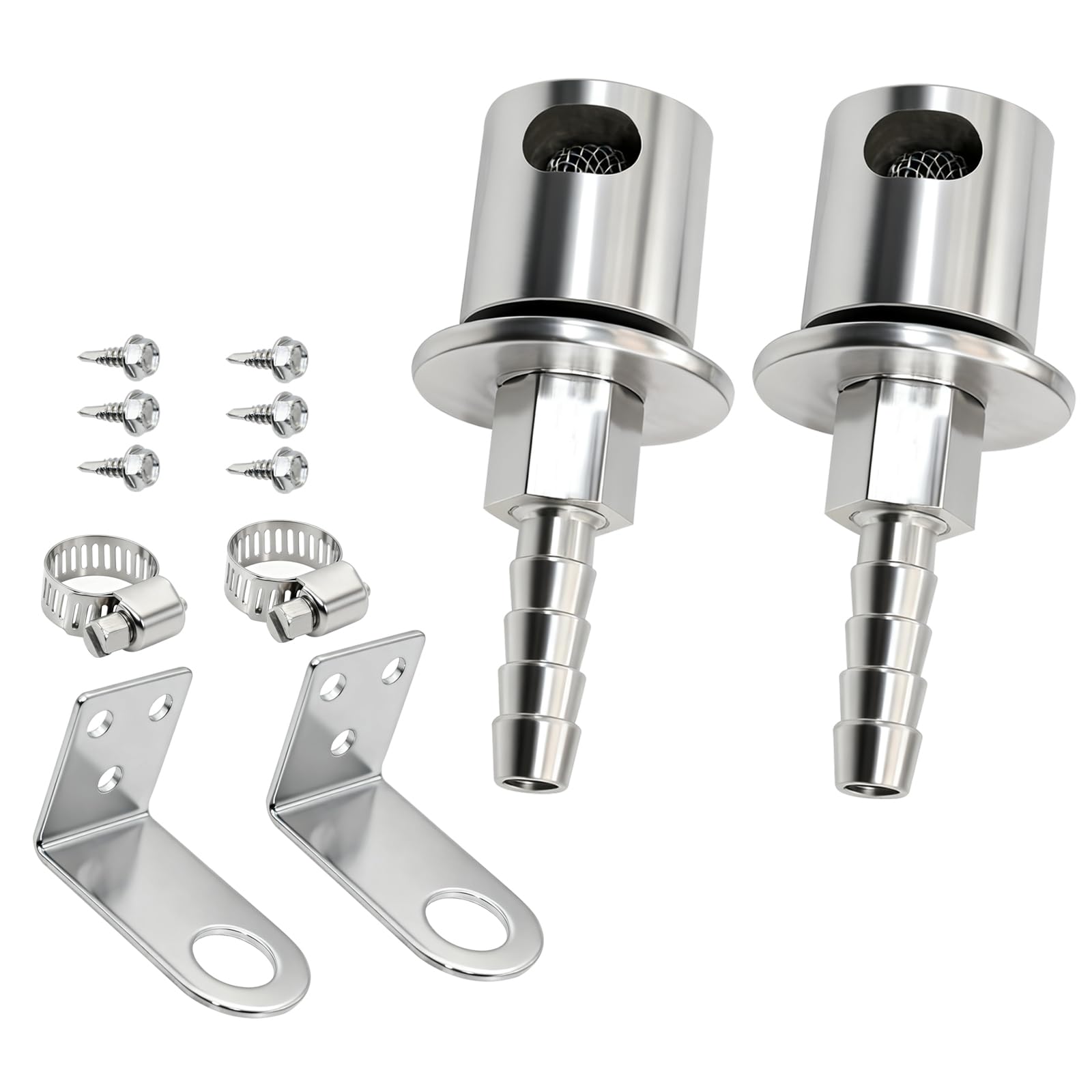
This one is for builds where the original vent location is inconvenient or unsafe. The 5/16″ hose barb — matching the 0.31-inch outlet — connects to a fuel line you run up to a firewall or another protected spot, so fumes vent far from the rear wheel well. It comes as two valves in one kit, and the pack can be split if you only need one.
Buyers praise the functionality most, with fit close behind. Buyers report gutting gasoline smells from the garage entirely by adapting this to the top of a fuel cap, which then relieved pressure buildup. On a 20-gallon plastic tank in an old Cherokee, the same valve handled a line routed to the engine compartment without a hitch.
Sizing is the honest trade-off. The unit is a bit bulkier than expected, and a few owners had to fabricate their own bracket because the included 90-degree bracket did not fit their space. It also needs to sit vertical, with the check ball in the bottom fitting, so plan your mounting spot accordingly. Two valves for the price of one makes this the volume play.
Dual tank setup: anyone relocating a tank vent line to a cleaner spot and wanting a spare valve on hand.
Tight quarters: space is extremely tight — the body is noticeably bulkier than smaller single valves.
3. keehui Universal 90° Fuel Vent 316 Stainless Steel Marine Grade

A mirror-polished stainless vent that blends into the hull and shrugs off salt water.
If corrosion resistance is your top concern, this is the valve. It is machined from 316 stainless steel — including the backing nut — and finished with a fine mirror polish, so it looks bright and stays precise against a tank surface. The 90-degree bend and compact body make it nearly unnoticeable once installed, which owners love on boats like a Key Largo.
Installation needs no drilling or welding. You cut a roughly 1 3/8-inch hole and slide the barb in, then connect a 5/8-inch interior diameter hose — the actual barb measures 0.63 inches, not some metric size. Buyers confirm the hose barb is a true 5/8″ and that the whole assembly feels solid and durable.
One caveat: this valve is application-specific. When used as a fuel vent, owners mention the screened openings run all the way around the outside, not just two protected holes as the photo suggests. That makes it better suited to water tank duty than a fuel tank in some setups. For freshwater tanks and marine use, it is exactly what you were looking for. It holds a 4.5-star score across nearly a hundred owners.
Saltwater use: you want a corrosion-proof marine-grade vent that installs through a single clean hole.
Low clearance: you need a true rollover check ball — this is a breather vent, not a crash-safety valve.
4. MAD HORNETS Fuel Check Valve Vent, 1/2″ NPTF Male Threads

The derby-car workhorse that threads straight into a homemade fuel cell bung.
This brass valve is the no-frills pick for anyone building their own fuel cell. It threads in with a 1/2″ NPTF male pipe thread — tightened with a 7/8″ socket or wrench — and accepts a 5/16″ ID hose on the other side. The check ball inside keeps fuel in the tank if the vehicle ends up upside down, which is exactly what a derby car needs.
The flow numbers are the concrete reason this one stands out. It moves up to 70 cubic feet per hour, with a vent flow of 30 cfm and a maximum back pressure of 0.23 psi. That means the tank breathes freely under normal driving without building pressure or vacuum, and a highly boosted setup still gets enough air movement.
The recurring gripe is the threads. One owner found the NPTF threads needed a 1/2″ x 14 tap run through the bung to get a full 5 1/4 turns of engagement, otherwise the valve would only catch about three turns. For a derby car’s homemade fuel cell, customers note it works great as a rollover valve; for a fuel transfer tank, it works good. Expect to chase threads on some bungs.
High flow lines: budget builders with a threaded tank bung who want real rollover protection and high airflow.
Small fuel ports: your tank bung has worn or non-standard threads — this valve may need a tap to seat fully.
5. Jetuplusllc Fuel Tank Remote Mount Vent Valve (Black)
The off-road safety add-on that keeps relocated fuel cells calm under hard braking.
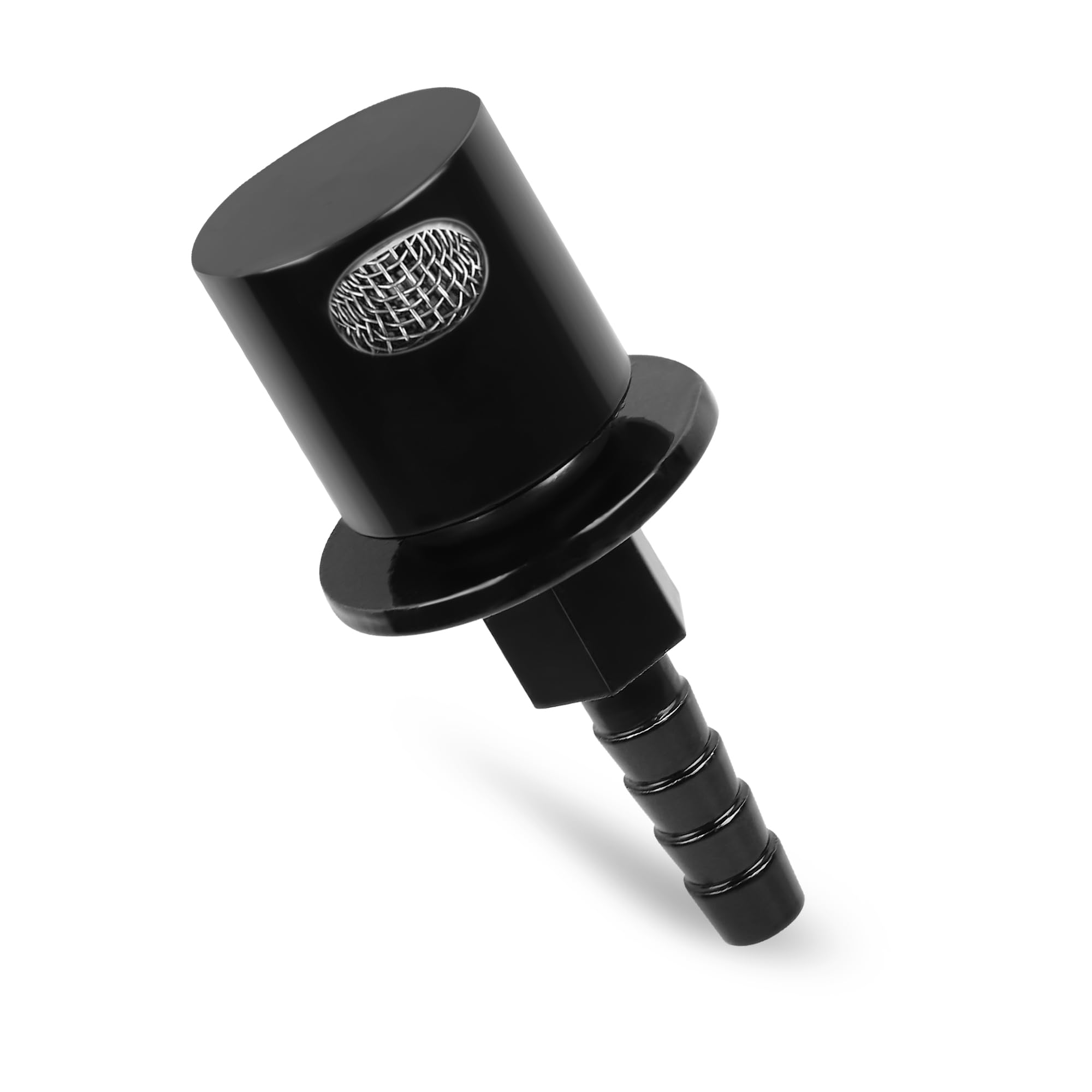
This one targets the off-road crowd — ATVs, UTVs, SXSs, and custom truck builds. It connects to a 5/16″ barbed hose (a 0.31-inch inlet) and mounts remotely, so you can place it where a rollover is least likely to expose it. The internal check ball seals the vent tube if the vehicle flips, and a mesh screen keeps dust and debris out of the line.
Owners running aggressive street-driving tests report nothing leaked — even with hard acceleration and braking on a relocated fuel cell. The design allows air in and out of the tank to prevent blow-back while filling and vacuum buildup while drawing fuel. Made from durable aluminum and steel with a black finish, it is built to live under a truck or on a trail rig.
Vertical mounting is non-negotiable here. The valve must sit upright with the ball in the bottom fitting. A few owners warn that the ball can act like a one-way valve if mounted wrong or tilted, which could restrict fuel flow out of the tank. For a custom EFI setup with a relocated cell, this solved venting issues cleanly while adding a safety layer. It comes with a 1-year warranty for confidence.
Hidden installs: you run an off-road rig or custom fuel cell and want a compact remote-mounted rollover valve with a debris screen.
Direct mount: you cannot guarantee a fully vertical mount — a tilted install can turn the check ball into a one-way valve.
Understanding the Specs
Thread size and type
The thread that screws into your tank bung must match exactly. Common options are 1/2″ NPTF pipe thread (for welded bungs) and 6AN flare (for AN fittings). Getting this wrong means fuel leaks at the connection point.
Hose barb diameter
If your tank vents through a rubber line, the barb size matters. The most common are 5/16″ (0.31 inches) for automotive lines and 5/8″ (0.63 inches) for larger marine hoses. The wrong size either slips off or refuses to seat.
FAQ
What does a rollover vent valve actually do in a crash?
Will a 5/16 inch hose barb fit my existing fuel line?
How do I know if I need NPT threads or AN flare?
Can I mount these valves horizontally or at an angle?
Will a vent valve stop fuel smell in my garage?
What is the difference between a breather vent and a rollover valve?
How much airflow do I need for a boosted fuel cell?
Will these valves work with diesel fuel tanks?
Can I use a marine stainless vent on my car’s fuel tank?
Why is vertical mounting so important for installation?
Final Thoughts: The Verdict
Across the board, the universal fuel tank vent valve winner is the Podavelle 6AN Rollover Valve because it combines genuine rollover protection with the durability to handle high return pressure on boosted builds. If you want a two-pack for relocating a vent line, grab the Alsoyixia Remote Mount. And for marine or corrosion-heavy environments, the keehui 316 Stainless Vent is the one to reach for.
How We Picked
We do not accept paid placement. Every pick is matched to a real buyer and a real use-case; we do not hands-on test units.
Sources & Methodology
Specifications: manufacturer listings and product documentation. Review insights: verified customer reviews, as of August 2026. Pricing: not shown on this page (it changes often); check the current price via the retailer link.
As an Amazon Associate, GoCarLife earns from qualifying purchases. This does not affect which products we feature.