
Our readers keep the lights on and the garage heater humming. As an Amazon Associate, I earn from qualifying purchases.
Specs are compiled from manufacturer listings and verified buyer reviews and can change over time — please confirm the key details on the product page before buying.
An exhaust flex pipe is the shock absorber for your whole exhaust system. It soaks up engine vibration so your manifold and downpipe don’t crack, and it fixes that annoying rattle when a mount wears out. The catch is that cheap flex pipes rust out fast, especially if you live where roads get salted, so the material and the braid quality matter more than anything else on the spec sheet.
I’m Mo Maruf — the founder and writer behind GoCarLife. This guide is built by comparing the manufacturers’ published specifications and the patterns across verified customer reviews, so you get each pick’s real strengths and trade-offs instead of marketing spin.
You’ll learn which braid style survives daily driving, why inside diameter beats outside diameter when sizing, and how to spot a genuine T304 pipe from an impostor in the search for a universal exhaust flex pipe.
Our Picks at a Glance
How To Choose The Best Universal Exhaust Flex Pipe
Before you buy, you need to figure out the inside diameter your exhaust tubing actually has. Most flex pipes are sized by inlet and outlet ID, and the pipe should slide over your existing exhaust pipe to create a seal. Grab a caliper or a ruler, measure the outside of your current pipe, and match it to the flex pipe’s ID.
Inside Diameter and Overall Length
The ID is the measurement that decides whether the pipe fits over your exhaust tubing. A 2.5″ ID flex pipe slides over 2.5″ OD pipe, which is why most buyers report a snug fit right from the start. Overall length matters for a different reason: a 6-inch flex pipe is a connector, while a 72-inch tube is meant to route exhaust across a long gap like a generator shed or a custom downpipe.
Braid Type: Single Roll vs Double Braid
The braid is the woven stainless mesh that gives the pipe its flexibility. A double-braid layer is thicker and stiffer, which actually helps it resist kinking and absorbs more engine vibration. Expect a double-braid pipe to feel very rigid when you first handle it — that stiffness is the whole point, and owners mention it’s exactly what a heavy-duty flex joint should feel like.
Material Grade: T304 vs T409
Stainless steel comes in grades, and T304 is the premium choice because it resists corrosion in salt and moisture far better than cheaper grades. The catch is that some listings claim stainless but ship a pipe that rusts within weeks in harsh climates. Look for T304 stated in the title or description, and check buyer reports about rust before you commit to a daily driver.
Quick Comparison
| Model | Best For | Material | Inside Diameter | Overall Length | Amazon |
|---|---|---|---|---|---|
| RP Remarkable Power 3″x10″★ Best Overall | Daily driver rust resistance | Stainless Steel | 3″ | 14″ | Amazon |
| TORDXICS 2.5″ ID x 16.5″Top Value | Quick clamp-on repairs | T304 Stainless | 2.5″ | 16.5″ | Amazon |
| FGJQEFG 2PCS 2.5″ x 6″ | Budget two-pipe repair | T304 + T409 | 2.5″ | 5.8″ | Amazon |
| Walker Heavy Duty 54047 | 3″ heavy-gauge fixes | Stainless Steel | 3″ | 36″ | Amazon |
| TORDXICS T304 72″ 1.5″ | Long exhaust routing | T304 Stainless | 1.5″ | 72″ | Amazon |
In‑Depth Reviews
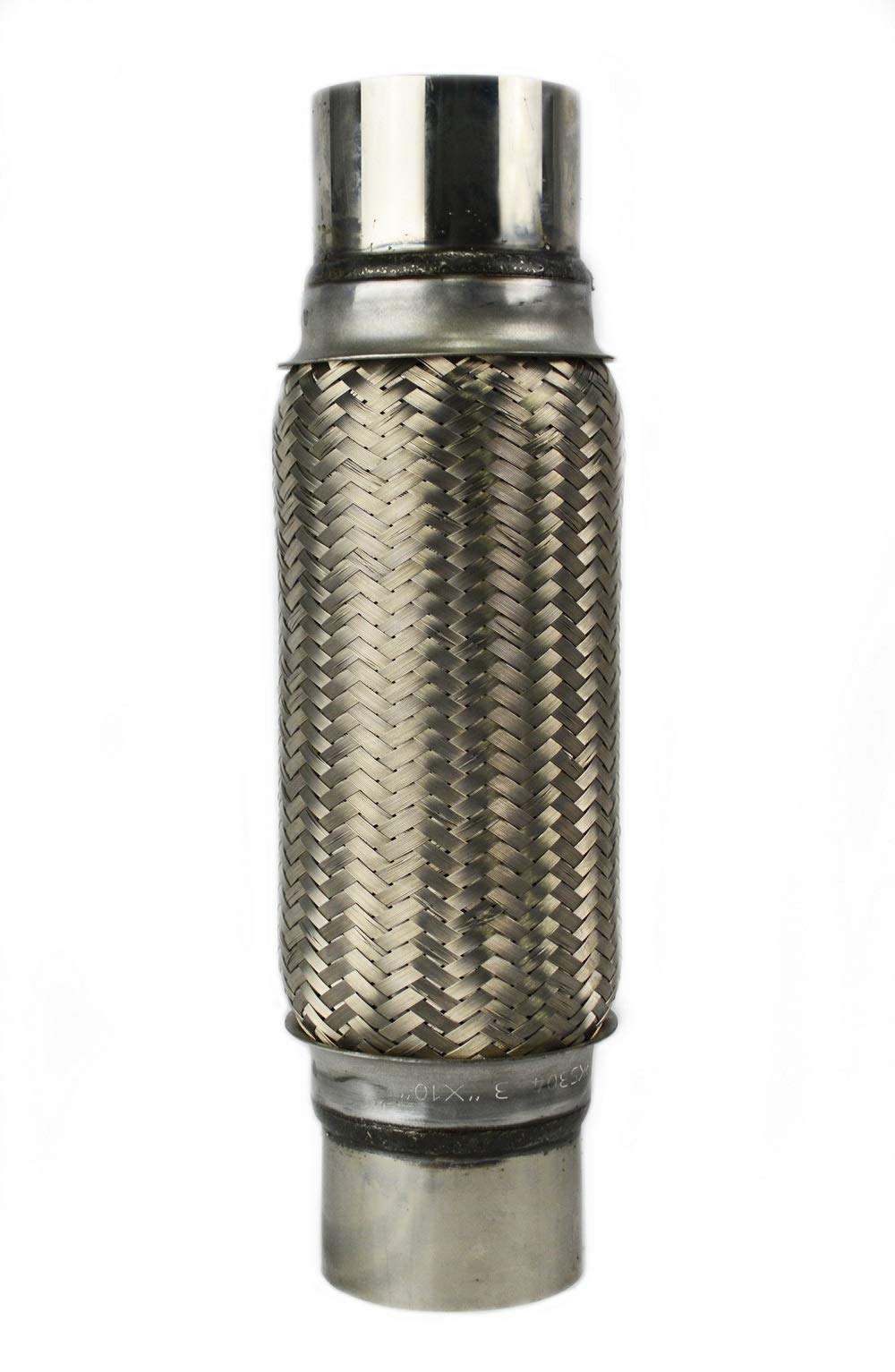
1. Exhaust Flex Pipe 3″x10″ Heavy Duty Stainless Steel 14″ OL | RK7552
Our pick — 4.5★ from 650+ verified ratings; the strongest balance of quality and price.
The rust-belt survivor that keeps proving its stainless steel claims
The double-braided stainless steel body measures 3″ across the inlet and reaches 14″ in total length including the extension, which gives you a solid 4″ more pipe to work with than the smaller budget connector mentioned below. It welds cleanly and slides snugly over existing tubing, so holders of custom turbo downpipe builds say the flange is on the thin side but the weld took without issue.
The thing everyone raves about is the build quality, and it’s clear why when you read about the 8-month stint on a custom turbo downpipe with no surface rust. It’s stiff enough to hold its shape but retains “decent flex,” and customers note it didn’t create a noticeable sound difference from stock. What wins people over is the combination of a tight fit and good weldability that makes it feel like a premium part at a fraction of parts-store pricing.
One honest catch: if your car is lowered, the 14″ hanging length can scrape badly on driveway ramps, so measure your clearance first. The material gets mixed feedback in the reviews, with several owners noting the pipe doesn’t match the advertised stainless, even though the long-term rust reports suggest the unit itself holds up.
What Owners Praise
- Proven 1-year-plus performance in salted northern roads
- Welds cleanly and fits snugly over existing exhaust tubing
- Held up for 8 months on a custom turbo downpipe with zero surface rust
Watch Out For
- Hangs low enough to scrape on a lowered car’s driveway
- Thin gauge on the end flanges
- Some units reportedly show rust within weeks, so the steel grade varies
Reach for this if: you drive in winter salt and need a 3″ flex that will hold up through at least a full year of abuse.
Look elsewhere if: your car sits low and you can only spare a few inches of ground clearance.
2. 2.5″ ID x 16.5″ Universal T304 Stainless Steel Exhaust Flex Pipe with U Bolt Clamps
The 16.5-inch bridge that fixes misaligned pipes without a welder
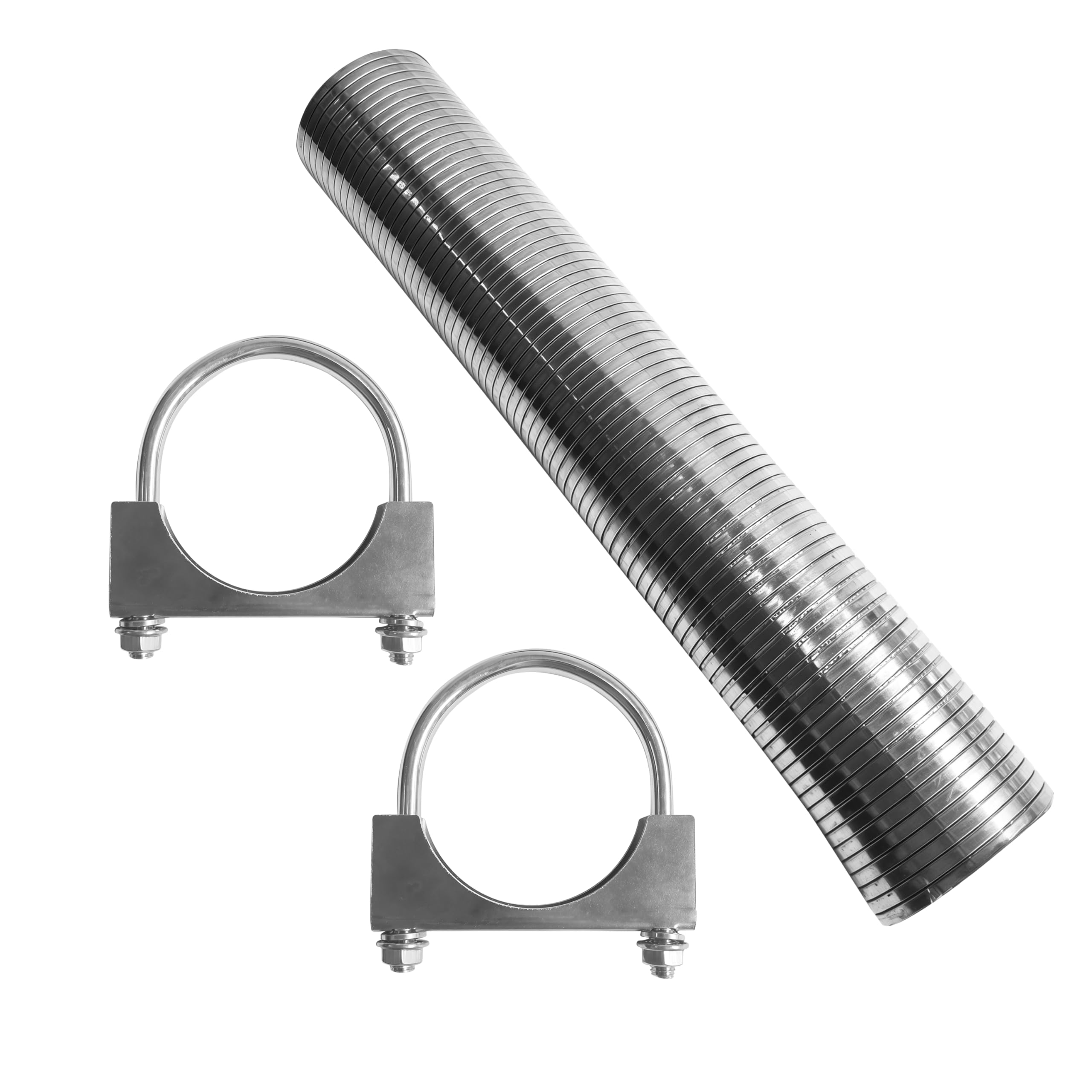
You can connect misaligned exhaust sections without welding, thanks to the included two metal steel U-bolt clamps on the TORDXICS 16.5″. At 16.5″ long with a 2.5″ inside diameter, it gives you nearly triple the reach of the 5.8″ budget pipe below, so it bridges gaps that shorter joints can’t. Reviewers point out it fits perfectly to extend the exhaust of an instant water heater, noting that “hard to saw through but it can be done.”
What wins people over is the T304 stainless steel construction paired with those included clamps, since it means you can be done in minutes instead of booking a welding session. The universal fit is genuinely broad — buyers mention using it for a 420 golf cart swap and predator piping, alongside the heater application. At a 2.5″ ID, it’s designed for catback systems, mufflers, downpipes, headers, and tips.
Shoppers say this pipe is “a little less flexible than I expected,” and one application slowly bent its support while trying to straighten out. Plan on supporting the pipe at both ends, since the stiffness is real even though the material quality earns solid marks.
Straightforward fix: A well-made clamp-on flex pipe that also handles generator and water-heater work, though its stiffness means you should anchor both ends.
Who it’s not for: Anyone relying on the pipe to bend sharply around a tight corner, since it resists staying curved.
3. 2PCS Exhaust Flex Pipe Stainless Steel Double Braid Heavy Duty, 2.5″ x 6″

A two-pack of stiff, heavy-duty connectors that weld up like parts-store parts at a third of the price
For a budget repair on a truck or bus exhaust, you get two connectors for the price of one with this pipe. Each pipe measures 2.5″ inside diameter with a visible braid length of 3.7″ and an overall length of 5.8″, so it’s a true joint rather than a routing tube. The construction pairs T304 stainless steel double braid with T409 stainless steel extensions for corrosion resistance, and buyers report these “welded up just fine” with the same quality as an auto parts store at roughly a third of the cost.
What wins people over is the quality-to-price ratio, with owners calling the build “excellent” and noting the installation is economical since you don’t replace entire exhaust assemblies. The vibration control is the core job here, and the double-braid layer is built to soak up engine shake. Because you get two pieces, it’s also handy for a dual-exhaust setup or a spare to keep in the shop.
Buyers warn these “are VERY stiff, and they’re supposed to be” — this is not a pipe that bends easily into position. A few owners also note the material quality is a concern, with some reporting rust within a year, so it’s a fair value play rather than a lifetime part. One buyer found cut-off extra pipe inside the ends, which is odd but didn’t stop the weld job.
Smart budget call: A two-for-one repair kit whose stiffness and T304 braid make it a legit heavy-duty connector, best for welded installations with room to maneuver.
The trade-off: skip it if you need a flexible pipe that bends around obstacles, since the whole point is rigidity.
4. Walker Heavy Duty 54047 Universal Exhaust Flex Pipe 3″ Inlet (ID) 3″ Outlet (ID)

The catalytic-theft fix that fits 3-inch piping with heavy-gauge confidence
This is the pick for anyone whose catalytic converter was stolen and needs a heavy-duty bridge to reconnect the exhaust — a scenario buyers describe as a 40-minute install with about half an inch of wiggle room. Walker builds this flex connector with a 3″ inlet and 3″ outlet, matching the diameter of the 3″ OD pipes on trucks like the 2000 F-250 Super Duty. At 36″ long and 5 pounds, it’s the heaviest unit here, and owners mention it’s “much heavier gauge flex than the ones at the parts stores.”
What wins people over is the perfect fit on 3″ exhaust systems, with owners noting it fit flawlessly over a 2004 6.0 Powerstroke and sealed a previously leaking joint. The flexibility gets mixed feedback — some say it bends minimally, which is fine since the job is mostly straight-line bridging. Cut it to length with a grinder, connect the front pipe first, then the rear to the muffler, and you’re done.
The larger outside diameter makes it awkward to incorporate into some exhaust systems — it’s a 3″ pipe through and through, so don’t try to neck it down. There’s no manufacturer warranty on this one, so what you see on arrival is what you get, though the heavy-gauge build earns strong quality marks in the reviews. Pair it with the recommended Walker exhaust clamp for a clean result.
Heavy-duty anchor: A 36-inch, 5-pound flex connector built for 3″ truck exhausts and catalytic-theft repairs, with a 40-minute install turnaround.
Not for tight spaces: The beefy gauge adds weight and a larger OD, making it awkward in systems with minimal clearance.
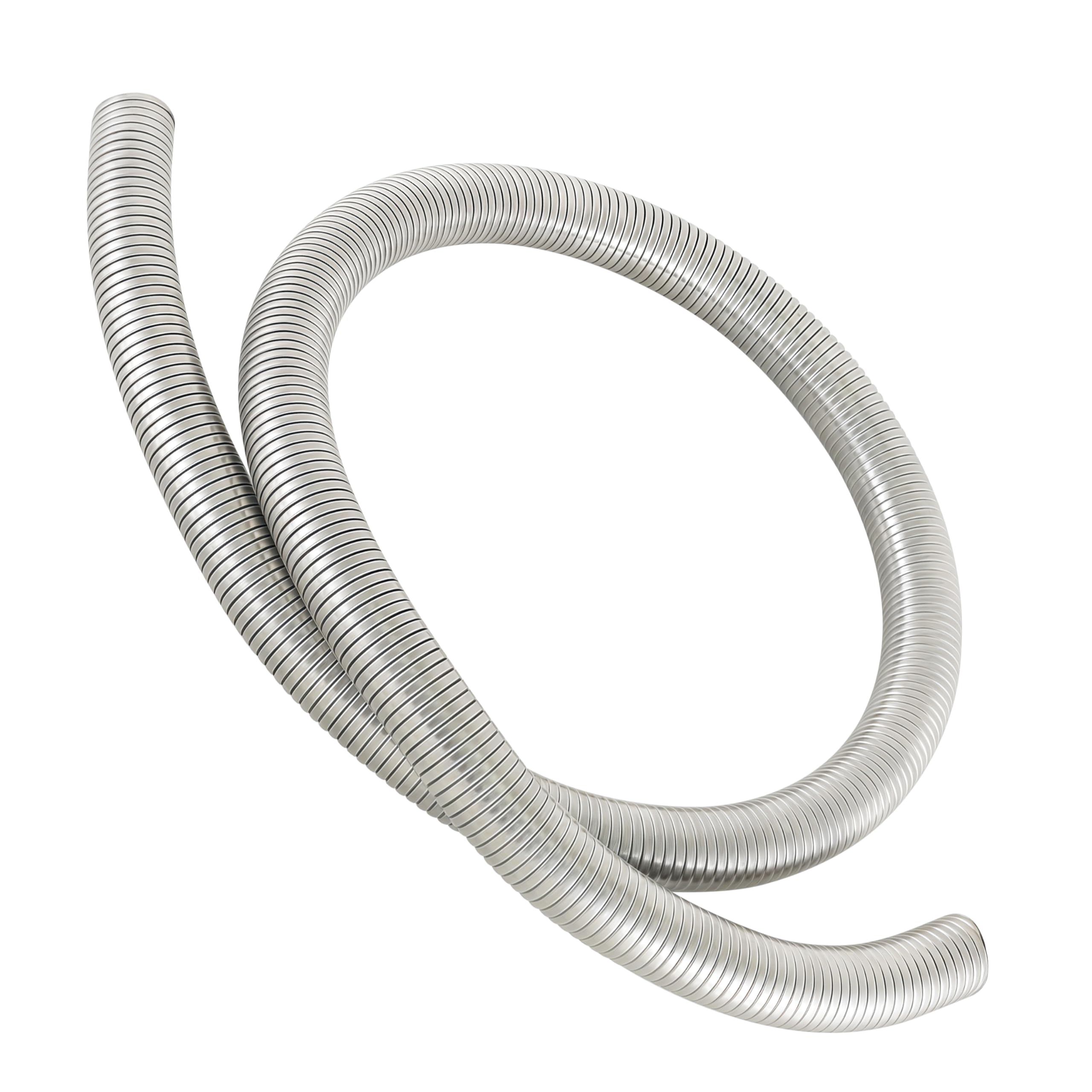
5. Universal T304 Stainless Steel Exhaust Flex Pipe Flex Tube — 72″ 6 Feet Length, 1.5″ ID
A 6-foot T304 hose that routes small-engine exhaust wherever you need it
When you need to route exhaust a long distance from a portable generator, a semi truck’s alternative power unit, or a small engine, this 72-inch tube does the job where short joints can’t. At 1.5″ inside diameter, it’s the narrowest pipe here, which is exactly why it fits small muffler outlets like a portable Generac generator’s exhaust. The single roll band construction keeps it flexible enough that customers note routing it out from underneath a semi was easy, and one used it to extend exhaust out of a generator shed so the CO safety system wouldn’t shut the unit down.
What wins people over is the T304 stainless steel build, which resists rust and corrosion, and reviewers point out the flexibility makes routing in tight engine bays genuinely simple. The length is the standout — at 72 inches, it’s a twelve-fold reach compared to the 5.8-inch budget connector above, letting you run exhaust from a garage to outside during an ice storm. Pre-cut and ready to weld or clamp, it suits both installation styles.
One fit caveat: the pipe wouldn’t slide over a 1.5″ OD exhaust flange without an exhaust pipe expander, so treat the ID as snug and plan for a bit of persuasion. The quality earns solid marks, and shoppers say the fit is tight but workable once you get it on.
Owners Love
- 6-foot reach routes exhaust out of a shed or garage during power outages
- T304 stainless resists rust while handling heat
- Flexible enough to route around a semi’s undercarriage easily
Plan Around
- Tight 1.5″ ID may need a pipe expander to fit over a flanged outlet
- Single roll band is less rigid than double-braid units
Grab it for: generator venting, small-engine discharge, or any job where exhaust needs to travel six feet away from the machine.
Pass if: you’re repairing a car’s main exhaust — the 1.5″ bore is too small for most vehicle systems.
Understanding the Specs
Inside Diameter vs Outside Diameter
The inside diameter (ID) is the hole the exhaust gas flows through, and it’s the number that decides fitment. A flex pipe is supposed to slide over your existing exhaust pipe, so you match the flex pipe’s ID to your pipe’s outside diameter (OD). When buyers report a 1.5″ pipe wouldn’t slide over a 1.5″ OD flange, that’s because the ID measurement is slightly smaller than the nominal size — a little expander or grinder work fixes it.
T304 vs T409 Stainless Steel
T304 is the higher-grade stainless with more chromium and nickel, which is why it resists corrosion so much better in salty, wet climates. T409 is a cheaper ferritic grade that’s still corrosion-resistant but more prone to surface rust in winter conditions. If you live in the rust belt, the T304 double-braid pipe is the safer daily-driver bet.
Overall Length and Visible Braid Length
Overall length is the total pipe including the solid end extensions, while the visible braid length is the actual flexible mesh section in the middle. A 6-inch flex pipe with 3.7 inches of visible braid is a short connector, while a 72-inch tube is a full routing solution. Measure your gap before buying so you don’t end up with a connector that’s too short to span the distance.
Double Braid vs Single Roll Band
The braid is the woven stainless layer that gives a flex pipe its bend. A double-braid layer is two overlapping mesh layers, which makes the pipe stiffer and more resistant to kinking — the trade-off is rigidity that fights back during installation. A single roll band is lighter and more flexible, making it easier to route around corners but less sturdy for high-vibration vehicle mounting.
FAQ
How do I measure for a universal exhaust flex pipe?
Can I clamp an exhaust flex pipe instead of welding it?
Why is my flex pipe not flexible enough?
How long does an exhaust flex pipe last?
Will a 3-inch flex pipe fit my truck?
Can I use an exhaust flex pipe on a generator or water heater?
What’s the difference between T304 and T409 stainless steel?
Why does my new flex pipe scrape on the driveway?
Final Thoughts: The Verdict
For most people, the universal exhaust flex pipe winner is the RP Remarkable Power 3″x10″ because its double-braid stainless build has proven rust resistance over a year-plus in the salt belt, and it welds cleanly for the daily driver. If you want a clamp-on fix that takes minutes instead of a welding session, grab the TORDXICS 16.5″ with its included U-bolt clamps. And for a 3″ truck exhaust or a catalytic-theft repair, the Walker 54047 heavy-gauge unit is the one to reach for.
How We Picked
We do not accept paid placement. Every pick is matched to a real buyer and a real use-case; we do not hands-on test units.
Sources & Methodology
Specifications: manufacturer listings and product documentation. Review insights: verified customer reviews, as of August 2026. Pricing: not shown on this page (it changes often); check the current price via the retailer link.
As an Amazon Associate, GoCarLife earns from qualifying purchases. This does not affect which products we feature.