
Our readers keep the lights on and the garage heater humming. As an Amazon Associate, I earn from qualifying purchases.
Specs are compiled from manufacturer listings and verified buyer reviews and can change over time — please confirm the key details on the product page before buying.
Upgrading your factory radio can transform your daily drive, but the right choice depends on three honest questions: how much power you want from your speakers, how you’ll get music into the car (Bluetooth, USB, or a screen), and how deep your dash allows the install to reach. That last point matters more than most expect — a single-DIN unit with a short chassis can drop into a shallow dash, while a double-DIN touchscreen needs a bigger rectangular opening. With options from bare-bones Bluetooth receivers to full CarPlay screens, the real task is matching the feature set to the car you drive and the way you listen.
I’m Mo Maruf — the founder and writer behind GoCarLife. This guide is built by comparing the manufacturers’ published specifications and the patterns across verified customer reviews, so you get each pick’s real strengths and trade-offs instead of marketing spin.
The best universal car stereo for most drivers balances proven reliability, clean Bluetooth sound, and a price that doesn’t hurt. This guide breaks down nine models across single-DIN and double-DIN designs to help you pick the right one.
Our Picks at a Glance


How To Choose The Best Universal Car Stereo
Before you scroll through specs, decide on the size of the opening in your dash. A single-DIN slot is a tall, narrow rectangle that fits most older cars and trucks, while a double-DIN opening is twice as tall and is the only space that accommodates a large touchscreen. Measuring your dash opening first will instantly narrow your list by half.
Match the Power to Your Speakers
Most aftermarket units put out around 50 watts per channel to four speakers, which is a clear jump over a worn-out factory amp. If you plan to add an external amplifier or a subwoofer, you’ll want a head unit with dedicated RCA preamp outputs — look for a pair labeled for rear speakers and a separate one for the sub.
Bluetooth Is the Standard, Not the Extra
Every unit here streams audio wirelessly and handles hands-free calls, but the connection quality and pairing behavior vary. Some owners find pairing finicky when other Bluetooth devices are nearby, so a stable module matters more than a long feature list.
Check the Chassis Depth for a Tight Dash
The physical depth of the unit behind the dash matters just as much as the face size. A “mechless” receiver that skips the CD player is significantly shallower, making it a lifesaver for older trucks and boats with limited space behind the dash.
Quick Comparison
| Model | Best For | Type | Max Power | EQ Bands | Amazon |
|---|---|---|---|---|---|
| Kenwood KMM-BT332U★ Best Overall | Amplifier owners | Single DIN | 50W x 4 | 13-band | Amazon |
| Pioneer MVH-S110BTBudget Champion | Budget buyers | Single DIN | 50W x 4 | — | Amazon |
| Pioneer MVH-S230BTCompact Pick | Compact instals | Single DIN | 50W x 4 | — | Amazon |
| JVC KD-SX27BT | Multi-phone pairing | Single DIN | 50W x 4 | 13-band | Amazon |
| Kenwood KMM-BT270U | Max output | Single DIN | 200W Max | 13-band | Amazon |
| JVC KD-SR87BT | CD collectors | Single DIN | 50W x 4 | 13-band | Amazon |
| SJOYBRING W021 | CarPlay on a budget | Double DIN | 240W | — | Amazon |
| SJOYBRING W022 | Responsive screen | Double DIN | 240W | — | Amazon |
| PLZ MP-926W | Bluetooth 5.3 | Double DIN | 240W | 10-band | Amazon |
In-Depth Reviews
1. Kenwood KMM-BT332U
Our pick — over 4.5★ from 600+ verified ratings; the strongest balance of quality and price.
The amplifier-friendly pick that turns an old truck into a modern sound system.
If you are running aftermarket amplifiers, this is the unit to start with. The KMM-BT332U carries six channels of preamp outputs — 2.5-volt rear and sub — so you can feed a four-channel amp and a separate subwoofer amp straight from the head unit without any line-out converter hack. Owners confirm they connect their amps directly to the deck and love having subwoofer control and EQ settings right at hand.
The sound-shaping depth is where this one pulls ahead: a 13-band equalizer with digital time alignment lets you delay each speaker’s output so the sound reaches your ears at the same moment. It also plays high-res FLAC and WAV files, so your lossless library stays lossless. The detachable face protects the unit when you park, and the built-in mic handles hands-free calls.
The trade-off is weight — at 1.3 pounds, it runs a hair heavier than the 1.1-pound Pioneer MVH-S110BT, a small difference you’ll only feel during the install itself. It skips CD playback entirely, which is the norm for this “mechless” class and barely matters to streaming listeners.
The Amp-Builder’s Case
- Six RCA preamp outputs give you dedicated rear and sub channels
- 13-band EQ plus time alignment lets you fine-tune the stage
- USB 1.5A port charges your phone while it plays FLAC
The Known Limits
- No CD slot, so physical discs are out
- Slightly heavier than the lightest single-DIN rivals
Grab it for: anyone building a system with external amps who wants EQ tuning at the source.
Think twice if: you still have a CD collection — this unit is digital-only.
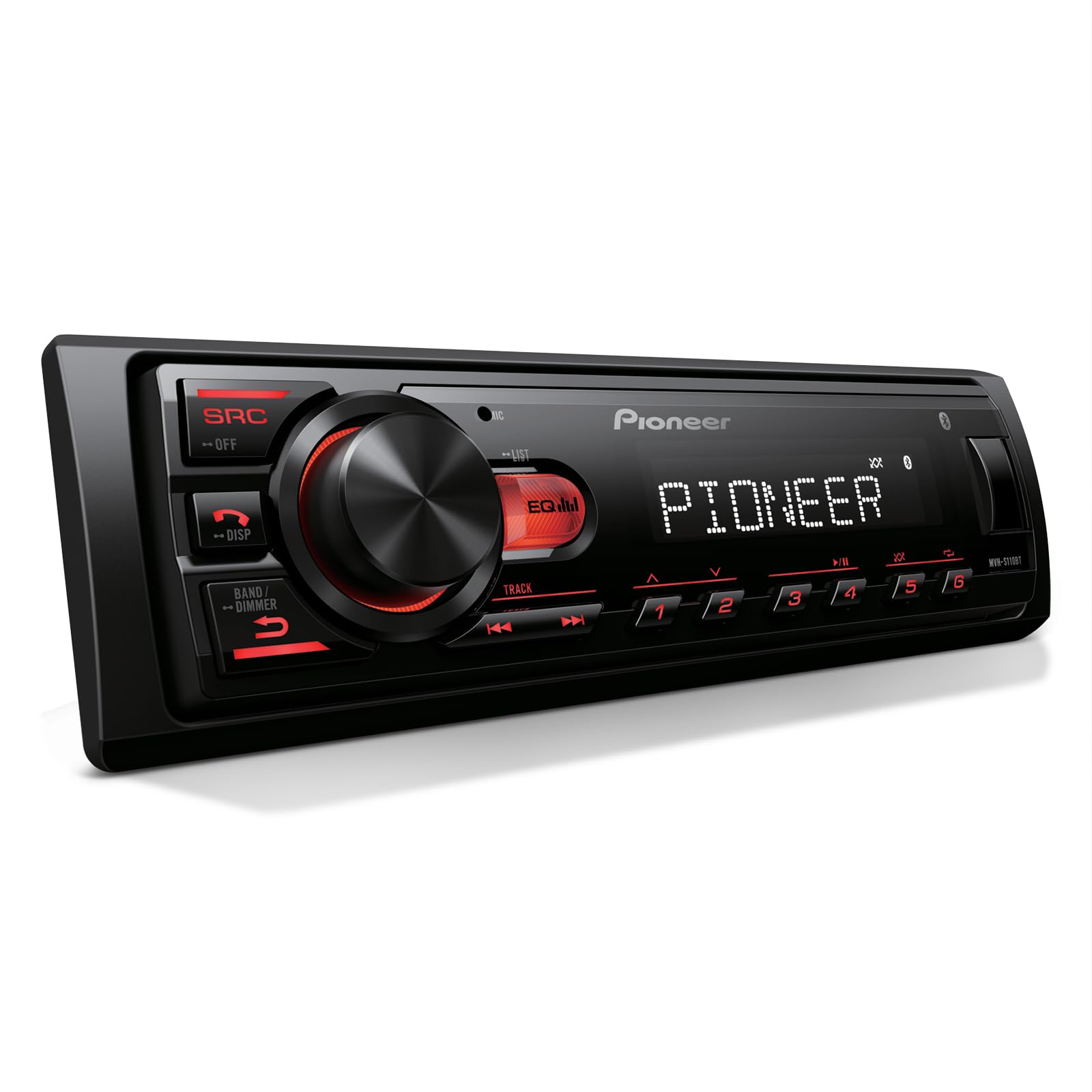
2. Pioneer MVH-S110BT
The featherweight that climbs into tight dashes without wheezing.
At 1.1 pounds, this is the lightest single-DIN unit on the list, and its super-short chassis is built for vehicles with limited dash space. The built-in MOSFET amplifier pushes up to 50 watts per channel to four speakers, which owners find plenty for door speakers and even a surprising wake-up for factory drivers. Dedicated Direct EQ keys sit on the face, so bass, treble, and balance tweaks don’t require digging through menus.
The front USB input plays FLAC, MP3, and WMA, and the whole package feels more substantial than its entry-level price suggests — buyers routinely call the build quality and sound a genuine surprise at this tier. It’s a clean, dead-simple digital media receiver with no CD mechanism to fail.
The one honest catch is Bluetooth pairing, which earns mixed feedback: some owners say it connects quickly, while others report it refuses to pair until they remove an Apple Watch, after which it connected immediately. Expect to fiddle once during setup, then enjoy stable streaming after.
The Value Read: you get a real Pioneer amp stage and a light, shallow chassis for a very accessible price.
Pairing Caveat: the Bluetooth module can be picky with other nearby devices during the first hookup.
3. Pioneer MVH-S230BT
A shallow chassis with a sound-restoring brain for compressed music files.
This digital media receiver is less than 4 inches deep, which makes installation in shallow dashes and even utility vehicles far easier than a full CD unit. Its standout feature is the Advanced Sound Retriever, which works to restore audio detail lost during file compression — genuinely useful for Spotify and MP3 listeners who want cleaner highs from lower-bitrate tracks. It plays MP3, WMA, AAC, and WAV straight from a USB drive.
Owners describe the sound as crisp and clean, a clear leap over the no-name deck it replaced, and the Bluetooth pairs without drama for most. The 50W x 4 output drives factory speakers fine and leaves headroom for a small amp.
The honest warnings come from long-term and RV use: there is no power button, so some owners worry about battery drain in a camper, and at least one unit’s display gave out after about four months. A second owner notes single RCA amp output and no A/B speaker switch — fine for most cars, limiting if you run two speaker zones. If you’re replacing a 1.5 DIN slot, buyers report it works with a Magnadyne face frame.
Best suited to: installers who need a short unit with decent file-format support and a single-amp hookup.
Not ideal for: RV owners who need a physical power switch to avoid parasitic draw.
4. JVC KD-SX27BT

The multi-phone manager that keeps two devices connected all day.
This JVC receiver handles a genuinely rare trick: it can hold two phones connected full-time for hands-free calls while allowing up to five Bluetooth devices to stream audio simultaneously. That makes it the easy pick for a shared car or a household where both drivers’ phones live in the cabin. The built-in 100W amp (50W per channel) uses K2 technology and a 13-band EQ, with Time Alignment so sound from each speaker arrives at the same instant — a feature usually reserved for pricier decks.
Sound Lift enhances audio positioning, and the front USB 1.5A port fast-charges your phone while playing MP3, WMA, WAV, AAC, or high-res FLAC. The short chassis drops into tight dashes, and installs range from a 1987 Monte Carlo to a golf cart, where owners mention clear sound on stock speakers with no amp at all.
The mixed verdict lands on Bluetooth: some owners find it pairs well, others report it won’t connect to iPhones and occasionally needs a power cycle when you first hop in. Reliability reviews are genuinely split, so treat the connection as a fit-to-your-device question rather than a universal flaw. If your phone plays nice, the sound and feature set are hard to fault at this tier.
The Flexible Angle: five devices streaming at once makes this the best party deck in the lineup.
The Device Caveat: iPhone pairing is the recurring complaint — test your phone before fully committing.
5. Kenwood KMM-BT270U

The 200-watt wall of sound that rattles stock speakers to life.
This is the most powerful single-DIN pick here, rated at up to 200 watts max output through a built-in MOSFET amplifier. Owners warn it will “really wake up the speakers” — even factory drivers — which is exactly what people hunting a dramatic volume jump want. The 13-band EQ and a high-contrast LCD round out a receiver that is otherwise remarkably simple to run once it’s in.
It plays digital media from USB and AUX, streams via Bluetooth with a built-in mic for calls, and the detachable face adds a layer of theft deterrence. The front USB connection doubles as a rapid charger for your phone during the drive. Setup is straightforward enough that owners are dropping it into golf carts as easily as pickup trucks.
The catch is control ergonomics: some owners find the interface less user-friendly than rivals, with balance and fade controls that feel hidden or missing, and Bluetooth pairing can take a couple of tries. Reliability feedback is also mixed, so this is the pick when you want maximum built-in punch and can live with a slightly clunkier interface.
Why It Earns Power
- 200W max output makes stock speakers seriously louder
- Detachable face offers real theft protection
- USB port charges your phone while you drive
Where It Trips Up
- Balance and fade controls are hard to find in the menus
- Pairing takes persistence on some phones
6. JVC KD-SR87BT

The rare single-DIN that still spins a CD and streams Spotify without fuss.
If you aren’t ready to abandon your disc collection, this is the standout. JVC squeezed a full CD player into a single-DIN chassis alongside Bluetooth, a 13-band EQ with digital time alignment, and K2 technology to polish the sound of compressed files. It also wirelessly controls Pandora and Spotify from an Android device, giving streamers a reason to look past the disc slot. The 50W x 4 amp (200W max total) delivers clean output, and the front USB 1.5A port fast-charges your phone.
Install stories run from a ’94 Camry to a ’04 Wrangler, and owners consistently report fast, stable Bluetooth with Pixel and other phones, intuitive controls, and no connectivity headaches. One owner who has lived with Alpine decks since 1984 found this JVC a worthy, cheaper rival — praising its mid-volume performance while noting sound gets “fluttery” at maximum volume. Another notes the screen brightness can dim or flicker intermittently, possibly an install quirk.
For the money, it is a compelling hybrid: all the streaming convenience of a modern mechless unit plus the physical disc playback that’s vanishing from the category. The deeper 6-1/8″ chassis is the one thing to verify before you buy, since it won’t fit every shallow dash the way a CD-free unit will.
Reach for it if: you still listen to CDs but want Bluetooth and Spotify control in the same slot.
Check your dash if: space behind the radio is tight — the CD mechanism adds real depth.
7. SJOYBRING 7″ QLED (W021)

The budget doorway into wireless CarPlay with a camera in the box.
This double-DIN brings a 7-inch QLED HD screen at 1280×720 with 1080P video playback, plus wireless Apple CarPlay and Android Auto that connect without a cable. The included HD night-vision backup camera with a 170-degree ultra-wide view auto-displays when you shift into reverse — the cable is long enough to reach an 18-foot truck, and the guidelines are toggleable. Four channels of RCA audio out run to an aftermarket amp, with two separate subwoofer outputs for bass heads.
Owners across a 2004 Tundra, 2006 Xterra, and 2008 Wrangler report no issues after months of use, responsive touchscreens, and quick CarPlay connection. The catch: it arrives in pieces, so you’ll likely need a dash kit, a wiring harness adapter, and an antenna adapter for your specific vehicle. The manual is thin, so expect to lean on YouTube for a first-time install, and steering wheel controls require a separately purchased interface.
The recurring honest notes are a sun-glare issue at side angles and a slight delay in all touch actions, more noticeable on a 2001 Tundra than newer cars. For the price, the feature density is remarkable, but budget extra time and parts for the fit.
The Screen-First Angle: a sharp QLED panel and a good backup cam make this the visual-value king.
The Install Reality: plan for extra adapters, a dash kit, and a patient afternoon of wiring.
8. SJOYBRING 7″ QLED (W022)

The responsive QLED screen with a volume knob that owners actually praise.
This double-DIN is the crowd’s answer to laggy budget touchscreens: owners repeatedly call it fast-starting and lag-free, with a physical volume knob thrown in for good measure. The 7-inch QLED panel runs 1280×720 and supports 1080P playback, with an auto-dimming option tied to your headlights. It handles wireless CarPlay and Android Auto over Bluetooth, and the 4.2-channel output drives front and rear speakers plus two subwoofers with custom EQ tuning.
The included rear camera feeds HD night-vision images that power on automatically in reverse. Fit reports are strong — owners mention clean installs in a 2007 Camry, ’08 Grand Prix, and a 2003 Ranger, with steering wheel controls programming easily through the on-screen menu (an extra interface is required). Audio quality gets called a real leap over FM transmitters, with zero static and fine volume control.
The quirks are specific: the bundled double-DIN bezels feel flimsy, the built-in mic is quiet on calls, and one owner’s CarPlay initially failed nine times out of ten until support adjusted a WiFi setting — after which it worked. There’s no fan, so long-term heat endurance is the open question. Support earns consistent praise for sending firmware updates, custom boot logos, and even replacement units.
What Wins People Over
- Fast startup and responsive touchscreen with a real volume knob
- Steering wheel controls program easily on-screen
- Bright, high-res display with auto-dim
The Honest Faults
- Built-in microphone is quiet during calls
- No cooling fan, so prolonged heat durability is unproven
9. PLZ MP-926W

The Bluetooth 5.3 specialist with a 10-band DSP for obsessive fine-tuning.
This is the only unit on the list running an independent Bluetooth 5.3 module (the latest wireless standard), and it shows: owners describe Android Auto and wireless CarPlay connecting automatically the moment the car starts, with lower signal delay than older decks. The 7-inch QLED screen hits 1280×720 resolution with 1080P video support, and a large heat sink keeps the amp cool during long sessions. Inside, a 10-band DSP equalizer (a digital sound tuner) lets you shape front, rear, left, and right channels independently, plus two subwoofer outputs for serious bass — all rated at 240W max.
The included 1080P backup camera earns specific praise for sharpness, and the whole kit — unit, frames, harness, and camera — arrives complete. Install stories range from a 15-minute wiring job in a Ford Expedition to a careful fit in a 1997 Eclipse, with owners calling the boot time fast and the touch response snappy. Support is the sleeper asset: firmware updates and custom boot logos come through quickly when you message the seller.
The trade-offs are honest: Apple CarPlay can be buggier than Android Auto for some, pairing your phone can be a small challenge, and one owner notes it runs “85-90% OEM speed” (nearly as fast as a factory system) with minor quirks like album art glitches. The WiFi connection can also conflict with your home network — and there’s no WiFi hotspot function, so don’t buy it expecting to share mobile data.
The Connection Read: the most dependable wireless pairing in this lineup, backed by a genuinely good camera.
The Speed Reality: near-OEM responsiveness, not quite flagship, with occasional CarPlay quirks on some phones.
Understanding the Specs
Single DIN vs Double DIN
This is the first filter that decides your entire shortlist. A single-DIN slot is a short, wide rectangle about 2 inches tall and 7 inches wide, common in most cars built before the mid-2000s. A double-DIN opening is twice as tall, and it’s the only size that fits a large touchscreen. Most of the space-saving “mechless” units on this list are single-DIN — they drop into shallow dashes where a CD player physically won’t fit.
Power Ratings (50W x 4 vs 200W Max)
Car stereo power gets advertised two ways. “50W x 4” means each of the four speaker channels pushes 50 watts RMS — a clean, continuous output figure. “200W Max” is the peak burst number, which sounds bigger but matters less for everyday listening. For driving factory speakers without an amp, 50W per channel is plenty; for running an external amplifier, what you really need are the RCA preamp outputs, not just raw wattage.
RCA Preamp Outputs
These are the round, color-coded jacks on the back that send an unpowered audio signal to an external amplifier. A deck with dedicated rear and sub outputs lets you connect an amp or subwoofer directly without a line-output converter. If you plan to build a system with serious power, count the preamp channels before you buy — a pair of outputs for rear speakers plus a separate one for the sub is the setup to look for.
Detachable Face
A faceplate that clicks off the main unit, so you can take the stereo’s controls with you when you park. It’s one of the simplest theft deterrents in car audio — a head unit without its face is far less tempting to steal. Every single-DIN pick here has one except the entry-level Pioneer, which saves cost by skipping the mechanism.
FAQ
Will any of these stereos fit my specific car?
What is the difference between single DIN and double DIN size?
Do I need a special adapter for the steering wheel controls?
Can I use a backup camera with these car stereos?
How long does it take to install a universal car stereo?
Will Bluetooth connect to both iPhone and Android?
Do I need an amplifier with a 50W per channel car stereo?
What file formats can I play from a USB drive?
Are these stereos good for trucks, boats, and golf carts?
Is a detachable face worth having for security?
Final Thoughts: The Verdict
For the majority of shoppers, the universal car stereo winner is the Kenwood KMM-BT332U because it pairs the highest owner approval with the preamp outputs that make future amp upgrades painless. If you want wireless CarPlay and a backup camera at a sharp price, grab the SJOYBRING W021. And for a dependable, ultra-budget single-DIN that disappears into a shallow dash, the Pioneer MVH-S110BT is the one to reach for.
How We Picked
We do not accept paid placement. Every pick is matched to a real buyer and a real use-case; we do not hands-on test units.
Sources & Methodology
Specifications: manufacturer listings and product documentation. Review insights: verified customer reviews, as of August 2026. Pricing: not shown on this page (it changes often); check the current price via the retailer link.
As an Amazon Associate, GoCarLife earns from qualifying purchases. This does not affect which products we feature.