
Our readers keep the lights on and the garage heater humming. As an Amazon Associate, I earn from qualifying purchases.
Specs are compiled from manufacturer listings and verified buyer reviews and can change over time — please confirm the key details on the product page before buying.
A traditional box subwoofer and external amp consume trunk space, but an under-seat powered sub fits in tight cabins. An under-seat powered subwoofer combines a slim enclosure and built-in amp to add bass without sacrificing cargo space.
I’m Mo Maruf — the founder and writer behind GoCarLife. This guide is built by comparing the manufacturers’ published specifications and the patterns across verified customer reviews, so you get each pick’s real strengths and trade-offs instead of marketing spin.
The tricky part is matching the right power and depth to your ride, so here is the under-seat powered subwoofer list that cuts through the noise and gets you to the best pick for your cabin.
Our Picks at a Glance


How To Choose The Best Under-Seat Powered Subwoofer
This category exists to deliver real bass from a compact enclosure that fits under a seat. Before buying, measure your seat clearance, confirm the input type matches your radio, and set a realistic output goal.
Start with the physical fit
Measure the space under your seat with the seat in its normal driving position. These subs are slim, but they are not identical — some sit around 2.7 inches tall while others push past 5 inches, so a quick tape measure saves you a return. You also want to confirm the length and width leave room for the seat tracks and any wiring underneath.
Match the power to your goal
RMS watts tell you how much continuous power the sub can handle, and that matters more than the flashy peak number. A 150-watt RMS unit will fill in missing low end for most factory systems, while a 300-watt setup gives you noticeably harder hits. If you just want to round out your music, a modest unit is plenty — if you want your mirrors to shake, go bigger.
Check how it connects to your radio
Some models give you high-level input, which taps directly into your factory speaker wires, and that is the easiest path for a stock radio. Others rely on low-level RCA input, which works best with aftermarket head units that have RCA pre-outs — or you may need a line output converter to bridge the gap. Pick the one that matches the gear you already have.
Quick Comparison
| Model | Best For | Max Power | Driver Size | Height | Amazon |
|---|---|---|---|---|---|
| Rockville RW8CA★ Best Overall | Chest-thump on a budget | 600W Peak | 8 inches | 2.7 inches | Amazon |
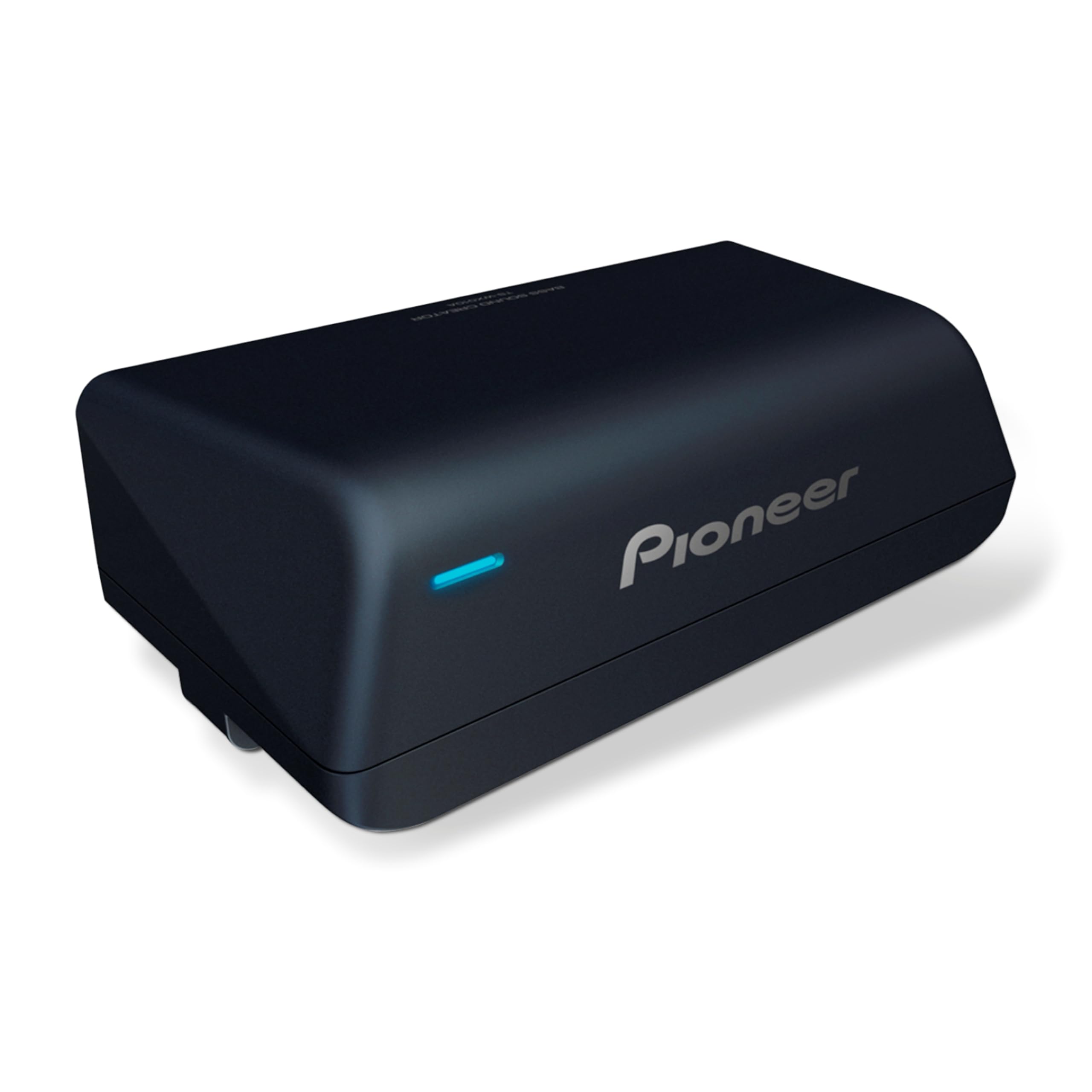
| Pioneer TS-WX010ACompact Pick | Small cabins and sports cars | 160W Max | 6.58 inches | 2.75 inches | Amazon |
| Pioneer TS-WX140DAEV tune | Electric vehicles | 250W Max | 8 inches | — | Amazon |
| JBL BassPro SL | Clean bass with audio sense auto-on | 250W Peak | 8 inches | — | Amazon |
| Kicker 11HS8 | Punchy rock and pop in tight cabs | 150W RMS | 8 inches | 3.125 inches | Amazon |
| Rockford Fosgate P300-8P | Refined depth near 12-inch output | 300W | 8 inches | 5.6 inches | Amazon |
| Alpine PWE-S8 | Musical, tight bass in small cars | 240W Peak | 8 inches | — | Amazon |
| Kicker 46HS10 | Bigger impact from a 10-inch driver | — | 10 inches | — | Amazon |
| JBL BassPro SL2 | Premium build and clean 8-inch kick | 125W RMS | 8 inches | — | Amazon |
In‑Depth Reviews
1. Rockville RW8CA
The 8-inch chest-thumper that proves you do not need a trunk box to feel your music.
You get a serious 600-watt peak punch from Rockville, yet the sealed enclosure stands just 2.7 inches tall, so it slides under the passenger seat of a sedan or the rear seat of a Wrangler without drilling. The 150-watt RMS amplifier drives that 8-inch driver with a 100dB sensitivity rating, meaning it gets loud on modest power — and the included wired bass knob lets you dial the thump up or down per song from the dash.
What wins people over is the sound — buyers report it “kicks it at 60-80 hz and vibrates your chest,” which is exactly the tactile feel most under-seat buyers want. The compact size earns its own wave of praise, with truck owners slipping it behind the driver’s seat of a 2-door Jeep with zero drilling. It is the crowd favorite — sitting comfortably above 4 stars across 600+ ratings, which is a strong vote of confidence for a budget-priced unit.
The honest trade-off is that this is not a full-range audiophile sub. The frequency response tops out at 150Hz, and the real magic lives in that 60-80Hz zone, so it is about the kick, not the deepest sub-bass sweep. You also get useful protections — thermal, short, and overload circuits — and a phase switch to time-align it with your door speakers.
The Punch Line
- 600W peak output makes music feel physical, not just audible
- 2.7-inch slim profile fits tight spots under seats
- Wired remote bass knob keeps control at your fingertips
- Auto turn-on tech with high-level input simplifies factory radio hookup
Know The Limits
- Frequency range narrows around the 60-80Hz kick zone
- Audiophiles wanting full sub-bass lows should look elsewhere
Grab it for: the strongest per-dollar chest-thump in a package thin enough to vanish under a seat.
Look past it if: you need deep, wide-range bass rather than a punchy mid-bass kick.
2. Pioneer TS-WX010A
Tiny footprint, surprising depth — built for Miata-sized cabins where space is a luxury.
This Pioneer hides a 160W max amplifier and a 6.58-inch driver inside a body just 2.75 inches tall, and it is the go-to for sports cars. A Miata owner summed it up perfectly: it fills the bass void without being thunderous — exactly what a tiny roadster needs. The compact size shows up in nearly every owner story, and the 4.3-star average across a few hundred ratings backs up the consistency.
The engineering here is about clean integration, not brute force. An adjustable low-pass crossover (50Hz – 125Hz) lets you blend the sub with your door speakers, and the high-level input means it can grab signal straight from a factory radio. Owners mention it connects easily to a stock stereo, which is the whole point of an all-in-one unit — no separate amp, no external crossover.
The catch, as customers note, is that the box ships without RCA cables or a line output converter, so if your setup needs them you will add that to the install. One common routing: use a fuse tap for remote power, since this model does not sense signal on its own. The low range gets mixed feedback — it is a bass enhancer, not a subwoofer that will shake your mirrors.
Perfect for: small-cabin owners — Miatas, Elantras, single-cab trucks — who want a clean low-end fill with minimal install fuss. The 160W output beats the stock gap without rattling the roof.
3. Pioneer TS-WX140DA
The rare subwoofer engineered to add bass without draining your EV’s battery range.
Pioneer built this one specifically for electric vehicles, and the spec that matters is the current draw: only 4.3 amps on its built-in high-efficiency 170-watt Class-D amplifier. That means you get 250W max of added low end without noticeably cutting into your driving range — a real concern for EV owners that most subs ignore entirely.
Beyond the EV angle, this 8-inch unit gives you three selectable listening modes — Deep, Dynamic, and Natural — so you can shape the bass to the music and your cabin. Sensitivity runs 95dB in Deep, 100dB in Dynamic, and 98dB in Natural, which keeps output clear and distortion low even at higher volumes. Owners praise the clean, subtle bass that integrates rather than bloats, and the build quality earns consistent compliments.
Two honest caveats: the included wired bass control has a long 16.25-foot cable that some find bulky, and speaker-level input requires cutting or splitting the factory wire. A rare unit has arrived defective with a broken reset button, though the larger pattern across reviews is strong sound and easy fit under the seat as advertised.
Reach for it if: you drive electric and refuse to give up bass for battery life — the 4.3-amp draw makes this the guilty-free upgrade.
Think twice if: you want window-rattling output; this is tuned for clean luxury-car-style depth, not attention-seeking thump.
4. JBL BassPro SL

The all-in-one fix that rescues weak factory systems with 250 watts of JBL authority.
JBL’s BassPro SL packs a 250-watt peak punch (125 watts RMS) from an efficient Class-D amplifier, and it has a trick the others lack — audio sense auto-on. That means it wakes up when it hears signal from your factory head unit, so you do not need to run a separate remote turn-on wire. Owners regularly use it to rescue weak stock systems, like the Ford B&O setup that one listener called “wimpy” until this filled in the lows.
The 8-inch driver pairs with soft-start turn-on (a feature that prevents the annoying pop in your speakers when powering up), and the speaker-level inputs make it a natural bolt-on for stock radios. Install stories are consistent: it is compact, fits anywhere, and completes the sound without overwhelming the cabin. It draws strong praise for sound quality more than any other single trait, and the 4.4-star average across 700+ ratings makes it among the most-trusted picks in this list.
The recurring theme in owner feedback is that it is powerful enough to be too much if you crank it — one Porsche owner found it overpowering for a passenger. Mounting it on foam blocks or insulating it does matter, since the aluminum chassis can vibrate against the floor if left loose.
Best for: drivers with factory stereos who want a smooth, auto-waking bass upgrade. Keep in mind: it can overpower small cabins — start with gain low and tune up.
5. Kicker 11HS8

A 150-watt RMS Hideaway that brings clean, punchy bass to rock and pop in tight cabins.
Kicker’s Hideaway is an institution in this category, and the 11HS8 delivers 150 watts RMS (at 14.4V) from an 8-inch internal sub in a body that measures 13 7/8 x 9 3/8 x 3 1/8 inches. That is slim enough to tuck under a front seat or angle under a rear seat, and the included nylon straps with Velcro fasteners make securing it simple. Owners call it ideal for trucks and tight cabins, delivering more bass than they expected.
The sound signature leans punchy and crisp rather than boomy — reviewers find it perfect for rock and pop, and it slots in cleanly at a 70Hz crossover balance (the frequency where the sub hands off to your main speakers). It is the most-reviewed sub in this lineup, with sound quality by far the most-praised element, and that scale of feedback gives you confidence in the core product.
The trade-off is real, though: the install can fight you. Multiple owners found the wires too short, needing extra cable, a line output converter, and sometimes an ANC disconnect in modern vehicles. And while most units are flawless, a smaller share has reported failure — one owner’s unit died the next day with a blue LED and no sound, and durability complaints appear in the long tail of reviews. Break-in time is real here; the bass tightens up after a couple of hours.
The strong suit: 150W RMS of punchy, clean bass in a genuinely compact package. The catch: budget extra wire and patience for the install — and this one is taller than some seats allow.
6. Rockford Fosgate Punch P300-8P

The 300-watt benchmark that gets startlingly close to 12-inch output from an 8-inch shell.
This is the most powerful option in the lineup on continuous output — an internal 300-watt Class-D amplifier drives the 8-inch driver, and the numbers show up in the listening. Owners say it beats stock 8-inch subs and approaches 12-inch performance at reasonable volumes, which is remarkable for a package that measures 11.4 x 17.6 x 5.6 inches. The 4.6-star average is the highest in this article, and it is built on deep praise for sound quality and how easy it is to install.
The flexibility is what earns the premium. It has an adjustable 12dB/Octave low-pass crossover, an on-board bass boost EQ, and a phase switch, plus both speaker-level inputs for factory systems and line-level inputs for aftermarket head units. The included remote Punch level control lets you adjust bass on the fly. It is genuinely thin for the power, fitting behind rear seats and in tight spots, and the Rockford Fosgate build quality carries a full 1-year warranty.
The honest limit: this is a ported design, so at high drive levels you can hear port air noise, and the gain knob becomes less effective beyond a third of the way up. It is built for daily bass that fills out your music, not for pounding. One owner put the value bluntly — prove him wrong if you can find better sound for the money.
Why It Leads
- 300-watt built-in amp delivers near-12-inch output
- 4.6-star average is the best in this lineup
- Full crossover, EQ, and phase control for fine tuning
- 1-year warranty on a trusted build
The Fine Print
- Ported design can hiss with air at high volume
- 5.6-inch height needs more clearance than slimmer rivals
- Not built for aggressive, window-rattling output
The verdict: the premium pick for anyone who wants the most refined, powerful bass that still hides away — just measure your seat height first.
7. Alpine PWE-S8

The nimble 8-inch that plays bass guitar and piano with tuneful agility, not just thump.
Alpine’s PWE-S8 is the choice for music lovers who want to feel the low end without losing the notes. It runs on a built-in Class-D amplifier with 240-watt peak (120 watts RMS) and an 8-inch high-excursion woofer, and the frequency response stretches from 32-150Hz, which is a wider, deeper range than most rivals here. Owners describe tight, controlled bass that fills out the spectrum below 50Hz — you hear the bass line, not just a drone.
Install flexibility is a standout. It fits under the driver’s seat of a Jetta, under the rear seat of a Jeep TJ, and even tucks into a trunk under the spare tire when seats are too tight. The 4.5-star average across 700+ ratings is a strong, trusted score, and the praise for sound quality and build quality is consistent. A remote level control gives you on-the-fly volume adjustment across genres.
Two caveats from the field: it is not for huge SUVs, where the 120-watt RMS gets lost, and the ground connection is fussy — several owners needed to sand to bare metal before it powered on. Once that is sorted, it is a clean, musical addition that plays well with a factory or aftermarket deck.
Pick it for: accurate, tuneful bass that reveals instruments instead of just shaking the cabin. skip it if: your ride is a large SUV and you demand serious output.
8. Kicker 46HS10

A 10-inch Hideaway that upgrades the class with more power in a tough all-aluminum frame.
Kicker’s bigger Hideaway swaps the 8-inch driver for a 10-inch one, delivering more low-frequency impact while staying low-profile — it is only two millimeters taller than the HS8. The all-aluminum frame shrugs off the rattles that plastic enclosures develop, and the included remote control lets you change bass output without touching the radio volume. The 4.4-star average across 800+ ratings gives it one of the largest, most-established feedback bases in this list.
It is packed with integration tools: an adjustable low-pass crossover, a variable +6dB bass boost, a phase switch, and two auto turn-on options — DC-offset or signal sensing. The quick-connect Molex plug and harness bundles power, signal, and remote turn-on, and high- and low-level inputs mean it works with nearly any factory or aftermarket head unit. Owners describe it as chest-hitting when properly mounted, and it hides in trunk compartments or under rear seats in full-size trucks.
The strongest pattern in owner feedback is the break-in curve — several buyers were unimpressed at first, then after a couple of hours of play it “hits clean and booms.” Mounting matters enormously; it needs a solid bracket or strap to transfer vibration, otherwise it loses impact. Value gets mixed reviews, so if you are looking for sheer output per dollar, the 8-inch siblings give you more bang.
Reach for it if: you want a 10-inch’s bigger low-end presence without sacrificing your cabin space. Know this: budget for proper mounting and a break-in period before judging it.
9. JBL BassPro SL2

The refined successor that brings 125W RMS of clean, premium-feeling bass to stock systems.
The SL2 built on everything that made the original BassPro SL a favorite, keeping the 125W RMS output on an 8-inch driver while adding a bass boost from 0dB to +9dB at 70Hz. The frequency response covers 35Hz to 120Hz, which is a practical band for filling out a factory system. Owners consistently call out that it “feels premium as expected from JBL,” and it has proven itself in a 2025 Jeep Gladiator Mojave and a Ford Maverick Hybrid — where the install was straightforward thanks to the rear battery.
This is an 8-inch sub and amp combo built for hatchbacks and small cars, where it transforms the sound of stock speakers. Owner reports are filled with lines about a huge difference in clarity and volume after the upgrade, and it delivers what one buyer described as “good boom juice” for a Civic. The gain tuning is key — it is optimal around 1/8 gain, and pushing higher drowns out the mids and vibrates the mirrors.
The downsides are honest: reliability gets mixed feedback, and one dissatisfied owner found it about as loud as a large Bluetooth speaker at maximum. Sound dampening in the doors boosts its effectiveness considerably. For most small-car owners, it is a clean, moderate bass addition — not a plate-rattler.
Choose this for: a premium-feel, clean bass upgrade in hatchbacks and compact cars with factory audio. Set expectations: moderate output by design — and tune the gain gently.
Understanding the Specs
RMS vs Peak Power
RMS (continuous) power is the honest number for how loud a sub can play without distorting, and it is what you should compare between models. Peak or Max wattage is the marketing number that shows the absolute ceiling in a brief burst. A 600-watt peak unit might only deliver 150 watts RMS, so when two subs look different on paper, compare the RMS figures first to know which genuinely hits harder.
High-Level vs Low-Level Inputs
High-level (speaker-level) inputs let you tap into the wires going to your factory door speakers, which is the easiest way to add bass to a stock radio without buying anything else. Low-level RCA inputs expect a dedicated subwoofer output from an aftermarket head unit — if your radio lacks RCA pre-outs, you will need a line output converter to bridge the gap. Check which inputs a sub offers before buying so your install does not stall.
FAQ
Will an under-seat powered subwoofer fit under my car seat?
Can I add this to my factory radio without an aftermarket head unit?
How much bass will a powered under-seat sub actually add?
What is the difference between high-level and low-level inputs?
How do I power the subwoofer in my car?
Is a 10-inch under-seat subwoofer better than an 8-inch?
Will the subwoofer drain my car battery?
Why does my new under-seat sub sound weak at first?
Final Thoughts: The Verdict
Across the board, the under-seat powered subwoofer winner is the Rockville RW8CA because it delivers the best chest-thump per dollar in a 2.7-inch package, backed by the strongest review consensus in its tier. If you want the most refined, powerful output and care about fine tuning, grab the Rockford Fosgate P300-8P — the 4.6-star crowd favorite that nears 12-inch performance. And for small-cabin sports cars and daily drivers where space is the enemy, the Alpine PWE-S8 is the one to reach for thanks to its musical, tight bass.
How We Picked
We do not accept paid placement. Every pick is matched to a real buyer and a real use-case; we do not hands-on test units.
Sources & Methodology
Specifications: manufacturer listings and product documentation. Review insights: verified customer reviews, as of August 2026. Pricing: not shown on this page (it changes often); check the current price via the retailer link.
As an Amazon Associate, GoCarLife earns from qualifying purchases. This does not affect which products we feature.