
Our readers keep the lights on and the garage heater humming. As an Amazon Associate, I earn from qualifying purchases.
Specs are compiled from manufacturer listings and verified buyer reviews and can change over time — please confirm the key details on the product page before buying.
Chasing a slow refrigerant or coolant leak by feel is a fool’s errand — the dye-and-black-light method turns a frustrating guess into a glowing, obvious answer. These kits inject a fluorescent dye into the system, and a UV flashlight makes the escape point shine like a beacon, even in tight, dark corners of the engine bay.
I’m Mo Maruf — the founder and writer behind GoCarLife. This guide is built by comparing the manufacturers’ published specifications and the patterns across verified customer reviews, so you get each pick’s real strengths and trade-offs instead of marketing spin.
We have weighed the pros and cons of five leading ultraviolet dye leak detectors to help you choose a reliable kit for your garage or workshop.
Our Picks at a Glance

How To Choose The Best Ultraviolet Dye Leak Detectors
Before you buy, you need to know which refrigerant your car or appliance uses. Most modern cars run R-134a or the newer R-1234yf, so a kit that handles both saves you from buying a second injector later. Legacy systems might still use R12, which needs a specific adapter.
Match the Injector to Your System
The injector is the heart of the kit. Some use pre-filled, single-use cartridges that guarantee a clean, measured dose every time. Others use a refillable syringe-style injector with a twist-handle, which costs less per use but demands a careful purge of air before you inject to avoid putting air into the AC system.
Don’t Forget the Light Source
The dye is useless without a proper UV light. Look for a high-intensity or LED flashlight that makes the fluorescent dye glow clearly in daylight or dark conditions. A low-quality light will leave you squinting at hoses and fittings, missing the very leak you are hunting.
Consider the Complete Kit Contents
Count the accessories. A kit that includes safety glasses, dye remover, service labels, and multiple couplers (for low-side ports and mini-split adapters) is usually worth more than a bare injector. These extras are not fluff; they are what turn a one-time tool into a complete diagnostic station.
Quick Comparison
| Model | Best For | Dye Type | Light Source | Refrigerant Support | Amazon |
|---|---|---|---|---|---|
| Mastercool 53351★ Best Overall | All-in-one value | Oil & Coolant | 12V High-Intensity | R134a / R12 | Amazon |
| Tellegloww KitMulti-System Pick | Multi-refrigerant use | Oil UV Dye | 68-LED Flashlight | R134a / R1234yf / R22 / R410a | Amazon |
| LF021 Leakfinder | Quick single-use shots | Single-Use Cartridges | UV LED Flashlight | R-134a / R-1234yf | Amazon |
| Mastercool 53451-110 | Professional refillable use | 2 oz Refillable Universal | Rechargeable Flashlight | R134a / R12 | Amazon |
| Leak Saver 6 Pack | Sealing & finding combo | Sealer with UV Dye | 51-LED UV Light | All (except ammonia) | Amazon |
In‑Depth Reviews
1. Mastercool 53351 Professional UV Leak Detection Kit
Our pick — 4.5★ from 400+ verified ratings; the strongest balance of quality and price.
The complete box that turns a retired master mechanic’s 46 years of expertise into a plug-and-play kit.
This is the kit that gives you everything in one molded case — a 50-watt 12V UV light, a 1 oz cartridge of oil-based fluorescent dye good for 10 applications, a 1 oz coolant dye, UV-enhancing safety glasses, a 4 oz dye remover, and 25 service labels. You connect the light straight to the car battery, so there are no batteries to die mid-diagnosis, and the long cord lets you move around the engine bay freely.
What wins people over here is the triple-method approach: eyes, black light, and a spray bottle all working together across AC, motor oil, and transmission systems. Buyers report it outperforms electronic sniffers, and the value is a recurring theme. The honest catch is the dye injector — the connector does not fit the R-134a port properly for some owners, and the light’s rubber lens retainer can weaken with heat and let the lens fall out after several uses.
This compact box measures 9.75 x 6.75 x 3.25 inches, making it easy to toss in a truck bed for mobile work. For a shade-tree mechanic who wants professional results without a pro-shop price tag, this remains the crowd favorite.
The Full-Package Approach
- 10 applications from a single oil dye cartridge stretches your dollar
- Battery-connected 12V light means no dead AA batteries mid-job
- Dye remover and service labels keep the workspace professional
Where It Stumbles
- Injector connector may mismatch R-134a ports, requiring a workaround
- Heat can weaken the lens retainer, letting the glass drop out
Grab it for: a one-box answer for AC, coolant, oil, and fuel leaks with a light that runs off the car’s own battery.
Plan around: the finicky injector fitting that some R-134a systems simply refuse to accept.
2. Tellegloww AC Leak Detector Kit
The only kit here that jumps between a car’s R-134a port and a home mini-split’s R410a fitting without skipping a beat.
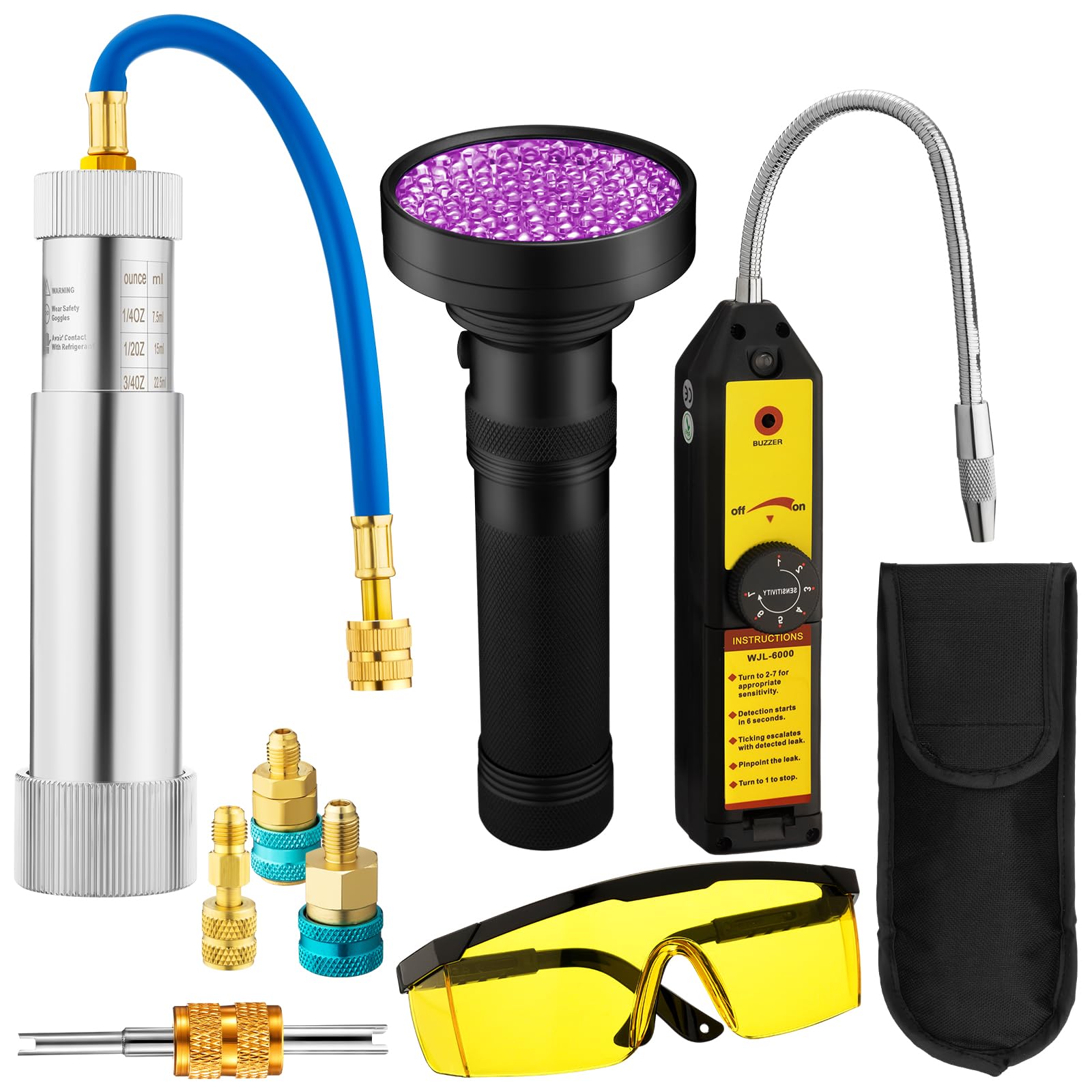
This kit is a coverage machine. The packing list reads like a full diagnostic bench: an AC oil injector, an R134a low side quick coupler, an R1234yf low side quick coupler, an R410 mini split adapter, a valve core remover, a 68-LED UV flashlight, and a pair of UV protective glasses. You can trace a leak on your car’s AC, then walk over and check a ductless mini-split at home with the same box.
The clever bit is the refrigerant detector’s adjustable probe, roughly 8.46 inches long, which snakes into tight spots where your hand cannot reach. Owners mention it nails leaks that were invisible otherwise, and the glow from the included halogen-style leak detector is the highlight. The recurring gripe is the dye injector — “everything works perfect except for the dye injector” — and one owner found the fit too small for the original hole on many cars.
The whole kit measures 9.06 x 5.91 x 4.72 inches, a bit deeper than the Mastercool 53351 above, but that extra size buys you the mini-split compatibility no other kit here offers. It is ready to detect 6 seconds after powering on, with a textured handle that stays grippy even when your hands are slick with oil.
Why It Stands Out
- R410a mini-split adapter covers home HVAC, not just cars
- Both R134a and R1234yf quick couplers included for modern fleets
- Flexible 8.46-inch probe reaches buried fittings
The Trade-Off
- The dye injector is the weak link — functional but not the star
- Fitting size may be too small for some factory ports
Choose this when: your driveway holds both a car and a mini-split, and you want one kit to cover both refrigerants.
Expect to manage: a dye injector that works but does not earn the praise the detector does.
3. LF021 Multi-System Leak Detection Kit
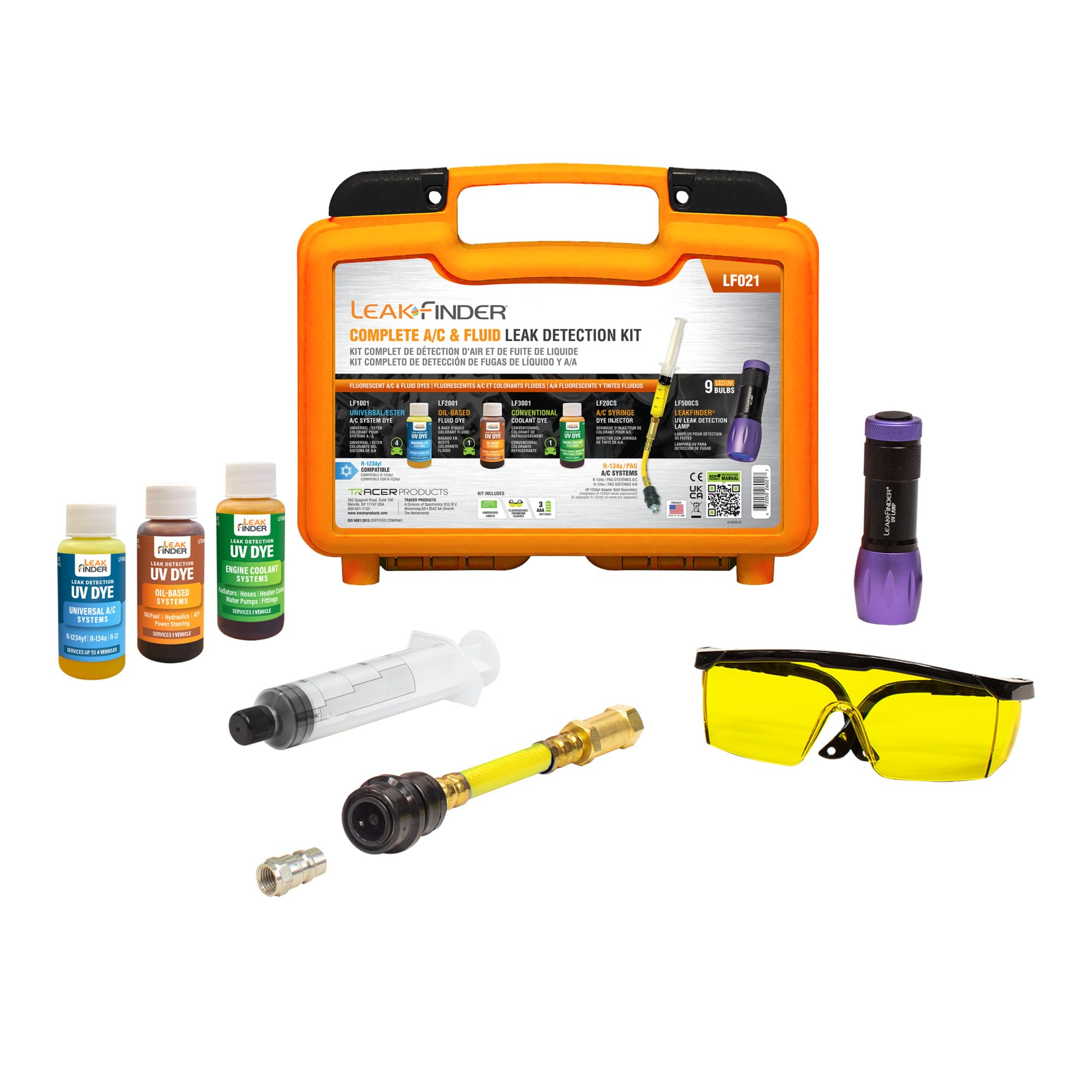
A two-minute diagnosis for intermittent leaks, thanks to pre-measured single-use cartridges that skip the messy refill routine.
Speed is the whole personality of this kit from LEAKFINDER by Tracer Products. The injector delivers a precise, pre-measured dye shot every time, which matters when you are a mobile tech bouncing between jobs and do not want to fiddle with twist-handle doses. A real-world win: one owner squirted it into a cooling system and spotted a small, isolated coolant leak on the back of the head in minutes.
It is built for modern systems, working with both R-134a and R-1234yf using OEM-approved dye that is safe for compressors and recovery equipment. The lightweight, compact design lets you run it one-handed in tight engine bays, and the kit ships with the injector, pre-filled cartridges, a service hose and coupler, and a UV LED flashlight. A veteran tech found the diagnosis of intermittent leaks went from hours to “2 minutes and that was it.”
The honest counterweight is build quality — a fair share of owners call the mostly-plastic construction “toy like,” so this is not the unit for a daily-beaten shop floor. But for a quick, clean, single-shot diagnosis, the convenience is hard to argue with.
Perfect for the road: single-use cartridges mean no cleaning, no air-purge steps, and no guesswork on dose — just inject, run, and scan.
Not for the heavy shop: the plastic body feels flimsy to several owners, so treat it as a precision tool, not a throw-around.
Reach for it if: you want the fastest, cleanest injection possible and value convenience over rugged construction.
Think twice if: you need a tool that survives being tossed into a crowded toolbox every single day.
4. Mastercool 53451-110 Rechargeable UV Leak Detection Kit

The rechargeable workhorse for a working shop, with a 2 oz refillable injector that handles a staggering 25 applications per fill.
Where the 53351 is the all-in-one starter box, this is the refillable professional sibling. Instead of throwing away cartridges, you get a durable 2 oz injector that works with R134a and R12 systems and supports oil, coolant, and refrigerant dye. The included 2 oz concentrated universal dye stretches to 25 applications, which makes the per-use cost drop fast for someone doing this weekly.
The star is the rechargeable UV flashlight, which frees you from both the car battery cord and the AA battery aisle. A full shop kit includes the injector, the hose and service coupler, dye remover, and UV-enhancing safety glasses. The twist-handle design with air purge steps gives you real control over dosing, and a shop owner called it “THE all in one kit… had everything you need to check for AC leaks.”
The risk is electronic reliability — a few customers note the UV light arrives dead or the household AC adapter blocks liquid flow, which kills the kit’s usefulness until replaced. Treat the light as the component to verify first on arrival.
The longevity play: a refillable 2 oz injector plus 25-application dye makes this the most economical per-diagnosis pick on the list.
The quality gamble: a handful of units ship with a faulty UV light or clogged adapter, so test it the day it lands on your bench.
Best for the pro: a shop tech who does multiple leak hunts a week and wants a rechargeable light plus refillable dye economy.
Heads-up: the rechargeable light and household adapter are the components most likely to need a replacement from the start.
5. Leak Saver Direct Inject Refrigerant Leak Sealer with UV Dye, 6 Pack

A sealer and a tracer in one shot — this six-pack both plugs small leaks and lights up the big ones you still need to find.
This is the only pick that does double duty. Each injector carries a polymer sealer that reacts with air and moisture at the leak site to permanently seal small refrigerant leaks, plus a UV dye that glows under a flashlight when a leak is too large to seal. The “seal it or find it” philosophy means you fix the small stuff and diagnose the big stuff in one pass.
Injection is the easiest on this list — no syringes, no hoses, no pressurized cans. You push it straight into the system with a basic manifold gauge set, and the brand notes you will still need a standard 134A to 1/4-inch charging adapter for automotive systems. It is compatible with all refrigerants except ammonia, covering R410A, R22, R134a, R1234yf, R404A, R290, and R600a across central air, cars, refrigerators, mini-splits, and heat pumps.
The six-pack comes with a 51-LED UV light and protective glasses. The dye earns consistent praise for being easy to use and great at locating leaks in the freon circuit, though the sealer’s ability to actually stop small leaks is still “jury is out” for some owners. And check your batch — a few buyers found some injectors in the pack were the blue model without the traceable UV dye inside.
The Dual-Action Edge
- Seals small leaks while dye finds large ones in a single product
- Mess-free direct injection with no syringe or hose fuss
- Six injectors cover multiple systems or vehicles
What To Double-Check
- Sealing effectiveness is questioned by some owners
- Not every injector in the pack may contain the UV traceable dye
Pick it up when: you want a preventive-maintenance sealer that also doubles as a leak locator across every refrigerant type you own.
Verify on arrival: that each of the six injectors is the UV-dye version before you rely on it for a diagnosis.
Understanding the Specs
Fluorescent Dye vs. Refrigerant Type
The dye must match the oil in your system. Oil-based fluorescent dye works for AC, oil, ATF, and fuel systems, while a separate engine coolant dye is needed for the cooling system. Check that the kit’s dye is compatible with your refrigerant — R-134a and R-1234yf are common in modern cars, while R12 needs legacy support and R410a applies to home mini-splits.
UV Light Output and Power Source
The light is what makes the dye visible. High-intensity lights (like a 50-watt 12V unit) plug into the car battery and never run out of power mid-job, while rechargeable flashlights offer cordless freedom but depend on battery health. LED lights with many individual bulbs (like 51 or 68) spread an even glow over a wide area, making small leaks easier to spot in dark engine bays.
FAQ
How does a UV dye leak detector actually work?
Will these kits work with R-1234yf refrigerant?
Can I use the same dye for engine coolant and AC refrigerant?
What is the difference between single-use cartridges and a refillable injector?
Do I need special glasses for the UV light?
Can a UV leak detector find a leak in a home mini-split?
How long does the dye stay in the system after I inject it?
Is a UV leak detector better than an electronic refrigerant sniffer?
Can a refrigerant leak sealer replace a UV dye leak detector?
Why does the dye injector sometimes fail to fit my car’s port?
Final Thoughts: The Verdict
If you want one dependable pick, the ultraviolet dye leak detectors winner is the Mastercool 53351 because it bundles the battery-powered light, dual dyes, glasses, and remover into one rugged case at a value the crowd consistently praises. If you want to cover both your car and a home mini-split, grab the Tellegloww kit for its R410a adapter and multi-refrigerant couplers. And for a shop that hunts leaks weekly, the refillable Mastercool 53451-110 makes the most sense with its rechargeable light and 25-application dye economy.
How We Picked
We do not accept paid placement. Every pick is matched to a real buyer and a real use-case; we do not hands-on test units.
Sources & Methodology
Specifications: manufacturer listings and product documentation. Review insights: verified customer reviews, as of August 2026. Pricing: not shown on this page (it changes often); check the current price via the retailer link.
As an Amazon Associate, GoCarLife earns from qualifying purchases. This does not affect which products we feature.