
Our readers keep the lights on and the garage heater humming. As an Amazon Associate, I earn from qualifying purchases.
Specs are compiled from manufacturer listings and verified buyer reviews and can change over time — please confirm the key details on the product page before buying.
That first mow of spring should be about the grass, not about whether your mower will turn over. If you are tired of lifting a 20-pound lead-acid brick every season and crossing your fingers at the key, a lithium swap fixes it. The catch is that not every lithium U1 is the same, and the wrong pick can leave you stranded mid-lawn or, worse, damage your mower’s charging system.
I’m Mo Maruf — the founder and writer behind GoCarLife. This guide is built by comparing the manufacturers’ published specifications and the patterns across verified customer reviews, so you get each pick’s real strengths and trade-offs instead of marketing spin.
Whether you ride a John Deere, Cub Cadet, or Craftsman, a U1 lithium battery is meant to be a direct swap that cranks faster and weighs less. The trick is matching the right cold cranking amps to your engine and checking your charging system. Use this guide to find the u1 lithium battery that actually fits your tractor and your routine before you buy.
Our Picks at a Glance
How To Choose The Best U1 Lithium Battery
Picking a lithium battery for your mower or tractor means looking past the brand name and checking a few numbers that determine whether it starts, fits, and survives. The three things that matter most are cranking power, physical size, and whether your machine can charge it safely.
Match the Cold Cranking Amps to Your Engine
Cold Cranking Amps (CCA) is the punch your battery delivers to spin the engine on a cold morning. A small single-cylinder mower might start fine on 320 CCA, while a bigger tractor or a generator wants 480 or even 650 CCA. Buy too little and your starter will struggle; buy much more and you simply have headroom for accessories and cold weather.
Verify Your Charging System Is Regulated
Lithium batteries pair with a smart Battery Management System (BMS) that cuts power to protect the cells. That BMS can be confused by an unregulated charging system that spikes above about 14.6 volts. If your mower was built before the mid-2010s without a voltage regulator, confirm the output range before you install lithium, or you risk damage to the battery and your electronics.
Quick Comparison
| Model | Best For | Capacity | CCA | Weight | Amazon |
|---|---|---|---|---|---|
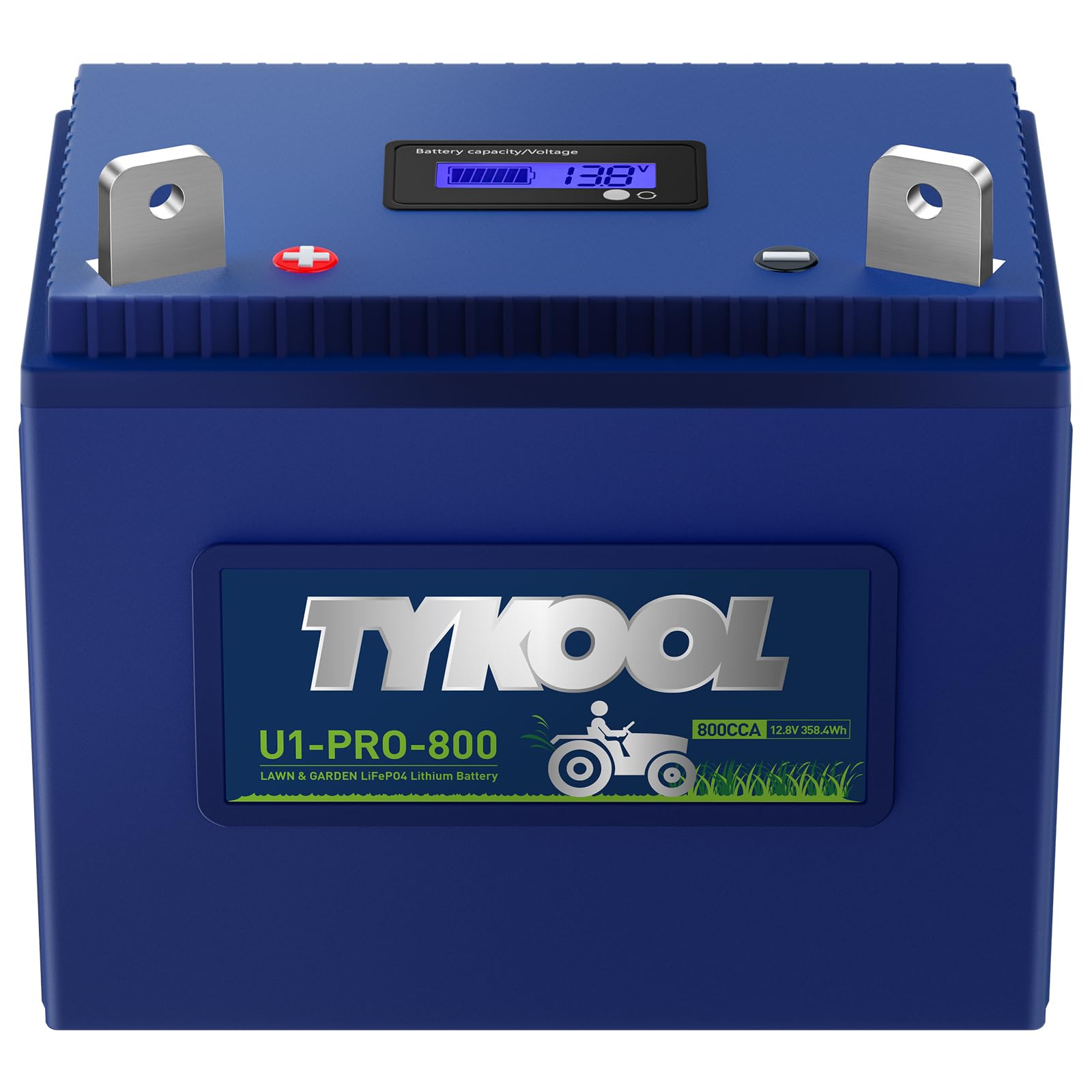
| TYKOOL U1-Pro-800★ Best Overall | Big tractors that need max cranking | 28 Ah | 800 A | 8.1 lbs | Amazon |
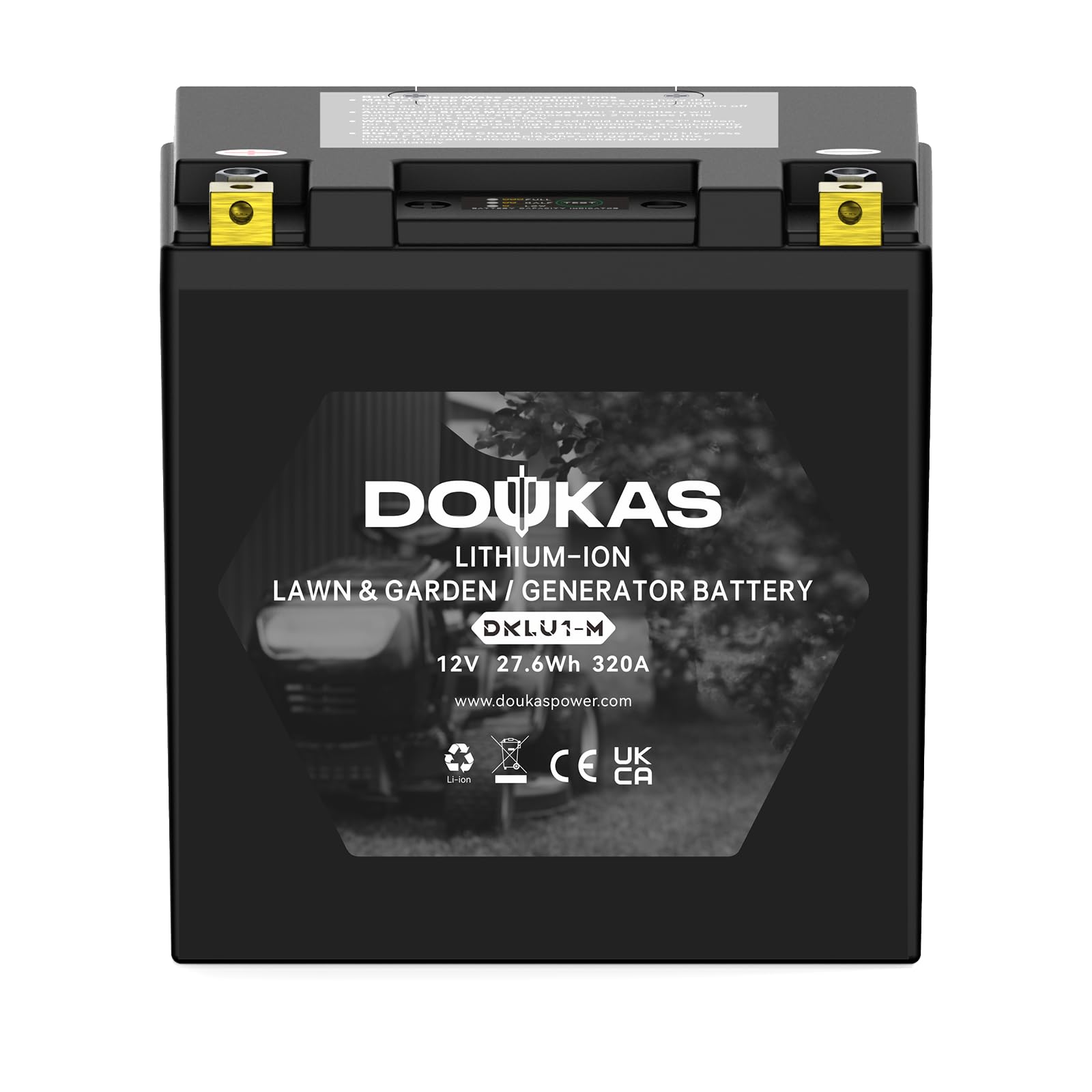
| DOUKAS DKLU1-MBudget Value | Budget drop-in for small engines | 2.3 Ah | 320 A | 0.5 lbs | Amazon |
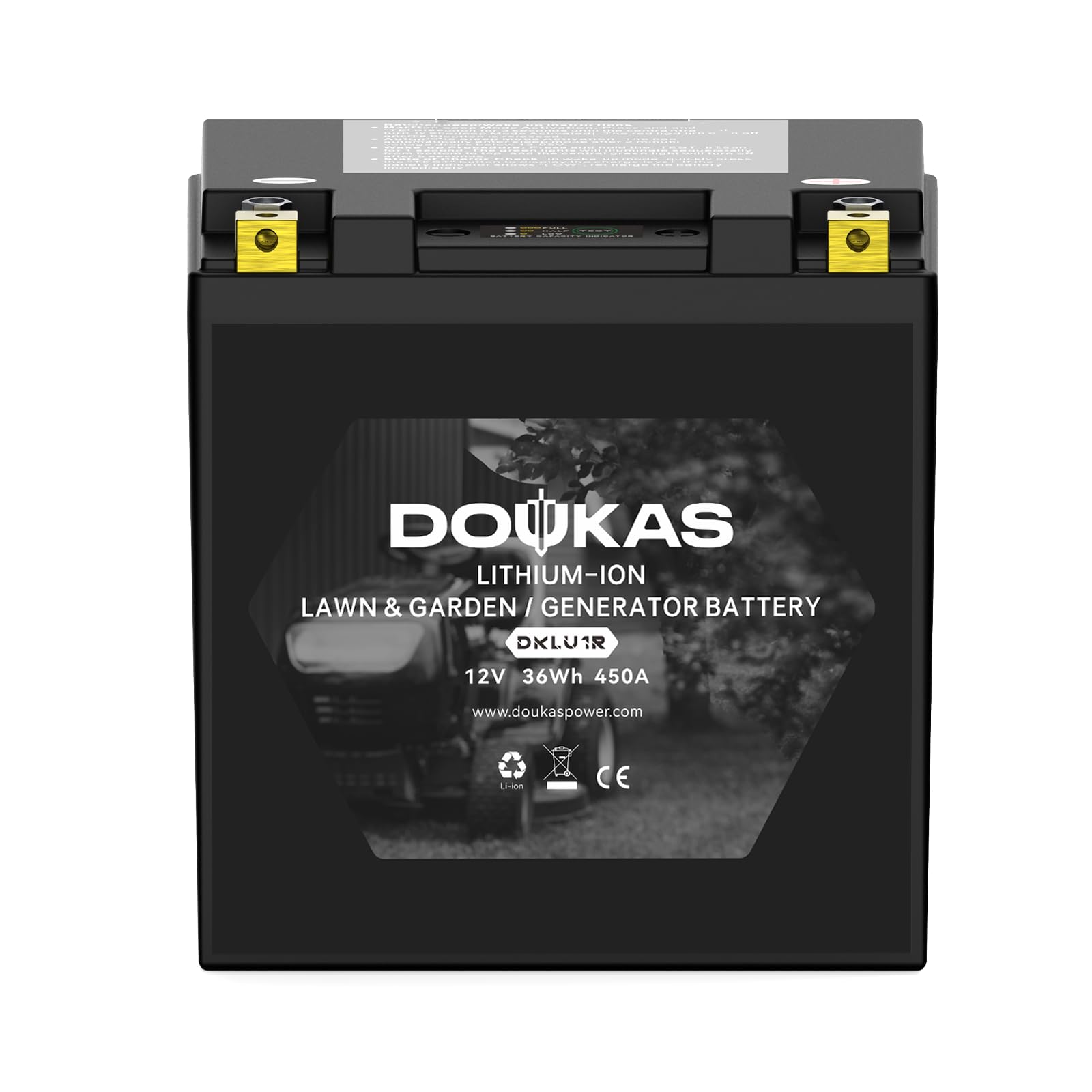
| DOUKAS DKLU1-RSmart Pick | Lightweight pick with smart sleep mode | 3 Ah | 450 A | 3.3 lbs | Amazon |
| Forgetyo U-R9 | Mid-sized tractors with cold starts | 10 Ah | 650 A | — | Amazon |
| TYKOOL U1-M-480 | Reliable daily use with a voltage display | 12 Ah | 480 A | — | Amazon |
| Mighty Max ML35-12LI-U1 | Solar generators and light duty | 35 Ah | — | 12 lbs | Amazon |
| Redodo 12V 20Ah | Marine outboards and vibration | 20 Ah | 800 A | 9.7 lbs | Amazon |
| AMPXELL U1-480 | Side-by-sides and go-karts | — | 480 A | — | Amazon |
In-Depth Reviews
1. TYKOOL U1-Pro-800
The heavy hitter that brings 28 amp-hours and a digital battery gauge to big tractors.
You get a battery that pushes 800A of starting current and a 28 amp-hour capacity that matches the same energy as the lead-acid unit you are removing. On a cold morning or the first mow of the season, that cranking muscle spins John Deere, Cub Cadet, and Craftsman tractors instantly. It weighs 8.1 pounds, which is more than many lithium rivals, but that extra mass buys you real runtime for accessories and long mowing sessions.
Owners love the built-in digital SOC (State of Charge) screen that shows live voltage and battery health at a glance, and the dual protection of a V0 fireproof shell plus an IP66 all-weather build means wet grass and dust are not a worry. The smart BMS delivers 5-layer protection against overcharge, over-discharge, and short circuits. One critical note: it needs a regulated charging system producing 13.8V-14.6V DC, so older mowers predating 2015 need a voltage check first.
Feature-wise it is a true drop-in for U1-9 and U1-7 models at 7.6 x 4.8 x 6.9 inches with standard polarity (positive on the left). Buyers report it cranks faster and better than any lead-acid they have used, and the double-boxed shipping keeps the unit secure in transit. A rare complaint mentions a vaporware-level failure causing a regulator issue, but the majority of owners would never go back to lead-acid.
fast charging speed
- Massive 800A cranking power starts big engines easily
- 28Ah capacity matches a standard lead-acid battery’s runtime
- Digital display shows real-time voltage and battery health
- IP66 waterproof housing handles wet grass and dust
heavy build weight
- Requires a regulated charging system (13.8V-14.6V) to stay safe
- Heavier than most lithium picks at 8.1 pounds
- Not meant for pre-2015 mowers without a voltage regulator
top performer: This is the pick for tractor owners who want lead-acid-matching capacity with lithium starting punch and a live battery gauge.
backup only: your mower predates 2015 or lacks a regulated charging system, since the BMS needs that voltage range to stay protected.
2. DOUKAS DKLU1-M
A featherweight 0.5-pound starting battery that disappears into small mowers and generators.
At just 0.5 pounds, this is the lightest battery in the lineup and an easy lift for anyone tired of hauling lead-acid. It delivers 320A of starting power, which suits smaller single-cylinder engines and generators, and it is a direct replacement for U1-5, U1-7, and U1-9 models. The IP65 waterproofing and internal shock-absorbing layer mean rain, mud, and vibration are handled season after season.
Compatibility is broad — it fits Craftsman, John Deere, Cub Cadet, Husqvarna, Ariens, Troy-Bilt, and Toro machines. However, the manufacturer explicitly excludes helicopters, automobiles, UTVs, and v-twin motors, and recommends it only for vehicles made after the year 2000. This is where buyer feedback splits: owners praise the lightness and easy charge status visibility, but a notable share report the battery suddenly cutting out mid-mow and needing a test-button reset.
The real trade-off here is the capacity. At 2.3 amp-hours, it has far less energy storage than bigger picks like the TYKOOL 28Ah unit, so it is built for starting, not for running accessories. It also requires a dedicated lithium charger, which is not included. For a tiny mower that only needs a reliable crank, this is a fine budget entry, but it is not the one to trust for heavy use.
space saver: you want the absolute lightest drop-in for a small mower and already own a lithium charger.
power hungry: you need dependable all-day runtime or run a bigger engine, since the 2.3Ah capacity and intermittent shutdown reports are real limits.
3. DOUKAS DKLU1-R
A 3.3-pound battery with a smart sleep mode that holds its charge for months of storage.
The defining feature here is smart sleep mode, which automatically puts the battery into a low-power state when not in use so it is ready for the next cut. That, plus a 450A CCA rating, means this unit can cover any previous model with CCA up to 450, including the 110, 150, 190, 200, 210, 230, 245, 270, 300, 320, 340, 350, and 400 ratings. It weighs just 3.3 pounds, which the maker says is one-fifth the weight of a traditional battery.
The built-in BMS guards against overcharge, over-discharge, overheating, and freezing temperatures, and the IP65 waterproofing plus shock-absorbing layer make it fine for outdoor life. Owners are genuinely surprised by the weight — the review pages sum it up: “Feels like an empty plastic box, but it has a test button and it works awesome.” It is a direct replacement for U1-5, U1-7, U1-9, and U1-11 models, fitting Craftsman, John Deere, Cub Cadet, Husqvarna, Ariens, Troy-Bilt, and Toro.
The catch is longevity reports. A handful of owners had the battery die or refuse to recharge within the first month, and the manufacturer did not always answer inquiries promptly. The 3 amp-hour capacity is also modest, so this is a starting battery first. For a 36″ zero-turn or a smaller tractor that sits for weeks between uses, the sleep mode is a genuine convenience that heavier lithium rivals do not offer.
off-road pick: owners who park their mower for long stretches and want a battery that preserves its charge while sitting.
garage queen: anyone who needs high amp-hour capacity for accessories, since 3Ah is a lean reserve and durability reports are mixed.
4. Forgetyo U-R9
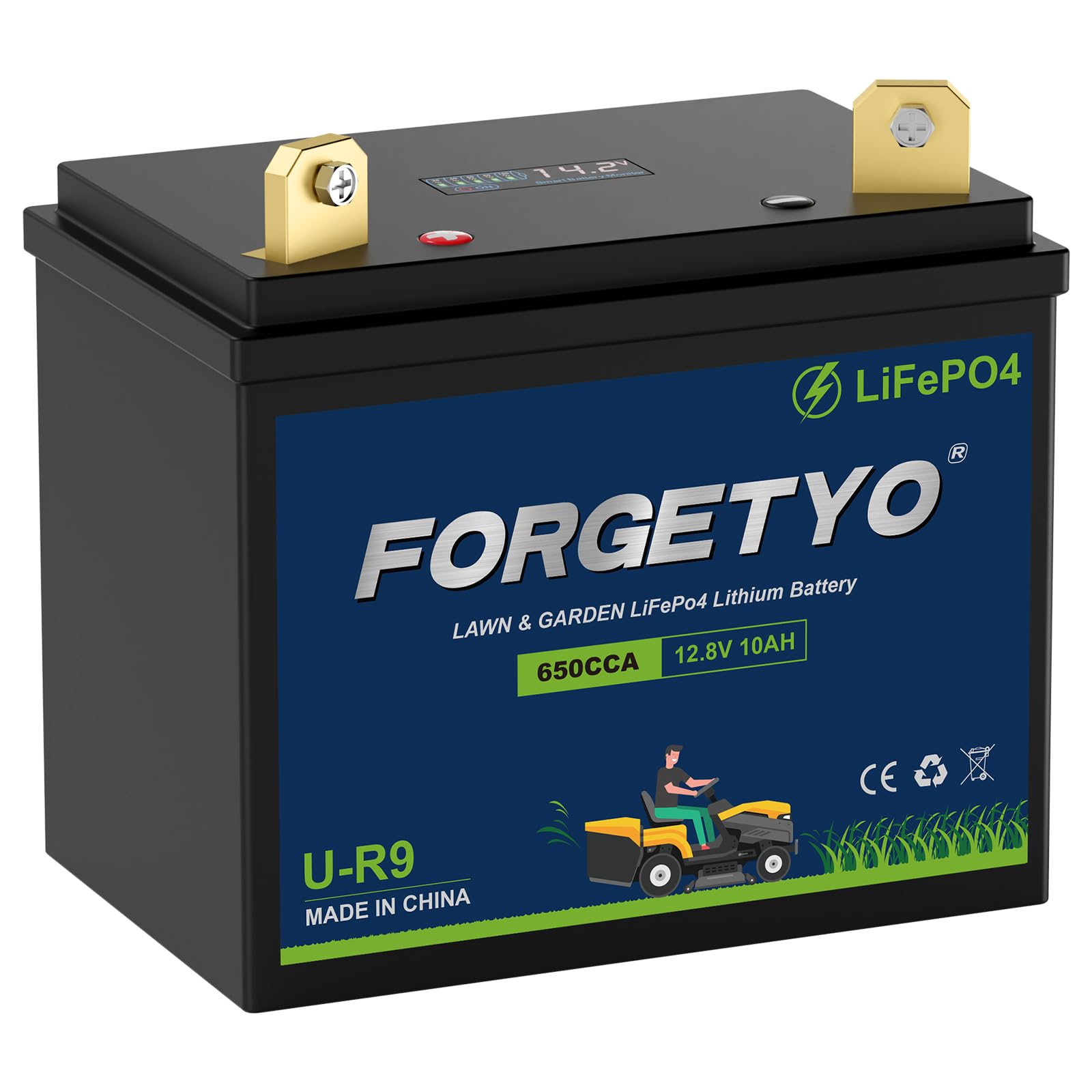
A 650-CCA starter built for cold spring mornings when lead-acid batteries give up.
The big selling point is 650 CCA, a rating tailored for mid-sized lawn tractors and professional mowers that need a strong surge to ignite instantly in the cold. It carries a 10 amp-hour capacity and weighs only about a third of a lead-acid battery, so the mower fires off right away. The maker rates it for 2,000 discharge cycles versus 300 for lead-acid, justifying the premium price.
Safety comes from a built-in BMS that cuts the circuit on overcharge, over-discharge, short circuit, and overheating. For winter storage, the lithium chemistry holds its charge for months without a battery tender, so you can disconnect it and skip the jump-start come spring. It charges through a 14.6V DC lithium charger with a recommended 14.6V 2A rate.
Buyers consistently note how comically light it is compared to conventional lead-acid, and how quickly the engine cranks. It works across John Deere, Cub Cadet, Husqvarna, Craftsman, Toro, Ariens, Poulan Pro, and Troy-Bilt machines. The honest trade-off is price — It costs about twice as much as lead-acid, so savings only appear if it lasts twice as long.
value choice: professional-grade cold-starting power and a two-year warranty on a battery that weighs almost nothing.
frequent swaps: it carries a premium price, so the value only lands if the long cycle life delivers as promised.
5. TYKOOL U1-M-480
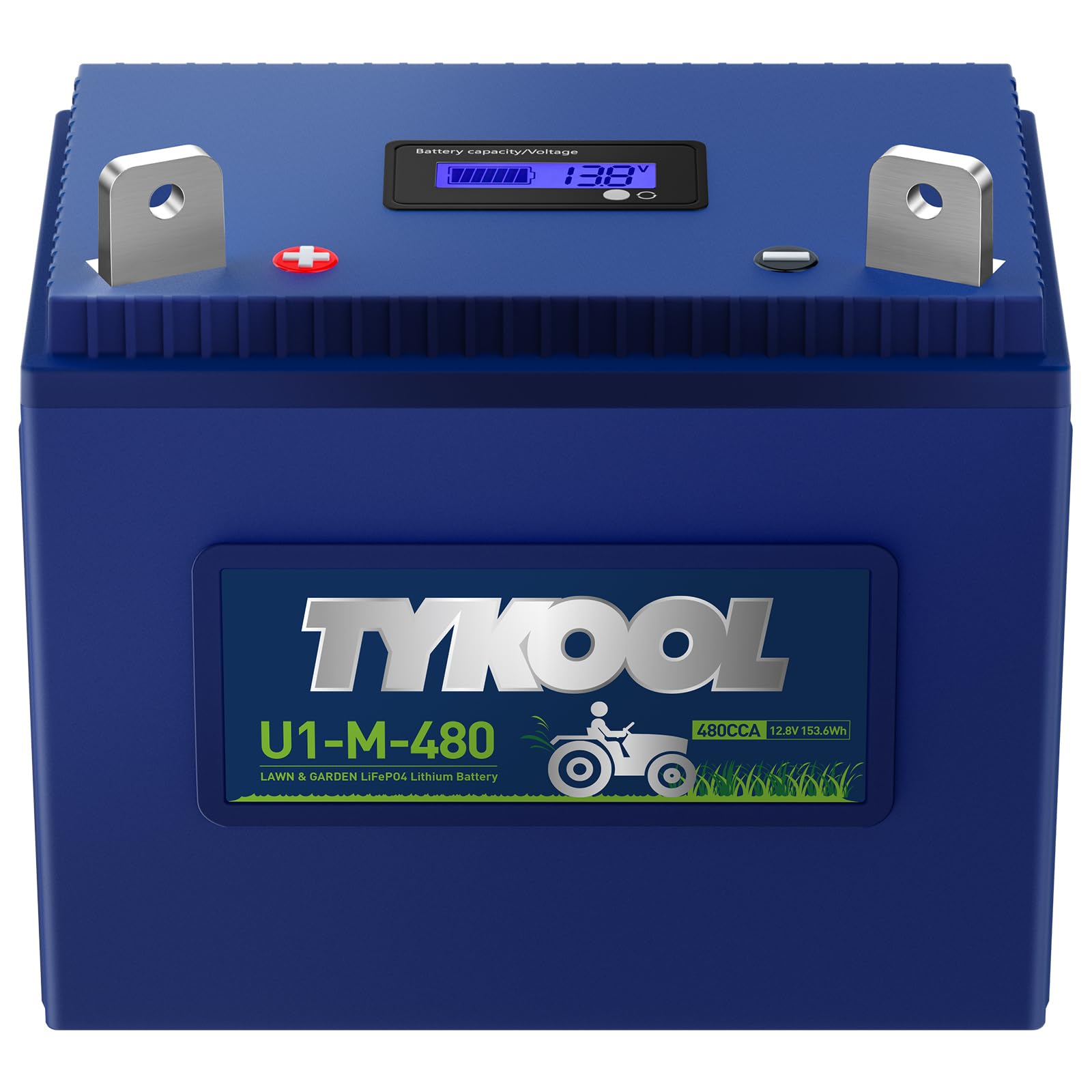
A reliable 480-CCA workhorse with a voltage display and a decade of expected service.
This TYKOOL carries 480A of cold cranking power and a 12 amp-hour capacity, which the maker says is 50% more than entry-level models. That extra capacity handles frequent restarts and electronic accessories without strain. It is rated for over 3,000 cycles, which the brand says equals a decade of maintenance-free service., and it is a small enough unit to drop into a 2025 Toro TimeCutter without removing the covers.
The integrated SOC (State of Charge) monitor shows real-time voltage on a digital display, and the smart BMS layers 5-way protection covering overcharge, discharge, heat, short-circuit, and balance. The IP66 waterproof housing and V0 fireproof enclosure stand up to engine heat, pressure washes, and damp grass. It replaces U1-9, U1-7, and U1-5 models at 7.6 x 4.8 x 6.9 inches, but it is not suitable for the compact 725-17335 tray.
Owners mention it starts instantly on the first mow, survives cold winters without issue, and that the voltage display is genuinely handy. The company stands behind the product — one buyer had a unit fail at 11 months and received a quick replacement that charged to 100%. The downsides: a small minority saw failure around the 5-month mark, likely a BMS issue, and it still needs a regulated charging system between 13.8V and 14.6V.
all-rounder: you want a dependable daily driver with a live voltage gauge and the brand support to back it up.
extended trips: your mower has an unregulated charging system, since the BMS needs that 13.8V-14.6V range to operate safely.
6. Mighty Max ML35-12LI-U1

A 35Ah lithium unit that is really built for solar generators, not just mowers.
This battery steps out of the mower lane and into the solar generator world, designed as a direct drop-in for the Goal Zero Yeti 400. It packs a 35 amp-hour capacity in a U1 case that measures 7.56 x 5.19 x 6.69 inches, and it weighs 12 pounds — still lighter than the lead-acid it replaces. The brand rates it for a 2,500 cycle life expectancy, the key reason for its higher price.
Safety is covered by a built-in BMS that handles high voltage, low voltage, high current, high temperature, short circuit, and overcharge protection. You can link up to four identical batteries in parallel or series, which expands your storage. The catch is that you must use a compatible lithium charger, and the internal-thread terminals need a firm connection or heat builds up and damages the cells.
Fitment is the recurring theme in owner feedback. In an older Goal Zero Yeti 400, the battery is slightly fatter and taller, so the case closes with effort and is not fully rain-safe. It is a drop-in only for the lithium version of the Yeti 400, not the older AGM model, so verify your unit first. That one mismatch aside, customers note it runs a shower pump and lights longer than lead-acid ever did, and the weight savings are significant.
marine use: you want to modernize a Lithium Yeti 400 with a lighter, higher-capacity cell that outlasts lead-acid.
daily driver: the fit is snug in older units and it is not compatible with the AGM version of the Yeti 400.
7. Redodo 12V 20Ah
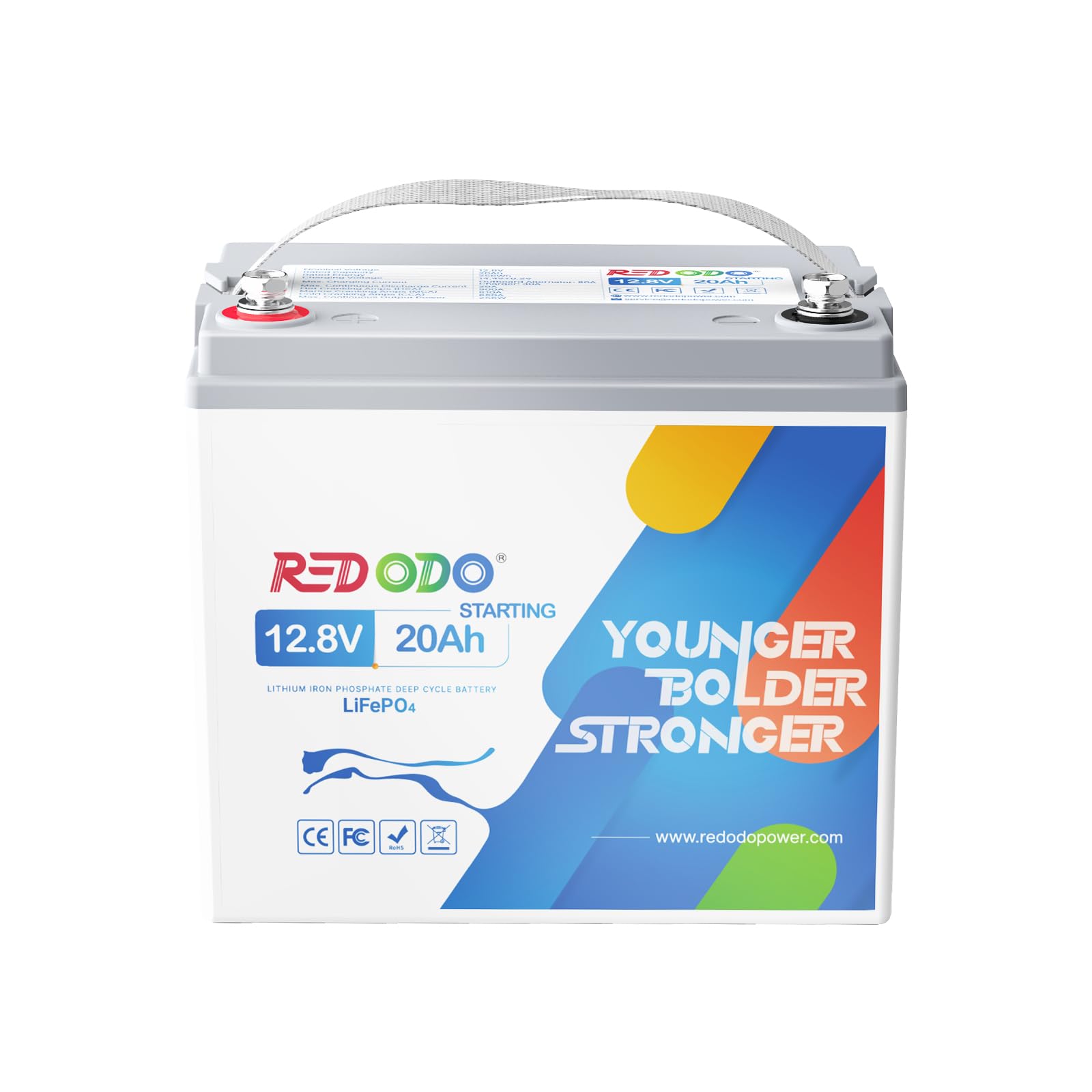
A marine-minded 800-CCA battery with a sheet-metal shell built to shrug off boat vibration.
Redodo aimed this at the water, using prismatic cells that resist shock and vibration better than soft-pack cells, plus a proprietary sheet-metal design that fights swelling. It pushes 800 CCA and 20 amp-hours, and it weighs 9.7 pounds — lighter than the lead-acid it replaces. The IP67 waterproof and dustproof rating means spray and splashes are not a concern on deck.
It charges in 40 minutes on a 30A current, a real convenience between trips. It comes with a 20A BMS for safety, and It meets ABYC standards and passes FCC, CE, RoHS, and UN38.3 testing.. Owners running a Tohatsu 15hp or a 75hp Mercury 4-stroke report strong starting with ample power and plenty of cranking for the size.
This one has real limitations to weigh. It is not for outboard motors built before 2005, nor for models without voltage regulators, and a couple of reviewers point out the battery depleting from 13V to 3V over a handful of trips. The 5-year warranty is a point in its favor., but the mixed reliability reports mean it is a gamble for a primary boat starter. For the right modern outboard, it is a lightweight, high-cranking win.
weight saver: boaters with a post-2005 outboard who want a vibration-proof, fast-charging 800-CCA starter.
freezing temps: reliability is inconsistent, and it must pair with a voltage-regulated outboard to avoid a dead battery mid-trip.
8. AMPXELL U1-480
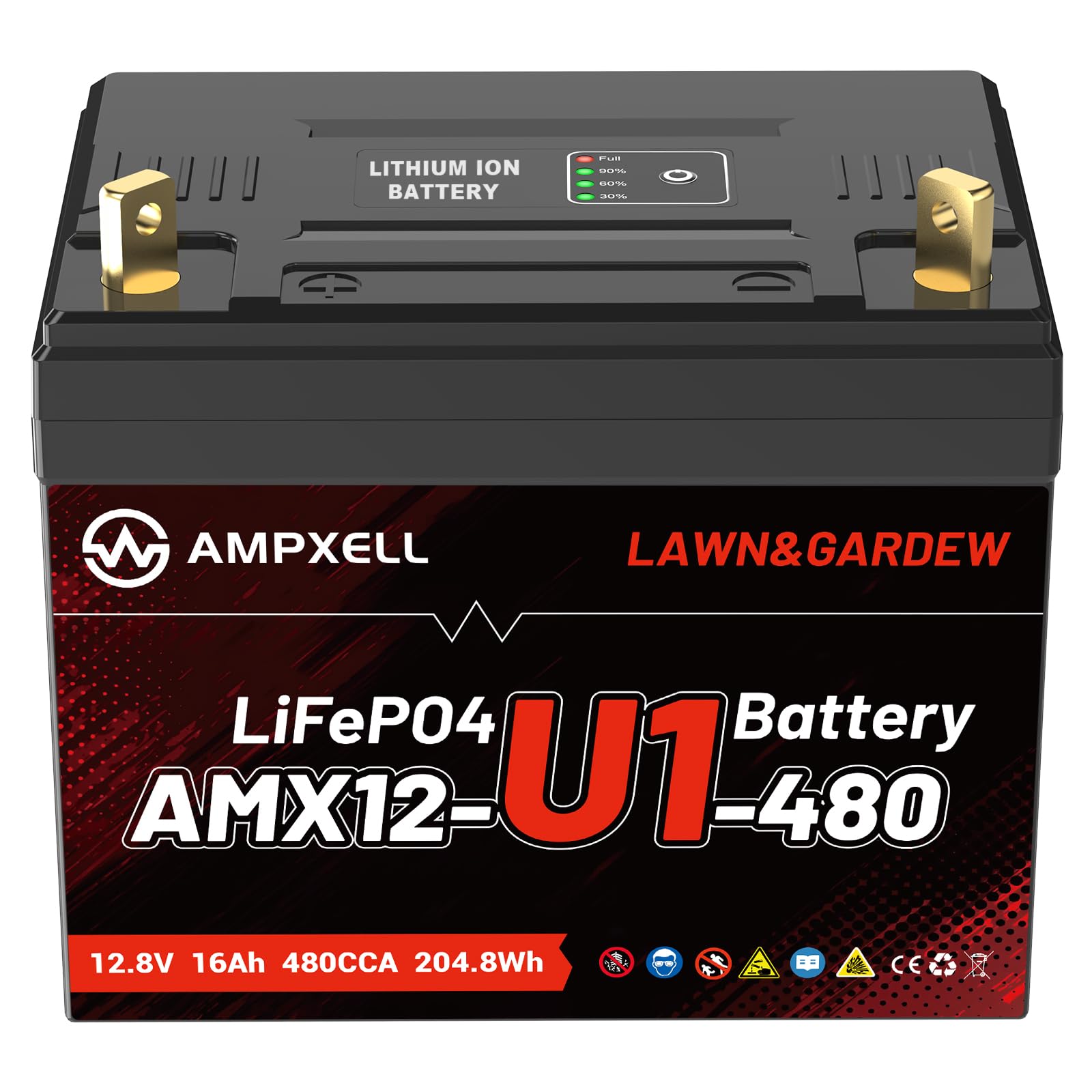
A 480-CCA drop-in so light it fools you, with a push-button charge gauge for quick checks.
The standout trait here is the weight — the maker claims it is only one-third the weight of a lead-acid battery, and owners confirm they could barely believe it when they lifted it. It delivers 480A of cold cranking amps, which fits most riding mowers, lawn tractors, and generators, plus smaller toys. The push-button battery level indicator shows charge in 25% increments, a small but genuinely handy touch.
It is a universal-fit drop-in for most riding mowers and tractors, working across John Deere, Cub Cadet, and Craftsman, and it has posts on both sides, which makes it a great fit for go-karts and other small machines. The LiFePO4 chemistry is rated for 2,000+ cycles., and the built-in BMS handles protection so it is maintenance-free. Owners using it in a 2023 Yamaha Rmax side-by-side report great cranking.
Compatibility is broad, drawing positive reviews from owners who run it in side-by-sides, go-karts, and mowers alike. The main gap is that the listed customer service phone number is missing, which is a concern if you need support. It also arrives needing a first charge. For the price, it is a lightweight, high-cranking unit that fits more than just lawn equipment.
quick install: a versatile, ultra-light 480-CCA starter that works in mowers, side-by-sides, and go-karts.
winter climates: the missing customer service line and the need to charge it fully before first use are the two real nits.
Understanding the Specs
Cold Cranking Amps (CCA)
CCA is the amount of current a battery can push for 30 seconds at 0°F without dropping voltage. A bigger number means a stronger start on cold mornings. A small mower might only need 320 CCA, while a large tractor or a professional mower wants 650 or more. Matching CCA to your engine is the single most important starting decision.
Amp-Hours (Ah) and Battery Management System (BMS)
Amp-hours measure how much energy the battery stores, which drives accessory runtime. A 2.3Ah unit is built purely for starting, while a 28Ah unit can power lights and electronics for hours. The BMS is an internal computer that protects the lithium cells from overcharge, over-discharge, heat, and short circuits by cutting power when something goes wrong.
FAQ
Will a U1 lithium battery fit my mower without modifications?
What charging system does my mower need for lithium?
How long does a lithium lawn mower battery actually last?
Can I use my existing lead-acid charger on a lithium battery?
How much lighter is a lithium U1 battery than lead-acid?
What does the BMS protect against?
Is a higher CCA rating always better?
Can I store a lithium U1 battery over the winter without a tender?
Why did my lithium battery suddenly stop working mid-mow?
Are lithium U1 batteries compatible with generators?
Final Thoughts: The Verdict
For the majority of shoppers, the u1 lithium battery winner is the TYKOOL U1-Pro-800 because it pairs a huge 800A cranking punch with a 28 amp-hour capacity and a digital battery gauge that few rivals offer. If you want a featherweight with smart sleep mode for long storage, grab the DOUKAS DKLU1-R. And for cold-starting power on a professional-grade mower, the Forgetyo U-R9 is the one to reach for.
How We Picked
We do not accept paid placement. Every pick is matched to a real buyer and a real use-case; we do not hands-on test units.
Sources & Methodology
Specifications: manufacturer listings and product documentation. Review insights: verified customer reviews, as of August 2026. Pricing: not shown on this page (it changes often); check the current price via the retailer link.
As an Amazon Associate, GoCarLife earns from qualifying purchases. This does not affect which products we feature.