
Our readers keep the lights on and the garage heater humming. As an Amazon Associate, I earn from qualifying purchases.
Specs are compiled from manufacturer listings and verified buyer reviews and can change over time — please confirm the key details on the product page before buying.
If you drive a car built after 2015, one thing is certain: your AC system needs R-1234yf refrigerant, and picking the right can means the difference between a 20-minute DIY recharge and a costly mistake. The biggest trap buyers hit is grabbing the wrong gas or the wrong thread pattern, so this guide breaks down the five most common ways to buy R-1234yf — from bare cans to full kits with gauges — and tells you exactly which one fits your skill level.
I’m Mo Maruf — the founder and writer behind GoCarLife. This guide is built by comparing the manufacturers’ published specifications and the patterns across verified customer reviews, so you get each pick’s real strengths and trade-offs instead of marketing spin.
Here is how to pick the right one for your car by looking at can size, included hardware, and thread compatibility. types of freon for cars matter most when you match the gas to your vehicle’s model year and your own comfort under the hood.
Our Picks at a Glance

How To Choose The Best Types of Freon for Cars
Your car’s AC is a sealed loop, and the only gas it will accept is the one stamped on the under-hood sticker. For 2014-and-newer vehicles, that means R-1234yf (a low-global-warming-potential gas), so the first job is confirming you are not holding an old R-134a can that will not even thread on.
Check the Can Size and Your System’s Appetite
Refrigerant cans come in 4 oz and 8 oz sizes, and most car systems take 2-3 cans to fill. A larger 8 oz can means fewer purchases, but a smaller 4 oz can is easier to pour in precisely if you are just topping off a slightly warm system.
Decide What Hardware You Already Own
Bare cans assume you have a dedicated R-1234yf recharge hose with the left-handed thread. Kits bundle a brass tap gauge, so you can read low-side pressure as you fill. If you are starting from zero, a kit saves you from buying the gauge separately.
Match the Thread to Your Hose
R-1234yf cans use a reverse-thread (left-handed) design so they cannot accidentally connect to R-134a tools. That safety feature is great, but it means your old R-134a hose will never work, no matter how hard you push.
Quick Comparison
| Model | Best For | Can Size | Cans Included | Hardware | Amazon |
|---|---|---|---|---|---|
| ZeroR R1234YF 2-Pack★ Best Overall | Best Overall Value | 8 oz | 2 | None (bare cans) | Amazon |
| National Refrigerants R1234yfBest Single Can | Single Can Top-Up | 8 oz | 1 | None (bare can) | Amazon |
| Arctic Air 2-Pack w/ Gauge | Beginner With Gauge | 4 oz | 2 | Brass Gauge | Amazon |
| Arctic Air 3-Pack w/ Hose | Multi-Can Budget Kit | 4 oz | 3 | Charging Hose | Amazon |
| ZeroR R1234YF Recharge Kit | Premium All-In-One | 8 oz | 3 | 24″ Brass Tap Gauge | Amazon |
In‑Depth Reviews
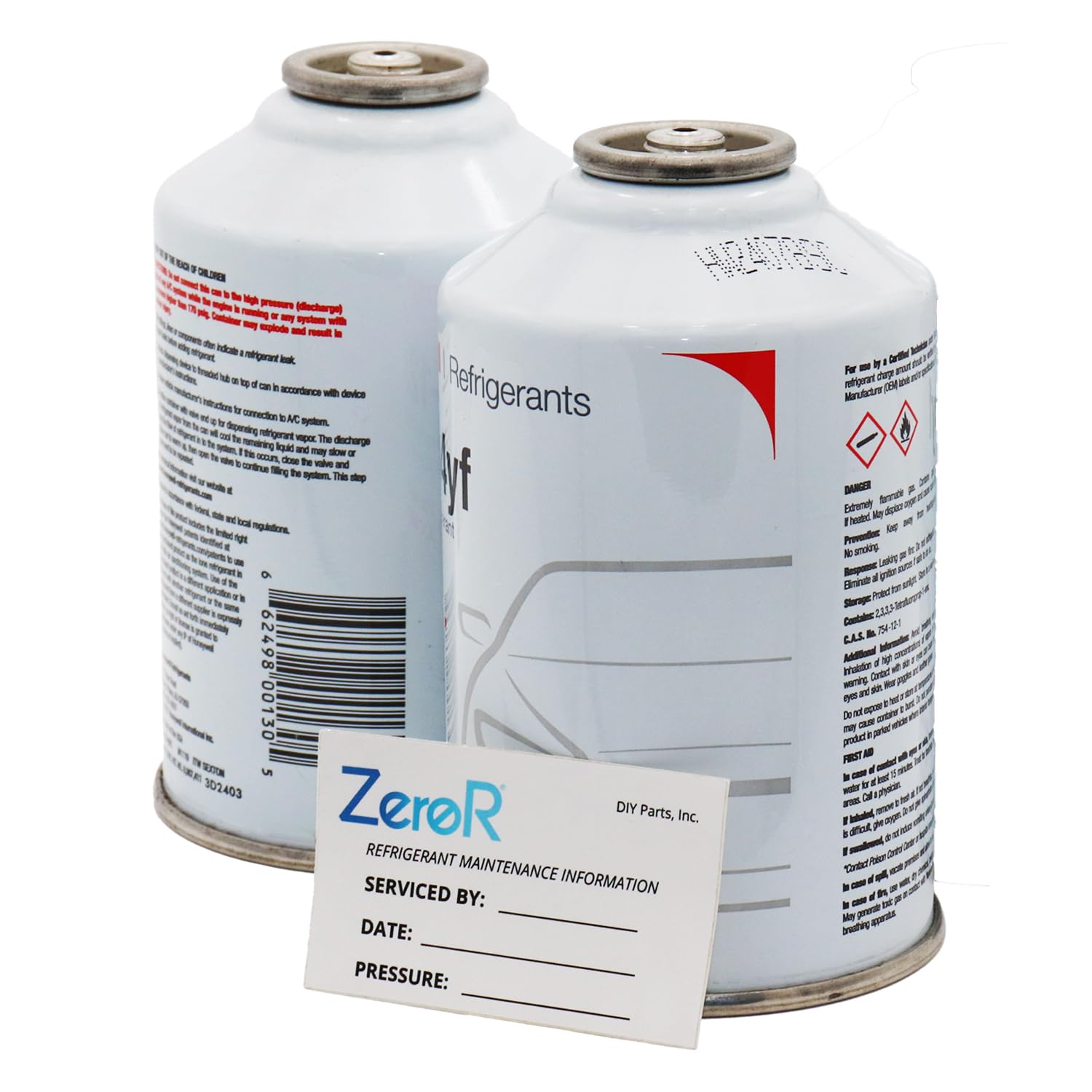
1. ZeroR® Genuine R1234YF Refrigerant Can — 8 Oz, 2 Can
Our pick — over 4.5★ from 300+ verified ratings; the strongest balance of quality and price.
The crowd-favorite two-pack that restores arctic air without a shop visit.
This is the pick that wins people over on value first — buyers consistently call out the price versus the auto-parts counter, and the 8 oz can measured by weight means you know exactly how much gas you are putting in. Since most systems need 2-3 cans, the two-pack gets you most of the way there in one order, and the included service sticker is a genuinely useful touch for labeling the system for future maintenance.
Buyers report it worked on a Civic 2017LX 2.0L with just one can to reach 40 PSI, blowing cold air again, which tells you the accuracy is real. The reverse-thread design is the safety net here — you cannot accidentally jam this onto an R-134a hose, and buyers confirm the counterclockwise connection is secure. The main trade-off is the price tag; even happy owners note it is “way too expensive” compared to the old R-134a days, but for a greener low-GWP gas, that is the standard trade-off for low-GWP refrigerants..
Compatibility gets a mixed nod from owners, with some difficulty attaching it to manifold gauges, so check your tool’s thread direction before you start. For the money-versus-cooling balance, this two-pack is the smart default for most buyers..
Why It Leads
- 8 oz per can measured by weight — no guesswork on how much you added
- Two cans cover most systems without a second order
- Reverse-thread design blocks wrong-hose mistakes
The Trade-Offs
- Premium pricing — owners call it pricey despite the value praise
- Bare cans mean you need your own R-1234yf hose and gauge
Reach for it if: you want the best value-per-can for a modern R-1234yf system and already own the recharge hardware.
Look elsewhere if: you are starting from zero tools — you will need to buy a dedicated left-handed-thread hose separately.
2. National Refrigerants R1234yf 8 oz Can
The no-frills 8 oz can built for a quick single top-up.
When you only need a small boost, this single 8 oz can from National Refrigerants is the most direct option — buyers call it a “great price, great Freon” for filling a Chevy Traverse. It is built to the SAE J2844 standard, which is the professional benchmark for R-1234yf, so you are getting a gas that matches factory specs, not a no-name blend.
The honest catch is the thread, and owners spell it out clearly: R-1234yf uses left-handed threads, and this will not work with an R-134a recharge hose. You must have a dedicated R-1234yf hose, which makes this a poor first purchase if you are new, but a perfect restock if you already own the kit. One owner found the return process frustrating, so double-check your fit before opening the can.
Cooling results are immediate — one owner joked it is “almost too cold now” after a single can, which is exactly what you want on a hot day.. Compared to the two-pack above, you get half the gas for a lower upfront outlay, which suits a system that just needs a gentle top-off rather than a full recharge.
Editor’s read: A clean, compliant single can that rewards owners who already have the left-handed-thread hardware, and punishes those who show up with an R-134a hose.
Pick this if: you have an R-1234yf recharge kit at home and just want one more can to finish the job.
Think twice if: you are buying your first-ever refrigerant — you will also need the dedicated hose.
3. Arctic Air R1234YF 2-Pack with Brass Gauge
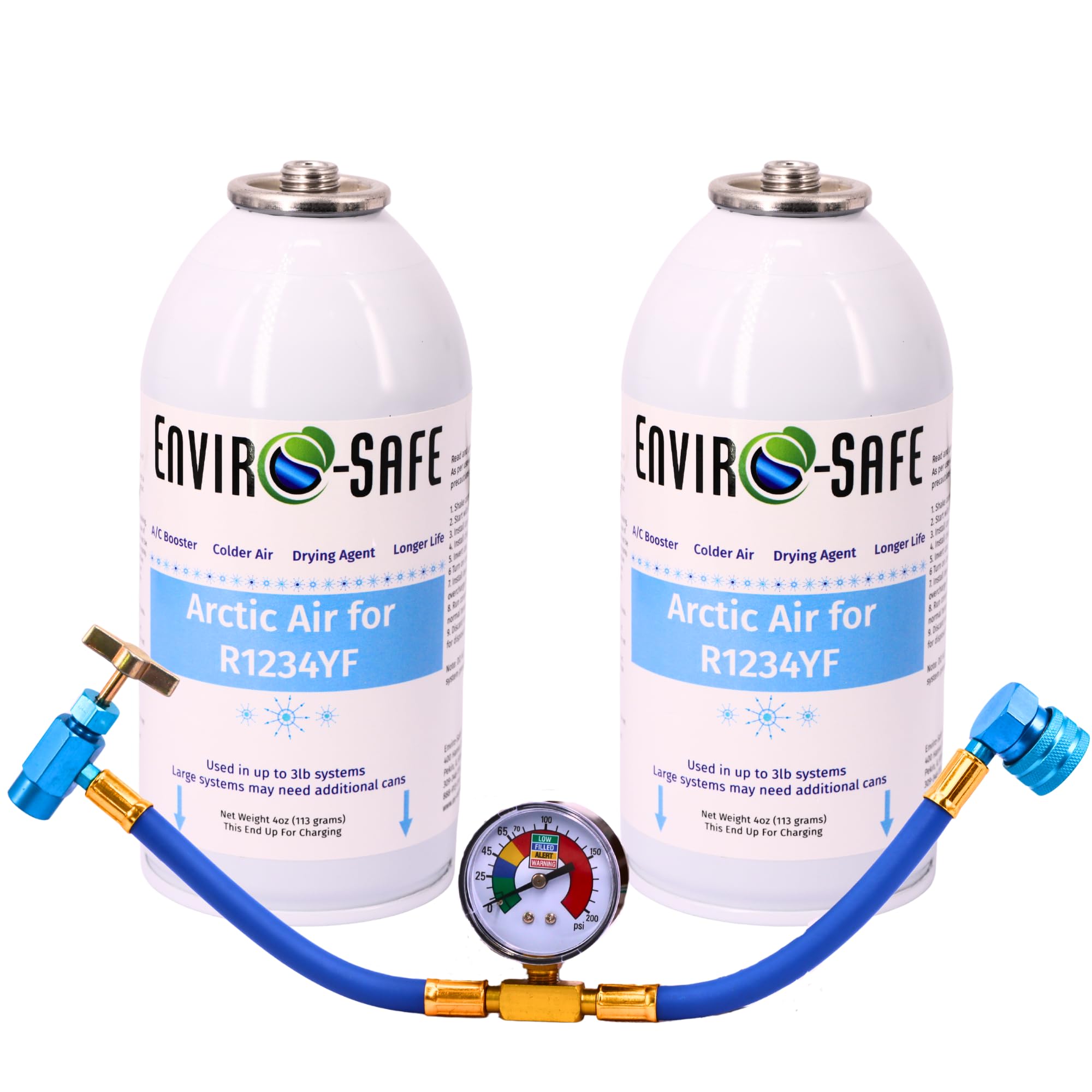
A beginner-friendly kit with a heavy-duty brass gauge that takes the guesswork out.
What wins people over here is the brass gauge — owners call it easy to read and operate, with directions on the can that are simple to follow. This is the kit that turns a first-time DIYer into someone who can watch the low-side pressure as they fill, and the 4 oz cans give you fine control over how much gas goes in. It is labeled for R1234YF systems from 2014 and newer, and The moisture-removal and lubrication additives support long-term compressor health..
The honest fit-note is the mixed value verdict: while some owners call it “well worth the money,” the price-per-ounce is higher than the straight 8 oz cans above, and one owner on a 2020 Kia Rio found the hose too short to reach the low-pressure port with the engine running. That is a fit problem, not a quality problem — treat it as a sign to check your port location before you buy.
For the cooling result, owners mention it restores cold air effectively and is “100% the easiest refrigerant to put in” — This kit gives first-timers the confidence to complete a recharge correctly.. Compared to the bare-can options, you are paying a little more for the self-contained gauge setup that gets you from zero to done in one box.
What Stands Out
- Heavy-duty brass gauge rated to 3000 psi for confident monitoring
- Two 4 oz cans give precise, controlled top-offs
- Owner-praised ease of use for first-timers
Know Before Buying
- Value is mixed — some owners find it overpriced per ounce
- Short hose may struggle on some cars’ hard-to-reach ports
Best for: the driver who wants a full beginner kit with a readable gauge and does not already own R-1234yf tools.
Not ideal for: those with a low-pressure port buried deep in the engine bay — measure your access first.
4. Generic Arctic Air For 1234yf — 3 Cans with Charging Hose
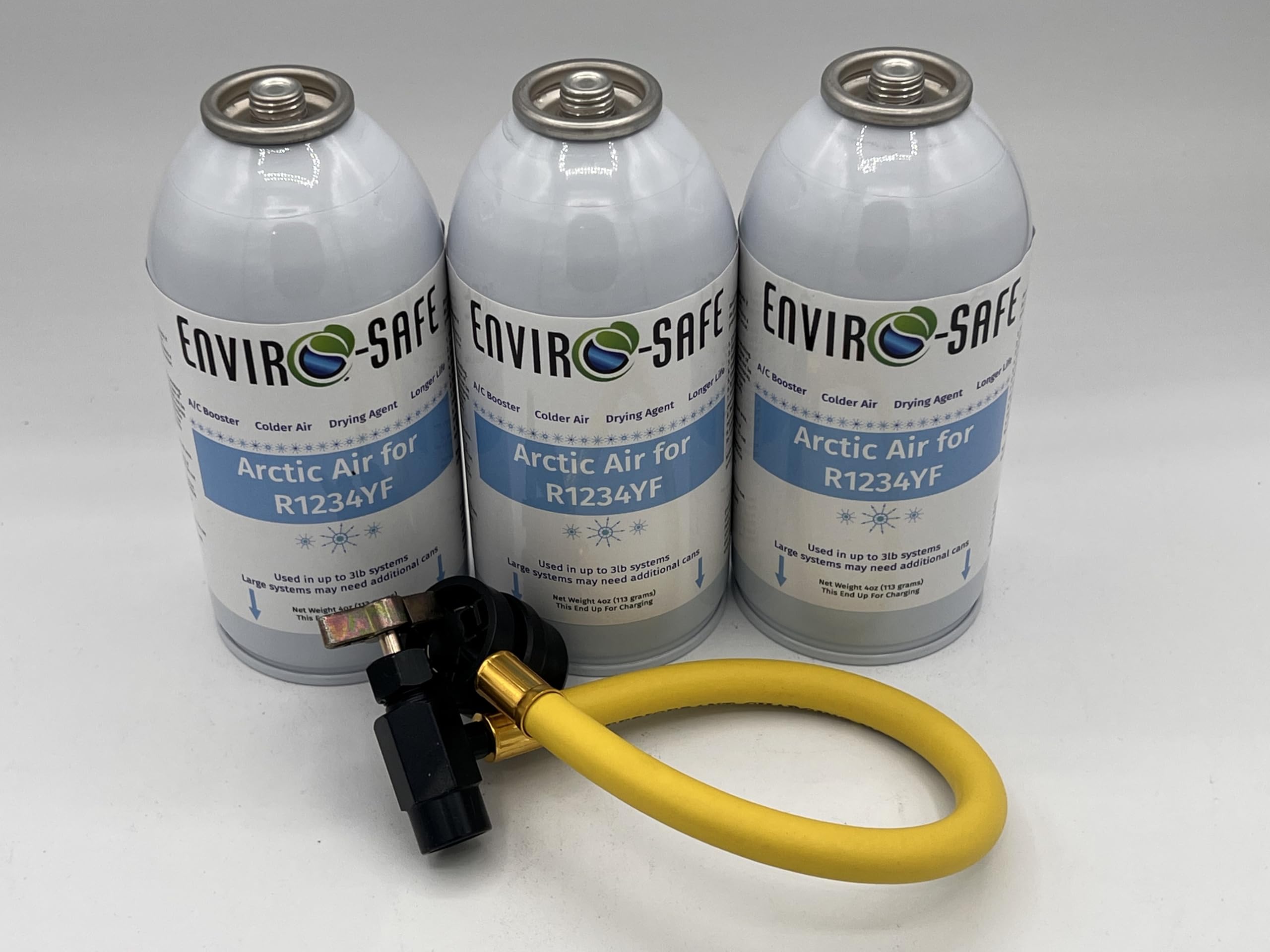
The thrifty three-can bundle that gets your AC blowing cold on a budget.
Three 4 oz cans plus a charging hose makes this the most complete budget-tier option for a full system recharge, and owners confirm it works — a 2018 GMC Canyon Denali was back to cold air quickly, and a Dodge Charger owner had no trouble with it either. The included hose removes the biggest barrier to entry for newbies who would otherwise need to buy one separately.
The honest caution is the fill-level complaint: at least one buyer was adamant the cans arrived “not even half full” and called it a total ripoff. That is a QC risk on a budget-tier product, so weigh the savings against the chance of a short-weight can. On the flip side, owners also report it is “not difficult to use” and that the adapter that comes with it works better than a separate gauge they had on hand.
The 3.0x can-count gap versus the single-can National Refrigerants option above is the key advantage here — three chances to get the charge right for about the same money as one premium can. If you are topping off an older 2014-era R-1234yf system and want a full kit without the premium price, this is the value play..
Editor’s read: A strong cost-per-can kit with a handy hose, held back only by inconsistent fill levels that make quality a bit of a lottery.
Go for it if: you want three cans and a hose for one low price and a straightforward recharge.
skip it if: you would rather pay more for a verified-weight can from a name-brand maker.
5. ZeroR® R1234YF Recharge Kit — 3 Cans with 24″ Brass Tap Gauge
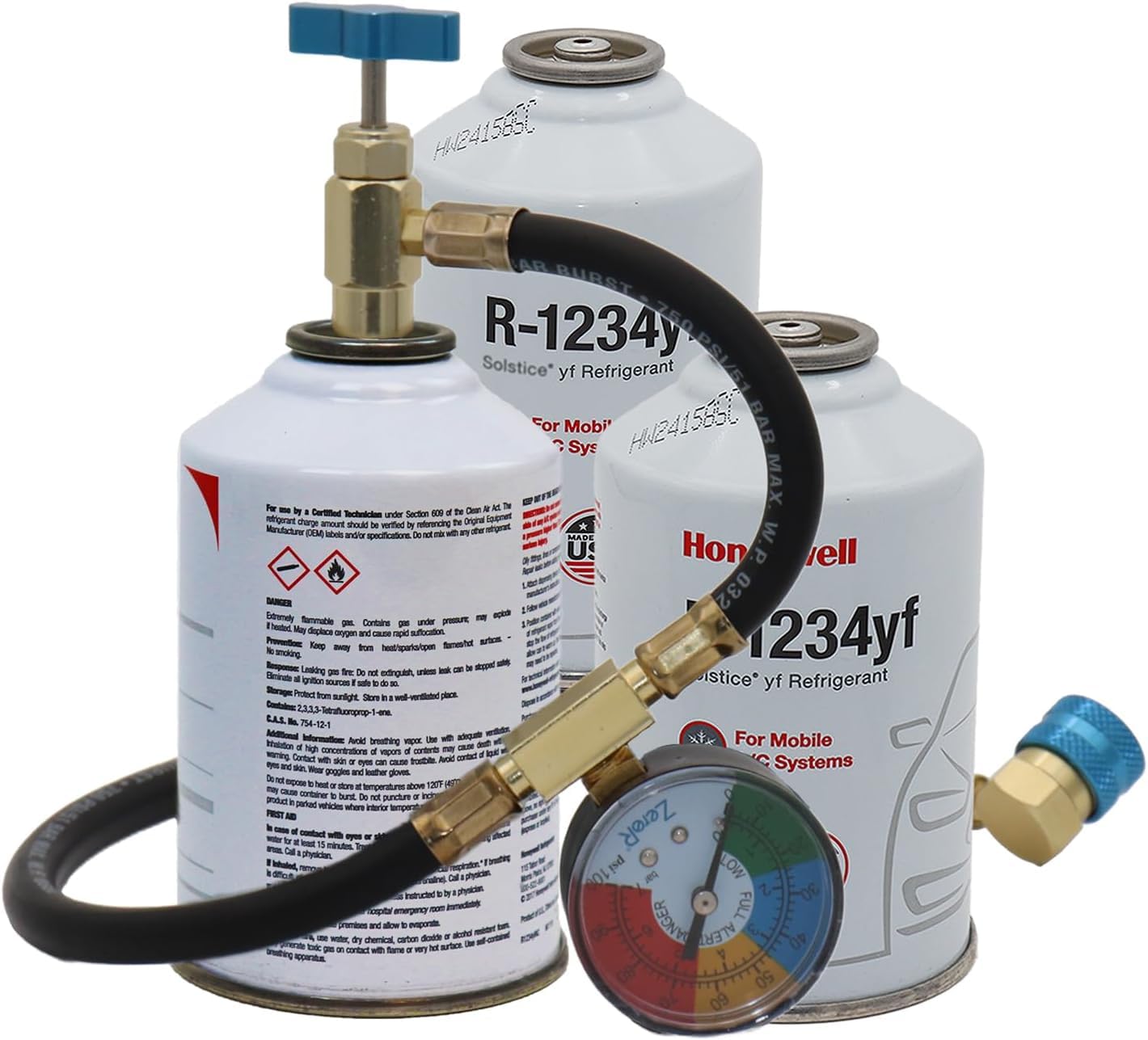
The long-reach premium kit built for hard-to-access AC ports.
This is the all-in-one answer for the driver whose low-side port is buried somewhere awkward. The 24-inch heavy-duty brass can tap with gauge is the defining spec — that extended hose reaches tight spots shorter hoses simply cannot, which is exactly the pain the Arctic Air 2-pack above ran into on a Kia Rio. Each of the three cans holds 8 oz measured by weight, and most systems take 2-3 cans, so this kit is designed to complete a full recharge in one session.
Owners confirm the reverse-thread design works as intended — one BMW owner accidentally tried to thread it right-handed before realizing it is safety-designed to go left, and it still cooled the car down well. The 2016 Dodge Challenger SXT Plus fit “perfectly,” and a Honda owner said it “fixed my AC from blowing hot air.” The flip side is quality control: several customers note defective hoses and thread damage, with one seller unresponsive to returns, so inspect the brass tap carefully on arrival.
The 2.0x capacity per can versus the 4 oz options above means fewer purchases and a more complete system fill. If you value one-and-done convenience and a heavy-duty reach, this is the premium way to get there — just be ready to check the hardware before you connect.
The Upside
- 24-inch hose reaches ports standard hoses cannot access
- Three 8 oz cans = full recharge in one box
- Reverse-thread design stops wrong-tool connections
The Risk
- Quality is mixed — some units arrive with defective hose threads
- Highest price point in this lineup
Choose this if: your AC port is hard to reach and you want everything needed for a complete recharge in one premium box.
Think twice if: you are on a tight budget or want to avoid the QC lottery on the hose threads.
Understanding the Specs
Can Size: 4 oz vs 8 oz
This is the single most practical decision you will make. An 8 oz can means fewer purchases and a better price per ounce of gas, while a 4 oz can gives you finer control for a gentle top-off without overcharging. Most car systems take 2-3 cans total, so think about whether you are doing a full recharge or just a boost.
Reverse-Thread (Left-Handed) Design
Modern R-1234yf cans thread on counterclockwise, the opposite of everything you learned with R-134a. This is a safety feature that physically prevents you from connecting the wrong gas to the wrong hose. It also means your old R-134a recharge hose will never fit, so you need a dedicated R-1234yf hose.
Low GWP (Global Warming Potential)
R-1234yf is the greener replacement for R-134a, engineered with a lower global warming potential. That is why 2014-and-newer cars use it, and why the cans cost more than the old gas. You are paying a premium for an environmentally friendlier chemistry that your car’s factory system requires.
SAE J2844 Standard
This is the professional industry spec for R-1234yf refrigerant quality. A can that meets SAE J2844 has been held to the same safety and performance expectations that mechanics and auto shops rely on, which is a useful trust signal when you are buying from an unfamiliar brand.
FAQ
How do I know if my car needs R-1234yf or R-134a?
Why is the R-1234yf can heavier than an R-134a can for the same amount of gas?
Will an R-134a recharge hose work on an R-1234yf can?
How many cans of R-1234yf does a typical car need?
Is it safe to recharge my car AC myself with R-1234yf?
What does the low GWP rating mean for my car?
Why do some R-1234yf cans feel lighter than labeled?
Do I need a gauge to recharge my AC, or can I use a bare can?
Is a 4 oz can or an 8 oz can the better buy?
Final Thoughts: The Verdict
For most drivers, the types of freon for cars winner is the ZeroR R1234YF 2-Pack because it delivers the best value-per-ounce with weight-accurate 8 oz cans and a service sticker. If you want a complete beginner setup with a readable gauge, the Arctic Air 2-Pack with Brass Gauge is the one to reach for. And for drivers wrestling with hard-to-reach AC ports, the ZeroR Recharge Kit with the 24-inch tap is worth the premium — just verify the threads on arrival.
How We Picked
We do not accept paid placement. Every pick is matched to a real buyer and a real use-case; we do not hands-on test units.
Sources & Methodology
Specifications: manufacturer listings and product documentation. Review insights: verified customer reviews, as of August 2026. Pricing: not shown on this page (it changes often); check the current price via the retailer link.
As an Amazon Associate, GoCarLife earns from qualifying purchases. This does not affect which products we feature.